Possible importance of Cannabis sativa L. in regulation of insulin and IL-6R/MAO-A in cancer cell progression and migration of breast cancer patients with diabetes
Asis Bala; Motlalepula G. Matsabisa
Department of Pharmacology, University of the Free State, Bloemfontein, South Africa
Keywords: breast cancer cell progression; breast cancer cell migration; marijuana; hemp; dagga; diabetic patients
According to the World Health Organization report122,3 The breast cancer incidence is rising in South Africa, where some women are diagnosed late and, as a result, have poor outcomes.34
The South African government has yet to legalise medical cannabis; however, much debate on the subject has taken place in the last few years. The requirement for adequate research on Cannabis sativa L. - the variety of cannabis or marijuana found in South Africa - is periodically mentioned in local scientific publications such as the South African Medical Journal.5-7 Interestingly, C. sativa has been found to be equally effective in inhibiting breast cancer cell proliferation and regulating insulin levels in patients with diabetes.8,9
The current global market for cannabis products is USD3 billion; this figure is expected to rise to USD56 billion within 10 years, as more countries and US states join the legalisation trend.1011C. sativa is known in southern Africa.
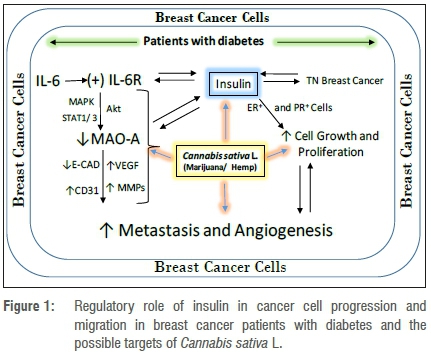
Here we summarise the regulatory role of insulin in MAO-A and IL-6/IL-6R-regulated metastasis and angiogenesis in breast cancer in patients with diabetes and the possible importance of the South African variety of C. sativa is outlined as a possible beneficial research option in this context. The pharmacological efficiencies of C. sativa in inhibiting breast cancer cell progression and migration will support the medicinal application and will act as an initial step towards its industrialisation, thereby contributing to the South African bio-economy through its R&D.
Regulatory role of insulin in breast cancer in patients with diabetes
Targeting the tumour vasculature, rather than directly targeting tumour cells, has been the more recent approach to inhibiting tumour growth in all invasive and metastatic cancers, including breast cancer.121314
Insulin acts as a major mitogen in normal mammary gland tissue as well as in breast cancer cells.151414,15 In most human oestrogen-receptor- and progesterone-receptor-positive breast cancer cell lines, like MCF-7, insulin stimulates cell growth via its own receptor; however, insulin, at concentrations as high as 100 nM, has no effect on cell growth in triple negative breast cancer cells line like MDA-MB231, meriting further studies in this context.16
In contrast, insulin enhances the metabolic capacity of cancer cells by dual regulation of the glycolytic enzyme pyruvate kinase M2.1718,19 IL-6 is a cytokine involved in a number of cellular inflammatory disease conditions.1920
Monoamine oxidase (MAO) has two isoforms: MAO-A and MAO-B, which are generally present in the outer mitochondrial membrane. MAO-A levels are significantly lower in multiple invasive and metastatic cancer types including breast cancer. A recent study highlighted the differential expression of IL-6/IL-6R and MAO-A in the regulation of invasion/angiogenesis in breast cancer.19,20 In addition, this IL-6R regulation of MAO-A occurs through cellular MAP kinase and Akt pathways.20
Other findings demonstrate that regulation of monoamine levels by MAO activity in β cells is pivotal for physiological insulin in type 2 diabetes.21212221,23 Therefore, the regulatory role of insulin in breast cancer cell progression in persons with and those without diabetes needs to be delineated; development of the possible therapy outlined here will provide new insight into the immunotherapy of breast cancer.
Importance of South African Cannabis sativa L.
Medical cannabis is a drug that comes from two species of cannabis, C. sativa and C. indica. C. sativa is known commonly as hemp in the northern hemisphere and as dagga or marijuana in South Africa.1024C. sativa) contains higher amounts of psychoactive THC than of CBD whereas hemp contains higher amounts of non-psychoactive CBD than of THC.11,25
Cannabinoids could be the first non-toxic agent to show promise in treating metastatic forms of breast cancer.2626,27 Many cannabinoids mediate their effects by binding to endocannabinoid receptors like CB1, CB2 or the vanilloid receptor; however, it is indicated that the effect of CBDs is independent of these receptors.26
For people with obesity and type 2 diabetes, endocannabinoid imbalance is a key regulator.8278,28
Conclusion
Breast cancer cell progression and migration is directly influenced by insulin levels in patients with diabetes and IL-6/IL-6R mediates its regulatory role in MAO-A-controlled cell metastasis and angiogenesis. Importantly, the IKS Research Group of the Department of Pharmacology at the University of the Free State (Bloemfontein, South Africa) is presently working on this immunobiology and validating this dual role of cannabis in the South African context.
The CBD-enriched variety of C. sativa found in South Africa may offer new hope for the regulation of insulin action on MAO-A- and IL-6/IL6R-regulated metastasis and angiogenesis in breast cancer of patients with diabetes, as shown in Figure 1. The pharmacological efficiencies of C. sativa in inhibiting breast cancer cell progression and migration will further support its medicinal application and will lead to further industrialisation, thereby contributing to the South African bio-economy in the future.
References
-
1. World Health Organization. GLOBOCAN 2008 update: Cancer prevalence estimates are now available [document on the Internet]. c2011 [cited 2018 Jul 05]. Available from: https://www.iarc.fr/en/media-centre/iarcnews/2011/globocan2008-prev.php
» https://www.iarc.fr/en/media-centre/iarcnews/2011/globocan2008-prev.php - 2. Autier P, Koechlin A, Robertson C, Bota M, Boniol M, Leroith D, et al. Breast cancer and diabetes. J Clin Oncol. 2013;31(15 suppl), e12507.
-
3. Joffe M, Ayeni O, Norris SA, McCormack VA, Ruff P, Das I. Barriers to early presentation of breast cancer among women in Soweto, South Africa. PLoS ONE. 2018;13(2), e0192071, 16 pages. https://doi.org/10.1371/journal.pone.0192071
» https://doi.org/10.1371/journal.pone.0192071 -
4. Samson ME, Adams SA, Orekoya O, Hebert JR. Understanding the association of type 2 diabetes mellitus in breast cancer among African American and European American populations in South Carolina. J Racial Ethn Health Disparities. 2016;3(3):546-554. https://doi.org/10.1007/s40615-015-0173-0
» https://doi.org/10.1007/s40615-015-0173-0 -
5. Farham B. The cannabis debate: Let's do the research. S Afr Med J. 2016;106(9):833. https://doi.org/10.7196/SAMJ.2016.v106i9.11354
» https://doi.org/10.7196/SAMJ.2016.v106i9.11354 -
6. Parry CDH, Myers BJ. Legalizing medical use of cannabis in South Africa: Is the empirical evidence sufficient to support policy shifts in this direction? S Afr Med J. 2014;104(6):399-400. https://doi.org/10.7196/SAMJ.8135
» https://doi.org/10.7196/SAMJ.8135 -
7. Van Niekerk JP. Medical marijuana and beyond. S Afr Med J. 2014;104(6):387. https://doi.org/10.7196/SAMJ.8335
» https://doi.org/10.7196/SAMJ.8335 -
8. Penner EA, Buettner H, Mittleman MA. The impact of marijuana use on glucose, insulin, and insulin resistance among US adults. Am J Med. 2013;126(7):583-589. https://doi.org/10.1016/j.amjmed.2013.03.002
» https://doi.org/10.1016/j.amjmed.2013.03.002 -
9. Velasco G, Sanchez C, Guzman M. Towards the use of cannabinoids as antitumor agents. Nat Rev Cancer. 2012;12:436-444. https://doi.org/10.1038/nrc3247
» https://doi.org/10.1038/nrc3247 -
10. Hall J. Medical marijuana a huge opportunity for Africa. IOL News. 2017 October 11. Available from: https://www.iol.co.za/news/opinion/medical-marijuana-a-huge-opportunity-for-africa-11550668
» https://www.iol.co.za/news/opinion/medical-marijuana-a-huge-opportunity-for-africa-11550668 - 11. Herbst MC. Fact sheet and position statement on cannabis. Pretoria: Cancer Association of South Africa (CANSA); 2012.
-
12. Shi W, Yin Y, Wang Y, Zhang B, Tan P, Jiang T, et al. A tissue factor-cascade-targeted strategy to tumor vasculature: A combination of EGFP-EGF1 conjugation nanoparticles with photodynamic therapy. Oncotarget. 2017;8(19):32212-32227. http://dx.doi.org/10.18632/oncotarget.12922
» http://dx.doi.org/10.18632/oncotarget.12922 - 13. Papa V, Pezzino V, Costantino A, Belfiore A, Giuffrida D, Frittitta L, et al. Elevated insulin receptor content in human breast cancer. J Clin Invest. 1990;86(5):1503-1510.
-
14. Chappell J, Leitner JW, Solomon S, Golovchenko I, Goalstone ML, Draznin B. Effect of insulin on cell cycle progression in MCF-7 breast cancer cells. J Biol Chem. 2001;276(41):38023-38028. http://dx.doi.org/10.1074/jbc.M104416200
» http://dx.doi.org/10.1074/jbc.M104416200 - 15. Gliozzo B, Sung CK, Scalia P, Papa V, Frasca F, Sciacca L, et al. Insulin-stimulated cell growth in insulin receptor substrate-1-deficient ZR/75/1 cells is mediated by a phosphatidylinositol/3-kinase-independent pathway. J Cell Biochem. 1998;70:268-280.
- 16. Costantino A, Milazzo G, Giorgino F, Russo P, Goldfine ID, Vigneri R, et al. Insulin-resistant MDA-MB231 human breast cancer cells contain a tyrosine kinase inhibiting activity. Mol Endocrinol. 1993;7(12):1667-1676.
-
17. Iqbal MA, Siddiqui FA, Gupta V, Chattopadhyay S, Gopinath P, Kumar B, et al. Insulin enhances metabolic capacities of cancer cells by dual regulation of glycolytic enzyme pyruvate kinase M2. Mol Cancer. 2013;12, Art. #72, 12 pages. https://doi.org/10.1186/1476-4598-12-72
» https://doi.org/10.1186/1476-4598-12-72 -
18. Miele C, Rochford JJ, Filippa N, Giorgetti-Peraldi S, Van Obberghen E. Insulin and insulin-like growth factor-i induce vascular endothelial growth factor mRNA expression via different signaling pathways. J Biol Chem. 2000;275:21695-21702. https://doi.org/10.1074/jbc.M000805200
» https://doi.org/10.1074/jbc.M000805200 - 19. Scheller J, Chalaris A, Schmidt-Arras D, Rose-John S. The pro- and anti-inflammatory properties of the cytokine interleukin-6. Mol Cell Res. 2011;1813:878-888.
-
20. Bharti R, Dey G, Das AK, Mandal M. Differential expression of IL-6/IL-6R and MAO-A regulates invasion/angiogenesis in breast cancer. Brit J Cancer. 2018;118:1442-1452. https://doi.org/10.1038/s41416-018-0078-x
» https://doi.org/10.1038/s41416-018-0078-x -
21. Aleyassine H, Gardiner RJ. Dual action of antidepressant drugs (MAO inhibitors) on insulin release. Endocrinology. 1975;96(3):702-710. https://doi.org/10.1210/endo-96-3-702
» https://doi.org/10.1210/endo-96-3-702 -
22. Hamlin E, Neptune M. Monoamine oxidase inhibition in a patient with type 1 diabetes and depression. J Diabetes Sci Technol. 2016;10(5):1203-1204. https://doi.org/10.1177/1932296816638106
» https://doi.org/10.1177/1932296816638106 -
23. Regazzetti C, Peraldi P, Grémeaux T, Najem-Lendom R, Ben-Sahra I, Cormont M, et al. Hypoxia decreases insulin signaling pathways in adipocytes. Diabetes. 2009;58(1):95-103. https://doi.org/10.2337/db08-0457
» https://doi.org/10.2337/db08-0457 -
24. Alexander A, Smith PF, Rosengren R.J. Cannabinoids in the treatment of cancer. Cancer Lett. 2009;285:6-12. https://doi.org/10.1016/j.canlet.2009.04.005
» https://doi.org/10.1016/j.canlet.2009.04.005 - 25. Christelle MA, Jean-Francois H, Gea G. Cannabis sativa: The plant of the thousand and one molecules. Front Plant Sci. 2016:7-19.
- 26. Bandana C, Ravi J, Ganju RK. Cannabinoids as therapeutic agents in cancer: Current status and future implications. Oncotarget. 2014;5(15):5852-5872.
-
27. Shrivastava A, Kuzontkoski PM, Groopman JE, Prasad A. Cannabidiol induces programmed cell death in breast cancer cells by coordinating the cross-talk between apoptosis and autophagy. 2011;10(7):1161-1172. https://doi.org/10.1158/1535-7163.MCT-10-1100
» https://doi.org/10.1158/1535-7163.MCT-10-1100 -
28. Lianne. Diabetes and marijuana: A possible treatment? [webpage on the Internet]. c2017 [updated 2018 Mar 28; cited 2018 June 28]. Available from: https://www.thediabetescouncil.com/diabetes-and-marijuana-a-possible-treatment/
» https://www.thediabetescouncil.com/diabetes-and-marijuana-a-possible-treatment/