Use of biochar to improve sewage sludge quality in Maluti-A-Phofung Municipality, South Africa
Abstract
Research on wastewater treatment processes in Maluti-a-Phofung Municipality (South Africa) has revealed that substandard wastewater management in this region contributes to terrestrial and aquatic pollution. Because this pollution poses a threat to the environment, there is a pressing need to reduce the environmental impact of poorly managed sewage sludge in the region. Biochar has been regarded as a cost-effective way of reducing chemical toxicity in terrestrial environments. In the present study, we aimed to investigate the effectiveness of biochar in the remediation of the toxicity of sewage sludge using the earthworm Eisenia fetida. Sewage sludge was collected from a local wastewater treatment plant and E. fetida were exposed to 0, 25, 50, and 100% non-amended and 10% biochar-amended sludge. After 28 days, survival, biomass and reproduction were assessed. Separately, in clean artificial soil, E. fetida was exposed to 5, 10 and 15% biochar amendment for 96 hours to determine if biochar amendment alone could be harmful to E. fetida. The results showed no significant differences in all parameters between the worms exposed to non-amended sludge and 10% biochar-amended sludge. Assessment of acetylcholinesterase and catalase activities in the earthworms that were exposed to biochar via clean soil revealed that 10% and 15% biochar amendment rates caused the worms to experience significant levels of neurotoxic and oxidative stress (p < 0.05). These findings reveal that biochar alone is likely to have adverse effects on soil organisms, and amendment rates higher or equal to 10% are not suitable to alleviate the toxic effects of sewage sludge. SIGNIFICANCE: This study can be used as a reference in the usage of biochar as a toxicity remediator. Different biochar rates (> 10%) can have different effects on soil-dwelling organisms. Policymakers can use this study when constructing laws regarding the disposal of sewage sludge by wastewater treatment plants.
sewage sludge; wastewater; treatment; biochar; biochar; remediation; Eisenia fetida
Introduction
Sewage sludge is one of the by-products of the wastewater treatment process. It contains high levels of organic matter and nutrients and is valued for agricultural application.1,21,344,5
Sewage sludge is usually disposed of via landfilling, incineration, and cropland application.67 8,9410Eisenia andrei. Malinska et al.1112
Specifications from the existing South African sludge management regulations indicate three categories of sewage sludge: a microbiological class, a stabilisation class, and a pollutant class.131313,14
The known toxicity of sewage sludge has prompted the need to find affordable and effective means of decreasing its potential deleterious effects before it is discarded through landfilling or harnessed for agricultural application.6 1516 17-1920-28
In the present study, we aimed to investigate the effectiveness of biochar in the remediation of the toxicity of sewage sludge on the survival, reproduction, and biomass of the earthworm Eisenia fetida. A secondary aim was to assess, at the biomarker level, if biochar on its own could prove detrimental to earthworms. We hypothesised that the inclusion of biochar in the soil would improve the survival, reproduction and biomass of the earthworms. We also expected that the potential beneficial effects of biochar at the level of the whole organism would be supported by concurrent biomarker responses within the organism.
Materials and methods
Study area
Sewage sludge was collected from the wastewater treatment plant (WWTP) in Harrismith (28°16'46.5"S; 29°05'46.9"E). This town is located in the Maluti-A-Phofung municipality within the Drakensberg Afromontane region of the eastern Free State Province of South Africa. The area rises from 1500 m to 2400 m above sea level and experiences summer rainfall (www.floodmap.net). The chosen WWTP receives wastewater from neighbouring households and industries in the region, which is a densely populated peri-urban economic hub, with several industries such as textile, dairy, and aluminium industries.29
Experimental organism
Adult E. fetida earthworms bred in the Ecotoxicology Laboratory, housed in the Department of Zoology and Entomology of the University of the Free State, QwaQwa Campus, were used as the experimental organism. The earthworms were maintained on a diet consisting only of dried cow dung .
Preparation of exposure substrates
Preparation of soil
The artificial soil used during this study was prepared following the Organisation for Economic Co-operation and Development (OECD) guidelines.30
Preparation of non-biochar amended sewage
The sewage sludge was dried at room temperature before use. After drying, it was blended and sieved through a 2 mm sieve. Non-biochar amended sewage was prepared by mixing OECD artificial soil with sewage sludge. The mixing was carried out to make the following concentrations of the sludge: 0 (OECD artificial soil control), 25, 50, and 100% sewage sludge. The total exposure substrate weight per treatment was 500 g. Distilled water was used to moisten each soil treatment to 40-60% of their respective water-holding capacity.30
Preparation of biochar amended sewage sludge
Biochar from pine wood obtained in pellet form was purchased from C FERT™ South Africa. According to the manufacturer, it was made at a pyrolysis temperature range of 400-500 °C. This produced a biochar with about 100 μηι pore size on average and containing 30.35% carbon, 3.54% nitrogen, 0.13% potassium, 0.02% phosphorus, 20.31% calcium, 0.34% magnesium, and 0.14% sulfur. Biochar-amended substrates were made by replacing 50 g of the 500 g non-amended OECD/sewage substrates with 50 g of biochar for each concentration (including the control), thus making a 10% biochar amendment. Thus, a 10% biochar amendment rate was applied to the 0, 25, 50, and 100% sludge treatments. Distilled water was used to moisten each biochar-amended treatment to 40-60% of their respective water-holding capacity. All the treatments were prepared and left undisturbed for 7 days before exposure. This was necessary to allow for biochar activation by the microorganisms in the sewage sludge.
Metal contents of the sewage sludge
The total concentrations of arsenic (As), cadmium (Cd), chromium (Cr), copper (Cu), lead (Pb), mercury (Hg), nickel (Ni), and zinc (Zn) in the sewage sludge were determined following the EPA 3052 digestion method3114
Ecotoxicological assays
Prior to exposure, the earthworms were weighed, and their masses were recorded. Ten adult E. fetida were exposed to the biochar-amended and non-amended treatments and incubated at 20 ± 2 °C (in a Labcon low-temperature incubator) for 28 days. All exposures were carried out in triplicate. During the exposure period, the worms were fed 5 g of ground and moist cattle manure once a week. After 4 weeks, the earthworms were weighed once again, and their masses were recorded. The number of cocoons laid in each treatment was recorded. To assess whether biochar on its own could prove detrimental to earthworms at biomarker level, in another experiment, we exposed 10 adult E. fetida to 500 g of OECD artificial soil (no sewage sludge involved) amended with 0, 5, 10, and 15% biochar. The exposures conducted in triplicate were incubated at 20 ± 1 °C (in a Labcon low-temperature incubator) for a duration of 4 days. This exposure duration was chosen both to fill a gap in the literature because studies on biochar often last longer26,32-3435
Determination of acetylcholinesterase activity
Acetylcholinesterase (AChE) is an enzyme involved in the hydrolysis of acetylcholine (which is an essential neurotransmitter of the central nervous system) into choline.36g for 10 min at 4 °C. Supernatants were then used for AChE and protein analyses. The protein concentrations of the homogenates were determined using the Bradford method.3738
Determination of catalase activity
Catalase activity was determined following the method of Cohen et al.39 2O2/min/mg protein.
Statistical analysis
The data obtained from this study were subjected to statistical analysis using Microsoft Excel 2010 and GraphPad Prism version 13.2. Statistical analyses of survival, reproduction, biomass and acetylcholinesterase activity data were performed in GraphPad Prism using a one-way ANOVA followed by a Bonferroni post-test for pairwise comparisons. The level of significance was p < 0.05. Finally, ToxRat® version 2.10.05 was used to generate median lethal concentrations (LC50) and half-maximal effective concentrations (EC50) whenever possible.
Results and discussion
Concentration of heavy metals in sewage sludge
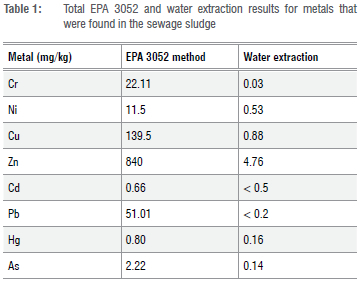
Using the EPA 3052, the concentration of metals observed in sewage sludge in this study were in the following order: Zn > Cu > Pb > Cr > Ni > As > Hg > Cd, varying from 840 mg/kg for Zn to 0.66 mg/kg for Cd (Table 1). The water extraction method revealed the following order: Zn > Cu > Ni > Hg > As > Cd > Pb > Cr, varying from 4.76 mg/kg for Zn to 0.03 mg/kg for Cr. (Table 1). When comparing the EPA 3052 and the water extraction data, it was discovered that Zn was the chemical with the highest concentration in both methods, while Cd had the lowest concentration in the EPA 3052, and Cr had the lowest concentration in the water extraction method. This trend is consistent with the findings of Berrow and Webber40411441,424313Table 1). Therefore, from the results of the total metal analysis, the concentrations of metals were below the specified limits.
Nevertheless, the presence of these heavy metals in the sewage sludge and the water extract especially, implies that they could be a source of pollution and toxic stress in soils, especially in agricultural lands where they can accumulate to higher levels.44,4514
Ecotoxicological assays
Survival of Eisenia fetida in biochar-amended and non-amended sewage sludge
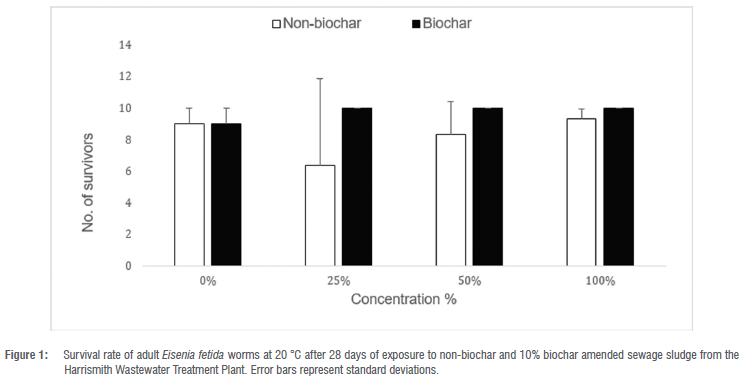
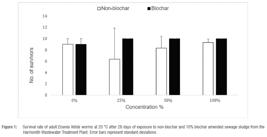
The results show that there was no significant difference (p > 0.05) in the survival rates of E. fetida exposed to biochar-amended and non-amended sewage sludge for 28 days (Figure 1). This indicates that the presence of biochar did not statistically affect or improve the odds of survival of E. fetida. Nevertheless, survival rates in the 25, 50 and 100% sewage sludge treatments was 100% (Figure 1). In comparison, in the absence of biochar in the same treatments, survival rates were 60, 80 and 90% for 25, 50 and 100% treatments, respectively. Such beneficial attributes of biochar to the survival of the earthworm E. fetida have been reported by several authors: Elliston and Oliver46114748492650,5152E. fetida utilises sewage sludge as a food source, thus its ability to do well in soil amended with sewage sludge. This report has been corroborated by the works of Contreras-Ramos et al.534714Enchytraeus albidus.
Reproduction of Eisenia fetida in biochar-amended and non-amended sewage sludge
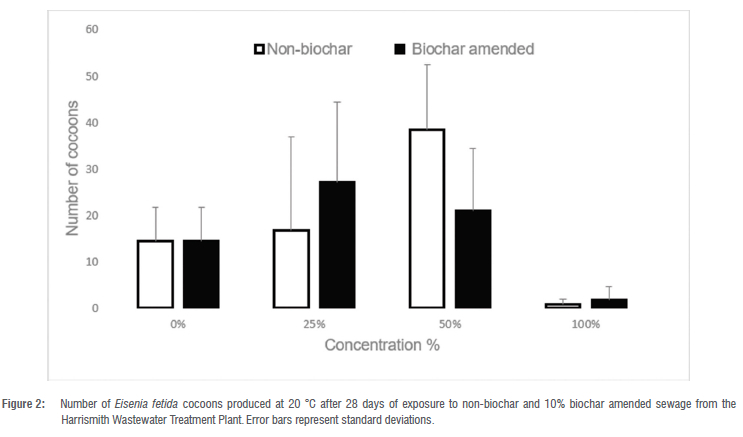
For both biochar-amended and non-amended sewage sludge, there was no significant reduction in cocoon production in the 100% (pure) sewage sludge when compared to the control (p > 0.05; Figure 2). Despite this observation, in pure sewage sludge, the reproduction of E. fetida was visibly hampered in both the biochar-amended and non-amended sewage sludge. This observation is similar to the findings of Mosolloane et al.14 Enchytraeus albidus after exposure to the pure sewage sludge from the same WWTP
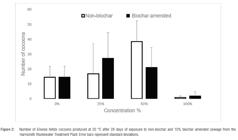
In the present study, the lack of significant differences in cocoon production between all the treatments indicates that biochar amendment did not improve the odds of reproduction in E. fetida. Although some authors, such as Gong et al.5434E. fetida in biochar-amended soil, others, such as Li et al.3326Enchytraeus albidus and others55Enchytraeus crypticus. Dlamini and Voua Otomo5626,34543355
Biomass change in Eisenia fetida exposed to biochar-amended and non-amended sewage sludge
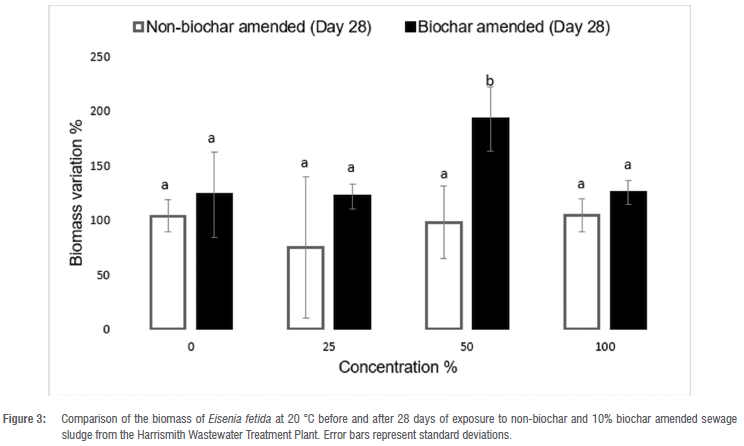
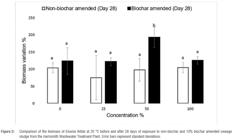
After 28 days of exposure, there were no significant changes in the biomass of E. fetida in all amended and non-amended treatments except for the 50% biochar amended treatment in which a significant weight gain was observed (Figure 3). The results from this study are similar to the results obtained by Liesch et al.32E. fetida. Although not always significant, Figure 3 reveals a slight increase in biomass in all biochar-amended treatments, indicating that the presence of biochar has a somewhat positive effect on the biomass of E. fetida. This could be attributed to the fact that there was an increase in nutrient content in the soils amended with biochar. It has been reported that biochar can increase the capacity of the soil to absorb and replenish plant nutrients, which in turn has a positive impact on soil invertebrates.57,5833E. fetida for 28 days in soil amended with different rates (0.1,10, and 20%) of biochar produced from apple wood chips. Atkinson et al.5960E. fetida exposed to soil treated with deciduous, hardwood-derived biochar.
Acetylcholinesterase activity of Eisenia fetida
After assessing the activity of AChE in different rates of biochar in the absence of sewage sludge, significantly high activity could only be observed in the 15% biochar amended soil (Figure. 4). These findings demonstrate that even in the absence of a pollutant, high biochar amendment levels, particularly above 15%, resulted in an increase in AChE activity. Khalid et al.61Pheretima posthuma at 5% and 10% amendment rates after 30 days of exposure in soil amended with 0, 5, 10, and 25% biochar. Such inhibition in AChE activity was not observed in the present study. The pine tree biochar assessed herein favoured biochar activity, especially in the 15% amendment rate. The divergence in findings between our studies could be due to differences in both the biomass used to create the biochar and the duration of exposure, which was substantially shorter in our case (4 vs 30 days).
Catalase activity of Eisenia fetida
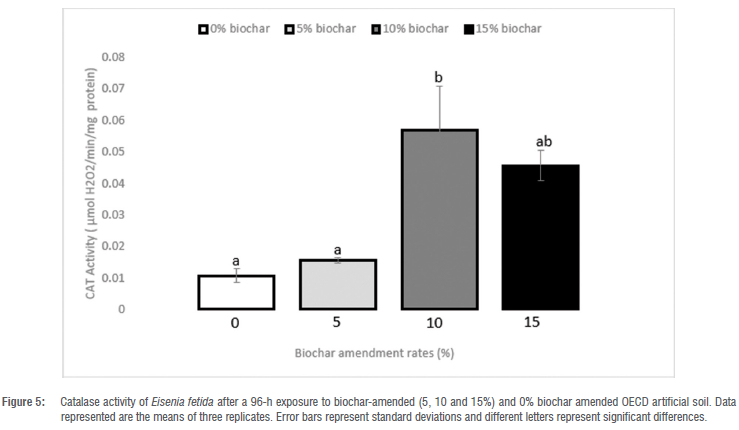
Catalase activity was similar in the earthworms exposed to all biochar amendment rates except for the 10% amendment in which it was significantly higher. This indicates an increase in oxidative stress associated with greater rates of biochar amendment (Figure 5), especially considering that catalase activity was statistically similar in both highest amendment rates.
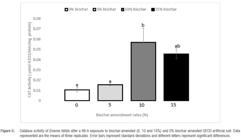
Our findings are supported by those of Han et al.62E. fetida exposed to 0-5% biochar made from rice straws, although other authors such as Shi et al.63E. fetida exposed to soil amended with less than 5% biochar made from cow dung. In our study, such low biochar rates did not result in any significant alterations in catalase activity, indicating that the feed used to make the biochar might play a role in the observed variations. The pyrolysis temperature might also be a factor. Shi et al.6348 E. fetida, and discovered that at 5% amendment, the biochar produced at a pyrolysis temperature of 550 °C caused higher catalase activity than biochar produced at a temperature of 300 °C. The biochar utilised in this study was made at a temperature range that should cause relatively less catalase activity (400-450 °C), although our pine tree biochar did cause noticeable catalase increases at 10% amendment (Figure 5).
Conclusions
We set out to test whether biochar amendment could help improve the quality of sewage sludge by assessing multiple endpoints at biomarker and whole organism levels in the earthworm Eisenia fetida. Our results show little to no benefit to selected life-cycle parameters. A biochar rate experiment revealed that biochar rates of 10% and 15% could significantly increase catalase and AChE activities, respectively. Overall, the results indicate that biochar amendment could help organisms such as earthworms better withstand environmental stress brought about by sewage sludge application or be used as a prior step to environmental disposal of wastewater treatment waste.
Competing interests
We have no competing interests to declare.
Authors' contributions
N.PD.: Methodology; investigation; project administration; writing - first draft, reviewing and editing. PV.O.: Supervision; writing - reviewing and editing; project management, project administration.
Acknowledgements
We acknowledge funding from the South African National Research Foundation.
References
- 1. Baffour-Asare E. Co-composting of dewatered sewage sludge (biosolids) and sawdust for agricultural use as an organic fertilizer: A case study of the KNUST sewage treatment plant [doctoral dissertation]. Kumasi: Department of Theoretical and Applied Biology, Kwame Nkrumah University of Science and Technology; 2009.
- 2. Sohi S, Lopez-Capel E, Krull E, Bol R. Biochar, climate change and soil: A review to guide future research. CSIRO Land Water Sci Rep. 2009;5(9):17-31.
- 3. Strauss M, Heinss U, Montangero A. On-site sanitation: When the pits are full -planning for resource protection in faecal sludge management. Schriftenr Ver Wasser Boden Lufthyg. 2000;105:353-360.
-
4. Oleszczuk P Hollert H. Comparison of sewage sludge toxicity to plants and invertebrates in three different soils. Chemosphere. 2011;83(4):502-509. https://doi.org/10.1016/j.chemosphere.2010.12.061
» https://doi.org/10.1016/j.chemosphere.2010.12.061 - 5. Gorman ML, Trowbridge BJ. The role of odor in the social lives of carnivores. In: Carnivore behavior, ecology, and evolution. Boston, MA: Springer; 1989. p. 57-88.
-
6. Bagreev A, Bandosz TJ, Locke DC. Pore structure and surface chemistry of adsorbents obtained by pyrolysis of sewage sludge-derived fertilizer. Carbon. 2001;39(13):1971-1979. https://doi.org/10.1016/S0008-6223(01)00026-4
» https://doi.org/10.1016/S0008-6223(01)00026-4 -
7. Banerjee MR, Burton DL, Depoe S. Impact of sewage sludge application on soil biological characteristics. Agric Ecosyst Environ. 1997;66(3):241-249. https://doi.org/10.1016/S0167-8809(97)00129-1
» https://doi.org/10.1016/S0167-8809(97)00129-1 - 8. Lewis-Jones R, Winkler M. Sludge parasites and other pathogens. Chichester: Ellis Horwood Limited; 1991.
-
9. Wong JW, Li K, Fang M, Su DC. Toxicity evaluation of sewage sludges in Hong Kong. Environ Int. 2001;27(5):373-380. https://doi.org/10.1016/S0160-4120(01)00088-5
» https://doi.org/10.1016/S0160-4120(01)00088-5 -
10. Klee N, Gustavsson L, Kosmehl T, Engwall M, Erdinger L, Braunbeck T, et al. Changes in toxicity and genotoxicity of industrial sewage sludge samples containing nitro-and amino-aromatic compounds following treatment in bioreactors with different oxygen regimes. Environ Sci Pollut Res. 2004;11(5):313-320. https://doi.org/10.1007/BF02979645
» https://doi.org/10.1007/BF02979645 -
11. Malinska K, Zabochnicka-Swiatek M, Cáceres R, Marfà O. The effect of precomposted sewage sludge mixture amended with biochar on the growth and reproduction of Eisenia fetida during laboratory vermicomposting. Ecol Eng. 2016; 90:35-41. https://doi.org/10.1016/j.ecoleng.2016.01.042
» https://doi.org/10.1016/j.ecoleng.2016.01.042 -
12. Singh RP, Agrawal M. Effects of sewage sludge amendment on heavy metal accumulation and consequent responses of Beta vulgaris plants. Chemosphere. 2007;67(11):2229-2240. https://doi.org/10.1016/j.chemosphere.2006.12.019
» https://doi.org/10.1016/j.chemosphere.2006.12.019 - 13. Herselman JE, Snyman HG. Guidelines for the utilisation and disposal of wastewater sludge. Pretoria: Water Research Commission; 2009.
-
14. Mosolloane PM, Bredenhand E, Otomo PV. Laboratory assessment of the ecotoxic effects of sewage sludge from the Maluti-Drakensberg region on a terrestrial oligochaete species. Ecotoxicol. 2019;28(1):86-91. https://doi.org/10.1007/s10646-018-2002-9
» https://doi.org/10.1007/s10646-018-2002-9 -
15. Wang M, Zhu Y Cheng L, Andserson B, Zhao X, Wang D, et al. Review on utilization of biochar for metal-contaminated soil and sediment remediation. J Environ Sci. 2018;63:156-173. https://doi.org/10.1016/j.jes.2017.08.004
» https://doi.org/10.1016/j.jes.2017.08.004 -
16. Roberts KG, Gloy BA, Joseph S, Scott NR, Lehmann J. Life cycle assessment of biochar systems: Estimating the energetic, economic, and climate change potential. Environ Sci Technol. 2010;44(2):827-833. https://doi.org/10.1021/es902266r
» https://doi.org/10.1021/es902266r -
17. Bridgwater AV. Renewable fuels and chemicals by thermal processing of biomass. J Chem Eng. 2003;91(2-3):87-102. https://doi.org/10.1016/S1385-8947(02)00142-0
» https://doi.org/10.1016/S1385-8947(02)00142-0 -
18. Cantrell KB, Ducey T, Ro KS, Hunt PG. Livestock waste-to-bioenergy generation opportunities. Bioresour Technol. 2008;99(17):7941-7953. https://doi.org/10.1016/j.biortech.2008.02.061
» https://doi.org/10.1016/j.biortech.2008.02.061 -
19. Ro KS, Cantrell KB, Hunt PG. High-temperature pyrolysis of blended animal manures for producing renewable energy and value-added biochar. Indust Eng Chem Res. 2010;49(20):10125-10131. https://doi.org/10.1021/ie101155m
» https://doi.org/10.1021/ie101155m -
20. Park JH, Choppala GK, Bolan NS, Chung JW, Chuasavathi T. Biochar reduces the bioavailability and phytotoxicity of heavy metals. Plant Soil. 2011;348(1):439-451. https://doi.org/10.1007/s11104-011-0948-y
» https://doi.org/10.1007/s11104-011-0948-y -
21. Zhang X, Wang H, He L, Lu K, Sarmah A, Li J, et al. Using biochar for remediation of soils contaminated with heavy metals and organic pollutants. Environ Sci Pollut Res. 2013;20(12):8472-8483. https://doi.org/10.1007/s11356-013-1659-0
» https://doi.org/10.1007/s11356-013-1659-0 -
22. Fellet G, Marmiroli M, Marchiol L. Elements uptake by metal accumulator species grown on mine tailings amended with three types of biochar. Sci Total Environ. 2014;468:598-608. https://doi.org/10.1016/j.scitotenv.2013.08.072
» https://doi.org/10.1016/j.scitotenv.2013.08.072 -
23. Paz-Ferreiro J, Lu H, Fu S, Mendez A, Gasco G. Use of phytoremediation and biochar to remediate heavy metal polluted soils: A review. Solid Earth. 2014;5(1):65-75. https://doi.org/10.5194/se-5-65-2014
» https://doi.org/10.5194/se-5-65-2014 -
24. Puga AP Abreu C, Melo LC, Beesley L. Biochar application to a contaminated soil reduces the availability and plant uptake of zinc, lead and cadmium. J Environ Manage. 2015;159:86-93. https://doi.org/10.1016/j.jenvman.2015.05.036
» https://doi.org/10.1016/j.jenvman.2015.05.036 -
25. Zou Q, An W, Wu C, Li W, Fu A, Xiao R, et al. Red mud-modified biochar reduces soil arsenic availability and changes bacterial composition. Environ Chem Lett. 2018;16(2):615-622. https://doi.org/10.1007/s10311-017-0688-1
» https://doi.org/10.1007/s10311-017-0688-1 -
26. Nyoka NW, Kanyile SN, Bredenhand E, Prinsloo GJ, Voua Otomo P Biochar alleviates the toxicity of imidacloprid and silver nanoparticles (AgNPs) to Enchytraeus albidus (Oligochaeta). Environ Sci Pollut Res. 2018;25(11):10937-10945. https://doi.org/10.1007/s11356-018-1383-x
» https://doi.org/10.1007/s11356-018-1383-x -
27. Cui L, Noerpel MR, Scheckel KG, Ippolito JA. Wheat straw biochar reduces environmental cadmium bioavailability. Environ Int. 2019;126:69-75. https://doi.org/10.1016/j.envint.2019.02.022
» https://doi.org/10.1016/j.envint.2019.02.022 -
28. Yu H, Zou W, Chen J, Chen H, Yu Z, Huang J, et al. Biochar amendment improves crop production in problem soils: A review. J Environ Manage. 2019;232:8-21. https://doi.org/10.1016/j.jenvman.2018.10.117
» https://doi.org/10.1016/j.jenvman.2018.10.117 -
29. Liedtke S. DTI completes R50m Phase 1 upgrade of Phuthaditjhaba Industrial Park. Creamer Media Engineering News. 2018 May 3. Available from: https://www.engineeringnews.co.za/article/dti-completes-r50m-phase-1-upgrade-of-phuthaditjhaba-industrial-park-2018-05-03
» https://www.engineeringnews.co.za/article/dti-completes-r50m-phase-1-upgrade-of-phuthaditjhaba-industrial-park-2018-05-03 - 30. Organisation for Economic Co-operation and Development (OECD). Earthworm reproduction test. Guideline for testing chemicals no. 222. Paris: OECD; 2004.
- 31. Environmental Protection Agency US. Method 6010B: Inductively coupled plasma-atomic emission spectrometry. SW-846 test methods for evaluating solid wastes. Washington: US Environmental Protection Agency; 1996.
- 32. Liesch AM, Weyers SL, Gaskin JW, Das KC. Impact of two different biochars on earthworm growth and survival. Ann Environ Sci. 2010;4:1-9.
-
33. Li D, Hockaday WC, Masiello CA, Alvarez PJ. Earthworm avoidance of biochar can be mitigated by wetting. Soil Biol Biochem. 2011;43(8):1732-1737. https://doi.org/10.1016/j.soilbio.2011.04.019
» https://doi.org/10.1016/j.soilbio.2011.04.019 -
34. Nyoka NWK, Ogbeide O, Otomo PV. Reproduction and biomarker responses of Eisenia fetida after exposure to imidacloprid in biochar-amended soil. Biochar. 2021;3:615-624. https://doi.org/10.1007/s42773-021-00103-4
» https://doi.org/10.1007/s42773-021-00103-4 -
35. Wang Y Cang T, Zhao X, Yu R, Chen L, Wu C. Comparative acute toxicity of twenty-four insecticides to earthworm, Eisenia fetida. Ecotoxicol Environ Saf. 2012;79:122-128. https://doi.org/10.1016/j.ecoenv.2011.12.016
» https://doi.org/10.1016/j.ecoenv.2011.12.016 - 36. Colovic MB, Krstic DZ, Lazarevic-Pasti TD, Bondzic AM, Vasic VM. Acetylcholinesterase inhibitors: Pharmacology and toxicology. Curr Neuropharmacol. 2013;11(3):315-335.
-
37. Bradford MM. A rapid and sensitive method for the quantitation of microgram quantities of protein utilizing the principle of protein-dye binding. Anal Biochem. 1976;72(1-2):248-254. https://doi.org/10.1016/0003-2697(76)90527-3
» https://doi.org/10.1016/0003-2697(76)90527-3 -
38. Ellman GL, Courtney KD, Andres V Jr, Featherstone RM. A new and rapid colorimetric determination of acetylcholinesterase activity. Biochem Pharmacol. 1961;7(2):88-95. https://doi.org/10.1016/0006-2952(61)90145-9
» https://doi.org/10.1016/0006-2952(61)90145-9 -
39. Cohen G, Dembiec D, Marcus J. Measurement of catalase activity in tissue extracts. Anal Biochem. 1970;34(1):30-38. https://doi.org/10.1016/0003-2697(70)90083-7
» https://doi.org/10.1016/0003-2697(70)90083-7 -
40. Berrow ML, Webber J. Trace elements in sewage sludges. J Sci Food Agric. 1972;23(1):93-100. https://doi.org/10.1002/jsfa.2740230112
» https://doi.org/10.1002/jsfa.2740230112 -
41. Zufiaurre R, Olivar A, Chamorro P Callizo A. Speciation of metals in sewage sludge for agricultural uses. Analyst. 1998;123(2):255-259. https://doi.org/10.1039/A705168I
» https://doi.org/10.1039/A705168I -
42. Scancar J, Milacic R, Strazar M, Burica O. Total metal concentrations and partitioning of Cd, Cr, Cu, Fe, Ni and Zn in sewage sludge. Sci Total Environ. 2000;250(1-3):9-19. https://doi.org/10.1016/S0048-9697(99)00478-7
» https://doi.org/10.1016/S0048-9697(99)00478-7 - 43. Snyman HG, Herselman JE. Guidelines for the utilisation and disposal of wastewater sludge volume 1: Selection of management options. WRC report no. TT 261/06. Pretoria: Water Research Commission; 2006.
-
44. Obbard JP. Ecotoxicological assessment of heavy metals in sewage sludge amended soils. Appl Geochem. 2001;16(11-12):1405-1411. https://doi.org/10.1016/S0883-2927(01)00042-7
» https://doi.org/10.1016/S0883-2927(01)00042-7 -
45. Tytla M. Assessment of heavy metal pollution and potential ecological risk in sewage sludge from municipal wastewater treatment plant located in the most industrialized region in Poland - case study. Int J Environ Res Public Health. 2019;16(13):2430. https://www.mdpi.com/journalproposal/sendproposalspecialissue/ijerph
» https://www.mdpi.com/journalproposal/sendproposalspecialissue/ijerph -
46. Elliston T, Oliver IW. Ecotoxicological assessments of biochar additions to soil employing earthworm species Eisenia fetida and Lumbricus terrestris. Environ Sci Pollut Res. 2020;27(27):33410-33418. https://doi.org/10.1007/s11356-019-04542-2
» https://doi.org/10.1007/s11356-019-04542-2 -
47. Malinska K, Golanska M, Caceres R, Rorat A, Weisser IP Slezak E. Biochar amendment for integrated composting and vermicomposting of sewage sludge-the effect of biochar on the activity of Eisenia fetida and the obtained vermicompost. Bioresour Technol. 2017;225:206-214. https://doi.org/10.1016/j.biortech.2016.11.049
» https://doi.org/10.1016/j.biortech.2016.11.049 -
48. Kim WI, Kunhikrishnan A, Go WR, Jeong SH, Kim GJ, Lee S, et al. Influence of various biochars on the survival, growth, and oxidative DNA damage in the earthworm Eisenia fetida. Korean J Environ Agric. 2014;33(4):231-238. http://dx.doi.org/10.5338/KJEA.2014.33.4.231
» http://dx.doi.org/10.5338/KJEA.2014.33.4.231 -
49. Zhang Q, Saleem M, Wang C. Effects of biochar on the earthworm (Eisenia foetida) in soil contaminated with and/or without pesticide mesotrione. Sci Total Environ. 2019;671:52-58. https://doi.org/10.1016/j.scitotenv.2019.03.364
» https://doi.org/10.1016/j.scitotenv.2019.03.364 -
50. Ameloot N, Graber ER, Verheijen FGA, De Neve S. Interactions between biochar stability and soil organisms: Review and research needs. Eur J Soil Sci. 2013;64:379-390. https://doi.org/10.1111/ejss.12064
» https://doi.org/10.1111/ejss.12064 -
51. Sanchez-Hernandez JC, Ro KS, Díaz FJ. Biochar and earthworms working in tandem: Research opportunities for soil bioremediation. Sci Total Environ. 2019;688:574-583. https://doi.org/10.1016/j.scitotenv.2019.06.212
» https://doi.org/10.1016/j.scitotenv.2019.06.212 -
52. Domínguez J, Edwards CA, Webster M. Vermicomposting of sewage sludge: Effect of bulking materials on the growth and reproduction of the earthworm Eisenia andrei. Pedobiologia. 2000;44(1):24-32. https://doi.org/10.1078/S0031-4056(04)70025-6
» https://doi.org/10.1078/S0031-4056(04)70025-6 -
53. Contreras-Ramos SM, Alvarez-Bernal D, Dendooven L. Characteristics of earthworms (Eisenia fetida) in PAHs contaminated soil amended with sewage sludge or vermicompost. Appl Soil Ecol. 2009;41(3):269-276. https://doi.org/10.1016/j.apsoil.2008.11.008
» https://doi.org/10.1016/j.apsoil.2008.11.008 -
54. Gong X, Cai L, Li S, Chang SX, Sun X, An Z. Bamboo biochar amendment improves the growth and reproduction of Eisenia fetida and the quality of green waste vermicompost. Ecotoxicol Environ Saf. 2018;156:197-204. https://doi.org/10.1016/j.ecoenv.2018.03.023
» https://doi.org/10.1016/j.ecoenv.2018.03.023 -
55. Marks EA, Mattana S, Alcaniz JM, Domene X. Biochars provoke diverse soil mesofauna reproductive responses in laboratory bioassays. Eur J Soil Biol. 2014;60:104-111. https://doi.org/10.1016/j.ejsobi.2013.12.002
» https://doi.org/10.1016/j.ejsobi.2013.12.002 -
56. Dlamini NP Voua Otomo P. High rates of biochar soil amendment cause increased incidences of neurotoxic and oxidative stress in Eisenia fetida (Oligochaeta) exposed to glyphosate. Appl Sci. 2022;12, Art. #2381. https://doi.org/10.3390/app12052381
» https://doi.org/10.3390/app12052381 -
57. Cheng CH, Lehmann J, Engelhard MH. Natural oxidation of black carbon in soils: Changes in molecular form and surface charge along a climosequence. Geochimica et Cosmochimica Acta. 2008;72(6):1598-1610. https://doi.org/10.1016/j.gca.2008.01.010
» https://doi.org/10.1016/j.gca.2008.01.010 -
58. Laird DA, Fleming P Davis DD, Horton R, Wang B, Karlen DL. Impact of biochar amendments on the quality of a typical Midwestern agricultural soil. Geoderma. 2010;158(3-4):443-449. https://doi.org/10.1016/j.geoderma.2010.05.013
» https://doi.org/10.1016/j.geoderma.2010.05.013 -
59. Atkinson CJ, Fitzgerald JD, Hipps NA. Potential mechanisms for achieving agricultural benefits from biochar application to temperate soils: A review. Plant Soil. 2010;337(1):1-8. https://doi.org/10.1007/s11104-010-0464-5
» https://doi.org/10.1007/s11104-010-0464-5 -
60. Gomez-Eyles JL, Sizmur T, Collins CD, Hodson ME. Effects of biochar and the earthworm Eisenia fetida on the bioavailability of polycyclic aromatic hydrocarbons and potentially toxic elements. Environ Pollut. 2011; 159(2):616-622. https://doi.org/10.1016/j.envpol.2010.09.037
» https://doi.org/10.1016/j.envpol.2010.09.037 -
61. Khalid H, Kashif Zahoor M, Riaz D, Arshad M, Yaqoob R, Ranian K. Sewage sludge induced effect on growth, enzyme inhibition and the genotoxicity can be ameliorated using wheat straw and biochar in Pheretima posthuma earthworms. Front Environ Sci. 2022;10:633. https://doi.org/10.3389/fenvs.2022.888394
» https://doi.org/10.3389/fenvs.2022.888394 -
62. Han J, Huang Y Meng J, Fan C, Yang F, Tan H, et al. Exposure of earthworm (Eisenia fetida) to rice straw biochar: Ecotoxicity assessments for soil-amended programmes. Sci Total Environ. 2021;794:148802. https://doi.org/10.1016/j.scitotenv.2021.148802
» https://doi.org/10.1016/j.scitotenv.2021.148802 -
63. Shi Z, Yan J, Ren X, Wen M, Zhao Y Wang C. Effects of biochar and thermally treated biochar on Eisenia fetida survival, growth, lysosomal membrane stability and oxidative stress. Sci Total Environ. 2021;770, Art. #144778. https://doi.org/10.1016/j.scitotenv.2020.144778
» https://doi.org/10.1016/j.scitotenv.2020.144778

Revised: 30 Jan. 2024
Accepted: 08 Feb. 2024
Published: 28 May 2024
Funding:South African National Research Foundation