Results from an Australopithecus africanus dental enamel fragment confirm the potential of palaeoproteomics for South African Plio-Pleistocene fossil sites
Abstract
The southern African Late Pliocene to Early Pleistocene hominin record is abundant and exhibits a high taxonomic diversity with three genera represented: Australopithecus, Paranthropus and Homo. Hominin fossil diversity and variation are often contextualised within other fossil assemblages or modern/extant counterparts. However, the incompleteness of the fossil record, sample selection bias and taphonomic condition of the specimens themselves constrain interpretations of diversity and variation within and between species. Thus, species identification and the nature of the observed variation are frequently debated. Palaeoproteomics can help improve our understanding of taxonomic variation, as demonstrated by the recently generated proteome of Paranthropus specimens from Swartkrans. Here, we demonstrate protein preservation for an A. africanus specimen from Sterkfontein Member 4, Sts 63, using minimally invasive analysis, and identify it as belonging to a male individual. We then discuss some of the current limitations of palaeoproteomics and how we can potentially overcome them. Although it is still in its infancy for Plio-Pleistocene hominin fossils, palaeoproteomics has the potential to help unravel the causes of observed morphological variation. Lastly, we strongly believe that the involvement of African researchers at all levels of this research, including leadership, is of great importance. SIGNIFICANCE: We have successfully determined the biological sex of an Australopithecus africanus specimen (Sts 63) from Sterkfontein Member 4 with the age range of 3.5 to 2.01 Ma, with a high degree of confidence, and we have assessed the extent of protein preservation. These discoveries hold significant implications for our understanding of sexual dimorphism and intraspecies variation as observed in African Plio-Pleistocene hominins.
Sterkfontein; sex identification; Paranthropus; hominins
Introduction
Since the discovery of the Taung Child a century ago1Homo sapiens. Today, South Africa is well positioned to unpack these relationships, as it has a rich and taxonomically diverse hominin fossil record, particularly at sites located in the UNESCO World Heritage Site of the Cradle of Humankind. Important or iconic finds and specimens include individuals assigned to Australopithecus africanus, A. sediba, A. prometheus, Paranthropus robustus, Homo erectus, and H. naledi, with some of these species living contemporaneously2
A consequence of this rich and diverse fossil record is that there is considerable interindividual variation that can be attributed to numerous factors, including the potential sampling of morphological variation between species (i.e. taxonomic diversity), as well as variation within species (i.e. sexual dimorphism, inter-locality variation and microevolution/temporal depth variation). Teasing apart the presence of these different contributors to variation can be challenging.3,4P. robustus, a taxonomic group only found in South Africa, has been subject to varying hypotheses explaining the underlying causes of variation. Lockwood et al.5P. robustus is due to sexual dimorphism. However, the discovery of DNH 155, a purported male individual, and dental remains from the site of Drimolen attributed to P. robustus showing a less robust morphology than some of the material from the site of Swartkrans, led to the hypothesis that the observed variation is due to temporal depth variation6,75,86P. robustus from both Drimolen and Swartkrans suggested the variation may be due to different specimen compositions across localities.910 9,10
Similarly, the Australopithecus assemblage from Sterkfontein, South Africa, is highly variable morphologically, and it is suggested that there are multiple species of Australopithecus (A. prometheus and A. africanus) found in Member 2 and Member 4 that are thought to have overlapped.11,12A. africanus.1314,1516,17P. robustus as well as the Sterkfontein Australopithecus assemblage, controlling for sexual dimorphism by confidently attributing the sex of individuals would contribute significantly to our understanding of the underlying causes of variation.
Enamel palaeoproteomics studies of fossil hominins
Palaeoproteomics is the study of proteins from fossilised material, and it exists at the intersection of multiple disciplines: chemistry, molecular biology, archaeology, palaeontology, palaeoanthropology, palaeoecology, computational biology and history.18,1920212223
A few years ago, a study employed a digestion-free peptide extraction protocol24Gigantopithecus blacki dated to 1.9 Ma from Chifeng Cave, China2526Homo antecessor and H. erectus, providing the oldest genetic information for the genus Homo. For the H. antecessor specimen, they recovered amelogenin-Y (AMELY), demonstrating that it belonged to a male individual, while there was no detection of an AMELY signal for the H. erectus specimen. These studies demonstrated the feasibility of using the enamel proteome to understand fossil variation from temperate and subtropical regions of the world. In these contexts, the enamel proteome can provide both tentative phylogenetic signals and confident biological sex identification of ancient male individuals.
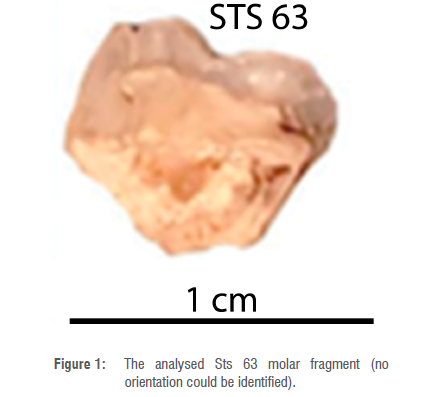
One of the major questions that arose from the above studies is whether it is feasible to recover ancient proteomes from an African context, given the differences in ancient climate, geology and taphonomy. Subsequently, the southern African Paranthropus dental enamel proteome demonstrated the feasibility of palaeoproteomics27A. africanus, we report a palaeoproteomic profile of specimen Sts 63 (Figure 1), morphologically identified as A. africanus, from Sterkfontein Member 4. We then provide additional examples from a recent palaeoproteomic investigation of Paranthropus27
Methods
Permission for temporary export and sampling (permit IDs 3026 and 3079) was granted by the South African Heritage Resource Agency for palaeoproteomic analysis of Sts 63 (Figure 1), an A. africanus molar fragment, with no significant morphology preserved, from Sterkfontein Member 4.
Biomolecular preservation
Chiral amino acid analysis was undertaken on enamel (± 5 mg) from Sts 63 following the protocols of Dickinson et al.2829
Etching extraction
Sts 63 peptides were extracted using a minimally destructive extraction method, specifically acid etching, as first demonstrated by Stewart et al.303124 32
Liquid chromatography with tandem mass spectrometry analysis
The peptides were eluted with 30 μL of 40% acetonitrile (ACN) and 0.1% formic acid (FA) into a 96-well mass spectrometry (MS) plate from the C18 StageTip.3124,33
Data analysis
The files generated by the mass spectrometer in the '.raw' file format were then processed using MaxQuant version 2.1.0.334Homo sapiens, publicly available ancient hominins, and members of Pan, Gorilla and Pongo downloaded from Uniprot and NCBI and translated in-house35
The Andromeda threshold score for both unmodified and modified proteins was set to 40, to filter out peptide spectral matches (PSM) with a low-quality score. No fixed post-translational modifications were set. Glutamine and asparagine deamidation, oxidation of methionine, oxidation of proline, oxidation of tyrosine, phosphorylation of serine/ threonine/tyrosine, ornithine conversion from asparagine, and N-terminal pyroglutamic acid from glutamic and aspartic acids were all included as possible variable modifications.
Proteins included in the database of common contaminants provided by MaxQuant, for example, proteinaceous laboratory reagents and human skin keratins, as well as reverse sequences, were manually removed and not considered any further. Similarly, proteins detected in the laboratory blank were not considered further.
Results
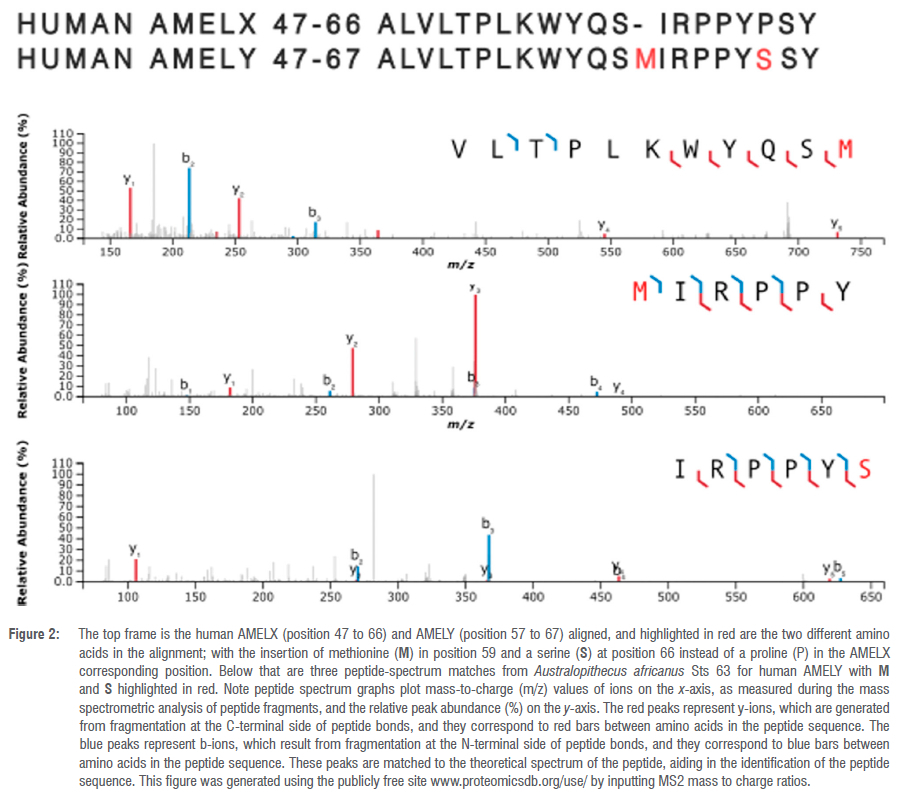
A total of 142 amino acids was recovered for both AMELX and AMELY with 118 peptides, 4 unique to AMELX and 3 unique to AMELY (Table 1). Thus, we were able to identify Sts 63 as belonging to a male individual, with the confident detection of three specific AMELY peptides (Figure 2). Subsequently, we observed similar diagenetic markers as seen in Cappellini et al.2425,2627Figure 3A and 3B). Moreover, we observed higher levels of intra-crystalline protein decomposition in Sts 63 relative to Paranthropus specimens from Swartkrans, including higher levels of racemisation (conversion of the L-amino acids to their D-form). The high intra-crystalline protein decomposition patterns in the enamel are consistent with a closed system behaviour, thus indicating that the recovered proteins are endogenous to the enamel matrix (Figure 3C). The higher levels of intra-crystalline protein decomposition are consistent with radiometric dating that indicates Sts 63 (Sterkfontein Member 4) is older than the Paranthropus specimens studied in Madupe et al.27
Discussion
A preliminary protein profile of A. africanus
Studies carried out on ancient hominin specimens allow us to start to unpack whether hominin morphological variation is due to sexual dimorphism, taxonomic differences or potentially other forms of variation. However, these studies are still in their infancy. Madupe et al.27Paranthropus teeth dated to ca 2 Ma36Paranthropus specimens, corroborating independent observations made on morphology.37Paranthropus within the hominin clade, which formed the outgroup of the clade, including H. sapiens, Neanderthals and Denisovans.
In contrast, the analysis carried out here on Sts 63 is via a minimally invasive extraction protocol, which generated a minimal proteome (Table 1). Excitingly, this allowed us to confirm the presence of ancient proteins in the sample, and to identify the sex of Sts 63 as male, confirming the potential for these studies using material from Sterkfontein. However, we are currently limited in the scope of a comparative analysis with P. robustus, which will require a larger A. africanus enamel proteome generated from extracting higher amounts of enamel from additional individuals. Moreover, in South Africa, species of Australopithecus, Paranthropus and early Homo were contemporaneous, and, ideally, phylogenetic comparisons based on genetic data should include information from all these taxa, allowing us to answer important questions about sexual dimorphism and taxonomic relationships. This is an exciting avenue for future research.
Consequently, this raises the question of whether hominins outside the South African Cradle cave systems will also have sufficiently good preservation for ancient protein recovery. The fossil A. africanus tooth studied here, as well as the Paranthropus specimens studied by Madupe et al.273827,3940
The current limitations - and future opportunities of palaeoproteomics
Palaeoproteomics provides deep-time genetic data that were previously inaccessible. The ancient genetic data allow us to draw tentative hominin phylogenies and study interspecies and intraspecies variation, sexual dimorphism, and temporal depth variation. These are all incredibly exciting breakthroughs that are poised to revolutionise our understanding of human evolution. However, there are still some limitations and pitfalls to overcome.
As amelogenin-X is expressed in both female and male individuals, it is challenging to identify female individuals unambiguously; absence of evidence (e.g. no detection of AMELY) does not always mean evidence of absence. Currently, there is no experimental way of positively identifying male individuals with a deletion of the amelogenin-Y gene -a condition that has been documented in modern humans41,424327,44-46
Another important consideration is the small amount of genetic information currently retrieved by enamel palaeoproteomic analysis. Proteins only represent the expression of the exonic part of the genome, and the ancient enamel proteome is not particularly rich, counting only about 12 proteins.24-2647,4849 50
In Madupe et al.27P. robustus is tentative due to the size of the recovered proteome, and here we did not include a reconstructed phylogeny as the minimally invasive peptide extraction protocol resulted in a very small proteome, making any phylogeny even less reliable. For comparison, in the initial phases of a DNA analysis, researchers relied on short DNA sequences, such as portions of the mitochondrial DNA (mtDNA). Although these studies provided preliminary insights, they had limitations. They did not detect gene flow between Neanderthals and modern humans because they focused on uniparentally inherited markers.5152,5354-565750
Final thoughts
The relatively new field of palaeoproteomics has the potential to revolutionise our understanding of Plio-Pleistocene hominin diversity in southern Africa, and possibly in Africa more broadly. Recent and ongoing studies have demonstrated its application in interpreting morphological variation. Madupe et al.27Paranthropus, in addition to identifying biological sex. Additionally, here we have presented the protein preservation of a specimen identified morphologically as A. africanus. This is the first step to attempt the recovery of the enamel proteome for this specimen. In addition to the preliminary palaeoproteomic characterisation, we also identified the sex of the specimen and validated the endogeneity of the recovered enamel proteins. The studies of Paranthropus proteomes, combined with the initial palaeoproteomic analysis of the A. africanus specimen presented here, demonstrate the feasibility and utility of palaeoproteomic studies in South Africa. Even though palaeoproteomics is still in its infancy and caution should be used in interpreting the results, it is still poised to be able to answer some of palaeoanthropology's most fundamental questions about sexual dimorphism, variation and phylogeny.
Future studies should focus on improving protein recovery and on increasing the breadth and depth of amino acid sequence coverage, as well as on the number of studied samples and taxa. Moreover, less destructive protein extraction methods need to be explored. Currently, the most common approach is to extract proteins by destructively sampling approximately 100 mg of dental enamel. In the future, alternative methods, such as the minimally destructive method used in this study, would make the application of palaeoproteomics more broadly applicable.
Palaeoproteomic research is a new and burgeoning field that has the potential to increase our understanding of the deep past. We see huge potential for the application of palaeoproteomics in understanding Plio-Pleistocene hominin diversity. As we have explored here, a lot of work still needs to be done, and this provides a unique and exciting opportunity for this field to be developed collaboratively, together with African researchers at the forefront. In this current special issue, Lee-Thorp and Sponheimer58
In conclusion, palaeoproteomics research is at the cusp of remarkable discoveries, making this an ideal time to develop new ways in which research could be done. We also want to emphasise that palaeoproteomics should not be another field of study in which marginalised communities are left out, or in which parachute/helicopter5960-62 6364
Funding
PPM., F.M., K.P, J.V.O. and E.C. were supported by the European Union's Horizon 2020 Research and Innovation Programme under the Marie Sklodowska-Curie 'PUSHH' training network, grant no. 861389. E.C., L.S., J.V.O., R.R.A., A.J.T., M.M. and PPM. are supported by the European Research Council (ERC) under the European Union's Horizon 2020 Research and Innovation Programme (grant no. 101021361). M.M. was supported in part by a grant from the Danish National Research Foundation award to Matthew Collins (PROTEIOS, DNRF128). Work at the Novo Nordisk Foundation Center for Protein Research is funded in part by a donation from the Novo Nordisk Foundation (NNF14CC0001). R.R.A. and N.H. are supported by the African Origins Platform, National Research Foundation of South Africa (grant no. 117670 and 136512). L.S. is funded by a Discovery Grant from the Natural Sciences and Engineering Research Council of Canada (NSERC Discovery grant no. RGPIN-2020-04159). M.D. and K.P are supported by the Natural Environment Research Council (NERC) through grant NE/S010211/1. C.Z. received funding from the French government through the ANR GenoMorph (ANR-20-CE12-0018) and in the framework of the University of Bordeaux's IdEx 'Investments for the Future' programme / GPR 'Human Past'.
Data availability
The mass spectrometry proteomics data have been deposited to the ProteomeXchange Consortium (http://proteomecentral.proteomexchange.org) via the PRIDE partner repository with the data set identifier PXD054431.
Declarations
We have no competing interests to declare. We have no AI or LLM use to declare.
Authors' contributions
PPM.: Conceptualisation, data collection, sample analysis, data analysis, writing - the initial draft, writing - revisions, project leadership, project management. F.M.: Data collection, sample analysis, data analysis. M.D.: Data collection, sample analysis, data analysis, writing - revisions. A.J.T.: Data collection, sample analysis, writing - revisions. M.M.: Data collection, sample analysis, writing - revisions. M.T.: Provided the specimens. C.M.: Writing - revisions. N.H.: Writing - revisions. K.P: Writing - revisions. L.S.: Writing - revisions, student supervision. C.Z.: Writing -revisions. J.V.O.: Funding acquisition. R.R.A.: Conceptualisation, writing - revisions, student supervision, project leadership, project management, funding acquisition. E.C.: Conceptualisation, writing -revisions, student supervision, project leadership, project management, funding acquisition. All authors read and approved the final manuscript.
References
-
1. Dart RA. The Taungs skull. Nature. 1925;116:462. https://doi.org/10.1038/116462a0
» https://doi.org/10.1038/116462a0 -
2. Herries AIR, Martin JM, Leece AB, Adams JW, Boschian G, Joannes-Boyau R, et al. Contemporaneity of Australopithecus, Paranthropus, and early Homo erectus in South Africa. Science. 2020;368(6486), eaaw7293. https://doi.org/10.1126/science.aaw7293
» https://doi.org/10.1126/science.aaw7293 -
3. Frayer DW, Wolpoff MH. Sexual dimorphism. Annu Rev Anthropol. 1985;14:429-473. https://doi.org/10.1146/annurev.an.14.100185.002241
» https://doi.org/10.1146/annurev.an.14.100185.002241 -
4. Thackeray JF, Dykes S. Morphometric analyses of hominoid crania, probabilities of conspecificity and an approximation of a biological species constant. Homo. 2016;67:1-10. https://doi.org/10.1016/j.jchb.2015.09.003
» https://doi.org/10.1016/j.jchb.2015.09.003 -
5. Lockwood CA, Menter CG, Moggi-Cecchi J, Keyser AW. Extended male growth in a fossil hominin species. Science. 2007;318:1443-1446. https://doi.org/10.1126/science.1149211
» https://doi.org/10.1126/science.1149211 -
6. Martin JM, Leece B, Neubauer S, Baker SE, Mongle CS, Boschian G, et al. Drimolen cranium DNH 155 documents microevolution in an early hominin species. Nat Ecol Evol. 2021;5:38-45. https://doi.org/10.1038/s41559-020-01319-6
» https://doi.org/10.1038/s41559-020-01319-6 -
7. Leece AB, Martin JM, Baker S, Wilson C, Strait DS, Schwartz GT, et al. New hominin dental remains from the ~2.04-1.95 Ma Drimolen Main Quarry, South Africa. Ann Hum Biol. 2023;50:407-427. https://doi.org/10.1080/03014460.2023.2261849
» https://doi.org/10.1080/03014460.2023.2261849 - 8. Keyser AW. The Drimolen skull: The most complete australopithecine cranium and mandible to date. S Afr J Sci. 2000;96:189-193.
-
9. Leece AB, Martin JM, Herries AIR, Riga A, Menter CG, Moggi-Cecchi J. New hominin dental remains from the Drimolen Main Quarry, South Africa (1999-2008). Am J Biol Anthropol. 2022;179:240-260. https://doi.org/10.1002/ajpa.24570
» https://doi.org/10.1002/ajpa.24570 -
10. Braga J, Chinamatira G, Zipfel B, Zimmer V. New fossils from Kromdraai and Drimolen, South Africa, and their distinctiveness among Paranthropus robustus. Sci Rep. 2022;12, Art. #13956. https://doi.org/10.1038/s41598-022-18223-7
» https://doi.org/10.1038/s41598-022-18223-7 -
11. Clarke RJ. Latest information on Sterkfontein's Australopithecus skeleton and a new look at Australopithecus. S Afr J Sci. 2008;104:443-449. https://doi.org/10.1590/S0038-23532008000600015
» https://doi.org/10.1590/S0038-23532008000600015 -
12. Clarke RJ, Kuman K. The skull of StW 573, a 3.67 Ma Australopithecus prometheus skeleton from Sterkfontein Caves, South Africa. J Hum Evol. 2019;134, Art. #102634. https://doi.org/10.1016/j.jhevol.2019.06.005
» https://doi.org/10.1016/j.jhevol.2019.06.005 -
13. Lockwood CA, Tobias PV. Morphology and affinities of new hominin cranial remains from Member 4 of the Sterkfontein Formation, Gauteng Province, South Africa. J Hum Evol. 2002;42:389-450. https://doi.org/10.1006/jhev.2001.0532
» https://doi.org/10.1006/jhev.2001.0532 -
14. Moggi-Cecchi J, Grine FE, Tobias PV. Early hominid dental remains from Members 4 and 5 of the Sterkfontein Formation (1966-1996 excavations): Catalogue, individual associations, morphological descriptions and initial metrical analysis. J Hum Evol. 2006;50:239-328. https://doi.org/10.1016/j.jhevol.2005.08.012
» https://doi.org/10.1016/j.jhevol.2005.08.012 -
15. Beaudet A. The Australopithecus assemblage from Sterkfontein Member 4 (South Africa) and the concept of variation in palaeontology. Evol Anthropol. 2023;32:154-168. https://doi.org/10.1002/evan.21972
» https://doi.org/10.1002/evan.21972 -
16. Pickering R, Kramers JD. Re-appraisal of the stratigraphy and determination of new U-Pb dates for the Sterkfontein hominin site, South Africa. J Hum Evol. 2010;59:70-86. https://doi.org/10.1016/j.jhevol.2010.03.014
» https://doi.org/10.1016/j.jhevol.2010.03.014 -
17. Granger DE, Stratford D, Bruxelles L, Gibbon RJ, Clarke RJ, Kuman K. Cosmogenic nuclide dating of Australopithecus at Sterkfontein, South Africa. Proc Natl Acad Sci USA. 2022;119, e2123516119. https://doi.org/10.1073/pnas.2123516119
» https://doi.org/10.1073/pnas.2123516119 -
18. Warinner C, Korzow Richter K, Collins MJ. Paleoproteomics. Chem Rev. 2022;122:13401-13446. https://doi.org/10.1021/acs.chemrev.1c00703
» https://doi.org/10.1021/acs.chemrev.1c00703 -
19. Cappellini E, Prohaska A, Racimo F, Welker F Pedersen MW, Allentoft ME, et al. Ancient biomolecules and evolutionary inference. Annu Rev Biochem. 2018;87:1029-1060. https://doi.org/10.1146/annurev-biochem-062917-012002
» https://doi.org/10.1146/annurev-biochem-062917-012002 - 20. Demarchi B, Hall S, Roncal-Herrero T, Freeman CL, Woolley J, Crisp MK, et al. Protein sequences bound to mineral surfaces persist into deep time. eLife. 2016;5, e17092.
-
21. Lipson M, Sawchuk EA, Thompson JC, Oppenheimer J. Ancient DNA and deep population structure in sub-Saharan African foragers. Nature. 2022;603:290-296. https://doi.org/10.1038/s41586-022-04430-9
» https://doi.org/10.1038/s41586-022-04430-9 -
22. Nielsen-Marsh CM, Stegemann C, Hoffmann R, Smith T, Feeney R, Toussaint M, et al. Extraction and sequencing of human and Neanderthal mature enamel proteins using MALDI-TOF/TOF MS. J Archaeol Sci. 2009;36:1758-1763. https://doi.org/10.1016/j.jas.2009.04.004
» https://doi.org/10.1016/j.jas.2009.04.004 -
23. Fincham AG, Bessem CC, Lau EC, Pavlova Z, Shuler C, Slavkin HC, et al. Human developing enamel proteins exhibit a sex-linked dimorphism. Calcif Tissue Int. 1991;48:288-290. https://doi.org/10.1007/BF02556382
» https://doi.org/10.1007/BF02556382 -
24. Cappellini E, Welker F Pandolfi L, Ramos-Madrigal J, Samodova D, Rüther PL, et al. Early Pleistocene enamel proteome from Dmanisi resolves Stephanorhinus phylogeny. Nature. 2019;574:103-107. https://doi.org/10.1038/s41586-019-1555-y
» https://doi.org/10.1038/s41586-019-1555-y -
25. Welker F, Ramos-Madrigal J, Kuhlwilm M, Liao W, Gutenbrunner P de Manuel M, et al. Enamel proteome shows that Gigantopithecus was an early diverging pongine. Nature. 2019;576:262-265. https://doi.org/10.1038/s41586-019-1728-8
» https://doi.org/10.1038/s41586-019-1728-8 -
26. Welker F, Ramos-Madrigal J, Gutenbrunner P, Mackie M, Tiwary S, Jersie-Christensen RR, et al. The dental proteome of Homo antecessor. Nature. 2020;580:235-238. https://doi.org/10.1038/s41586-020-2153-8
» https://doi.org/10.1038/s41586-020-2153-8 -
27. Madupe PP, Koenig C, Patramanis I, Rüther PL, Hlazo N, Mackie M, et al. Enamel proteins reveal biological sex and genetic variability within southern African Paranthropus [preprint]. bioRxiv 2023.07.03.547326. https://doi.org/10.1101/2023.07.03.547326
» https://doi.org/10.1101/2023.07.03.547326 -
28. Dickinson MR, Lister AM, Penkman KEH. A new method for enamel amino acid racemization dating: A closed system approach. Quat Geochronol. 2019;50:29-46. https://doi.org/10.1016/j.quageo.2018.11.005
» https://doi.org/10.1016/j.quageo.2018.11.005 -
29. Kaufman DS, Manley WF. A new procedure for determining dl amino acid ratios in fossils using reverse phase liquid chromatography. Quat Sci Rev. 1998;17:987-1000. https://doi.org/10.1016/S0277-3791(97)00086-3
» https://doi.org/10.1016/S0277-3791(97)00086-3 -
30. Stewart NA, Molina GF, Issa JPM, Yates NA, Sosovicka M, Vieira AR, et al. The identification of peptides by nanoLC-MS/MS from human surface tooth enamel following a simple acid etch extraction. RSC Adv. 2016;6:61673-61679. https://doi.org/10.1039/C6RA05120K
» https://doi.org/10.1039/C6RA05120K -
31. Rappsilber J, Ishihama Y, Mann M. Stop and go extraction tips for matrix-assisted laser desorption/ionization, nanoelectrospray, and LC/MS sample pretreatment in proteomics. Anal Chem. 2003;75:663-670. https://doi.org/10.1021/ac026117i
» https://doi.org/10.1021/ac026117i -
32. Taurozzi AJ, Rüther PL, Patramanis I, Koenig C, Paterson RS, Madupe PP, et al. Deep-time phylogenetic inference by paleoproteomic analysis of dental enamel. Nat Protoc. 2024;19:2085-2116. https://doi.org/10.1038/s41596-024-00975-3
» https://doi.org/10.1038/s41596-024-00975-3 -
33. Mackie M, Rüther P Samodova D, Di Gianvincenzo F, Granzotto C, Lyon D, et al. Palaeoproteomic profiling of conservation layers on a 14th century Italian wall painting. Angew Chem Int Ed. 2018;57:7369-7374. https://doi.org/10.1002/anie.201713020
» https://doi.org/10.1002/anie.201713020 -
34. Cox J, Mann M. MaxQuant enables high peptide identification rates, individualized p.p.b.-range mass accuracies and proteome-wide protein quantification. Nat Biotechnol. 2008;26:1367-1372. https://doi.org/10.1038/nbt.1511
» https://doi.org/10.1038/nbt.1511 -
35. Patramanis I, Ramos-Madrigal J, Cappellini E, Racimo F. PaleoProPhyler: A reproducible pipeline for phylogenetic inference using ancient proteins. Peer Commun J. 2023;3, e112. https://doi.org/10.24072/pcjournal.344
» https://doi.org/10.24072/pcjournal.344 -
36. Pickering R, Kramers JD, Hancox PJ, de Ruiter DJ, Woodhead JD. Contemporary flowstone development links early hominin bearing cave deposits in South Africa. Earth Planet Sci Lett. 2011;306:23-32. https://doi.org/10.1016/j.epsl.2011.03.019
» https://doi.org/10.1016/j.epsl.2011.03.019 -
37. Zanolli C, Davies TW, Joannes-Boyau R, Beaudet A, Bruxelles L, de Beer F, et al. Dental data challenge the ubiquitous presence of Homo in the Cradle of Humankind. Proc Natl Acad Sci USA. 2022;119, e2111212119. https://doi.org/10.1073/pnas.2111212119
» https://doi.org/10.1073/pnas.2111212119 -
38. Pickering R, Hancox PJ, Lee-Thorp JA, Grün R, Mortimer GE, McCulloch M, et al. Stratigraphy, U-Th chronology, and paleoenvironments at Gladysvale Cave: Insights into the climatic control of South African hominin-bearing cave deposits. J Hum Evol. 2007;53:602-619. https://doi.org/10.1016/j.jhevol.2007.02.005
» https://doi.org/10.1016/j.jhevol.2007.02.005 -
39. Pickering R, Herries AIR, Woodhead JD, Hellstrom JC, Green HE, Paul B, et al. U-Pb-dated flowstones restrict South African early hominin record to dry climate phases. Nature. 2018;565:226-229. https://doi.org/10.1038/s41586-018-0711-0
» https://doi.org/10.1038/s41586-018-0711-0 -
40. Kohn MJ, Schoeninger MJ, Barker WW. Altered states: Effects of diagenesis on fossil tooth chemistry. Geochim Cosmochim Acta. 1999;63:2737-2747. https://doi.org/10.1016/S0016-7037(99)00208-2
» https://doi.org/10.1016/S0016-7037(99)00208-2 -
41. Cheng JB, Liu Q, Long F, Huang DX, Yi SH. Analysis of the Yp11.2 deletion region of phenotypically normal males with an AMELY-Null allele in the Chinese Han population. Genet Test Mol Biomark. 2019;23:359-362. https://doi.org/10.1089/gtmb.2018.0231
» https://doi.org/10.1089/gtmb.2018.0231 -
42. Mitchell RJ, Kreskas M, Baxter E, Buffalino L, Van Oorschot RAH. An investigation of sequence deletions of amelogenin (AMELY), a Y-chromosome locus commonly used for gender determination. Ann Hum Biol. 2006;33:227-240. https://doi.org/10.1080/03014460600594620
» https://doi.org/10.1080/03014460600594620 -
43. Skov L, Peyrégne S, Popli D, Iasi LNM, Devièse T, Slon V et al. Genetic insights into the social organization of Neanderthals. Nature. 2022;610:519-525. https://doi.org/10.1038/s41586-022-05283-y
» https://doi.org/10.1038/s41586-022-05283-y -
44. Parker GJ, Yip JM, Eerkens JW, Salemi M, Durbin-Johnson B, Kiesow C, et al. Sex estimation using sexually dimorphic amelogenin protein fragments in human enamel. J Archaeol Sci. 2019;101:169-180. https://doi.org/10.1016/j.jas.2018.08.011
» https://doi.org/10.1016/j.jas.2018.08.011 -
45. Froment C, Hourset M, Sáenz-Oyhéréguy N, Mouton-Barbosa E, Willmann C, Zanolli C, et al. Analysis of 5000 year-old human teeth using optimized large-scale and targeted proteomics approaches for detection of sex-specific peptides. J Proteomics. 2020;211, Art. #103548. https://doi.org/10.1016/j.jprot.2019.103548
» https://doi.org/10.1016/j.jprot.2019.103548 -
46. Koenig C, Bortel P, Paterson RS, Rendl B, Madupe PP, Troché GB, et al. Automated high-throughput biological sex identification from archaeological human dental enamel using targeted proteomics [preprint]. bioRxiv 2024.02.20.581140. https://doi.org/10.1101/2024.02.20.581140
» https://doi.org/10.1101/2024.02.20.581140 -
47. Lu YY Papagerakis P Yamakoshi Y Hu JCC, Bartlett JD, Simmer JP. Functions of KLK4 and MMP-20 in dental enamel formation. Biol Chem. 2008;389:695-700. https://doi.org/10.1515/BC.2008.080
» https://doi.org/10.1515/BC.2008.080 -
48. Yamakoshi Y Hu JCC, Fukae M, Yamakoshi F Simmer JP How do enamelysin and kallikrein 4 process the 32-kDa enamelin? Eur J Oral Sci. 2006;114(Suppl 1):45-51. Discussion 93-5, 379-80. https://doi.org/10.1111/j.1600-0722.2006.00281.x
» https://doi.org/10.1111/j.1600-0722.2006.00281.x -
49. Degnan JH, Rosenberg NA. Gene tree discordance, phylogenetic inference and the multispecies coalescent. Trends Ecol Evol. 2009;24:332-340. https://doi.org/10.1016/j.tree.2009.01.009
» https://doi.org/10.1016/j.tree.2009.01.009 -
50. Paterson RS, Madupe PP, Cappellini E. Paleoproteomics sheds light on million-year-old fossils. Nat Rev Mol Cell Biol. 2024;26:1-2. https://doi.org/10.1038/s41580-024-00803-2
» https://doi.org/10.1038/s41580-024-00803-2 -
51. Paijmans JLA, Gilbert MTP, Hofreiter M. Mitogenomic analyses from ancient DNA. Mol Phylogenet Evol. 2013;69:404-416. https://doi.org/10.1016/j.ympev.2012.06.002
» https://doi.org/10.1016/j.ympev.2012.06.002 -
52. Orlando L, Allaby R, Skoglund P Der Sarkissian C, Stockhammer PW, Ávila-Arcos MC, et al. Ancient DNA analysis. Nat Rev Methods Primers. 2021;1:14. https://doi.org/10.1038/s43586-020-00011-0
» https://doi.org/10.1038/s43586-020-00011-0 -
53. Knapp M, Hofreiter M. Next Generation Sequencing of Ancient DNA: Requirements, Strategies and Perspectives. Genes. 2010;1:227-243. https://doi.org/10.3390/genes1020227
» https://doi.org/10.3390/genes1020227 -
54. Green RE, Krause J, Briggs AW, Maricic T, Stenzel U, Kircher M, et al. A draft sequence of the Neandertal genome. Science. 2010;328:710-722. https://doi.org/10.1126/science.1188021
» https://doi.org/10.1126/science.1188021 -
55. Meyer M, Kircher M, Gansauge MT, Li H, Racimo F, Mallick S, et al. A high-coverage genome sequence from an archaic Denisovan individual. Science. 2012;338:222-226. https://doi.org/10.1126/science.1224344
» https://doi.org/10.1126/science.1224344 -
56. Reich D, Green RE, Kircher M, Krause J, Patterson N, Durand EY, et al. Genetic history of an archaic hominin group from Denisova cave in Siberia. Nature. 2010;468:1053-1060. https://doi.org/10.1038/nature09710
» https://doi.org/10.1038/nature09710 -
57. Floyd BM, Marcotte EM. Protein sequencing, one molecule at a time. Annu Rev Biophys. 2022;51:181-200. https://doi.org/10.1146/annurev-biophys-102121-103615
» https://doi.org/10.1146/annurev-biophys-102121-103615 -
58. Lee-Thorp J, Sponheimer M. The development of chemical approaches to fossil hominin ecology in South Africa. S Afr J Sci. 2025;121(1/2), Art. #18529. https://doi.org/10.17159/sajs.2025/18529
» https://doi.org/10.17159/sajs.2025/18529 -
59. Adame F. Meaningful collaborations can end 'helicopter research'. Nature Career Column. 29 June 2021. https://doi.org/10.1038/d41586-021-01795-1
» https://doi.org/10.1038/d41586-021-01795-1 -
60. Schroeder L, Ackermann RR. Moving beyond the adaptationist paradigm for human evolution, and why it matters. J Hum Evol. 2023;174, Art. #103296. https://doi.org/10.1016/j.jhevol.2022.103296
» https://doi.org/10.1016/j.jhevol.2022.103296 -
61. Elbein A. Decolonizing the hunt for dinosaurs and other fossils. The New York Times. 22 March 2021. Available from: https://www.nytimes.com/2021/03/22/science/dinosaurs-fossils-colonialism.html
» https://www.nytimes.com/2021/03/22/science/dinosaurs-fossils-colonialism.html -
62. Athreya S, Ackermann R. Colonialism and narratives of human origins in Asia and Africa. In: Porr M, Matthews J. Interrogating human origins. London: Routledge; 2019. p. 72-95. https://doi.org/10.4324/9780203731659-4
» https://doi.org/10.4324/9780203731659-4 -
63. Stevens KR, Masters KS Imoukhuede PI, Haynes KA, Setton LA, Cosgriff-Hernandez E, et al. Fund Black scientists. Cell. 2021;184:561-565. https://doi.org/10.1016/j.cell.2021.01.011
» https://doi.org/10.1016/j.cell.2021.01.011 -
64. Gomez LE, Bernet P Diversity improves performance and outcomes. J Natl Med Assoc. 2019;111:383-392. https://doi.org/10.1016/j.jnma.2019.01.006
» https://doi.org/10.1016/j.jnma.2019.01.006

Revised: 19 Dec. 2024
Accepted: 20 Dec. 2024
Published: 07 Feb. 2025
Funding: European Union's Horizon 2020 (861389, 101021361), Danish National Research Foundation (PROTEIOS, DNRF128), Novo Nordisk Foundation (NNF14CC0001), South African National Research Foundation (117670, 136512), Natural Sciences and Engineering Research Council of Canada (RGPIN-2020-04159), Natural Environment Research Council (NERC) (NE/S010211/1), GenoMorph (ANR-20-CE12-0018), University of Bordeaux