A review of soybean rust from a South African perspective
Abstract
This review article describes the nature of the soybean rust pathogen, its interaction with the soybean host and documents some of the history of soybean rust in South Africa. Soybean rust has affected soybean cropping in parts of South Africa since 2001. The disease causes leaf lesions, which may progress to premature defoliation and ultimately result in grain yield loss in susceptible soybean genotypes. Chemical control measures have been successfully employed to limit commercial yield losses in South Africa; however, controlling the effects of this disease through host-resistance or tolerance mechanisms remains a long-term goal.
Phakopsora pachyrhizi; Glycine max; chemical control; tolerance
Introduction
Soybean rust, caused by the fungus Phakopsora pachyrhizi Sydow, was reported on soybeans (Glycine max L. Merr) in the Vryheid district of South Africa in February 2001,123
The pathogen
There are approximately 80 species of Phakopsora known worldwide,4P. pachyrhizi and, less commonly, P. meibomiae (Arthur) Arthur. The latter species (P. meibomiae), commonly known as the cause of Latin American rust or Legume rust, is found in the western hemisphere and is not known to cause severe yield losses.54P. pachyrhizi, the cause of the disease known commonly as Asian soybean rust, or simply soybean rust hereafter.
Global distribution
Before 1992, soybean rust was known to cause significant losses in Asia and Australasia, inclusive of the following countries: Australia, India, Indonesia, Japan, Korea, Peoples Republic of China, Philippines, Taiwan, Thailand, Vietnam.67P. pachyrhizi was detected in Paraguay8910111213et al.1415
Alternative hosts
The soybean rust pathogen is known to naturally infect 95 species from 42 genera of legumes, inclusive of important weed species like Kudzu vine (Pueraria lobata) and major crop species such as common bean (Phaseolus vulgaris).55
Epidemiology of soybean rust
The presence of a susceptible host, viable pathogen spores and suitable environmental conditions are requisites for the development of a soybean rust epidemic. The optimum temperature for urediniospore germination ranges between 12 and 27°C, depending on the source of the research.16–18 Urediniospore germination is greater in darkness, with light either inhibiting or delaying germination.18192021
Symptoms of soybean rust
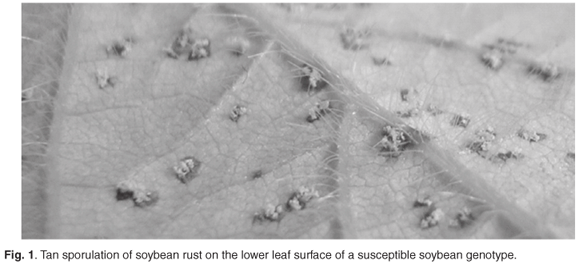
First symptoms of soybean rust could be described as small water soaked lesions which develop into grey, tan to dark brown, or reddish brown lesions (uredinia) particularly on the abaxial leaf surface.226Fig. 1) indicates a fully compatible reaction. During the early stages of development, before sporulation, soybean rust may be confused with bacterial pustule disease [Xanthomonas campestris pv glycines (Nakano) Dye].2223
Effect of soybean rust on yield
There is a dearth of published information on the effects of soybean rust on soybean yields in South Africa. Researchers that have published data relating to the effects of soybean rust on yield have recorded considerable variability over seasons and genotypes.24,25 McLaren2524
Initial indications from the research of Caldwell and McLaren242425–1 and in 2004/05 season it was a devastating 60.9% or 3.4 t ha–1. Genotype ranking for yield loss percentage between the two seasons was substantially different, highlighting the considerable variability of soybean rust epidemics over seasons and the difficulty in selecting for improved genotypic response.
Distribution and spread of soybean rust in South Africa
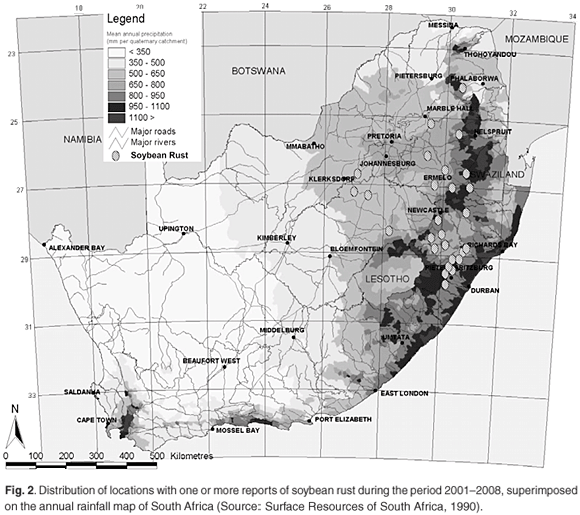
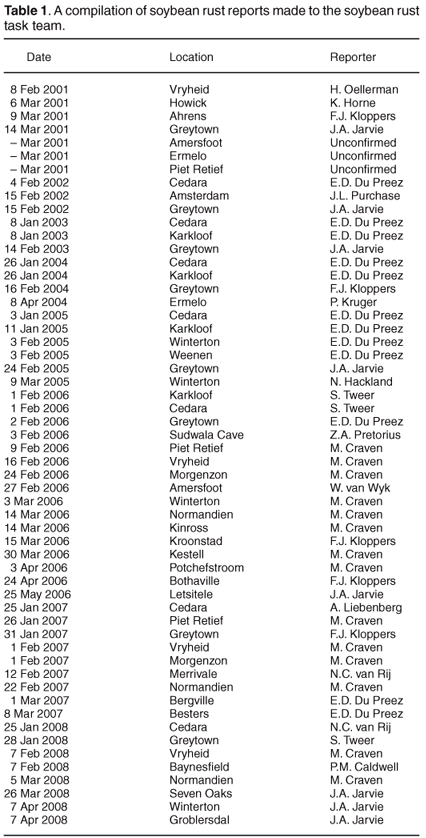
There has not yet been a formal attempt to survey the distribution of soybean rust in South Africa; however, the reports of positive identification of soybean rust sent in by members of the soybean rust task team have been collated for the period 2001–2008 (Table 1). The reports increased in frequency over the years surveyed, likely as a result of more scientists becoming involved in reporting rather than an increase in disease incidence. The distribution of locations with one or more soybean rust reports have been plotted on a rainfall map of South Africa (Fig. 2). The area with the highest incidence of soybean rust reports coincides with the high rainfall region east of the Drakensberg mountain range. Del Ponte et al.26Table 1) to have a significant impact on yield.
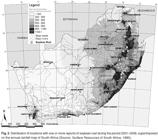
The collated reports are probably not ideally suited to making judgements on the progression of the disease, because the date of the report is not always a good indication of the start of the epidemic. However, in seasons that had sufficient reports to substantiate a trend (2006–2008), first reports for the season generally started in the east and progressed westward. While this may indicate a closer proximity to the inoculum source in the east of the production region, weather conditions favouring infection and development of symptoms may simply occur earlier in the season in the east compared to the west.
There is no literature on how the soybean rust pathogen survives from one season to the next in South Africa; however, Caldwell and McLaren24
Pivonia and Yang27P. pachyrhizi across the world based only on historical temperature and moisture data. Host availability and presence of an inoculum source were not considered. They found that conditions for the survival of P. pachyrhizi were very favourable all along the east and southern coasts of South Africa. Since this area does not coincide with the soybean production area, it is likely then that the soybean rust pathogen survives the winter in this area on the many possible alternative hosts. Pretorius et al.28Pueraria lobata) was one of the alternate hosts of P. pachyrhizi that provided a green bridge in South Africa for the survival of the pathogen through winter in the frost-free areas. It is speculated that this frost-free area then provides the initial inoculum source each season for the inland areas that have summer conditions favourable for the development of soybean rust. The consistency with which the epidemics have occurred since 2001 (Table 1) would tend to support the postulation that the source of urediniospores is, at the very least, regional and that local epidemics are not reliant on major weather phenomena for the deposition of urediniospores from the tropics of Africa.
Chemical control
Emergency registration of a number of chemicals made it possible for farmers to control epidemics during the first two seasons that soybean rust affected production in South Africa.2952930293132in situ and via leaf samples in the laboratory. These plots were used as sentinel plots to give producers advance warning of the presence and severity of the disease in an area. Producers were notified of the first presence of soybean rust in their area via cell phone SMS or alerts on farm radio programmes.32333415
In 2005, a report from Washington State University35P. pachyrhizi under laboratory conditions. Owing to the popularity of Roundup Ready (RR) soybean genotypes in South Africa, Kloppers and Jarvie (unpubl. data) performed a pilot study with sequential sprays of Roundup on an experimental RR genotype to establish whether there was a need to pursue this avenue of research further. The preliminary results showed that pre-flower applications of Roundup had no effect on soybean rust severity, but post-flower applications visibly reduced the premature defoliation due to rust. Since Roundup, when used as a herbicide, is primarily applied to soybeans at a pre-flower stage, it was felt that these findings would have little practical applicability and this line of research was not pursued further. The results of this pilot study were later confirmed by independent research conducted in the U.S.A. by Jurick and co-workers.36
Resistance
Screening for resistance
From the early 1960s through to the 1990s, much of the soybean rust research focused on resistance. Tschanz3738P. pachyrhizi in Brazil, China, Paraguay and Thailand.3915
Under field conditions, early maturing soybean genotypes will have a higher disease rating earlier in the season than the equivalent later maturing genotype. The rate of rust development in these genotypes is also higher than that of later maturing genotypes, and if a correction for host maturity is not made, erroneous conclusions from field data will result.4025
Specific resistance in soybean
McLean and Byth41P. pachyrhizi on soybean genotypes in Australia. Race 1 was virulent on Wills and avirulent on PI 200492. Race 2 was virulent on both varieties. Subsequent to this, considerable variation in isolate virulence (collected from the same field, as well as isolates from geographically-distant regions) has been shown to occur.56P. pachyrhizi isolates by Wang and Hartman,642P. pachyrhizi race that had three virulence genes, more than were necessary to overcome host resistance. More recent research5Uromyces appendiculatus) where the more tropical locations (like South Africa) were found to induce greater race variability than more temperate climates.4344
The specific resistance gene in PI 200492 was given the designation Rpp1,452;463;474.481 and Rpp3 genes are ineffective and Rpp2 and Rpp4 currently confer resistance, Neto492 and Rpp4, and of the 26 sources reported, 23 were found to be at different loci to Rpp 2 and Rpp4. One of these sources of resistance was conditioned by a single recessive gene49492 and Rpp4 in a single genotype had no additive advantage in the expression of resistance.
The presence of multiple virulence genes in the pathogen population and the lack of multiple resistance genes in the host provides the soybean rust pathogen with a competitive advantage. The deployment of specific single genes for resistance is thus unlikely to be a successful strategy. As an example of gene failure, Hartman et al.51, Rpp2 and Rpp3 lost their effectiveness in the field within 10 years of exposure. In Taiwan, Shanmugasudaram et al.501) becoming susceptible within a few years of release. Genotypes PI 230970 and PI 230971 were identified as being resistant in Taiwan, and these were subsequently used as parents in crosses to generate a number of resistant lines (AGS 181, AGS 182, AGS 183, AGS 229, AGS 233, AGS 240, AGS 244, AGS 247). So too were the resistances of these lines short lived. Following that, new sources of resistance were identified in PI 459024, PI 459025 (Rpp4) and PI 339871 (G. soja) but have all since been defeated.5,50 In Brazil, Yorinori10
The use of gene pyramiding and gene rotation is also unlikely to be a stable solution because the pathogen retains unnecessary virulence genes at a high frequency in its population.5151
Partial resistance
Partial or rate-reducing resistance to soybean rust has been documented in soybean,51et al.5
Tolerance
Tolerance implies susceptibility, and can be defined as the relative ability of a genotype to yield under stress from rust.655254049
Conclusion
High levels of tolerance or sustainable rust resistance in South African genotypes is not imminent, which means that for the foreseeable future control of soybean rust by a combination of chemical and cultural means will need to continue. An efficient warning system and effective fungicides have been instrumental in averting potentially large financial losses to producers. Whilst seasonal soybean rust epidemics will persist and control measures will continue to be required, the soybean rust crisis in South African soybean production is largely over as a result of the efforts of forward-thinking policy-makers and pro-active researchers.
I thank Paula Kruger, Maryke Craven, Rikus Kloppers for their contribution to the collection of data and gratefully acknowledge editorial assistance from Eve Dunlop and Paul Shanahan.
References
- 1. Pretorius Z.A., Kloppers F.J. and Frederick R.D. (2001). First report of soybean rust in South Africa. Plant Dis. 85, 1288.
- 2. Smit M.A. (1998). Proceedings of Workshop on Soybean Rust (Phakopsora pachyrhizi), October 1998. ARC Summer Grains Centre, Potchefstroom.
- 3. Smit M.A. (1999). Phakopsora pachyrhizi in Afrika: Verslag van Vergadering te Harare 9 Maart, 1999. ARC Summer Grains Centre, Potchefstroom.
- 4. Hennen J.F. (1996). The taxonomy of soybean rusts. In Proceedings of the Soybean Rust Workshop, 9–11 August 1995, eds J.B. Sinclair and G.L. Hartman, pp. 29–32. College of Agricultural, Consumer and Environmental Sciences, National Research Laboratory, Urbana, Illinois.
-
5. Hartman G.L., Miles M.R. and Frederick R.D. (2005). Historical viewpoint and soybean resistance to soybean rust. In Proceedings of the 2005 Illinois Crop Protection Conference, pp. 16–20. Available Online at: www.ipm.uiuc.edu/education/proceedings/index.html
» www.ipm.uiuc.edu/education/proceedings/index.html - 6. Wang T.C. and Hartman G.L. (1992). Epidemiology of soybean rust and breeding for host resistance. Plant Prot. Bull. 34, 109–124.
- 7. Levy C. (2003). Measures to control soybean rust in southern Africa and initial investigation of the meteorological factors that favour its development. Phytopathology 93, 103.
- 8. Morel W., Scheid N., Amarilla V. and Cubilla L.E. (2004). Soybean rust in Paraguay, evolution in the last three years. In Proceedings of the VII World Soybean Research Conference, eds F. Moscardi, C.B Hoffmann-Campo, O.F. Saraiva, P.R. Galerani, F.C. Krzyzanowski and M.C. Carrão-Panizzi, pp. 361–364. Embrapa, Londrina.
- 9. Rossi R.L. (2004). Current status of soybean production and utilization in Argentina. In Proceedings of the VII World Soybean Research Conference, eds F. Moscardi, C.B Hoffmann-Campo, O.F. Saraiva, P.R. Galerani, F.C. Krzyzanowski and M.C. Carrão-Panizzi, pp. 38–49. Embrapa, Londrina.
- 10. Yorinori J.T. (2004). Country report and rust control strategies. In Proceedings of the VII World Soybean Research Conference, eds F. Moscardi, C.B Hoffmann-Campo, O.F. Saraiva, P.R. Galerani, F.C. Krzyzanowski and M.C. Carrão-Panizzi, pp. 447–455. Embrapa, Londrina.
- 11. Stewart S., Guillin E.A and Díaz I. (2005). First report of soybean rust caused by Phakopsora pachyrhizi in Uruguay. Plant Dis. 89, 909.
- 12. Killgore E.M. and Heu R. (1994). First report of soybean rust in Hawaii. Plant Dis. 78, 1216.
- 13. Sinclair J.B. and Hartman G.L. (1996). Potential threat to U.S. continental soybeans. In Proceedings of the Soybean Rust Workshop, 9–11 August 1995, eds J.B. Sinclair and G.L. Hartman, p.6. College of Agricultural, Consumer and Environmental Sciences, National Research Laboratory, Urbana, Illinois.
- 14. Schneider R.W., Hollier C.A., Whitam H.K., Palm M.E., McKemy J.M., Hernández J.R., Levy L. and deVries-Paterson R. (2005). First report of soybean rust caused by Phakopsora pachyrhizi in the continental United States. Plant Dis. 89, 774.
-
15. Hartman G.L. (2007). Soybean rust: The first three years. Proceedings of the 2007 Illinois Crop Protection Conference, pp. 21–25. Online at: www.ipm.uiuc.edu/ education/proceedings/index.html
» www.ipm.uiuc.edu/ education/proceedings/index.html - 16. Keogh R.C. (1974). Studies on Phakopsora pachyrhizi Syd.: The causal agent of soybean rust. M.Sc. thesis, University of Sydney, Sydney, Australia.
- 17. Melching J.S. and Bromfield K.R. (1975). Factors influencing spore germination and infection by Phakopsora pachyrhizi and intensification and spread of soybean rust under controlled conditions. (Abstr) Proc. Am. Phytopathol. Soc. 2, 125.
- 18. Marchetti M.A., Melching J.S. and Bromfield K.R. (1976). Effects of temperature and due period on germination and infection by uredospores of Phakopsora pachyrhizi. Phytopathology 66, 461–463.
- 19. Tschanz A.T. and Shanmugasundaram S. (1984). Soybean rust. World Soybean Research Conference III 1984. Iowa State University, Iowa.
- 20. Kochman J.K. (1979). The effect of temperature on the development of soybean rust (Phakopsora pachyrhizi). Aust. J. Agric. Res. 30, 273–277.
- 21. Shanmugasundaram S. (1999). Epidemiology and control strategies for soybean rust – A knowledge base for Africa. In Proceedings of Workshop on Soybean Rust (Phakopsora pachyrhizi), ed. M.A. Smit, pp. 4–27. ARC Summer Grains Centre, Potchefstroom.
- 22. Sinclair J.B. and Hartman G.L. (1999). Soybean rust. In Compendium of Soybean Diseases, 4th edn., eds G.L. Hartman, J.B. Sinclair, and J.C. Rupe, pp. 25–26. American Phytopathological Society, St Paul, Minnesota.
- 23. Tichagwa J.S. (2004). Breeding for resistance to soybean rust in Zimbabwe. In Proceedings of the VII World Soybean Research Conference, eds F. Moscardi, C.B Hoffmann-Campo, O.F. Saraiva, P.R. Galerani, F.C. Krzyzanowski and M.C. Carrão-Panizzi, pp. 349–353. Embrapa, Londrina.
- 24. Caldwell P.M. and McLaren N.W. (2004). Soybean rust research in South Africa. In Proceedings of the VII World Soybean Research Conference, eds F. Moscardi, C.B Hoffmann-Campo, O.F. Saraiva, P.R. Galerani, F.C. Krzyzanowski and M.C. Carrão-Panizzi, pp. 354–360. Embrapa, Londrina.
- 25. McLaren N.W. (2008). Reaction of soybean cultivars to rust caused by Phakopsora pachyrhizi. S. Afr. J. Plant Soil 25, 49–54.
- 26. Del Ponte E.M., Godoy C.V., Li X. and Yang X.B. (2006). Predicting severity of Asian soybean rust epidemics with empirical rainfall data. Phytopathology 96, 797–803.
- 27. Pivonia S. and Yang X.B. (2004). Assessment of the potential year-round establishment of soybean rust throughout the world. Plant Dis. 88, 523–529.
- 28. Pretorius Z.A., Visser B. and du Preez P.J. (2007). First report of Asian soybean rust caused by Phakopsora pachyrhizi on Kudzu in South Africa. Plant Dis. 91, 1364.
- 29. Du Preez E.D. and Caldwell P.M. (2004). Chemical control of soybean rust (Phakopsora pachyrhizi Syd.) in South Africa. In Proceedings of the VII World Soybean Research Conference, eds F. Moscardi, C.B Hoffmann-Campo, O.F. Saraiva, P.R. Galerani, F.C. Krzyzanowski and M.C. Carrão-Panizzi, pp. 431– 435. Embrapa, Londrina.
- 30. Pretorius Z.A. and McLaren N.W. (2006). Identification and control of soybean rust/Identifikasie en beheer van sojaboonroes. Pamphlet, ARC Summer Grains Centre, Potchefstroom.
- 31. Miles M.R., Hartman G.L., Levy C. and Morel W. (2003). Current status of soybean rust control by fungicides. Pesticide Outlook, October 2003, 197–200.
- 32. Craven M. (2008). Monitering help om sojaboonroes te bekamp. SA Graan 10, 46–47.
-
33. Schonyers L.E., Kemerait R.C., Brock J., Phillips D.V., Jost P.H., Sikora E.J., Gutierrez-Estrada A., Mueller J.D., Marois J.J., Wright D.L. and Harmon C.L. (2006). Asian soybean rust in 2005: a perspective of the southeastern United States. APSnet January 2006 feature, American Phytopathological Society, St Paul, Minnesota. Available Online from: www.apsnet.org/online/feature/sbr/ default.asp
» www.apsnet.org/online/feature/sbr/ default.asp - 34. Levy C. (2004). Zimbabwe – a country report on soybean rust control. In Proceedings of the VII World Soybean Research Conference, eds F. Moscardi, C.B Hoffmann-Campo, O.F. Saraiva, P.R. Galerani, F.C. Krzyzanowski and M.C. Carrão-Panizzi, pp. 340–348. Embrapa, Londrina.
- 35. Feng P.C.C., Baley G.J., Clinton W.P., Bunkers G.J., Alibhai M.F., Paulitz T.C. and Kidwell K.K. (2005). Glyphosate inhibits rust diseases in glyphosate-resistant wheat and soybean. Proc. Natl. Acad. Sci. 102, 17290–17295.
- 36. Jurick W.M., Nequi N., Semer C.R, Mueller T., Marois J.J., Wright D.L., Harmon C.L., Gevens A.J. and Harmon P.F. (2007). The effect of Roundup on Asian soybean rust pathogen (Phakopsora pachyrhizi) in the field and in vitro. Proceedings of the 2007 National Soybean Rust Symposium, 12–14 December 2007, Louisville, Kentucky.
- 37. Tschanz A.T., Wang T.C. and Tsai B.Y. (1983). Recent advances in soybean rust research. International Symposium on Soybean in Tropical and Sub-tropical Cropping Systems, September 1983, Tsukuba, Japan.
- 38. Hartwig E.E. (1996). Resistance to soybean rust. In Proceedings of the Soybean Rust Workshop, 9–11 August 1995, eds J.B. Sinclair and G.L. Hartman, pp. 65–66. College of Agricultural, Consumer and Environmental Sciences, National Research Laboratory, Urbana, Illinois.
- 39. Miles M.R., Morel W., Yorinori J.T., Ma Z.H., Poonpogul S., Hartman G.L. and Frederick R.D. (2004). Preliminary report of Asian rust reaction on soybean accessions planted in Brazil, China, Paraguay and Thailand with seedling reactions from glasshouse screens in the United States. In Abstracts and Contributed Papers of the VII World Soybean Research Conference, eds F. Moscardi, C.B Hoffmann-Campo, O.F. Saraiva, P.R. Galerani, F.C. Krzyzanowski and M.C. Carrão-Panizzi, poster P198. Embrapa, Londrina.
- 40. Hartman G.L. (1996). Highlights of soybean rust research at the Asian Vegetable Research and Development Centre. In Proceedings of the Soybean Rust Workshop, 9–11 August 1995, eds J.B. Sinclair and G.L. Hartman, pp. 19–28. College of Agricultural, Consumer and Environmental Sciences, National Research Laboratory, Urbana, Illinois.
- 41. McLean R.J. and Byth D.E. (1980). Inheritance of resistance to rust (Phakopsora pachyrhizi) in soybeans. Austr. J. Agric. Res. 31, 951–956.
- 42. Bromfield K.R. (1984). Soybean rust. American Phytopathological Society, St Paul, Minnesota.
- 43. Jochua C., Amane M.I.V., Steadman J.R., Xue X. and Eskridge K.M. (2008). Virulence diversity of the common bean rust pathogen within and among individual bean fields and development of sampling strategies. Plant Dis. 92, 401–408.
- 44. Hartman G.L., Bonde M.R., Miles M.R. and Frederick R.D. (2004). Variation of Phakopsora pachyrhizi isolates on soybean. In Proceedings of the VII World Soybean Research Conference, eds F. Moscardi, C.B Hoffmann-Campo, O.F. Saraiva, P.R. Galerani, F.C. Krzyzanowski and M.C. Carrão-Panizzi, pp. 440–446. Embrapa, Londrina.
- 45. Bromfield K.R. and Hartwig E.E. (1980). Resistance to soybean rust and mode of inheritance. Crop Sci. 20, 254–255.
- 46. Bromfield K.R., Melching J.S. and Kingsolver C.H. (1980). Virulence and aggressiveness of Phakopsora pachyrhizi isolates causing soybean rust. Phytopathology 70, 17–21.
- 47. Hartwig E.E. and Bromfield K.R. (1983). Relationships among three genes conferring specific resistance to rust in soybeans. Crop Sci. 23, 237–239.
- 48. Hartwig E.E. (1986). Identification of a fourth major gene conferring resistance to soybean rust. Crop Sci. 26, 1135–1136.
- 49. Neto A. L. de F. (2007). Breeding for soybean rust resistance in Brazil. Proceedings of the 2007 National Soybean Rust Symposium, 12–14 December 2007, Louisville, Kentucky.
- 50. Shanmugasundaram S., Yan M.R. and Wang T.C. (2004). Soybean rust in Taiwan. In Proceedings of the VII World Soybean Research Conference, eds F. Moscardi, C.B Hoffmann-Campo, O.F. Saraiva, P.R. Galerani, F.C. Krzyzanowski and M.C. Carrão-Panizzi, pp. 365–368. Embrapa, Londrina.
- 51. Tschanz A.T. (1987). Soybean Rust Epidemiology – Final Report. Asian Vegetable Research and Development Center, Shanhua, Taiwan.
- 52. Kang M.S. (2002). Genotype-environment interaction: progress and prospects. In Quantitative Genetics, Genomics and Plant Breeding, ed. M.S. Kang, pp. 221–243. CABI publishing, Wallingford.