The diversity of culturable airborne fungi in an active South African gold mine
Abstract
Several studies have been conducted on the presence and diversity of airborne fungal spores in residential and occupational areas. This is the first investigation on this topic in the mining environment. The impact of fungi-especially as opportunistic pathogens-on their health and productivity needs to be assessed, considering the compromised health of a large number of HIV-infected miners in South Africa. Accordingly, the aim of this study was to determine the abundance of fungal spores as well as the diversity of culturable airborne fungi in an active gold mine. The results indicate that three of the sampled sites in the mine contain abundant numbers of culturable airborne fungi. The first site was next to an auxiliary extraction fan, which could act as an accumulator for airborne fungal spores from the rest of the mine. The two other sites had high human activity, disturbances from which may contribute to an elevated fungal load in the air. The presence of timber supports at one site may serve as a growth substrate for several fungal genera. The diversity of filamentous fungal genera increased from outside the mine to deeper into the mine, whereas the diversity of yeast genera followed an opposite trend, with no yeasts detected deep in the mine. Although most of the isolates identified are not pathogens, they could still have a negative impact (either as opportunistic pathogens or allergens) on workers, especially immunocompromised persons if exposed to them for prolonged periods.
Introduction
No assessment has yet been made of the impact of fungi on the health and performance of mine workers, although extensive research has been conducted on occupational hazards associated with the unique and often harsh conditions of mining activities. The ability of fungi to act as opportunistic pathogens in immunocompromised persons is of specific importance.1 2–4 In addition, the respiration of fungal spores and the subsequent low-level exposure to mycotoxins and β-D-glucan could have adverse effects on workers' immune systems.5
This study aims to provide a better understanding of possible diversity of pathogens and/or allergens in the air circulating through mines because the mining environment provides a unique habitat for fungi.
Methods
See appendix.
Results and discussion
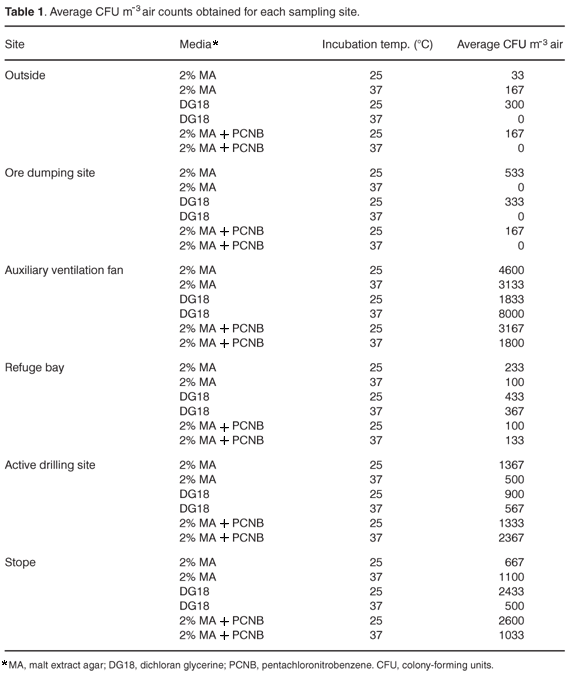
Table 1 (see supplementary material online at www.sajs.co.za) lists the average CFU/m3 3 3 12 –1). During an extensive literature search, no health-related limits to permissible amounts of fungal spores in the air could be found, although several governments are formulating guidelines for building owners and occupational-health officers. Our counts do not appear to be excessively high compared with other reports of viable and non-viable spores/m312,13 However, Bush and Portnoy3 3 3 12
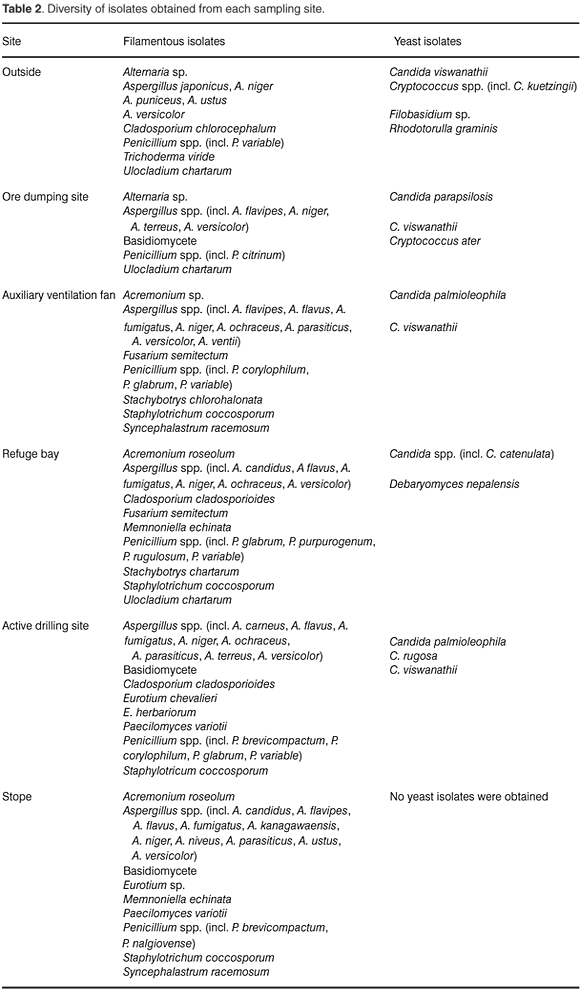
The diversity of filamentous fungi and yeasts obtained from these samples is shown in Table 2 (see supplementary material online). The majority of the isolated filamentous fungi are known to occur either with cellulose-containing material, such as wood, or other living or dead plant material or as soil fungi. These substrates are abundant in and around the mine and may serve as sources of fungi. The isolated yeasts were found to be mainly those associated with soil and humans, elements of the mining environment.
Although no specific trend is evident regarding the total number of genera (filamentous fungi and yeasts) from the different sites, it is interesting to note that the number of recorded filamentous fungal genera, increased from outside the mine (6 genera) and at the beginning of the level of the ore dumping site (5 genera) to deeper in the mine (7 genera at the ventilation fan and active drilling site; 9 genera at the stope). In the light of this observation, the higher diversity in the refuge bay (9 genera) is against expectation, as it has a direct air supply from the surface. This may indicate the presence of growing fungi in biofilms that line the ventilation ducts of the refuge bay. The findings regarding the number of yeast genera show a contrasting trend. There are more yeast genera obtained from the samples taken outside, and no yeast isolates obtained from the samples taken in the stope.
Although very few human pathogens were identified in this study, we identified several opportunistic pathogens. This could constitute a health hazard, especially for those mine workers who are HIV positive or who have conditions such as tuberculosis.
Conclusions
We conclude that certain mining sites, especially those with high wind speed and human activity, contain health-risk related numbers and diversity of culturable fungal spores in the air. Although most of the fungal isolates identified were not human pathogens, inhalation of these fungal spores could have a negative effect on the health and productivity of mine workers—especially those with HIV or other pre-existing conditions, such as tuberculosis.
This is the first study of this nature in the mining environment, and several interesting questions still await investigation. Some of these include the seasonal variation in fungal spore diversity and numbers, together with a study to determine the correlation between the occurrence of fungi and reports of fungal related disease.
This study was funded by the Safety in Mines Research Advisory Committee (Grant no. SIM 03-06-02). We thank O. Moloko, S. Fuku and K. Pudumo for their assistance.
References
- 1. Warnock D.W. and Richardson M.D. (1982). Preface. In Fungal Infection in the Compromised Patient, eds D.W. Warnock and M.D. Richardson, pp. xi. John Wiley, Chichester.
- 2. Verhoeff A.P. and Burge A.H. (1997). Health risk assessment fungi in home environments. Ann. Allergy Asthma Immunol. 78, 544–556.
- 3. Bush K.R. and Portnoy M.J. (2001). The role and abatement of fungal allergens in allergic diseases. J. Allergy Clin. Immunol. 107, 430–440.
- 4. Davis J.P. (2001). Moulds, toxic moulds, and indoor air quality. California Res. Bureau. 8(1), 1–18.
- 5. McNeel S. and Kreutzer R. (1996). Fungi and indoor air quality. Health Environ. Digest 10(2), 9–12.
- 6. Hoekstra E.S., Samson R.A. and Summerbell R.C. (2004). Methods for the identification and isolation of fungi in the indoor environments. In Introduction to Food-and Airborne Fungi, 7th edn. Centraalbureau voor Schimmelcultures, Utrecht.
- 7. Klich M.A. (2002). Identification of Common Aspergillus Species. Centraalbureau voor Schimmelcultures, Utrecht.
- 8. Samson R.A., Hoekstra E.S. and Frisvad J.C. (2004). Introduction to Food-and Airborne Fungi, 7th edn. Centraalbureau voor Schimmelcultures, Utrecht.
- 9. Abarca M.L., Accensi F., Cano J. and Cabañes F.J. (2004). Taxonomy and significance of black aspergilli. Ant. Leeuwenhoek 86, 33–49.
- 10. Nelson P.E., Toussoun T.A. and Marasas W.F.O. (1983). Fusarium species: an illustrated manual for identification, p. 193. Pennsylvania State University Press, University Park.
- 11. Kurtzman C.P. and Robnett C.J. (1998). Identification and phylogeny of ascomycetous yeasts from analysis of nuclear large subunit (26S) ribosomal DNA partial sequences. Ant. Leeuwenhoek 73, 331–371.
- 12. Sakiyan N. and Inceoglu O. (2003). Atmospheric concentrations of Cladosporium Link and Alternaria Nees spores in Ankara and the effects of meteorological factors. Turk. J. Bot. 27, 77–81.
- 13. Krysinska-Traczyk E. and Dutkiewicz J. (2000). Aspergillus candidus: a respiratory hazard associated with grain dust. Ann. Agric. Environ. Med. 7(2), 101–109.
* Author for correspondence. E-mail:
Supplementary material to:
Pohl C.H., Kriel W., Venter P., Van Heerden E. and Albertyn J. (2007). The diversity of culturable airborne fungi in an active South African gold mine. S. Afr. J. Sci. 103, 277–278.