
 Will the real custodian of natural resource management please stand up
Charlie Shackleton
Department of Environmental Science, Rhodes University, Grahamstown 6140, South Africa. E-mail:
Use of natural resources in South Africa
South Africa is the custodian of an immense wealth of biodiversity resources, and is estimated to be the third most biodiverse country in the world.123,4 Consumption of and trade in these resources is the very mainstay of their well-being, and crucial in preventing deeper poverty levels.5,6 For example, despite massive improvements in the provision of electricity, most rural and a significant proportion of urban South Africans continue to use fuelwood as a key energy source for cooking (e.g. 65% of electrified households in the urban areas of Makana municipality,78
Custodianship of natural resources
Currently the responsibility for maintaining these biodiversity resources, both for their intrinsic value, as well as to ensure they continue to supply the household and trade needs of poor households, is fragmented and weakly implemented. The national and provincial departments of the environment have a mandate to conserve biodiversity, as do the national and provincial parks agencies. However, these bodies focus on protection of biodiversity through a variety of land zonation and permit systems, as opposed to balancing that with encouragement and support for sustainable use. They focus on protection of designated conservation areas and high-value or charismatic species. At times this protectionism is implemented in a fashion that has a limited scientific basis resulting in negative impacts on local livelihoods.910,11 It is noteworthy that the area under communal tenure where there is widespread direct reliance on biodiversity resources is over double that in formal conservation areas.
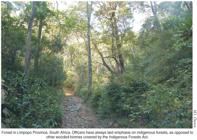
The forestry arm of the Department of Water Affairs and Forestry has a mandate for indigenous forests, which, according to the definition in the Act, includes most portions of all the wooded biomes.1213Sclerocarya birrea subsp. caffra) fruits was 2 000 tons. Nothing was said about the thousands of tons and billions of rand trade in other resources from the forests (in the sense of the Act), such as medicinal plants, weaving and basketry fibres, forest ferns, woodroses, mopane worms, bushmeat, etc.41415et al.16
In some areas, local residents look to the traditional authorities for guidance and permission for harvesting certain resources. However, in most areas this has broken down, effectively leaving an institutional control vacuum.17,18 Nevertheless, in those areas where some semblance of regulation remains, the traditional authority lacks capacity to monitor or control supply and demand, and offers no advice on sustainable harvesting methods and land management approaches. They simply collect permit fees, or issue fines when they catch transgressors. This policing is at times appreciated by local communities as a means of potentially deterring external or commercial harvesters—but where such external agencies are determined, the local authorities are relatively powerless to prevent them.19,20 The funds collected by these two means are not invested in sustainable management strategies or education or awareness programmes around natural resource management within the communities where they are levied. There is no active support to promote poverty alleviation or local livelihoods through active, but sustainable, use of natural resources.
The Department of Agriculture has a resource conservation division, logically focused on what are deemed as key agricultural resources, namely, grazing and soil. It also boasts a land-care programme, which here and there includes a tree-planting project. These activities operate mainly within the private farming sector to ensure grazing and burning practices are not excessive, and that measures to limit soil erosion are practised. Transformation of natural vegetation to cultivated lands requires a permit. In the communal areas the department has a reasonable, but still insufficient, network of extension officers and livestock health officers that support both arable and livestock activities. This is extremely useful, although the disproportional emphasis on livestock (and hence power of livestock owners) at times is a source of conflict for land-use management decisions that undermine the supply of natural resources that are vital in the livelihoods of the wider community at large, such as thatch grass, reeds for weaving, some medicinal plants, or even biomass fuel supplies.21–23 Yet the direct-use value of natural resource extraction by rural communities is the equivalent to the benefits they obtain from both arable and livestock production (all value streams included) combined,24
Local government also has an environmental mandate. However, they lack resources and skills to proactively manage commons.2579
Finding or making a champion
In conclusion, it is clear that currently there is no government department in South Africa that has a clear, comprehensive and financed focus on promoting sustainable natural resource use. Additionally, there is no government programme promoting sustainable live-lihoods that takes cognisance of the existing immense contribution of ecosystem services and natural resources to livelihoods, and consequently the State. There are far too few formal government initiatives for poverty alleviation based on natural resource use (such as Working for Water), or building on existing initiatives and trade networks of local communities. How long can this continue? Perhaps the time is ripe for the establishment of a directorate of natural resource management in at least one of the national departments that nominally deal with natural resource issues (a cross-cutting rural livelihoods ministry would probably be better). The mandate and focus of such a directorate would not be punitive and policing, but to actively engage with rural communities in a participatory fashion through appropriately trained extension officers to foster harvesting of natural resources in a sustainable manner, and, where the resource is to be traded, add value at a level fitting the target market, i.e. local, regional or national. In local areas where use of specific resources has reached unsustainable levels, which is jeopardising local livelihoods, increasing poverty, and impairing ecosystem structure and function, they would promote activities to address this. There is a large suite of options in such situations, such as promoting sustainable harvest approaches for remaining stocks, a community 'permit' system for outside harvesters, species or resource substitution, landscape or species restoration, enrichment planting, home cultivation or rearing, sourcing sustainably harvested stocks elsewhere, negotiating access to State or private lands for 'accredited' harvesters and community-based monitoring. But with increasing levels of unsustainable use the time has come for the real custodian of natural resource management to stand up.
I am grateful for useful comments on earlier drafts from Jenny Botha and Wayne Twine, colleagues with deep experience and insights in natural resource management challenges in rural South Africa.
References
- 1. Wynberg R. (2002). A decade of biodiversity conservation and use in South Africa: tracking progress from the Rio Earth Summit to the Johannesburg World Summit on Sustainable Development. S. Afr. J. Sci. 98, 233–243.
- 2. Scholes R. and Biggs R. (eds) (2004). In Ecosystem Services in Southern Africa: A Regional Assessment. CSIR, Pretoria.
- 3. Twine W., Moshe D., Netshiluvhi T.R. and Siphugu V. (2003). Consumption and direct-use values of savanna bio-resources used by rural households in Mametja, a semi-arid area of Limpopo province, South Africa. S. Afr. J. Sci. 99, 467–473.
- 4. Lawes M., Eeley H., Shackleton C.M. and Geach B. (eds) (2004). In Indigenous Forests and Woodlands in South Africa: Policy, People and Practice. University of KwaZulu-Natal Press, Pietermaritzburg.
- 5. Shackleton C.M., Shackleton S.E., Buiten E. and Bird N. (2007). The importance of dry forests and woodlands in rural livelihoods and poverty alleviation in South Africa. For. Pol. Econ. 9, 558–577.
- 6. Shackleton S.E., Campbell B., Lotz-Sisitka H. and Shackleton C.M. (2008). Links between the local trade in natural products, livelihoods and poverty alleviation in a semi-arid region of South Africa. World Dev. 36, 505–526.
- 7. Shackleton C.M., Gambiza J. and Jones R. (2007). Household energy use in small-electrified towns in the Makana District, Eastern Cape, South Africa. J. Energy Sthn. Afr. 18, 4–10.
- 8. Madubansi M. and Shackleton C.M. (2006). Changing energy profiles and consumption patterns following electrification in five rural villages, South Africa. Energy Pol. 34, 4081–4092.
- 9. Shackleton C.M., Chauke M.I., Downsborough L., Olsen A., Parkin F., Weideman C. and Brill G. (2009). Conservation, commercialisation and confusion: harvesting of Ischreyolepis in a coastal forest, South Africa. Environ. Devel. Sustain. 11, 229–240.
- 10. Dressler W. and Büscher B. (2008). Market triumphalism and the CBNRM 'crisis' at the South African section of the Great Limpopo Transfrontier Park. Geoforum 39, 452–465.
- 11. Holmes-Watts T. and Watts S. (2008). Legal frameworks for and the practice of participatory natural resources management in South Africa. For. Pol. Econ. 10, 435–443.
- 12. National Forests Act (1998). Government Gazette, 400 (194078), 1–82.
- 13. Willis C.B. (2004). Policy frameworks pertaining to the conservation and sustainable use of forests and woodlands in South Africa. In Indigenous Forests and Woodlands in South Africa: Policy, People and Practice, eds M. Lawes, H. Eeley, C.M. Shackleton and B. Geach, pp. 77–108. University of KwaZulu-Natal Press, Pietermaritzburg.
- 14. Wynberg R., Laird S., Shackleton S., Mander M., Shackleton C., du Plessis P., den Adel S., Leakey R.R.B., Botelle A., Lombard C., Sullivan C., Cunningham T. and O' Regan D. (2003). Marula commercialisation for sustainable and equitable livelihoods. For. Trees Livelih. 13, 203 215.
-
15. FAO (2005). Global Forest Resources Assessment 2005. Online at: www.fao.org/forestry/FRA2005/
» www.fao.org/forestry/FRA2005/ - 16. Guijt I., Hinchcliffe F. and Melnyk M. (1995). In The Hidden Harvest: the Value of Wild Resources in Agricultural Systems. IIED, London.
- 17. Von Maltitz G.P. and Shackleton S.E. (2004). Use and management of forests and woodlands in South Africa. In Indigenous Forests and Woodlands in South Africa: Policy, People and Practice, eds M. Lawes, H. Eeley, C.M. Shackleton and B. Geach, pp. 109–135. University of KwaZulu-Natal Press, Pietermaritzburg.
- 18. Mwalukomo H. (2007). The role of traditional leaders in environmental governance in the context of decentralisation: a case study of grass utilisation on QwaQwa, eastern Free State. M.Sc. thesis, University of the Witwatersrand, South Africa.
- 19. Twine W., Siphugu V. and Moshe D. (2003). Harvesting of communal resources by outsiders in rural South Africa: a case of xenophobia or a real threat to sustainability. Intn. J. Sustain. Dev. World Ecol. 10, 263–274.
- 20. White R.M. (2004). People and forest fauna: a case study from coastal dune forest in the Transkei region of the Eastern Cape. In Indigenous Forests and Woodlands in South Africa: Policy, People and Practice, eds M. Lawes, H. Eeley, C.M. Shackleton and B. Geach, pp. 553–574. University of KwaZulu-Natal Press, Pietermaritzburg.
- 21. Ntshona Z.M. (2001). The contribution of communal rangelands to rural people's livelihoods in the Maluti District. M.Phil. thesis, University of the Western Cape, South Africa.
- 22. Kepe T.V. (2002). Grassland vegetation and rural live-lihoods: a case study of resource value and social dynamics on the Wild Coast, South Africa. Ph.D. thesis, University of the Western Cape, South Africa.
- 23. Shackleton C.M. and Gambiza J. (2008). Social and ecological trade-offs in combating land degradation: the case of invasion of a woody shrub (Euryops floribundus) at Macubeni, South Africa. Land Degr. Dev. 19, 454–464.
- 24. Shackleton C.M., Shackleton, S.E. and Cousins B. (2001). The role of land-based strategies in rural livelihoods: the contribution of arable production, animal husbandry and natural resource harvesting. Dev. Sthn. Afr. 18, 581–604.
- 25. Martens C. (2009). The governance and management of commonages in three small towns in the Eastern Cape, South Africa. M.Sc thesis, Rhodes University, South Africa.