
 Human response and adaptation to drought in the arid zone: lessons from southern Africa
Abstract
Human adaptation and response to drought is primarily through evasion or endurance. A review of historical agricultural practices in southern Africa demonstrates evidence of drought evasion response strategies in well-established transhumance routes, where herders move livestock on a seasonal basis in order to exploit resources subject to different climatic regimes. European settlers to the arid regions of South Africa quickly recognised the necessity of these evasion options to survive drought, and adopted the transhumance practices of indigenous farmers. Areas of geographically diverse resource bases became hotly contested by settlers and indigenous farmers. The success of evasion systems are shown to hinge on good social and institutional support structures. When movement is not an option, drought endurance is pursued by attempting to limit the damage to the natural resource base. This is through a number of means such as forage conservation, varying livestock types and numbers, water and soil conservation and taking up alternative livelihood options. State responses to drought over the last century reflect the general South African pattern of racially divided and unjust policies relating to resource access. Historically the state provided considerable support to white commercial farmers. This support was frequently contradictory in its aims and generally was inadequate to enable farmers to cope with drought. Since the advent of democracy in 1994, the state has intervened less, with some support extended to previously disadvantaged and poor communal farmers. Climate change predictions suggest an increase in drought, suggesting that the adoption of mitigating strategies should be a matter of urgency. To do this South Africa needs to build social and institutional capacity, strive for better economic and environmental sustainability, embed drought-coping mechanisms into land restitution policy to ensure the success of this programme, and acknowledge the diversity of the agricultural sector.
transhumance; drought-proofing; drought endurance; climate change; sustainable agriculture; social and institutional capacity
Introduction
'Everybody talks about the weather, but nobody does anything about it', said Mark Twain.123,4 The influence of this variable climate on agricultural activities cannot be over-emphasised.56
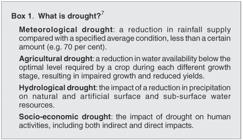
While a lack of rainfall is the underlying cause of drought, diverse socio-economic, biological and agricultural factors determine the severity of its impact.7per se, but aims rather to make the point that drought can be defined both biologically and socially. Drought can be variously defined as 'meteorological drought', 'agricultural drought', 'hydrological drought' and 'socio-economic drought', each with their own boundary conditions and thresholds (Box 1).7
Responses and mechanisms
Drought has posed a challenge to livestock farmers for centuries,82,9 Adjustment is a response that requires more time where people might, for example, diversify their food sources or livestock types.22,9,10
Additionally, there is a spatial dimension relating to the mechanisms of response to drought. These mechanisms can be through endurance or evasion, and are sometimes coupled with drought prediction.28,11 How people respond to drought is a function of a variety of factors typically relating to the severity, frequency and duration of the drought.
Evading drought – historical transhumance
Transhumance, or the seasonal migration of livestock, has long been recognised as an effective means of evading unfavourable climatic effects, such as drought, whereby moving domestic livestock across a landscape allows maximum forage use across a variety of climatic regimes and events.121314–18 Transhumance is characterised by yearly movement cycles of livestock, following seasonal shifts in resource availability, coupled with variants in pattern associated with climatic events such as years of drought. A reduction in rainfall or even smaller scale shifts in the timing of rainfall, can result in ecosystem responses such as switches from grass to shrub-cover dominance or the failure of annual plant production.1920
Evading drought – current practices
Despite considerable effort to contain pastoralists, reduce wide-ranging transhumance, and to formalise livestock production, vestiges of the movement patterns of climate-based resource exploitation and drought evasion remain today. Examples of this are found in both the communal and commercial livestock production systems in the arid regions of southern Africa. Some farmers on communal land still use herding strategies to manage environmental variability in conjunction with a variety of socio-economic goals.251326
Movement strategies in association with climate and vegetation responses are also still evident in the commercial farming sector. Farmers move their livestock according to vegetation type in association with rainfall patterns, but strategies are constrained by land ownership, so they must adjust their strategy in accordance to their particular mix of available vegetation types.16
Landscapes are highly variable, both abiotically and biotically. Thus the drought response of a given plant species may differ with soil type, and different vegetation types respond variably to the timing and amount of rainfall.1313,19 Superimposed on biological considerations are the mosaic of different land uses and the highly fragmented landscape of variable land tenure and access, all of which constrain current drought evasion strategies.
The long history of drought evasion in southern Africa, the rapid adoption of the system by European settlers, and its persistence in current agricultural landscapes clearly highlight the merit of this response strategy to variable climatic regimes and the avoidance of drought.21
Evading drought – facilitating factors
Drought evasion requires the movement of livestock and often entire families. Movement is difficult and requires considerable effort and adjustment. In order to move, farmers need networks and social linkages that extend into other ecological zones not created by drought.1313
Drought-evading strategies of this nature have the benefit of cementing social relationships or maintaining social capital with potential reciprocation and interdependence.211313
A further recorded drought-evasion mechanism among both communal and commercial farmers is through loaning arrangements.13131327,28
Occasionally people will abandon their land entirely and move to a city. Alternatively, one or two members of the family will move to a city to seek an alternative livelihood depending on the length of and number of droughts experienced.9,29
Enduring drought
Endurance largely translates into the preservation of the ecosystem dynamics to aid recovery after drought.88
The most obvious ecological aspects to be managed during drought are those systems that give rise to forage. This is particularly relevant to areas that have been overstocked and degraded. The variable response of natural vegetation to the late or early onset of rain, or reduced rainfall is demonstrated in the example where six million sheep died from poisoning in the widespread southern African drought of 1969, after grazing on the available toxic biomass.3010810
Other livestock management responses for enduring drought include improving the quality of livestock while reducing quantity, switching to hardier breeds, or changing ratios of animal types.108,10 Similarly goats are generally considered more drought-hardy than sheep and farmers adjust the composition of their herds as a means of reducing possible livestock losses.8,11 While water requirements for sheep rise considerably with a rise in temperature, goats get most of their water requirements from forage.11,31 Similarly, indigenous animals, such as springbok, eland and gemsbok, are often considered to be better adapted to local conditions and may fare better in drought than domesticated animals.8,10
The effective management and use of available water is critical to drought endurance. Water is acquired through water conservation and harvesting, river diversion, run-off farming and through the establishment of boreholes.8,10 Improving water-use efficiency is also a key factor in making limited water go further and gains are mostly achieved through improved irrigation techniques. Water availability is described as the single most important health factor for livestock in drought and is seen as the primary limiting factor of herd size.1111,31
Farmers respond to the shortage of grazing in times of drought by buying in or producing their own fodder, or renting additional pastures or grazing lands.8,10,11 Sometimes money to buy additional fodder is made available through the sale of livestock or through state subsidy schemes. Fodder may be sourced in a variety of ways, for example by harvesting biomass from road verges and by chopping down branches or trees so animals can forage off these trees.8Prosopis sp.), saltbush (Atriplex nummularia), agave (Agave americana), and spineless cactus (Opuntia sp.), have all been promoted as drought-tolerant fodder production species,8,10 although all these species have a tendency to invade drainage lines where they may compete with indigenous trees and windmills for groundwater. In some cases, species such as saltbush are promoted as ruminant stimulants enabling animals to digest other less palatable species, as might be required when available forage is limited during drought. Moving towards more water-efficient feeds such as millet or sorghum in place of lucerne or maize is a further means of surviving drought.8,27 The production of additional fodder on a farm or the purchase of supplementary fodder, as opposed to taking or moving livestock to available grazing, requires financial capital in contrast to the movement of animals.
Improving veld condition, through resting, pasture re-seeding and rehabilitation efforts aimed at preserving and enhancing ecosystem function, is a further drought-endurance strategy aimed at making the resource last, although views on the usefulness of this strategy are widely divergent.108,10 retaining large amounts of crop residue on the soil surface and increasing the length of fallow periods.32
Farm-level diversification or the diversification of economic activities that a farmer engages in, is a well-established endurance mechanism.1010,33,34 In the Little Karoo where more than 80% of farmers surveyed kept ostriches, only 17% were totally dependent upon ostrich farming for income, because they kept other types of livestock as well as engaging in tourism-related enterprises.353636
Financial endurance through drought periods is managed through reductions in resource consumption, self-sufficiency, as well as risk spreading, examples of these being reducing fuel usage, establishing woodlots, and the spreading of losses across a broader community.101010,34 Such approaches occur among the Tswana people; communal building and ploughing systems, and a system of sharing cattle and communal herding require a certain degree of community cohesion.99
Predicting and anticipating
Mark Twain suggests there has never been a shortage of speculation and discussion around the weather and most communities have indicators and signs through which drought is predicted and anticipated. In southern Africa recorded indicators include variation in the timing and sounds of winds and rains, the use of livestock appearance such as the quality of their hair, the appearance of termites and their mounds, birds and their specific colour, the absence of mole hills or the presence of poisonous plants, the flowering of certain tree species, the appearance and size of stars, and higher-than-normal temperatures.11,37 More obvious means of prediction are the measurement of lower than usual rainfall or through the use of climate forecast data.3838,39,40 Perceptions on the accuracy of climate forecasts differ between communal and commercial farmers, with commercial farmers having a far greater trust in and reliance on these.11
It is also important to note that the timing and duration of droughts cannot always effectively be predicted, and while people are surprised by drought, the variety of social responses shows a deep understanding and belief that drought is always possible. Also significant to note is that while a drought may be predicted, the intensity and duration of a drought continues to be elusive, demanding considerable flexibility in adopting coping, adjustment and adaptation strategies and mechanisms.4041
A history of response by the state in South Africa
The arrival of European settlers in South Africa, the ensuing period of colonialism, and the subsequent apartheid era, saw significant changes in both land tenure arrangements and social structures. The development of homeland policies, betterment schemes and forced removals saw indigenous people being dispossessed and removed from their land.42111
Government policy over the past 100 years has acknowledged the significance of drought in South Africa. The Senate Select Committee report titled 'Droughts, Rainfall and Soil Erosion', released in 1914, was the first formal inquiry into drought as a driver in southern Africa.224211
State support for white commercial farmers was initiated in the 1930s and intensified during drought periods.11,21 Contradictory government policy was evident from an early stage. Whilst the effects of heavy stocking were being noted by this commission, drought aid was being provided for restocking.21402141111
The post-1994 stance of the first democratic government towards drought support reflected their greater agricultural support policies. This era, from the mid-1990s to the present, saw a more hands-off approach by government towards the agricultural sector, without the same degree of tax relief and easy finance extended to farmers. This was mirrored in their approach to drought, where farmers have largely been left to fend for themselves. This said, there has been some effort to aid previously disadvantaged, poor, and communal farmers, who have received some drought relief in the form of feed and government loans.
On reflection, state interventions cannot be viewed as having been highly successful. Interventions have largely been reactive, and not enough emphasis has been placed on developing capacity to cope with drought. No collective strategies to combat drought have been developed, and increasingly people respond in their individual capacity. There is historical distrust of the government and political fear of government or institutional response to collective measures. In the past there was greater local and regional alliance where people relied on institutions such as traditional leaders for support, as well as distant relatives. Now people tend to turn to national government for support. Drought remains a stressful and often crippling event for farmers across all sectors in South Africa today.
Coping and adapting into the future
Climate change predictions for the arid zones of southern Africa include greater climate variability and potentially a greater increase in drought frequency.43
History tells us that social capital, apparent in social interactions, labour and land loaning or sharing schemes are necessary in coping with drought.3333
Drought and climatic variability is reflected in our production systems with changing production levels and income variability. This variability needs to be managed, particularly with regard to drought where the economic repercussions can be devastating. For better financial stability, farming strategies need to take cognisance of the constraints imposed by climate and manage with the aim of having systems that are both economically and environmentally sustainable.
Financial stability will dictate responses. Wealthier farmers are better buffered against the impacts of drought.333333
Policies relating to land reform, land restitution and redistribution must include drought-coping mechanisms. Putting people on land without these identified drought-proofing strategies will result in a failure to meet restitution and redistribution ends, evidenced in bankruptcy, land sales and degradation.
History shows us there are a number of ways to respond to the spatial and temporal variability inherent in drought stress. Most future scenarios suggest that the South African agricultural landscape is going to become increasingly heterogeneous and variable. For example, gradients in vegetation responses to drought, coupled with grazing, have been found to be intensifying over the long-term in northern Botswana.4413
ConclusionsDrought has been around and responded to for as long as people have utilised the resources of southern Africa's arid landscapes. This is reflected in utilisation patterns of the past. Drought highlights social and biophysical connectivity, and coping with and adapting to drought requires acknowledgement and engagement with both these elements. A more recent analysis of drought response by the state reflects South Africa's history of racially-developed, unjust approaches. This era saw considerable reactive support to white farmers during times of drought. While this allowed the continuation of commercial agriculture, it did not encourage pro-active and adaptive developments in terms of enabling farmers to cope with drought. Future adaptation measures need to acknowledge the importance of social and institutional capacity and be sensitively integrated with current development pathways in order to be sustainable and relevant to local priorities.
References
- 1. Andrews R. (1993). The Columbia Dictionary of Quotations. Columbia University Press, New York.
- 2. Sewell W.R.D., Kates R.W. and Phillips L.E. (1968). Human response to weather and climate: geographical contributions. Geogr. Rev. 58(2), 262–280.
- 3. Fauchereau N., Trzaska S., Rouault M. and Richard Y. (2003). Rainfall variability and changes in Southern Africa during the 20th century in the global warming context. Nat. Hazards 29, 139–154.
- 4. Vogel C. (1993). Dimensions of drought: South African case studies. GeoJournal 30(1), 93–98.
- 5. Vogel C. (1994). South Africa. In Drought Follows the Plow, ed. M.H. Glantz, pp. 151–170. Cambridge University Press, Cambridge.
- 6. du Toit P.F., Aucamp A.J. and Bruwer J.J. (1991). The national grazing strategy of the Republic of South Africa. Objectives, achievements and future challenges. J. Grassl. Soc. S. Afr. 8, 126–130.
- 7. Wilhite D.A. and Glantz M.H. (1985). Understanding the drought phenomenon: the role of definitions. Water Int. 10(3), 111–120.
- 8. Le Houerou H.N. (1996). Climate change, drought and desertification. J. Arid Environ. 34(2), 133–185.
- 9. Vogel C. (1995). People and drought in South Africa: reaction and mitigation. In People and Environment in Africa, ed. T. Binns, pp. 249–256. John Wiley & Sons, Chichester.
- 10. Myburgh D.W. (1994). The response of farmers to the drought hazard in the Karoo environment. GeoJournal 33(4), 401–410.
- 11. Hudson J.W. (2002). Responses to Climate Variability of the Livestock Sector in the North-West Province, South Africa. Colorado State University, Fort Collins.
- 12. Danckwerts J.E. and Tainton N.M. (1996). Range management: optimising forage production and quality. Bull. Grassl. Soc. S. Afr. 7 (1), 36–43.
- 13. Scoones I. (1992). Coping with drought – responses of herders and livestock in contrasting savanna environments in southern Zimbabwe. Hum. Ecol. 20(3), 293–314.
- 14. Smith A.B. (1983). Prehistoric pastoralism in the south-western Cape, South Africa. World Archaeol. 15(1), 79–89.
- 15. Hoffman M.T., Cousins B., Meyer T., Petersen A. and Hendricks H. (1999). History and contemporary land use and the desertification of the Karoo. In The Karoo: Ecological patterns and processes, eds W.R.J. Dean and S.J Milton, pp. 257–273. Cambridge University Press, Cambridge.
- 16. O'Farrell P.J., Donaldson J.S. and Hoffman M.T. (2007). The influence of ecosystem goods and services on livestock management practices on the Bokkeveld plateau, South Africa. Agric. Ecosyst. Environ. 122(3), 312–324.
- 17. Talbot W.J. (1961). Land utilization in the arid regions of southern Africa. Part I. South Africa. In A History of Land Use in Arid Regions. Arid Zones Research, ed. L.D. Stamp, pp. 299–338. UNESCO, Paris.
- 18. van der Merwe P.J. (1945). Trek; Studies oor die mobiliteit van die pioniersbevolking aan die Kaap. Nasionale Pers Beperk, Kaapstad.
- 19. Ellis J. and Galvin K.A. (1994). Climate patterns and land-use practices in the dry zones of Africa. Bioscience 44(5), 340–349.
- 20. Penn N.G. (1986). Pastoralists and Pastoralism in the Northern Cape Frontier Zone during the Eighteenth Century. University of Cape Town, Centre for African Studies, Cape Town.
- 21. Beinart W. (2003). The Rise of Conservation in South Africa: settlers, livestock and the environment 1770–1950. Oxford University Press, Cape Town.
- 22. Union of South Africa, Senate (1914). Report from the select committee on droughts, rainfall and soil erosion, S.C.2. Union Parliament, Cape Town.
- 23. Archer S. (2000). Technology and ecology in the Karoo: a century of windmills, wire and changing farming practice. J. South. Afr. Stud. 26(4), 675–696.
- 24. Rohde R.F. and Hoffman M.T. (2008). One hundred years of separation: the historical ecology of a South African 'coloured reserve'. Africa 78(2), 189–222.
- 25. Baker L.E. and Hoffman M.T. (2006). Managing variability: herding strategies in communal rangelands of semi-arid Namaqualand, South Africa. Hum. Ecol. 34(6), 765–784.
- 26. Samuels M.I., Allsopp N. and Knight R.S. (2007). Patterns of resource use by livestock during and after drought on the commons of Namaqualand, South Africa. J. Arid Environ. 70, 728–739.
- 27. Ballard C. (1986). Drought and economic distress – South-Africa in the 1800s. J. Interdiscip. Hist. 17(2), 359–378.
- 28. Dovie D.B.K. (2006). Local vulnerability of the human-biodiversity interface to drought in South Africa. In Global Environmental Change and Food Systems (GECAFS). First meeting of Vulnerability of Food Systems to GEC Research Network. Oxford, U.K.
- 29. Cousins B., Hoffman M.T., Allsopp N. and Rohde R.F. (2007). A synthesis of social and biological perspectives on sustainable land use in Namaqualand. J. Arid Environ. 70, 834–846.
- 30. Kellerman T.S., Coetzer J.A.W. and Naudé T.W. (1988). Plant Poisonings and Mycotoxicoses of Livestock in Southern Africa. Oxford University Press, Cape Town.
- 31. Maynard L.A., Loosli J., Hintz H., Warner R. and Zappa C.R. (1979). Animal Nutrition. McGraw-Hill, New York.
- 32. Bennie A.T.P. and Hensley M. (2001). Maximizing precipitation utilization in dryland agriculture in South Africa – a review. J. Hydrol. 241(1–2), 124–139.
- 33. Ziervogel G., Bharwani S. and Downing T.E. (2006). Adapting to climate variability: pumpkins, people and policy. Nat. Resour. Forum 30(4), 294–305.
- 34. Speranza C.I., Kiteme B. and Wiesmann U. (2008). Droughts and famines: the underlying factors and the causal links among agro-pastoral households in semi-arid Makueni district, Kenya. Glob. Environ. Change 18(1), 220–233.
- 35. Cupido C.F. (2005). Assessment of veld utilisation practices and veld condition in the Little Karoo. M.Sc. thesis, University of Stellenbosch, Stellenbosch.
- 36. O'Farrell P.J., Le Maitre D., Gelderblom C., Bonora D., Hoffman T. and Reyers B. (2008). Applying a resilience framework in the pursuit of sustainable land-use development in the Little Karoo, South Africa. In Advancing Sustainability Science in South Africa, eds M. Burns and A. Weaver, pp. 383–432. SUN Press, Stellenbosch.
- 37. Slegers M.F.W. (2008). "If only it would rain": farmers' perceptions of rainfall and drought in semi-arid central Tanzania. J. Arid Environ. 72, 2106–2123.
- 38. Thornton P.K., Fawcett R.H., Galvin K.A., Boone, R.B., Hudson J.W. and Vogel C.H. (2004). Evaluating management options that use climate forecasts: modelling livestock production systems in the semi-arid zone of South Africa. Clim. Res. 26(1), 33–42.
- 39. Booysen J. and Rowswell D.I. (1983). The drought problem in the Karoo areas. Proc. Grassl. Soc. S. Afr. 18, 40–45.
- 40. du Pisani L.G., Fouche H.J. and Venter J.C. (1998). Assessing rangeland drought in South Africa. Agric. Syst. 57(3), 367–380.
- 41. Venter J.C. (2004). An overview of Karoo vegetation modelling. S. Afr. J. Plant & Soil 21(2), 126–132.
- 42. UG 49-23 (1923). Final report of the drought investigation committee, 1923. Government Printer, Cape Town.
- 43. Solomon S., Qin D., Manning M., Chen Z., Marquis M., Averyt K.B., Tignor M. and Miller H.L. (2007). Climate Change 2007: The Physical Science Basis. Contribution of working group I to the fourth assessment report of the intergovernmental panel on climate change. Cambridge University Press, Cambridge.
- 44. Dube O.P. and Pickup G. (2001). Effects of rainfall variability and communal and semi-commercial grazing on land cover in southern African rangelands. Clim. Res. 17(2), 195–208.