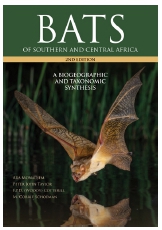
Latest compendium on bats of southern and central Africa
Kate L. MacEwan
Inkululeko Wildlife Services (Pty) Ltd, Durban, South Africa. Email:
Book Title: Bats of southern and central Africa: A biogeographic and taxonomic synthesis
Authors: Ara Monadjem, Peter J. Taylor, Fenton PD. (Woody) Cotterill and M. Corrie Schoeman
Publisher: Wits University Press, Johannesburg; ZAR600 (714 pp)
Published: 2020
Public interest in bats has increased over the past few decades for a myriad of reasons. Bat-focused research and publications are escalating as bats face increasing threat from wind energy, habitat loss, white nose syndrome (a fungal disease that attacks the bare skin of hibernating bats and has killed millions of bats in North America in the recent past), persecution due to superstitions and misinformation on the spread of disease, and other factors. With a growing awareness of the important ecosystem services that bats provide, there is a rise in bat conservation efforts mediated by citizen science, and more public bat interest groups are being formed. For academics, conservationists, citizen scientists and others, an accurate and comprehensive reference book is essential for identifying bats, keeping abreast of the latest bat taxonomic changes, understanding bat biology and biogeography, and for informing expanding bat conservation efforts.
For the southern African region, the first bat-specific reference and field guidebook was brought out by Taylor112
As a guest speaker during the last annual general meeting of the Gauteng and Northern Regions Bat Interest Group, lead author Ara Monadjem briefly summarised the updates of the second edition. Ara stated that the main aims of the book are to provide a way for people to identify differences between bat species through the use of identification matrices, and to obtain updated taxonomic information and distribution maps for the bats of southern and central Africa. The revised edition is larger in size (700 pages) and the hardcopy has a much stronger and field-friendly binding. Specific updates pertain, but are not limited to, the number of new species and distribution records presented, updated taxonomies, and additional and improved photographs and sonograms. It is important to note that information in the revised edition is current up until 2019 when the book was submitted to the publishers. The introductory chapters have been revised, with a very important update being changes in the conservation status of the now 125 described bat species for southern and central Africa (nine new species were added to the new book). Whilst bats are experiencing threats and some populations are declining, the significant changes in the conservation statuses reflect an altered vetting process by the International Union for Conservation of Nature, rather than definite changes in the conservation status of these species. The authors have done away with the modelled distribution areas that caused confusion for some users. A species' distribution is now displayed through the plotted locality points of all known museum specimens (as well as photographic distribution records for the more easily identifiable species, such as Taphozous mauritianus and Eidolon helvum). Many more sonograms are presented in the latest edition, and photographs of almost all bats and skulls are displayed. Besides photographs for the newly listed species, the quality of photographs has improved in some cases, especially within the family Vespertilionidae. Several species have received updated names, and more than 100 new references are included, with the reference list now exceeding over 700 sources of original work.
The book represents the most comprehensive account to date of the bats of southern and central Africa and is a valuable addition to the library of anyone with an interest in bats. I and my colleagues have used the first edition2