Food production needs fuel too: perspectives on the impact of biofuels in southern Africa
Introduction
The developing world faces huge challenges in achieving basic food security and economic development in the face of soaring crude oil prices. The recent food riots in more than 30 countries,1 23
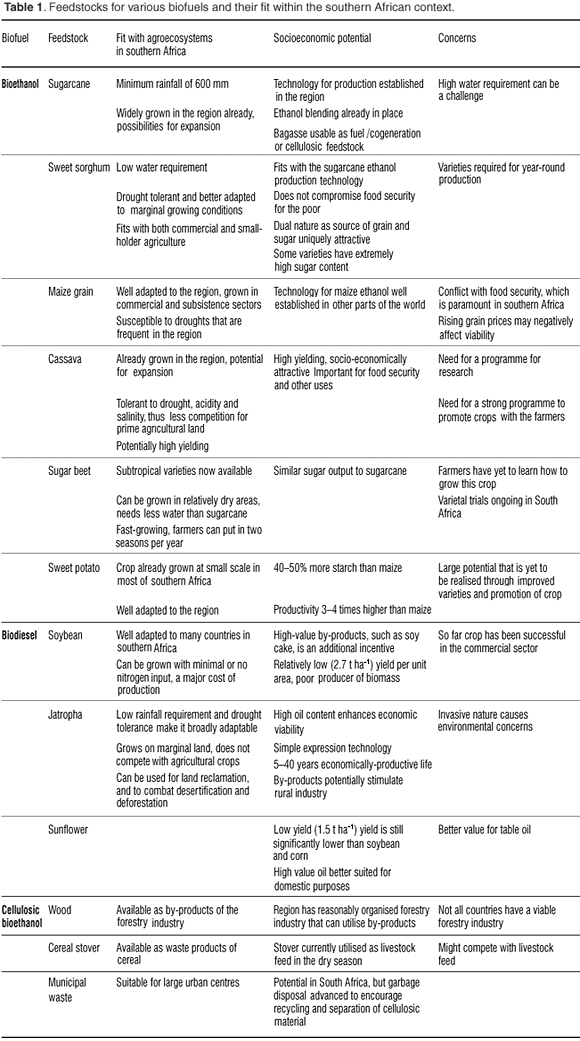
Biofuels are gaseous, liquid or solid fuels rendered from raw biological materials (plants, sewage, dry matter, cane sugar or wood pulp). Those developed by 'conventional technology' are commonly known as first generation biofuels and include vegetable oil, bioethanol, biodiesel and butanol, among others (Table 1). Biofuels that are made from cellulosic biomass feedstocks, using advanced technical processes, are called second generation biofuels and include biohydrogen and bio-dimethyl-ether (bio-DME). Although some of the fuels are as old as human civilisation, the past decade has seen unprecedented investment in new technologies aimed at driving old and new fuels into the mainstream economy. In this review the term biofuel refers to the liquid biofuel unless otherwise specified; wood and charcoal would be referred to explicitly. Global interest in biofuels continues to soar as a result of the recent crises and increasing awareness of the many challenges of relying on petroleum, particularly for transport fuels, but also as a source of polymers. While major milestones have been made in transport fuel production from fermentation technologies that utilise sugarcane and corn in Brazil and the U.S.A., respectively, in other parts of the world commercialisation of bio-based materials is developing at a very slow pace. We discuss progress in the development of biofuels, as well as the associated environmental and socioeconomic issues from a southern African regional perspective. Southern Africa, and South Africa in particular, is suffering from the worst energy crisis in its history owing to the escalating global oil prices, poor planning on infrastructure development and production constraints. A clearer picture of the niche of biofuels can thus only be extrapolated from the overall energy demand and supply dynamics of the subcontinent. Some obvious differences in this regard prohibit a 'one-blanket-fits-all' inference as far as energy is concerned, and such differences will be highlighted.
Energy context in southern Africa
The population of the African continent is expected to reach 1.3 billion by 2020 and 17% of these people will reside in southern Africa.44
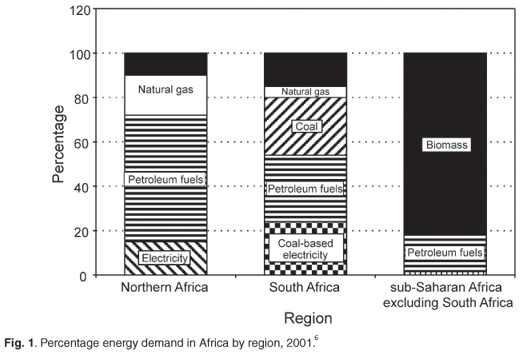
Africa's total energy supply is growing at an extremely slow pace; its global share of total primary energy supply has only increased from 3.5% to 5.2% between 1973 and 2003, despite an annual increase in population of about 3% for several years, indicating a reduction in energy access on a per capita basis.567Figure 1 shows the percentage energy demand across the continent. More than half a billion people in Africa rely on solid biomass (fire wood, agricultural residues, animal waste) to meet basic energy needs for cooking, heating and lighting.8,9 These fuels are generally labour intensive, inefficient, polluting and destructive to the environment through deforestation and desertification. For most countries, commercial energy sources are generally under-developed; the infrastructure, such as pipelines and power grids, to deliver commercial energy to customers', especially in rural areas, is poorly developed. This poor development negatively affects service delivery, in particular education and health services, to the bulk of the region's population. Unfortunately, the above scenario accurately describes the current status of most southern African countries, excluding South Africa (Fig. 1).
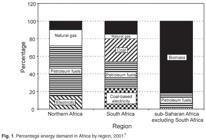
Southern Africa has a unique pattern of energy sources and usage owing to the dominant influence of South Africa, which has the lion's share of energy resources and consumes the largest fraction of energy produced in the region. As the economic powerhouse of the region, it influences patterns in fuel production, consumption, carbon emissions and most importantly energy policy. As a consequence of the current rapid economic growth, coupled with a coal-dependent industry for power generation, and to an extent synthetic liquid fuels made from coal, South Africa is among the largest emitters of greenhouse gas in Africa and one of the most carbon emission-intensive countries in the world.10
For the past five years, South Africa has had rolling electricity blackouts as a result of a peak generation capacity that cannot cope with the rapid economic development and the related increase in demand. Energy security through diversification of supply in South Africa is one of the key goals of the Government of South Africa's 2003 White Paper On Renewable Energy Policy,11,12 since a major portion of the nation's energy expenditure is via dollar-denominated imported fuels that impose a heavy burden on the economy.11
A modern and diversified energy sector for southern Africa is not only a prerequisite for economic growth but also a human rights issue as it affects health, food security and stability, as evidenced by the food riots elsewhere.
With that background this paper aims to assess the potential of and the niche for biofuels in southern Africa as well as to critically analyse the strategies that could be adopted if this promising technology is to succeed in our region. Research into second generation fuels is still in the early stages but their potential within South Africa is well articulated by Lynd et al.13
Bioethanol
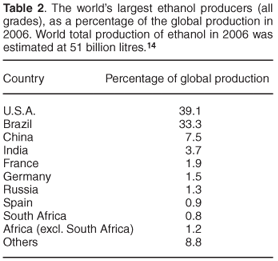
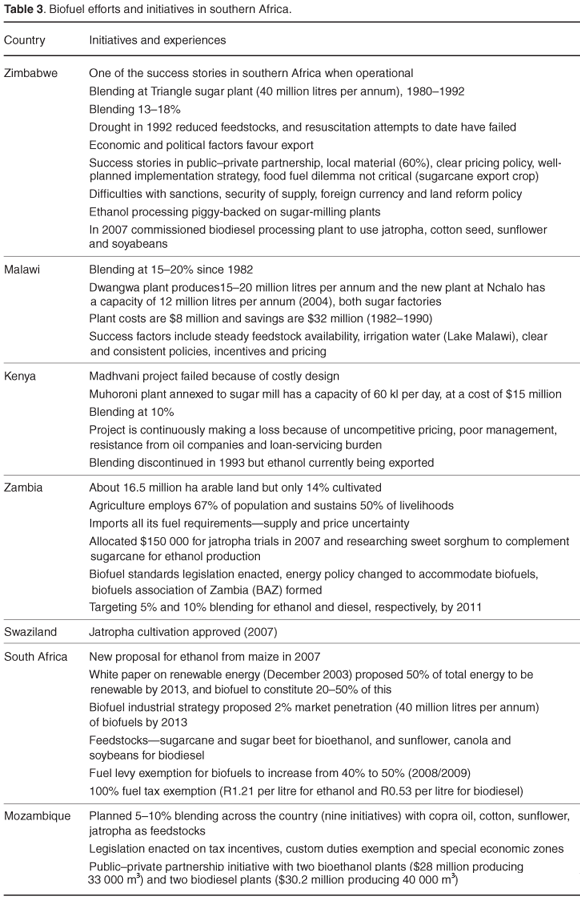
Ethanol is the most common biofuel worldwide with more than 50 billion litres (both fuel and non-fuel) produced in 2006.1414Table 2). Table 3 shows the various countries with notable bioethanol initiatives and the various drivers for bioethanol in each country. The process of making ethanol generates a series of valuable coproducts including corn oil, protein feed, gluten meal, germ, refined starches, corn sweeteners and commercial carbon dioxide. The value of the final products is roughly double that of the raw corn15
Bioethanol can be produced from three types of feedstock: a) from starch contained in different food crops, such as corn, wheat, cassava and potato; b) from stalks of sugar-accumulating crops, such as sugarcane and sweet sorghum; and c) from cellulosic materials from virtually any plant or plant parts, such as wood and crop residues (see Table 1). Cellulose and hemicellose are the main components of plant cell walls and constitute the most abundant sources of carbohydrate on earth. Even though the technology for converting starch and sugars to ethanol has been well developed over thousands of years,111614,17 The higher blends require the modification of engines and therefore many car manufacturers, particularly in countries like Brazil, are producing flexible-fuel vehicles, which can safely run either on 100% bioethanol or on any combination of bioethanol and gasoline blend. As clearly outlined by Gnansounou and colleagues,18
Biodiesel
Biodiesel is produced from vegetable oils by converting the triglyceride oils to methyl (or ethyl) esters in a transesterification process that yields glycerine as one of the byproducts.192021
Net energy balance of biofuel feedstocks
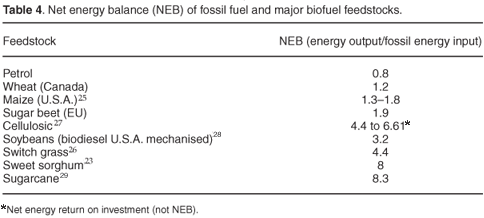
Net energy balance (NEB) analysis is the most common measure of the economic and environmental impact of biofuels vis-à-vis fossil fuels. It equates to the relationship between energy input and energy output throughout the energy crop production to biofuel production cycle.222322–24 With limited data on NEB, especially for developing countries, the NEB calculations are usually approximations from Europe or the U.S.A. and these are based on certain parameters of feedstock production and processing and other assumptions. Table 4 shows the approximated NEB for the major biofuels and shall be used as a reference for further discussions. It is interesting to note that sugarcane has the highest NEB and so does sweet sorghum (Table 4). This suggests that there is a big gain in NEB, expected from an improvement genetically or agronomically, for these tropical high energy-efficient C4 plants. Biodiesel from soybeans has more than three times the NEB of corn-based bioethanol, even under the heavily mechanised U.S.A. farming system.2525
In summary, one can predict substantial increases in the NEB of biofuels owing to: a) genetic improvements of the existing crops/feedstocks; b) improved agronomic practices, to lower inputs without compromising yield; c) improved conversion technologies; d) discovery of new feedstocks (both crop and cellulosic); and e) better business models, since the biofuel industry has its own unique challenges that call for business solutions.
Socioeconomic drivers of biofuels
In order to have a clear understanding of the impact biofuels may have in southern Africa we dissected the major drivers of the technology, globally and regionally. Broadly, geopolitical and economic drivers have played a major role in the development of biofuels. Geopolitical factors include supply security and post-Kyoto emissions reductions, and economic drivers are the prices of fossil fuels and advances in biofuels technology. The need to alleviate over-reliance on the volatile Middle East oil supply is common to many regions of the world. Climate change and the role that the burning of fossil fuels has played in this phenomenon have driven the agenda in biofuels development in the developed world. In the European Union (EU), there is an overall acceptance of the need to reduce pollution by working gradually towards environmentally-friendly fuel alternatives and biofuels are viable candidates. The EU has put in place a policy package to reduce greenhouse gas emission by 20% in 2020 and to reduce dependency on fossil fuels. In the U.S.A., major gains in carbon emissions in the range of 72% and 7% per kilometer have been realised in the U.S.A. on their E85 and E10 blend fuels, respectively.25,30
The major drivers of biofuels in the U.S.A. are the high prices of liquid fuels, the transfer of billions of dollars out of the U.S.A. economy to purchase fuel abroad, reliance on unreliable (and sometimes antagonistic) overseas suppliers, and the perceived need to reduce the usage of fossil fuels, which has led to widespread support for producing liquid fuels from renewable agriculture-based feedstock.31323132
The demand for affordable energy is a major issue in developing countries. In southern African countries, like other developing countries, a key motivation in the development of biofuels is the possibility of diversifying energy resources and displacing large oil import bills with spending on locally-produced biofuels. Most of the countries, being land-locked, have to contend with paying high fuel prices on the world market as well as the cost of transporting the fuel over long distances inland. The associated opportunities for rural development, which benefits from a dynamic bioenergy sector, are also an important factor. While the need for reduction in emissions from fossil fuels is a major global driver, pollution from industry in southern Africa is not a major problem except for South Africa, which has a highly-developed industrial sector with huge energy demands, the bulk of which are met via electricity generation from coal. A key discussion in the Bali Road Map, a U.N. conference on climate change in Bali-Indonesia in 2007, focused on the development of a new protocol to succeed Kyoto, especially on how developing countries can curb emissions. Industry, for example, has for a long time relied on road transport for regional and cross-border transport and very limited rail transport inland, resulting in high transportation costs and related emissions. Being signatories to the Kyoto protocol, it makes political sense for the SADC region to be planning future development initiatives to be powered in part by environmentally-friendly energy sources. Having said that, unemployment figures are reaching alarming levels, for example 36–42% in South Africa (2007 estimate) and 80% in Zimbabwe (2005 estimate),333434
Benefits from biofuels
The most obvious benefit of biofuels would be the possibility of a locally-produced fuel to supplement fossil fuels and the subsequent reduction in oil import bills. Biofuels can also meet the energy demands of rural communities, circumventing the problems of poorly-developed grid networks, and this in turn will result in ripple beneficial effects such as electricity supply to rural schools and health facilities, thus stimulating economic growth. Long-term energy security from renewable sources is a key benefit, since energy supply is a key driver of economic growth. Biofuels, such as vegetable oils and biodiesel, can contribute to small-scale power production in rural areas and be competitive in displacing more expensive fossil fuels. Ensuring that the economic and social benefits of biofuels reach small-scale producers, however, will require ongoing efforts to reduce costs and enhance efficiencies of small-scale generation systems.
As biofuel industries grow, significant economic opportunities can emerge for small-scale farmers and entrepreneurs as the production, transport and processing of crops often takes place in rural areas. Rural communities can also derive income from the processing of biofuels byproducts, such as soap production, fertilisers and cattle cakes. Agricultural crops for biofuels can offer new income streams for farmers. Non-edible crops can be grown and harvested for biofuel applications and several biofuels feedstocks can be planted and grown on arable and marginal lands that are not under cultivation. Small-scale biofuel production and use implies no net increase in atmospheric carbon and could contribute to a reduction of greenhouse gas emissions if it is produced and used on a larger scale, displacing fossil fuels.
Hurdles to biofuels production in southern Africa
Despite the potential of biofuels to address both fuel security and rural development, there are several hurdles that are yet to be overcome. In general, there is a low-level awareness of the opportunities and potential benefits of biofuels by stakeholders in the various sectors of the economy, from the various government departments and the private sector, and to the farmers. This is exacerbated in most of the countries by the absence of policy frameworks and instruments to facilitate realisation of these opportunities. This hurdle could potentially be overcome by governments putting in place policies to support the development of biofuels, from feedstock supply, which requires highly organised agriculture; acceptability by the motor industry, which necessitates legal and regulatory frameworks; and financing required at all levels.
Technology limitations are a key hurdle to biofuels establishment. Biofuel production and consumption (blending) technologies are new to some parts of the subregion, and introduction and establishment of new technologies is a long-term effort and as such immediate impact should not be expected. Investment in appropriate research and development support in all aspects of the technology is essential to the success of biofuels. Capital investment is also required to establish some of the technology, and this requires financial commitment from both government and the private sector. While such commitment is apparent in some countries such as South Africa, the other regional economies appear to be simply too small to make meaningful investment, emphasising the need for regional cooperation.
Availability of appropriate biofuel feedstocks in adequate amounts, and in steady supply throughout the year, is a major challenge. Agricultural support services will thus need to be enhanced to bolster the production of feedstocks (new and established). The crop mix for biofuel requires careful selection. In most of the countries in southern Africa, there are currently no fuel crops specifically for biofuels production; the crops that could be used as feedstocks are currently grown for human and animal consumption, hence the need to scale up production of existing crops and to introduce new specialised crops. Resource allocation for the production of feedstocks is a major issue. There is potential conflict between biofuels and food crops. Energy crops, if grown on a large scale, may compete with food crops for various inputs, including land use, investment requirements, infrastructure support, water, fertilisers and, importantly, agricultural land and water resources, both of which are limited in the region and have to be allocated prudently. A balance in resource (land, water, inputs) allocation between food and fuel production would thus need to be struck. Demand for biofuels could increase the pressure for deforestation by requiring more land for biofuel crops, leading to land degradation. Thus cultivation of biofuel crops may focus on land that would not otherwise be used for food crop cultivation, as well as marginal lands. This will achieve the dual target of land rehabilitation as well as the fuel-related benefits.
Good governance is the key to the establishment of any technology for the good of the people in the region. Because of volatility in some parts of the region, the agricultural potential is not fully exploited, resulting in regional food insecurity. Zimbabwe is a specific case in point— until the mid-1990s, Zimbabwe was the bread basket of the region, supplying seed and grain to most of the other countries regionally. The instability in that country has enhanced the vulnerability of the region to food insecurity, and indirectly limited the options of feedstocks that are available to the region.
Bio-ethanol from maize: a case of biofuel versus food security
While the interest in biofuels has increased in the past few years, a heated debate has ensued on the appropriate feedstock for generation of such fuels. Of particular concern is the use of grain as feedstocks, specifically maize which in the U.S.A. market is thought to have caused an increase in food prices. Maize is a major staple food in Africa; about 95% of maize produced in Africa is for human consumption, and among the 22 countries in the world where maize is the major dietary component, 16 are in Africa. This is exemplified in Zambia, where maize consumption accounts for 58% of total calories in the national diet, and in Malawi, where maize occupies 90% of cultivated land and represents 54% of Malawians' total caloric intake.35
Technology for maize-based biofuel is highly developed, particularly in the U.S.A., a major supplier of grain to the world market. The unequal distribution of food on a global scale and drought in some parts of Australia and Asia have reduced global grain supplies, exacerbating the current food insecurity, especially in developing countries. Whether the advent of the biofuel era has improved or worsened the food security situation worldwide is debatable, with two different schools of thought. On the one hand, the argument is that the U.S.A. government's policy of subsidies on maize/ethanol is the major cause of escalating food prices.3636
The other school of thought is that the skyrocketing food and oil prices and increased biofuel production were coincidental.3737
There is evidence of price distortions of maize, mainly as a result of the opening of the corn industry to market speculations, leading to about a 42% increase in corn prices from 2006 to 2007.35,36 In South Africa, maize prices increased in line with the world market and so did all the products relying on maize, including dairy and meat. Consequently, food inflation increased by about 22% in South Africa, and even more in neighbouring countries.37
The Southern African Biofuels Association (SABA) has a different view. In their paper on the impact of biofuel production on food security, SABA speculated that using maize grain for fuel may in fact stabilise the price in the long term, especially considering that the volatile prices are as a result of a limited market for local maize.34
Sweet sorghum: a dual-use crop
Sweet sorghum is currently being touted globally as the dual food and fuel crop of the future. Sweet sorghum, also called cane sorghum (Sorghum bicolor), contains 10–25% sugar in juice, derived from the stalk at grain maturity.3839–41 and its tolerance to abiotic stresses like drought.4243
The use of sweet sorghum as a source of ethanol does not compromise food security for the poor, particularly in Africa, since the farmers can continue to use the grain for food. It can be used as a feedstock in the currently-existing sugarcane processing plants for ethanol production, and these are established in southern Africa.
Furthermore, an analysis of the NEBs show some interesting inferences about sweet sorghum, especially when one considers the distance from the point of production to consumption. For sweet sorghum, the processing plants would have to be located in close proximity to the source of the feedstocks, thus promoting local and domestic industry. One could therefore be justified to suggest that in some subtropical areas, such as southern Africa, the NEB of sweet sorghum-derived bioethanol might be higher than the global approximation, especially when used, produced and consumed in the proximity of the feedstock-producing areas. We speculate that the sweet sorghum NEB, if produced in the drier parts of southern Africa, can potentially be higher than that of sugarcane, which is grown under irrigation in many parts of the region, and thus may consume more energy for its production.
The major challenge would be to produce sweet sorghum year-round for continuous processing into liquid fuel. This can be achieved through breeding of cold-tolerant varieties, irrigation and the exploitation of various agroecological regions. With modern biotechnologies such solutions may become reality.
Future outlook
Despite being in early technological development, the potential of biofuels for securing fuel supply for economic development, providing environmentally-friendly energy and alleviating poverty is clear. However, there are many technological, economic and socioeconomic hurdles to overcome. Relevant policies and investment in all aspects of the technology, from research and development to uptake by the market, are essential for the establishment of biofuels. Technologically, much still needs to be done in the establishment of biofuel production (process aspects) and consumption (blending). The fact that most first-generation biofuels are relatively more expensive than fossil fuels speaks to the potential relevance of policies and political will to facilitate increased production and economies of scale. In that respect, governments hold the key in providing incentives through favourable tax regimes that encourage investment into the development of biofuels. Mandatory blending of petroleum products (with biodiesel into petrodiesel or bioethanol into petrol) are examples of such policy strategies. With respect to the limited funding that is directed towards research in most of the countries in the region (excluding South Africa), it is imperative that the private sector be encouraged through various incentive schemes to invest in this area.
While regional countries are trying to promote biofuels to drive economic development, increase their energy security and reduce their fossil fuel carbon emissions and pollution, they are also justifiably concerned that the bioenergy revolution could marginalise the poor, raise food prices and degrade the environment. This is further aggravated by the fact that bioenergy uses resources (land, water and labour) that compete with food production. The food-versus-fuel trade-off will always be an issue with which to contend in cases where innovation and technology investments are largely absent and where trade and subsidy policies are failing. This issue can be avoided if primary/staple food crops are not used for biofuels, and also if biofuel and crop production technology advancements are taken into account. Alternative starch crops and technological advances in cellulosic conversion for biofuel production are worth developing and investing further in. The strong global price increases for root crops like cassava, suggest that without the necessary productivity improvements, aggressive growth in biofuels could have adverse effects on well-being in regions like sub-Saharan Africa, where a large proportion of cassava consumption is for food. Data available suggest that the cost of biofuels could be considerably higher than the projected price of oil, so there would need to be compelling non-price factors for its uptake at the aggressive levels assumed in the first scenario.
On the plus side, the potentially positive role of biofuels for rural development should be encouraged. New crops that are dedicated to oil or oil and food present new agro-enterprises. The establishment of biofuel plants and the processing of byproducts have the potential to stimulate the rural economy. Needless to say though, southern Africa has a rich plant diversity that could be effectively utilised for home-grown biofuel feedstocks, rather than attempt to adapt imported crops and ideas that are not suitable for our environment nor make biofuel ventures worthwhile. Schemes for cost-effective feedstock production in the rural areas should be designed. Subcontracting arrangements that provide farmers with credit and assured price and market, and access to inputs such as fertiliser, hybrid seed and training supplied by the processor, are measures that will couple biofuel production with rural poverty alleviation. The alternative may be a systems approach where small processors located across the country would provide for the local demand and feed the surplus into the national supply system. Such an approach would encompass a franchise business approach or contract farming. With proper controls and standards, a continuous supply of the feedstock and fuel would almost be guaranteed.
Other factors influencing the southern African countries to adopt biofuel strategies, and indeed the nature of such strategies, include national energy security and positive externalities to the environment. If developing economies like those in southern Africa are to participate beneficially in the growth of renewable bioenergy production, and still maintain adequate levels of food security, then a complementary set of investments would need to be made along the lines suggested. By making such investments, these countries are likely to produce benefits for consumers of both food and energy, while also contributing to the broader growth of their economies and the betterment of human well-being.
It is clear that the agenda for biofuels and the demands of food security have led to increased food prices due to the competition for the same raw materials. It therefore follows that a calculated holistic approach to biofuels is needed for southern Africa if the potential of biofuels is to be realised, the foundation of which should be discrimination of feedstocks for food and fuel; crops for use as feedstocks that are suitable to the local environment; proper government policy; and, most importantly, the balance between the competing factors. While the need to respond to climate change is well appreciated, we contend that environmental priorities should not supersede the basic food requirements of the poor. Otherwise, biofuels and the benefits they bring, will remain a pipe dream for the rest of the region.
References
- 1. Lunch C. (2008). Growing food crisis strains UN. Washington Post, 25 May, A19.
-
2. Cotis J-P. (2004). Regaining momentum despite oil turbulence. OECD Observer No. 245, November 2004, Paris. Online at: http://www.oecdobserver. org/news/fullstory.php/aid/1388/Regaining_ momentum_despite_oil_turbulence.html
» http://www.oecdobserver. org/news/fullstory.php/aid/1388/Regaining_ momentum_despite_oil_turbulence.html - 3. Hirsch R.L., Bezdek R.H. and Wendling R.M. (2005). Peaking of World Oil Production: Impacts, Mitigation and Risk Management. Department of Energy, National Energy Technology Laboratory, Pittsburgh.
-
4. UNIDO (2004). The Industrial Development Report 2004: Industrialization, Environment and the Millennium Development Goals in Sub-Saharan Africa. United Nations Industrial Development Organization, New York. Online at: http://www.unido. org/doc/43849
» http://www.unido. org/doc/43849 - 5. IEA (2005). Energy Balances of OECD Countries (2003 Edition) and Energy Balances of Non-OECD Countries (2003 Edition), Paris.
- 6. BP (2006). BP Statistical Review of World Energy. British Petroleum, London.
- 7. Davidson O. and Sokona Y. (2002). A New Sustainable Energy Path for African Development: Think Bigger Act Faster. Energy Development Centre, University of Cape Town, Cape Town, and the Environmental Development Action in the Third World, Senegal
- 8. Karekezi S. and Kithyoma W. (2006). Bioenergy and the poor. In Bioenergy and Agriculture: Promises and Challenges. International Food Policy Research Institute 2020 Focus No. 14, Washington D.C.
- 9. United Nations Department of Economic and Social Affairs (2007). Small-Scale Production and Use of Liquid Biofuels in Sub-Saharan Africa: Perspectives for Sustainable Development. Commission on Sustainable Development, Background Paper No. 2, DESA/DSD/2007/2,51, New York.
-
10. Walser M.L. (topic ed.). (2008). Greenhouse gas emissions: perspectives on the top 20 emitters and developed versus developing nations. In Encyclopedia of Earth, ed. C.J. Cleveland. Environmental Information Coalition, National Council for Science and the Environment, Washington D.C. Online at: http://www.eoearth.org/article/ Greenhouse_gas_emissions:_perspectives_ on_the_top_20_emitters_and_developed_ versus_ developing_nations
» http://www.eoearth.org/article/ Greenhouse_gas_emissions:_perspectives_ on_the_top_20_emitters_and_developed_ versus_ developing_nations -
11. Department of Minerals and Energy (2003). White Paper on the Energy Policy of the Republic of South Africa 2003. Online at: http://www.info.gov.za/ whitepapers/2002/rewp220802.pdf.
» : http://www.info.gov.za/ whitepapers/2002/rewp220802.pdf - 12. Department of Minerals and Energy (2007). Biofuel Industrial Strategy of the Republic of South Africa. Department of Minerals and Energy, Pretoria.
- 13. Lynd L.R., von Blottnitz H., Tait B., de Boer J., Pretorius I.S., Rumbold K. and van Zyl W.H. (2003). Converting plant biomass to fuels and commodity chemicals in South Africa: a third chapter. S. Afr. J. Sci. 99, 499.
-
14. Building New Horizons: Ethanol Industry Outlook 2007. Renewable Fuels Association (RFA), Washington D.C. Online at: http://www.ethanolrfa. org/objects/pdf/outlook/RFA_Outlook_2007.pdf
» http://www.ethanolrfa. org/objects/pdf/outlook/RFA_Outlook_2007.pdf -
15. Harvest Clean Energy (2008). Biofuels. Online from: http://www.harvestcleanenergy.org
» http://www.harvestcleanenergy.org - 16. Bailey B.K. (1996). Performance of ethanol as a transportation fuel. In Handbook on Bioethanol: Production and Utilization, Applied Energy Technology Series, ed. C.E. Wyman, pp. 37–60. Taylor and Francis, Washington D.C.
- 17. REN21 (2008). Renewables 2007 Global Status Report. Paris: REN21 Secretariat and Washington D.C.: Worldwatch Institute, Deutsche Gesellschaft für Technische Zusammenarbeit, GmbH, Eschborn.
- 18. Gnansounou E., Dauriat A. and Wyman C.E. (2005). Refining sweet sorghum to ethanol and sugar: economic trade-offs in the context of North China. Bioresour. Technol. 96, 985–1002.
- 19. Abdullah A.Z., Razali N., Mootabadi H. and Salamatinia B. (2007). Critical technical areas for future improvement in biodiesel technologies. Environ. Res. Lett. 2, 034001.
-
20. Radich A. (2004). Biodiesel Performance, Costs and Use. US Department of Energy, Energy Information Administration, Washington D.C. Online from: http://www.eia.doe.gov
» http://www.eia.doe.gov -
21. EPA (2002). A Comprehensive Analysis of Biodiesel Impacts on Exhaust Emissions. Environmental Protection Agency Technical Report, Washington D.C. Online at: http://www.epa.gov/otaq/ models/analysis/biodsl/p02001.pdf)
» http://www.epa.gov/otaq/ models/analysis/biodsl/p02001.pdf - 22. Pimentel D. (2003). Ethanol fuels: energy balance, economics and environmental impacts are negative. Nat. Resour. Res. 12(2), 127–134.
- 23. Shapouri H., Duffield J.A. and Wang M. (2002). The Energy Balance of Corn Ethanol: An Update. Agricultural Economic Report No. 813, U.S. Department of Agriculture, Office of the Chief Economist, Office of Energy Policy and New Uses, Washington D.C.
- 24. Farrell A.E., Plevin R.J., Turner B.T., Jones A.D., O'Hare M. and Kammen D.M. (2006). Ethanol can contribute to energy and environmental goals. Science 311, 506–508.
- 25. Hill J., Nelson E., Tillman D., Polasky S. and Tiffany D. (2006). Environmental, economic, and energetic costs and benefits of biodiesel and ethanol biofuels. Proc. Natl. Acad. Sci. U.S.A. 103(30), 11206–11210.
- 26. Schmer M.R., Vogel K.P., Mitchell R.B. and Perrin R.K. (2008). Net energy of cellulosic ethanol from switchgrass. Proc. Natl. Acad. Sci. U.S.A. 105(2), 464–469.
- 27. Hammerschlag R. (2006). Ethanol return on investment: a survey of literature 1990–present. Environ. Sci. Technol. 40, 1744–1750.
- 28. Sheehan J. and Duffield J. (1998). Life Cycle Assessment of Petroleum-Based Diesel Fuel and Biodiesel. Report June 1998, Biotechnology Center of the National Renewable Energy Laboratory under contract with the US Department of Energy, Golden, Colorado.
- 29. Bourne J.K. Jr and Clark R. (2007). Green dreams. National Geographic, October 2007, 41.
- 30. Kim S. and Dale B.E. (2006). Ethanol fuels: E10 or E85 – life cycle perspectives. Int. J. LCA 11(2), 117–121.
- 31. Slingerland S. and van Geuns L. (2005). Drivers for an International Biofuels Market. Discussion paper, Clingendael International Energy Programme (CIEP), CIEP Seminar 9 December 2005, Clingendael Institute, Netherlands.
-
32. Tyson K.S., Bozell J., Wallace R., Petersen E. and Moens L. (2004). Biomass Oil Analysis: Research Needs and Recommendations. National Renewable Energy Laboratory, Washington D.C. Online at: http://www.nrel.gov/docs/fy04osti/34796.pdf
» http://www.nrel.gov/docs/fy04osti/34796.pdf -
33. CIA World Factbook. Online at: http://www.cia. gov/library/publications/the-world-factbook/ print/sf.html
» http://www.cia. gov/library/publications/the-world-factbook/ print/sf.html -
34. SABA (2007). Bio-ethanol from grains to increase food security? Southern African Biofuels Association (SABA), Johannesburg. Online at: http://www. eepublishers.co.za/view.php?sid=10835
» http://www. eepublishers.co.za/view.php?sid=10835 - 35. McCann J.C. (2005). Maize and Grace: Africa's Encounter with a New World Crop, 1500–2000. Harvard University Press, Cambridge.
-
36. Kingsbury K. (2007). After the oil crisis, a food crisis? Time Magazine, 16 November. Online at: http://www.time.com/time/business/article/0, 8599,1684910,00.html
» http://www.time.com/time/business/article/0, 8599,1684910,00.html - 37. Heller G. (2008). Bad policy, not biofuel, drive food prices: Merkel. Reuters (Berlin), 17 April. Online at: http://www.alertnet.org/thenews/ newsdesk/ L17211135.htm
-
38. Business Wire (2008). Corn Products International Reports 42 Percent Increase in 2007 Fourth Quarter EPS and Record 2007 Full-Year Results. Online at: http://findarticles.com/p/articles/mi_m0EIN/is_ 2008_Feb_5/ai_n24247490
» http://findarticles.com/p/articles/mi_m0EIN/is_ 2008_Feb_5/ai_n24247490 - 39. Reddy B.V.S., Reddy P.S., Kumar A.A. and Ramaiah B. (2007). Variation in the quality parameters of sweet sorghum across different dates of sowing. SAT eJournal 5, 1–3.
-
40. Manuel T. (2008). How Rising Food Prices Are Affecting South Africa, And What Can Be Done About It. The Challenge For Feeding The Poor. Politicsweb, 2 May. Online at: http://www.politicsweb.co.za/ politicsweb/view/politicsweb/en/page71654?oid=89153&sn=Detail
» http://www.politicsweb.co.za/ politicsweb/view/politicsweb/en/page71654?oid=89153 & sn=Detail - 41. Harlan J.R. and de Wet J.M.J. (1972). A simplified classification of cultivated sorghum. Crop Sci. 12, 172–176.
- 42. Reddy B.V.S., Ramesh S., Reddy P.S., Ramaiah B., Salimath P.M. and Kachapur R. (2005). Sweet sorghum – a potential alternative raw material for bio-ethanol and bio-energy. International Sorghum and Millets Newsletter 46, 79–86.
- 43. Chiaramonti D., Grassi G., Tondi G., Lutter E., Helm P., Fjallstrom T., Wang M. and Dong W. (2001). Bioenergy village strategy for sustainable development. In 1st World Conference on Biomass for Energy and Industry, Proceedings Int. Conf., Sevilla, Spain, 5–9 June 2000, vol. 2, eds S. Kyritsis, A. Beenackers, P. Helm, A. Grassi and D. Chiaramonti, pp. 1422–1425. James & James (Science Publishers) Ltd, London.