The sustainable use approach could save South Africa's rhinos
Introduction
South Africa is facing a surge in rhino poaching driven by the high and rising price of rhino horn, which benefits criminals but not landholders or conservation agencies. It is estimated that illegal traders earned $5000/kg of rhino horn in 2009, rising to $10 000/kg in 2010 and $20 000/kg by the end of 2011, or $60 000 - $80 000 for each animal poached.1
Landholders benefit from rhinos through tourism, (very limited) hunting and live sales. When the opportunity costs of protecting rhinos were low, these benefits were sufficient to cover the costs of keeping them, but this cost-benefit calculation has been reversed by the escalation of poaching and the costs and risks of tackling armed poachers. Rhinos are becoming a liability and some owners are attempting to sell off animals, which might ultimately have the effect of reducing the 22 274 km22
Would trading rhino horn and expanding sustainable hunting change these cost-benefit calculations? Because rhino horn regrows, dehorning can produce almost 1 kg of horn per rhino annually, earning about $20 000 per animal - about 100 times the income from domestic stock.1
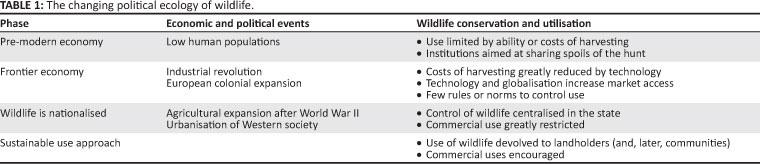
No domestic species has gone extinct because it was valuable, so why is high value a threat to wild species, rather than an enormous opportunity? This question is not new. In the 1960s, conservationists in southern Africa asked the same question: if wildlife is so valuable, why is it disappearing so rapidly? Through bold policy experiments that sought to maximise the value of wildlife to landholders, wildlife in southern Africa recovered against great odds. This recovery led to the claim that the commercialisation of wildlife represents 'one of the great agricultural transformations in Africa's recent history'3Table 1 summarises the changing political economy of wildlife in southern Africa.
In the pre-modern economy, wildlife was plentiful relative to the human population. However the European Industrial Revolution and colonisation of Africa and the America's, radically altered the balance between wildlife and people. New technologies such as guns, rifles and steel traps greatly lowered the cost of harvesting wildlife, and market demand was expanded through improved transportation (e.g. roads and railways). Global markets expanded and, in the absence of institutions which controlled wildlife use in frontier economies, species such as the American bison were devastated.
In 1900 and again in 1933, concerned at this slaughter, the colonial powers met in London and set in place new wildlife policies that radically altered the relationship between wildlife and people.4
New norms of conservation were based on three principles:
1. the establishment of state protected areas
2. the restriction or banning of the commercial use of wildlife
3. the centralisation of the control of wildlife in the colonial state.
Similar policies emerged in North America, where leaders and sportsmen like Theodore Roosevelt argued against market hunting by the masses and expanded state-protected areas. In many ways, wildlife was nationalised as a response to the perceived threat that it was being overutilised. This political process was driven by the urban elite at the expense of market hunters and landholders.
The threat to wildlife quickly changed, but policies did not. After World War II, human populations and agriculture in Africa entered an exponential phase of growth. The primary threat to wildlife became habitat modification - through both the plough and the cow. Beginning in the 1960s, conservationists in southern and East Africa began to respond to the sentiment that 'you can't farm in a zoo' with a new mantra - 'use it or lose it'. The 1961 Arusha Conference entitled 'Conservation of Wildlife in Modern African States'5
The 'sustainable use approach'
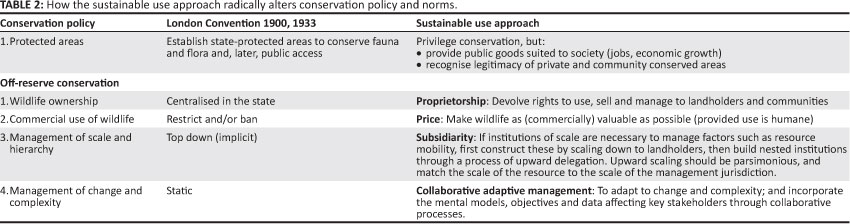
Put simply, the sustainable use approach aims to 'maximize the benefits from wildlife to the people on whose land it lives'6Table 2). For the purposes of this paper we will focus on price and proprietorship, noting only that subsidiarity describes how nested institutions need to be built parsimoniously from the bottom up following the principle of 'delegated aggregation'.7
The sustainable use approach reverses the colonial policies of centralising ownership of wildlife and removing it from the market place (Table 2). The price-proprietorship hypothesis suggests that if wildlife is valuable, and if this value accrues to landholders, then there is a high probability that landholders will manage wildlife sustainably, just as they would manage livestock.
Between the 1960s and 1980s, park authorities in southern Africa collaborated on a bold policy experiment. They devolved the rights to use wildlife to landholders (and communities), they encouraged multiple commercial uses of wildlife to drive up its value and, in some countries, they deliberately slashed bureaucratic requirements which act as a tax against wildlife. These policies were highly successful. Wildlife populations on private land in South Africa increased from half a million in the 1960s to several million now,3 8910,11,12 In Zimbabwe, many cattle ranchers overcame ecological and financial decline by switching partially or entirely to wildlife1314
Gaining confidence in wildlife as an economic option, policymakers began to transfer this approach to communal areas through community-based natural resource management. The economic power of wildlife also allowed experimentation with new management approaches in protected areas. In South Africa, Pilanesberg and Madikwe were the first state-protected areas developed primarily to drive the local economy151616
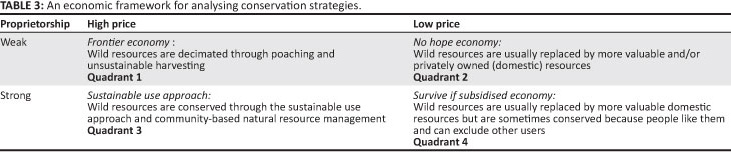
However, price and proprietorship interact (Table 3), and misunderstanding this interaction is why conservation policy is often confused economically. The sustainable use approach is most effective where proprietorship is strong and prices are high - as indicated in Quadrant 3 in Table 3. However, where wildlife is valuable, but proprietorship is weak or absent (Quadrant 1), a frontier or open-access economy exists with a high likelihood that wildlife will be rapidly exploited. As we see with rhinos, the usual approach has been to ban trade in the hope of reducing the incentives for poaching. Unfortunately, this ban moves the resource from Quadrant 1 to Quadrant 2, which is the 'no hope' strategy where landholders switch to more viable enterprises, park agencies have less income to fight poachers, and government places a lower priority on wildlife because its social and economic benefits are reduced. A more constructive strategy is to move from Quadrant 1 to Quadrant 3 by devolving rights to use rhinos to landholders (and reducing regulatory restrictions), and encouraging trade to drive up its price through innovation. Banning or restricting commercial use shifts the political economy of wildlife into the right-hand column. This approach is unlikely to work without long-term international or state funding coupled with strong rights of exclusion (Quadrant 4). A good example of Quadrant 4 is state-protected areas. Parks can be effective if well funded, but in some cases are reasonably effective even with limited funding, provided that their boundaries are well delineated and the resources they contain are not too valuable. Quadrant 4 also represents the increasing number of landholders who conserve nature, not for financial reasons, but because they understand and own it. Thus, strategies whereby state agencies educate landholders to conserve 'their' biodiversity are effective. But the high-handed imposition of regulations often backfires because this strategy removes ownership and effectively moves resources from Quadrant 4 to Quadrant 2.
Conclusion
The sustainable use approach suggests we can choose to perceive the high price of rhinos as an economic blessing rather than a threat. The approach provides us with a powerful lever for rhino conservation and indeed the conservation of ecosystems, but only if we are prepared to use it and run the political gauntlet - the current governance regime for rhinos is in direct contradiction of the sustainable use approach. Today's approach emphasises national and international public interest in preventing rhino poaching, but the associated restrictions on use (both through CITES and nationally in South Africa) shifts the R3 billion opportunity costs of these preservationist policies to rhino producers.1
The rhino crisis confronts us with a stark choice. Do we continue with a conservation strategy based on centralised conservation and trade bans that has been in place for 35 years and is failing? Or is the better risk strategy to boldly reverse a system that is not working? The argument that we need to wait for evidence that trade will work before we open markets is rather like telling your 16-year-old that they can drive a car only once they prove they can drive. Just as the only way to learn to drive is in a car, the only way to test if trade will save rhinos is to open trade. We would not be doing this blindly, but learning from 50 years of experience in the wildlife sector. The sustainable use approach suggests that rhinos (and South Africa's economy and employment figures) would benefit by replacing a failed no-trade regulatory approach with a carefully designed policy experiment to trade rhino horn through carefully configured and simple (not simplistic) institutions. Specifically, this experiment would require devolving full use rights for rhinos to landholders, and allowing them to trade freely in rhino products (including hunting), while carefully monitoring outcomes.
Effectiveness might be increased, and risks reduced, by linking the power of private ownership to collective self-regulation following the principle of subsidiarity. Thus, the devolution of use rights might be contingent on landholder conservancies of, for example, more than 15 landholders and 10 000 - 20 000 hectares, constituting themselves to manage and regulate rhinos collectively. Following well-accepted theory,17
Rhino conservancies would be automatically granted the rights to use and manage rhinos collectively, with the single national responsibility of submitting a minimal set of data that enables society to oversee progress through adaptive management. Such collective action places checks and balances on maverick landholders, encourages ecologies and economies of scale and, if rhinos are truly worth many times what domestic stock is, is highly likely to shift large areas of land into the bio-experience economy. The government, after carefully designing a system with checks and balances, would step back into a more strategic and focused role: to track the efficacy of its new policy and improve this policy adaptively on the basis of data, and to intervene strategically and locally only where there is clear evidence that a particular community is not working.
Scholars of cross-scale governance18197
There are widely used arguments that whatever the local success in southern Africa, the trade in rhino horn, or ivory for that matter, will be used as a cover for illegal trade from other countries with less successful wildlife conservation policy. There are three counter arguments to this:
- Rhino horn trade has been banned for 35 years (since 1977), yet rhinos are still highly threatened, and surely it is time to devise new approaches.
- Legalising rhino horn trade for South Africa is likely to shift the market out of the hands of organised crime into legal channels, which must be good for rhinos and other wildlife currently moving through these illicit channels. A large and steady supply of horns is also likely to lower and stabilise prices, which also plays against the black market.
- Rhinos are most seriously threatened where proprietorship of them is weak (Quadrant 2, Table 3) or where there are insufficient funds for law enforcement in protected areas (Quadrant 3).
This failure is predictable, and good policy should not be held hostage by bad. Where a non-trade approach is chosen it should be explicitly paid for, both by funding rhino protection in situ, and by paying the opportunity costs imposed on rhino producers like protected areas, communities and private landholders in southern Africa. It is not in the interests of conservation that international mandates are unfunded, or that rhino producers in southern Africa bear an annual opportunity cost approaching $400 million at current prices resulting from decisions at international forums likes CITES.
The sustainable use approach predicts that:
- Devolving the ownership of rhinos to private, community and state landholders.
- Promoting legal markets for rhino hunting and trade within an institutional framework that is built up from the bottom and managed adaptively.
This will provide powerful economic incentives for rhino conservation in South Africa.
References
-
1. Martin R. Rhino poaching. A threat to hard-won population increases achieved by conservation authorities. Submission to the Parliamentary Portfolio Committee on Water and Environmental Affairs in response to a request for written comments [homepage on the Internet]. c2012 [cited 2012 July 06]. Available from: http://www.pmg.org.za/node/30129
» http://www.pmg.org.za/node/30129 - 2. Fourie R. The rhino moratorium curse. Pretoria: Wildlife Ranching South Africa; 2011.
-
3. Carruthers J. "Wilding the farm or farming the wild"? The evolution of scientific game ranching in South Africa from the 1960s to the present. Trans Roy Soc S Afr. 2008;63(2):160-181. http://dx.doi.org/10.1080/00359190809519220
» http://dx.doi.org/10.1080/00359190809519220 - 4. Van Heijnsbergen P. International legal protection of wild fauna and flora. Amsterdam: OIS Press; 1997.
- 5. International Union for the Conservation of Nature and Natural Resources (IUCN). Conservation of nature and natural resources in modern African states. Morges, Switzerland: IUCN; 1963.
- 6. Child G. Wildlife and people: The Zimbabwean success. How the conflict between animals and people became progress for both. Harare: Wisdom Foundation; 1995.
- 7. Murphree M. Constituting the commons: Crafting sustainable commons in the new millennium. Paper presented at: the Eighth Biennial Conference of the International Association for the Study of Common Property (IASCP); 2000 May 31 - June 4; Bloomington, IN, USA.
- 8. Dry G. Wildlife ranching in perspective. Wildlife Ranching. 2011:24-27.
- 9. Cousins JA, Sadler JP, Evans J. Exploring the role of private wildlife ranching as a conservation tool in South Africa: Stakeholder perspectives. Ecol Soc. 2008;3(2).
- 10. Barnes J, Jones B. Game ranching in Namibia. In: Suich H, Child B, editors. Evolution and innovation in wildlife conservation: From parks and game ranches to transfrontier conservation areas. London: Earthscan, 2009; p. 113-126.
-
11. Van Schalkwyk DL, McMillin KW, Witthuhn RC, Hoffman LC. The contribution of wildlife to sustainable natural resource utilization in Namibia: A review. Sustainability. 2010;2:3479-3499. http://dx.doi.org/10.3390/su2113479
» http://dx.doi.org/10.3390/su2113479 - 12. Lange G-M, Barnes JI, Motinga DJ. Cattle numbers, biomass, productivity, and land degradation in the commercial farming sector of Namibia, 1915 to 1995. Pretoria: Department of Environmental Affairs; 1997.
- 13. Cumming D. Are multispecies systems a viable land use option for southern African rangelands? In: Hofmann RR, Schartz HJ, editors. Wild and domestic ruminants in extensive land use systems. Berlin: Humbolt University, 1995; p. 203-234.
- 14. Lindsay P, Du Toit R, Pole A, Romanach S. Save Valley Conservancy: A large-scale African experiment in cooperative wildlife management. In: Suich H, Child B, editors. Evolution and innovation in wildlife conservation. London: Earthscan, 2009; p. 163-186.
- 15. Johnson SR, Boonzaaier W, Collinson R, Davies R. Changing institutions to respond to challenges: North West Parks, South Africa. In: Suich H, Child B, editors. Evolution and innovation in wildlife conservation. London: Earthscan, 2009; p. 289-306.
- 16. Castley G, Knight M, Gordon J. Making conservation work: Innovative approaches to meeting biodiversity conservation and socio-economic objectives (an example from the Addo Elephant National Park, South Africa). In: Suich H, Child B, editors. Evolution and innovation in wildlife conservation: Parks and game ranches to transfrontier conservation areas. London: Earthscan, 2009; p. 307-323.
-
17. Ostrom E. Governing the commons: The evolution of institutions for collective action. Cambridge: Cambridge University Press; 1990. http://dx.doi.org/10.1017/CBO9780511807763
» http://dx.doi.org/10.1017/CBO9780511807763 - 18. Cash DW, Adger WN, Berkes F, et al. Scale and cross-scale dynamics: Governance and information in a multilevel world. Ecol Soc. 2006;11(2):8.
- 19. Meadows DH. Thinking in systems: A primer. London: Earthscan; 2008.
 Correspondence to:
Brian Child
Private Bag X1, Matieland 7602, South Africa
Email: