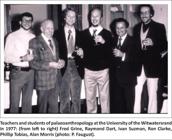
Phillip Tobias: anthropologist and mentor (1925-2012)
Alan Morris
Department of Human Biology, University of Cape Town, Cape Town, South Africa
Correspondence to
The death of Phillip Valentine Tobias on 07 June 2012 marked the end of an era in the study of physical anthropology and human origins in South Africa. Although he had been officially retired since 1990, Tobias continued his research and writing well into his 80s and I think it would be safe to say that his ideas and academic output influenced every scholar of physical anthropology - not only in South Africa but across the world.
Born in Durban in 1925, Tobias initially trained as a medical doctor, graduating in 1950, but he chose an academic rather than a clinical career. His name is inextricably linked to the University of the Witwatersrand in Johannesburg, where he completed both his undergraduate and postgraduate training and was Professor of Anatomy from 1959 until 1990.
Tobias preferred to be regarded as a human biologist rather than a palaeoanthropologist.1 23,4,5
Palaeoanthropology was the field in which Tobias earned his greatest international fame. As an anatomist of great skill and knowledge, Tobias was responsible for the description and evolutionary interpretation of a wide range of human fossils from ancient Australopithecines to relatively recent human ancestors. While attending the 4th Pan-African Congress of Prehistory and Quaternary Research at Leopoldville in 1959, Louis and Mary Leakey offered him the opportunity to describe their newly excavated 'Zinjanthropus' fossil cranium. This began a long association between the Leakeys and Tobias which resulted in the full monographic description of both Australopithecus boisei67Homo habilis bone fragments at Olduvai Gorge in Tanzania was heralded by Louis Leakey as the earliest sign of the genus Homo, but it was not until 1964 that Tobias felt that enough fossil specimens had been discovered to warrant the formal description of a new species. In that year, he, Leakey and John Napier described Homo habilis for the first time.8
There is another side to Tobias that did not primarily involve the man of science. From his earliest student days Tobias fought against the rise and influence of apartheid. As president of the National Union of South African Students in the late 1940s, Tobias, both as a student leader and afterward as a young lecturer, championed the idea of non-racialism in South African universities and argued that Wits had to retain its 'open' status even after the slamming of the door against students of colour in 1959. Despite threats and surveillance, Tobias wrote and spoke out against apartheid. During his tenure as Dean of the Faculty of Medicine, Tobias and his colleagues challenged the South African Medical and Dental Council (SAMDC) whitewash of the doctors who had failed to treat Steve Biko in the days before his death. The court case launched by Tobias forced the SAMDC to reverse its position and acknowledge that medical practitioners had collaborated with the apartheid police. The object of Tobias' action was not to punish the perpetrators, but to force the medical community to resist the machinations of the apartheid state by honouring the Hippocratic Oath.
Tobias' vision of human rights was consistent throughout his career. He, like a number of other South African archaeologists and human palaeontologists, was excluded from the World Archaeological Congress in Southampton in 1986. Although currently seen as a major plank in the opposition to apartheid, the cultural and scientific boycott which resulted in the exclusions was vigorously opposed by Tobias910
Tobias will be remembered in the books of historians as a scientist and opponent of apartheid, but there is another even more important domain in which his influence has been felt. An outstanding and inspiring lecturer, Tobias was first and foremost a teacher of medical and science students. Thousands of students have been exposed to his love and enthusiasm for the study of human origins. Generations of medical students visited the site at Sterkfontein during Tobias' classes on human evolution in the medical programme, giving them a time depth in their perspective of medicine which is not normally part of the curriculum. His influence was even greater on the science students who were trained by him as undergraduates and postgraduates - over 30 students earned doctorates under his supervision. These students are his academic children, and these offspring have given him many academic grandchildren. This contribution is perhaps his foremost importance, as each of these protégés has carried his message on to their own students. Not just his ideas on human evolution, but also his love of humanity and his sense of justice.
My own first contact with Phillip Tobias was in 1973 when I applied from my home in Canada to do postgraduate studies under him in Johannesburg. He took a gamble when he accepted me, a zoologist with very little anthropology in my background, but I am pleased to say that his venture paid off and I am still here teaching my own set of South African students to add to his metaphorical academic grandchildren. From Tobias I learned to listen to my students because they can teach me as much as I can teach them.
Tobias finished his career with over 1300 publications, honorary degrees from multiple institutions, national awards and the unending respect of colleagues, whether they agreed with his scientific arguments or not. Tobias the man is gone, but Tobias' legacy will be with us for decades to come.
References
-
1. Wood B. An interview with Phillip Tobias. Curr Anthropol. 1989;30(2):215-224. http://dx.doi.org/10.1086/203735
» http://dx.doi.org/10.1086/203735 - 2. Tobias PV. Physical stature in disadvantaged communities. S Afr J Sci. 1986;82:585-588.
- 3. Tobias PV. The meaning of race. Johannesburg: South African Institute of Race Relations; 1961.
-
4. Tobias PV. Brain size, grey matter and race - fact or fiction? Am J Phys Anthropol. 1970;32:3-26. http://dx.doi.org/10.1002/ajpa.1330320103
» http://dx.doi.org/10.1002/ajpa.1330320103 - 5. Tobias PV. IQ and the nature-nurture controversy. J Behav Sci. 1974;2:3-24.
-
6. Tobias PV. Olduvai Gorge, volume 2: The cranium and maxillary dentition of Australopithecus (Zinjanthropus) boisei. Cambridge: Cambridge University Press; 1967. http://dx.doi.org/10.1017/CBO9780511897795
» http://dx.doi.org/10.1017/CBO9780511897795 - 7. Tobias PV. Olduvai Gorge, volume 4: The skulls, endocasts and teeth of Homo habilis. Cambridge: Cambridge University Press; 1991.
-
8. Leakey LSB, Tobias PV, Napier JR. A new species of the genus Homo from Olduvai Gorge. Nature. 1964;202:7-9. http://dx.doi.org/10.1038/202007a0
» http://dx.doi.org/10.1038/202007a0 - 9. Tobias PV. Prehistory and political discrimination. S Afr J Sci. 1985;81:667-671.
- 10. Tobias PV. Saartje Baartman: Her life, her remains, and the negotiations for their repatriation from France to South Africa. S Afr J Sci. 2002;98:107-110.
 Correspondence to:
Alan Morris
Private Bag X3, Observatory 7935,
South Africa
Email: