Whose environmentalism? A critical reading of 'Reclaiming African Environmentalism'
Boaventura Monjane
Institute for Poverty, Land and Agrarian Studies, University of the Western Cape, Cape Town, South Africa. Email:
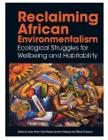
Book Title: Reclaiming African Environmentalism: Ecological Struggles for Wellbeing and Habitability
Editors: Lesley Green, Frank Matose, Anselmo Matusse and Nikiwe Solomon
ISBN: 9780796926906 (paperback, 292pp)
Publisher: HSRC Press, Cape Town; ZAR380
Published: 2025
Reclaiming African Environmentalism: Ecological Struggles for Wellbeing and Habitability is a timely and politically urgent collection that arrives at a critical juncture in global debates about environmental governance, climate justice and decolonial scholarship. Edited by Lesley Green, Frank Matose, Anselmo Matusse and Nikiwe Solomon - all affiliated with Environmental Humanities South at the University of Cape Town - the volume brings together 14 chapters spanning nine African countries, from South Africa, Zimbabwe and Mozambique to the DRC, Kenya, Ghana, Lesotho, Botswana and Tanzania. The collection emerges from a decade of graduate research and collective intellectual labour at Environmental Humanities South, and is prefaced by Nigerian environmental activist and poet Nnimmo Bassey.
The book's central argument is that mainstream environmentalism - whether expressed through carbon markets, conservation enclosures, 'green' energy projects or payment for ecosystem services schemes - has been largely imposed on African communities in ways that reproduce colonial relations of dispossession, financialisation and violence. Against this, the editors articulate what they call 'African Environmentalism': a form of ecological thought and practice rooted in lived African experience, ubuntu ethics, Indigenous knowledge systems and human- Earth relations that resist monetised governance. With characteristic intellectual humility, the editors present the collection not as an authoritative account but as a "dilemma tale, in the tradition of African philosophy" (p. 5), one that embraces incompleteness and uncertainty as epistemological virtues rather than deficits.
The volume opens dramatically: the introduction begins with the catastrophic flooding of Beira, Mozambique, following Cyclone Idai in 2019, made worse by illegal timber harvesting and the failure of REDD+ schemes to protect the forests that would have buffered the city. This framing crystallises the book's core thesis - that financialising nature amplifies, rather than mitigates, extractive relations. Nnimmo Bassey's preface sets the moral register with characteristic directness, situating the volume within the ongoing crisis of African dispossession and calling on readers not merely to read but to act.
The chapters are organised into three thematic parts: 'Property and the Commons', 'Extraction and Waste' and 'Grieving, Reclaiming and Defending Earthly Relations'. Across these sections, contributors deploy ethnographic fieldwork, oral history, literary analysis, archival research, political ecology frameworks and activist testimony. The case studies move from Maasai pastoralists in Kenya facing drought and land privatisation, to a carbon-credit conflict in the DRC implicating a US company and Ngongo Basengele communities, to farmworker displacement brought by a wind energy project in South Africa's Eastern Cape. The volume also includes a chapter analysing the novels of Yvonne Vera and Mia Couto as forms of environmental witness, and closes with a forensic account of sewage governance along Cape Town's Kuils River. One chapter is authored not by an academic but by an activist, Sinegugu Zukulu, who documents the AmaMpondo people's struggle against titanium mining on the Wild Coast - a deliberate editorial choice that enacts the volume's epistemic commitments.
The collection makes several major contributions. Its geographical breadth is extraordinary and prevents the volume from generalising from a single national context while still building a coherent continental argument. Its methodological pluralism - rather than being a compromise - is itself constitutive of the alternative epistemology the editors advocate, echoing de Sousa Santos's "ecology of knowledges".1
The most significant theoretical lacuna concerns the volume's central concept. 'African environmentalism' is invoked with considerable energy and empirical support, yet it is never subjected to sustained theoretical interrogation. What fundamentally distinguishes it from other forms of anti-extractivist environmentalism? How does it relate to or challenge Latin American frameworks such as Buen Vivir, or South Asian traditions of environmental justice? The concept accumulates meaning through its case studies rather than through direct theoretical elaboration - an approach with genuine virtues, but one that leaves readers wishing for a more explicit engagement with conceptual boundaries. A dedicated theoretical chapter, or a more expansive conclusion, would have significantly strengthened the volume's contribution to environmental theory.
A related tension concerns the volume's treatment of the state. The editors are rightly critical of postcolonial African state complicity in extractivism and dispossession. Yet the analysis could benefit from greater attention to the internal heterogeneity of state formations - to moments when state actors have supported community land claims, or to progressive constitutional traditions recognising nature's rights. The conclusion gestures toward reimagining a different kind of state, which is particularly pertinent given the increasingly erratic democratic trajectories visible across much of southern Africa2
These are criticisms offered in the constructive spirit appropriate to a work of this importance. The tensions and incompleteness the book contains are, in the editors' own words, part of what it means to present research as it is - struggling, partial and alive to the complexities of the terrain it maps. In a field that still too often reads the African environment as a problem-space rather than as a site of rich thought and robust resistance, Reclaiming African Environmentalism is a landmark contribution. It is indispensable reading for scholars and students of political ecology, African studies, environmental humanities, postcolonial theory and development studies, and essential for practitioners working on climate justice, conservation ethics or land rights. It demonstrates convincingly that a genuinely African environmental scholarship - grounded, plural, politically committed and theoretically sophisticated - is not a future aspiration but a present reality.
References
- 1. De Sousa Santos B, Meneses MPG, Nunes JA. Conhecimento e transformação social: Para uma ecologia dos saberes [Knowledge and social transformation: Towards an ecology of knowledges]. Somanlu Rev Estud Amazôn. 2007;7(1):175-189. Portuguese.
-
2. Monjane B. Bridging divides against erratic democratic trajectories: The politics of rural and urban social movements in southern Africa. Globalizations. Forthcoming 2026. https://doi.org/10.1080/14747731.2026.2669413
» https://doi.org/10.1080/14747731.2026.2669413