A reconstruction of the Cape (South African) fur seal harvest 1653-1899 and a comparison with the 20th-century harvest
Abstract
The Cape fur seal was an abundant resource in southern Africa, when first discovered by itinerant sailing vessels in the late 16th century. Seals were slaughtered indiscriminately by the sailors for skins, meat and oil for three centuries from around 1600 to 1899. Government controls over the sealing industry were first introduced as late as 1893, by which time at least 23 seal colonies had become extinct and the seal population had been significantly reduced. This paper reconstructs the historical seal harvest from the time of arrival of the first settlers in 1652 up to 1899. These data are then compared with modern harvest data from 1900 to 2000, illustrating the marked increase in the harvest from about 1950, and the concomitant recovery of the seal population to a level of around 1.5-2 million animals.
Introduction
The Benguela Current ecosystem on the west coast of southern Africa is a region of rich upwelling, which supports an abundance of marine species, some of which have been exploited by man for several centuries. The reconstruction of historical marine animal populations in the Benguela region establishes baselines against which modern catch and population data can be compared and interpreted. To this end, the painstaking labours of Richards and du Pasquier, and of Best and Ross, have yielded an estimate of the pristine 18th-century right whale stock and a historical catch record for this species, from the extant catch records of British, French and American whalers.1,2
Another species of significant commercial importance, which lends itself to this kind of historical analysis, is the Cape fur seal (Arctocephalus pusillus pusillus), which was the target of perhaps the oldest of all fisheries in the Benguela ecosystem. Its pristine population size is unknown and attempted assessments must rely on a few isolated catch data prior to 1900.3–5 The observation that seal numbers were very low in the late 19th century, as witnessed by the fact that at least 23 island colonies had become extinct by then, coupled with the evident need to regulate and control the sealing industry, induced the government of the Cape Colony to give seals their first legal protection in 1893.54–7 This paper tests the premise that the reason for the low seal numbers during the 1890s was severe depletion by indiscriminate sealing in the three centuries from about 1600 to 1900.
Under government management, seal numbers had recovered to a level of about 1.5 to 2 million animals by 1995.8
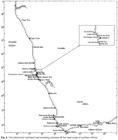
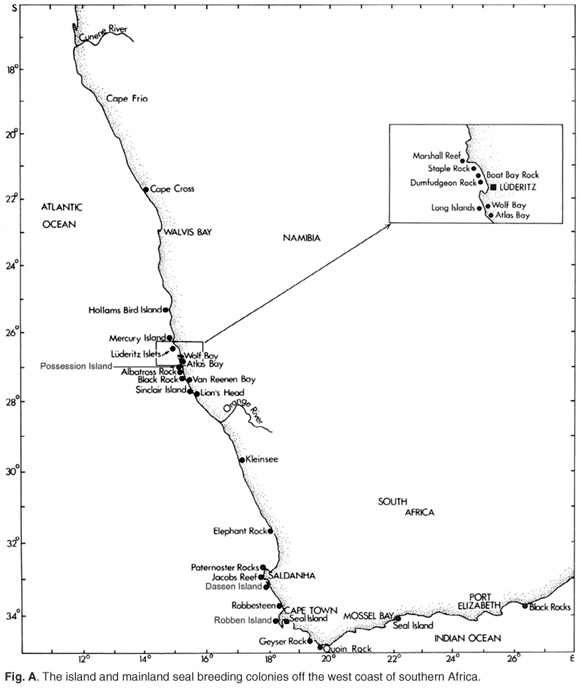
Since the early time of exploitation, when all colonies were on islands, seven mainland colonies have become established (six in Namibia and one in South Africa), all of which are not space limited and which have become home to around 75% of the population.7Fig. A in supplementary material online at www.sajs.co.za). One of the largest of the mainland colonies is Cape Cross, which has been in existence for longer than the others,930305–7 The formation of Wolf Bay and Atlas Bay colonies in Namibia probably resulted from overflow from nearby Long Islands, and the absence of human disturbance allowed them to flourish.
History of exploitation
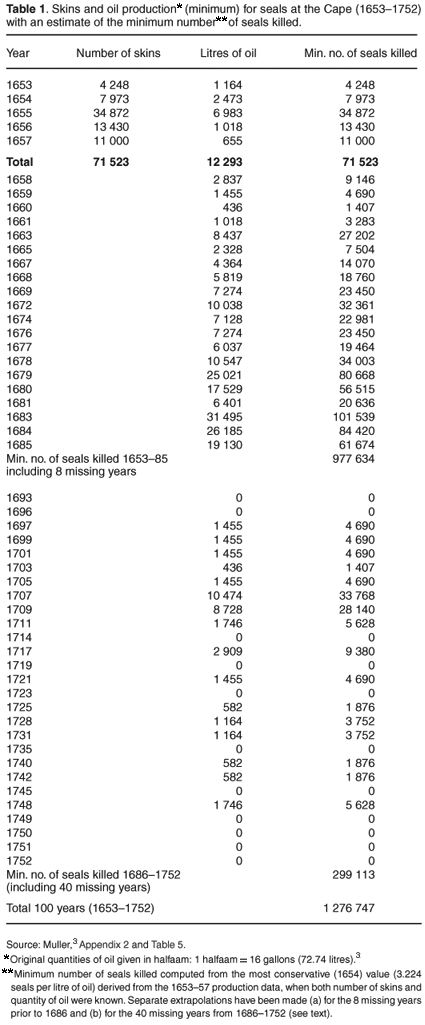
Although neither the pristine population size nor that of the 1890s is known, the extinction of the 23 aforementioned colonies makes it clear that the seal population was severely depleted, and that its present size represents a recovery from years of over-exploitation. It is valuable to use historical catch data to test this hypothesis more critically. Although catch records are incomplete prior to 1814, there is sufficient evidence for seal harvesting before the arrival of the first Dutch settlers in 16525,10 and of seal skin exports and seal oil production from the records of the Dutch East India Company (DEIC) for the 100 years following settlement3Table 1 in supplementary material online at www.sajs.co.za), to enable us to make an estimate of the minimum number of seals that were killed up to 1752.
At first, the officials of the DEIC hoped that the expenses incurred in maintaining the station at Table Bay would be defrayed by export of seal skins to Holland. To this end, 71 523 skins were exported in the first five years (Table 1). However, the company officials in Holland discovered that they could not get their expected price for the skins and ordered Van Riebeeck not to send any more.3,11 Nevertheless, seals continued to be harvested during the next 95 years for meat and oil for the DEIC garrison at Cape Town.
Presentation of the historical data on seal and oil harvests
Records of both the number of seal skins and the quantity of oil produced are available only from 1653–57 (Table 1), from which we can determine the ratio of seals killed to litres of oil produced. Only oil production figures were recorded thereafter (Table 1), as skins were no longer exported. Although incomplete, these data show the minimum quantity of oil that was produced up to 1752.3Table 1) compared with values from seal harvests in the 1960s of four to five litres per seal.12
We selected the record for 1654, which is the most conservative historical estimate, namely 3.22 seals killed per litre of oil (Table 1). This value has been used to calculate the number of seals killed during each year for which the oil production was known. This yields a total of about 841 000 seals killed in the 52 years for which there are data. Seals were harvested annually, and there is no evidence that seals were not harvested during the 48 years of missing records (Table 13pro rata for the century up to 1752. But, inspection of Table 1 shows that the number of seals killed annually before 1686 was consistently higher than in the years after 1685 (mean annual harvest 1658–1685 = 32 361 seals; mean harvest 1686–1752 = 4464 seals). Consequently, we have made two separate extrapolations, the first for the eight years missing before 1686 and the second for the 40 years missing between 1686 and 1752, giving a total harvest of about 1.28 million animals (Table 1). Given the incompleteness of the records and the general absence of numbers prior to 1653, it is believed that this would constitute a minimum harvest, with the caveat of an assumption regarding the oil yield per seal after 1657.
There is an absence of quantitative data from 1752 to 1795, but it is clear that by about 1750 seal numbers had declined to the extent that on Marcus, Jutten, Malgas (in Saldanha Bay) and Dassen islands they had become rare. Indeed, in 1751, three DEIC soldiers were stationed on Dassen Island to prevent the crews of passing ships from landing and killing seals there.131313
Data are also scarce during the transition phase between Dutch and final British rule in South Africa c.1795–1814, when British and American whalers decimated the west coast right whale population.1,2 Seal exports are likely to have been insignificant during this period, however, as seals had become very scarce, and sealing was not generally conducted on the Saldanha Bay islands between 1793 and 1806.1314,32 The American sealer Captain Benjamin Morrell4,31,32 reported that this colony was extinct by 1828.
Presentation of historical data on imports and exports of seal skins
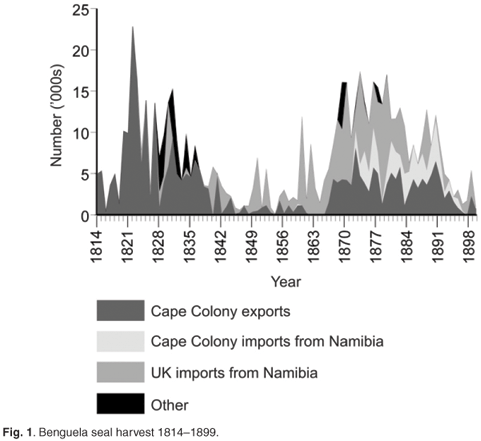
The export of seal skins was resumed after the final transfer of South Africa from Dutch to British control in 1814, but there are no records for the period 1814–1821, and the earliest extant Cape export data series starts only in 1822.15–17 The seal catch series can be extended back to 1814, and post-1822 export data can be significantly augmented,18Fig. 1). Additional sources of data were records of seal skin imports from Namibia to the Cape Colony between 1857 and 1899,16Fig. 1. Information on the take by itinerant American sealers was extracted from the few scattered published accounts,4,21 but could not be recovered from the published U.S. customs records, which fail to enumerate either commodities or countries of origin in the necessary detail.22,23 The published accounts, however, suggest that American sealing was a component in the Benguela region for only about a decade after 1825, ceasing altogether around 1835.21,24
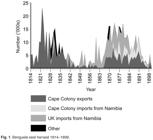
Figure 1 indicates that all of the U.K. seal skin imports for 1814–21 are assumed to represent Cape Colony exports. For the period 1822–c.1868, the excess of U.K. imports over Cape Colony exports is assumed to represent the activities of itinerant British and other sealers in Namibia. For c.1868–99, this excess is ascribed to direct exports by De Pass, Spence and Company, who during that period were the leaseholders of a group of specific islands known as the 'guano islands',19,20 where both seals and seabird guano were harvested. The only risk of double-counting arises with Namibian seal skin imports to the Cape Colony. The Namibian import data were entered for re-export up to 1871, and 'home consumption' thereafter. These former data were excluded from Fig. 1 to avoid double-counting in Cape Colony exports to the U.K. Figure 1 is thus a composite picture of the 19th-century seal harvest in the Benguela region, from the official records of imports and exports. We believe it represents at least minimum values, for this reason.
Reconstructed catch series for seals
The reconstructed catch series suggests two periods of intensified exploitation of the seal population, near the beginning and end of the century, separated by a twenty-year break during the period c.1840–60. The latter period corresponds to the African guano rush of 1843–452519Fig. 1) and also because seals were denied access to some breeding sites, in order to increase the surface area available for seabirds. The concomitant extension of British authority over the Namibian islands2621
The resurgence of seal harvesting in the 1860s was the product of two separate developments. South of the Orange River, Cape Colony guano, characterized by chemical analysis as being of poor quality, was gradually excluded from all but the small, cash-poor local market. Leaseholders thus shifted to harvesting penguin eggs and seals from their islands.19,27 Similarly, the granting of a 27-year monopoly over all the Namibian islands to De Pass, Spence and Company in 1868 ended the period of lawlessness following the guano rush, and allowed both seal and seabird populations to recover. Seals and seabird guano could then be harvested in tandem from the fifteen or so islands along the Namibian coast.2020,28
The conversion of guano production to a state enterprise, to supply Western Cape wheat farmers with subsidized fertilizer, was an attempt to compensate for the prevailing trend of falling yields.29
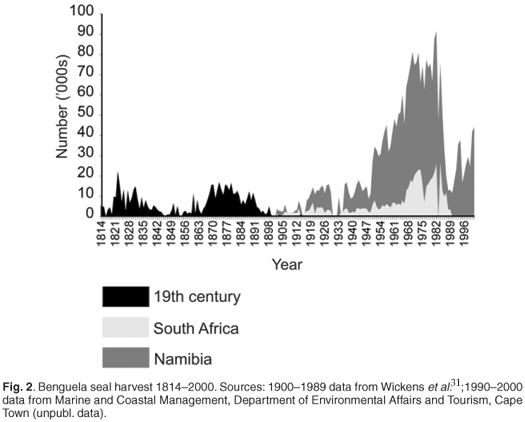
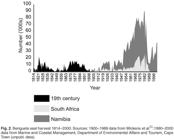
The relatively small numbers harvested in the 19th century (approximately 650 000 seals in the eighty-five years after 1814, an average of c. 7600 seals per year; Fig. 1) support the belief that the seal population had already been severely reduced by sealing during the previous two centuries. Certainly, Best and Shaughnessy45Fig. 2). Furthermore, access to the mainland colonies was much easier for the sealers, as this did not require boats and access was not subject to the vagaries of the weather. Consequently, the time spent during harvesting there was more productive. This increased harvest is noteworthy, considering that a total of 2.5 million animals were taken during the period from 1900 to 1989 (an average of c. 27 800 seals per year) the vast majority of which (2.2 million) were harvested after 19507,30 (an average of 55 000 seals per year) (Fig. 2). Seal harvesting in South Africa was banned by the government in 1990, but is still legal in Namibia.
Conclusion
There are many gaps in the historical records of seal harvesting along the southern African coast from the time of the earliest sailing vessels. The total numbers taken before the arrival of Dutch settlers in 1652 are unknown. We do know of some large harvests (for example, the 45 000 seals taken by the Dutch in 1610) and that the sealing was sufficiently destructive to cause Robben Island to be almost devoid of seals soon after the arrival of the colonists in 1652. To this must be added the reconstructed harvest of about 1.28 million seals taken between 1652 and 1752 (Table 1) and the documented export of at least 650 000 seal skins from southern Africa during the 19th century (Fig. 1), which totals at least 1.93 million seals killed up to 1899. This evidence, as well as other facts such as that seals on Dassen Island and the Saldanha Bay islands were virtually extinct by 1795,134
We conclude that this evidence is sufficient to verify that the seal population was severely reduced by uncontrolled exploitation, and that the prohibition on sealing introduced in 1893, and expanded by other ordinances in subsequent years,5
We thank Jo Duffy for the meticulous retrieval of the U.K. data from the Public Records Office, Amy Bell-Mulaudzi for locating American trade statistics, Bill Leavenworth for locating ref. 21, and the Web URL, History of Marine Animal Populations, for funding the research. Peter Best is thanked for valuable comments on the first draft. The History of Marine Animal Populations (HMAP) is the historical component of the 'Census of Marine Life' (CoML) program (www.coml.org). HMAP was established in the autumn of 1999, based on the approach outlined in P. Holm, T. Smith and D.J. Starkey. History of Marine Animal Populations: Testing Ecological Hypotheses (www.cmrh.dk/hmappros.html). See also P. Holm, T. Smith and D.J. Starkey (eds)(2002). Exploited Seas. Directions for marine environmental history (Research in International Maritime History, No. 21) St John's, Nflnd.
References
- 1. Richards R. and du Pasquier T. (1989). Bay whaling off southern Africa c.1785–1805. S. Afr. J. Mar. Sci. 8, 231–250.
- 2. Best P.B. and Ross G.B. (1986). Catches of right whales from shore-based establishments in southern Africa 1792–1975. Report of the International Whaling Commission Special Issue 10, 275–89.
- 3. Muller C.F.J. (1938). Die vroeë geskiedenis van die visserye in Suid-Afrika. M.A. thesis, University of Stellenbosch (published without tables in Archives Yearbook for South African History, 1942.1)
- 4. Best P.B. and Shaughnessy P.D. (1979). An independent account of Captain Benjamin Morrell's sealing voyage to the south-west coast of Africa in the Antarctic, 1828/29. Fish. Bull. S. Afr. 12, 1–19.
- 5. Shaughnessy P.D. (1984). Historical population levels of seals and seabirds on islands off southern Africa, with special reference to Seal Island, False Bay. Investl Rep. Sea Fish. Res. Inst. S. Afr. 127: 61 pp.
- 6. David J.H.M. (1987). South African fur seal Arctocephalus pusillus pusillus. In The Status, Biology and Ecology of Fur Seals, eds J.P. Croxall and R.L. Gentry. NOAA Tech. Rep. 51, 65–71.
- 7. David J.H.M. (1989). Seals. In Oceans of Life off Southern Africa, eds A.I.L. Payne and R.J.M. Crawford, pp. 288–302. Vlaeberg, Cape Town.
- 8. Butterworth D.S., Punt A.E., Oosthuizen W.H. and Wickens P.A. (1995). The effects of future consumption by the Cape fur seal on catches and catch rates of the Cape hakes. 3. Modelling the dynamics of the Cape fur seal Arctocephalus pusillus pusillus. S. Afr. J. mar. Sci. 16, 161–183.
- 9. Rand R.W. (1972). The Cape fur-seal Arctocephalus pusillus. 4. Estimates of population size. Investl Rep. Divn Sea Fish. S. Afr. 89,1–28.
- 10. Raven-Hart R. (1967). Before van Riebeeck. Callers at South Africa from 1488 to 1652. Struik, Cape Town.
- 11. Skead C.J. (1980). Historical Mammal Incidence in the Cape Province, vol. 1 The Western and Northern Cape. Department of Nature and Environmental Conservation of the Provincial Administration of the Cape of Good Hope, Cape Town.
- 12. Rand R.W. (1971). Marine resources of South Africa. In Protein and Food Supply in the Republic of South Africa, pp. 103–128. A.A. Balkema, Cape Town.
- 13. Roux A.P. (1975). Die geskiedenis van Saldanhabaai, St Helenabaai en Dasseneiland 1652–1806. M.A. thesis, University of Stellenbosch.
- 14. Alexander T. (1795). Remarks on board the Star on a cruise off the coast of Africa. Miscellaneous papers held by Hydrographic Office, Ministry of Defence, Taunton, vol. 86, (unpublished manuscript, logbook).
- 15. Cape Town Archives Repository (KAB) (1822–1839). CO 5963–5981, Blue Books.
- 16. Cape of Good Hope (1840–1885). Blue Book. Saul Solomon, Cape Town
- 17. Cape of Good Hope (1886–1899). Statistical Register. W.A. Richards, Cape Town.
- 18. United Kingdom, Public Records Office (1811–1899). CUST 4 /39–CUST 4/94.
- 19. Cape of Good Hope (1860). Report of the Select Committee on the Annexation of Ichaboe [A11–61]. Saul Solomon, Cape Town.
- 20. Cape of Good Hope (1895). Report of the Select Committee on Petition of Mr D. De Pass [A03-95]. W.A. Richards, Cape Town.
- 21. Goode G.B. (1887). The Fisheries and Fishery Industries of the United States, section 5, vol. 2. Government Printing Office, Washington, D.C.
- 22. US Department of the Treasury (1821–1866). Commerce and Navigation. Government Printing Office, Washington, D.C.
- 23. US Bureau of Census (1975). Historical Statistics of the United States: Colonial Times to 1970. Government Printing Office, Washington, D.C.
- 24. Busch B.C. (1985). The War Against the Seals: A History of the North American Seal Fishery. McGill-Queens University Press, Kingston and Montreal.
- 25. Craig R. (1964). The African guano trade. The Mariner's Mirror 50(1), 25–55.
- 26. Kinahan J. (1992). By Command of their Lordships: The Exploration of the Namibian Coast by the Royal Navy, 1795–1895. Namibian Archaeological Trust, Windhoek.
- 27. Cape of Good Hope (1879). Return showing the Amount of Revenue derived from Guano Islands of the Colony. [A24–79]. Saul Solomon, Cape Town.
- 28. Angra Pequena and West Coast Claims Joint Commission (1885). Proceedings of the Angra Pequena and West Coast Joint Claims Commission, March–September 1885. Saul Solomon, Cape Town.
- 29. Cape of Good Hope (1889). House of Assembly Debates. Cape Town.
- 30. Wickens P.A., David J.H.M., Shelton P.A. and Field J.G. (1991). Trends in harvests and pup numbers of the South African fur seal: implications and management. S. Afr. J. Mar. Sci. 11, 307–326.
- 31. Petrie P. (1844). Morrell's Narrative of a Voyage to the South and West Coast of Africa containing the Information from whence Originated the Present Trade in Guano found on certain Islands on that Coast. Whittaker & Co, London.
- 32. Wyatt T. (1980). Morrell's seals. J. Cons. Int. l'Explor. Mer 39, 1–6.
* Author for correspondence. E-mail: