Why heads matter in palaeoanthropology: The impacts and consequences of collecting skulls
This piece reflects on the importance of and focus on heads - especially the collecting of skulls and its impacts - in alpha taxonomy, biological anthropology, and Western science more broadly. We consider how the announcement and overall discovery story of the Taung Child revolutionised our understanding of hominin cranial evolution, but also fit within these skull-collecting objectives and contributed to the palaeoanthropological fixation on the skull. We contextualise this within the history of 'physical' anthropology in light of its initial goals in scientific racism, and consider how this process of skull collecting has become normalised in the discipline as a result of this history. As evidence for this, we quantify the possible effects of skull-collecting by collating available data on the number of skulls versus post-crania curated in a representative South African collection and compare the number of skulls versus post-cranial hominin fossils that form part of species hypodigms. We also explore how the ownership of skulls and ownership of narrative in the discipline have been intertwined throughout its history. Finally, we focus on how this early overemphasis on skulls, and especially brain size/intelligence, may have skewed our understanding of human evolution and contributed to ideas of human exceptionalism. SIGNIFICANCE: • The discipline of palaeoanthropology has a history of skull-focused research rooted in skull collecting and racist research. • Historial skeletal collections and holotypes of fossil hominins are skull-biased. • The Taung Child fossil postcranial remains were not included in the original study, which reflects this skull-centrism. • Palaeoanthropologists need to recognise biases in research choices and the context from which our field developed.
Taung Child; crania; physical anthropology; postcrania; scientific racism
Why heads matter in palaeoanthropology: The impacts and consequences of collecting skulls
Lauren SchroetterI, II; Paige MadisonIII; Rebecca R. AckermannII, IV
IDepartment of Anthropology, University of Toronto Mississauga, Mississauga, Ontario, Canada
IIHuman Evolution Research Institute, University of Cape Town, Cape Town, South Africa
IIIDepartment of Applied Ecology, North Carolina State University, Raleigh, North Carolina, USA
IVDepartment of Archaeology, University of Cape Town, Cape Town, South Africa
This piece reflects on the importance of and focus on heads - especially the collecting of skulls and its impacts - in alpha taxonomy, biological anthropology, and Western science more broadly. We consider how the announcement and overall discovery story of the Taung Child revolutionised our understanding of hominin cranial evolution, but also fit within these skull-collecting objectives and contributed to the palaeoanthropological fixation on the skull. We contextualise this within the history of 'physical' anthropology in light of its initial goals in scientific racism, and consider how this process of skull collecting has become normalised in the discipline as a result of this history. As evidence for this, we quantify the possible effects of skull-collecting by collating available data on the number of skulls versus post-crania curated in a representative South African collection and compare the number of skulls versus post-cranial hominin fossils that form part of species hypodigms. We also explore how the ownership of skulls and ownership of narrative in the discipline have been intertwined throughout its history. Finally, we focus on how this early overemphasis on skulls, and especially brain size/intelligence, may have skewed our understanding of human evolution and contributed to ideas of human exceptionalism.
SIGNIFICANCE:
• The discipline of palaeoanthropology has a history of skull-focused research rooted in skull collecting and racist research.
• Historial skeletal collections and holotypes of fossil hominins are skull-biased.
• The Taung Child fossil postcranial remains were not included in the original study, which reflects this skull-centrism.
• Palaeoanthropologists need to recognise biases in research choices and the context from which our field developed.
Keywords: Taung Child, crania, physical anthropology, postcrania, scientific racism
The Taung Child - not just a head
In February 1925, the world was introduced to a fossil declared to be an "intermediate between living anthropoids and [humans]"1(p.195). The discovery was a juvenile skull, with a well-preserved face and mandible, as well as a relatively complete endocast, and was designated Australopithecus africanus (the southern ape from Africa) and nicknamed the Taung Child. The announcement - and publications afterward - failed to mention, however, that the skull was not the full extent of the discovery. There were also associated postcranial remains. In the "rock mass containing the facial fragment", the "distal ends of the forearm bones and the small phalanges were present", wrote Australian-born Raymond Dart.2(p.22) Dart, who had spent weeks preparing the skull using his wife's sharpened knitting needles, "strove to develop [the postcrania] without success, as they were so friable", adding that "portions are still visible in the stone"2(p.22). While preparing phalanges is undoubtedly significantly more difficult than preparing a skull, the decision to take the preparation no further (as well as the uncertainty around the location of that block of stone to this day) reveals an interesting truth: the skull itself was privileged.
In a science that emerged three-quarters of a century earlier from a European fascination with measuring human skulls in the service of scientific racism, the skull had long held much attention.345
This skull-centrism persisted into the 20th century despite a growing fossil record in Europe and Asia, and a recognition that bipedalism (and the significant modifications it made to the skeleton) was a significant evolutionary adaptation. When the juvenile fossil was blasted from a quarry seven miles southwest of the Taung railway station in 192467
So when Dart received a block of breccia in late 1924, central questions about human evolutionary history remained open. Yet, despite such uncertainty, certain hypotheses and assumptions were widely subscribed to by naturalists. The most prevalent assumption centred on the importance -and early emergence - of the large brain. Anatomists like Dart's mentor, Grafton Elliot Smith, hypothesised that an increase in brain size was the first distinctively human trait to have evolved, preceding upright walking, tool making, and other adaptations. "It was not the adoption of the erect attitude that made [humans] from an ape", Elliot Smith argued the year before Taung was published, but instead the "gradual perfecting of the brain"8(p.39). It follows, then, that the skull would be the most important aspect of an ancestor.
Dart, too, favoured the skull in terms of its theoretical contribution, declaring it precisely the piece of anatomy needed to identify a significant, transitional human ancestor. While some others claimed "if missing links are to be traced with complete success, the foot, far more than the skull, or the teeth...will mark them as Monkey or Man"9(p.195), Dart, agreeing with his mentor, declared this "preposterous"2(p.58). Instead, the skull told the anatomist everything they needed to know about the creature's character, behaviour, posture, and taxonomic status. Notably, Dart and Elliot Smith agreed on the skull's importance despite disagreeing on the timing and significance of increased brain size. Following Elliot Smith's logic that the brain led the way in human evolution, the Taung Child with its small brain, not to mention its location in Africa, was all wrong as a candidate for human ancestor. Yet, as a neuroanatomist, Dart argued that the organisation of the brain revealed that Australopithecus had "shot ahead of all apes in intelligence"2(p.210). Thus, Dart elevated his specimen to a position of prime importance despite its small brain - seemingly a feature that would preclude it from an important evolutionary role. Indeed, he turned the small brain size around to be the central significance of the fossil. This illustrates that, regardless of the theoretical commitments a scientist had about the expansion of brain size, the skull was seen as the key to unlocking the human evolutionary story.
The Taung Child clearly contributed to the palaeoanthropological fixation on the skull, but the head-collecting objectives of the discipline go well beyond this important find. In this article, we use the discovery of the Taung Child as a jumping-off point for further interrogating the focus on skulls in alpha taxonomy and its history in racist research. We demonstrate that skull-centrism in palaeoanthropology is widespread, as evidenced by a skeletal inventory from a well-known historical South African human skeletal collection, as well as what bones comprise type specimens of currently recognised hominin species, and that this has impacted hypothesis generation and narrative construction in the discipline.
Heads on a mantle, scientific racism and taxonomy
How can we understand the privileging of the skull in palaeoanthropology through the lens of the Taung Child and what can we learn from such skull-centrism? Importantly, this theme pervades the entire story, as the Taung skull even found its way to Dart through another skull, that of a cercopithecoid monkey loaned by Mr E.G. Izod, Director of the Rand Mines. That specimen had sat proudly on the mantle of Pat Izod's home, the son of E.G. Izod, to be recognised by anatomy student Josephine Salmons and brought to Dart at the University of the Witwatersrand, instigating his interest in the area.1(p.195),10(p.40) This cercopithecoid skull was not only an important moment in the history that led to the Taung Child discovery, but also its placement, as a curiosity on a mantle, provides a poignant image that exemplifies the history of skull collecting in scientific pursuits. This skull-centric approach was consistent with the history of 'physical' anthropology, and we would argue that the process of head collecting has remained normalised in the discipline as a result of this history.
The long sordid history of body (skeleton) and especially head (skull) collecting is intertwined with Euro-colonial conquest, dehumanisation, and white supremacy.11,1213-1516-1920,2122153
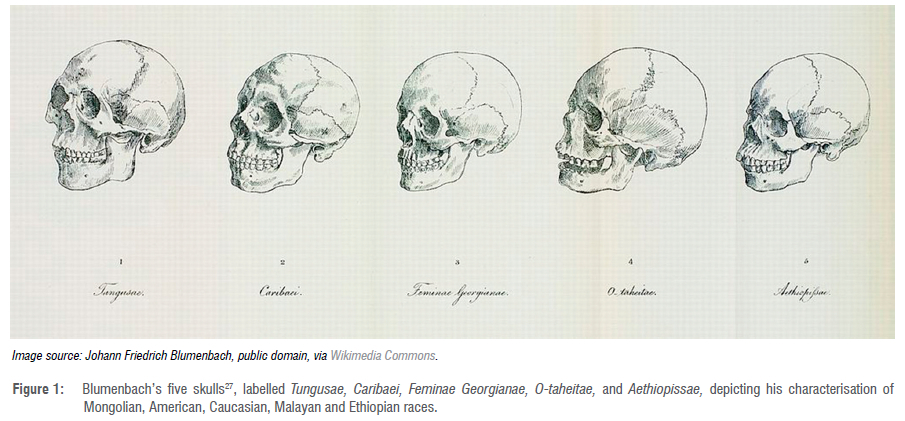
Building on the previous taxonomic classification of Homo sapiens into four racial "subspecies" (as well as a fifth category that has been called a racist and "non-geographical grab-bag", Homo monstrosus23) by Carl Linnaeus in his Systema Naturae2425-2728Figure 1).
Early physical anthropology in the 19th century was seen as a way to scientifically validate race, defined as a physical disposition, as well as the complete race complex, which also included behavioural, intellectual and character differences between human groups.29-333435
One major debate that raged during this time, rooted in Euro-Christian theology, was whether human races were of monogenetic or polygenetic origin. Monogenists believed that there was a common origin for races in the deep past (and that some had "degenerated") whereas polygenists argued for different origins and therefore different species.36 151420133215,37
When Charles Darwin published On the Origin of Species in 1859 promoting a monogenetic view of humans3839The Descent of Man in 1871 that, although there was common descent, the differences between races through geographic isolation were subspecific and each subspecies had different mental faculties - a reflection of his bias as a 19th-century Eurocentric scientist404142(p.234) by many scholars, which essentially created a hierarchy of humanness434445
Skulls and their power
Collections of human remains across the world ballooned in the late 19th and early 20th centuries. As a way to legitimise the scientific study of race (and racism), quantitative statistical methods for examining human differences became popular4615
Anthropological collections around the world were amassed for race science by powerful researchers in the field, including Samuel Morton (discussed above), Paul Broca and Ales Hrdlicka, who all engaged in dubious collection and preparation practices, and colonial powers such as Germany that violently collected thousands of skulls to populate their research institutes (as described in13,15,43,47,48Directions for Collecting Information and Specimens for Physical Anthropology49, Ales Hrdlicka, the founder of the American Journal of Physical Anthropology wrote: "The skull.. .preserves the zoological as well as the racial characteristics of the individual, and also the general form and size of by far the most important human organ, the brain."49(p.8) These collections also created a competition amongst colonial powers.2050(p.7). Collections also provided the necessary data for narrative building in anthropology and beyond, thus giving researchers affiliated with collections power over early theories about human evolution and human variation.
In South Africa, museums and institutes were not immune to this human remains collection frenzy and competition.2017,5117,52,53(p.130) Broom's motivation for his collecting practice was race science and especially craniology, a method he used to argue for the prehistoric nature of living Khoesan peoples.51,53
Louis Péringuey, then curator of Anthropology at the South African Museum, was inspired by comments made in 1905 by A.C. Haddon, president of the British Association for the Advancement of Science, to collect anthropological data on "primitive" native races within colonies that were dying out.5454,55 5620,54,555420,57,58
Raymond Dart was introduced to the idea of human skeletal collections in 1921 as a Rockefeller Fellow visiting Robert Terry in the Anatomy Department of Washington University in St. Louis, USA, just two years before he immigrated to South Africa as the Chair of Anatomy at the University of the Witwatersrand.59-62595959596363
Upon Dart's retirement in 1958, the collection was named The Raymond A Dart Collection of Human Skeletons.62595959(p.326). This illustrates very clearly that the skull-centrism of the discipline extended at least into the 1950s.
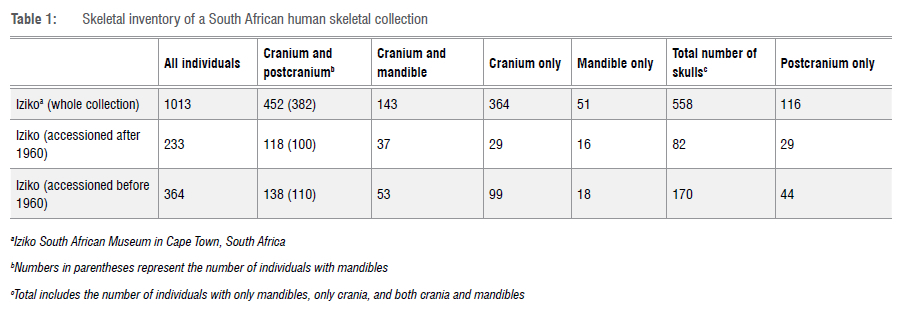
Today, an examination of the collection of human skeletons at Iziko South African Museum in Cape Town (previously South African Museum) reveals the extent of this skull-centric bias (Table 1). This collection was further split into those that were accessioned before 1960 and after 1960. About half of the individuals in the collection have accession date information. Of the 1013 individuals, 55% are represented by skull remains, and 45% are full skeletons. Indeed, in her extensive skeletal inventory of individuals housed across seven South African institutions, Tessa Campbell6464
When split by period, the pattern shows up more obviously before 1960. Out of the 364 skeletons accessioned before 1960, 48% are skulls, and 38% are skulls and postcrania. After 1960, 35% are skulls, and 51% also include postcrania. A chi-square test of independence indicates that the relationship between the date of accession and skeletal element is statistically significant, χ2N = 597) = 9.97, p < 0.01. This indicates that the skull-centric bias in collecting was more pronounced prior to 1960.
Heads and species hypodigms
In the history of physical anthropology, there is a direct link between scientific racism and its manifestations (e.g. study of living people, skeletal collections, head collecting) and the study of human evolution. In South Africa, this played out very clearly. Not only was Dart growing an extensive skeletal collection of primarily Indigenous Africans, biased towards heads, but he was also deeply involved in studies of living Indigenous southern Africans.51,6517,20,21,46,51,55516646,5166(p.183)
For any new fossil discovery, comparative taxonomic assessments of difference or similarity are made with species hypodigms that revolve around a holotype or "type specimen" - a specimen that serves as a morphological guide for comparisons. When we consider type specimens for hominin taxa - both prior and subsequent to the discovery of the Taung Child - we see that species diagnoses are overwhelmingly made on the basis of craniodental and mandibular material. Supplementary table 1 provides a list of currently used species names in palaeoanthropology and their type specimens, including which bone(s) make up those type specimens. This table was compiled using the Origins nomenclature resource on Paleo Core (https://paleocore.org/origins).67only skull remains. Even with the recognition that craniodental preservation in a taphonomic sense is generally better than that of other skeletal elements68(Homo luzonensis69), and those that have substantial postcranial material (Homo naledi70). For H. naledi, the choice of the holotype is striking, as Berger et al.7070(p.23).
Scientific racism first developed into a legitimate area of inquiry before the discovery of hominin fossils, meaning that the entrenchment of scientific racism into palaeoanthropology occurred in concert with early historical hominin discoveries. Taking this further, the race-based approaches to considering humankind, which is essentially (unjustifiable) taxonomy below the species level for H. sapiens, almost certainly influenced decisions to base hominin taxonomy largely on skull morphology. Or said another way, the decision that what was found represented a new species was only confidently made on the basis of skull differences. This makes sense given the importance of heads in race science and the fact that comparative human collections used for species diagnosis were skewed towards skulls. The same "objective scientific" methodologies and measurement techniques/instruments like callipers are also used in both pursuits: to put people in distinct typological categories in the service of scientific racism and to characterise fossil hominins.45
But aren't heads the best for species diagnosis?
Researchers might argue that skulls are simply more taxonomically diagnostic than postcranial remains, which explains our emphasis on them, and that our argument for a connection is therefore correlation but not causation. The supposed lack of phylogenetic usefulness of postcranial morphology is often attributed to the assumption that postcranial morphology is more reflective of function and behaviour, thus increasing the probability of homoplasy specifically in cladistic analyses.71,7273-7576,7778-8283,848585
For the Taung Child discovery, as discussed above, we know that postcranial material existed, but it not only did not make it into the scientific publication of Taung1A. africanus (Stw 14) ended up being the nail in the coffin for any arguments that this species was not a bipedal human ancestor, demonstrating the importance of postcranial material in this particular instance. More recently discovered hominins like H. naledi have also illustrated how important it is to have information from entire skeletons to accurately understand the complex nature of human evolution.70
As another example, brain size, a characteristic long linked with taxonomy and humanness, and, ironically, the main trait that influenced the initial scepticism about the Taung Child, may not be particularly useful for interpreting either. We now know that hominin brain size did not increase linearly; instead brain size has been variable, within and between taxa, both through time and also in contemporaneous groups from ca. 2 Ma right up to the recent past. For example, Homo erectus (sensu lato), and early Homo in general, had a wide range of variation86sapiens). Some large-brained H. erectus and small-brained H. habilis were contemporaries capable of tool-making, but very different in brain size. Small-brained H. floresiensis also lived at the same time (and presumably space) as large-brained hominins, and had cultural capabilities.87H. sapiens - an enigma to palaeoanthropologists, given that historically they were considered less capable despite their large brains (although we now know that is not true88
Conclusion: Why does it matter?
This link between scientific racism, research on bodies, and especially heads, and human evolution studies reframes the story of the Taung Child discovery - and indeed both prior and subsequent hominin species discoveries - in a new way. The discovery is embedded in a history and practice that inevitably impacted the interpretation of the fossil find (see also 6589,9091
The tendency to centre skulls in palaeoanthropology has affected the lens through which we interpret the past in multiple ways. First, it has potentially skewed the historical trajectory of the field. Focusing on heads and not on postcrania might mean that evidence for human evolution was overlooked or downplayed in its importance, as evidenced, for example, by the disregarding of the Taung postcrania. Second, an overemphasis on skulls has potentially skewed how we narrate the story of human evolution. Palaeoanthropologists have been obsessed with measuring head/brain size and shape, and linking this to intelligence and capabilities, right from the beginning of the discipline, an obsession that comes directly out of race science. The focus has been on why our heads are bigger or smaller (e.g. intelligence), what fuelled it (e.g. meat-eating), and what advantage it gave us (e.g. culture). Large brains are embedded in humanness, even though we now know that even small-brained hominins appear to have had the capacity for culture. Moreover, comparative primatology, and studies of other organisms (e.g. octopus), are telling us that large mammalian brains are not central to intelligence, or may not be directly tied to meat-eating (e.g.92
Going forward, it is important to recognise the biases that underlie our research choices. Why have we been so insistent on linking brain size to intelligence and capabilities, even in the face of intra- and interspecific variation that illustrates that this is not true? How do we move beyond this skull-centrism? Obviously, with modern techniques, we have the capability to fully examine the entire skeleton. Improved excavation approaches, including the ability to CT scan breccia and the like to identify materials embedded in rocks, give us the capability to identify and prepare (virtually) even the most friable material, including the arm and hand bones of the Taung Child should they ever be located. However, fully moving away from a head-centred approach is going to require a conscious shift in mindset, and the understanding that we risk being typological and essentialist by not shifting our approach. We just have to do it!
Funding
L.S. is funded by the Natural Sciences and Engineering Research Council of Canada (Discovery grant RGPIN-2020-04159). R.R.A. is funded by the National Research Foundation of South Africa (grant no. 136512).
Data availability
Data captured in Table 1 of this study are available on request from the curator of the Iziko South African Museum. Data captured in Supplementary table 1 are freely available via https://paleocore.org/origins/nomina/.
Declarations
We have no competing interests to declare. We have no AI or LLM use to declare.
Authors' contributions
L.S.: Conceptualisation, writing - the initial draft, data collection, writing -revisions, data analysis, data curation. PM.: Conceptualisation, writing -the initial draft. R.R.A:: Conceptualisation, writing - the initial draft, data collection, writing - revisions. All authors read and approved the final manuscript.
Acknowledgements
We are grateful to W. Black, W. Seconna and B. Marais for helping to collate data from the Iziko Museum skeletal inventory.
References
-
1. Dart R. Australopithecus africanus: The man-ape of South Africa. Nature. 1925;115:195-199. http://dx.doi.org/10.1038/115195a0
» http://dx.doi.org/10.1038/115195a0 - 2. Dart R. Australopithecus africanus: And his place in human origins. Raymond Dart Papers, University of the Witwatersrand. 1929. Unpublished.
-
3. Goodrum MR. The beginnings of human palaeontology: Prehistory, craniometry and the 'fossil human races'. Br J Hist Sci. 2016;49(3):387-409. http://dx.doi.org/10.1017/s0007087416000674
» http://dx.doi.org/10.1017/s0007087416000674 -
4. Madison P. Brutish Neanderthals: History of a merciless characterization. Evol Anthropol. 2021;30(6):366-374. http://dx.doi.org/10.1002/evan.21918
» http://dx.doi.org/10.1002/evan.21918 -
5. Madison P. The most brutal of human skulls: Measuring and knowing the first Neanderthal. Br J Hist Sci. 2016;49(3):411-432. http://dx.doi.org/10.1017/s0007087416000650
» http://dx.doi.org/10.1017/s0007087416000650 - 6. Young RB. The calcareous tufa deposits of the Campbell Rand, from Boetsap to Taungs Native Reserve. South Afr J of Geol. 1925;28:55-67.
-
7. Grün R, Pike A, McDermott F, Eggins S, Mortimer G, Aubert M, et al. Dating the skull from Broken Hill, Zambia, and its position in human evolution. Nature. 2020;580(7803):372-375. http://dx.doi.org/10.1038/s41586-020-2165-4
» http://dx.doi.org/10.1038/s41586-020-2165-4 - 8. Elliott Smith G. The evolution of man: Essays. London: Oxford University Press; 1924.
-
9. Morton DJ. Human origin. Correlation of previous studies of primate feet and posture with other morphologic evidence. Am J Phys Anthropol. 1927;10(2):173-203. http://dx.doi.org/10.1002/ajpa.1330100203
» http://dx.doi.org/10.1002/ajpa.1330100203 - 10. McKee JK. The Riddled chain: Chance, coincidence, and chaos in human evolution. New Brunswick, NJ: Rutgers University Press; 2000.
-
11. Roque R. Headhunting and colonialism: Anthropology and the circulation of human skulls in the Portuguese empire, 1870-1930. Basingstoke: Palgrave Macmillan; 2010. http://dx.doi.org/10.3917/mond1.201.0177
» http://dx.doi.org/10.3917/mond1.201.0177 -
12. Turnbull P Collecting and colonial violence. In: Fforde C, McKeown CT, Keeler H, editors. The Routledge companion to indigenous repatriation. London: Routledge; 2020. p. 452-468. http://dx.doi.org/10.4324/9780203730966-27
» http://dx.doi.org/10.4324/9780203730966-27 -
13. Fabian A. The skull collectors: Race, science, and America's unburied dead. Chicago, IL: University of Chicago Press; 2010. http://dx.doi.org/10.7208/chicago/9780226233499.001.0001
» http://dx.doi.org/10.7208/chicago/9780226233499.001.0001 -
14. Redman SJ. Bone rooms: From scientific racism to human prehistory in museums. Cambridge, MA: Harvard University Press; 2016. http://dx.doi.org/10.1126/science.abk3114
» http://dx.doi.org/10.1126/science.abk3114 -
15. Stahn C. Confronting colonial objects: Histories, legalities, and access to culture. Oxford: Oxford University Press; 2023. http://dx.doi.org/10.1093/oso/9780192868121.001.0001
» http://dx.doi.org/10.1093/oso/9780192868121.001.0001 -
16. de Rooy L. The shelf life of skulls: Anthropology and 'race' in the Vrolik craniological collection. J Hist Biol. 2023;56(2):309-337. http://dx.doi.org/10.1007/s10739-023-09716-w
» http://dx.doi.org/10.1007/s10739-023-09716-w -
17. Morris AG. The reflection of the collector: San and Khoi skeletons in museum collections. S Afr Archaeol Bull. 1987;42(145):12-22. http://dx.doi.org/10.2307/3887769
» http://dx.doi.org/10.2307/3887769 -
18. Qureshi S. Peoples on parade: Exhibitions, empire, and anthropology in nineteenth-century Britain. Chicago, IL: University of Chicago Press; 2019. http://dx.doi.org/10.7208/chicago/9780226700984.001.0001
» http://dx.doi.org/10.7208/chicago/9780226700984.001.0001 - 19. Spennemann D. Skulls as curios, crania as science: Some notes on the collection of skeletal material during the German colonial period. Micronesian J Hum Soc Sci. 2006;5:70-78.
- 20. Legassick M, Rassool C. Skeletons in the cupboard: South African museums and the trade in human remains 1907-1917. Cape Town and Kimberley: South African Museum and McGregor Museum; 2000.
-
21. Rassool C. Re-storing the skeletons of empire: Return, reburial and rehumanisation in Southern Africa. J S Afr Stud. 2015;41(3):653-670. http://dx.doi.org/10.1080/03057070.2015.1028002
» http://dx.doi.org/10.1080/03057070.2015.1028002 -
22. Webb DA. War, racism and the taking of heads: Revisiting military conflict in the Cape Colony and Western Xhosaland in the nineteenth century. J Afr Hist. 2015;56:37-55. http://dx.doi.org/10.1017/s0021853714000693
» http://dx.doi.org/10.1017/s0021853714000693 -
23. Marks J. Long shadow of Linnaeus's human taxonomy. Nature. 2007; 447(7140):28. http://dx.doi.org/10.1038/447028a
» http://dx.doi.org/10.1038/447028a -
24. Linnaeus C. Systema naturae per regna tria naturae: Secundum classes, ordines, genera, species, cum characteribus, differentiis, synonymis, locis [The system of nature through the three kingdoms of nature: According to classes, orders, genera, species, with characters, differences, synonyms, places]. Volume 1. 10th ed. Holmiae: Laurentii Salvii; 1758. Latin. http://dx.doi.org/10.5962/bhl.title.156772
» http://dx.doi.org/10.5962/bhl.title.156772 -
25. Blumenbach JF. De generis humani varietate nativa. Editio tertia. Praemissa est epistola ad virum Josephum Banks [Of the native variety of the human race. The third edition. A letter addressed to Mr. Joseph Banks]. Göttingen: Vandenhoek & Ruprecht; 1795. Latin. http://dx.doi.org/10.5962/bhl.title.35972
» http://dx.doi.org/10.5962/bhl.title.35972 -
26. Böker W. Blumenbach's collection of human skulls. In: Rupke N, Lauer G, editors. Johann Friedrich Blumenbach: Race and natural history, 1750-1850. London: Routledge; 2018. p. 80-95. http://dx.doi.org/10.4324/9781315184777-5
» http://dx.doi.org/10.4324/9781315184777-5 -
27. Rupke N, Lauer G, editors. Johann Friedrich Blumenbach: Race and natural history, 1750-1850. London: Routledge; 2018. http://dx.doi.org/10.4324/9781315184777
» http://dx.doi.org/10.4324/9781315184777 -
28. Junker T. Blumenbach's theory of human races and the natural unity of humankind. In: Rupke N, Lauer G, editors. Johann Friedrich Blumenbach: Race and natural history. London: Routledge; 2018. p. 96-112. http://dx.doi.org/10.4324/9781315184777-6
» http://dx.doi.org/10.4324/9781315184777-6 -
29. Blakey ML. Skull doctors: Intrinsic social and political bias in the history of American physical anthropology; with special reference to the work of Ales Hrdlicka. Crit Anthropol. 1987;7:7-35. http://dx.doi.org/10.1177/0308275x8700700203
» http://dx.doi.org/10.1177/0308275x8700700203 -
30. Blakey ML. Understanding racism in physical (biological) anthropology. Am J Phys Anthropol. 2021;175(2):316-325. http://dx.doi.org/10.1002/ajpa.24208
» http://dx.doi.org/10.1002/ajpa.24208 -
31. Caspari R. Race, then and now: 1918 revisited. Am J Phys Anthropol. 2018;165(4):924-938. http://dx.doi.org/10.1002/ajpa.23417
» http://dx.doi.org/10.1002/ajpa.23417 - 32. Gould SJ. The mismeasure of man. New York: WW Norton; 1981.
- 33. Marks J. Is science racist? Hoboken, NJ: John Wiley & Sons; 2017.
-
34. Turnbull P. Surveying craniometry. In: Fforde C, Howes H, Knapman G, Ormond-Parker L, editors. Repatriation, science and identity. London: Routledge; 2023. p. 51-73. http://dx.doi.org/10.4324/9781003144953
» http://dx.doi.org/10.4324/9781003144953 -
35. Poskett J. Materials of the mind: Phrenology, race, and the global history of science, 1815-1920. Chicago, IL: University of Chicago Press; 2019. http://dx.doi.org/10.7208/chicago/9780226626895.001.0001
» http://dx.doi.org/10.7208/chicago/9780226626895.001.0001 -
36. Haller JS Jr. The species problem: Nineteenth-century concepts of racial inferiority in the origin of man controversy. Am Anthropol. 1970;72(6):1319-1329. http://dx.doi.org/10.1525/aa.1970.72.6.02a00060
» http://dx.doi.org/10.1525/aa.1970.72.6.02a00060 -
37. Gulliford A. Bones of contention: The repatriation of Native American human remains. Public Hist. 1996;18(4):119-143. http://dx.doi.org/10.2307/3379790
» http://dx.doi.org/10.2307/3379790 -
38. Darwin C. On the origin of species by means of natural selection: Or, the preservation of favoured races in the struggle for life. London: Murray; 1859. http://dx.doi.org/10.5962/bhl.title.68064
» http://dx.doi.org/10.5962/bhl.title.68064 -
39. Brown BR. Until Darwin, science, human variety and the origins of race. London: Routledge; 2011. https://doi.org/10.4324/9781315655826
» https://doi.org/10.4324/9781315655826 - 40. Darwin C. The descent of man, and selection in relation to sex. London: John Murray; 1871.
-
41. Fuentes A. 7 "On the races of man": Race, racism, science, and hope. In: DeSilva J, editor. A most interesting problem: What Darwin's descent of man got right and wrong about human evolution. Princeton, NJ: Princeton University Press; 2021. p. 144-161. http://dx.doi.org/10.1515/9780691210810-011
» http://dx.doi.org/10.1515/9780691210810-011 -
42. Rupke N. The origins of scientific racism and Huxley's rule. In: Rupke N, Lauer G, editors. Johann Friedrich Blumenbach: Race and natural history. London: Routledge; 2018. p. 233-247. http://dx.doi.org/10.4324/9781315184777-12
» http://dx.doi.org/10.4324/9781315184777-12 -
43. Dias N. Nineteenth-century French collections of skulls and the cult of bones. Nuncius. 2012;27(2):330-347. http://dx.doi.org/10.1163/18253911-02702006
» http://dx.doi.org/10.1163/18253911-02702006 - 44. Huxley TH. Evidence as to man's place in nature. London: Williams and Norgate; 1863.
- 45. Haeckel E. Natürliche Schöpfungsgeschichte [Natural creation story]. Berlin: Reimer; 1868. German.
- 46. Clever II. The lives and afterlives of skulls: The development of biometric methods of measuring race (1880-1950) [dissertation]. Los Angeles, CA: University of California; 2020.
-
47. Athreya S, Ackermann RR. Colonialism and narratives of human origins in Asia and Africa. In: Porr M, Matthews J, editors. Interrogating human origins. London: Routledge; 2019. p. 72-95. http://dx.doi.org/10.4324/9780203731659-4
» http://dx.doi.org/10.4324/9780203731659-4 -
48. Stoecker H, Winkelmann A. Skulls and skeletons from Namibia in Berlin: Results of the Charité human remains project. Hum Remains Viol: Interdiscip J. 2018;4(2):5-26. http://dx.doi.org/10.7227/hrv.4.2.2
» http://dx.doi.org/10.7227/hrv.4.2.2 - 49. Hrdlicka A. Directions for collecting information and specimens for physical anthropology. Washington DC: US Government Printing Office; 1904.
- 50. Van Eynde J. Bodies of the weak: The circulation of the indigenous dead in the British world, 1780-1880 [dissertation]. Ann Arbor, MI: The University of Michigan; 2018.
- 51. Kuljian C. Darwin's hunch: Science, race and the search for human origins. Johannesburg: Jacana; 2016.
- 52. Broom R. Bushmen, Koranas and Hottentots. Ann Transv Mus. 1941; 20:217-249.
-
53. Morris AG. Bones and bodies: How South African scientists studied race. New York: NYU Press; 2022. http://dx.doi.org/10.18772/12022027236
» http://dx.doi.org/10.18772/12022027236 -
54. Morris AG. The British Association meeting of 1905 and the rise of physical anthropology in South Africa. S Afr J Sci. 2002;98:336-340. https://journals.co.za/doi/pdf/10.10520/EJC97516
» https://journals.co.za/doi/pdf/10.10520/EJC97516 -
55. Witz L, Minkley G, Rassool C. Unsettled history: Making South African public pasts. Ann Arbor, MI: University of Michigan Press; 2017. http://dx.doi.org/10.3998/mpub.9200634
» http://dx.doi.org/10.3998/mpub.9200634 -
56. Péringuey L. The bushman as a palaeolithic man. Trans R Soc S Afr. 1915;5(1):225-236. https://doi.org/10.1080/00359191509519720
» https://doi.org/10.1080/00359191509519720 -
57. Davison P. The politics and poetics of the Bushman diorama at the South African Museum. ICOFOM Study Ser. 2018;46:81-97. http://dx.doi.org/10.4000/iss.921
» http://dx.doi.org/10.4000/iss.921 -
58. Morris AG. Searching for 'real' Hottentots: The Khoekhoe in the history of South African physical anthropology. S Afr Hum. 2008;20(1):221-233. https://journals.co.za/doi/pdf/10.10520/EJC84793
» https://journals.co.za/doi/pdf/10.10520/EJC84793 -
59. Dayal MR, Kegley DT, Strkalj G, Bidmos MA, Kuykendall KL. The history and composition of the Raymond A. Dart collection of human skeletons at the University of the Witwatersrand, Johannesburg, South Africa. Am J Phys Anthropol. 2009;140(2):324-335. http://dx.doi.org/10.1002/ajpa.21072
» http://dx.doi.org/10.1002/ajpa.21072 - 60. Tobias P Dart, Taung and the 'missing link'. Johannesburg: Witwatersrand University Press; 1984.
-
61. Tobias P. History of physical anthropology in southern Africa. Am J Phys Anthropol. 1985;28:1-52. https://doi.org/10.1002/ajpa.1330280503
» https://doi.org/10.1002/ajpa.1330280503 - 62. Tobias P. Memoirs of Robert James Terry (1871-1966) and the genesis of the Terry and Dart collections of human skeletons. Adler Mus Bull. 1987;13:31-34.
-
63. Houlton TMR, Billings BK. Blood, sweat and plaster casts: Reviewing the history, composition, and scientific value of the Raymond A. Dart collection of African life and death masks. HOMO. 2017;68(5):362-377. http://dx.doi.org/10.1016/j.jchb.2017.08.004
» http://dx.doi.org/10.1016/j.jchb.2017.08.004 -
64. Campbell T. Investigating the emergence and spread of tuberculosis in South Africa [dissertation]. Cape Town: University of Cape Town; 2019. http://dx.doi.org/10.15641/ghi.v2i1.728
» http://dx.doi.org/10.15641/ghi.v2i1.728 -
65. Kuljian C. Contesting a legendary legacy: A century of reflection on Raymond Dart and the Taung skull. S Afr J Sci. 2025;121(1/2), Art.#18323. https://doi.org/10.17159/sajs.2025/18323
» https://doi.org/10.17159/sajs.2025/18323 -
66. Witz L, Minkley G, Rassool C. Sources and genealogies of the new museum: The living fossil, the photograph and the speaking subject. In: Witz L, Minkley G, Rassool C, editors. Unsettled history: Making South African public pasts. Ann Arbor, MI: University of Michigan Press; 2017. p. 177-203. http://dx.doi.org/10.3998/mpub.9200634
» http://dx.doi.org/10.3998/mpub.9200634 -
67. Reed DN, Raney E, Johnson J, Jackson H, Virabalin N, Mbonu N. Hominin nomenclature and the importance of information systems for managing complexity in paleoanthropology. J Hum Evol. 2023;175, Art. #103308. http://dx.doi.org/10.1016/j.jhevol.2022.103308
» http://dx.doi.org/10.1016/j.jhevol.2022.103308 -
68. Grupe G, Harbeck M. Taphonomic and diagenetic processes. In: Henke W, Tattersall I, editors. Handbook of paleoanthropology. Berlin/Heidelberg: Springer; 2015. p. 417-439. http://dx.doi.org/10.1007/978-3-642-39979-4_7
» http://dx.doi.org/10.1007/978-3-642-39979-4_7 -
69. Détroit F, Mijares AS, Corny J, Daver G, Zanolli C, Dizon E, et al. A new species of Homo from the Late Pleistocene of the Philippines. Nature. 2019;568(7751):181-186. http://dx.doi.org/10.1038/s41586-019-1067-9
» http://dx.doi.org/10.1038/s41586-019-1067-9 -
70. Berger LR, Hawks J, de Ruiter DJ, Churchill SE, Schmid P, Delezene LK, et al. Homo naledi, a new species of the genus Homo from the Dinaledi Chamber, South Africa. eLife. 2015;4, e09560. http://dx.doi.org/10.7554/elife.09560.030
» http://dx.doi.org/10.7554/elife.09560.030 -
71. Lockwood CA, Fleagle JG. The recognition and evaluation of homoplasy in primate and human evolution. Am J Phys Anthropol. 1999;110(S29):189-232. https://doi.org/10.1002/(SICI)1096-8644(1999)110:29+<189::AID-A JPA7>3.0.CO;2-3
» https://doi.org/10.1002/(SICI)1096-8644(1999)110:29+<189::AID-A JPA7>3.0.CO;2-3 -
72. Lockwood CA. Homoplasy and adaptation in the atelid postcranium. Am J Phys Anthropol. 1999;108(4):459-482. https://doi.org/10.1002/(SICI)1096-8644(199904)108:4<459::AID-AJPA6>3.0.CO;2-R
» https://doi.org/10.1002/(SICI)1096-8644(199904)108:4<459::AID-AJPA6>3.0.CO;2-R -
73. Sánchez-Villagra MR, Williams BA. Levels of homoplasy in the evolution of the mammalian skeleton. J Mamm Evol. 1998;5(2):113-126. https://link.springer.com/article/10.1023/A:1020549505177
» https://link.springer.com/article/10.1023/A:1020549505177 -
74. McCarthy RC, DiVito TA, Bains J, Fatima M. Phylogenetic utility of mammalian postcranial characters. FASEB J. 2017;31:578.12. https://doi.org/10.1096/fasebj.31.1_supplement.578.12
» https://doi.org/10.1096/fasebj.31.1_supplement.578.12 -
75. Williams BA. Comparing levels of homoplasy in the primate skeleton. J Hum Evol. 2007;52(5):480-489. https://doi.org/10.1016/j.jhevol.2006.11.011
» https://doi.org/10.1016/j.jhevol.2006.11.011 -
76. Fleagle JG, McGraw WS. Skeletal and dental morphology of African papionins: Unmasking a cryptic clade. J Hum Evol. 2002;42(3):267-292. https://doi.org/10.1006/jhev.2001.0526
» https://doi.org/10.1006/jhev.2001.0526 -
77. Argue D, Groves CP, Lee MS, Jungers WL. The affinities of Homo floresiensis based on phylogenetic analyses of cranial, dental, and postcranial characters. J Hum Evol. 2017;107:107-133. https://doi.org/10.1016/j.jhevol.2017.02.006
» https://doi.org/10.1016/j.jhevol.2017.02.006 -
78. Kenyon-Flatt B, Conaway MA, Lycett SJ, von Cramon-Taubadel N. The relative efficacy of the cranium and os coxa for taxonomic assessment in macaques. Am J Phys Anthropol. 2020;173(2):350-367. http://dx.doi.org/10.1002/ajpa.24100
» http://dx.doi.org/10.1002/ajpa.24100 -
79. Kenyon-Flatt B, von Cramon-Taubadel N. Intrageneric taxonomic distinction based on morphological variation in the macaque (Macaca) skeleton. Anat Rec. 2024;307(1):118-140. http://dx.doi.org/10.1002/ar.25283
» http://dx.doi.org/10.1002/ar.25283 -
80. Young NM. A comparison of the ontogeny of shape variation in the anthropoid scapula: Functional and phylogenetic signal. Am J Phys Anthropol. 2008; 136(3):247-264. http://dx.doi.org/10.1002/ajpa.20799
» http://dx.doi.org/10.1002/ajpa.20799 -
81. von Cramon-Taubadel N, Lycett SJ. A comparison of catarrhine genetic distances with pelvic and cranial morphology: Implications for determining hominin phylogeny. J Hum Evol. 2014;77:179-186. https://doi.org/10.1016/j.jhevol.2014.06.009
» https://doi.org/10.1016/j.jhevol.2014.06.009 -
82. Young NM. Estimating hominoid phylogeny from morphological data: Character choice, phylogenetic signal and postcranial data. In: Lieberman D, Smith RW, Kelley J, editors. Interpreting the past. Leiden: Brill; 2005. p. 1-13. https://doi.org/10.1163/9789047416616_007
» https://doi.org/10.1163/9789047416616_007 -
83. von Cramon-Taubadel N, Smith HF. The relative congruence of cranial and genetic estimates of hominoid taxon relationships: Implications for the reconstruction of hominin phylogeny. J Hum Evol. 2012;62(5):640-653. http://dx.doi.org/10.1016/j.jhevol.2012.02.007
» http://dx.doi.org/10.1016/j.jhevol.2012.02.007 -
84. von Cramon-Taubadel N. The relative efficacy of functional and developmental cranial modules for reconstructing global human population history. Am J Phys Anthropol. 2011;146(1):83-93. http://dx.doi.org/10.1002/ajpa.21550
» http://dx.doi.org/10.1002/ajpa.21550 -
85. Schroeder L, Ackermann RR. Moving beyond the adaptationist paradigm for human evolution, and why it matters. J Hum Evol. 2023;174, Art. #103296. https://doi.org/10.1016/j.jhevol.2022.103296
» https://doi.org/10.1016/j.jhevol.2022.103296 -
86. Spoor F, Gunz P, Neubauer S, Stelzer S, Scott N, Kwekason A, et al. Reconstructed Homo habilis type OH 7 suggests deep-rooted species diversity in early Homo. Nature. 2015;519(7541):83-86. https://doi.org/10.1038/nature14224
» https://doi.org/10.1038/nature14224 -
87. Moore MW, Sutikna T, Morwood MJ, Brumm A. Continuities in stone flaking technology at Liang Bua, Flores, Indonesia. J Hum Evol. 2009;57(5):503-526. http://dx.doi.org/10.1016/j.jhevol.2008.10.006
» http://dx.doi.org/10.1016/j.jhevol.2008.10.006 -
88. Sykes RW. Kindred: Neanderthal life, love, death and art. London: Bloomsbury Publishing; 2020. http://dx.doi.org/10.5040/9781472988201
» http://dx.doi.org/10.5040/9781472988201 -
89. Black W, Gibbon VE, Omar R. Navigating shifting sands: Guidelines for human skeletal repatriation and restitution from South Africa. In: Smith C, Pollard K, Kanungo AK, May SK, López Varela SL, Watkins J, editors. The Oxford handbook of global indigenous archaeologies. Oxford: Oxford University Press; 2022. http://dx.doi.org/10.1093/oxfordhb/9780197607695.013.29
» http://dx.doi.org/10.1093/oxfordhb/9780197607695.013.29 -
90. Meloche CH, Spake L, Nichols KL. Working with and for ancestors. Abingdon: Routledge; 2020. https://doi.org/10.4324/9780367809317
» https://doi.org/10.4324/9780367809317 -
91. DiGangi EA, Bethard JD. Uncloaking a lost cause: Decolonizing ancestry estimation in the United States. Am J Phys Anthropol. 2021;175(2):422-436. http://dx.doi.org/10.1002/ajpa.24212
» http://dx.doi.org/10.1002/ajpa.24212 -
92. Bryant KL, Hansen C, Hecht EE. Fermentation technology as a driver of human brain expansion. Commun Biol. 2023;6(1), Art. #1190. http://dx.doi.org/10.1038/s42003-023-05517-3
» http://dx.doi.org/10.1038/s42003-023-05517-3

Revised: 06 Sep. 2024
Accepted: 17 Sep. 2024
Published: 07 Feb. 2025
Supplementary Data
Funding: Natural Sciences and Engineering Research Council of Canada (RGPIN-2020-04159), South African National Research Foundation (136512)