A review of phytoplankton dynamics in tropical African lakes
Abstract
This paper provides a synthesis of current knowledge on phytoplankton production, seasonality, and stratification in tropical African lakes and considers the effects of nutrient enrichment and the potential impacts of climate warming on phytoplankton production and composition. Tropical African lakes are especially sensitive to climate warming as they experience wide fluctuations in the thermocline over a narrow range of high water temperatures. Recent climate warming has reduced phytoplankton biomass and production in the lakes. A decline in the production of palatable chlorophytes and an increase in cyanobacteria has led to reduced zooplankton production and a consequent decline in fish stocks, all of which can be associated with the elevated water temperatures. This indicates that even moderate climate warming may destabilise phytoplankton dynamics in tropical African lakes, thereby reducing water quality and food resources for planktivorous fish, with consequent negative impacts on human livelihoods.
phytoplankton; African lakes; changing environment; nutrient; habitat
INTRODUCTION
Tropical African lakes provide an important source of dietary protein to rural communities; potable water for humans, livestock and agriculture; a means of transportation of goods and generation of hydro-electric power; and a source of revenue from fishing and eco-tourism. Also, many of these lakes are havens for diverse endemic fish fauna of immense ecological and scientific importance that are dependent on sustained phytoplankton seasonality and stratification. Previous reports on phytoplankton in tropical African lakes have had a predominantly taxonomic focus, with some considering phytoplankton composition and production in specific lakes as a reflection of that lake's overall health. However, a comprehensive review of phytoplankton production, seasonality and stratification in all tropical African lakes, as well as phytoplankton responses to eutrophication and climate warming, and the consequent effect of this on fish stocks and human livelihoods, has not been undertaken. This paper seeks to address these issues, considering that such information is especially pertinent in the wake of the deteriorations in water quality and declines in fish abundance and diversity that have been recently experienced in many tropical African lakes, as a result of climate change and increased anthropogenic pressures.
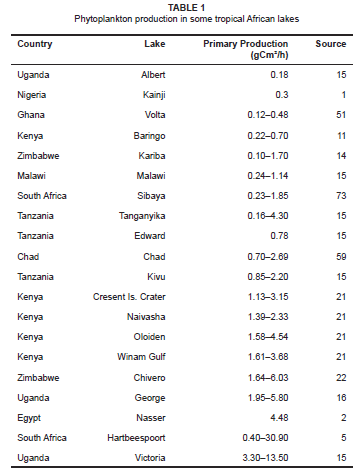
PRIMARY PRODUCTIONTropical African lakes display a considerable range in phytoplankton production (see Table 1) which reflects their trophic state. Lake Kainji is a typical example of a nutrient-poor (oligotrophic) African lake with a low phytoplankton production of 0.3 gCm21 22 22223,4 Similarly, in the physionomically similar Hartbeespoort Dam, primary production levels, which normally range between 0.40 gCm22255,6 In deeper African lakes, nutrient inflows also exert prominent effects on primary production. Examples include Lake Malawi, where primary production levels of 0.24 gCm22227 222891011
STRATIFICATION
Environmental factors such as water pH, conductivity, dissolved oxygen and nutrient concentration and light intensity influence primary production and these in turn are affected by thermal stratification, which is a common feature of tropical African lakes. Stratification is a result of thermal differences in the upper warm layer of water, (the epilimnion), the lower cold layer (the hypolimnion), and a zone of steep temperature gradient, (the thermocline), which separates the two and is usually created during periods of high summer temperatures. Stratification is characterised by vertical profiles of water temperature, conductivity, dissolved oxygen concentration and pH. In Lake Tanganyika, a fairly stable stratification is established during the wet season, which is generated by increased water temperatures and diminished wind intensities. However, currents and internal waves, as well as coastal jets and return flows, do cause localised up-welling, which may partly disrupt this stratification.12
The general annual cycle of thermal stratification in these lakes includes a short phase of partial vertical mixing which is often accompanied, or immediately followed, by a peak of algal abundance to which diatoms make a major contribution.12 12 13 14,15
Density stratification is also a natural feature of many shallow, naturally saline African lakes such as George16,17, Naivasha18192021226
Stratification generally has a negative impact on overall primary production as it confines nutrients to deeper waters of greater density beyond the euphotic zone,232432526
SEASONALITYMost African lakes have a well-established seasonality in phytoplankton abundance, which is governed mainly by climate. The community of larger phytoplankton in Lake Tanganyika is mainly composed of chlorophytes and diatoms (Nitzschia spp.), with large blooms of diastrophic filamentous cyanobacteria also periodically observed during September to November at the onset of the rainy season.27,28 However, more recently, these cyanobacteria have not been observed as a major constituent of the phytoplankton biomass.29,30 Rather the biomass exhibits contrasting picocyanobacteria and diatom concentrations due to changes in water column stability also observed at the southern and northern ends of the lake.31,32 A seasonal succession of major algal groups similar to that in Lake Tanganyika is also found in the natural oligotrophic Lakes Edward, Kivu and Malawi, which have a low phytoplankton biomass and species diversity,15Cylindrospermopsis, Anabaena, Pseudoanabaena) and blue-green algae dominate when the phytoplankton biomass reaches its peak (up to 1.52 mg per litre of chlorophyll a) during the rainy season, with diatoms dominating at turnover during the dry season.3334Urosolenia sp., Nitzschia bacata, Fragilaria danica) are normally associated with oligotrophic, phosphorous-deficient African lakes.34
The concept of stable phytoplankton communities has been questioned with regards to some African lakes. Observations of primary production and phytoplankton densities at regular (weekly and fortnightly) intervals in Lake Kinneret, Israel, over a 35-year period (1969-2004), has led to a repudiation of the concept of a stable phytoplankton seasonality.35Peridium gatunense blooms, intensification of winter Melosira granulata (=Aulacoseira) blooms and increased variability in the magnitude of blooms in other species. Also, nanoplanktonic palatable forms in the high summer phytoplankton biomass were replaced by less palatable forms. There was a new appearance and increase in absolute biomass of toxin-producing, nitrogen-fixing cyanobacteria as well as an increased incidence of fungi attacking Peridium gatunense.3536 14
THE INFLUENCE OF NUTRIENTSIn the tropics and at mid-latitudes, phytoplankton are typically nutrient-limited; and reduced biological productivity, phytoplankton biomass and growth have been linked to increased water temperatures and reduced nutrient supply.3611,37 Indeed, in many African lakes nitrogen-fixing taxa such as Anabaena and Cylindrospermum proliferate due to the limiting concentrations of this nutrient for other taxa in their waters.11,12,18,30,38 The low phytoplankton biomass variability of Lake George in Uganda has been attributed to both nitrogen and phosphorous limitations, and the extreme predominance of algal production over that of other biota.3839183030 30
The composition and abundance of phytoplankton often reflect the nutrient status of African lakes with, for example, the low Euglenophyceae biomass in Lake Ogelube proposed to be indicative of low organic pollution and the predominance of desmids indicative of oligotrophic conditions.136 Microcystis aeruginosa dominating and Melosira spp. co-dominating the phytoplankton community.4,6 Cyanobacterial blooms have also been reported in nutrient-enriched South African impoundments, namely the Hartbeespoort Dam4041342 43 39 44Salvinia molesta (Kariba weed) and, more recently, to the propagation of another aquatic weed, Eichhornia crassipes (water hyacinth), which is currently prevalent in Lakes Chivero and Victoria, as well as in Lakes Baringo, Chad, Malawi, Naivasha, Nakuru, Tanganyika and Victoria, where it is adversely affecting fishing industries.45
CLIMATE WARMINGThe impact of global warming projected by climate change models46,47,48 on the function of African aquatic ecosystems is uncertain, although some likely effects have been reported4950 515249,53 East African lakes, for example, are known to be potentially highly sensitive to climate change54 55 56575353,58 These findings were corroborated by another study that demonstrated a close correspondence between phytoplankton biomass and climate in Lake Tanganyika.36
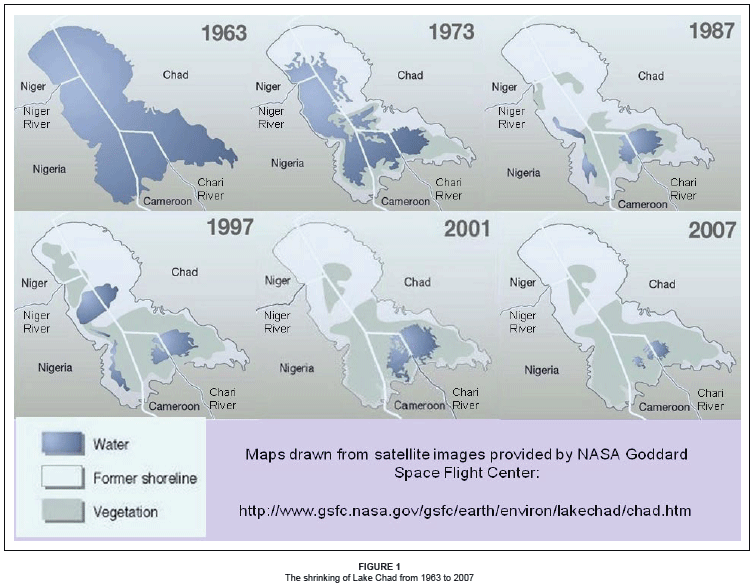
Much of what is happening to lakes across Africa is attributable to years of drought that have reduced river inflows and rising temperatures and caused increased evaporative water loss.48 22Figure 1). This decrease can also be attributed to large and unsustainable irrigation projects built by Niger, Nigeria, Cameroon and Chad, which have diverted water from the lake as well as the Chari, Logone and Niger Rivers, and major overgrazing in the region resulting in a loss of vegetation and serious deforestation contributing to a drier climate.59,60 Another example of an African lake that may be responding to increasing temperatures driven by climate change is Lake Turkana, the largest, most northerly and most saline of Africa's Rift Valley lakes, whose level has dropped 10 m between 1975 and 1992 due to reduced inflow.61 62,63 For the Zambezi basin, simulated runoff under climate change is projected to decrease by about 40% or more, which would greatly reduce the size and depth of Lakes Cabora Bassa, Kafue and Kariba.645353,58 However, fishing effort continues to rise and technologies have improved to such an extent that landings have increased during the warming period, making it difficult to decipher any effect on fish productivity in response to warming. In Lake Victoria, climate warming has been implicated in the eutrophication of the world's largest lake fishery.656563
Increased water temperatures associated with climate warming are likely to cause a shift in phytoplankton species composition from Chlorophyceae to Cyanophyceae, which are competitively superior at higher temperatures. Microcosm studies have demonstrated that elevated temperatures suppress total zooplankton biomass by altering phytoplankton community composition towards high temperature tolerant species, though total phytoplankton biomass is not usually altered.66675757Limnothrissa fish populations.49
As water temperatures increase, algal succession follows a progression - from diatoms to chlorophytes to cyanobacteria.33Microcystis at concentrations of 34 000 colonies per millilitre (77.6 mg/L), the blooms corresponding with high temperatures, discharge of nutrients from river inflows, nutrient upwelling and nutrient release from sediments.6858696,70 In this lake, the dissolved oxygen concentrations following an algal bloom die-off, ranged from 2 mg/L at a depth of 5 m to 3.9 mg/L at the lake surface. These oxygen concentrations were even lower than those (3.2 mg/L to 4.8 mg/L) measured in the Nyanza Gulf of Lake Victoria, following the collapse of a phytoplankton bloom and associated with high fish mortalities of Oreochromis niloticus.686,22 but it has not been established whether these are toxic to humans and other fauna.70Microcystis have been identified in other African fresh water bodies, as well as in fresh water systems elsewhere in the world.71
HUMAN LIVELIHOODSThe future of tropical African lakes in a changing climate seems bleak and this poses several challenges, the most important of which is an understanding of how changes in climate will affect aquatic ecosystems and human livelihoods, need to be overcome.47,49 The consequences of climate warming on lake hydrology (through destabilisation of stratification) and on lake temperature, could affect phytoplankton production by reducing both abundance and composition in many tropical African lakes. The consequent cascade through a longer trophic chain due to the dominance of smaller phytoplankton, could potentially affect zooplankton and fish production and ultimately threaten the viable fishery industries that sustain the livelihoods of riparian communities. Unfortunately, the poor are most at risk because they depend on the natural resources provided by many African lakes, yet policies around these resources do not benefit them much. For instance, upon Lake Kariba's creation, 57 000 people were resettled to make way for the lake, but suitable land was not sufficiently available in the direct vicinity.7245
REFERENCES
- 1. Karlman SG. The annual flood regime as a regulatory mechanism for phytoplankton production in Kainji Lake, Nigeria. Arch. Hydr. 1982;86:93-97.
- 2. Samaan AA. Report on the trip of Lake Nasser to investigate its primary productivity during March 1971. Report to Lake Nasser Development Centre Project, Aswan (mimeo).
- 3. Robarts RD. Underwater light penetration, chlorophyll a and primary production in a tropical African lake (Lake Mcllwaine, Rhodesia). Arch Hydrobiol. 1979;86:423-444.
- 4. Ndebele MR. Some aspects of the phytoplankton community of Lake Chivero, Harare, Zimbabwe. MSc. thesis, University of Zimbabwe, Harare; 2003.
- 5. Robarts RD. Factors controlling primary productivity in a hypereutrophic lake (Hartbeespoort Dam, South Africa). J Plankton Res. 1984;6:91-105.
- 6. Mhlanga L, Day J, Cronberg C, Chimbari M, Siziba N, Annadotter H. Observations on limnological conditions associated with a fish kill of Oreochromis niloticus in Lake Chivero following collapse of an algal bloom. Afr J Ecol. 2006;44:199-208.
- 7. Guildford SJ, Bootsman HA, Taylor WD, Hecky RE. High variability of phytoplankton photosynthesis in response to environmental forcing in an oligotrophic Lake Malawi/Nyasa. J Great Lakes Res. 2007;33:170-185.
- 8. Mugidde R. The increase in phytoplankton activity in Lake Victoria (Uganda). Verh. Int. Ver. Limnol. 1993; 25:846-849.
- 9. Robarts RD, Southall GC. Nutrient limitation of phytoplankton growth in seven tropical man-made lakes, with special reference to Lake Mcllwaine, Rhodesia. Arch Hydrobiol. 1977;79:1-35.
- 10. Yasindi AW, Taylor WD. The abundance, biomass and composition of pelagic ciliates in East African lakes of different salinity and trophy. Aquat Ecosyst Health Manage. 2003;6:289-297.
- 11. Talling JF, Talling IB. The chemical composition of African lake waters. Int Rev Gesamten Hydrobiol. 1965;50:421-463.
- 12. Chale FMM. Inorganic nutrient concentrations and chlorophyll in the euphotic zone of Lake Tanganyika. Hydrobiologia 2004;00:1-9.
- 13. Nweze NO. Seasonal variations in phytoplankton populations in Ogelube Lake, a small natural West African Lake. Lakes Reserv Res Manage. 2006;11:63-72.
- 14. Cronberg G. Phytoplankton in Lake Kariba. In: Moreau J, editor. Advances in the ecology of lake Kariba. Harare: University of Zimbabwe Publications, 1997; p.66-72
- 15. Hecky RE, Kling HJ. Phytoplankton ecology of the great lakes in the rift valleys of Central Africa. Arch Hydrobiol. Beiheft Ergebnisse Limnol. 1987;25:197-228.
- 16. Ganf GG. Photosynthetic production and irradiance-photosynthesis relationship of the phytoplankton from a shallow equatorial lake (Lake George, Uganda). Oceologia (Berlin) 1975;18:165-183.
- 17. Wood RB, Prosser MV, Baxter RM. The seasonal pattern of thermal characteristics of four of the Bishoftu crater lakes, Ethiopia. Freshwat Biol. 1976;6:519-530.
- 18. Hubble DS, Harper DM. Nutrient control of phytoplankton production in Lake Naivasha, Kenya. Hydrobiologia. 2002;488: 99-105.
- 19. Vareschi E. The ecology of Lake Nakuru (Kenya). III. Abiotic factors and primary production. Oceologia. 1982;55:81-101.
- 20. Langenberg VT, Mwape LM, Tshibangu K, et al. Comparison of thermal stratification, light attenuation and chlorophyll-a dynamics between the ends of Lake Tanganyika. Aquat Ecosyst Health Manage. 2002;5:255-265.
- 21. Melack JM. Photosynthetic rates in four tropical African fresh waters. Freshw Biol. 1979;9:555-571.
- 22. Ndebele MR, Magadza CHD. The occurrence of Microcystin-LR in Lake Chivero, Zimbabwe. Lakes Reserv.: Res Manage. 2006;11:57-62.
- 23. Spigel RH, Coulter GW. Comparison of hydrology and physical limnology of the East African Great Lakes: Tanganyika, Malawi, Victoria, Kivu and Turkana (with reference to some North American Great Lakes). In: Johnson TC, Odada E. The limnology, climatology and paleoclimatology of the east African lakes. Toronto: Gordon and Breach; 1996. Toronto: Gordon and Breach; 1996.
- 24. Vuorio K, Nuottajarvi M, Kalevi S, Sarvala J. Spatial distribution of phytoplankton and picocyanobacteria in Lake Tanganyika in March and April 1998. Aquat Ecosyst Health Manage. 2003;6:263-278.
- 25. Talling JF, Wood RB, Prosser MV, Baxter RM. The upper limit of photosynthetic productivity by phytoplankton: evidence from Ethiopian Soda lakes. Freshwat Biol. 1973;3:5376.
- 26. Henderson F. A limnological description of Kainji Lake 1969-1971. FAO repository report prepared for the Kainji Lake Project FI: DP/NIR 66/524/10, Rome; 1973.
- 27. Salonen K, Sarvala J, Jarvinen M, et al. Phytoplankton in LakeTanganyika- vertical and horizontal distribution of in vivo fluorescence. Hydrobiologia. 1999;407:89-103.
- 28. Cocquyt C, Vyverman W. Phytoplankton in Lake Tanganyika: a comparison of community composition and biomass off Kigoma with previous studies 27 years ago. J Great Lakes Res. 2005;31:535-546.
- 29. Descy JP, Hardy MA, Stenuite S, et al. Phytoplankton pigments and community composition in Lake Tanganyika. Freshw Biol. 2005;50:668-684.
- 30. De Wever A, Muylaert K, Langlet D, et al. Differential response of phytoplankton to additions of nitrogen, phosphorus and iron in Lake Tanganyika. Freshw Biol. 2008;53:264-277.
- 31. Hecky RE., Kling HJ. The phytoplankton and proto-zooplankton of the euphotic zone of Lake Tanganyika- species composition, biomass, chlorophyll content, and spatio-temporal distribution. Limnol Oceanogr. 1981;26:548-564.
- 32. Vuorio K, Nuottajarvi M, Kalevi S, Sarvala J. Spatial distribution of phytoplankton and picocyanobacteria in Lake Tanganyika in March and April 1998. Aquat Ecosyst Health Manage. 2003;6:263-278.
- 33. Ramberg L. Phytoplankton succession in the Sanyati basin, Lake Kariba. Hydrobiologia 1987;153:193-202.
- 34. Sarmento H, Isumbisho M, Descy JP. Phytoplankton ecology of Lake Kivu (eastern Africa). J Plankton Res. 2006;28:815-829.
- 35. Zohary T. Changes to the phytoplankton assemblage of Lake Kinneret after decades of a predictable, repetitive pattern. Freshw Biol. 2004;49:1355-1371.
- 36. Bergamino N, Loisellea SA, Cozar A, Dattiloa AM, Bracchini L, Rossi C. Examining the dynamics of phytoplankton biomass in Lake Tanganyika using empirical orthogonal functions. Ecolog. 2007 Model. 204,156-162.
- 37. Viner AB. Relationships of nitrogen and phosphorus to a tropical phytoplankton population. Hydrobiologia. 1977;52:185-196.
- 38. Ganf GG. Photosynthetic production and irradiance-photosynthesis relationship of the phytoplankton from a shallow equatorial lake (Lake George, Uganda). Oceologia. 1975;18:165-183.
- 39. Moyo S.M. Cyanobacterial nitrogen fixation in Lake Kariba, Zimbabwe. Verh Int Ver Limnol. 1991;24:1123-1127.
- 40. Robarts RD, Zohary T. The influence of a cyanobacterial hyperscum on the heterotrophic activity of planktonic bacteria in a hypereutrophic lake. Appl Environ Microbiol. 1986;51:609-613.
- 41. Van Ginkel CE, Hohls BC. Toxic algae in Erfenis and Allemanskraal dams. Occasional report by the Institute for Quality Studies, Department of Water Affairs and Forestry. N/C400/03/DEO/1999.
- 42. Kemka N, Njine T, Togouet SHZ, et al. Eutrophication of lakes in urbanized areas: The case of Yaounde Municipal Lake in Cameroon, Central Africa. Lakes Reserv Res Manage. 2006;11:47-55.
- 43. Feresu SB, Van Sickle J. Coliforms as a measure of sewage contamination of the River Zambezi. J Appl Bacteriol. 1990;68:397-403.
- 44. Magadza CHD, Dhlomo EJ. Wet seasons coincidence of coliform bacteria in inshore waters of Kariba town area. Lakes Reserv Res Manage. 1996;2:89-96.
- 45. Ogutu-Ohwayo R, Balirwa JS. Management challenges of freshwater fisheries in Africa. Lakes Reserv. Res Manage. 2006;11:215-226.
- 46. Hulme M. Climate change and southern Africa: an exploration of some potential impacts and implications in the SADC region. WWF International, Avenue du Mont Blanc, Gland, Switzerland; 1996.
- 47. Hulme M, Doherty R, Ngara T, New M, Lister D. African climate change: 1900-2100. Climate Res. 2001;17:145-168.
- 48. Intergovernmental Panel on Climate Change (IPCC). Freshwater Resources and Their Management. A Special Report of Working Group II. Fourth Assessment Report on Climate Change. Cambridge University Press, Cambridge, United Kingdom; 2007.
- 49. Magadza CHD. Climate change: some multiple impacts in Southern Africa. In: Downing T-E, editor. Climate change and food security. NATO ASI Series. Series 1: Global Environmental Change. 1994;37:662.
- 50. Lehman JT, Litt AH, Mugidde R, Lehman DA. In: Lehman JT, editor. Environmental change and response in east African lakes. Amsterdam: Kluwer.
- 51. John DM. The inland waters of tropical West Africa. An introduction and botanical review. Arch Hydrobiol Ergebneisse Limnol. 1986;23:1-244.
- 52. Cocquyt C, Vyverman W. Composition and diversity of the algal flora in the East African great lakes: a comparative survey of lakes Tanganyika, Malawi (Nyasa), and Victoria. Arch. Hydrobiol. Beiheft Ergebnisse Limnol. 1994;44:161-172.
- 53. O'Reilly CM, Alin SR, Plisnier PD, Cohen AS, MaKee BA. Climate change decreases aquatic ecosystem productivity of Lake Tanganyika, Africa. Nature. 2003;424:766-768.
- 54. Johnson TC, Odada EO. The limnology, climatology and paleoclimatology of the East African Lakes. Amsterdam: Gordon and Breach; 1996.
- 55. Lewis MW. Primary production in the plankton community of a tropical lake. Ecolog Monogr. 1974;44:377-409.
- 56. Plisnier PD, Chitamwebwa D, Mwape L, Tshibangu K, Langenberg V, Coenen E. Limnological annual cycle inferred from physical-chemical fluctuations at three stations of Lake Tanganyika. Hydrobiologia. 1999;407:45-58.
- 57. Magadza CHD. State of Environment on Lake Kariba and the Zambezi valley. Lakes Reserv. Res. Manage. In press; 2009.
- 58. Stenuite S, Pirlot S, Hardy MA, Sarmento H, Tarbe A, LB, Leporcq B, Descy JP. Phytoplankton production and growth rate in Lake Tanganyika: evidence of a decline in primary productivity in recent decades. Freshw Biol. 2007;52:2226-2239.
- 59. Carmouze JP, Durand JR, Lévêque C. Lake Chad. Ecology and productivity of a shallow tropical ecosystem. Monogr Biol. 1983;53.
- 60. Coe MT, Foley JA. Human and natural impacts on the water resources of the Lake Chad basin. J. Geophysical Res. (Atmospheres) 2001;106:3349-3356.
- 61. McGinley M. Lake Turkana National Parks, Kenya. In Encyclopaedia of earth.Washington DC: Environmental Information Coalition, National Council for Science and the Environment; 2008.
- 62. Awange JL, Sharifi MA, Ogonda G, Wickert J, Grafarend EW, Omulo MA. The falling Lake Victoria water level: GRACE, TRIMM and CHAMP satellite analysis of the Lake Basin. Water Resour Manage. 2008;22:775-796.
- 63. Phoon SY, Shamseldin AY, Vairavamoorthym K. Assessing impacts of climate change on Lake Victoria Basin, Africa. In proc. Of the 30th WEDC International Conference: People-centred approaches to water and environmental sanitation. Vientiane, Lao PDR. 2004.
- 64. Desanker P, Magadza CHD. In: McCarthy JJ, Canziani O-F, Leary N, Docken DJK, White S, editors. Climate change 2001: Impacts and adaptations. CUP; 2001.
- 65. Fryer G. Biological implications of a suggested late Pleistocene desiccation of Lake Victoria. Hydrobiol. 1997;354:177-182.
- 66. Doney SC. Plankton in a warmer world. Nature. 2006;444:695-696.
- 67. Sibanda P. The possible effects of global warming on the growth of algae. B.Sc. thesis, University of Zimbabwe, Harare, Zimbabwe; 2003.
- 68. Ochumba OP, Kibaara DI. Observations on blue-green algal blooms in the open waters of Lake Victoria, Kenya Afri J Ecol. 1989;27:23-34.
- 69. Strecker AL, Cobb TP, Vinebrooke RD. Effects of experimental greenhouse warming on phytoplankton and zooplankton communities in fishless alpine ponds. Limnol and Oceanogr. 2004;49:1182-1190.
- 70. Moyo NAG. The causes of massive fish deaths in Lake Chivero. In: Moyo NAG, editor. Lake Chivero a polluted lake. Harare: University of Harare.
- 71. Chen J, Xie P, Xu J. First identification of the hepatotoxic microcystin in the serum of a chronically exposed human population together with indication of hepatocellular damage. Toxicol Science 2009;108:81-89.
- 72. Scudder T. Man-made lakes and population resettlement in Africa. In: Lowe-McConnell RH, editor. Man-made lakes. New York: Academic Press; 1966.

 Correspondence to:
Mzime Ndebele-Murisa
Department of Biodiversity and Conservation Biology
University of the Western Cape, Box X17
Bellville 7535, Cape Town, South Africa
email: murisa.mzime@gmail.com
Accepted: 11 Dec. 2009
Published: 11 Mar. 2010