Recovery of oculomotor nerve palsy after endovascular management of posterior communicating artery aneurysms
Abstract
BACKGROUND: Oculomotor nerve palsy (ONP) is a common clinical presentation of posterior communicating artery (PcomA) aneurysms. It remains unclear if patients have a better rate of recovery after surgical clipping or endovascular coiling. OBJECTIVES: The main objectives of this study were to assess the overall rate of ONP recovery after endovascular coiling of PcomA aneurysms, as well as to determine the associated predictive factors of oculomotor nerve recovery. METHOD: We retrospectively evaluated the demographic, clinical, and radiological characteristics and the outcome of consecutive patients presenting with PcomA aneurysms treated by endovascular coiling from January 2012 to November 2016 with at least 1 year clinical and radiological follow-up. Statistical analysis was applied to determine the association between ONP recovery and the demographic, clinical and radiological variables. RESULTS: A total of 91 patients with PcomA aneurysms were treated endovascularly. Thirty-four patients (22 women and 12 men) with ONP related to PcomA aneurysms were included. The mean age of the patients was 49.8 years. Subarachnoid haemorrhage was present in 27 patients. The mean aneurysm size was 6.7 mm. The overall rate of recovery was 88.2%. Complete nerve recovery was seen in 16 (47%) patients and partial recovery was observed in 14 (41.2%) patients, whilst 4 (11.8%) patients remained unchanged after treatment. The non-posterolateral direction of the aneurysm showed a tendency towards better recovery compared to the posterolateral projection (p = 0.060. CONCLUSION: Endovascular coiling of PcomA aneurysms in patients with ONP resulted in a cure or improvement of oculomotor nerve dysfunction in the majority of patients.
ONP; PcomA; clipping versus coiling; diagnostic radiology; Endovascular coiling; Oculomotor nerve recovery
Introduction
Posterior communicating artery (PcomA) aneurysms are one of the most common aneurysms encountered by neurosurgeons and neuro-interventional radiologists, representing 50% of all internal carotid artery (ICA) aneurysms. They are the second most common aneurysms overall (25% of all aneurysms).12,34,5
The treatment of ONP-related to PcomA aneurysms is still controversial and has been limited by the small series of cases. The first surgical series of aneurysmal third nerve palsy was published in 1947 by Jefferson et al.,67,89,1011,12,13,14
The primary aim of this study was to assess the rate of ONP recovery related to PcomA aneurysms in an institution where coiling is the first policy. The secondary aim was to determine the predictive factors of oculomotor nerve recovery.
Material and methods
Study population
This was a retrospective, descriptive and analytic study of patients who presented with oculomotor nerve palsies related to PcomA aneurysms and underwent endovascular treatment with coiling from January 2012 to November 2016 in the Neurosurgery Department at Inkosi Albert Luthuli Central Hospital (IALCH) in South Africa. Patients with at least 1 year clinical and radiological follow-up were included in the study.
Data collection
Patient data were obtained from the computer database of the Hospital Information System at IALCH. Demographics, clinical presentation and ophthalmologic examination were recorded from the patients' medical files. Images were accessed via the Radiological Information System and Picture Archiving and Communication System. Data on the endovascular procedure and the course of ophthalmologic and angiographic follow-up were obtained.
Pre-operative and postoperative evaluation
Complete ONP was defined as patients with all of the following: diplopia, ptosis, ophthalmoplegia and pupillary dysfunction. Partial (incomplete) ONP was defined as patients with one or two of the above. The following factors were assessed: demographic data (gender and age), clinical data (co-morbidities, degree of ONP at presentation, aneurysm rupture status before treatment and length of ONP before treatment) and radiological data (size and aneurysm direction). Postoperative evaluation of ONP was classified as unchanged (no improvement), incomplete recovery or complete recovery.
Statistical analysis
Data are presented as means and ranges for continuous variables and as frequencies for categoric variables. Statistical analyses were performed using the Fisher's exact test. The level of statistical significance used was p < 0.05 for the whole study. Statistical analysis was performed using the Statistical Package for the Social Sciences (SPSS) version 26.0.
Ethical consideration
Ethical approval to conduct the study was obtained from the Higher Research Committee at the University of KwaZulu-Natal (approval number: BE510/17).
Results
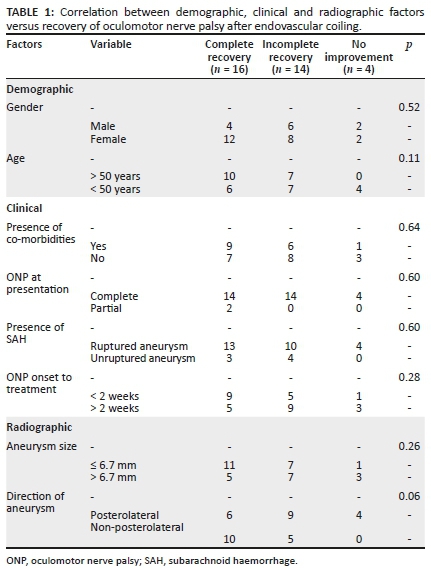
The study population consisted of 91 patients who each presented with a PcomA aneurysm. Of the 91 patients, 40 (43.9%) had oculomotor palsy and were treated with endovascular coiling. Thirty-four patients were included in this study as they had follow-up data. Of the 34 patients, 30 patients (88.2%) had ONP recovery, whilst 4 patients (11.8%) remained unchanged after endovascular treatment. Of the 30 patients who had ONP recovery, 16 patients had complete recovery of oculomotor nerve function, whilst 14 had an incomplete recovery. The demographic, clinical and radiographic data are presented in Table 1.
Demographic data in correlation with oculomotor nerve palsy recovery
Of the 34 patients with ONP, 22 (64.7%) were women and 12 (35.3%) were men. The mean age of the patients was 49.8 years (range 14-81 years). No relationship could be found between gender (p = 0.52) or age (p = 0.11) and ONP recovery.
Clinical data in correlation with oculomotor nerve palsy recovery
Of the 34 patients who developed ONP, co-morbidities (hypertension/diabetes mellitus) were found in 16 patients (47%), whereas 18 patients (53%) had no comorbidity. At the time of admission, ONP was complete in 32 patients (94.1%) and partial in 2 patients (6.9%). Subarachnoid haemorrhage (SAH), in keeping with aneurysm rupture, was present in 27 patients (79.4%) with ONP, whereas 7 patients (20.6%) had unruptured aneurysms. No statistically significant correlation was found between co-morbidities, the degree of ONP at presentation or SAH versus ONP recovery. Of the 34 patients, the length of ONP before treatment was not documented in two patients. Fifteen patients had early treatment (≤ 14 days), whilst late endovascular coiling (> 15 days) was performed in 17 patients. Early treatment showed a slightly higher tendency towards better ONP recovery compared with late treatment. Nevertheless, the difference did not reach statistical significance (p = 0.28).
Radiological data in correlation with oculomotor nerve palsy recovery
The mean size of the aneurysms was 6.7 mm (range 3 mm - 12.4 mm). Small aneurysms showed a slightly higher tendency towards better ONP recovery compared with larger aneurysms. Nevertheless, the difference did not reach statistical significance (p = 0.26). For the 34 patients who developed ONP, aneurysm direction was posterolateral in 19 patients (55.9%), lateral in 10 patients (29.4%), anterolateral in 2 patients (5.9%), inferolateral in 2 patients (5.9%) and medial in 1 patient (27.5%). Patients with a non-posterolateral aneurysm direction indicated a higher tendency towards better ONP recovery compared with the posterolateral group (p = 0.06).
Discussion
The main objectives of this study were to assess the overall rate of ONP recovery related to PcomA aneurysm after endovascular coiling, as well as to determine the associated predictive factors of oculomotor nerve recovery.
In our study, we found that 43.9% of patients with PcomA aneurysms developed ONP. This is comparable to most previous studies, where the range of ONP varied from 34% to 56% amongst patients presenting with PcomA aneurysm.4,5
We assessed the resolution of ONP in a series of 34 patients after endovascular treatment. An overall improvement occurred in 88.2% of the patients. We found that endovascular therapy allowed complete nerve recovery in 47% and partial recovery in 41.2% of patients, whilst only 11.8% remained unchanged. These findings are also in agreement with previous studies that have reported favourable recovery rates with endovascular therapy, ranging from 80% to 90%. In these studies, complete recovery was observed in 40% - 50% of patients, whilst partial recovery was seen in 40% - 45% of patients after endovascular therapy.15,16177,8,11,13 Illustrative cases demonstrating simple coiling, balloon remodelling and stent-assisted coiling techniques are presented in Figures 1-4.
Correlation of demographic data with oculomotor nerve palsy recovery
The effect of demographics on the final ONP recovery has been shown in several studies. Stiebel-Kalish et al.1819201521p = 0.52, p = 0.11, respectively).
Correlation of clinical data with oculomotor nerve palsy recovery
Stiebel-Kalish et al.1822p = 0.64), and, most likely, recovery was dependent on other factors.
Previous researches have studied the effect of the pre-operative degree of oculomotor nerve paresis in determining eventual recovery. Many studies noted that the degree of ONP before treatment was an important factor in determining the eventual recovery of oculomotor nerve function.7,8,23,242526p = 0.60). This is difficult to evaluate as we had only two patients who initially presented with partial ONP at admission.
The effect of aneurysm rupture status on oculomotor nerve recovery has been debated. Some studies have noted that the aneurysm rupture status before treatment was not an important factor in determining the eventual recovery of ONP.20,2728,29p = 0.60). The better ophthalmologic outcome with SAH can be explained by the probable difference of the ONP mechanism after SAH, which is probably related to the irritating effect of subarachnoid blood on the nerve itself, rather than to direct mass effect.
The influence of early aneurysm treatment after the onset of oculomotor nerve dysfunction and ONP resolution has been debated. Many studies have noted that the duration of ONP before treatment was an important factor in determining the eventual recovery.30,31,3233,34p = 0.28). This finding could be explained by the idea of neuropraxia which has an excellent prognosis with full recovery within the first few weeks, whilst recovery may not take place or occur only partially, when the third nerve palsy is of a long duration (a few months), because of intraneural scarring with axonal death and Wallerian degeneration.
Correlation of radiological data with oculomotor nerve palsy recovery
Various studies have found that smaller aneurysms (< 10 mm in size) showed a higher tendency towards better ONP recovery, although the difference in the outcome was not statistically significant.16,29,355,20,34p = 0.26).
Although it seems intuitive that large PcomA aneurysms are more likely to generate mass effect and result in ONP and would influence the degree of ONP recovery, this is not supported by the literature. Severe neurovascular compression can be seen even with small aneurysms because of nerve ischaemia. Interestingly, Anan et al.36
Hamer et al.3724242p = 0.06). This is an interesting finding, which might be because of the anatomical relationship between the aneurysm sac and the compression on the third nerve. With a posterolateral aneurysm direction, more compression of the nerve can be expected, which could lead to increased axonal damage and poor recovery later on. On the other hand, the non-posterolateral aneurysm direction might have less pressure effect on the third nerve and a subsequently better possibility of recovery.
Limitations
The main limitations of our study are the retrospective nature of the research and the relatively small sample size, which might influence the statistical significance.
Conclusion
This is the first study in South Africa that examined the oculomotor recovery related to PcomA aneurysms after endovascular management. We found that the recovery of ONP after coiling of PcomA aneurysms occurred in 88.3% of the patients. Non-posterolateral aneurysm direction showed a higher tendency towards better recovery (p = 0.06). Smaller aneurysm size and shorter length of time of ONP before treatment, showed better recovery, but these factors were not of statistical significance. Other possible factors, such as patient gender, co-morbidities and pre-operative degree of ONP, had no predictive value in our patient group. For aneurysms amenable to both endovascular coiling and surgical clipping, including PcomA aneurysms with ONP, we recommend endovascular management as the first option.
Competing interests
The authors have declared that no competing interests exist.
Authors' contributions
E.A. was the principal investigator and wrote the manuscript. K.A. and R.H. were the supervisors of the study and made conceptual contributions to the study and participated in manuscript editing. D.R. assisted with the critical review of the manuscript and was directly involved in patient management.
Funding information
This research received no specific grant from any funding agency in the public, commercial or not-for-profit sector.
Data availability statement
Data sharing is not applicable to this article as no new data were created or analysed in this study.
Disclaimer
The views and opinions expressed in this article are those of the authors and do not necessarily reflect the official policy or position of any affiliated agency of the authors.
Acknowledgements
The principal author (E.A.) would like to express his gratitude to his supervisor Mr R. Harrichandparsad, whose encouragement, guidance, tremendous assistance and support from the initial to the final stage enabled him to develop an understanding of the subject. He also expresses his deepest gratitude to Dr K. Amod for all the assistance in this study, without which this would not have been successful. Lastly, the author offers his regards and blessing to all of those who supported him in any respect during the completion of this degree.
References
- 1.Ojemann RG, Crowell RM. Internal carotid artery aneurysms. Surgical management of cerebrovascular disease. 2nd ed. Baltimore: Williams and Wilkins; 1988; p. 179-198.
-
2.Soni SR. Aneurysms of the posterior communicating arteries and oculomotor paresis. J Neurol Neurosurg Psychiatry. 1974;37(4):475-484. https://doi.org/10.1136/jnnp.37.4.475
» https://doi.org/10.1136/jnnp.37.4.475 -
3.Suzuki J, Mizoi K, Sato T. Disturbances of ocular movement due to cerebral aneurysm - based upon the experience in 1000 directly operated patients. In: Samii M., Jannetta P.J. (eds). The cranial nerves. Heidelberg: Springer; 1981; p. 229-236. https://doi.org/10.1007/978-3-642-67980-3_31
» https://doi.org/10.1007/978-3-642-67980-3_31 -
4.Zuelch KJ. Pathomechanism of oculomotor and abducens paresis in supra and infratentorial processes. In: Samii M., Jannetta P.J. (eds). The cranial nerves. Heidelberg: Springer; 1981; p. 226-228. https://doi.org/10.1007/978-3-642-67980-3_30
» https://doi.org/10.1007/978-3-642-67980-3_30 -
5.Suzuki J, Iwabuchi T. Ocular motor disturbances occurring as false localizing signs in ruptured intracranial aneurysms. Acta Neurochir (Wien). 1974;30:1(1-2):119-128. https://doi.org/10.1007/BF01405760
» https://doi.org/10.1007/BF01405760 - 6.Jefferson, G. Isolated oculomotor palsy caused by an intracranial aneurysm. Proc R Soc Med. 1947;40(8):419-432.
-
7.Javalkar V, Cardenas R, Nanda A. Recovery of third nerve palsy following surgical clipping of posterior communicating artery aneurysms. World Neurosurg. 2010;73(4):353-356. https://doi.org/10.1016/j.wneu.2010.01.002
» https://doi.org/10.1016/j.wneu.2010.01.002 -
8.Yerramneni VK, Chandra PS, Kasliwal MK, et al. Recovery of oculomotor palsy following surgical clipping of posterior communicating artery aneurysms. Neurol India. 2010;58(1):103-105. https://doi.org/10.4103/0028-3886.60413
» https://doi.org/10.4103/0028-3886.60413 -
9.Chalouhi N, Th Theofanis T, Jabbour P, et al. Endovascular treatment of posterior communicating artery aneurysms with oculomotor nerve palsy: Clinical outcomes and predictors of nerve recovery. Am J Neuroradiol. 2013;34(4):828-832. https://doi.org/10.3174/ajnr.A3294
» https://doi.org/10.3174/ajnr.A3294 -
10.Zu QQ, Liu XL, Wang B, et al. Recovery of oculomotor nerve palsy after endovascular treatment of ruptured posterior communicating artery aneurysm. Neuroradiology. 2017;59(11):1165-1170. https://doi.org/10.1007/s00234-017-1909-9
» https://doi.org/10.1007/s00234-017-1909-9 -
11.Khan S, Agrawal A, Hailey C, et al. Effect of surgical clipping versus endovascular coiling on recovery from oculomotor nerve palsy in patients with posterior communicating artery aneurysms: A retrospective comparative study and meta-analysis. Asian J Neurosurg. 2013;8(3):117-124. https://doi.org/10.4103/1793-5482.121671
» https://doi.org/10.4103/1793-5482.121671 -
12.Mak S, Qiu L, Ng Y. Recovery of oculomotor nerve palsy after endovascular and surgical treatment of posterior communicating artery aneurysms: A single institutional experience. Asian J Neurosurg. 2018;13(3):555-559. https://doi.org/10.4103/1793-5482.238085
» https://doi.org/10.4103/1793-5482.238085 -
13.Nam KH, Choi CH, Lee JI, et al. Unruptured intracranial aneurysms with oculomotor nerve palsy: Clinical outcome between surgical clipping and coil embolization. J Korean Neurosurg Soc. 2010;48(2):109-114. https://doi.org/10.3340/jkns.2010.48.2.109
» https://doi.org/10.3340/jkns.2010.48.2.109 -
14.Brigui M, Chauvet D, Clarençon F, et al. Recovery from oculomotor nerve palsy due to posterior communicating artery aneurysms: Results after clipping versus coiling in a single-center series. Acta Neurochirur. 2014;156(5):879-884. https://doi.org/10.1007/s00701-014-2050-8
» https://doi.org/10.1007/s00701-014-2050-8 -
15.Gu DQ, Luo B, Zhang X, Long X.-A, Duan C Z. Recovery of posterior communicating artery aneurysm-induced oculomotor nerve paresis after endovascular treatment. Clin Neurol Neurosurg. 2012;114(9):1238-1242. https://doi.org/10.1016/j.clineuro.2012.03.016
» https://doi.org/10.1016/j.clineuro.2012.03.016 -
16.Panagiotopoulos V, Ladd SC, Gizewski E, et al. Recovery of ophthalmoplegia after the endovascular treatment of intracranial aneurysms. AJNR Am J Neuroradiol. 2011;32(2):276-282. https://doi.org/10.3174/ajnr.A2281
» https://doi.org/10.3174/ajnr.A2281 -
17.Inamasu J, Nakamura Y, Saito R, Kuroshima Y, Ohba S, Ichikizaki K. Early resolution of third nerve palsy following endovascular treatment of a posterior communicating artery aneurysm. J Neuroophthalmol. 2002;22(1):12-14. https://doi.org/10.1097/00041327-200203000-00004
» https://doi.org/10.1097/00041327-200203000-00004 -
18.Stiebel-Kalish H, Maimon S, Amsalem J, et al. Evolution of oculomotor nerve paresis after endovascular coiling of posterior communicating artery aneurysms: A neuro-ophthalmological perspective. Neurosurgery. 2003;53(6):1268-1273. https://doi.org/10.1227/01.NEU.0000093495.70639.AE
» https://doi.org/10.1227/01.NEU.0000093495.70639.AE -
19.Ahn JY, Han IB, Yoon PH. Clipping vs. coiling of posterior communicating artery aneurysms with third nerve palsy. Neurology. 2006;66(12):121-123. https://doi.org/10.1212/01.wnl.0000191398.76450.c4
» https://doi.org/10.1212/01.wnl.0000191398.76450.c4 -
20.Chen PR, Amin-Hanjani S, Albuquerque FC. The outcome of oculomotor nerve palsy from posterior communicating artery aneurysms: Comparison of clipping and coiling. Neurosurgery 2006;58(6):1040-1046. https://doi.org/10.1227/01.NEU.0000215853.95187.5E
» https://doi.org/10.1227/01.NEU.0000215853.95187.5E -
21.Yanaka K, Matsumaru Y, Mashiko R, Hyodo A, Sugimoto K, Nose T. Small unruptured cerebral aneurysms presenting with oculomotor nerve palsy. Neurosurgery. 2003;52(3):553-557. https://doi.org/10.1227/01.NEU.0000047816.02757.39
» https://doi.org/10.1227/01.NEU.0000047816.02757.39 -
22.Santillan A, Zink WE, Knopman J, et al. Early endovascular management of oculomotor nerve palsy associated with posterior communicating artery aneurysms. Interv Neuroradiol. 2010;16(1):17-21. https://doi.org/10.1177/159101991001600102
» https://doi.org/10.1177/159101991001600102 -
23.Kyriakides T, Aziz TZ, Torrens MJ. Postoperative recovery of third nerve palsy due to posterior communicating aneurysms. Br J Neurosurg. 1989;3(1):109-112. https://doi.org/10.3109/02688698909001032
» https://doi.org/10.3109/02688698909001032 -
24.Giombini S, Ferraresi S, Pluchino F. Reversal of oculomotor disorders after intracranial aneurysm surgery. Acta Neurochir. 1991;112(1-2):19-24. https://doi.org/10.1007/BF01402449
» https://doi.org/10.1007/BF01402449 -
25.Guresir E, Schuss P, Setzer M, et al. Posterior communicating artery aneurysm-related oculomotor nerve palsy: Influence of surgical and endovascular treatment on recovery: Single-center series and systematic review. Neurosurgery. 2011;68(6):1527-1533. https://doi.org/10.1227/NEU.0b013e31820edd82
» https://doi.org/10.1227/NEU.0b013e31820edd82 -
26.Patel K, Guilfoyle MR, Bulters DO, et al. Recovery of oculomotor nerve palsy secondary to posterior communicating artery aneurysms. Br J Neurosurg. 2014;28(4):483-487. https://doi.org/10.3109/02688697.2013.857007
» https://doi.org/10.3109/02688697.2013.857007 -
27.Watanabe A, Ishii R, Tanuka R. Postoperative course involved cranial nerves due to intracranial aneurysm. Neurol Med Chir. 1985;25:633-639. https://doi.org/10.2176/nmc.25.633
» https://doi.org/10.2176/nmc.25.633 -
28.Kassis SZ, Jouanneau E, et al. Recovery of third nerve palsy after endovascular treatment of posterior communicating artery aneurysms. World Neurosurg. 2009;73(1):11-16. https://doi.org/10.1016/j.surneu.2009.03.042
» https://doi.org/10.1016/j.surneu.2009.03.042 -
29.Mansour N, Kamel MH, Kelleher MA. Resolution of cranial nerve paresis after endovascular management of cerebral aneurysms. Surg Neurol. 2007;68(5):500-504. https://doi.org/10.1016/j.surneu.2006.12.061
» https://doi.org/10.1016/j.surneu.2006.12.061 -
30.Feely M, Kapoor S. Third nerve palsy due to posterior communicating artery aneurysm: The importance of early surgery. J Neurol, Neurosurg and Psychiatry. 1987;50(8):1051-1052. https://doi.org/10.1136/jnnp.50.8.1051
» https://doi.org/10.1136/jnnp.50.8.1051 -
31.Leivo S, Hernesniemi J, Luukkonen M, Vapalahti M. Early surgery improves the cure of aneurysm-induced oculomotor palsy. Surg Neurol. 1996;45(5):430-434. https://doi.org/10.1016/0090-3019(95)00432-7
» https://doi.org/10.1016/0090-3019(95)00432-7 - 32.Birchall D, Khangure MS, McAuliffe W. Resolution of third nerve paresis after endovascular management of aneurysms of the posterior communicating artery. AJNR Am J Neuroradiol. 1999;20(3):411-413.
-
33.Mavilio N, Pisani R, Rivano C, et al. Recovery of third nerve palsy after endovascular packing of internal carotid-posterior communicating artery aneurysms. Intervent Neuroradiol. 2000;6(3):203-209. https://doi.org/10.1177/159101990000600305
» https://doi.org/10.1177/159101990000600305 -
34.Hanse MC, Gerrits MC, van Rooij WJ, Houben MP, Nijssen PC, Sluzewski M. Recovery of posterior communicating artery aneurysm-induced oculomotor palsy after coiling. Am J Neuroradiol. 2008;29(5):988-990. https://doi.org/10.3174/ajnr.A1019
» https://doi.org/10.3174/ajnr.A1019 -
35.Kim DJ, Kim DI, et al. Unruptured aneurysms with cranial nerve symptoms: Efficacy of endovascular Guglielmi detachable coil treatment. Korean J Radiol. 2003;4(3):141-145. https://doi.org/10.3348/kjr.2003.4.3.141
» https://doi.org/10.3348/kjr.2003.4.3.141 -
36.Anan M, Nagai Y, Fudaba H, et al. Third nerve palsy caused by compression of the posterior communicating artery aneurysm does not depend on the size of the aneurysm, but on the distance between the ICA and the anterior-posterior clinoid process. Clin Neurol Neurosurg. 2014;123:169-173. https://doi.org/10.1016/j.clineuro.2014.05.006
» https://doi.org/10.1016/j.clineuro.2014.05.006 -
37.Hamer J. Prognosis of Oculomotor palsy in patients with aneurysms of the posterior communicating artery. Acta Neurochirurgica. 1982;66:173-185. https://doi.org/10.1007/BF02074504
» https://doi.org/10.1007/BF02074504

Accepted: 27 May 2020
Published: 31 Aug. 2020