Endovascular management of intracranial aneurysms at Chris Hani Baragwanath Academic Hospital
Abstract
BACKGROUND: Worldwide, intracranial aneurysms are associated with a high mortality rate. While endovascular management has proven to be the choice of treatment in selected patients, patient demographics and aneurysm characteristics differ between study populations OBJECTIVES: This study aimed to investigate the profile of patients with intracranial aneurysms who underwent endovascular management in the Interventional Neuroradiology Unit at Chris Hani Baragwanath Academic Hospital. Patient demographics, risk factors, indications, aneurysm characteristics and intra-operative complications were studied. METHOD: This was a 3-year retrospective study of all adult patients between 01 January 2018 and 31 January 2021. The Chi-square test was used to compare categorical variables. RESULTS: A total of 77 patients were included in this study. The mean age of the patients was 47 ± 11.6 with a male-to-female ratio of 1:1.8. Hypertension was the most reported risk factor in 27% of patients. There was no statistical correlation between the gender groups according to presentation, multiplicity, aneurysmal size dimensions and locations. According to the presentation, there was statistical significance in ruptured intracranial aneurysms (p = 0.020), neck size dimensions less than 4 mm (p = 0.010), and aneurysms located in the internal cerebral artery (ICA) circulation (p = 0.001). CONCLUSION: The study findings support known parameters including females and anterior circulation aneurysm preponderance, and the low complication risk of endovascular management. Interestingly, intracranial aneurysms presented with rupture at smaller size dimensions CONTRIBUTION: This study provides valuable insights into intracranial aneurysm characteristics and endovascular management efficacy in a resource-limited setting.
endovascular management; intracranial aneurysms; cerebral aneurysms; interventional neuroradiology; cerebral angiography
Introduction
Intracranial aneurysms are a common condition affecting nearly 3.2% of the adult (mean age of 50 years) population globally.1,234,56
According to the World Health Organization (WHO), non-communicable diseases (NCDs) are the leading cause of death globally, with low- and middle-income countries carrying the highest burden,7,8,91,2,410,118121314
Intracranial aneurysm rupture depends on certain characteristics such as size, location and shape.155161,17,18,191812
Endovascular management of intracranial aneurysms is an evolving field with new technological advancements.2015,17,19,21,222324,2526
Endovascular coiling was also shown to be a more durable treatment method compared with surgical clipping in terms of patients' long-term outcomes.2724,2824,28
This study aimed at assessing the profile of patients with intracranial aneurysms who underwent endovascular management at Chris Hani Baragwanath Academic Hospital (CHBAH) in Soweto, South Africa, investigating the patient demographics, risk factors, aneurysm characteristics and intraoperative complications.
Materials and methods
This was a retrospective study of patients who underwent endovascular management of ruptured and unruptured intracranial aneurysms in the Interventional Neuroradiology Unit at CHBAH over a period of 3 years, from 01 January 2018 to 31 January 2021. The data were recorded on an electronic data recording sheet, and included patient demographics (age and gender), risk factors (hypertension, hypercholestrolaemia, smoking, family history, genetics and pregnancy), presentation on admission (ruptured or unruptured), aneurysm location (anterior cerebral artery [ACA], anterior communicating artery [AComA], posterior cerebral artery [PCA], posterior communicating artery [PComA], middle cerebral artery [MCA], internal cerebral artery [ICA] and basilar tip [BT]), aneurysm size (neck and maximum diameter dimensions), aneurysm multiplicity (single or multiple), and intraoperative complications (aneurysm perforation and thromboembolic event). Aneurysm size definitions were adopted from Pierot et al. where maximum diameter (dome width) was dichotomised into < 5 mm and ≥ 5 mm and a neck size ≥ 4 mm was defined as a wide-neck aneurysm, rendering a narrow-neck aneurysm as < 4 mm.
All patients 19 years of age or older who underwent endovascular management for index ruptured or unruptured intracranial aneurysms with complete records (images and angiogram reports) were included. Angiogram reports and accompanying images were obtained from the Picture Archiving and Communication System (PACS) in the Radiology Department at CHBAH. The principal investigator was primarily responsible for data collection and data analysis supported by a biostatistician. A p-value < 0.05 was used to determine statistical significance by utilising the Chi-square test.
Ethical considerations
The study was approved by the Human Research Ethics Committee of the University of the Witwatersrand (certificate number M211038). Participants' consent was not sought as this was a retrospective record review and to maintain strict anonymity, no personally identifiable information was recorded.
Results
A final sample of 77 patients who underwent endovascular management for intracranial aneurysms were included. A total of 49 were female and 28 were male patients (1:1.8 male:female ratio) with a mean age of 47 years (p = 0.217). The angiogram reports yielded 21 (27%) patients with documented hypertension, one patient with hypercholesterolaemia (1%), and two (4%) patients from the female group who presented with ruptured intracranial aneurysms during pregnancy.
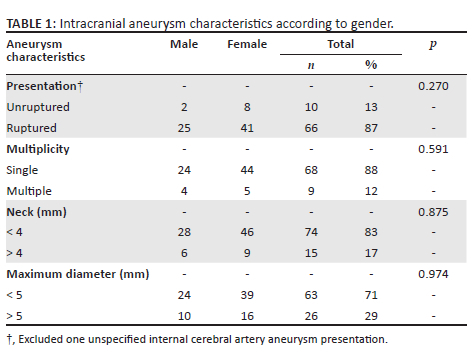
Sixty six patients (87%) presented with ruptured intracranial aneurysms. One patient's mode of presentation was unspecified on the angiogram report and there was no supporting imaging on PACS as the patient was referred from a regional hospital; therefore, the patient was excluded from the statistical analysis according to presentation. A total of 89 aneurysms were detected among the 77 patients. The majority of patients had a single aneurysm (88%), while nine (12%) presented with multiple aneurysms. Most intracranial aneurysms were narrow neck aneurysms (83%). Similarly, the maximum diameter dimensions were less than 5 mm in 83%. There was no statistical significance in presentation, multiplicity, neck and maximum diameter dimensions regardless of gender (Table 1).
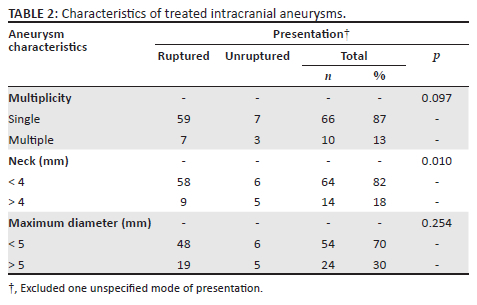
There was no statistical significance in presentation regardless of aneurysm multiplicity and maximum diameter dimensions. Narrow neck aneurysms (< 4 mm) constituted a significant proportion (83%) of aneurysms on presentation (p = 0.01) (Table 2).
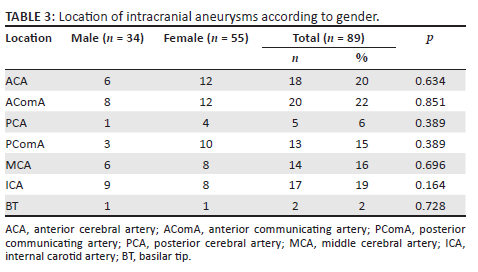
In total, AComA (22%) aneurysms were the most common. Basilar tip aneurysms (2%) accounted for the least common location. Males were mostly affected by ICA (26%) and AComA (24%) aneurysms. Anterior cerebral artery (22%) and AComA (22%) aneurysm locations were equally distributed among females. No statistical significance was demonstrated in intracranial aneurysm location according to gender (Table 3).
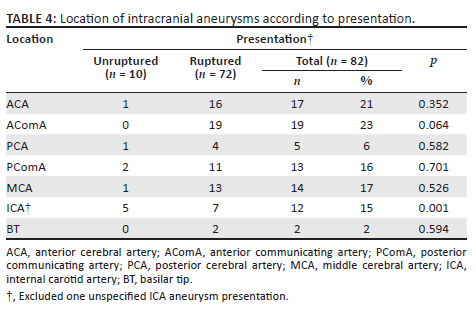
In total, 88% of the study population presented with ruptured intracranial aneurysms (p = 0.02) and of these, AComA aneurysms were the most common (23%). All patients who underwent intervention for AComA aneurysms were ruptured on presentation; however, there was no statistical significance according to location (p = 0.064). The ICA aneurysms demonstrated statistical significance (p = 0.001) according to location (Table 4).
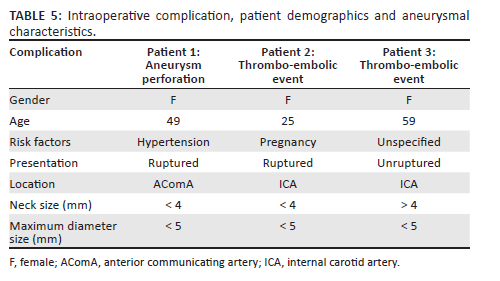
Referring to Table 5, there were three patients who developed intraoperative complications from the total of 82 aneurysms managed endovascularly, yielding a complication rate of approximately 4%. In all three instances, the complications were immediately identified and managed. Two patients presented with no immediate postoperative neurology. The third patient had no records available regarding the immediate neurological status of the patient in the postoperative angiogram report.
Discussion
Consistent with local and international studies, this South African-based population study of patients who underwent endovascular management for intracranial aneurysms demonstrated a female predominance with a male: female ratio of 1:1.8.2,11,14,16,18,21,252,4,151112
There is a high population variance regarding intracranial aneurysm location in the literature, some with a posterior circulation predominance and some with an anterior predominance.14,15,16,23,26
Patients with ruptured aneurysms often present with subarachnoid haemorrhage on initial diagnostic imaging.229
According to the literature, larger aneurysms are an independent risk factor for the risk to rupture. Although the literature is not clear as to the exact dimensions, some studies have reported maximum aneurysm diameters of 6 mm - 7 mm as a guide for the decision to treat.1,17,18,19
Endovascular neuro-intervention has been shown to reduce morbidity and, in some studies mortality, compared to surgical clipping.19,21,23,2428
Limitations
This was a retrospective, single institutional study with a small sample size limiting comparison of the location, aneurysm morphology and larger-sized aneurysm subcategories. In addition, angiogram reports did not include comprehensive documentation of patient risk factors and were primarily dependent on information provided on the patient's request forms for endovascular management. Finally, this study did not investigate long-term clinical outcomes on subsequent follow-up cerebral angiography.
Conclusion
Overall, this study supports known parameters including a female and anterior circulation aneurysm preponderance, and the low complication risk of endovascular management. Interestingly, intracranial aneurysms presented with rupture at smaller size dimensions. Multi-institutional prospective studies are recommended to further investigate aneurysm morphology and risk factor stratification. The findings may influence the decision threshold to treat smaller-sized intracranial aneurysm dimensions and anterior circulation aneurysms in our population.
Competing interests
The authors declare that they have no financial or personal relationships that may have inappropriately influenced them in writing this article.
Authors' contributions
H.C. was the principal investigator responsible for the literature review, data collection, and preparation of the manuscript. T.N. and V.M. were responsible for the research conception and supervisory roles.
Funding information
This research received no grant from any funding agency in the public, commercial or not-for-profit sectors.
Data availability
The data supporting this study's findings are available from the corresponding author, H.C.
Disclaimer
The views and opinions expressed in this article are those of the authors and do not necessarily reflect the official policy or position of any affiliated agency of the authors.
Acknowledgements
The authors would like to acknowledge Dr Z. Zingoni for her review and support in the data analysis.
References
-
1.Thompson BG, Brown RD, Amin-Hanjani S, et al. Guidelines for the management of patients with unruptured intracranial aneurysms: A guideline for healthcare professionals from the American Heart Association/American Stroke Association. Stroke. 2015;46(8):2368-2400. https://doi.org/10.1161/str.0000000000000070
» https://doi.org/10.1161/str.0000000000000070 -
2.Hurford R, Taveira I, Kuker W, Rothwell PM. Prevalence, predictors and prognosis of incidental intracranial aneurysms in patients with suspected TIA and minor stroke: A population-based study and systematic review. J Neurol Neurosurg Psychiatry. 2021;92(5):542-548. https://doi.org/10.1136/jnnp-2020-324418
» https://doi.org/10.1136/jnnp-2020-324418 -
3.Orz Y, AlYamany M. The impact of size and location on rupture of intracranial aneurysms. Asian J Neurosurg. 2015;10(1):26-31. https://doi.org/10.4103/1793-5482.144159
» https://doi.org/10.4103/1793-5482.144159 -
4.Bederson JB, Connolly ES, Batjer HH, et al. Guidelines for the management of aneurysmal subarachnoid hemorrhage: A statement for healthcare professionals from a special writing group of the stroke council, American heart association. Stroke. 2009;40(3): 994-1025. https://doi.org/10.1161/strokeaha.108.191395
» https://doi.org/10.1161/strokeaha.108.191395 - 5.Jersey AM, Foster DM. Cerebral Aneurysm. 2021 May 19. Treasure Island, FL: StatPearls Publishing; 2021.
-
6.Raymond J, Guillemin F, Proust F, et al. Unruptured intracranial aneurysms. Interv Neuroradiol. 2008;14(1):85-96. https://doi.org/10.1177/159101990801400111
» https://doi.org/10.1177/159101990801400111 -
7.Global status report on noncommunicable diseases 2014. Attaining the nine global noncommunicable diseases targets; a shared responsibility [homepage on the Internet]. 2014 [cited 2021 May 02]. Available from: https://apps.who.int/iris/bitstream/handle/10665/148114/9789241564854_eng.pdf.
» https://apps.who.int/iris/bitstream/handle/10665/148114/9789241564854_eng.pdf -
8.Jessica B, Gabriel E, Christelle C. Cardiovascular disease statistics reference document [homepage on the Internet]. 2016 [cited 2021 May 30]. Available from: https://heartfoundation.co.za/
» https://heartfoundation.co.za/ -
9.Jardim TV, Reiger S, Abrahams-Gessel S, et al. Disparities in management of cardiovascular disease in rural South Africa. Circ Cardiovasc Qual Outcomes. 2017;10(11): e004094. https://doi.org/10.1161/circoutcomes.117.004094
» https://doi.org/10.1161/circoutcomes.117.004094 -
10.Kizilkilic O, Albayram S, Adaletli I, et al. Endovascular treatment of ruptured intracranial aneurysms during pregnancy: Report of three cases. Arch Gynecol Obstet. 2003;268(4):325-328. https://doi.org/10.1007/s00404-002-0384-6
» https://doi.org/10.1007/s00404-002-0384-6 -
11.Barbarite E, Hussain S, Dellarole A, Elhammady MS, Peterson E. The Management of Intracranial Aneurysms During Pregnancy: A Systematic Review. Turk Neurosurg. 2016;26(4):465-474. https://doi.org/10.5137/1019-5149.jtn.15773-15.0
» https://doi.org/10.5137/1019-5149.jtn.15773-15.0 -
12.Blignaut G, Loggenberg E, De Vries C. The radiological appearance of intracranial aneurysms in adults infected with the human immunodeficiency virus (HIV). S Afr J Radiol. 2014;18(1):586. https://doi/org.10.4102/sajr.v18i1.586
» https://doi/org.10.4102/sajr.v18i1.586 -
13.Rotim K, Splavski B, Trkanjec Z, Kalousek V, Rotim A, Sajko T. The risk of multiple intracranial aneurysm formation in patients with malignant disease undergoing radiation therapy: A case report and literature review. Acta Clin Croat. 2020;59(2):359-364. https://doi.org/10.20471/acc.2020.59.02.21
» https://doi.org/10.20471/acc.2020.59.02.21 -
14.Louw D, De Vries C, Joubert G. Cerebral aneurysms an audit. S Afr J Radiol. 2004;8(2):a130. https://doi.org/10.4102/sajr.v8i2.130
» https://doi.org/10.4102/sajr.v8i2.130 -
15.Gawlitza M, Soize S, Barbe C, et al. Aneurysm characteristics, study population, and endovascular techniques for the treatment of intracranial aneurysms in a large, prospective, multicenter cohort: Results of the analysis of recanalization after endovascular treatment of intracranial aneurysm study. Am J Neuroradiol. 2019;40(3):517-523. https://doi.org/10.3174/ajnr.a5991
» https://doi.org/10.3174/ajnr.a5991 -
16.Ogeng'o JA, Otieno BO, Kilonzi J, Sinkeet SR, Muthoka JM. Intracranial aneurysms in an African country. Neurol India. 2009;57(5):613-616. https://doi.org/10.4103/0028-3886.57816
» https://doi.org/10.4103/0028-3886.57816 -
17.Renowden S. Interventional neuroradiology. J Neurol Neurosurg Psychiatry. 2005; 76(suppl 3):iii48-iii63. https://doi.org/10.1136/jnnp.2005.075226
» https://doi.org/10.1136/jnnp.2005.075226 -
18.Swartbooi A, Meyer C, De Vries C. Digital subtraction angiography findings and population demographics of patients with subarachnoidal haemorrhage and subsequent causative aneurysms at Universitas Academic Hospital, Bloemfontein. S Afr J Rad. 2016;20(1), a1030. https://doi.org/10.4102/sajr.v20i1.1030
» https://doi.org/10.4102/sajr.v20i1.1030 -
19.Molyneux A, Kerr R, Stratton I, et al. International Subarachnoid Aneurysm Trial (ISAT) of neurosurgical clipping versus endovascular coiling in 2143 patients with ruptured intracranial aneurysms: A randomised trial. Lancet. 2002 26;360(9342):1267-1274. https://doi.org/10.1016/s0140-6736(05)67214-5
» https://doi.org/10.1016/s0140-6736(05)67214-5 -
20.Jiang B, Paff M, Colby GP, Coon AL, Lin LM. Cerebral aneurysm treatment: Modern neurovascular techniques. Stroke Vasc Neurol. 2016;1(3):93-100. https://doi.org/10.1136/svn-2016-000027
» https://doi.org/10.1136/svn-2016-000027 -
21.Lanzino G, Murad MH, D'Urso PI, Rabinstein AA. Coil embolization versus clipping for ruptured intracranial aneurysms: A meta-analysis of prospective controlled published studies. Am J Neuroradiol. 2013;34(9):1764-1768. https://doi.org/10.3174/ajnr.a3515
» https://doi.org/10.3174/ajnr.a3515 -
22.Hua X, Gray A, Wolstenholme J, et al. Survival, dependency, and health-related quality of life in patients with ruptured intracranial aneurysm: 10-year follow-up of the United Kingdom Cohort of the International subarachnoid aneurysm trial. Neurosurgery. 2021;88(2):252-260. https://doi.org/10.1093/neuros/nyaa454
» https://doi.org/10.1093/neuros/nyaa454 -
23.Shao B, Wang J, Chen Y, et al. Clipping versus coiling for ruptured intracranial aneurysms: A meta-analysis of randomized controlled trials. World Neurosurg. 2019;127:e353-e365. https://doi.org/10.1016/j.wneu.2019.03.123
» https://doi.org/10.1016/j.wneu.2019.03.123 -
24.Pierot L, Barbe C, Nguyen HA, et al. Intraoperative complications of endovascular treatment of intracranial aneurysms with coiling or balloon-assisted coiling in a prospective multicenter cohort of 1088 participants: Analysis of recanalization after endovascular Treatment of Intracranial Aneurysm (ARETA) study. Radiology. 2020;295(2):381-389. https://doi.org/10.1148/radiol.2020191842
» https://doi.org/10.1148/radiol.2020191842 -
25.Tetinou F, Kanmounye US, Nitcheu I, Ndajiwo AB. The burden of the management of cerebral aneurysms in Africa: A scoping review. BJS Open [serial online]. 2021 [cited 2021 May 20];5(suppl 1). Available from: https://academic.oup.com/bjsopen/article/5/Supplement_1/zrab032.119/6217255.
» https://academic.oup.com/bjsopen/article/5/Supplement_1/zrab032.119/6217255 - 26.Taylor A, Le Feuvre D. The impact of endovascular treatment on cerebral aneurysm outcome at Groote Schuur Hospital. S Afr Med J. 2004;94(12):977-980.
-
27.Le Feuvre David E, Taylor Allan G. Endovascular cerebral aneurysm treatment: Long-term outcomes. S Afr Med J [serial onine]. 2008 [cited 2021 July 08]; 98(12):954-957. Available from: http://www.scielo.org.za/scielo.php?script=sci_arttext&pid=S0256-95742008001200019&lng=en.
» http://www.scielo.org.za/scielo.php?script=sci_arttext& pid=S0256-95742008001200019& lng=en -
28.Sharma DP, Singh D, Jagetia A, Singh H, Tandon M, Ganjoo P. Intra procedure rupture of intracranial aneurysm during endovascular coiling: Neurosurgeons' experience and review of the literature. Neurol India. 2011;59(5):690-695. https://doi.org/10.4103/0028-3886.86542
» https://doi.org/10.4103/0028-3886.86542 -
29.Vlak MH, Algra A, Brandenburg R, Rinkel GJ. Prevalence of unruptured intracranial aneurysms, with emphasis on sex, age, comorbidity, country, and time period: A systematic review and meta-analysis. Lancet Neurol. 2011;10(7):626-636. https://doi.org/10.1016/s1474-4422(11)70109-0
» https://doi.org/10.1016/s1474-4422(11)70109-0

Accepted: 11 Apr. 2023
Published: 26 May 2023