Pneumomastia following subdermal upper arm helium contouring treatment
Abstract
A case is presented of extensive pneumomastia seen on a screening mammogram of an asymptomatic patient who had helium plasma treatment 2 weeks earlier for flabby upper arms. CONTRIBUTION: Rare complications of subcutaneous emphysema, following helium plasma treatment, have been discussed to highlight that such emphysema is usually self-limiting.
mammogram; subcutaneous emphysema; J-Plasma; Renuvion device; fascial planes
Introduction
Gas in the breast (pneumomastia), after interventional breast procedures, is a common occurrence.1,211,23445467
This report describes a case of gas visualised on a screening mammogram of a patient who underwent treatment for flabby arms 2 weeks earlier. To the best of our knowledge, there are no cases in the literature of gas visualised in the breasts following this novel treatment.
Ethical considerations
This article followed all ethical standards for research. Written consent was obtained from the patient.
Patient presentation
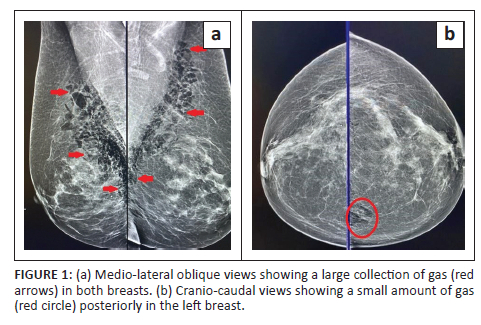
A 73-year-old woman, with an unremarkable history, presented for her annual screening mammogram. The examination of both breasts was performed using a Siemens Mammomat Revelation system together with 3D tomosynthesis. Her mammogram images are presented in Figure 1a and b. There is a large collection of gas in the anterior and posterior aspects of both breasts as shown in the medio-lateral oblique (MLO) views in Figure 1a. There is a small amount of gas posteriorly in the left cranio-caudal (CC) view in Figure 1b. There was no evidence of micro-calcification or carcinoma. The patient did not complain of pain during compression of her breasts. She had screening mammograms in September 2022 and May 2021 where no abnormalities were noted.
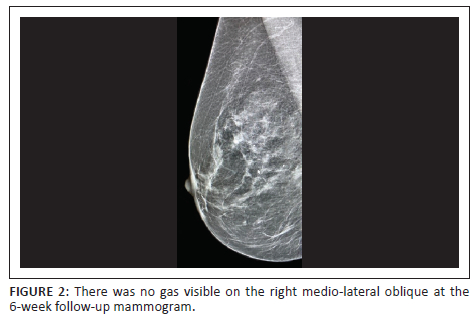
In order to establish a reason for the gas, she was questioned about any recent procedures. She stated that she had a bilateral brachioplasty procedure 2 weeks earlier. The procedure was vibration amplification of sound energy at resonance (VASER)-assisted liposuction, coupled with Renuvion skin tightening by J-Plasma for skin retraction. Being asymptomatic, she was managed conservatively, and a 6-week follow-up right MLO mammogram (Figure 2) showed no evidence of the previously visualised gas.
Discussion
Vibration amplification of sound energy at resonance liposuction4,891010111213,14
Complications reported in the literature occurred shortly after liposuction and body contouring treatment. Kim et al.1546
In the presented case, the patient did not experience any pain or discomfort; hence she was unaware of the presence of gas in her breasts when undergoing a screening mammogram 2 weeks after her brachioplasty (Figure 1). As described above, the use of helium is introduced by means of a Renuvion cannula into small skin incisions.10,1116Figure 2, there was no evidence of gas 6 weeks after the initial mammogram.
Conclusion
This case underscores the important role of questioning patients in order to consider possible causes of gas in the subcutaneous tissue. A procedural complication, of no clinical concern, was observed on a screening mammogram. There was a collection of gas in the superior and posterior aspects of both breasts. The patient had no symptoms or complaints during the examination. She was unaware of the presence of gas, but on questioning, she reported having undergone liposuction together with the use of Renuvion (J-Plasma) to her upper arms 2 weeks before the mammogram. With the increasing use of this treatment, it is suggested that there may be more cases of surgical emphysema. It is evident that the complication in this case was self-limiting as the gas had resorbed when a 6-week follow-up single-view mammogram was performed.
Competing interests
The authors declare that they have no financial or personal relationships that may have inappropriately influenced them in writing this case report.
Authors' contributions
J.H.B. and J.L. contributed equally to this work.
Funding information
This research received no specific grant from any funding agency in the public, commercial or not-for-profit sectors.
Data availability
The authors confirm that the data supporting the findings of this study are available within the case report.
Disclaimer
The views and opinions expressed in this case report are those of the authors and are the product of professional research. It does not necessarily reflect the official policy or position of any affiliated institution, funder, agency or that of the publisher. The authors are responsible for this case report's results, findings and content.
Acknowledgements
References
-
1.Green DH. An unusual case of pneumomastia: Mammographic appearances. BMJ Case Rep. 2011;2011:bcr0320102852. https://doi.org/10.1136/bcr.03.2010.2852
» https://doi.org/10.1136/bcr.03.2010.2852 -
2.Entezari P, Scheel JR. Unknown case #8 diagnosis: Pneumomastia. J Breast Imaging. 2020;2(4):e4-e5. https://doi.org/10.1093/jbi/wbz069
» https://doi.org/10.1093/jbi/wbz069 -
3.Paulraj S, Ashok KP, Sekhon N, Gambhir HSS. Air in the breast: A rare cause of iatrogenic pneumomastia. Cureus. 2020;12(6):e8447. https://doi.org/10.7759/cureus.8447
» https://doi.org/10.7759/cureus.8447 -
4.Lim JY, Javed MU, Pilch W, Ibrahim A, Harbison J. Widespread subcutaneous emphysema after J-Plasma therapy. Am J Cosmetic Surg. 2021;38(1):24-26. https://doi.org/10.1177/0748806820947906
» https://doi.org/10.1177/0748806820947906 -
5.Brown NF, Wong-Taylor L, Beckles M. Subcutaneous emphysema. BMJ. 2011;343:d5843. https://doi.org/10.1136/sbmj.d5843
» https://doi.org/10.1136/sbmj.d5843 -
6.Alqahtani M, Mahabbat N, Fayi K. Rare complication of coupled VASER liposuction and Renuvion technologies: Acase report. Case reports plast. Surg Hand Surg. 2023;10(1):2181175. https://doi.org/10.1080/23320885.2023.2181175
» https://doi.org/10.1080/23320885.2023.2181175 -
7.Kipling M, Christou C, Barthelmes L. Pneumomastia: A rare cause of breast swelling. Breast Care (Basel). 2013;8(3):218-219. https://doi.org/10.1159/000352098
» https://doi.org/10.1159/000352098 -
8.Hoyos AE, Millard JA. VASER-assisted high-definition liposculpture. Aesthetic Surg J. 2007;27(6):594-604. https://doi.org/10.1016/j.asj.2007.08.007
» https://doi.org/10.1016/j.asj.2007.08.007 -
9.Ruff PG, Bharti G, Hunstad J, et al. Safety and efficacy of Renuvion helium plasma to improve the appearance of loose skin in the neck and submental region. Aesthetic Surg J. 2023;43(10):1174-1188. https://doi.org/10.1093/asj/sjad055
» https://doi.org/10.1093/asj/sjad055 -
10.Shridharani SM, Kennedy ML. Safety of helium-based plasma technology for coagulation of soft tissue: A retrospective review. Aesthetic Surg J Open Forum. 2022;4:ojac081. https://doi.org/10.1093/asjof/ojac081
» https://doi.org/10.1093/asjof/ojac081 -
11.Gentile RD. Renuvion/J-Plasma for subdermal skin tightening facial contouring and skin rejuvenation of the face and neck. Facial PlastSurgClin North Am. 2019;27(3):273-290. https://doi.org/10.1016/j.fsc.2019.03.001
» https://doi.org/10.1016/j.fsc.2019.03.001 -
12.Doolabh V. A Single-site postmarket retrospective chart review of subdermal coagulation procedures with Renuvion. Plast Reconstr Surg Glob Open. 2019;7(11):e2502. https://doi.org/10.1097/GOX.0000000000002502
» https://doi.org/10.1097/GOX.0000000000002502 -
13.Cuzalina A, Tolomeo PG. A retrospective study to evaluate the efficacy of a plasma energy system (Renuvion) in the management of skin laxity to improve tightening at the time of standard liposuction of the arms. Am Cosmetic Surg. 2022;39(2):115-122. https://doi.org/10.1177/07488068211031096
» https://doi.org/10.1177/07488068211031096 -
14.Ibrahiem SM. Aesthetic nonexcisional arm contouring. Aesthetic Surg J. 2022;42(7):NP463-NP473. https://doi.org/10.1093/asj/sjac031
» https://doi.org/10.1093/asj/sjac031 -
15.Kim KT, Sun H, Chung EH. Traumatic subcutaneous emphysema after liposuction. Arch Craniofac Surg. 2019;20(3):199-202. https://doi.org/10.7181/acfs.2018.02355
» https://doi.org/10.7181/acfs.2018.02355 -
16.Rehnke RD, Groening R, Van Buskirk E, Clarke JM. Anatomy of the superficial fascia system of the breast: A comprehensive theory of breast fascial anatomy. Plastic Reconstruct Surg. 2018;142(5):1135-1144. https://doi.org/10.1097/PRS.0000000000004948
» https://doi.org/10.1097/PRS.0000000000004948

Accepted: 14 Apr. 2024
Published: 24 July 2024