Clinical and psychological changes associated with music listening in haemodialysis patients: A prospective study
Abstract
BACKGROUND: Chronic kidney disease (CKD) is a progressive condition associated with high morbidity and mortality. Haemodialysis (HD) patients experience significant psychological and physiological stress. Non-pharmacological interventions such as music listening sessions can alleviate anxiety and depression without drug-related side effects AIM: This study was conducted to evaluate the effects of music therapy on psychological well-being and selected biochemical parameters in HD patients SETTING: This study was conducted with 49 HD patients at the Dialysis Unit of Harran University Faculty of Medicine between May and July 2025 METHODS: All patients underwent a 4-week music listening programme (12 sessions, each session consisting of 30 min of traditional music). Psychological status was assessed before and after the intervention using the Beck Anxiety and Depression Inventories. Biochemical parameters and dialysis efficiency indicators were also recorded. Data were analysed using the Wilcoxon Signed-Rank Test RESULTS: Significant decreases were observed in anxiety and depression scores (p < 0.001). Biochemical analyses showed significant changes in sodium (p < 0.001), calcium (p = 0.002), glucose (p = 0.024) and albumin (p < 0.001) levels. No significant changes were observed in dialysis efficiency indicators CONCLUSION: Music listening sessions administered during HD sessions improved patients' psychological state and affected selected biochemical parameters. This is a safe, cost-effective, complementary intervention that may increase comfort and potentially improve physiological outcomes CONTRIBUTION: This study highlights the potential of music listening sessions as an adjunct to conventional treatments in HD care
chronic kidney disease; haemodialysis; music; anxiety; depression; biochemical parameters
Introduction
Chronic kidney disease (CKD) is a progressive condition characterised by a gradual decline in kidney function, representing a significant medical, social and economic burden with high morbidity and mortality rates.1223
Haemodialysis (HD) is a life-sustaining treatment for patients with CKD, yet it poses numerous psychological and physical challenges. Individuals undergoing HD frequently report heightened anxiety, discomfort and stress, stemming not only from the procedure itself but also from the broader impact of living with a chronic condition. Typical complications include sleep disturbances, muscle cramps, itching and fluctuations in blood pressure and heart rate, all of which may compromise patient comfort and treatment effectiveness, ultimately diminishing quality of life and increasing the likelihood of negative health outcomes.4567869,10,1112,13,144,5,6,7,8,9,10,11,12,13,14,15
Research methods and design
This interventional study included all patients receiving routine HD at the Dialysis Unit of Harran University Faculty of Medicine Hospital. No sampling method was employed; all patients were included (n = 49). Data were collected face to face between May and July 2025. The data collection instrument comprised two sections. The first section gathered demographic information, including age, gender and aetiology of dialysis. The second section included the Beck Depression Inventory (BDI) and Beck Anxiety Inventory (BAI). The BDI contains 21 items: 2 for emotions, 11 for cognition, 2 for behaviour, 5 for somatic symptoms and 1 for interpersonal concerns. Each item is scored from 0 to 3, yielding a total score of 0-63. Scores were interpreted as follows: 0-9 minimal depression, 10-18 mild, 19-29 moderate and 30-63 severe.1617,181920
All stages of this research were carried out solely by the author without any external assistance. The freely available OpenAI GPT-4o tool was used in a very limited capacity. Its use was confined to minor tasks such as paragraph formatting, section separation, standardisation of reference formatting, suggesting synonyms for no more than 10 words and correcting a few typographical errors.
Ethical considerations
Ethical approval was granted by Harran University Clinical Research Ethics Committee (Approval Number: HRÜ/25.03.55). Written informed consent was obtained from all participants. Measures to ensure confidentiality included anonymising data and secure storage. This study involved human participants and was conducted in accordance with the ethical guidelines of the Helsinki Declaration.
Results
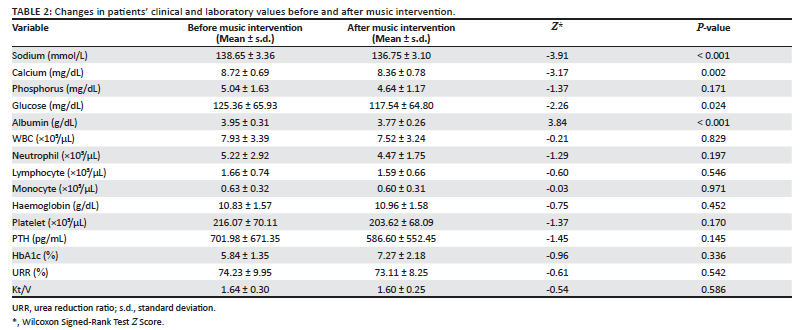
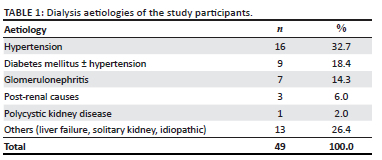
Of the participants, 44.9% (n = 22) were female. The median age of the patients was 61 ± 2.52 years (range: 20-87), and the median duration of dialysis was 48 ± 8.04 months (range: 1-192). Among the patients, 55.1% (n = 27) were undergoing HD via arteriovenous fistula (AVF), while the remainder were dialysed through tunnelled dialysis catheters. Regarding the aetiologies leading to dialysis, hypertension accounted for 32.7%, idiopathic causes for 22.4% and glomerulonephritis for 14.3%, with other causes and their frequencies detailed in Table 1. The changes in patients' clinical and laboratory values before and after the music intervention were examined. Statistically significant changes were observed in sodium, calcium, glucose and albumin concentrations (p = 0.001, p = 0.002, p = 0.024 and p =0.001, respectively). Changes in other measured parameters were not statistically significant and are presented in Table 2. Patients' anxiety and depression experiences, measured using the BAI and BDI before and after the music intervention, are presented in Table 3. The observed changes were found to be statistically significant for both measures (p = 0.001 for both).
Discussion
This study aimed to evaluate the associations between music listening during the HD process and patients' psychological states as well as certain biochemical parameters. Our findings demonstrated that music listening was associated with reductions in the extent of anxiety and depression experiences and coincided with changes in some biochemical concentrations. In our study, music listening was associated with significant reductions in the extent of anxiety and depressive experiences, as measured by the Beck Anxiety and Depression Inventories (both p = 0.001). This effect can be explained by music's relaxing, attention-diverting and mood-regulating properties. Additionally, music may influence the limbic system and be associated with a reduction in the release of stress hormones.21222324
These findings collectively indicate possible associations between musical exposure and physiological regulation although causal mechanisms remain to be established. Moreover, the individualised approach emphasised in these meta-analyses represents an important factor to consider in clinical practice to support treatment effectiveness.25,26
In this study, participants listened to traditional Turkish music during HD sessions. This intervention does not constitute clinical music therapy, and its therapeutic effects were not formally established.
Limitations of the study
This study has several limitations. Firstly, it was conducted at a single centre with a relatively small sample size (n = 49), which limits the generalisability of the findings. Secondly, music listening was applied using only a specific type of music, and the effects of other music genres or individually selected music could not be evaluated. Thirdly, only short-term effects were examined, and no information was obtained regarding long-term psychological or physiological outcomes. Additionally, pre- and post-music listening blood pressure measurements could not be collected, which limited the assessment of physiological responses. Furthermore, patients' music listening habits or cultural differences were not considered. Fourthly, changes observed in biochemical parameters may not be solely attributable to music listening, as physiological fluctuations related to dialysis sessions could also have contributed. Additionally, the intervention was implemented by a medical doctor without formal training in music listening, which may limit the standardisation of the procedure. Moreover, causal inferences cannot be drawn due to the absence of a control group.
Conclusion
In conclusion, music listening applied during HD provides beneficial effects on both psychological well-being and certain clinical parameters. Music listening represents a low-cost, safe and highly feasible complementary method in dialysis centres. Supporting such interventions is important for enhancing patient comfort and psychological well-being in clinical practice. Music reduces stress levels, modulating the autonomic nervous system and hormonal regulation, which could in turn contribute to improved physiological balance. Our study, consistent with findings in the literature, supports the psychological and physiological benefits of music listening during HD. Therefore, music listening may serve as a valuable complementary approach integrated into chronic treatment regimens to optimise patient care. Future studies should include larger sample sizes, randomised controlled designs and different musical genres to validate these findings and explore long-term outcomes.
Competing interests
The authors declare that they have no financial or personal relationships that may have inappropriately influenced them in writing this article.
CRediT authorship contribution
Fatma Zehra AĞAN: Conceptualisation, Methodology, Investigation, Writing - original draft, Project administration, Resources, Funding acquisition. Çiğdem Cindoğlu: Conceptualisation, Methodology, Writing - original draft, Resources, Supervision, Funding acquisition. Neriman Sila KOÇ: Conceptualisation, Methodology, Writing - review & editing. Ülker Fedai: Conceptualisation, Methodology, Writing - review & editing. Burcu Beyazgül: Methodology, Formal analysis, Writing - review & editing. Ceylan Keskin: Data curation. Veysel Ağan: Data curation, Writing - review & editing.
All authors reviewed the article, contributed to the discussion of results, approved the final version for submission and publication and take responsibility for the integrity of its findings.
Funding information
This research received no specific grant from any funding agency in the public, commercial or not-for-profit sectors.
Data availability
The data that support the findings of this study are available from the corresponding author, Fatma Zehra Ağan, upon reasonable request.
Disclaimer
The views and opinions expressed in this article are those of the authors and are the product of professional research. It does not necessarily reflect the official policy or position of any affiliated institution, funder, agency or that of the publisher. The authors are responsible for this article's results, findings and content.
Acknowledgements
References
-
1. Miguel V, Kramann R. Metabolic reprogramming heterogeneity in chronic kidney disease. FEBS Open Bio. 2023;13(7):1154-1163. https://doi.org/10.1002/2211-5463.13568
» https://doi.org/10.1002/2211-5463.13568 -
2. Jones A, Swan D, Lisman T, Barnes GD, Thachil J. Anticoagulation in chronic kidney disease: Current status and future perspectives. J Thromb Haemost. 2024;22(2):323-336. https://doi.org/10.1016/j.jtha.2023.09.020
» https://doi.org/10.1016/j.jtha.2023.09.020 -
3. Kalantar-Zadeh K, Jafar TH, Nitsch D, Neuen BL, Perkovic V. Chronic kidney disease. Lancet. 2021;398(10302):786-802. https://doi.org/10.1016/S0140-6736(21)00519-5
» https://doi.org/10.1016/S0140-6736(21)00519-5 -
4. Lin F, Chen L, Gao Y. Music therapy in hemodialysis patients: Systematic review and meta-analysis. Complement Ther Med. 2024;86:103090. https://doi.org/10.1016/j.ctim.2024.103090
» https://doi.org/10.1016/j.ctim.2024.103090 -
5. Nagy E, Tharwat S, Elsayed AM, Shabaka SAE, Nassar MK. Anxiety and depression in maintenance hemodialysis patients: Prevalence and their effects on health-related quality of life. Int Urol Nephrol. 2023;55(11):2905-2914. https://doi.org/10.1007/s11255-023-03556-7
» https://doi.org/10.1007/s11255-023-03556-7 -
6. Yonata A, Islamy N, Taruna A, Pura L. Factors affecting quality of life in hemodialysis patients. Int J Gen Med. 2022;15:7173-7178. https://doi.org/10.2147/IJGM.S375994
» https://doi.org/10.2147/IJGM.S375994 -
7. Pompili M, Venturini P, Montebovi F, et al. Suicide risk in dialysis: Review of current literature. Int J Psychiatry Med. 2013;46(1):85-108. https://doi.org/10.2190/PM.46.1.f
» https://doi.org/10.2190/PM.46.1.f -
8. Zerbinati L, Caccia F, Baciga F, et al. Suicide risk in patients undergoing hemodialysis: A systematic review and meta-analysis of prevalence. Ren Fail. 2025;47(1):2521453. https://doi.org/10.1080/0886022X.2025.2521453
» https://doi.org/10.1080/0886022X.2025.2521453 -
9. Bullen A, Awdishu L, Lester W, Moore T, Trzebinska D. Effect of acupuncture or massage on health-related quality of life of hemodialysis patients. J Altern Complement Med. 2018;24(11):1069-1075. https://doi.org/10.1089/acm.2018.0030
» https://doi.org/10.1089/acm.2018.0030 -
10. Silletti A, Guzzo I, Mastrolorenzo A, Piga S, Atti MCD, Grimaldi Capitello T. Effects of live music during hemodialysis treatments in pediatric patients. J Nephrol. 2023;36(7):2071-2079. https://doi.org/10.1007/s40620-023-01717-6
» https://doi.org/10.1007/s40620-023-01717-6 -
11. Chu SWF, Yeam CT, Low LL, Tay WY, Foo WYM, Seng JJB. The role of mind-body interventions in pre-dialysis chronic kidney disease and dialysis patients - A systematic review of literature. Complement Ther Med. 2021;57:102652. https://doi.org/10.1016/j.ctim.2020.102652
» https://doi.org/10.1016/j.ctim.2020.102652 -
12. Watkins GR. Music therapy: Proposed physiological mechanisms and clinical implications. Clin Nurse Spec. 1997;11(2):43-50. https://doi.org/10.1097/00002800-199703000-00003
» https://doi.org/10.1097/00002800-199703000-00003 -
13. Lin Y-J, Lu K-C, Chen C-M, Chang C-C. The effects of music as therapy on the overall well-being of elderly patients on maintenance hemodialysis. Biol Res Nurs. 2011;14(3):277-285. https://doi.org/10.1177/1099800411413259
» https://doi.org/10.1177/1099800411413259 -
14. Cantekin I, Tan M. The influence of music therapy on perceived stressors and anxiety levels of hemodialysis patients. Renal Fail. 2013;35(1):105-109. https://doi.org/10.3109/0886022X.2012.736294
» https://doi.org/10.3109/0886022X.2012.736294 -
15. Ba X, Li X, Zhang Z, Liu W. Effect of music therapy on the psychological well-being of maintenance hemodialysis patients: A retrospective study. Noise Health. 2024;26(121):192-197. https://doi.org/10.4103/nah.nah_56_24
» https://doi.org/10.4103/nah.nah_56_24 -
16. Beck AT. An inventory for measuring depression. Arch Gen Psychiatry. 1961;4(6):561-571. https://doi.org/10.1001/archpsyc.1961.01710120031004
» https://doi.org/10.1001/archpsyc.1961.01710120031004 - 17. Teğin B. Cognitive processes in depression: An examination according to the Beck model. J Psychol. 1987;6:116-121.
- 18. Hisli N. Validity and reliability of the Beck Depression Inventory for university students. J Psychol. 1989;7:13.
-
19. Beck AT, Epstein N, Brown G, Ster RA. An inventory for measuring clinical anxiety: Psychometric properties. J Consult Clin Psychol. 1988;56(6):893-897. https://doi.org/10.1037/0022-006X.56.6.893
» https://doi.org/10.1037/0022-006X.56.6.893 - 20. Ulusoy M, Şahin NH, Erkmen H. Turkish version of the Beck Anxiety Inventory: Psychometric properties. J Cognit Psychother. 1996;12(2):163-172.
-
21. Zaatar MT, Alhakim K, Enayeh M, Tamer R. The transformative power of music: Insights into neuroplasticity, health, and disease. Brain Behav Immun Health. 2023;35:100716. https://doi.org/10.1016/j.bbih.2023.100716
» https://doi.org/10.1016/j.bbih.2023.100716 -
22. Bradt J, Dileo C, Myers-Coffman K, Biondo J. Music interventions for improving psychological and physical outcomes in people with cancer. Cochrane Database Syst Rev. 2021;10(10):CD006911. https://doi.org/10.1002/14651858.CD006911
» https://doi.org/10.1002/14651858.CD006911 -
23. Ferrer AJ. The effect of live music on decreasing anxiety in patients undergoing chemotherapy treatment. J Music Ther. 2007;44(3):242-255. https://doi.org/10.1093/jmt/44.3.242
» https://doi.org/10.1093/jmt/44.3.242 -
24. Lee OK, Chung YF, Chan MF, Chan WM. Music and its effect on the physiological responses and anxiety levels of patients receiving mechanical ventilation: A pilot study. J Clin Nurs. 2005;14(5):609-620. https://doi.org/10.1111/j.1365-2702.2004.01103
» https://doi.org/10.1111/j.1365-2702.2004.01103 -
25. De Witte M, Aalbers S, Vink A, et al. Music therapy for the treatment of anxiety: A systematic review with multilevel meta-analyses. EClinicalMedicine. 2025;84:103293. https://doi.org/10.1016/j.eclinm.2025.103293
» https://doi.org/10.1016/j.eclinm.2025.103293 -
26. Tang Q, Huang Z, Zhou H, Ye P. Effects of music therapy on depression: A meta-analysis of randomized controlled trials. PLoS One. 2020;15(11):e0240862. https://doi.org/10.1371/journal.pone.0240862
» https://doi.org/10.1371/journal.pone.0240862

Accepted: 28 Nov. 2025
Published: 20 Jan. 2026