Alcohol use among high school learners in rural areas of Limpopo province
Abstract
BACKGROUND: Alcohol use is a serious public health concern among youth in South Africa and worldwide. AIM: To determine the factors contributing to alcohol use among high school learners in the rural areas of Limpopo province. SETTING: The Greater Marble-Hall municipality, Sekhukhune district in Limpopo province. METHOD: A quantitative, cross-sectional study design was conducted on 314 learners from three high schools in a rural area in Limpopo. A stratified random sampling technique was used to select learners from 11 to 25 years of age. The drinking behaviour was classified according to predetermined Alcohol Use Disorders Identification Test (AUDIT). Data were analysed using SPSS Software v23.0. RESULTS: More than half of the respondents were consuming alcohol 169 (53.8%). Also, 173 (55.1%) of respondents had parents who consume alcohol and 204 (65%) had friends who drank alcohol. Most respondents were classified as low-risk drinkers (AUDIT score < 8) and a quarter of the respondents were classified as almost dependent on alcohol (AUDIT score > 13). Significant associations were found between learners' alcohol consumption and parents and friends who drank alcohol (p = 0.000; p = 0.000, respectively CONCLUSION: Alcohol use was prevalent among high school learners in the area under investigation. Also, learners who had parents and friends who consume alcohol were more likely to consume alcohol. Further, learners who were classified as almost dependent on alcohol needed urgent intervention as their health-related quality of life was likely to be poor.
alcohol abuse; audit; alcohol dependence; highs; rural areas; high school learners; drinking behaviour
Introduction
Alcohol use among young and old people is one of the most significant public health and social problems worldwide.1,23444435456
World Health Organization44789101,1112131314159
Limpopo province is largely rural and alcohol (all types including traditionally brewed alcohol) is used mostly in traditional and cultural practices and rituals. This sometimes exposes adolescents to alcohol use at a young age.1016
Methods
Study method
The study utilised a quantitative approach and a cross-sectional research design. Data were collected in three high schools in Toitskraal, a rural area in Limpopo province. These schools are situated in deep rural areas of the Greater Marble-Hall municipality, Sekhukhune district. These schools cater for learners from low socio-economic backgrounds. Ethical clearance was obtained from the Ethics Committee of the University (TREC:116/2015:PG) and permission to collect data was also obtained from the Department of Education. A written consent letter was signed by parents and a written assent letter was signed by learners.
The study participants
A total of 314 learners were sampled from a population of 1030 learners from grade eight to grade 12 from all three high schools in Toitskraal. Only learners who were enrolled from grade eight to grade 12 during data collection and learners with parental consent and who assented to participate were included in the study. A stratified random sampling technique was used to select participants from those learners who consented and assented per school and per grade. Thus the population was known in line with Krejicie and Morgan,17 a table for determining the sample size was used.
Data collection
Data were collected using a close-ended questionnaire containing 15 questions over a period of 2 months.
It was developed in English and translated to Sepedi. It included two sections: sociodemographic profile and WHO's AUDIT. The questionnaire was completed by learners during their free periods, lunch breaks and after school to ensure that there were no interruptions of scheduled programmes. The questionnaire was checked for completeness on submission and no missing data on submitted questionnaires. Reliability of the instrument was ensured through pilot testing because this was a pre-validated tool; its reliability has been reported to be 1.0 which makes it a reliable instrument to assess alcohol use. The pre-validated standard WHO-AUDIT Questionnaire was used.
The AUDIT is a 10-question screening tool developed by the WHO and it is used for detection of risky and high-risk alcohol drinking. Alcohol Use Disorders Identification Test classifies levels of drinking into four categories: mainly low risk, risky, high-risk and almost dependent.
Data analysis
Data were loaded into and analysed using Statistical Package for the Social Science 23.0 software.
Descriptive and inferential statistical analysis was carried out. From AUDIT scores: a score of less than 8 is associated with low risk drinking, a score of 8 or more indicates harmful or hazardous drinking, a score of 13 or more in women and 15 or more in men indicates alcohol dependence. A Chi-squared test was used to determine associations between variables. The binary logistical regression analysis was used to calculate odds ratios and predictors of alcohol use among adolescents at 95% confidence interval.
Ethical consideration
The authors declare that they obtained ethical clearance (TREC/116/2015:PG); parental consent and assent prior to data collection.
Results
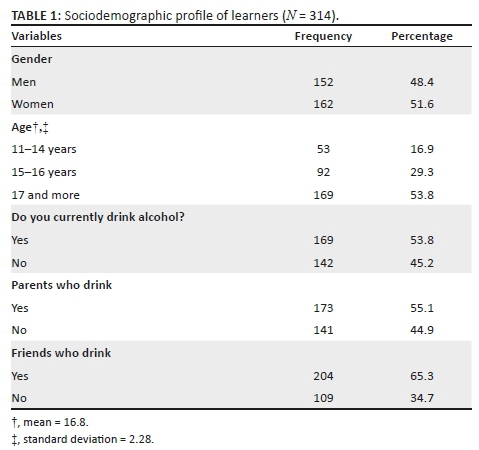
Table 1 describes the sociodemographic data of learners who participated in the study. Of the 314 learners, 152 (48.4%) were men and 53.8% were greater than or equal to 17 years of age. Furthermore, 173 (55.1%) of the learners reported that they had parents who drink alcohol and 204 (65%) reported that they had friends who drink alcohol. On self-drink, 169 (53.8%) of respondents currently drink alcohol and 142 (45.2%) did not drink alcohol.
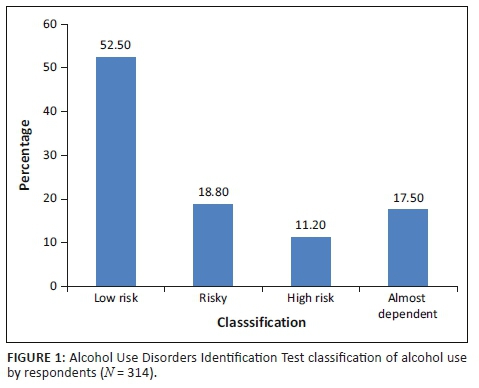
Figure 1 shows that most respondents 164 (52.5%) were low-risk drinkers (AUDIT scores < 8) followed by 59 (18.8%) who were risky drinkers (AUDIT scores 8-12) and 54 (17.5%) were almost dependent drinkers (AUDIT scores > 12).
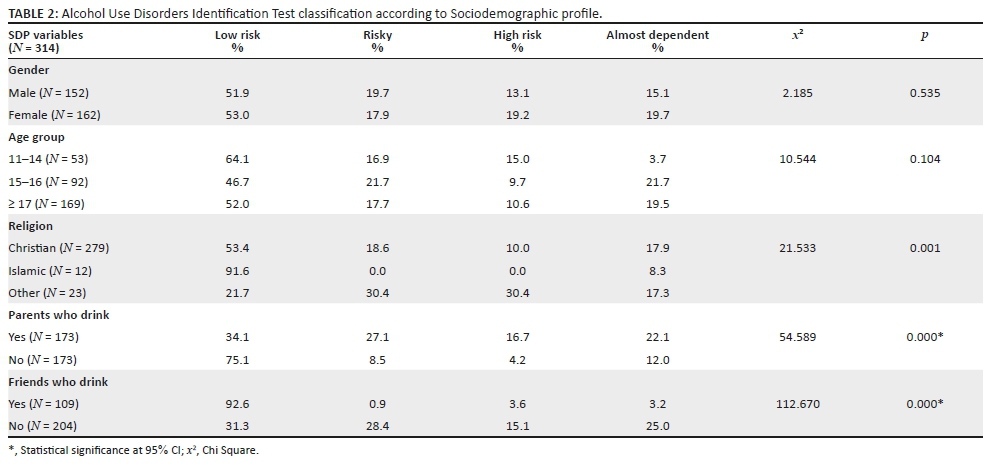
Table 2 shows alcohol consumption in terms of socio-demographic profile. There was no significant association between genders and age of the respondents and AUDIT classification of alcohol drinking (p = 0.535). In terms of religion, there was a significant association (p = 0.001). There was a significant association between alcohol consumption; parents and friends who drink alcohol (p = 0.001; p = 0.001). This means that having parents who drink alcohol is likely to influence an individual to follow the pattern.
Table 3 shows that parents who drink and friends who drink were significant predictors of drinking behaviours of learners and not gender (OR = 1.042, 2.321; p = 0.000; 0.000), respectively.
Discussion
Our results revealed that the majority of learners were between 17 and 25 years of age implying that they are at a stage characterised by many social, emotional and physical pressures.918192021,22
Rural areas are characterised by limited educational and recreational facilities232425262727
Studies have consistently shown that men consume more alcohol and have more alcohol-related problems than women.2,209,20,28,292626262630,31
Evidence suggests that the use of alcohol constitutes one of the most risk-taking forms of behaviour among adolescents in secondary schools.13,32333435
Factors that contribute to adolescent drinking were also investigated in this study. We found that more than two-thirds of the respondents have friends who drink alcohol. This means that having friends who drink alcohol significantly increases the likelihood of an individual to drink alcohol as well.243621,3721,24,36,371
Limitations of the study
The population in this study comprised high school learners from three schools in one village of Limpopo province. This has implications for the generalisability of the findings for the province. The self-reported data are subject to bias as respondents could have over or under-reported their rate of alcohol use.
Conclusion
This study revealed that over half of learners drink alcohol and they were risky drinkers; a few were almost dependent on alcohol. We conclude that alcohol use is highly prevalent among high school learners and alcohol dependence is becoming a threat at a very early age in this rural area of the Limpopo province. Peer and parental factors were also found to be significant predictors of alcohol use among adolescents in this study.
Recommendations
We, therefore, recommend that interventions to prevent and reduce alcohol use and all factors influencing alcohol use among adolescents be investigated to inform any type of intervention. The Department of Education should intensify the implementation of school-based alcohol prevention programmes. This drive should also include community mobilisation to assist in regulating the opening and closing hours of taverns nearer to schools.
Competing interests
The authors have declared that no competing interests exist.
Authors' contributions
L.S. conceptualised the article and analysed data and contributed 60%; O.M.M. collected data and writing of the article and contributed 30% and S.L.S. assisted with literature and proofreading of the article and contributed 10%.
Funding
VLIR-IOUS provided financial assistance for data collection and editing of the article.
Data availability statement
Data sharing is not applicable to this article as no new data were created or analysed in this study.
Disclaimer
The views and opinions expressed in this article are those of the authors and do not necessarily reflect the official policy or position of any affiliated agency of the authors.
Acknowledgements
References
-
1.Chauke TM, Van der Heever H, Hoque ME. Alcohol use amongst learners in rural high school in South Africa. Afr J Prim Health Care Fam Med. 2015;7(1):1-6. https://doi.org/10.4102/phcfm.v7i1.755
» https://doi.org/10.4102/phcfm.v7i1.755 -
2.Schulte MT, Monreal TK, Kia-Keating M, Brown SA. Influencing adolescent social perceptions of alcohol use to facilitate change through a school-based intervention. J Child Adolesc Subst Abuse. 2010;19(5):372-390. https://doi.org/10.1080/1067828X.2010.515877
» https://doi.org/10.1080/1067828X.2010.515877 -
3.National Council on Alcohol and Drug Dependence. Under-age drinking [homepage on the Internet]. 2015 [cited 2015 Jan 30]. Available from: https://ncadd.org/for-youth/underage-and-college
» https://ncadd.org/for-youth/underage-and-college -
4.World Health Organisation. Management of substance abuse. Global status report on alcohol and health [homepage on the Internet]. 2011 [cited 2019 Apr 13]. Available from: www.who.int/substance_abuse/publications/alcohol_2011/en.
» www.who.int/substance_abuse/publications/alcohol_2011/en -
5.World Health Organisation. Management of substance abuse. Global status report on alcohol and health [homepage on the Internet]. 2014 [cited 2015 Oct 23]. Available from: www.who.int/substance_abuse/publications/alcohol_2011/en.
» www.who.int/substance_abuse/publications/alcohol_2011/en -
6.World Health Organisation. Alcohol use and sexual risk behaviour: A cross-cultural study in eight provinces [homepage on the Internet]. 2005 [cited 2015 Mar 23]. Available from: http://www.who.int/substance_abuse/publications/alcohol_sexual_risk_crosscultural.pdf.
» http://www.who.int/substance_abuse/publications/alcohol_sexual_risk_crosscultural.pdf - 7.Makhubele J. Social exclusion as a contributing factor for the addition of harmful substances to home-made alcohol: The case of Mopani District in Limpopo Province, South Africa. Afr J Drug Alcohol Stud. 2012;11(1): 17-27.
-
8.Seggie J. Alcohol and South Africa's youth. SAMJ S Afr Med J. 2012;102(7):587. https://doi.org/10.7196/SAMJ.6003
» https://doi.org/10.7196/SAMJ.6003 - 9.South African Department of Basic Education. National strategy for the prevention and management of alcohol and drug use amongst learners in schools. Pretoria: Department of Basic Education; 2013.
-
10.Onya HE, Flisher AJ. Prevalence of substance use among rural high school students in Limpopo Province, South Africa. Afr J Drug Alcohol Stud. 2007;7(2). https://doi.org/10.4314/ajdas.v7i2.46362
» https://doi.org/10.4314/ajdas.v7i2.46362 -
11.Peltzer K, Ramlagan S. Alcohol use trends in South Africa. J Soc Sci. 2009;18(1):1-12. https://doi.org/10.1080/09718923.2009.11892661
» https://doi.org/10.1080/09718923.2009.11892661 - 12.Mothibi K. Substance abuse amongst high school learners in rural communities. Univ J Psychol. 2014;2(6):181-191.
- 13.Themane MJ. Family and peer influence on alcohol abuse among rural secondary school learners, Limpopo province, South Africa. J Educ Stud. 2014;13(1):50-70.
-
14.Cherian L, Mboweni M. Patterns and prevalence of alcohol use among University of Utopia students in South Africa. Mediter J Soc Sci. 2014;5(20):1573. https://doi.org/10.5901/mjss.2014.v5n20p1573
» https://doi.org/10.5901/mjss.2014.v5n20p1573 - 15.Geramian N, Akhavan S, Gharaat L, Tehrani AM, Farajzadegan Z. Determinants of drug abuse in high school students and their related knowledge and attitude. J Pak Med Assoc. 2012;62(3 Suppl 2):S62-S66.
- 16.Mabille PAN. The effect of alcohol abuse on high-risk sexual behaviour among students in Mafikeng [Unpublished Doctoral Thesis]. Stellenbosch: University of Stellenbosch; 2009.
-
17.Krejicie R, Morgan D. Determining sample size for research action. Educ Psychol Measur. 1970;30:608-609. https://doi.org/10.1177/001316447003000308
» https://doi.org/10.1177/001316447003000308 -
18.Bandura A. Social cognitive theory: An agentic perspective. Ann Rev Psychol. 2001;52(1):1-26. https://doi.org/10.1146/annurev.psych.52.1.1
» https://doi.org/10.1146/annurev.psych.52.1.1 - 19.South African Department of Social Development. National adolescent sexual and reproductive health and rights framework strategy 2014-2017. Pretoria; 2015.
-
20.Pengpid S, Peltzer K. Alcohol use and associated factors among adolescent students in Thailand. West Indian Med J. 2012;61(9):890-896. https://doi.org/10.7727/wimj.2012.059
» https://doi.org/10.7727/wimj.2012.059 - 21.Bendsen P. Adolescent alcohol use: The role of family. School, Community and Country [Unpublished Doctoral Thesis]. Copenhagen: University of Copenhagen; 2013.
-
22.Tshitangano TG, Tosin OH. Substance use amongst secondary school students in a rural setting in South Africa: Prevalence and possible contributing factors. Afr J Prim Health Care Fam Med. 2016;8(2):1-6. https://doi.org/10.4102/phcfm.v8i2.934
» https://doi.org/10.4102/phcfm.v8i2.934 - 23.Sibeko SD. The provision and utilisation of recreation facilities for the youth at Ngwelezane Township, KwaZulu-Natal [Masters Dissertation]. Durban: University of KwaZulu-Natal; 2007.
-
24.Setlalentoa M, Ryke E, Strydom H. Intervention strategies used to address alcohol abuse in the North West province, South Africa. Soc Work. 2015;51(1):80-100. https://doi.org/10.15270/51-1-429
» https://doi.org/10.15270/51-1-429 -
25.City Press. Taverns, a temptation to pupils [homepage on the Internet]. 2017. Available from: https://www.news24.com/SouthAfrica/News/taverns-a-temptation-for-pupils-20170916.
» https://www.news24.com/SouthAfrica/News/taverns-a-temptation-for-pupils-20170916 -
26.Onya H, Tessera A, Myers B, Flisher A. Adolescent alcohol use in rural South African high schools. Afr J Psychiatry. 2012;15(5):352-357. https://doi.org/10.4314/ajpsy.v15i5.44
» https://doi.org/10.4314/ajpsy.v15i5.44 -
27.National Institute on Alcohol Abuse and Alcoholism (NIAAA). Available from: www.rethinkingdrinking.niaaa.nih.gov and www.collegedrinkingprevention.gov.
» www.rethinkingdrinking.niaaa.nih.gov -
28.Hamdulay A, Mash R. The prevalence of substance use and its associations amongst students attending high school in Mitchells Plain, Cape Town. S Afr Fam Pract. 2011;53(1):83-90. https://doi.org/10.1080/20786204.2011.10874065
» https://doi.org/10.1080/20786204.2011.10874065 - 29.University of South Africa. Drug use and alcohol consumption among secondary learners in Gauteng. Pretoria: South African Bureau of Market Research; 2012.
-
30.MacArthur G, Smith M, Melotti R, et al. Patterns of alcohol use and multiple risk behaviour by gender during early and late adolescence: The ALSPAC cohort. J Public Health. 2012;34(Suppl_1):i20-i30. https://doi.org/10.1093/pubmed/fds006
» https://doi.org/10.1093/pubmed/fds006 - 31.Reinberg S. Teenage girls now try alcohol more than boys. Health Day News 2016 Apr 12.
-
32.Oshodi O, Aina O, Onajole A. Substance use among secondary school students in an urban setting in Nigeria: prevalence and associated factors. Afr J Psychiatry. 2010;13(1):52-57. https://doi.org/10.4314/ajpsy.v13i1.53430
» https://doi.org/10.4314/ajpsy.v13i1.53430 - 33.Prevention of and Treatment for Substance Abuse, Stat. Act, no. 70 (2008).
- 34.South African Department of Social Development. Substance use, misuse and abuse amongst the youth in Limpopo province. Pretoria; 2013.
-
35.Choudhry V, Agardh A, Stafström M, Östergren P-O. Patterns of alcohol consumption and risky sexual behaviour: A cross-sectional study among Ugandan university students. BMC Public Health. 2014;14(1):128. https://doi.org/10.1186/1471-2458-14-128
» https://doi.org/10.1186/1471-2458-14-128 -
36.Ward B, Snow P, Aroni R. Children's alcohol initiation: An analytic overview. Drugs Educ Prev Policy 2010;17(3):270-277. https://doi.org/10.3109/09687630802590526
» https://doi.org/10.3109/09687630802590526 - 37.Mohasoa IP. Substance abuse among male adolescents [Unpublished Masters Dissertation]. Pretoria: University of South Africa; 2010.

Accepted: 20 June 2019
Published: 17 Oct. 2019