Psychiatric nurses advocating for the human rights of mental health care users in Gauteng
Abstract
BACKGROUND: Psychiatric nurses play an important role in advocating for mental health care users such as advocating for the care, treatment and rehabilitation of mental health care users (MHCUs). Psychiatric nurses face various challenges while advocating for the human rights of MHCUs, particularly those unable to protect their rights because of the severity of their mental health conditions AIM: This study aimed to explore and describe psychiatric nurses' lived experiences in advocating for the human rights of MHCUs in the Gauteng province SETTING: The study was conducted within the primary healthcare (PHC) setting's mental health services, Sedibeng District, Gauteng province METHODS: The study employed a qualitative, exploratory, descriptive and contextual research design. Three phenomenological focus group interviews were conducted, and audio recorded to collect data. Data were analysed using Tesch's method RESULTS: Three themes emerged: (1) advocating for human rights was a strong push and an exhausting plea for psychiatric nurses in their attempts to voice and protect MHCUs' rights; (2) MHCUs and mental health services were discriminated against and excluded by various stakeholders; mental health awareness should be raised and (3) training needs to be conducted as a matter of urgency in order to destigmatise mental illness from government to societal level CONCLUSION: Psychiatric nurses experienced feelings of disempowerment, frustration and helplessness in advocating for MHCUs' human rights CONTRIBUTION: The study's findings will contribute to the body of knowledge in clinical psychiatric mental health practice on advocating for the human rights of MHCUs
advocacy; human rights; mental health care users; psychiatric nurses; experiences
Introduction
Mental illness, which is a debilitating condition, often renders mental health care users (MHCUs) incapable of their rights, necessitating advocacy from mental health care providers, particularly psychiatric nurses.1,2 This advocacy is rooted in the historical ill-treatment, stigmatisation and discrimination faced by MHCUs, dating back to 18th century in Britain and the United States during the custodial era.345
Globally, the human rights of MHCUs find recognition in the Universal Declaration of Human Rights.67,8,9 and their rights should be respected. However, these individuals' human rights are seldom advocated for despite these legislations. Notwithstanding these international frameworks, the advocacy for the human rights of these individuals is often insufficient, highlighting a gap between legislation and practical implementation.
A study in England that explored the experiences of psychiatric nurses in relation to human rights and ethical issues found that psychiatric nurses were powerless because of the lack of support, organisational limits, and ethical and moral conflicts.1011
Luca, Cavicchioli and Bianchi121213
Mental health care users globally and nationally are safeguarded by a range of laws.14,15,16 In South Africa, key protections include the Mental Health Care Act, No. 17 of 2002 (3)14Constitution of South Africa Act, No. 108 of 1996, (2)1718South African Nursing Act, No. 33 of 2005 (2)19National Health Act, No. 61 of 200320
Psychiatric nurses in primary health care (PHC) settings face the challenge of advocating for the human rights of MHCUs.155,17,21 The psychiatric nurses are advocating to the multi-disciplinary team, the government structures, and the community and family members. These difficulties are related to the human rights stipulated in the Constitution of South Africa Act, No. 108 of 1996 (2)17Mental Health Care Act, No. 17 of 2002 (3) of South Africa.1422
Dhai and McQuoid-Mason23
Research method and design
A qualitative, exploratory, descriptive and contextual design was used in the conduct of this research.242526
Setting
The study was conducted at a PHC mental health services setting in the Sedibeng District of Gauteng province. The Sedibeng District is located in the South Gauteng province, covering an area of 4173 km22728
Study population and sampling strategy
The study population consisted of psychiatric nurses who are working in mental health services and had experienced the phenomenon of interest, which was advocating for the human rights of MHCUs.293031
Data collection
Data for the study were collected through phenomenological focus group interviews, complemented by observation and field notes to ensure data triangulation. Three focus groups, consisting of five members each for two groups and six members for one group, were interviewed separately. One focus group interview was conducted at the mental health services consulting room in a PHC setting, while other two focus group interviews were conducted in the training room of a Level 1 hospital after the multidisciplinary team meeting. The researcher opted for this approach to overcome challenges in meeting with the psychiatric nurses in their designated areas. The researcher had no relationship with the participants. The researcher was employed at a higher education institution and the participants were working in the PHC setting.
The interviews conducted for the study lasted between 45 and 90 min. Data were collected during the participants' working time. Permission to collect data was obtained from the District office, and English language was used to collect data. Data were collected until saturation was reached when no new information was generated. The researcher provided an explanation of the purpose, and psychiatric nurses willingly signed consent forms, agreeing to have the sessions audio recorded to enhance trustworthiness, following the clarification of any questions. The participants were assured of their anonymity, confidentiality and privacy, and were informed of their right to voluntarily participate in the study. The researcher ensured to minimise harm to participants during the interviews. The researcher avoided bracketing her previous knowledge to gain a new understanding from the psychiatric nurses. Psychiatric nurses agreed to maintain anonymity and confidentiality during discussions, and participants were identified by focus group number (FG1), participant number (P) and gender (M/F) in the research report.
Therapeutic communication skills were used to help the researcher focus on the research question: 'How is it for you to promote the human rights of psychiatric patients?' The researcher also facilitated equal opportunity and participation among psychiatric nurses.
Data analysis
In qualitative research, data collection and analysis occur concurrently. The data were analysed using Tesch's eight steps of coding.3232
Rigour
The researcher adhered to trustworthiness criteria throughout the study, including credibility, transferability, dependability, confirmability and authenticity.30
Ethical considerations
The study adhered to ethical principles, including autonomy, non-maleficence, beneficence and justice.23
Approval was obtained from the Research Ethics Committee (reference no.: REC-01-61-2017) and the Higher Degrees Committee at a university (HDC-01-40-2017) before the research commenced. Approval was also granted by the Gauteng Department of Health (GP-201710-037), the Director of Sedibeng District Health Services and the Mental Health Coordinator.
Results
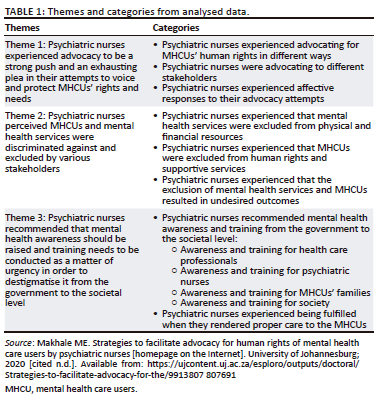
Sixteen psychiatric nurses participated in three phenomenological focus group interviews. Male and female participants, aged between 34 and 53, were included. Their experience in mental health ranged from 4 to 26 years. Three themes emerged from the analysed data, as presented in Table 1.33
Theme 1: Psychiatric nurses experienced advocacy to be a strong push and an exhausting plea in their attempts to voice and protect mental health care users' rights and needs
Advocating for the human rights of MHCUs has emerged as a formidable challenge for psychiatric nurses. The process demanded time, patience, teamwork and stakeholder involvement. However, the psychiatric nurses felt they were not supported in their attempts and were not achieving their goal of advocating for the MHCUs' human rights.
Category 1.1: Psychiatric nurses experienced advocating for mental health care users' human rights in different ways
Psychiatric nurses explained that many communication methods could be used to advocate for the human rights of MHCUs. These included accompaniments to speak on behalf of the MHCU, referral letters or memos, and telephonic discussions. One participant said: 'One of the easiest way that I find is to write on the memo, unlike sending the patient on her own to other side' (FG2, P3, F).
Another participant advocated for the human rights of MHCUs telephonically. 'I took a phone, dialled police station' (FG3, P3, F).
Category 1.2: Psychiatric nurses were advocating to different stakeholders
Psychiatric nurses said they had to advocate for MHCUs' human rights to different stakeholders. These included government departments, emergency medical services, the police, PHC professionals, family members and society at large. One participant who communicated with emergency medical services said: 'The EMS (Emergency Medical Services) claimed that the patients will break their equipment. How does the patient go to the hospital?' (FG3, P1, F).
Another participant who communicated with PHC professionals explained:
'I had to go and explain to them that this patient is medically ill. They have to attend to the medical problem of the patient irrespective of the fact that he is on Risperdal.' (FG1, P3, F)
Category 1.3: Psychiatric nurses experienced affective responses to their advocacy attempts
Psychiatric nurses experienced feelings of disempowerment, frustration and helplessness in advocating for the human rights of MHCUs. Participants' experiences with affective responses were congruent with the researcher's observation and field notes during interviews, as one participant said: 'We nurses are allowed to act up to so far. I wish we could be given more power to help the patients' (FG2, P3, F).
Another participant, who experienced frustration in advocating for the human rights of MHCUs, said:
'Well, promoting human rights of the patients is challenging, because you do it and you find others do not do it. It is frustrating because we don't do it together.' (FG2, P4, F)
One participant felt helpless when she referred a patient to the doctor, and the doctor did not attend to the stated problems. She explained: 'The doctor just copied everything I wrote there and did the X-Ray and that was it, sent the patient home right away like that' (FG1, P2, F).
Theme 2: Psychiatric nurses perceived mental health care users and mental health services were discriminated against and excluded by various stakeholders
Mental health services are part of health services, as the patient is treated holistically. However, ignorance results in mental health services still being discriminated against and excluded by various stakeholders. The consultation rooms allocated to mental health services are not conducive for the treatment of MHCUs; there is an unequal distribution of funds from the national government to the services of mental health of users; the human rights of MHCUs were violated, and support services display a negative attitude towards the MHCUs. Psychiatric nurses faced difficulty in advocating for MHCUs' human rights as they appeared mental health was not a priority, as discussed next.
Category 2.1: Psychiatric nurses experienced that mental health services were excluded from physical and financial resources
Physical and financial resources are needed in order to render effective mental health services so that MHCUs can receive quality care. Psychiatric nurses experienced an unequal distribution of these resources between mental health services and primary health services. This section discusses and examines these disparities.
Exclusion from physical resources: Psychiatric nurses expressed concern about the buildings and rooms that were allocated to mental health services. They stated that there were insufficient rooms and space. Moreover, some of the buildings and rooms promoted stigma against MHCUs as there was no privacy. Psychiatric nurses expressed the need for mental health facilities that will offer skills development, stimulation and rehabilitation for MHCUs. One participant explained the state of the mental health facility by saying:
'Some of our facilities are not even friendly. Look at that other mental health clinic. The environment is not conductive at all. There is little or no privacy. The place is noisy, lots of disturbance and on and on.' (FG2, P4, F)
Exclusion from financial resources: Financial resources are important to sustain all health services, including mental health services. Psychiatric nurses experienced that the health budget from the national government was unequally distributed, and mental health services received only a small portion. The following quotes reflect the stress psychiatric nurses experienced in terms of limited financial resources:
'So most of us have good ideas, like taking the patients out during Easter. You can just take a kombi, take them to Rand Easter Show, to show that they are very important. They need social life also. But the government will say that they don't have money for that. Our ideas are evaporating.' (FG1, P1, M)
'Mental health does not have budget. We are depending on PHC. If they are not happy, you don't get.' (FG2, P1, F)
Category 2.2: Psychiatric nurses experienced that mental health care users were excluded from human rights and supportive services
Mental health care users are human beings and are entitled to all the rights that every human being enjoys. This population is also entitled to all the supportive services available to other individuals. However, psychiatric nurses experienced that MHCUs were excluded from these services, as the discussion in this section indicates.
Exclusion from human rights: Psychiatric nurses experienced that MHCUs' human rights were violated. One participant expressed her dissatisfaction with the treatment of MHCUs at an NGO:
'The patients, they tell me, eat … you know when you peel your vegetables. That stuff. That's what they cook for them. Or potatoes or pumpkins peels, everything you meant to put for your compost in order to make manure, that's what they eat. I mean, the condition of that place!' (FG1, P3, F)
The aforementioned statement indicates that MHCUs were deprived of their rights, as stipulated in the Constitution of South Africa Act, No. 108 of 1996 (2)17Mental Health Care Act, No. 17 of 2002 (3).14
Exclusion from supportive services: Psychiatric nurses experienced that supportive services like the police, emergency medical services (EMS) and other government services excluded mental health services. Participants explained:
'I think the one is with EMS. They got this er … negative attitude towards mentally ill people, like, I'm not sure it's the issue of stigma or lack of knowledge or lack of training.' (FG1, P2, M)
'I went to the housing department because akere [you know] the councillor did not want to help.' (FG3, P2, F)
Category 2.3: Psychiatric nurses experienced that the exclusion of mental services and mental health care users resulted in undesired outcomes
Psychiatric nurses said MHCUs' and mental health services' exclusion from physical and financial resources, human rights and supportive services affected these individuals negatively. Participants also expressed that exclusion from the aforementioned services was affecting them, as they were unable to achieve their goal of advocating for the MHCUs' human rights as mental health was not recognised as a priority. The following quotation emphasises psychiatric nurses' experiences:
'But when we look at our people, once they are diagnosed, and then the stigma is already there. This is one of challenges. I know one guy who has a profession in IT and he is a lecturer, but because he keeps on relapsing, at work they don't want to hear anything about him anymore. He is economically excluded. He is just at home doing nothing to use those skills. So how do we go beyond that, go about helping them? You see.' (FG1, P2, M)
Theme 3: Psychiatric nurses recommended that mental health awareness should be raised and training needs to be conducted as a matter of urgency in order to destigmatise it from the government to the societal level
The psychiatric nurses recommended mental health awareness and training for the stakeholders as they were ignorant and lacked knowledge in the matter which made advocating for MHCUs challenging. Although the psychiatric nurses felt disempowered, they had a sense of satisfaction when advocating for the human rights of MHCUs.
Category 3.1: Psychiatric nurses recommended mental health awareness and training from the government to the societal level
As a result of their disempowerment, stakeholders' ignorance and the Life Esidimeni challenges, psychiatric nurses expressed an urgent need to conduct mental health awareness and training sessions with stakeholders. A participant claimed:
'The government should be given awareness about mental illness and mentally ill patients because they are not taken seriously, are of … hence the case of Life Esidimeni. It's the government you know, the stigma and the discrimination is one that caused Life Esidimeni.' (FG1, P4, F)
Awareness and training for health care professionals: 'And I always think that these PHC sisters need some sort of mental training you know …' (FG3, P2, F)
Awareness and training for psychiatric nurses: 'Surely there are new developments in mental health, because when you send your staff for training you are also boosting their morale.' (FG1, P3, F)
'In some countries you go for even refresher courses, like how to advocate for better treatment for patients, our guys go for what we call retraining courses, management and risk assessment. So to empower people and go an extra mile will help to avoid these mishaps.' (FG1, P2, M)
Awareness and training for mental health care users' families: 'Now you come across these difficult family members that will tell you that you favour the difficult patient! They tell us that he "is used to this, is undermining us." It really takes time for families to understand.' (FG2, P3, F)
'Even family members, they need to be trained, they need to be skilled how to manage them in terms of resources. The patient is the only one with income, so his grant is shared among the family members.' (FG1, P2, M)
Awareness and training for society: '… The other thing is the issue of NGOs that are not registered, you know. Mentally ill patients are dumped there. People are being abused.' (FG1, P3, F)
Category 3.2: Psychiatric nurses experienced being fulfilled when they rendered proper care to the mental health care users
Although psychiatric nurses shared various experiences of disempowerment in advocating for the human rights of MHCUs, they also stated that they felt content in solving MHCUs' problems:
'Anyway beside all the problems, I sometimes feel happy and satisfied where I acted successfully to solve the patient's problem. It's like I won a trophy.' (FG1, P3, F)
'Truly speaking, advocating for my patients where I am working, was easy in terms of equipment.' (FG2, P2, F)
Discussion
This study aimed to explore and describe psychiatric nurses' lived experiences in advocating for the human rights of MHCUs in the Gauteng province. A summary of the themes and categories that were identified from the analysis is presented in Table 1.33
The literature reveals a consistent approach among psychiatric nurses in advocating for MHCUs. Varghese343536
Participants in this study were concerned about insufficient space and the lack of privacy during therapeutic sessions with MHCUs. Participants also expressed concern over the lack of financial support from the national government for mental health services. The study by Lund, Kleintjies, Cooper, Petersen, Bhana, Fisher and MHaPP Research Programme Consortium37383302239
The WHO-AIMS383840,41 Trained health care professionals will also integrate mental health into PHC, thereby reducing stigma and discrimination against mental illness.42
Raising mental health awareness and offering training for MHCUs' family members is important as the family is the pillar of strength and support for this population.4322
Davoodvand, Abbaszadeh and Ahmad44
Strengths and limitations
This research excluded MHCUs' and family members' experiences of psychiatric nurses' advocacy for their human rights. The psychiatric nurses who worked in the PHC setting were excluded from the study, as the focus was on those in the secondary level of mental health services.
Recommendations
The findings of this study underscore the importance of integrating mental health into PHC to ensure a holistic approach to the treatment of MHCUs. Sufficient resources must be allocated to allow psychiatric nurses to render quality care to MHCUs. Training for all categories of nurses on mental health advocacy is also imperative and should be extended to family members and the community.
Conclusion
This study revealed that psychiatric nurses encounter feelings of disempowerment, frustration and helplessness when advocating for the human rights of MHCUs. Because of psychiatric nurses' affective experiences, strategies to improve their attempts at advocating for MHCUs' human rights need to be developed. These strategies will empower psychiatric nurses with the necessary skills to advocate for the MHCUs' human rights.
Competing interests
The authors declare that they have no financial or personal relationships that may have inappropriately influenced them in writing this article.
Authors' contributions
N.N. co-supervised the study, wrote the original draft, edited, reviewed, finalised and assisted with the submission of the manuscript. M.E.M. conducted the research and analysed the data. A.T. supervised the study, reviewed and edited the manuscript. M.P. co-supervised the study, reviewed and edited the manuscript for final submission.
Funding information
The research study received a supervisor-linked grant from the University of Johannesburg.
Data availability
Data sharing is not applicable to this article as no new data were created or analysed in this study.
Disclaimer
The views and opinions expressed in this article are those of the authors and are the product of professional research. It does not necessarily reflect the official policy or position of any affiliated institution, funder, agency, or that of the publisher. The authors are responsible for this article's results, findings, and content.
Acknowledgements
The authors acknowledge the psychiatric nurses who were working in the secondary level of mental health services in a PHC setting in the Sedibeng District for allowing the study to be conducted and for sharing their time to be part of the study.
References
-
1. World Health Organization. The World Health Report. 2001: Mental disorders affect one in four people. Treatment available but not being used [homepage on the Internet]. 2001 [cited 2023 Aug 13]. Available from: https://www.who.int/news/item/28-09-2001-the-world-health-report-2001-mental-disorders-affect-one-in-four-people
» https://www.who.int/news/item/28-09-2001-the-world-health-report-2001-mental-disorders-affect-one-in-four-people -
2. World Health Organization. Mental disorders [homepage on the Internet]. 2022 [cited 2023 Nov 11]. Available from: https://www.who.int/news-room/fact-sheets/detail/mental-disorders
» https://www.who.int/news-room/fact-sheets/detail/mental-disorders -
3. Miller D, Blanc E. Concepts of 'Moral Treatment' for the mentally ill: Implications for social work with post-hospital mental patients. Soc Serv Rev. 1967;41(1): 66-74. https://doi.org/10.1086/642033
» https://doi.org/10.1086/642033 -
4. Nelson EA. Dorothea Dix's liberation movement and why it matters today. Am J Psychiatry Resid J. 2021;17(2):8-9. https://doi.org/10.1176/appi.ajp-rj.2021.170203
» https://doi.org/10.1176/appi.ajp-rj.2021.170203 -
5. Kleintjies S, Lund C, Swartz L. Organizing self-advocacy in mental health: Experiences from seven African countries. Afr J Psychiatry. 2013;16(3):187-195. https://doi.org/10.4314/ajpsy.v16i3.25
» https://doi.org/10.4314/ajpsy.v16i3.25 -
6. Kuwonu F. Africa and the Universal Declaration of Human Rights: Dignity for all [homepage on the Internet]. Inclusion, Equity and Social Justice News Africa. United Nations; 2018 [cited 2023 Oct 20]. Available from: https://www.un.org/africarenewal/magazine/december-2018-march-2019/africa's-freedom-struggles-and-universal-declaration-human-rights
» https://www.un.org/africarenewal/magazine/december-2018-march-2019/africa's-freedom-struggles-and-universal-declaration-human-rights - 7. Matlala M, Maponya ML, Chigome AK, Meyer H. Overview of mental health: A public priority. S Afr Pharm J. 2018;85(6):46-53.
-
8. World Health Organization. Investing in mental health [homepage on the Internet]. Geneva; 2004 [cited 2018 June 15]. Available from: https://www.who.int/publications/i/item/9241562579
» https://www.who.int/publications/i/item/9241562579 -
9. World Health Organization. Mental Health Action Plan 2013-2020 [homepage on the Internet]. Geneva; 2013 [cited 2018 June 18]. Available from: https://www.who.int/publications/i/item/9789241506021
» https://www.who.int/publications/i/item/9789241506021 -
10. Ventura CA, Austin W, Carrara BS, De Brito ES. Nursing care in mental health: Human rights and ethical issues. Nurs Ethics. 2021;28(4):463-480. https://doi.org/10.1177/0969733020952102
» https://doi.org/10.1177/0969733020952102 -
11. Melnikov S, Kagan I, Felizardo H, et al. Practices and experiences of European frontline nurses under the shadow of COVID-19. Nurs Health Sci. 2022;24(2): 405-413. https://doi.org/10.1111/nhs.12936
» https://doi.org/10.1111/nhs.12936 -
12. Luca CE, Cavicchioli A, Bianchi M. Nurses who assume the role of advocate for older hospitalized patients: A qualitative study. SAGE Open Nurs. 2021;7:23779608211030651. https://doi.org/10.1177/23779608211030651
» https://doi.org/10.1177/23779608211030651 -
13. Kleebthong D, Chareonsuk S, Kristiansen L. Thai psychiatric nurses' experiences and perceptions of the professional role when caring for older people displaying depressive symptoms. Open J Nurs. 2018(1):45-59. https://doi.org/10.4236/ojn.2018.81004
» https://doi.org/10.4236/ojn.2018.81004 -
14. Mental Health Care Act 17 of 2002 [homepage on the Internet]. Cape Town: Government Gazette. [cited 2023 Oct 12]. Available from: https://www.gov.za/sites/default/files/gcis_document/201409/a17-02.pdf
» https://www.gov.za/sites/default/files/gcis_document/201409/a17-02.pdf -
15. Gaynor-Brook L, on behalf of the PLoS Medicine Editors. Towards mental health as a human right: The key role of lived experience. PLoS Med. 2023;20(10):e1004307. https://doi.org/10.1371/journal.pmed.1004307
» https://doi.org/10.1371/journal.pmed.1004307 -
16. World Health Organization. Mental health: Promoting and protecting human rights [homepage on the Internet]. 2023 [cited 2024 Feb 14]. Available from: https://www.who.int/news-room/questions-and-answers/item/mental-health-promoting-and-protecting-human-rights
» https://www.who.int/news-room/questions-and-answers/item/mental-health-promoting-and-protecting-human-rights -
17. Constitution of the Republic of South Africa No 108 of 1996 as amended [homepage on the Internet]. Cape Town: Government Gazette. [cited 2023 Oct 12]. Available from: https://www.gov.za/sites/default/files/images/a108-96.pdf
» https://www.gov.za/sites/default/files/images/a108-96.pdf -
18. National mental health policy and strategic plan for South Africa 2013-2020 [homepage on the Internet]. Cape Town: Government Printers. [cited 2023 Oct 12]. Available from: http://www.safmh.org/wp-content/uploads/2020/09/National-Mental-Health-Policy-Framework-2013-2020.pdf
» http://www.safmh.org/wp-content/uploads/2020/09/National-Mental-Health-Policy-Framework-2013-2020.pdf -
19. Nursing Act 33 of 2005 [homepage on the Internet]. Pretoria: Government Gazette. [cited 2023 Oct 12]. Available from: https://www.gov.za/sites/default/files/gcis_document/201409/a33-050.pdf
» https://www.gov.za/sites/default/files/gcis_document/201409/a33-050.pdf -
20. National Health Care Act 61 of 2003 [homepage on the Internet]. Cape Town: Government Printers. [cited 2023 Oct 12]. Available from: https://www.gov.za/sites/default/files/gcis_document/201409/a61-03.pdf
» https://www.gov.za/sites/default/files/gcis_document/201409/a61-03.pdf -
21. World Health Organization. Human rights [homepage on the Internet]. 2023 [cited 2024 Feb 14]. Available from: https://www.who.int/news-room/fact-sheets/detail/human-rights-and-health
» https://www.who.int/news-room/fact-sheets/detail/human-rights-and-health -
22. Makgoba MW. Esidimeni Life 94+ deaths of psychiatric patients [homepage on the Internet]. The Health Ombud report dated 01 February 2017. 2017 [cited 2017 Sept 30]. Available from www.politicsweb.co.za/documents/thelife-esidimeni-disaster-the-makgoba-report
» www.politicsweb.co.za/documents/thelife-esidimeni-disaster-the-makgoba-report - 23. Dhai A, McQuoid-Mason DJ. Bioethics human rights and health law. Principles and practise. Claremont, CA: Juta and Company Ltd; 2011.
- 24. Gray JR, Grove SK. The practice of nursing research: Appraisals, synthesis and generation of evidence. New York, NY: Saunders; 2021.
-
25. Burns M, Bally J, Burles M, Holtslander L, Peacock S. Constructivist grounded theory or interpretive phenomenology? Methodological choices within specific study contexts. Int J Qual Methods. 2022;21(1-13). https://doi.org/10.1177/16094069221077758
» https://doi.org/10.1177/16094069221077758 - 26. Punch FK. Introduction to social research. qualitative approaches. 3rd ed. London: Sage; 2014.
-
27. Sedibeng District Municipality. Health Summit 2009 [cited 2023 Nov 26]. Available from: http://sedibeng.gov.za/a_readmores/20091010_healthsummit.html
» http://sedibeng.gov.za/a_readmores/20091010_healthsummit.html -
28. Robertson LJ, Szabo CP. Community mental health services in Southern Gauteng: An audit using Gauteng District Health Information Systems data. S Afr J Psychiatr. 2017;23:1055. https://doi.org/10.4102/sajpsychiatry.v23i0.1055
» https://doi.org/10.4102/sajpsychiatry.v23i0.1055 -
29. Casteel A, Bridier NL. Describing populations and samples in doctoral student research. Int J Dr Stud. 2021;16(1):339-362. https://doi.org/10.28945/4766
» https://doi.org/10.28945/4766 -
30. Mfoafo-M'Carthy M, Huls S. Human rights violations and Mental illness implications for engagement and adherence. Sage J. 2014;4(1):1-18. https://doi.org/10.1177/2158244014526209
» https://doi.org/10.1177/2158244014526209 -
31. Regulation R425 of 1985 as amended by the R753 of 1988. Regulation relating to the approval and the minimum requirements for the education and training of a nurse [homepage on the Internet]. South African Nursing Council. Pretoria: Government Printers. [cited 2023 Oct 13]. Available from https://www.sanc.co.za/r-425/
» https://www.sanc.co.za/r-425/ - 32. Creswell JW. Research Design: Qualitative, quantitative and mixed methods. 4th ed. Thousand Oaks: CA: Sage; 2014.
-
33. Makhale ME. Strategies to facilitate advocacy for human rights of mental health care users by psychiatric nurses [homepage on the Internet]. University of Johannesburg; 2020 [cited n.d.]. Available from: https://ujcontent.uj.ac.za/esploro/outputs/doctoral/Strategies-to-facilitate-advocacy-for-the/9913807807691
» https://ujcontent.uj.ac.za/esploro/outputs/doctoral/Strategies-to-facilitate-advocacy-for-the/9913807807691 -
34. Varghese PJ. Advocacy in mental health: Offering a voice to the voiceless. Indian J Soc Psychiatry. 2015;31(1-2):4-8. https://doi.org/10.4103/0971-9962.161987
» https://doi.org/10.4103/0971-9962.161987 -
35. South African Depression and Anxiety Group (SADAG). African Depression And Anxiety Group. [homepage on the internet] [cited 2020 June 20] Available at: https://www.google.com/search?q=profile+of+the+south+african+depression+and+anxiety+group&oq=profile+of+the+south+african+depression+and+anxiety+group&aqs=chrome..69i57j33l7.33119j1j7&sourceid=chrome&ie=UTF-8
» https://www.google.com/search?q=profile+of+the+south+african+depression+and+anxiety+group&oq=profile+of+the+south+african+depression+and+anxiety+group&aqs=chrome..69i57j33l7.33119j1j7&sourceid=chrome&ie=UTF-8 -
36. Sobekwa ZC, Arunachallam S. Experiences of nurses caring for mental health patient in an acute admission unit at a psychiatric hospital in the Western Cape. Curationis. 2015;38(2):1509. https://doi.org/10.4102/curationis.v38i2.1509
» https://doi.org/10.4102/curationis.v38i2.1509 -
37. Lund C, Kleintjies S, Cooper S, et al. Challenges facing South Africa's mental health care system: Stakeholders perceptions of causes and potential solutions. Int J Cult Ment Health. 2011;4(1):23-38. https://doi.org/10.1080/17542863.2010.503039
» https://doi.org/10.1080/17542863.2010.503039 - 38. World Health Organization. WHO-AIMS report on Mental Health Systems in South Africa. Cape Town: WHO and Department of Psychiatry and Mental Health, University of Cape Town; 2007.
-
39. Emsley R, Seedat S. The South African Society of Psychiatrists SASOP treatment guidelines of psychiatric disorders. S Afr Soc Psychiatrists. 2013;19(13):942. https://doi.org/10.4102/sajpsychiatry.v19i3.942
» https://doi.org/10.4102/sajpsychiatry.v19i3.942 -
40. Jack-Ide IO, Uys LR, Middleton LE. Caregiving experiences of families of persons with serious mental health problems in the Niger Delta region of Nigeria. Int J Ment Health Nurs. 2013;22(2):170-179. https://doi.org/10.1111/j.1447-0349.2012.00853.x
» https://doi.org/10.1111/j.1447-0349.2012.00853.x - 41. Burns JK. Mental health gap in South Africa - Human Rights issue. Equal Rights Rev. 2011;6:99-113.
-
42. Municipalities of South Africa. Sedibeng District Municipality. Sedibeng District Municipality (DC42). 2023 [cited n.d.]. Available from https://municipalities.co.za/overview/114/sedibeng-district-municipality
» https://municipalities.co.za/overview/114/sedibeng-district-municipality -
43. Tlhowe T, Du Plessis E, Koen MP. Strengths of families to limit relapse in mentally ill family members. Health SA Gesondheid. 2017;22(1):28-35. https://doi.org/10.1016/j.hsag.2016.09.003
» https://doi.org/10.1016/j.hsag.2016.09.003 - 44. Davoodvand S, Abbaszadeh A, Ahmadi F. Patients advocacy from the clinical nurses' viewpoint: A qualitative study. J Med Ethics Hist Med. 2016;9:5.

Accepted: 07 Mar. 2024
Published: 02 May 2024