HIV prevalence and access to HIV testing and care in patients with psychosis in South Africa
Abstract
BACKGROUND: Human immunodeficiency virus (HIV) and psychosis share a complex bidirectional relationship, with people living with HIV being at increased risk of psychosis and those with psychosis at increased risk of HIV. However, people living with severe mental illness often have limited or reduced access to HIV testing and care. AIM: This study aimed to determine the prevalence of HIV and describe the access to HIV testing and care among adult patients with recent-onset psychosis who were admitted to a psychiatric hospital in KwaZulu-Natal (KZN) province, South Africa SETTING: A psychiatric hospital in Pietermaritzburg, KZN province, South Africa. METHOD: A retrospective chart review of 294 patients with recent-onset psychosis admitted between May 2018 and November 2020. RESULTS: A total of 291 (99%) patients had access to HIV testing during the study period, with the HIV seroprevalence rate being 21.5% among the 294 patients; HIV seropositivity was associated with the 25-49 age category (adjusted odds ratio [aOR] = 3.09, 95% confidence interval [CI] 1.27-7.50), female gender (aOR = 9.55, 95% CI 4.40-20.74), current alcohol and cannabis use (aOR = 3.43, 95% CI 1.01-11.62), family history of psychosis (aOR = 3.22, 95% CI 1.03-10.02) and no tertiary education (aOR = 3.7, 95% CI 0.14-0.99). All those living with HIV were on antiretroviral treatment. CONCLUSION: This study showed that HIV testing and care was accessible at a psychiatric hospital but the prevalence of HIV in people living with recent onset psychosis remains high. CONTRIBUTION: The study findings suggest the importance of integrating mental health and HIV management
psychosis; HIV; South Africa; viral load; prevalence
Introduction
It is estimated that in 2018, there were an estimated 20.6 million (18.2 million - 23.2 million) people living with human immunodeficiency virus (HIV) in Eastern and Southern Africa and 7.52 million in South Africa (SA).12
First-episode psychosis (FEP) may be defined as the first time someone experiences psychotic symptoms or a psychotic episode and accesses treatment.34
In SA, a study of 63 patients presenting with adult FEP at a psychiatric hospital in Pietermaritzburg, KwaZulu-Natal (KZN) province, found an HIV seroprevalence rate of 23.8%.567
As effective antiretroviral treatments (ARTs) are now available, it is critical to diagnose HIV infection early in the mentally ill, especially as they are a high risk population.899
The reported lifetime prevalence of HIV testing among individuals with severe mental illness ranges from 11% to 89%.10118128
A more recent cross-sectional study in 10 public sector health facilities in the Ekurhuleni District of SA found that 51.8% of general medical patients reported that they had not received an HIV test in the past 12 months, and 9.6% had ever been offered HIV testing.131415
The literature suggests that while the prevalence of HIV is high in people with mental illness, their access to HIV testing and care may be poor.8
Aim
This study aimed to determine the prevalence of HIV and describe the access to HIV testing and care among adult patients with recent onset psychosis who were admitted to a psychiatric hospital in the uMgungundlovu District, KZN province, SA.
Research method and design
The study entailed a retrospective chart review of all adult patients with recent onset psychosis admitted to a psychiatric hospital.
Study population and sampling strategy
In this retrospective chart review, all hospital charts of adults with any mental illness aged 18-65 years who were admitted to the psychiatric hospital from 01 May 2018 to 30 November 2020 were identified from the hospital admission register and screened for eligibility criteria by the principal investigator (PI) from the in-patient register. The files which were included were those of patients with recent onset psychosis and who also met the criteria of the Diagnostic and Statistical Manual of Mental Disorders, Fifth Edition (DSM-5)1616
Measures
This study utilised a structured sociodemographic and clinical data extraction tool based on the literature review to measure the selected variables. These included: demographic data (age, gender, family history, marital status, occupation and educational level), and clinical data (psychiatric diagnosis, HIV status, comorbid medical disorders, family history of mental illness, substance use history, record of ART and concomitant medication). Data on clinical investigations were also collated, such as HIV enzyme-linked immunosorbent assay (ELISA) rapid test to confirm HIV status, cluster of difference 4 (CD4) count and viral load (VL) (only in PLWHIV). The patients were categorised into three groups based on their HIV status viz. positive, negative or unknown. Access to HIV testing was measured by number of participants who were offered HIV testing with supporting clinical records on file and HIV care in terms of those who received ART if they had HIV infection.
Data analysis
The data were entered into a Research Electronic Data Capture (REDCap) database (Vanderbilt University, Nashville, Tennessee, United States) and analysed using Stata version 15.1 (StataCorp LLC, College Station, Texas, United States), with descriptive statistics, such as frequencies and percentages, being used to summarise the results. McNemar's chi-square test was used to test for any association between HIV status, virological suppression and patients' characteristics, such as age, sex, employment status and family history. Logistic regression models were used to test for the association between HIV status and patient characteristics, with the significance level being set at p = 0.05.
-
Definitions used in the study
Recent-onset psychosis was psychotic symptom onset within the past five years.417
Ethical considerations
Ethical approval to conduct the study was obtained from the Biomedical Research Ethics Committee (reference number BREC/00001591/2020) of the University of KwaZulu-Natal (UKZN), the public sector psychiatric hospital and the Department of Health (DOH). The study was conducted in accordance with SA DOH Research Ethics guidelines (2015) and the UKZN policy on research ethics.
Data storage and management
Data were stored at the university in a password-protected computer with access to researchers only. Data will be stored for five years after the study and then destroyed.
Confidentiality was maintained throughout and after completion of the research. All data had potential identifiers removed and replaced with codes to ensure the anonymity of participants. These codes will be retained separately from the data.
Results
Sociodemographic and clinical characteristics
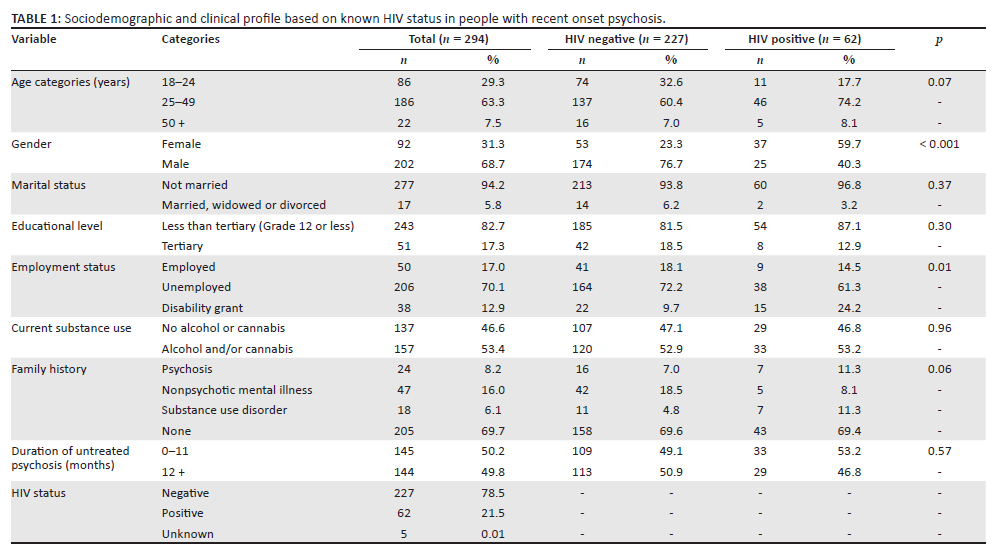
The clinical records of all 294 patients with recent-onset psychosis admitted during the study period were included, and where data were missing, this is indicated accordingly. The sociodemographic and clinical characteristics are stratified by HIV status (Table 1). Most participants admitted were in the 25-49 years age group (63.3%), male (68.7%), unmarried (94.2%) and unemployed (70.1%). The DUP ranged from 0 to 240 months (IQR 1-36 months), and 144 (49.8%) individuals had a DUP greater than 12 months.
HIV prevalence
The HIV seroprevalence rate was 21.5% (n = 62), with women accounting for 59.7% (n = 37), having a significantly higher HIV prevalence than the men (p ≤ 0.001), all of whom received ART while admitted.
Access to HIV testing and care
Almost all patients (291 of the 294) accessed HIV testing (or were offered it) whilst admitted to a psychiatric hospital. Five (1.7%) of the 294 patients did not have an HIV test result, three (1%) of whom had no documentation of whether HIV test was offered or the result, one (0.3%) of whom had refused to test and another (0.3%) of whom had tested but there was no record of the result.
Association between HIV status and patient characteristics
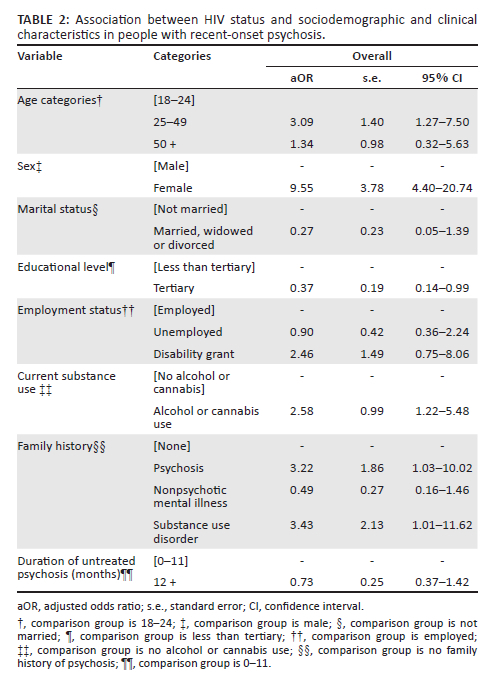
The association between HIV seropositivity and patient characteristics are presented in Table 2. The odds of being HIV positive were significantly higher for patients in the 25-49 age category (adjusted odds ratio [aOR] = 3.09, 95% CI 1.27-7.50), women (aOR = 9.55, 95% CI 4.40-20.74) and those who self-reported current alcohol and cannabis use (aOR = 3.43, 95% CI 1.01-11.62). A family history of psychosis (aOR = 3.22, 95% CI 1.03-10.02) also significantly increased the odds of living with HIV, while the odds of HIV were 63% lower for those who had a tertiary education compared with those who did not. There was no difference in the duration of untreated psychosis between the HIV-negative and -positive groups.
Viral load and patient characteristics
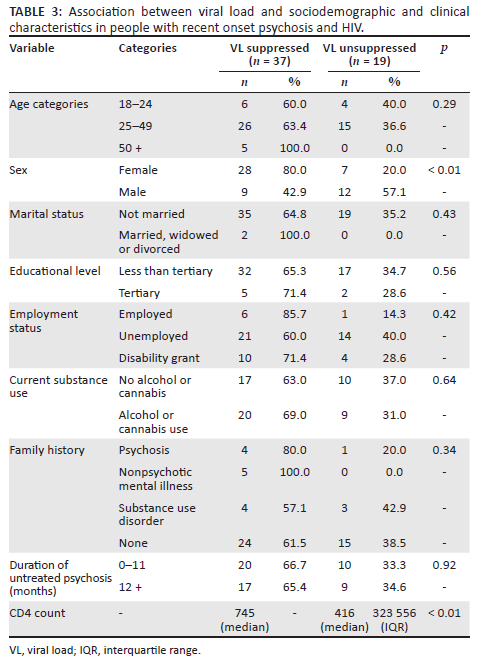
Of the 62 PLWHIV and recent onset psychosis, 37 (66.07%) were virologically suppressed, as indicated by a VL of lower than detectable, and 19 (33.93%) were virologically unsuppressed. The study was not able to establish from the records if individuals were newly diagnosed with HIV or were re-initiated on ART after defaulting treatment. The associations between VL measure and patients' sociodemographic and clinical characteristics are presented in Table 3, with being male and having a lower CD4 count being significantly associated with being virologically unsuppressed (p ≤ 0.01).
Discussion
In this study, the main findings were that 21.5% of patients admitted over the study period with recent-onset psychosis were living with HIV; its seroprevalence was associated with age 25-49 years, female gender, lower educational level, family history of psychosis and current alcohol or cannabis use. There was a very high rate of HIV testing (98%) and care, as all PLWHIV received ART while admitted. Nineteen of the 37 (51.3%) patients with HIV were virologically unsuppressed, with men being less likely to be virally suppressed.
The 21.5% prevalence rate of HIV among patients admitted with recent onset psychosis is slightly higher than the South African general population estimate of 19.0% HIV prevalence in adults aged 15-49 years.17
In this study, only five patients (1.7%) did not have an HIV test result, which indicates that access to HIV testing was good, and an extremely small proportion were missed or had an unknown HIV status; however, clinicians should endeavour to offer all patients HIV testing and care and document outcomes. This is in stark contrast to earlier studies, which found poor or inadequate access to HIV testing for those with mental illness.8101819202122
In this study, the HIV risk in people with recent-onset psychosis was associated with the age group 25-49 years, which is also consistent with HIV prevalence rates in the general population in KZN, SA, among people aged 15-49 in 2017, which was at 27%.23
In this study, women contributed 59.7% of the HIV-positive group and had a significantly higher HIV rate than the men (p ≤0.001), which is consistent with the literature.18,24,25,26,2718p = 0.012).2425
The HIV prevalence was also higher in those without a tertiary education compared with those with, which is supported by other South African studies in people with psychosis.282929
Individuals who report current substance use were more than three times more likely to have HIV in this study; this is consistent with international literature, which reports that substance use also increases the risk of HIV transmission, as it may contribute to increased risky behaviour.30,315,25
In this study of those living with HIV, 37 (66.07%) were virologically suppressed; this rate is lower than that reported in the international literature for PLWHIV but higher than that in a recent South African general population.32,333233
Nineteen (33.93%) of the participants in our study were virologically unsuppressed, which is concerning, as it suggests that the HIV care of patients with psychosis needs to be intensified. These participants were either newly diagnosed with HIV or were re-initiated on ART after defaulting treatment. However, this was difficult to determine from the records available, as anecdotal evidence suggests that patients may not disclose if diagnosed with HIV previously. This suggests a need to consider more active follow-up of those with psychosis and HIV in terms of adherence support to improve outcomes.
Study limitations
This was a single public sector hospital-based study, which may introduce sample bias and limit generalisability to community samples. However, it does provide a sample representing the clinical profile of patients with recent onset psychosis and the access to HIV testing and prevalence of HIV in a resource-constrained setting that drains large urban and rural populations. Other limitations include that the cross-sectional nature of the study design means that changes over time may be missed. The study was also not able to establish from the records if individuals were newly diagnosed with HIV or were re-initiated on ART after defaulting treatment. In addition, the retrospective chart review means that the data may be limited by the quality of record-keeping and depend on clinician-assigned diagnoses, which are less reliable than structured tools from the clinical records. However, all patients were assessed by a psychiatrist during the admission to review their diagnosis, and the PI also reviewed the clinical notes and diagnoses based on DSM-5 diagnostic criteria.16
Conclusion
This study found that while HIV testing and care were available, the prevalence of HIV in people living with recent onset psychosis remains high and that almost a third were not virologically suppressed. This suggests the importance of further interventions to integrate mental health and HIV prevention and promotion, treatment and rehabilitation, with a particular focus on those vulnerable to the comorbidity (women, those with lower education and young adults). This will hopefully improve mental and physical health outcomes. Further longitudinal studies with interventions that seek to screen for the dual burden of disease (psychosis and HIV) and provide integrated care with a multidisciplinary team are required.
Competing interests
The authors declare that they have no financial or personal relationships that may have inappropriately influenced them in writing this article.
Authors' contributions
M.P.M., the principal investigator, conceptualised the study and research design, developed the protocol, performed data collection and undertook the initial write-up for this study and subsequent manuscript revisions. S.P. supervised the project and assisted with study conceptualisation, protocol development and write-up of this study. B.C. made conceptual contributions to study design, assisted with protocol development and editorial manuscript revisions and supervised the project. V.N. assisted with protocol development, data analysis and contributions to manuscript revisions. A.T. was responsible for data analysis and made conceptual contributions to study design and editorial manuscript revisions.
Funding information
A.T. was supported by the South African Medical Research Council (ref. no. MRC-RFAUFSP-01-2013/UKZN HIVEPI) with funds from the National Treasury under its Economic Competitiveness and Support Package. S.P. was supported by the National Research Foundation of South Africa (ref. no. 117858), South African Research Council Self-Initiated Research (SIR) grant.
Data availability
The data that support the findings of this study are available from the corresponding author, M.P.M., upon reasonable request.
Disclaimer
The views and opinions expressed in this article are those of the authors and do not necessarily reflect the official policy or position of any affiliated agency of the authors.
Acknowledgements
References
- 1.Statistics South Africa. Mid-year population estimates. p. 8-9. Pretoria: South Africa StatsSA; 2018.
-
2.UNAIDS. UNAIDS Data 2019 [homepage on the Internet]. 2019. [cited 2020 April 02]. Available from: https://www.google.com/url?sa=t&rct=j&q=&esrc=s&source=web&cd=4&cad=rja&uact=8&ved=2ahUKEwjApZ-mrsXoAhXJ6eAKHfeLD2kQFjADegQIARAB&url=https%3A%2F/www.unaids.org% 2Fsites%2Fdefault%2Ffiles%2Fmedia_asset%2F2019-UNAIDS-data_en.pdf&usg=AOvVaw0PCW-o9HtZpIZRJ41Lqll7.
» https://www.google.com/url?sa=t& rct=j& q=& esrc=s& source=web& cd=4& cad=rja& uact=8& ved=2ahUKEwjApZ-mrsXoAhXJ6eAKHfeLD2kQFjADegQIARAB& url=https%3A%2F/www.unaids.org% 2Fsites%2Fdefault%2Ffiles%2Fmedia_asset%2F2019-UNAIDS-data_en.pdf& usg=AOvVaw0PCW-o9HtZpIZRJ41Lqll7 -
3.Yale School of Medicine. Specialised treatment in early psychosis (STEP). What is first episode psychosis [homepage on the Internet]. 2020. [cited 2022 April 02]. Available from: https://medicine.yale.edu/psychiatry/step/psychosis/firstepisode/.
» https://medicine.yale.edu/psychiatry/step/psychosis/firstepisode/ -
4.Newton R, Rouleau A, Nylander A-G, et al. Diverse definitions of the early course of schizophrenia - A targeted literature review. NPJ Schizophr. 2018;4(1):1-10. https://doi.org/10.1038/s41537-018-0063-7
» https://doi.org/10.1038/s41537-018-0063-7 -
5.Mashaphu S, Mkize D. HIV seropositivity in patients with first-episode psychosis. S Afr J Psychiatry. 2007;13(3):90-94. https://doi.org/10.4102/sajpsychiatry.v13i3.22
» https://doi.org/10.4102/sajpsychiatry.v13i3.22 -
6.Laher A, Ariefdien N, Etlouba Y. HIV prevalence among first-presentation psychotic patients. HIV Med. 2018;19(4):271-279. https://doi.org/10.1111/hiv.12575
» https://doi.org/10.1111/hiv.12575 -
7.Chhagan U, Ntlantsana V, Tomita A, Chiliza B, Paruk S. The dual burden of HIV infection and first episode psychosis in Africa. J Nerv Ment Dis. 2021;209(8):600-608. https://doi.org/10.1097/nmd.0000000000001366
» https://doi.org/10.1097/nmd.0000000000001366 - 8.Joska JA, Kaliski S, Benatar S. Patients with severe mental illness: A new approach to testing for HIV. S Afr Med J. 2008;98(3):213-217.
- 9.Joint United Nations Programme on HIV/AIDS. Policy statement on HIV testing. Geneva: UNAIDS; 2004.
-
10.Senn TE, Carey MP. HIV testing among individuals with a severe mental illness: Review, suggestions for research, and clinical implications. Psychol Med. 2009;39(3):355-363. https://doi.org/10.1017/S0033291708003930
» https://doi.org/10.1017/S0033291708003930 - 11.Chandra P, Krishna V, Ravi V, Desai A, Puttaram S. HIV related admissions in a psychiatric hospital a five year profile. Indian J Psychiatry. 1999;41(4):320.
- 12.Milligan P. Discharge audit database. Lentegeur Hospital. Cape Town; 2007(unpublished report)
-
13.Mabuto T, Hansoti B, Kerrigan D, et al. HIV testing services in healthcare facilities in South Africa: A missed opportunity. J Int AIDS Soc. 2019;22(10):e25367. https://doi.org/10.1002/jia2.25367
» https://doi.org/10.1002/jia2.25367 -
14.Yehia BR, Stephens-Shield AJ, Momplaisir F, et al. Health outcomes of HIV-infected people with mental illness. AIDS Behav. 2015;19(8):1491-1500. https://doi.org/10.1007/s10461-015-1080-4
» https://doi.org/10.1007/s10461-015-1080-4 -
15.Subedi S, Chalise P, Aich T, Thapa D. Psychiatric co-morbidity in HIV/AIDS: A neglected issue. J Psychiatrists' Assoc Nepal. 2013;2(2):6-10. https://doi.org/10.3126/jpan.v2i2.9718
» https://doi.org/10.3126/jpan.v2i2.9718 - 16.American Psychiatric Association, editor. Diagnostic and statistical manual of mental disorders (DSM-5®). 5th ed. Washington: American Psychiatric Publishing; 2013.
-
17.Marshall M, Lewis S, Lockwood A, Drake R, Jones P, Croudace T. Association between duration of untreated psychosis and outcome in cohorts of first-episode patients: A systematic review. Arch Gen Psychiatry. 2005;62(9):975-983. https://doi.org/10.1001/archpsyc.62.9.975
» https://doi.org/10.1001/archpsyc.62.9.975 - 18.Van Rensburg BJ, Bracken C. Acute psychiatric in-patients tested for HIV status: A clinical profile. Afr J Psychiatr. 2007;10(2):83-85.
-
19.Koen L, Uys S, Niehaus DJ, Emsley RA. Negative symptoms and HIV/AIDS risk-behavior knowledge in schizophrenia. Psychosomatics. 2007;48(2):128-134. https://doi.org/10.1176/appi.psy.48.2.128
» https://doi.org/10.1176/appi.psy.48.2.128 -
20.Lepping P. Consent in psychiatry - An ethical review. Psychiatr Bull. 2003;27(8):285-289. https://doi.org/10.1017/S0955603600002737
» https://doi.org/10.1017/S0955603600002737 -
21.Kalichman SC, Simbayi L. HIV testing attitudes, AIDS stigma, and voluntary HIV counselling and testing in a black township in Cape Town, South Africa. Sex transmitted Infect. 2003;79(6):442-447. https://doi.org/10.1136/sti.79.6.442
» https://doi.org/10.1136/sti.79.6.442 -
22.National Department of Health. National HIV testing services policy [homepage on the Internet]. Pretoria: National Department of Health; 2016. [cited 2022 April]. Available from: https://www.google.com/url?sa=t&rct=j&q=&esrc=s&source=web&cd=1&cad=rja&uact=8&ved=2ahUKEwjW2K-9usXoAhWNA2MBHbWZDJYQFjAAegQIAhAB&url=https%3A%2F%2Fsahivsoc.org%2FFiles%2FHTS% 2520Policy%252028%2520July%2520final%2520copy.pdf&usg=AOvVaw3T44-vdOKzVkWsAc5XGngh.
» https://www.google.com/url?sa=t& rct=j& q=& esrc=s& source=web& cd=1& cad=rja& uact=8& ved=2ahUKEwjW2K-9usXoAhWNA2MBHbWZDJYQFjAAegQIAhAB& url=https%3A%2F%2Fsahivsoc.org%2FFiles%2FHTS% 2520Policy%252028%2520July%2520final%2520copy.pdf& usg=AOvVaw3T44-vdOKzVkWsAc5XGngh -
23.Simbayi LC, Zuma K, Zungu N, et al. South African National HIV prevalence, incidence, behaviour and communication survey, 2017 [homepage on the Internet]. HSRC Press; 2019. [cited 2022 April] Available from: http://www.hsrc.ac.za/uploads/pageContent/10779/SABSSM%20V.pdf.
» http://www.hsrc.ac.za/uploads/pageContent/10779/SABSSM%20V.pdf -
24.Collins PY, Berkman A, Mestry K, Pillai A. HIV prevalence among men and women admitted to a South African public psychiatric hospital. Aids Care. 2009;21(7):863-867. https://doi.org/10.1080/09540120802626188
» https://doi.org/10.1080/09540120802626188 -
25.Mere SM, Paruk S. A chart review of human immunodeficiency virus status in patients admitted with psychosis in Durban, South Africa. S Afr J Psychiatr. 2018;24:1129. https://doi.org/10.4102/sajpsychiatry.v24i0.1129
» https://doi.org/10.4102/sajpsychiatry.v24i0.1129 -
26.Lundberg P, Nakasujja N, Musisi S, Thorson AE, Cantor-Graae E, Allebeck P. HIV prevalence in persons with severe mental illness in Uganda: A cross-sectional hospital-based study. Int J Ment Health Syst. 2013;7(1):1-9. https://doi.org/10.1186/1752-4458-7-20
» https://doi.org/10.1186/1752-4458-7-20 -
27.Maling S, Todd J, Van der Paal L, Grosskurth H, Kinyanda E. HIV-1 seroprevalence and risk factors for HIV infection among first-time psychiatric admissions in Uganda. AIDS Care. 2011;23(2):171-178. https://doi.org/10.1080/09540121.2010.498939
» https://doi.org/10.1080/09540121.2010.498939 -
28.Mamabolo M, Magagula T, Krüger C, Fletcher L. A survey of risk behaviour for contracting HIV among adult psychiatric patients. A South African study-Part 1. Afr J Psychiatr. 2012;15(5):329-334. https://doi.org/10.4314/ajpsy.v15i5.40
» https://doi.org/10.4314/ajpsy.v15i5.40 -
29.Hargreaves JR, Bonell CP, Boler T, et al. Systematic review exploring time trends in the association between educational attainment and risk of HIV infection in sub-Saharan Africa. AIDS. 2008;22(3):403-414. https://doi.org/10.1097/QAD.0b013e3282f2aac3
» https://doi.org/10.1097/QAD.0b013e3282f2aac3 -
30.Sewell DD, Jeste DV, Atkinson JH, et al. HIV-associated psychosis: A study of 20 cases. Am J Psychiatr. 1994;151(2):237-242. https://doi.org/10.1176/ajp.151.2.237
» https://doi.org/10.1176/ajp.151.2.237 -
31.Susser E, Colson P, Jandorf L, et al. HIV infection among young adults with psychotic disorders. Am J Psychiatr. 1997;154(6):864-866. https://doi.org/10.1176/ajp.154.6.864
» https://doi.org/10.1176/ajp.154.6.864 -
32.Nance RM, Delaney JC, Simoni JM, et al. HIV viral suppression trends over time among HIV-infected patients receiving care in the United States, 1997 to 2015: A cohort study. Ann Intern Med. 2018;169(6):376-384. https://doi.org/10.7326/M17-2242
» https://doi.org/10.7326/M17-2242 -
33.Woldesenbet SA, Kufa T, Barron P, et al. Viral suppression and factors associated with failure to achieve viral suppression among pregnant women in South Africa. AIDS. 2020;34(4):589. https://doi.org/10.1097/QAD.0000000000002457
» https://doi.org/10.1097/QAD.0000000000002457

Accepted: 06 Oct. 2022
Published: 31 Jan. 2023