Traumatic stress and psychological functioning in a South African adolescent community sample
Abstract
BACKGROUND: Traumatic stress may arise from various incidents often leading to posttraumatic stress disorder (PTSD). The lifetime prevalence of PTSD is estimated at 1% - 2% in Western Europe, 6% - 9% in North America and at just over 10% in countries exposed to long-term violence. In South Africa, the lifetime prevalence for PTSD in the general population is estimated at 2.3%. AIM: To examine the prevalence of posttraumatic stress symptomatology and related psychological functioning in a community sample of adolescents. SETTING: Low-socioeconomic communities in KwaZulu-Natal. METHODS: Home interviews with adolescents and their maternal caregivers were used to collect the data using standardised instruments. Adolescents completed the Trauma Symptom Checklist for Children; Children's Depression Inventory; Children's Somatization Inventory; and Revised Children's Manifest Anxiety Scale. The Child Behaviour Checklist was completed by the caregivers. The sample comprised Grade 7 (n = 256) and Grade 10 (n = 68) learners. Sixty-five percent of the sample was female, and ages ranged from 9 to 18 (M = 13.11, s.d. = 1.54). RESULTS: Almost 6% of the sample endorsed PTSD and an additional 4% of the participants had clinically significant traumatic stress symptomatology. There was a significant, large, positive correlation between posttraumatic stress and anxiety, and medium positive correlations between posttraumatic stress and depression and somatic symptoms. CONCLUSION: Posttraumatic stress symptomatology can be debilitating, often co-occurring with symptoms of depression, anxiety and somatic complications. This may lead to long-term academic, social and emotional consequences in this vulnerable group.
Introduction
Traumatic stress may arise from a variety of incidents, including artificial or natural disasters such as earthquakes and motor vehicle accidents or community violence such as gang violence, neighbourhood gun warfare, rape, school violence and victimisation.1,21,22
The global lifetime prevalence of PTSD is estimated to be 1% - 2% in Western Europe, 6% - 9% in North America and just over 10% in countries exposed to long-term violence. This widespread difference in prevalence is attributable to the variation in the exposure to traumatic events according to these authors,3456
Interpersonal violence prevails in South Africa with mortality rates reaching seven times that of the global rate.7787
In a South African-based rural study91011
PTSD is associated with psychiatric comorbidity, most notably substance use disorder, major depression, anxiety and somatic disorders.12,131,11,121415
PTSD and its associated sequelae are, therefore, a major public health concern in South Africa,1616,17
Many of the studies reviewed have employed clinical samples, with little work focusing on local community samples. Furthermore, most community-based studies in KwaZulu-Natal focused on single conditions and did not investigate co-occurrences of psychiatric symptoms. The aim of this study was to examine the prevalence of traumatic stress symptomatology and related psychological functioning in a community sample of adolescents in low-socioeconomic areas of KwaZulu-Natal.
Ethical Considerations
Ethical approval was obtained from the Biomedical Research Ethics Committee of UKZN. The KwaZulu-Natal Department of Education approved the study and consent was obtained from the relevant school principals. Participation in the study was voluntary and participants could withdraw at any stage. In order to compensate and show appreciation for their time, shopping vouchers to a value approved by the ethics committee were provided to the participants.
Research methods and design
Study design
A cross-sectional study design was used. The sample was dichotomised into participants with posttraumatic symptomatology (PTS+) and those without (PTS-) in order to examine the prevalence of traumatic stress symptomatology and related psychological functioning in this sample.
Setting
The study was conducted within low-socioeconomic communities in Durban, KwaZulu-Natal. Government census statistics were used to identify low-socioeconomic communities based on levels of crime, education and income.18,19
Study population and sampling strategy
Participants were maternal caregivers (N = 324) and their adolescents who were either in Grade 7 (n = 256) or Grade 10 (n = 68). Sixty-five percent of the sample was female. The majority of the participants were black African (55.00%), followed by Indian (23.44%), mixed race (14.69%) and white people (6.88%). The age of the participants ranged from 9 to 18 years (M = 13.11, s.d. = 1.54).
Data collection
Principals of identified schools were approached to participate in the study and learners were addressed in their classrooms based on a standardised script. Information packs, comprising a formal letter addressed to their maternal caregiver that described the study, assent forms and consent forms, were distributed to the learners. Caregivers and adolescents who agreed to participate provided written consent and assent, respectively, and were contacted to arrange for the home-based interviews. Each adolescent and their maternal caregiver were interviewed separately. At any given time four research assistants were trained to conduct the interviews.
Instruments
Several scales were used to collect the data. The Child Behaviour Checklist (CBCL) was completed by the maternal caregivers and all other scales were completed by the adolescents.
Trauma Symptom Checklist for Children
The Trauma Symptom Checklist for Children (TSCC)2020
Children's Depression Inventory
The Children's Depression Inventory (CDI)2121,22
Children's Somatization Inventory
The Children's Somatization Inventory (CSI)2323
Revised Children's Manifest Anxiety Scale
The Revised Children's Manifest Anxiety Scale (RCMAS) is a 37-item self-report instrument designed to measure emotions and physical symptoms of anxiety in children and adolescents aged between 6 and 19 years.2424
Child Behaviour Checklist
Data analysis
The Statistical Package for Social Sciences version 22 (SPSS 22) was employed for the analyses of data. The sample was dichotomised into participants with PTS+ and those without (PTS-) based on a t-score of ≥ 60 on the PTS sub-scale of the TSCC.20t-score of ≥ 65 on this scale is indicative of PTSD. The author20t-score of ≥ 60. Descriptive statistics as well as correlations between the study variables were undertaken. Independent t-tests were conducted to compare means and standard deviation scores for PTS+ and PTS- groups, to evaluate differences between the groups on scores for posttraumatic stress, anxiety, depression and somatisation. A series of two-way ANOVAs were conducted to compare the PTS+ and PTS- groups by race, grade and sex.
Results
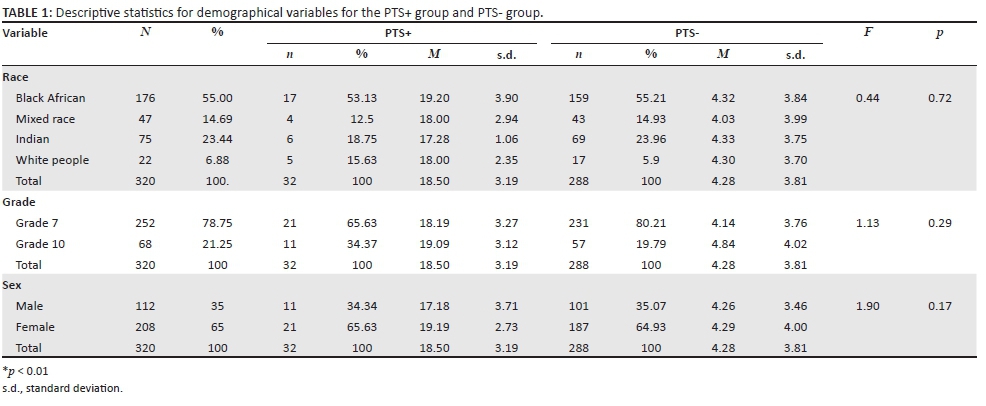
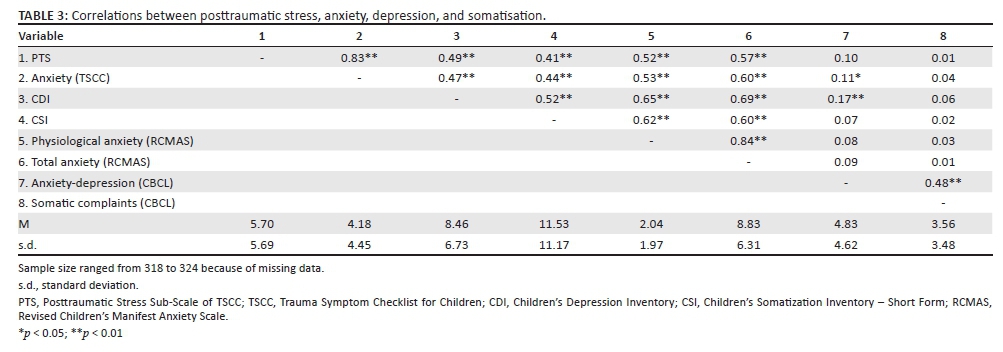
Descriptive statistics (Table 1) as well as correlations between the study variables (Table 3) were undertaken. Fifty-five percent of the youth were not living with two parents. In terms of the maternal caregivers, 54.0% had less than a high school level of education. Household income was reported as follows: 5.2% (less than R500 per month), 12.3% (R501 - R1500 per month), 13.3% (R1501 - R2500 per month), 9.9% (R2501 - R3500 per month), 11.7% (R3501 - R4500 per month), 8.6% (R4501 - R5000 per month) and 34.6% (R5001+ per month). Furthermore, 56.2% reported that this income was stable, whilst 43.8% noted this income was unstable and changed monthly.
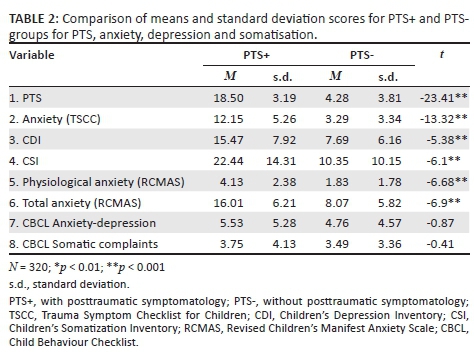
On the TSCC, 19 participants (5.94%) had t-scores of ≥ 65 and 13 participants (4.06%) had posttraumatic stress symptoms, with sub-diagnostic (t-scores) between 60 and 64. Thus, the total PTS+ group consisted of 32 participants (10% of the sample). Independent t-tests comparing age for the PTS+ and PTS- groups showed a significant difference between the PTS+ (M = 13.69, s.d. = 1.53) and the PTS- (M = 13.05, s.d. = 1.53, t(318) = -2.24, p = 0.02) groups indicating that the PTS+ group was significantly older. Independent t-tests (Table 2) comparing the PTS+ and PTS- groups revealed that the PTS+ group reported significantly more anxiety, depression and somatic symptoms.
The relationship between PTSS and the other study variables of anxiety, depression and somatic symptoms is represented in Table 3. There was a significant, positive correlation between posttraumatic stress and anxiety measured by the TSCC, physiological anxiety and total anxiety measured by the RCMAS, as well as youth-rated depressive and somatic symptoms. Interestingly, PTSS was not correlated with caregiver's ratings of anxiety, depression or somatic symptoms on the CBCL. Thus, a cross-rater effect was observed in that there was a clear discrepancy between what was being reported by the youth and their maternal caregivers in terms of the symptoms experienced by the adolescents.
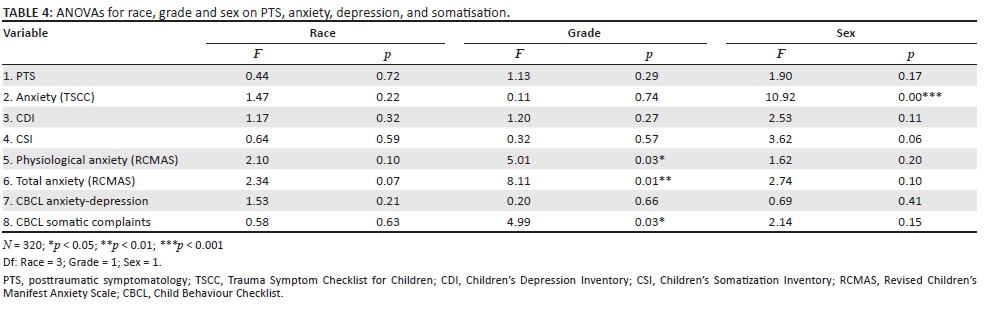
Table 4 presents the two-way ANOVAs for race, grade and sex in those with PTSS and those without. A two-way between-groups analysis of variance was conducted to explore the impact of race on levels of PTS scores. There was no statistically significant main effect for race (F [3, 312] = 0.44, p = 0.72). A two-way between-groups analysis of variance was conducted to explore the impact of grade on levels of PTS scores. There was no statistically significant main effect for school grade (F [1, 316] = 1.13, p = 0.29). A further two-way between-groups analysis of variance was conducted to explore the impact of sex and PTS groupings on levels of PTS scores. There was no statistically significant main effect for sex (F [1, 316] = 1.90, p = 0.17).
Multiple two-way ANOVAs were conducted considering the impact of race, grade and sex on the other study variables of anxiety, depression and somatic symptoms (see Table 4) with regard to PTS. Grade 10 participants reported higher scores (M = 2.70, s.d. = 2.20) on the physiological anxiety sub-scale than Grade 7 participants (M = 1.89, s.d. = 1.87). A similar trend was seen on the RCMAS total anxiety scores (Grade 10: M = 11.53, s.d. = 6.77; Grade 7: M = 8.14, s.d. = 6.00). Female participants (M = 9.16, s.d. = 6.58) reported significantly higher levels of total anxiety (RCMAS) than males (M = 8.32, s.d. = 5.80). Similarly, female participants scored significantly higher scores on the TSCC anxiety sub-scale (M = 4.41, s.d. = 4.74) than males (M = 3.75, s.d. = 3.84). Females (M = 11.85, SD = 11.18) in the overall sample reported marginally significantly higher somatic symptoms than males (M = 11.02, s.d. = 11.30).
Discussion
This study investigated the relationship between traumatic stress and anxiety, depression and somatisation in a multi-racial community sample. Ten percent of the adolescents in this study endorsed responses on the TSCC that indicated clinically significant PTSS. Almost 6.0% of the youth had PTSD (t-scores ≥ 65). This result is lower than other local studies, in which 8.4% of the sample had PTSD. Another study of adolescents from schools across Cape Town1163
It was hypothesised that traumatic stress levels would be positively correlated with levels of anxiety, depression and somatic symptoms. This study demonstrated a large positive correlation between traumatic stress and anxiety, and medium positive correlations between posttraumatic stress and depression and somatic symptoms, which is similar to other research findings.26,27,281,29,30,31Table 3 shows, although both adolescents and caregivers reported on the various symptomatology, the reports from the caregivers were not highly correlated. Such discrepant patterns have been observed in various studies3233
No statistically significant main effect for sex on PTS scores was found suggesting that sex was found to be unrelated to PTSD risk which is supported by other studies.11,34353535
Implications for clinical practice and policy
PTSD can be a debilitating disorder and may often have long-term academic, social and emotional consequences for an individual.3637,38
It is paramount that youth mental health status needs be addressed, as PTSS often has delayed comorbidity and is associated with several problems outlined above. As noted in other work,3936
Study limitations and directions for future research
A major limitation of this study is the cross-sectional design, which did not allow for the analysis of changes in symptomatology over time and their associated comorbidities. A further limitation is the exclusive reliance on self-reported psychometric inventories, the reliability of which may be affected by inattention, flawed recall or deliberate distortion.40
Conclusion
This community-sample study concluded that 10% of adolescents endorsed clinically significant PTSS, with almost 6% having PTSD. The results showed a correlation between traumatic stress and anxiety as well as between posttraumatic stress and depression and somatic symptoms. Females reported higher anxiety and somatic symptoms (Tables 1-4).
Competing interests
The authors declare that they have no financial or personal relationships which may have inappropriately influenced them in writing this article.
Authors' contributions
K.S. made a substantial contribution to the concept and design of the article; assisted with the acquisition of data in the form of training interviewer assistants; analysed the data; drafted the article; and approved the final version to be published. B.J.P. made a substantial contribution to the concept and design of the article; assisted with data analysis; revised the article; and approved the final version to be published. W.K. made a substantial contribution to the concept and design of the article; provided substantial assistance with data analysis; revised the article and approved the version to be published.
Acknowledgements
This study was funded by a Global Education Grant from Virginia Commonwealth University, United States, and from the Department of Behavioural Medicine at the University of KwaZulu-Natal. The entire Project CARE team at the University of KwaZulu-Natal and Virginia Commonwealth University is acknowledged with sincere thanks.
References
- 1. American Psychiatric Association. Diagnostic and statistical manual of mental disorders. Washington, DC: American Psychiatric Association; 2013.
- 2. Kaminer D, Eagle G. Traumatic stress in South Africa. Johannesburg, South Africa: Wits University Press; 2010.
- 3. Kessler RC, Ruscio AM, Shear K, Wittchen HU. Epidemiology of anxiety disorders. In: Steckler MBSaT, editor. Curr Top Behav Neurosci. Berlin: Springer-Verlag; 2009.
- 4. Ayuso-Mateos JL. Global burden of post-traumatic stress disorder in the year 2000. Geneva: World Health Organization; 2000.
-
5. Burri A, Maercker A. Differences in prevalence rates of PTSD in various European countries explained by war exposure, other trauma and cultural value orientation. BMC Res Notes. 2014;7(1):2-19. http://dx.doi.org/10.1186/1756-0500-7-407
» http://dx.doi.org/10.1186/1756-0500-7-407 - 6. Herman AA, Stein DJ, Seedat S, Heeringa SG, Moomal H, Williams DR. The South African Stress and Health (SASH) study: 12-month and lifetime prevalence of common mental disorders. S Afr Med J. 2009;99(5 Pt 2):339-344.
-
7. Norman R, Matzopoulos R, Groenewald P, Bradshaw D. The high burden of injuries in South Africa. Bull World Health Organ. 2007;85(9):695-702. http://dx.doi.org/10.2471/BLT.06.037184
» http://dx.doi.org/10.2471/BLT.06.037184 -
8. Schrieff LE, Thomas KG, Dollman AK, Rohlwink UK, Figaji AA. Demographic profile of severe traumatic brain injury admissions to Red Cross War Memorial Children's Hospital, 2006-2011. S Afr Med J. 2013;103(9):616-620. http://dx.doi.org/10.7196/samj.7137
» http://dx.doi.org/10.7196/samj.7137 -
9. Peltzer K. Posttraumatic stress symptoms in a population of rural children in South Africa. Psychol Rep. 1999;85(2):646-650. http://dx.doi.org/10.2466/pr0.1999.85.2.646
» http://dx.doi.org/10.2466/pr0.1999.85.2.646 - 10. Burton P. Snapshot results of the CJCP National Schools Violence Study. Centre for Justice and Crime Prev Res Bull. 2008;2008(2):1-4.
-
11. Seedat S, Nyamai C, Njenga F, Vythilingum B, Stein DJ. Trauma exposure and post-traumatic stress symptoms in urban African schools. Survey in CapeTown and Nairobi. Br J Psychiatry. 2004;184:169-175. http://dx.doi.org/10.1192/bjp.184.2.169
» http://dx.doi.org/10.1192/bjp.184.2.169 -
12. Angelakis S, Nixon RDV. The comorbidity of PTSD and MDD: Implications for clinical practice and future research. Behav Change. 2015;32(1):1-25. http://dx.doi.org/10.1017/bec.2014.26
» http://dx.doi.org/10.1017/bec.2014.26 -
13. Pillay BJ. Providing mental health services to survivors: A Kwa Zulu-Natal perspective. Ethn Health. 2000;5(3-4):269-272. http://dx.doi.org/10.1080/713667454
» http://dx.doi.org/10.1080/713667454 -
14. Kaminer D, du Plessis B, Hardy A, Benjamin A. Exposure to violence across multiple sites among young South African adolescents. Peace Confl: J Peace Psychol. 2013;19(2):112-124. http://dx.doi.org/10.1037/a0032487
» http://dx.doi.org/10.1037/a0032487 - 15. Ensink K, Robertson BA, Zissis C, Leger P. Post-traumatic stress disorder in children exposed to violence. S Afr Med J. 1997;87(11):1526-1530.
- 16. Edwards D. Post-traumatic stress disorder as a public health concern in South Africa. J Psychol Afr. 2005;15(2):125-134.
-
17. World Bank. World Development Indicators 2013. Washington, DC: World Bank; c2014 [cited 2013]. Available from: http://data.worldbank.org
» http://data.worldbank.org -
18. Evans GW, Kantrowitz E. Socioeconomic status and health: The potential role of environmental risk exposure. Annu Rev Public Health. 2002;23(1):303. http://dx.doi.org/10.1146/annurev.publhealth.23.112001.112349
» http://dx.doi.org/10.1146/annurev.publhealth.23.112001.112349 -
19. Census 2011 [homepage on the Internet]. 2012. Available from: http://www.statssa.gov.za/publications/P03014/P030142011.pdf
» http://www.statssa.gov.za/publications/P03014/P030142011.pdf - 20. Briere J. Trauma Symptom Checklist for Children (TSCC) Professional manual. Odessa, FL: Psychological Assessment Resources; 1996.
- 21. Kovacs M. The Children's Depression Inventory. Tonawanda, NY: Multi-Health Systems; 1992.
-
22. Myers K, Winters NC. Ten-year review of rating scales. II: Scales for internalizing disorders. J Am Acad Child Adolesc Psychiatry. 2002;41(6):634. http://dx.doi.org/10.1097/00004583-200206000-00004
» http://dx.doi.org/10.1097/00004583-200206000-00004 -
23. Walker LS, Garber J, Greene JW. Somatization symptoms in pediatric abdominal pain patients: Relation to chronicity of abdominal pain and parent somatization. J Abnorm Child Psychol. 1991;19(4):379-394. http://dx.doi.org/10.1007/BF00919084
» http://dx.doi.org/10.1007/BF00919084 -
24. Reynolds CR, Richmond BO. What i think and feel: A revised measure of children's manifest anxiety. J Abnormal Child Psychol. 1979;6(2):271-280. http://dx.doi.org/10.1007/BF00919131
» http://dx.doi.org/10.1007/BF00919131 - 25. Achenbach TM. Integrative guide for the 1991 CBCL/4-18, YSR, and TRF profiles. Burlington, VT: Department of Psychiatry, University of Vermont; 1991.
- 26. Bach JM, Louw D. Depression and exposure to violence among Venda and Northern Sotho adolescents in South Africa. Afr J Psychiatr. 2010;13(1):25-35.
-
27. Kennedy AC, Bybee D, Sullivan CM, Greeson M. The effects of community and family violence exposure on anxiety trajectories during middle childhood: The role of family social support as a moderator. J Clin Child Adolesc Psychol. 2009;38(3):365-79. http://dx.doi.org/10.1080/15374410902851713
» http://dx.doi.org/10.1080/15374410902851713 -
28. Voith LA, Gromoske AN, Holmes MR. Effects of cumulative violence exposure on children's trauma and depression symptoms: A social ecological examination using fixed effects regression. J Child Adolesc Trauma. 2014;7(4):207-216. http://dx.doi.org/10.1007/s40653-014-0026-8
» http://dx.doi.org/10.1007/s40653-014-0026-8 -
29. Fitzpatrick KM, Boldizar JP. The prevalence and consequences of exposure to violence among African-American youth. J Am Acad Child Adolesc Psychiatry. 1993;32(2):424-430. http://dx.doi.org/10.1097/00004583-199303000-00026
» http://dx.doi.org/10.1097/00004583-199303000-00026 -
30. Stein BD, Jaycox LH, Kataoka SH, Wong M, Tu W, Elliott MN, et al. A mental health intervention for school children exposed to violence: A randomized controlled trial. JAMA. 2003;290(5):603-611. http://dx.doi.org/10.1001/jama.290.5.603
» http://dx.doi.org/10.1001/jama.290.5.603 - 31. Tuscic SJ, Flander GB, Mateskovic D. The consequences of childhood abuse. Paediatrics Today. 2012;9(1):12.
-
32. de Los Reyes A, Kazdin AE. Informant discrepancies in the assessment of childhood psychopathology: A critical review, theoretical framework, and recommendations for further study. Psychol Bull. 2005;131(4):483-509. http://dx.doi.org/10.1037/0033-2909.131.4.483
» http://dx.doi.org/10.1037/0033-2909.131.4.483 -
33. Achenbach TM, McConaughy SH, Howell CT. Child/adolescent behavioral and emotional problems: Implications of cross-informant correlations for situational specificity. Psychol Bull. 1987;101(2):213-232. http://dx.doi.org/10.1037/0033-2909.101.2.213
» http://dx.doi.org/10.1037/0033-2909.101.2.213 -
34. Atwoli L, Stein DJ, Williams DR, McLaughlin KA, Petukhova M, Kessler RC, et al. Trauma and posttraumatic stress disorder in South Africa: Analysis from the South African stress and health study. BMC Psychiatry. 2013;13(1):1-12. http://dx.doi.org/10.1186/1471-244X-13-182
» http://dx.doi.org/10.1186/1471-244X-13-182 -
35. Barsky AJ, Peekna HM, Borus JF. Somatic symptom reporting in women and men. J Gen Intern Med. 2001;16(4):266-275. http://dx.doi.org/10.1046/j.1525-1497.2001.016004266.x
» http://dx.doi.org/10.1046/j.1525-1497.2001.016004266.x -
36. Kataoka S, Langley A, Wong M, Baweja S, Stein B. Responding to students with PTSD in schools. Child Adolesc Psychiatr Clin N Am. 2012;21(1):119-133. http://dx.doi.org/10.1016/j.chc.2011.08.009
» http://dx.doi.org/10.1016/j.chc.2011.08.009 -
37. Delaney-Black V, Covington C, Ondersma SJ, Nordstrom-Klee B, Templin T, Ager J, et al. Violence exposure, trauma, and IQ and/or reading deficits among urban children. Arch Pediatr Adolesc Med. 2002;156(3):280-285. http://dx.doi.org/10.1001/archpedi.156.3.280
» http://dx.doi.org/10.1001/archpedi.156.3.280 -
38. Putnam FW, Trickett PK. Psychobiological effects of sexual abuse. Ann N Y Acad Sci. 1997;821(1):150-159. http://dx.doi.org/10.1111/j.1749-6632.1997.tb48276.x
» http://dx.doi.org/10.1111/j.1749-6632.1997.tb48276.x -
39. Havens JF, Gudino OG, Biggs EA, Diamond UN, Weis JR, Cloitre M. Identification of trauma exposure and PTSD in adolescent psychiatric inpatients: An exploratory study. J Trauma Stress. 2012;25(2):171-178. http://dx.doi.org/10.1002/jts.21683
» http://dx.doi.org/10.1002/jts.21683 -
40. Liang H, Flisher AJ, Lombard CJ. Bullying, violence, and risk behavior in South African school students. Child Abuse Negl. 2007;31(2):161-171. http://dx.doi.org/10.1016/j.chiabu.2006.08.007
» http://dx.doi.org/10.1016/j.chiabu.2006.08.007

Accepted: 01 Dec. 2016
Published: 10 Mar. 2017