Post-traumatic stress disorder in an antenatal population in South Africa: Prevalence and associated factors
Abstract
BACKGROUND: The prevalence of post-traumatic stress disorder (PTSD) is uncertain globally, and there is a paucity of information in South Africa. Perinatal PTSD may impair maternal functioning and negatively affect their parenting ability AIM: This study aimed to determine the prevalence and associated factors of PTSD in an antenatal population in South Africa SETTING: The study was conducted at Johan Heyns Community Health Centre in Sedibeng district, Gauteng province METHODS: A cross-sectional questionnaire-based survey was conducted in which the Post-traumatic Stress Disorder Checklist for DSM-5 (PCL-5) was administered among women attending the Johan Heyns antenatal clinic. The PCL-5 is a validated screening tool for PTSD, which comprises 20 items scored on a 5-point Likert scale for symptom severity. A total score ≥ 31 indicates at least moderate PTSD RESULTS: Of the 98 pregnant women who participated in the study, 53 (54%) reported having experienced or witnessed a traumatic event. Total PCL-50 scores ranged from 0-65 (mean 13.8 standard deviation [s.d. = 18.1]), with at least one intrusion symptom endorsed by 37 women, followed by cognition and mood change by 36, arousal and reactivity by 32, and avoidance by 24. Sixteen women (16.3%) screened positive for PTSD (mean score 49.2 [s.d. = 12.7]). While univariate analysis found no significant associations with PTSD, alcohol use was associated with an increased risk of PTSD on multivariate analysis (RR 2.7; [95% confidence interval [CI] 1.1-7.0; p = 0.036 CONCLUSION: Post-traumatic stress disorder is common among antenatal women in Sedibeng district and may be associated with alcohol use in pregnancy CONTRIBUTION: This study highlights the importance of screening pregnant women for PTSD to ensure early intervention and management
antenatal; community health centre; prevalence; posttraumatic stress disorder; PCL-5
Introduction
Post-traumatic stress disorder (PTSD) results in impairment in functioning in several important areas such as social, interpersonal, vocational and academic functioning.1234
Post-traumatic stress disorder tends to be more common among women than men, especially following sexual trauma.256
The impairment in functioning among women with PTSD has particular relevance for the perinatal period, when PTSD may have potentially devastating consequences with respect to negative effects on various child outcomes and mother-infant bonding and attachment.7,8,910,1112
A systematic review and meta-analysis of 35 studies examining PTSD during pregnancy by Yildiz et al.13
The South African context provides unique opportunities for further research and work in the field of psychological trauma, exposure to trauma and its resultant effects on health, not limited to but including PTSD within the antenatal period. Intervention, management and treatment of individuals with severe PTSD requires intense, multifaceted biopsychosocial therapeutic interventions. Given the crucial role of maternal mental health in child development and attachment, early identification and treatment of antenatal PTSD is essential to improving outcomes for both mother and infant. This study aimed to determine the prevalence of PTSD symptoms among antenatal attendees at a district Community Health Centre (CHC) in Gauteng province and identify associated factors.
Research methods and design
Study design
A cross-sectional study design was conducted in which an investigator-administered questionnaire was used among pregnant women attending an antenatal clinic in the Sedibeng district of Gauteng province.
Setting
The antenatal clinic was at Johan Heyns Community Health Centre (CHC), which is in an industrial city of the Sedibeng district in Gauteng province and serves a mixed suburban, informal settlement and rural population. This CHC was chosen because it has a large and well-established antenatal clinic as well as a mental health care service with doctors, nurses, social workers, and psychologists available to aid patients needing escalation of care. The CHC has facilities for uncomplicated deliveries. Women identified at the antenatal clinic as having high-risk pregnancies are referred to the regional hospital for further antenatal and obstetric care. As part of routine antenatal care, women attending the antenatal clinic are screened for mental health issues by a professional nurse using a standard set of screening questions in the government-issued maternity case record. A 3-item tool validated in South Africa has been implemented as standard antenatal screening for perinatal common mental illnesses and suicidality.14
Study population and sampling strategy
The study population comprised pregnant women following up at Johan Heyns antenatal clinic. To be enrolled in the study, participants needed to be 18 years of age or older and have a basic proficiency in English, as all questionnaires were administered in English. Participants were recruited through convenience sampling on the day of their antenatal clinic follow-up. Convenience sampling was chosen for its simplicity, cost-effectiveness and practicality in a resource-limited setting. All women waiting for their antenatal appointment were informed of the study aims and objectives and invited to participate. Women willing to participate were taken to a private interview room in the clinic, consent was obtained, and study questions were administered. Exclusion criteria were women who were too physically unwell to participate and women without capacity to consent to the traumatic questions being asked in the questionnaire due to health concerns at the time of interview.
Calculation of sample size was conducted using Glenn Israel tables.1516
Study tools
Post-traumatic stress disorder checklist for DSM-5
The Post-traumatic Stress Disorder Checklist for DSM-5 (PCL-5) developed by the National Centre for PTSD at the US Department of Veterans Affairs17
A provisional diagnosis of PTSD may be determined from the PCL-5 in two ways: either through summing all 20 items from clusters B-E to arrive at a total score ranging between zero and 80 or by using DSM-5 diagnostic criteria. The National Centre for PTSD recommends using a total score with a cut-off score between 31 and 33 as psychometric studies indicate this to be more reliable for identifying at least moderate PTSD. The precise cut-point should be determined on a case-by-case basis and, in vulnerable populations, a lower cut-off score may apply to ensure no cases are missed, noting that the lower score may result in some false positives. As our study population is vulnerable, being pregnant women living in a society with a high level of interpersonal violence, we used the lower cut-off score of 31 to identify at least moderate PTSD in our study and to analyse associated factors.
When using DSM-5 criteria, an item is only endorsed as a symptom of PTSD if it is rated as 2 or more (i.e. experienced at least moderately). A diagnosis of PTSD requires endorsement of at least six items (one in each of clusters B and C and two in each of clusters D and E). To understand the nature of symptoms experienced by our study population, both methods were used to calculate PTSD probability.
Socio-demographic and clinical questionnaire
A questionnaire was developed by the principal investigator (Megan Fyffe) to obtain relevant socio-demographic and clinical variables, including age, population group, level of education, relationship status, employment, housing, antenatal, medical and substance use history. A population group was included to determine if the study sample is representative of the region and was documented using national census terminology.
Data collection
Women were informed of the study, provided with an information leaflet, and invited to participate while in the antenatal waiting room by Megan Fyffe. Those who wanted to participate were taken to a private consultation room and given an opportunity to ask questions before signing the consent. Socio-demographic, antenatal, medical and substance use data were collected and the PCL-5 was administered by Megan Fyffe. Antenatal data were captured from the maternal health record and during the interview. Participants were monitored for any signs of distress during the interview process. All women who exhibited distress, screened positive for PTSD, or were using substances were referred to an on-site mental health professional. A deliberately low threshold for referral was maintained given the vulnerability of the study population and the possibility of complex biopsychosocial causes of the distress.
The interviews were conducted in English. Participants were assured of anonymity, with each interviewee assigned a study number and all data collected were stored separately from any identifying information. Participants could choose to skip questions on the socio-demographic questionnaire and remain in the study. An effort was made to ensure a supportive and safe environment for women choosing to participate.
Data analysis
Data from all questionnaires were captured on a Microsoft Excel spreadsheet and imported into IBM SPSS version 29 for statistical analysis. Descriptive statistics including numbers, frequency distributions and means were used to summarise participants' socio-demographic data and responses to PCL-5. Frequencies and percentages were presented for categorical variables as overall and stratified by PTSD symptoms (negative vs. positive).
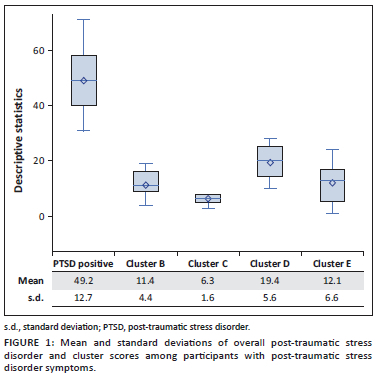
Cronbach's alpha was used to test for the reliability and consistency of the items of the PTSD scale. The tables stratified by PTSD symptoms were presented with denominators, referring to the number of participants who responded to a question and/or item. For continuous measures, means and standard deviations (s.d.) as well as medians and interquartile ranges were presented. A bar chart was used to report PTSD severity among participants with positive PTSD symptoms while a box and whisker plot provides graphical representational was used to report the means and s.d. for positive PTSD symptoms as well as the clusters of participants with positive PTSD symptoms.
To determine the statistical difference between participants with negative and positive PTSD symptoms, Chi-Square test or Fisher's test was used where appropriate. For statistical comparison in continuous measures, medians were compared using a non-parametric test (Kruskal-Wallis test). Generalised linear model, using a log binomial distribution link function, was used to assess factors associated with positive PTSD symptoms. This model was selected because the proportion of participants with positive PTSD symptoms was > 10%. No variables were significant at univariate analysis; therefore, all variables in the univariate analysis were included in the multivariate model, and a backward selection procedure was used to reach the final model. Results for the model are presented as relative risks (RR), 95% CIs and p-values. Statistical significance was defined as p-value ≤ 0.05. Statistical analysis was conducted using SAS Enterprise Guide 7.1 (SAS Institute Inc., Cary, North Carolina, United Sates).
Ethical considerations
An effort was made to ensure that consent to participate was voluntary. A distress protocol was put in place, and on-site access to mental health professionals was confirmed. All data were anonymised with the use of separately stored study numbers for each participant. Ethical consent for the study was approved by the Faculty of Health Sciences Human Research Ethics Committee of the University of the Witwatersrand (M240414MED24-03-477), and permission to conduct the study was provided by the Acting Chief Director of the Sedibeng District Health Services and the Operational Manager of Johan Heyns Clinic.
Results
Socio-demographic characteristics
The study sample comprised 98 women. Although 100 women initially participated in the study, one was excluded when it became apparent that she was under 18 years old. Another woman withdrew from the study as she experienced marked distress during the PCL-5 questionnaire, did not wish to continue and was referred to the mental health care services.
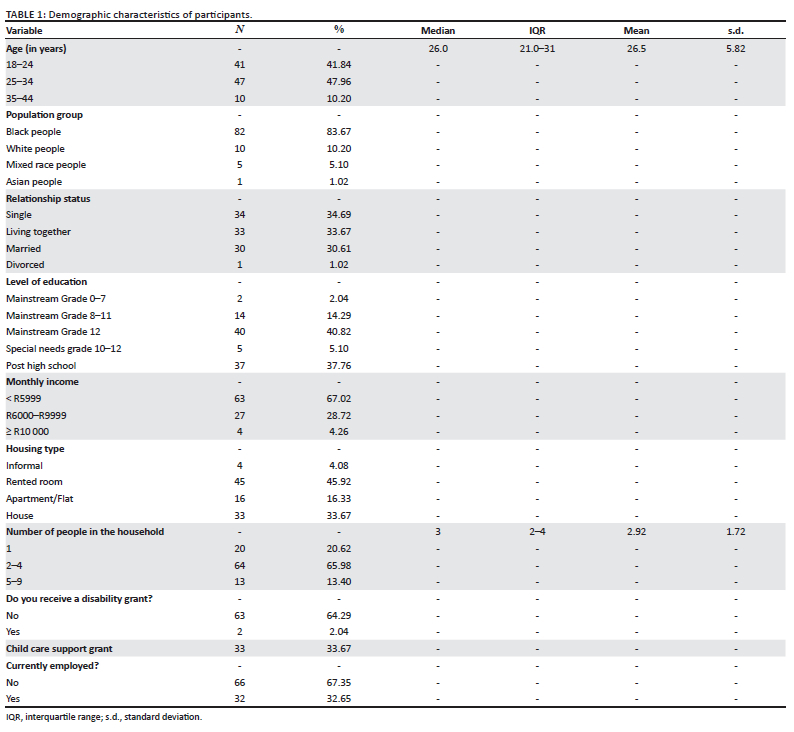
Socio-demographic characteristics are described in Table 1. The median age of participants was 26 years with 47 participants being between 25 and 34 years of age. Most participants were black African (84%), while white, mixed race and Indian and/or Asian population groups formed 10%, 5% and 1% of the sample, respectively. Just over a third (35%) of participants were single, and a high proportion (67%) had a monthly income of less than R5999. Only four participants reported earning over R10 000.00, while four preferred not to disclose their income status to the interviewer. A third (33%) of participants received a childcare support grant, while two participants received disability grants, both for bipolar disorder. Income insecurity was further underscored with 66 participants being unemployed.
With respect to living conditions, 46% of participants indicated they resided in rented rooms, and a large majority (66%) of participants lived in households with 2-5 people, while 20% lived alone. Educational attainment was limited, with only 40 participants having achieved matric and five having attended special education schools.
Maternal health factors and substance use history
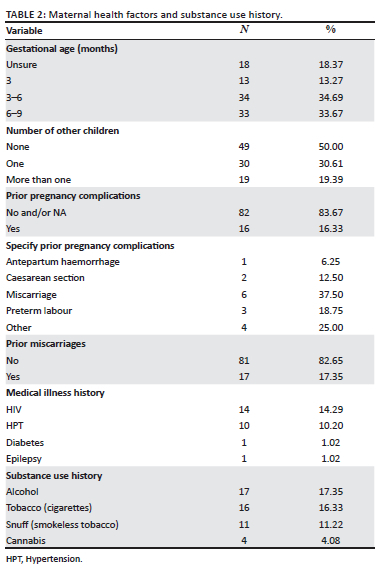
Maternal health factors and substance use history are outlined in Table 2. Half of the participants involved were primigravida and most (69%) were in their second or third trimester. Complications in previous pregnancies were reported by 16 participants. Eight participants reported having had previous contact with mental health services: five had received at least one counselling session (one after experiencing a stillbirth, one for suicidality and three for undisclosed reasons); and three had received psychiatric care (for PTSD, bipolar disorder and depression, respectively). The mental health screening tool in the maternity health record was completed in all participants, with one participant scoring 3, four scoring 2, one scoring 1 and 92 scoring 0. However, there was no documentation on whether counselling had been offered or a referral provided.
Twenty-four participants had comorbid medical conditions, two of whom had two conditions (one with hypertension and HIV and the other with hypertension and diabetes). Thirty-seven participants reported using at least one substance during their pregnancy. Tobacco was the most used substance, either smoked or used in a dry form as 'snuff'. We separated the two forms of use as there is less understanding regarding the harmful effects of snuff use in pregnancy. Of the participants who reported using more than one substance, tobacco and alcohol were the most frequently used combination.
Trauma history
Fifty-three participants reported having either personally experienced or witnessed a traumatic event. In 14 women, the traumatic event was linked to previous obstetric or gynaecological complications or neonatal demise. Four women reported experiencing IPV and three had a history of childhood trauma (one of whom was currently exposed to IPV). One woman reported exposure to criminal violence and another to workplace-related conflict. The remaining participants reporting a history of trauma did not wish to disclose its nature.
Post-traumatic stress disorder prevalence
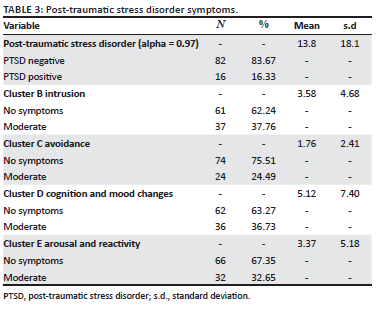
The results of the PCL-5 questionnaire are presented in Table 3, including the total score and the number of participants who endorsed at least one item in each cluster (i.e. who rated their experience as moderately severe for one or more items in each cluster). A Cronbach's alpha coefficient is a measure of internal consistency and a measure of scale reliability. A value of 0.97 indicates good internal consistency and reliability for the PCL-5 within our population sample.
The PCL-5 scores ranged from 0 to 71 with a mean score of 13.8 (s.d. = 18.1), and 16 of the 98 participants scored 31 or more. However, many women endorsed individual items, indicating the presence of PTSD symptoms even if the total score was less than 31. A score of 2 or more for an item (at least a moderate severity of the symptom) was reported by 37 participants for Cluster B (intrusion), 24 for Cluster C (avoidance), 36 for Cluster D (cognition and mood changes) and 32 for Cluster E (arousal and reactivity) symptoms.
Twelve participants met DSM-5 criteria for a diagnosis of PTSD, one of whom had a total score of only 26. Of the five participants with total scores of 31 or more who did not meet DSM-5 criteria, four had not endorsed two or more Cluster E (arousal and reactivity) symptoms and one did not endorse any Cluster B (intrusion) symptoms, which were all experienced but only mildly.
All four participants who had been exposed to IPV met DSM-5 criteria for PTSD, with total PCL-5 scores of 68, 61, 41, and 26. One participant with gynaecological trauma (a failed termination of pregnancy for the current pregnancy) met DSM-5 criteria for PTSD, with a PCL-5 score of 43, and one who had experienced a neonatal death secondary to eclampsia did not meet DSM-5 criteria, although she had a PCL-5 score of 35. None of the other women who provided details about the experienced traumatic event received a provisional diagnosis of PTSD on either scoring method. Of interest, only one of the eight women with prior contact with mental health services had PTSD (one of the women exposed to IPV who had previously received treatment for depression).
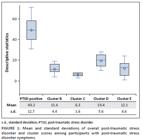
Among the 16 participants who screened positive for at least moderate PTSD when using the total score, the mean PCL-5 score was 49.2 (s.d. = 12.7), as illustrated in Figure 1. Of the clusters, Cluster D symptoms (cognition and mood changes) tended to be the most severe and Cluster C (avoidance) the least.
Comparison between those with and those without post-traumatic stress disorder
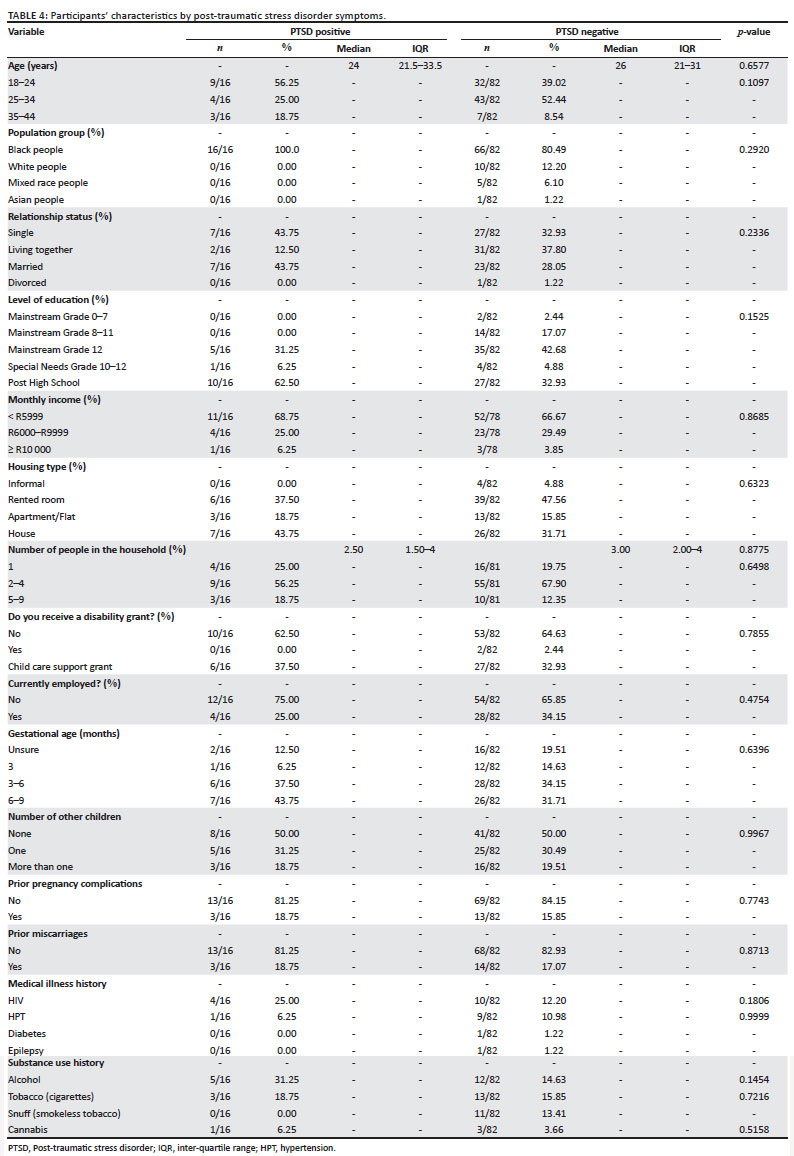
No statistically significant differences were found between participants with and those without PTSD across sociodemographic, maternal health or substance use variables (Table 4). Although not significant, participants who were 18-24 years had a higher proportion of positive PTSD symptoms compared to negative PTSD symptoms (56.2% vs. 39.0%, p = 0.1097). All 16 participants who had positive PTSD symptoms were black people. A high proportion of participants who had positive PTSD symptoms attended post-high school (62.5%), had a monthly income of < R5999 (68.8%), did not receive a disability grant (62.5%) and were not currently employed (75.0%).
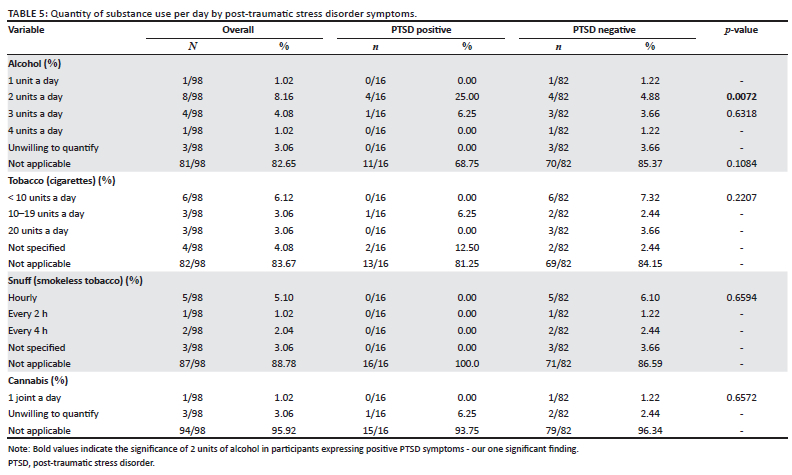
While there were no differences between the two groups in terms of each substance used, drinking two units of alcohol per day was significantly more common among those with PTSD compared to those without (25.0% vs. 4.9%, p = 0.0072) (Table 5).
Factors associated with post-traumatic stress disorder
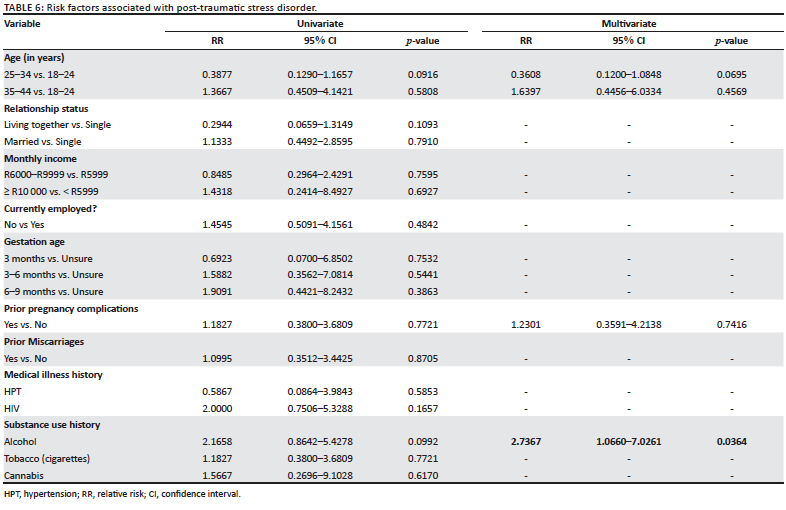
Multivariate analysis revealed alcohol use as the only factor significantly associated with having at least moderate PTSD (Relative Risk 2.7, 95% CI 1.1-7.0, p = 0.0364) (Table 6).
Distress protocol intervention
A total of 53 (54%) participants exhibited some distress during or after the interview and were referred to a mental health professional. In addition to those referred for management of their PTSD symptoms, others were referred for assistance with poor social support, family stressors and persistent substance use. While several referrals were to a registered counsellor or social worker, 30 were referred to the specialist mental health services.
Discussion
In this questionnaire-based study among pregnant women attending a community-based antenatal clinic in South Africa, PTSD was found to be highly prevalent at 16% of the participants. Alcohol use in pregnancy was the only risk factor significantly associated with PTSD in our study sample. In general, our sample is reflective of the broader population in Gauteng province, being mostly black African but with a slightly higher mixed race population than the rest of the province.1618
Our prevalence rate of 16% is closer to the 19% prevalence found among high-risk antenatal populations by Yildiz et al., compared to the 3.3% they found among community-based or general maternity populations.13
Psychological trauma, PTSD and associated risk factors among pregnant women in the Western Cape province of South Africa were investigated in the Drakenstein Child Health Study.19
As with the Drakenstein Child Health Study, we found a significant risk of alcohol abuse among those with PTSD. A positive relationship between alcohol use and PTSD has been well documented internationally in general population surveys20212223
Of serious concern is the poor identification and referral of mental health conditions in routine antenatal care, with only six participants having scored at least one on the routine mental health screen. In addition, only eight participants reported any previous contact with mental health services. The lack of mental health care is consistent with the treatment gap of 75% found in the SASH study for common mental disorders.324252627
Study limitations
This study has several limitations. The design of the study only allowed for general estimates of PTSD prevalence; thus, a temporal relationship or causality may not be inferred from the results. Another limitation was the presence of selection bias which meant that those participants who could not participate in the study were not screened and therefore may be at risk of PTSD and its associated complications. Similarly, only women who attended the clinic during data collection for their antenatal check-up were screened, leaving out those women who either did not visit the clinic or those who do not attend any antenatal clinic. Finally, the sample population was drawn from a peri-urban district in the most industrialised province of South Africa, and therefore, the findings may not be generalisable to the rest of the country.
Conclusion
Post-traumatic stress disorder is highly prevalent among pregnant women attending a community-based antenatal clinic in South Africa and is significantly associated with alcohol use during pregnancy. However, identification of mental health conditions and referral for appropriate interventions by antenatal clinic staff are poor, notwithstanding an emphasis on maternal mental health care in national policy and guidelines.
Recommendations
Further research is needed to explore means of strengthening maternal mental health care. However, increasing the capacity of antenatal nursing staff through additional training and improved human resources is likely to help. In particular, the addition of registered counsellors and/or social workers to antenatal clinics and midwifery units would be beneficial.
Competing interests
The authors declare that they have no financial or personal relationships that may have inappropriately influenced them in writing this article.
CRediT authorship contribution
Megan Fyffe: Conceptualisation, Methodology, Formal analysis, Investigation, Writing - original draft, Visualisation, Project administration, Validation, Data curation, Resources, Writing - review & editing, Supervision, Funding acquisition. Mojalefa Makgata: Conceptualisation, Visualisation, Resources, Writing - review & editing, Supervision. Lesley Robertson: Conceptualisation, Visualisation, Resources, Writing - review & editing, Supervision.
Funding information
This research received no specific grant from any funding agency in the public, commercial, or not-for-profit sectors.
Data availability
The data that support the findings of this study are available from the corresponding author, Megan Fyffe, upon reasonable request.
Disclaimer
The views and opinions expressed in this article are those of the authors and are the product of professional research. They do not necessarily reflect the official policy or position of any affiliated institution, funder, agency, or the publisher. The authors are responsible for this article's results, findings and content.
Acknowledgements
The authors wish to thank the Perinatal HIV Research Institute statistics department for assistance in data analysis.
References
- 1. American Psychiatric Association DSM-5 Task Force. Diagnostic and statistical manual of mental disorders: DSM-5. 5th ed. Washington, DC: American Psychiatric Association; 2013.
-
2. World Health Organization. Post-traumatic stress disorder [homepage on the Internet]. 2024 [cited 2025 Sep 09]. Available from: https://www.who.int/news-room/fact-sheets/detail/post-traumatic-stress-disorder
» https://www.who.int/news-room/fact-sheets/detail/post-traumatic-stress-disorder - 3. Herman AA, Stein DJ, Seedat S, Heeringa SG, Moomal H, Williams DR. The South African Stress and Health (SASH) study: 12-month and lifetime prevalence of common mental disorders. S Afr Med J. 2009;99(5 Pt 2):339-344.
-
4. Atwoli L, Stein DJ, Williams DR, et al. Trauma and posttraumatic stress disorder in South Africa: Analysis from the South African stress and health study. BMC Psychiatr. 2013;13(1):182. https://doi.org/10.1186/1471-244X-13-182
» https://doi.org/10.1186/1471-244X-13-182 -
5. Human Sciences Research Council (HSRC). Violence against women in South Africa: Intersecting vulnerabilities South Africa [homepage on the Internet]. 2025 [cited 2025 Sep 09]. Available from: https://hsrc.ac.za/news/review/violence-against-women-in-south-africa-intersecting-vulnerabilities/
» https://hsrc.ac.za/news/review/violence-against-women-in-south-africa-intersecting-vulnerabilities/ -
6. Machisa MT, Christofides N, Jewkes R. Mental ill health in structural pathways to women's experiences of intimate partner violence. PLoS One. 2017;12(4):e0175240. https://doi.org/10.1371/journal.pone.0175240
» https://doi.org/10.1371/journal.pone.0175240 -
7. Erickson N, Julian M, Muzik M. Perinatal depression, PTSD, and trauma: Impact on mother-infant attachment and interventions to mitigate the transmission of risk. Int Rev Psychiatr. 2019;31(3):245-263. https://doi.org/10.1080/09540261.2018.1563529
» https://doi.org/10.1080/09540261.2018.1563529 -
8. Cook N, Ayers S, Horsch A. Maternal posttraumatic stress disorder during the perinatal period and child outcomes: A systematic review. J Affect Disord. 2018;225:18-31. https://doi.org/10.1016/j.jad.2017.07.045
» https://doi.org/10.1016/j.jad.2017.07.045 -
9. Koen N, Brittain K, Donald KA, et al. Maternal posttraumatic stress disorder and infant developmental outcomes in a South African birth cohort study. Psychol Trauma. 2017;9(3):292-300. https://doi.org/10.1037/tra0000234
» https://doi.org/10.1037/tra0000234 -
10. Marshall RD, Garakani A. Psychobiology of the acute stress response and its relationship to the psychobiology of post-traumatic stress disorder. Psychiatr Clin North Am. 2002;25(2):385-395. https://doi.org/10.1016/S0193-953X(01)00005-3
» https://doi.org/10.1016/S0193-953X(01)00005-3 -
11. Glover V, O'Connor TG, O'Donnell K. Prenatal stress and the programming of the HPA axis. Neurosci Biobehav Rev. 2010;35(1):17-22. https://doi.org/10.1016/j.neubiorev.2009.11.008
» https://doi.org/10.1016/j.neubiorev.2009.11.008 -
12. Radtke KM, Ruf M, Gunter HM, et al. Transgenerational impact of intimate partner violence on methylation in the promoter of the glucocorticoid receptor. Transl Psychiatry. 2011;1(7):e21. https://doi.org/10.1038/tp.2011.21
» https://doi.org/10.1038/tp.2011.21 -
13. Yildiz PD, Ayers S, Phillips L. The prevalence of posttraumatic stress disorder in pregnancy and after birth: A systematic review and meta-analysis. J Affect Disord. 2017;208:634-645. https://doi.org/10.1016/j.jad.2016.10.009
» https://doi.org/10.1016/j.jad.2016.10.009 -
14. Abrahams Z, Schneider M, Field S, Honikman S. Validation of a brief mental health screening tool for pregnant women in a low socio-economic setting. BMC Psychol. 2019;7(1):77. https://doi.org/10.1186/s40359-019-0355-3
» https://doi.org/10.1186/s40359-019-0355-3 -
15. Israel G. Determining sample size. PEOD6: University of Florida IFAS extension [homepage on the Internet]. 1992 [cited 2024 Apr 11]. Available from: https://www.psycholosphere.com/Determining%20sample%20size%20by%20Glen%20Israel.pdf
» https://www.psycholosphere.com/Determining%20sample%20size%20by%20Glen%20Israel.pdf -
16. Statistics South Africa. Census 2022 Pretoria, South Africa [homepage on the Internet]. 2022 [cited 2025 Mar 05]. Available from: https://census.statssa.gov.za/#/
» https://census.statssa.gov.za/#/ -
17. National Center for PTSD. PTSD Checklist for DSM-5 (PCL-5) [homepage on the Internet]. U.S. Department of Veterans Affairs: Health; 2015 [cited 2023 Feb 20]. Available from: https://www.ptsd.va.gov/professional/assessment/adult-sr/ptsd-checklist.asp
» https://www.ptsd.va.gov/professional/assessment/adult-sr/ptsd-checklist.asp -
18. Statistics South Africa. Statistics South Africa on Quarterly Labour Force Survey (QLFS) - Q1: 2025 [homepage on the Internet]. South African Government; 2025 [cited 2025 Sep 09]. Available from: https://www.gov.za/news/media-statements/statistics-south-africa-quarterly-labour-force-survey-qlfs-%E2%80%93-q1-2025-13-may
» https://www.gov.za/news/media-statements/statistics-south-africa-quarterly-labour-force-survey-qlfs-%E2%80%93-q1-2025-13-may -
19. Koen N, Brittain K, Donald KA, et al. Psychological trauma and posttraumatic stress disorder: Risk factors and associations with birth outcomes in the Drakenstein child health study. Eur J Psychotraumatol. 2016;7(1):28720. https://doi.org/10.3402/ejpt.v7.28720
» https://doi.org/10.3402/ejpt.v7.28720 -
20. Smith NDL, Cottler LB. The epidemiology of post-traumatic stress disorder and alcohol use disorder. Alcohol Res. 2018;39(2):113-120. https://doi.org/10.35946/arcr.v39.2.02
» https://doi.org/10.35946/arcr.v39.2.02 -
21. Debell F, Fear NT, Head M, et al. A systematic review of the comorbidity between PTSD and alcohol misuse. Soc Psychiatry Psychiatr Epidemiol. 2014;49(9):1401-1425. https://doi.org/10.1007/s00127-014-0855-7
» https://doi.org/10.1007/s00127-014-0855-7 -
22. Popova S, Lange S, Probst C, Gmel G, Rehm J. Estimation of national, regional, and global prevalence of alcohol use during pregnancy and fetal alcohol syndrome: A systematic review and meta-analysis. Lancet Glob Health. 2017;5(3):e290-e2e9. https://doi.org/10.1016/S2214-109X(17)30021-9
» https://doi.org/10.1016/S2214-109X(17)30021-9 -
23. Peltzer K, Pengpid S. Maternal alcohol use during pregnancy in a general national population in South Africa. S Afr J Psychiatr. 2019;25:1236. https://doi.org/10.4102/sajpsychiatry.v25i0.1236
» https://doi.org/10.4102/sajpsychiatry.v25i0.1236 -
24. National Department of Health. South African maternal, perinatal and neonatal health policy Pretoria, South Africa [homepage on the Internet]. 2021 [cited 2025 Sep 09]. Available from: https://knowledgehub.health.gov.za/elibrary/south-african-maternal-perinatal-and-neonatal-health-policy
» https://knowledgehub.health.gov.za/elibrary/south-african-maternal-perinatal-and-neonatal-health-policy -
25. National Department of Health. National integrated maternal and perinatal guidelines for South Africa Pretoria, South Africa [homepage on the Internet]. 2024 [cited 2025 Sep 09]. Available from: https://knowledgehub.health.gov.za/elibrary/national-integrated-maternal-and-perinatal-care-guidelines-south-africa
» https://knowledgehub.health.gov.za/elibrary/national-integrated-maternal-and-perinatal-care-guidelines-south-africa -
26. Brown S, Sprague C. Health care providers' perceptions of barriers to perinatal mental healthcare in South Africa. BMC Public Health. 2021;21(1): 1905. https://doi.org/10.1186/s12889-021-11954-8
» https://doi.org/10.1186/s12889-021-11954-8 -
27. Robertson LJ, Moosa MYH, Jeenah FY. Strengthening of district mental health services in Gauteng Province, South Africa. S Afr Med J. 2021;111(6):538-543. https://doi.org/10.7196/SAMJ.2021.v111i6.15633
» https://doi.org/10.7196/SAMJ.2021.v111i6.15633

Accepted: 30 Oct. 2025
Published: 20 Dec. 2025