Evaluation of an undergraduate psychiatric clinical rotation: Exploring student perceptions
Abstract
BACKGROUND: Globally, the appropriate transformation of medical training is critical to ensure the graduation of competent physicians who can address the growing health needs. AIM: To explore medical students' perceptions of their learning experience during the undergraduate psychiatry late clinical rotation (PLCR) at Stellenbosch University (SU) and to use the findings to make possible recommendations regarding curriculum renewal SETTING: In recognition of this, the Department of Psychiatry at the Faculty of Medicine and Health Sciences of SU is reviewing its current teaching and learning practices. METHODS: Data were collected from two focus groups. RESULTS: Three main themes emerged: 'learning in the clinical context', 'gaining knowledge' and 'generational needs'. Whilst several suggestions were made for potential improvement, the participants still endorsed that the PLCR does provide them with a good learning experience in psychiatry. CONCLUSIONS: Considering that these perceptions are from a group of millennials, the insights arising from the 'generational needs' theme were especially valuable. To bridge the generational gap and develop a curriculum that will not only meet the standards expected by educators but also achieve acceptance from learners, future research with a specific focus on clinical teachers' perceptions is needed.
medical training; teaching and learning practices; medical students; undergraduate; clinical teachers; millennials
Introduction
Globally, there has been an increasing focus on equipping medical graduates with the appropriate competencies to adequately address the growing health needs of society. This can be achieved by appropriately transforming medical training programmes.1
In reviewing a curriculum, the evaluators must be mindful of the interests of the students.810101110
The Department of Psychiatry (DOP) at the Faculty of Medicine and Health Sciences (FMHS) of Stellenbosch University (SU) is reviewing its current teaching and learning practices. Whilst some data exist on using the perceptions of students regarding clinical rotations to improve curricula12,131415
Methods
Study design
This study used an exploratory, descriptive design generating data via thematic analysis. This type of research creates opportunities to generate theories of the world to be researched in an inductive manner.16
In this study, the 'voice' of the students as stakeholders17
This was achieved by describing themes identified from these students' dialogue.16
Target population and sampling
The target population for this study was the 2018 final year MBChB student cohort at SU FMHS (N = 210). Students were divided into six groups and attended the PLCR sequentially throughout the year with larger groups in the latter third of the year. Our sample consisted of students from two sequential groups attending the PLCR in July and September 2018. In total, 97 students were there in these two groups. All were informed of the study and invited to partake through an electronic invite. Two focus groups were formed by using convenience sampling to include the first respondents who volunteered to participate.
Data collection
Data were using two focus groups. This method has previously been shown to be valuable to evaluate medical education programmes.18
The groups consisted of seven (two male five female) and eight (two male and six female) participants. One interview per group was conducted by the primary researcher in a private location on campus, with each interview lasting approximately 50 min. Interviews were semi-structured and questions asked were guided by a document review of the existing psychiatry departmental data. After obtaining written and informed consent, both sessions were audio recorded and then transcribed independently. As the second focus group interview did not yield any new insights or thoughts, a third one was not indicated. During the interviews, the participants' comments were reflected back to them to ensure that the primary researcher understood the meaning.
The researcher made field notes during and after the focus groups and kept a research diary for documenting personal reflections and important decisions, including the reasons for these.
Analysis
The data collected during the focus groups were analysed using thematic analysis according to the 6-step approach of Braun and Clarke.19
Ethical considerations
Ethical clearance was granted by the Health Research Ethics Committee of the Faculty of Medicine and Health Sciences of Stellenbosch University (HREC reference number: S18/05/110), the MBChB programme committee and the DOP. Institutional approval was also obtained. Participation was completely voluntary and informed consent was obtained from each participant. Data was stored on a password protected computer. The identities of the participants were not disclosed to anyone outside of the focus groups.
Results
By examining the transcripts and triangulating the data with that of the field notes, three main themes were identified. These were 'learning in the clinical context' (with two subthemes, namely, 'clinical environment' and 'patient interviews'), 'gaining knowledge' and 'generational needs'.
Theme 1: Learning in the clinical context
This theme represents participants' perceptions of the learning activities and experiences in the various clinical placements. Although interviewing patients is part of the learning activities in the clinical environment, it constitutes a major component of clinical training in this discipline and will, therefore, be discussed separately to the rest of the students' perceptions of the clinical environment in general.
Sub-theme 1: Clinical environment
Both focus groups voiced the importance of the nature of the clinical environment. They appreciated a friendly and welcoming atmosphere where they were actively included in the ward programmes and given a measure of responsibility. They enjoyed working with the doctors and the rest of the multidisciplinary team and felt valued when treated as peers.
'The placement was nice. I thought it was a very nice ward and it is a very friendly environment and atmosphere.' (Participant 2, Male, Focus Group 2)
Ward doctors with whom they worked were reported to be valuable role models and they strongly communicated the need for access to, and regular contact with, the placement's doctors and consultant.
'The doctor deals with pressure so well and he is very engaging.' (Participant 4, Female, Focus Group 2)
'You could just knock on her door and just tell her anything that you saw that was interesting or whatever and just ask her questions, she was very accessible.' (Participant 7, Female, Focus Group 2)
For most of the students, working in the wards and observing the multidisciplinary team were also seen as an advantage for their learning. They could see the benefits of interacting with the team, both in learning from them and in seeing what their roles are and learning how a doctor relates to the team members in referring patients and receiving feedback.
'I could actually see that the other members of the MDT play a pivotal role. The doctor regulates the medication, but these people actually,… they actually form for me the psycho-social part of it more, they actually do most of the hard work for the patients.' (Participant 1, Male, Focus Group 1)
Participants reported that they learnt most when they were actively included in ward activities. Although they do not seem to want to take initiative in generating learning opportunities, if told to do something, they were more than willing to and even preferred this.
'I actually felt quite included, they have a lot of ward rounds and they would actually ask if I saw the patient as well, what did I think or what was my comments?' (Participant 4, Female, Focus Group 1)
Not only did they prefer to be included in activities, they also felt that being given a measure of responsibility added to their learning and to their insight into the responsibilities of being a doctor.
'What we enjoyed the most was that you were treated as colleagues and not as students and we were given a lot of responsibility but at the same time they were always there to help us.' (Participant 7, Female, Focus Group 2)
Sub-theme 2: Patient interviews
The participants found the activity of seeing and interviewing patients in the ward to be a positive experience.
'I feel that we do gain valuable experience and get a feel for the patients.' (Participant 6, Female, Focus Group 1)
However, there was a strong sense amongst the participants that learning took place only if the case could be discussed with a doctor. Both groups indicated that, after seeing patients, they were often unsure whether their findings were correct and that discussion with a more experienced person would be helpful to enable them to come to conclusions, such as making a diagnosis and deciding on a management plan.
'… [B]ut you can see all the patients you want, but if no one is correcting you … or correcting your interpretation at all so you might be doing it incorrectly.' (Participant 2, Male, Focus Group 2)
Despite the insight into the benefits of interviewing patients, this activity seemed to be experienced as being tedious. The participants felt that their learning was sufficient without seeing every patient or spending extended periods of time in the ward. They also felt that more time in wards did not deepen their learning, rather it became monotonous and uninteresting. The participants regarded the interviewing of patients as part of the routine ward work to be performed and not for the opportunity that it could be to gain experience. It could be concluded that the students did not make full use of the time or experience available to them.
'I don't need to go to see the whole ward now to get the experience, I just need to see like three different types of diseases.' (Participant 3, Female, Focus Group 2)
Some students indicated that they would have interviewed more patients if they had been given some kind of incentive or were explicitly told to do so.
'If we didn't have to do the patient write-ups or patient presentations, we wouldn't have even seen patients.' (Participant 8, Female, Focus Group 2)
Theme 2: Gaining knowledge
This theme relates to the participants' opinions regarding theoretical knowledge acquisition. Although the focus of the PLCR is on clinical training, the participants expressed the need to gain more theoretical knowledge. Theoretical knowledge that was gained in previous psychiatry training phases needed to be reviewed and this revision was deemed especially necessary to help conceptualise patients interviewed in the current placements.
'Proper formal learning must take place every single day that is structured, that is scheduled, by a consultant or by a registrar.' (Participant 3, Female, Focus Group 1)
Most of the participants reflected that the time of studying the textbook was more valuable to them than the time spent in the clinical environment.
'Are we going to spend more time in the ward, trying to see more patients or go home and start studying out of the text book from which all our questions is being asked from?' (Participant 1, Male, Focus Group 1)
Theme 3: Generational needs
This theme relates to the participants' expectations which could be attributed to their generational needs. There is a clear need that their time should not be wasted, rather it should be respected.
'So I think it is good if you have a set system where you can complete all your work, then you may leave and not keep us ransom till 4 o clock.' (Participant 3, Female, Focus Group 2)
The concept of fairness was prominent during the focus groups. Many students verbalised the need to be treated fairly and wanted structures put in place to ensure this. One of the main issues regarding fairness related to the doing of ward work. They expressed feelings around being misused and did not consider this as part of the learning process.
'Your purpose there is to learn, not to do the MO's work.' (Participant 5, Female, Focus Group 1)
Furthermore, a clear sense was felt about disparity between the different clinical placements.
'You get home at 5 and you know your colleagues are getting home at 12 or 1 every day, and you didn't get that, it's very hard not to feel like you've been handed the short straw.' (Participant 1, Male, Focus Group 1)
'Some are getting more teaching than others and it's not fair.' (Participant 4, Female, Focus Group 1)
It was voiced that fairness and protection against possible misuse could be ensured if structures were in place in all settings so that they themselves, as well as the other role players, have a clear understanding of the students' role.
'We must have a meeting with every single role player and the role is discussed, what is the role of the student, the nurses, the doctors so we can all know what we are there for.' (Participant 4, Female, Focus Group 1)
In addition to fairness they also wanted to be treated with consideration, especially regarding the amount of pressure that is put on them and the levels of anxiety that this provokes.
'… [A]nd if it is a practice environment you are going to learn more and be more ready for the test, because if you put a mark on that experience you are going to be so frazzled. You need to make it a safe learning environment where we can make mistakes.' (Participant 2, Male, Focus Group 1)
The participants also asked for more consideration in terms of their personal needs.
'The doctors don't feel any sympathy or empathy towards you.' (Participant 3, Female, Focus Group 1)
'You can't just take the day off.' (Participant 3, Female, Focus Group 2)
Discussion
This study explored student perceptions of an undergraduate psychiatry rotation, and the findings generated will be used to inform the curriculum renewal process that is currently being undertaken by the DOP at FMHS. The goal of this curriculum renewal is to ensure the graduation of more rounded primary care physicians. In general, the opinion from the participants of the focus groups was that the PLCR provided them with a good learning experience in psychiatry. They were particularly referring to the clinical environment and working with the multidisciplinary team and felt that this contributed to a positive experience. However, some important points were raised about the current curriculum, and several suggestions were made to potentially improve the current practice. Keeping in mind that these perceptions are from a group of millennials, some interesting insights arise especially when considering how this generation has been influenced by the world around them and the way in which they were raised.
Being millennials, our sample of students are expected to have had a less authoritative upbringing than most of their teachers and were active participants in their own households since an early age.2020
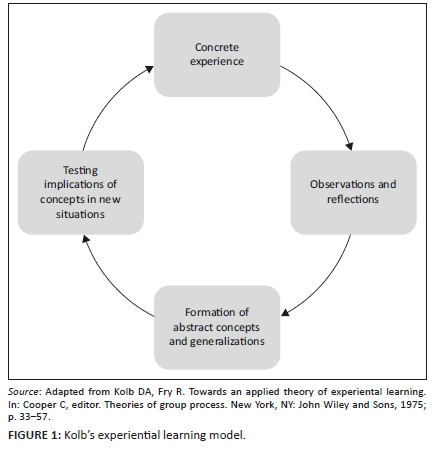
As per Kolb's experiential learning theory,521225
The participants of the focus groups were of the opinion that they do benefit from interviewing patients, but they found it challenging to link the clinical presentation of the patient to the theory from the textbook. Transferring knowledge to practice is a skill that develops through reflection and is a necessary step towards developing critical thinking.235
As most of our students form part of the millennial generation, it is possible that many grew up in a very child-focussed world exposed to the so-called 'helicopter parents'.242424
In focus groups, routine ward activities and follow-up patient interviews were reported to be perceived as the work of the permanent clinical staff; and students who commented on this felt that it was unfair to be expected to participate in these activities. It is possible that teachers from the previous generation may interpret this to reflect apathetic, disinterested, tuned out and selfish attitudes, but this might well be an erroneous perception. Chelsea Clinton25
Many millennials are quick to emphasise that a 'work-life balance' is important to them and that they do not see work as ending at 16:00 and personal life starting at this time. Rather, they see the two on a continuum.26
They also want consideration for their personal needs20
Curriculum design is influenced by the interplay between many factors, not least of which would be the values, beliefs and choices of the teachers who take the lead in the process.320
Our study is potentially limited by the fact that it was a small-scale, single-site study that only explored the perceptions of students who were self-selected on a first-come-first-serve basis. Also, the primary researcher, who conducted the focus group discussions and subsequent analysis, is a teacher of the participants, and we acknowledge the bias connected with an insider researcher. However, interesting insights were gained in terms of aligning the students' perceptions within the context of the generational gap, a concept that can be universally applied and, thus, can be regarded as a strength.
Conclusion
During the rotation evaluation process, our study participants offered many suggestions for change but still endorsed that the PLCR does provide them with a good learning experience in psychiatry. Whilst it will not be possible to implement all suggestions during the curriculum renewal process, the students' perceptions led to many valuable insights, particularly when framed within the context of the millennial generation's needs. Taking the generational gap into consideration, future research with a specific focus on clinical teachers' perceptions is needed. Understanding both the needs of teachers and students, whilst not compromising on quality, would likely be the best way to bridge the generational gap.
Competing interests
The authors declare that they have no financial or personal relationships that may have inappropriately influenced them in writing this article.
Authors' contributions
I.M.S. was involved in the study concept and design, data collection and analysis and coordinated manuscript preparation. L.K. was involved in the study concept and design, data analysis and preparation of the manuscript. M.V. was involved in the study concept and design, data analysis and preparation of the manuscript.
Funding information
This research received no specific grant from any funding agency in the public, commercial, or not-for-profit sectors.
Data availability
The data that support the findings of this study are available on request from the corresponding author, L.K.
Disclaimer
The views and opinions expressed in this article are those of the authors and do not necessarily reflect the official policy or position of any affiliated agency of the authors.
Acknowledgements
The authors wish to acknowledge and thank Dr Karis Moxley, BSc (Hons), PhD, for her generous editorial advice. She is a science writer and research coordinator with special interests in academic writing, higher education development and research capacity strengthening.
References
-
1.Frenk J, Chen L, Bhutta ZA, et al. Health professionals for a new century: Transforming education to strengthen health systems in an interdependent world. Lancet. 2010;376(9756):1923-1958. https://doi.org/10.1016/s0140-6736(10)61854-5
» https://doi.org/10.1016/s0140-6736(10)61854-5 -
2.Harden R. Ten questions to ask when planning a course or curriculum. Med Educ. 1986;20(4):356-365. https://doi.org/10.1111/j.1365-2923.1986.tb01379.x
» https://doi.org/10.1111/j.1365-2923.1986.tb01379.x - 3.Grant J. Understanding medical education: Principles of curriculum design. Oxford: Wiley Blackwell; 2014.
-
4.Kay D, Kibble J. Learning theories 101: Application to everyday teaching and scholarship. Adv Physiol Educ. 2016;40(1):17-25. https://doi.org/10.1152/advan.00132.2015
» https://doi.org/10.1152/advan.00132.2015 - 5.Kolb DA. Experiential learning: Experience as the source of learning and development. Englewood Cliffs, NJ: Prentice-Hall; 1984.
- 6.Kolb DA, Fry R. Towards an applied theory of experiental learning. In: Cooper C, editor. Theories of group process. New York, NY: John Wiley and Sons, 1975; p. 33-57.
-
7.Yardley S, Teunissen PW, Dornan T. Experiential learning: Transforming theory into practice. Med Teach. 2012;34(2):161-164. https://doi.org/10.3109/0142159x.2012.643264
» https://doi.org/10.3109/0142159x.2012.643264 -
8.Goldie J. AMEE Education Guide no. 29: Evaluating educational programmes. Med Teach. 2006;28(3):210-224. https://doi.org/10.1080/01421590500271282
» https://doi.org/10.1080/01421590500271282 -
9.Haji F, Morin M, Parker K. Rethinking programme evaluation in health professions education: Beyond 'did it work?'. Med Educ. 2013;47(4):342-351. https://doi.org/10.1111/medu.12091
» https://doi.org/10.1111/medu.12091 -
10.Desy JR, Reed DA, Wolanskyj AP. Milestones and millennials: A perfect pairing-competency-based medical education and the learning preferences of Generation Y. Mayo Clin Proc. 2017;92(2):243-250. https://doi.org/10.1016/j.mayocp.2016.10.026
» https://doi.org/10.1016/j.mayocp.2016.10.026 -
11.Borges NJ, Manuel RS, Elam CL, Jones BJ. Differences in motives between millennial and Generation X medical students. Med Educ. 2010;44(6):570-576. https://doi.org/10.1111/j.1365-2923.2010.03633.x
» https://doi.org/10.1111/j.1365-2923.2010.03633.x -
12.Stalmeijer RE, Dolmans DHJM, Wolfhagen IHAP, Peters WG, Van Coppenolle L, Scherpbier AJJA. Combined student ratings and self-assessment provide useful feedback for clinical teachers. Adv Heal Sci Educ. 2010;15(3):315-328. https://doi.org/10.1007/s10459-009-9199-6
» https://doi.org/10.1007/s10459-009-9199-6 -
13.Gathright MM, Thrush C, Guise JB, Krain L, Clardy J. What do medical students perceive as meaningful in the psychiatry clerkship learning environment? A content analysis of critical incident narratives. Acad Psychiatry. 2016;40(2):287-294. https://doi.org/10.1007/s40596-015-0303-3
» https://doi.org/10.1007/s40596-015-0303-3 -
14.Du Preez R, Bergh A-M, Grimbeck J, Van Der Linde M. Medical students' experience and perceptions of their final rotation in psychiatry. S Afr J Psychiatry. 2015;21(1):24-30. https://doi.org/10.4102/sajpsychiatry.v21i1.641
» https://doi.org/10.4102/sajpsychiatry.v21i1.641 -
15.Charlson FJ, Diminic S, Lund C, Degenhardt L, Whiteford HA. Mental and substance use disorders in sub-Saharan Africa: Predictions of epidemiological changes and mental health workforce requirements for the next 40 years. PLoS One. 2014;9(10):e110208. https://doi.org/10.1371/journal.pone.0110208
» https://doi.org/10.1371/journal.pone.0110208 -
16.Tavakol M, Sandars J. Quantitative and qualitative methods in medical education research: AMEE guide no 90: Part II. Med Teach. 2014;36(10):838-848. https://doi.org/10.3109/0142159x.2014.915297
» https://doi.org/10.3109/0142159x.2014.915297 - 17.Kern DE, Thomas PA, Howard DM, Bass EB. Curriculum development for medical education. A six-step approach. Baltimore: Johns Hopkins University Press; 1998.
-
18.Stalmeijer RE, Mcnaughton N, Van Mook WNKA. Using focus groups in medical education research: AMEE guide no. 91. Med Teach. 2014;36(11):923-939. https://doi.org/10.3109/0142159x.2014.917165
» https://doi.org/10.3109/0142159x.2014.917165 -
19.Braun V, Clarke V. Using thematic analysis in psychology. Qual Res Psychol. 2006;3(2):77-101. https://doi.org/10.1191/1478088706qp063oa
» https://doi.org/10.1191/1478088706qp063oa -
20.Williams VN, Medina J, Medina A, Clifton S. Bridging the millennial generation expectation gap: Perspectives and strategies for physician and interprofessional faculty. Am J Med Sci. 2017;353(2):109-115. https://doi.org/10.1016/j.amjms.2016.12.004
» https://doi.org/10.1016/j.amjms.2016.12.004 -
21.Tuhan I. Mastering CanMEDS roles in psychiatric residency: A resident's perspective. Can J Psychiartry. 2003;48(4):222-224. https://doi.org/10.1177/070674370304800404
» https://doi.org/10.1177/070674370304800404 -
22.Sternszus R, Cruess S, Cruess R, Young M, Steinert Y. Residents as role models: Impact on undergraduate trainees. Acad Med. 2012;87(9):1282-1287. https://doi.org/10.1097/acm.0b013e3182624c53
» https://doi.org/10.1097/acm.0b013e3182624c53 -
23.Persky AM, Medina MS, Castleberry AN. Developing critical thinking skills in pharmacy students. Am J Pharm Educ. 2019;83(2):161-170. https://doi.org/10.5688/ajpe7033
» https://doi.org/10.5688/ajpe7033 -
24.Little J. Rescuing - A universal phenomenon. Aust Psychiatry. 2014;22(6):533-535. https://doi.org/10.1177/1039856214553313
» https://doi.org/10.1177/1039856214553313 -
25.Clinton C. Four myths about millennials - They're all about money and mobile phones, right? Wrong [homepage on the Internet]. 2013 [cited n.d.]. Available from: https://ideas.time.com/2013/04/12/four-myths-about-millennials
» https://ideas.time.com/2013/04/12/four-myths-about-millennials - 26.Boysen PG, Daste L, Northern T. Multigenerational challenges and the future of graduate medical education. Ochsner J. 2016;16(1):101-107.

Accepted: 16 Mar. 2021
Published: 31 May 2021