Resilience and coping strategies of undergraduate medical students at the University of the Free State
Abstract
BACKGROUND: Medical studies place students at risk for burnout. Resilience enables students to cope with adversity. Students' coping skills will ensure the well-being of future healthcare professisonals. OBJECTIVES: This study investigated resilience and coping among undergraduate medical students. SETTING: Undergraduate students at the University of the Free State medical school. METHODS: A cross-sectional study was performed. Quantitative data regarding resilience (Connor-Davidson Resilience Scale), coping strategies (Brief COPE questionnaire) and relevant information were collected by means of an anonymous self-administered questionnaire. RESULTS: Five hundred students (pre-clinical n = 270; clinical n = 230; approximately 62% female) participated. Most students self-reported high resilience (84.6% pre-clinical; 91.8% clinical). Mean resilience scores were 72.5 (pre-clinical) and 75.4 (clinical). Clinical students had higher resilience scores, while black, pre-clinical, first-generation and female students scored lower Academic stress was most prominent (> 85%) and associated with lower resilience scores. Most students used adaptive coping strategies (e.g. instrumental or emotional support) associated with significantly increased resilience scores. Students who used dysfunctional strategies (e.g. substance abuse) had significantly lower resilience scores. CONCLUSION: Associations between resilience scores and year of study, gender, ethnicity, levels and type of stress varied. Academic pressure was a major source of stress. Adaptive coping strategies were associated with higher resilience scores
medical studies; resilience; coping skills; burnout; stress factors
Introduction
Medical studies place numerous demands on students, which continue into the future physician's career, making both students and healthcare workers vulnerable to burnout.1,2,3,4 Successful selection for medical school is merely the first hurdle in an increasingly complex, competitive and challenging arena. Demanding academic requirements as well as assessment and performance pressure, personal and financial adversity, early clinical exposure and the challenge of dealing with life and death issues, tough working environments and public expectations contribute to the rising rate of burnout.51,2,6
Burnout as an occupational phenomenon described in the revised ICD-11 is 'a syndrome conceptualised as resulting from chronic workplace stress that has not been successfully managed'. It includes three dimensions, namely 'feelings of energy depletion or exhaustion', 'increased mental distance, or feelings of negativism or cynicism related to one's job' and 'reduced professional efficacy'.7
Resilience is described as the ability to bounce back, grow stronger from failure, and remain positive in the midst of hard times.89101,11 However, training programmes to develop resilience have not yet proven to offer the optimal solution for the prevention of student burnout.1,12
In a small study among 94 medical students at the University of KwaZulu-Natal, South Africa, lifestyle changes and constructive engagement with various support structures were most commonly used. This study reported that at least 78% of students experienced stress during their medical studies.1314
In the face of concern about the wellness of the future physician workforce, it may be valuable to uncover coping strategies among resilient students. Identifying risks and protective factors can provide a more nuanced view of resilience as a competence. This 'deconstruction' of resilience, probing deeper than merely offering it as a panacea for burnout,4310
The aim of this study was to obtain a greater understanding of resilience and coping behaviours and the associations between resilience, coping strategies and demographic factors among undergraduate medical students, in order to inform intervention programmes focusing on prevention of burnout and enhancing resilience.
Methods
This study formed part of a larger research project on resilience in undergraduate medical students at the University of the Free State (UFS). For the purpose of this article, we collected quantitative data regarding resilience, coping strategies and associated factors by means of a standardised, validated anonymous self-administered questionnaire that also obtained demographic data.
The target population included all students in the undergraduate medical programme at the UFS Faculty of Health Sciences, who were invited to participate in a questionnaire survey. All undergraduate students registered in the five-year MB ChB programme, from first to final year, who were at least 18 years of age at the time of data collection, were eligible to participate.
The five-year programme is divided into three phases and 10 semesters. Students in Phase I (Semester 1) and II (Semesters 2-5) are pre-clinical students, and those in Phase III (Semesters 6-10) are clinical students. The study was done in the second semester of the academic year. Students in Semesters 2 and 4 (pre-clinical) and Semesters 6, 8 and 10 (clinical) were invited to participate in the study.
The questionnaire included variables such as demographic information (age, gender, race, year of study, relationship status), perceptions regarding students' own level of resilience, as well as the Connor-Davidson Resilience Scale (CDR)15
In addition to anonymous completion of the questionnaire, data were managed with strict confidentiality. One of the co-authors (G.J.) in the Department of Biostatistics performed the statistical analysis of quantitative data, using SAS software (SAS Institute; Cary, NC, USA). The analysis included the calculation of descriptive statistics and reliability coefficients, as well as the associations between resilience scores, demographic data and other factors affecting resilience. Numerical variables of subgroups were compared using t-tests and analysis of variance (ANOVA), and 95% confidence intervals were calculated for differences in means.
A pilot study was done on five students in the undergraduate Nutrition and Dietetics programme to ensure that the time taken to complete the questionnaire was sufficient, and to determine any logistical issues related to completion of the questionnaire. The data from the pilot study were not included in the analysis.
The questionnaires were distributed during classroom contact sessions to all undergraduate medical students in the MB ChB programme by one of the researchers. Students were informed that participation was voluntary and anonymous, and could ask questions to clarify concepts. An information document was provided to all participants explaining the study.
Students were advised that they would be referred to a clinical psychologist for support if they experienced any distress because of completion of the questionnaire, and were given contact details of a psychologist.
Ethical consideration
The Health Sciences Research Ethics Committee of the University of the Free State granted approval to conduct the study (HSREC 63/2017). The relevant university authorities gave permission to include the students in the research.
Results
A total of 500 from the sample population of 696 (71.8%) students completed the questionnaires. They were divided into pre-clinical (n = 270, 54.0%; response rate 79.2%; year 1 and 2; mean age 20 years) and clinical (n = 230, 46.0%; response rate 62%; year 3, 4 and 5; mean age 22.6 years) groups. The participants included 166 (63.9%) female students in the pre-clinical and 127 (57.2%) in the clinical groups. Only 55 (20.5%) of pre-clinical and 34 (15.6%) of clinical students reported that they were first-generation students (defined in this study as students whose parents had never been enrolled in post-school higher education).
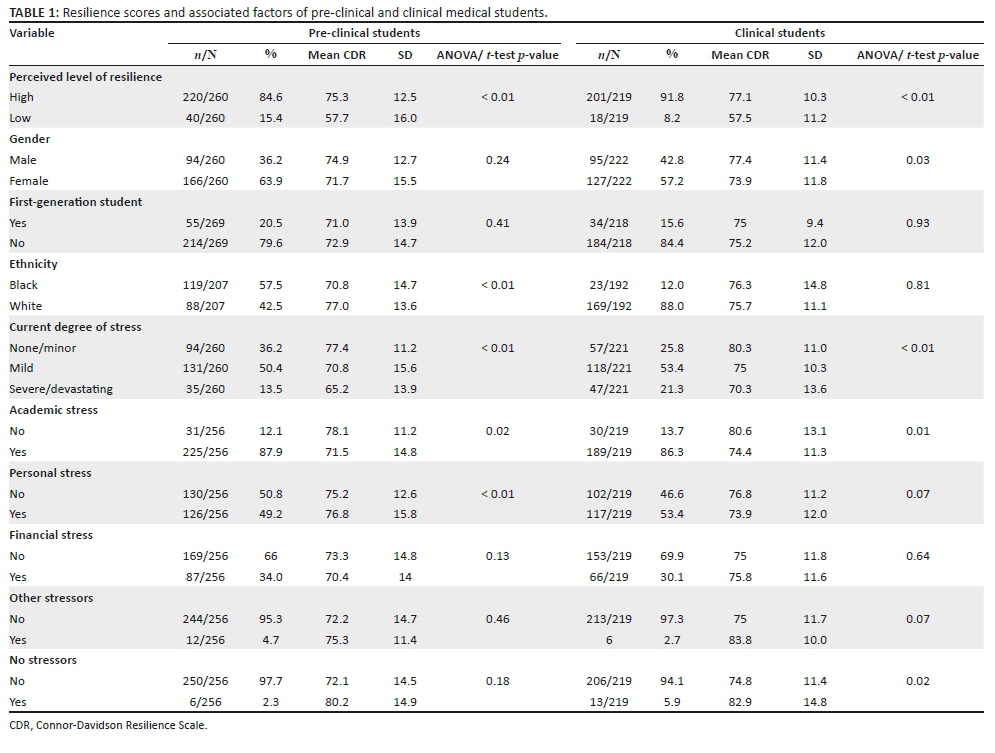
Table 1 shows the resilience scores of pre-clinical and clinical students, determined by means of the CDR.
Overall, in the pre-clinical group, the mean score obtained on the CDR was 72.5 (standard deviation [SD] 14.5), while clinical students scored significantly higher (75.4; SD 11.7; p = 0.02; 95% CI 0.6; 5.2). The mean scores on the CDR for pre-clinical (84.6%) and clinical (90.5%) students who perceived themselves as highly resilient were 75.3 (SD 12.5) and 77.1 (SD 10.3), while the mean scores for students who reported perceived low resilience were 57.7 (SD 16.0) and 57.5 (SD 11.2) for the pre-clinical and clinical groups, accordingly. These differences were statistically significant (p < 0.01). The Cronbach's alpha values determined for the pre-clinical and clinical groups were 0.92 and 0.91.
In both pre-clinical and clinical groups, there were no significant differences in resilience scores between male and female students, although male students in both groups had higher scores on the CDR. Although first-generation students scored lower on the CDR, these differences were not statistically significant. When comparing ethnic groups, black pre-clinical students had significantly lower resilience scores than white students, which was not the case in the clinical group where white students had slightly lower, although not significant, CDR scores.
More than a third of pre-clinical (n = 94, 36.2%) and a quarter of clinical students (n = 57, 25.8%) reported no or minor stress experienced at the time of the study. These students had significantly higher CDR scores in both the pre-clinical and clinical groups, and these scores were progressively and significantly lower as students reported their current degree of stress as mild to severe or devastating. Students who reported academic stress (pre-clinical n = 225, 87.9%; clinical n = 189, 86.3%) had significantly lower CDR scores in both groups. Pre-clinical students who reported personal stress (n = 126, 49.2%) had significantly lower CDR scores, while the slightly higher percentage of clinical students who reported personal stress (n = 117, 53.4%) did not have significantly lower CDR scores. There were no significant differences in CDR scores in both groups of students who reported financial (pre-clinical n = 87, 34.0%; clinical n = 66, 30.1%) or other (pre-clinical n = 12, 4.7%; clinical n = 6, 2.7%) stressors. In the clinical group, CDR scores were significantly higher in students who reported no stressors (n = 13, 5.9%), but these numbers were very low.
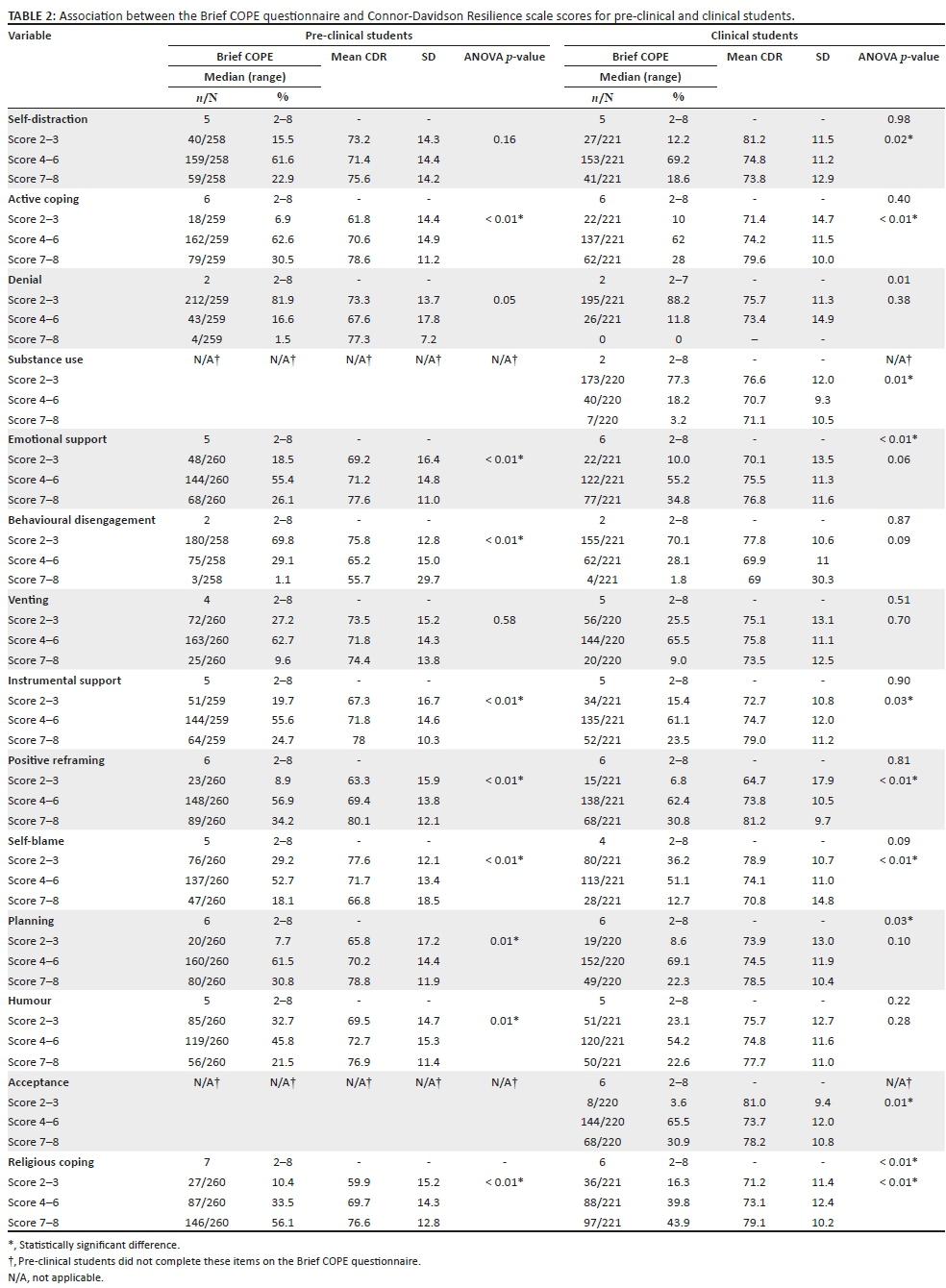
In Table 2, the results of the Brief COPE questionnaire in 14 coping styles are compared between pre-clinical and clinical students, and the associations with resilience scores obtained on the CDR are shown. The Brief COPE scores are indicated as 2-3 (low reliance), 4-6 (average) and 7-8 (high reliance) for each of the coping styles.
Pre-clinical students did not complete the questions related to substance abuse and acceptance; therefore, no comparisons were possible between the two groups regarding this coping style. Pre-clinical students had significantly higher reliance on religious coping than clinical students, while clinical students had significantly higher reliance on emotional support than pre-clinical students. There were no significant differences between pre-clinical and clinical students regarding the other coping styles.
The coping styles that were associated with significantly higher CDR scores in both the pre-clinical and clinical groups included active coping, instrumental support, positive reframing and religious coping. The majority of both pre-clinical and clinical students had average to high reliance on these coping styles. In pre-clinical students, the majority of whom had average to high reliance on emotional support, planning and humour as coping strategies, significantly higher CDR scores were found when these coping styles were used.
In clinical students, the majority had average to high reliance on acceptance as a coping strategy, which was associated with significantly higher CDR scores. In the students who had low reliance on this coping style with an associated significantly higher CDR score, the finding should be interpreted with caution due to the low number (n = 8). Clinical students (n = 68, 30.9%) who had high reliance on acceptance as coping style had significantly higher CDR scores than those with average reliance on this coping style (n = 144, 65.5%).
In both groups, average to high reliance on self-blame was associated with significantly lower CDR scores.
In clinical students, average to high reliance on substance abuse and self-distraction was associated with significantly lower CDR scores. A small percentage of clinical students had average (n = 40, 18.2%) or high (n = 7, 3.2%) reliance on substance abuse as a coping style, while the majority of these students had average (n = 153, 69.2%) to high (n = 41, 18.6%) reliance on self-distraction as a coping style. The majority of pre-clinical students showed low reliance on behavioural disengagement as a coping style, which was associated with significantly higher CDR scores.
Discussion
This study addressed the need to explore medical students' resilience strategies.513,14 Among a group of pre-clinical and clinical undergraduate medical students, the majority of students self-reported high resilience, and scored significantly higher on the CDR, pointing to good self-awareness.
Factors that promote or protect against burnout include personal characteristics (including demographic variables), perceptions of the learning environment, social support and levels of stress.2014
We found that the CDR score was significantly lower in both pre-clinical and clinical students who reported a current high degree of stress. Stress is inherent to medical studies, but also a common risk factor for burnout.21
Academic stress was most prominent, and the majority of students indicated that they experienced this stressor, which was associated with lower CDR scores, although not significantly. Whether academic stress among this cohort of medical students is higher than that of other students enrolled in tertiary studies should be investigated further.
Approximately half of both groups of students reported personal stress. Of note was that pre-clinical students who reported no personal stress had significantly lower CDR scores, which was surprising and might need further investigation. In clinical students, the presence of personal stress was associated with slightly lower CDR scores, but not significantly. Senior students' ability to manage adversity better in their personal lives should be investigated further.
Approximately one-third of students reported financial stress, but no significant association with CDR scores was observed. This finding was also surprising considering the fact that most South African students at tertiary institutions experience financial need, as reported in the South African Surveys of Student Engagement Annual Report 2016.22
What factors contributed to this cohort of students' resilience? Coping refers to the individual's cognitive and behavioural strategies to deal with perceived stressors, and may be functional or dysfunctional with a respective increased or decreased probability of burnout.36,9
For example, Erschens et al.33
Similarly, Thompson et al.6
In this study, we found that CDR scores were significantly higher in both pre-clinical and clinical students who used coping styles that included active coping, instrumental support, positive reframing and religious coping, indicating these as functional or adaptive coping styles. Among pre-clinical students, emotional support, planning and humour, and in clinical students, acceptance, were additional functional or adaptive coping styles, associated with significantly higher CDR scores.
Interventions aimed at fostering and developing resilience on both individual and system-wide levels, need to be researched further.16
Religious coping refers to the individual finding comfort in religion or spiritual beliefs or engaging in practices such as praying or meditating. In addition, irrespective of the situation they find themselves in, individuals may learn or develop the ability to get emotional support, comfort and understanding from others, plan or strategise the next move, and use humour to deal with or accept situations. These coping mechanisms are congruent with previously published research linking the beliefs of the individual's ability to positively impact on their environment, and that continuous effort is worthwhile despite adversity.10
Our findings are supported by literature indicating that social support reduces the probability of suffering from stress and exhaustion, and is important for nurturing resilience in medical students,203,5 This includes a focus on the learning environment and reducing stress.2
In both pre-clinical and clinical students in our study, self-blame (being critical of oneself), self-distraction (turning to work, entertainment or daydreaming) and substance abuse among clinical students, or behavioural disengagement (giving up) among pre-clinical students, could be regarded as maladaptive and dysfunctional coping styles, as these were associated with significantly lower CDR scores. Erschens et al.3 and Thompson et al.6 also described these behaviours, pointing towards the need to create awareness about the negative impact of these coping strategies, and to empower students to choose healthier options to prevent burnout and develop resilience.
Strengths and limitations
A strength of this study was that it provided a cross-sectional view of a large population of students from first to final year of an undergraduate medical programme, with fair to good response rates. It not only focused on individual constructs (resilience, stress and coping strategies), but also determined the associations between these constructs, providing a comprehensive exploration of what constitutes resilience in a cohort of medical students. Validated questionnaires were used, providing data that may be compared with findings from other populations.
The study had a number of limitations. Firstly, the cross-sectional nature of the study implied that the associations could not be used to identify causal relationships, and the consequences of coping strategies should be viewed accordingly. Secondly, the timing in the academic year could have meant that students' resilience was over-estimated and their stress underestimated. The survey took place during the third quarter of the academic year when no final assessments were scheduled. Thirdly, because students' self-reported data were used, the findings might have been misleading, as students' responses could have been influenced by stigma associated with mental health issues.6
Conclusion
In this cohort of first-year to final-year undergraduate medical students at the University of the Free State, the majority of students had self-reported high resilience associated with high resilience scores using the CDR. Clinical students scored significantly higher than pre-clinical students, while black pre-clinical students had significantly lower resilience scores. Female and first-generation students had slightly lower resilience scores, although not significant. Academic stress was most commonly reported and associated with lower resilience. Fewer students reported personal or financial stress that was not associated with lower resilience scores. In general, most students used adaptive coping strategies that were associated with significantly higher resilience. These include active coping, instrumental support, positive reframing, religious coping, emotional support and acceptance. Although very few students relied on mal-adaptive coping strategies, including self-blame, self-distraction or substance abuse, these were associated with significantly lower resilience scores.
Interventions to nurture resilience in medical students should focus on both individual and systems levels to empower students to engage in functional, positive strategies cultivating resilience. In the context of the UFS Faculty of Health Sciences, this could include providing workshops for students on mechanisms to develop adaptive coping strategies. Further research could focus on investigating what other forms of support students would require besides existing structures, such as academic support through the Division Student Learning and Development, as well as psycho-social support through a clinical psychologist and social worker.
Competing interests
The authors declare that they have no financial or personal relationships that may have inappropriately influenced them in writing this article.
Author's contributions
All authors contributed equally to this work.
Funding information
Partial funding was obtained from the UFS Research Directorate.
Data availability statement
Data are available on request from the corresponding author.
Disclaimer
The views and opinions expressed in this article are those of the authors and do not necessarily reflect the official policy of any affiliated agency of the authors.
Acknowledgements
The authors acknowledge Dr Daleen Struwig, medical writer and editor, for technical and editorial preparation of the manuscript, and the undergraduate students who participated in this research.
References
-
1.Dyrbye LN, Shanafelt TD, Werner L, Sood A, Satele D, Wolansyj AP. The impact of a required longitudinal stress management and resilience training course for first-year medical students. J Gen Intern Med. 2017;32(12):1309-1314. https://doi.org/10.1007/s11606-017-4171-2
» https://doi.org/10.1007/s11606-017-4171-2 -
2.Dyrbye L, Shanafelt T. A narrative review on burnout experienced by medical students and residents. Med Educ. 2016;50(1):132-149. https://doi.org/10.1111/medu.12927
» https://doi.org/10.1111/medu.12927 -
3.Erschens R, Loda T, Herrmann-Werner A, et al. Behaviour-based functional and dysfunctional strategies of medical students to cope with burnout. Med Educ Online. 2018;23(1):1535738. https://doi.org/10.1080/10872981.2018.1535738
» https://doi.org/10.1080/10872981.2018.1535738 -
4.Teodorczuk A, Thomson R, Chan K, Rogers GD. When I say … resilience. Med Educ. 2017;51(12):1206-1208. https://doi.org/10.1111/medu.13368
» https://doi.org/10.1111/medu.13368 -
5.Prayson RA, Bierer SB, Dannefer EF. Medical student resilience strategies: A content analysis of medical students' portfolios. Perspect Med Educ. 2017;6(1):29-35. https://doi.org/10.1007/s40037-016-0313-1
» https://doi.org/10.1007/s40037-016-0313-1 -
6.Thompson G, McBride RB, Hosford CC, Halaas G. Resilience among medical students: The role of coping style and social support. Teach Learn Med. 2016;28(2):174-182. https://doi.org/10.1080/10401334.2016.1146611
» https://doi.org/10.1080/10401334.2016.1146611 -
7.WHO. Burn-out an 'occupational phenomenon': International classification of diseases [homepage on the Internet]. 2019 [cited 20 Mar 2020]. Available from: https://www.who.int/mental_health/evidence/burn-out/en/
» https://www.who.int/mental_health/evidence/burn-out/en/ -
8.Epstein RM, Krasner MS. Physician resilience: What it means, why it matters, and how to promote it. Acad Med. 2013;88(3):301-303. https://doi.org/10.1097/ACM.0b013e318280cff0
» https://doi.org/10.1097/ACM.0b013e318280cff0 -
9.Zwack J, Schweitzer J. If every fifth physician is affected by burnout, what about the other four? Resilience strategies of experienced physicians. Acad Med. 2013;88(3):382-389. https://doi.org/10.1097/ACM.0b013e318281696b
» https://doi.org/10.1097/ACM.0b013e318281696b -
10.Howe A, Smajdor A, Stöckl A. Towards an understanding of resilience and its relevance to medical training. Med Educ. 2012;46(4):349-356. https://doi.org/10.1111/j.1365-2923.2011.04188.x
» https://doi.org/10.1111/j.1365-2923.2011.04188.x -
11.Kreitzer MJ, Klatt M. Educational innovations to foster resilience in the health professions. Med Teach. 2017;39(2):153-159. https://doi.org/10.1080/0142159X.2016.1248917
» https://doi.org/10.1080/0142159X.2016.1248917 -
12.Leppin AL, Bora PR, Tilburt JC, et al. The efficacy of resiliency training programmes: A systematic review and meta-analysis of randomised trials. PLoS One. 2014;9(10):e111420. https://doi.org/10.1371/journal.pone.0111420
» https://doi.org/10.1371/journal.pone.0111420 -
13.Naidoo SS, Van Wyk J, Higgins-Opitz SB, Moodley K. An evaluation of stress in medical students at a South African university. S Afr Fam Pract. 2014;56(5):258-262. https://doi.org/10.1080/20786190.2014.980157
» https://doi.org/10.1080/20786190.2014.980157 -
14.Van Der Walt S, Mabaso WS, Davids EL, De Vries PJ. The burden of depression and anxiety among medical students in South Africa: A cross-sectional survey at the University of Cape Town. S Afr Med J. 2019;110(1):69-76. https://doi.org/10.7196/SAMJ.2019.v110i1.14151
» https://doi.org/10.7196/SAMJ.2019.v110i1.14151 -
15.Connor KM, Davidson JRT. Development of a new resilience scale: The Connor-Davidson Resilience Scale (CD-RISC). Depress Anxiety. 2003;18(2):76-82. https://doi.org/10.1002/da.10113
» https://doi.org/10.1002/da.10113 -
16.Jørgensen I, Seedat S. Factor structure of the Connor-Davidson Resilience Scale in South African adolescents. Int J Adolesc Med Health. 2008;20(1):23-32. https://doi.org/10.1515/IJAMH.2008.20.1.23
» https://doi.org/10.1515/IJAMH.2008.20.1.23 -
17.Marx M, Young SY, Harvey J, Rosenstein D, Seedat S. An examination of differences in psychological resilience between social anxiety disorder and posttraumatic stress disorder in the context of early childhood trauma. Front Psychol. 2017;8(1):2058. https://doi.org/10.3389/fpsyg.2017.02058
» https://doi.org/10.3389/fpsyg.2017.02058 -
18.Carver CS. You want to measure coping, but your protocol's too long: Consider the brief COPE. Int J Behav Med. 1997;4(1):92-100. https://doi.org/10.1207/s15327558ijbm0401_6
» https://doi.org/10.1207/s15327558ijbm0401_6 -
19.Nel S, Roomaney R. A comparative study into the coping strategies employed by undergraduate psychology and non-psychology students. New Voices Psychol. 2015;11(1):45-62. https://doi.org/10.25159/1812-6371/1789
» https://doi.org/10.25159/1812-6371/1789 -
20.Dyrbye LN, Power DV, Massie FS, et al. Factors associated with resilience to and recovery from burnout: A prospective, multi-institutional study of US medical students. Med Educ. 2010;44(10):1016-1026. https://doi.org/10.1111/j.11.95pt11.95pt1365-2923.2010.03754.x
» https://doi.org/10.1111/j.11.95pt11.95pt1365-2923.2010.03754.x -
21.Fares J, Al Tabosh H, Saadeddin Z, El Mouhayyar C, Aridi H. Stress, burnout and coping strategies in preclinical medical students. N Am J Med Sci. 2016;8(2):75-81. https://doi.org/10.4103/1947-2714.177299
» https://doi.org/10.4103/1947-2714.177299 - 22.Henn M, Hen-Boisen L, Posthumus H. Understanding and supporting students entering higher education. In: Strydom JF, Kuh G, Loots S, editors. Engaging students - Using evidence to promote student success. Bloemfontein: African Sun Media, 2017; p. 55-72.

Accepted: 28 Apr. 2020
Published: 28 July 2020