Regional aspects of long-term public sector psychiatric care in the Eastern Cape
Abstract
OBJECTIVES: The objective of this research was to determine regional aspects (such as clinical, geographic and socio-demographic) influencing the use of public sector long-term psychiatric services in the Eastern Cape. This is important in improving service delivery, to assist policy developers with evidence-based research and in providing equitable and efficient resource utilisation. METHODOLOGY: A situational analysis of Tower Psychiatric Hospital and Psychosocial Rehabilitation Centre (TPHPRC) in the Eastern Cape was conducted. Patient administrative data were utilised to determine geographic origin, date and age at admission, gender and diagnosis as of December 2015. The number of admissions from each region for the years 2010-2015 was also extracted from these data RESULTS: As of December 2015, there were a total of 390 patients at TPHPRC. Of these, 87% were male patients. The average age at admission for male and female patients was 36 years and 44 years, respectively. Of the patients, 53% originated from the western regions and 57% of female patients presented with a dual diagnosis. The highest number of admissions was in 2015, with the majority originating from Port Elizabeth. CONCLUSION: Despite higher access to public psychiatric care in the western region, the majority of patients originated from there. Contributing factors to this include diagnoses, insufficient bed numbers and the absence of admission criteria and referral pathways. It is recommended that the provincial Department of Health set up a task team to determine a standardised working framework for all public sector psychiatric institutions. This should be informed by national policies, legislation and provincial norms and indicators.
Introduction
The World Health Assembly adopted the Comprehensive Mental Health Action Plan 2013-2020 in May 2013.12
However, prior to rapid deinstitutionalisation, it would be important to investigate the current utilisation of long-term psychiatric care provincially, specifically, the origin, demographic profile and reasons associated for admission. This information will provide the foundation for the development of an accessible community psychiatric service, which is as close to where patients reside. It will also inform the development of adjunctive services, such as substance-abuse rehabilitation centres, ambulatory services and child and adolescent facilities.
There is a wide variation within the Eastern Cape Province in the access to and availability of mental health services. The western region is more urbanised, has easier territorial access to public sector psychiatric care and non-governmental organisations (NGOs) that provide residential and day care facilities than in the central and eastern areas of the province.3
Tower Psychiatric Hospital and Psychosocial Rehabilitation Centre (TPHPRC), originally Fort Beaufort Asylum, has been in existence since 1894.454,6
As on 31 December 2015, TPHPRC did not have admission guidelines. All admissions were governed solely by the Mental Health Care Act 17 of 2002 (MHCA).7 This process meant legal admissions were in effect only after the promulgation of the MHCA in 2004. Patients transferred were required to have all MHCA documents, including the MHCA 16 and a brief referral form completed. There was no requirement for reports from Social Workers, Clinical Psychologists or detailed clinical notes. Prior to 2004, patients were transferred irrespective of diagnosis and age.
Therefore, the objective of this research was to determine the factors influencing the utilisation of medium- to long-term psychiatric services in the Eastern Cape. This information would provide an evidence base in the commissioning and planning of public sector mental health services with particular reference to medium- to long-term care. It would also allow for the equitable and efficient delivery of mental health services.
Methodology
The study was a situational analysis of medium- to long-term psychiatric service provision at TPHPRC, Eastern Cape. The study included all patients at the institution as of December 2015. The study was conducted as follows:
1. The patient administration officer at the institution was requested to provide a spreadsheet of all patients at the institution.
2. The information extracted from this spreadsheet was date of admission, gender, age at admission, current age, diagnosis and geographic origin. This was then grouped according to the five main locations where mental health facilities are available in the province, viz. Queenstown, Mthata, East London, Grahamstown and Port Elizabeth.
3. After grouping patients into their area of origin, the following descriptive statistics were calculated for male and female patients; minimum, maximum, mean, median, mode, standard deviation and standard error of the mean for age at admission. The same calculations were done for the total number of male and female patients. The online software, OpenEpi, developed by the Centers for Disease Control (United States) (available at: http://www.openepi.com), was utilised to calculate descriptive statistics.
4. Further information extracted included the number of admissions from each region to TPHPRC for the years 2011-2015.
5. For ease of analysis, the diagnoses were grouped as single, dual (mental disorder with either a co-occurring substance-related disorder or a general medical condition [GMC]) or triple (mental disorder with co-occurring substance-related disorder and a GMC). The data were analysed for the commonest GMC and substance of abuse. This was done per region of origin.
Results
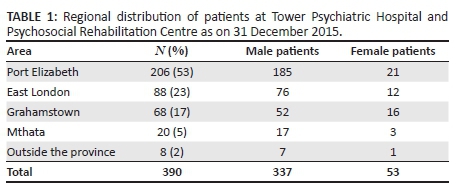
There was a total of 390 patients admitted to TPHPRC as on 31 December 2015, consisting of 337 male and 53 female patients. Approximately 55% of male patients and 40% of female patients originated from Port Elizabeth. There were no patients from the Queenstown area. Table 1 demonstrates the territorial distribution of these patients in the Eastern Cape.
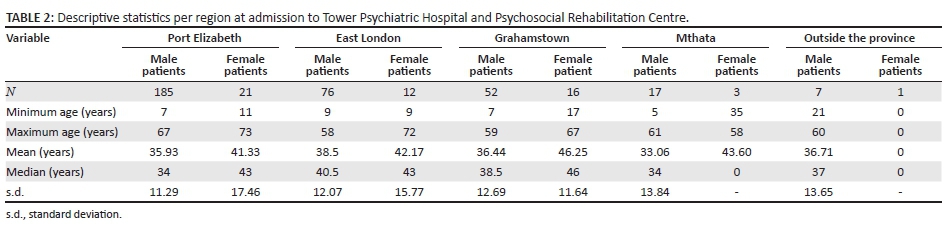
The mean age at admission for male and female patients was 36 and 43 years, respectively. The 5-year-old (male) and 9-year old (female) were children with intellectual disability.
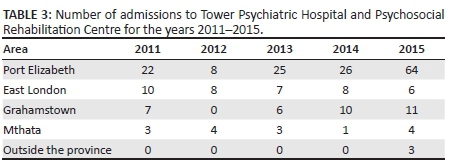
The descriptive statistics for patients from each region are shown in Table 2. Male patients from all regions were younger on admission compared to female patients. The highest number of admissions originated from the Port Elizabeth and East London areas. The number of admissions from all areas except East London increased in 2015. The number of admissions from the Port Elizabeth area increased 2.5 times in 2015 compared to 2014, as demonstrated in Table 3.
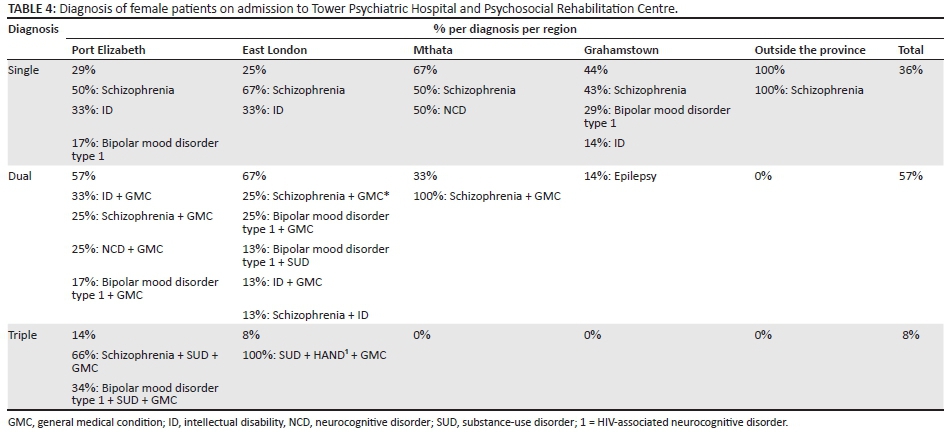
Of the female patients, 57% presented with a dual diagnosis, the majority originating from the East London area. The most frequent diagnosis was schizophrenia with a GMC, followed by intellectual disability with a GMC (Table 4). When the same population was analysed for GMCs, HIV ranked the highest followed by hypertension, non-insulin-dependent diabetes mellitus and asthma. In the triple-diagnosis category, all patients presented with co-occurring HIV. The commonest substance of abuse was cannabis followed by alcohol.
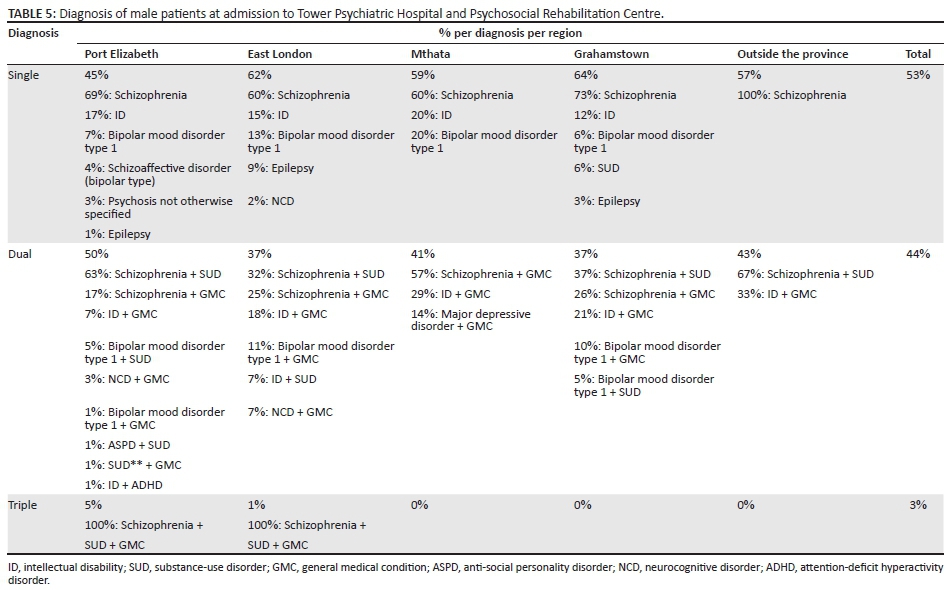
Among the male population, the majority (53%) presented with a single diagnosis, schizophrenia being predominant. The most frequent medical diagnosis was epilepsy, followed by hypertension, asthma and HIV. Overall cannabis alone, cannabis in combination with methaqualone (white pipe) and alcohol were the commonest substances abused. Among the male population from Port Elizabeth, Crystal methamphetamine (Tik) featured as the third commonest substance of abuse after cannabis and white pipe. The triple-diagnosis male patients from both Port Elizabeth and East London presented with cannabis as the most frequent substance of abuse. The co-occurring GMC in Port Elizabeth group was hypertension, while in the East London group it was HIV (Table 5).
Discussion
The results of this research show a higher number of admissions from the western compared to the eastern regions of the province, despite a higher access to public sector mental health services in the western region.6
Socio-economic factors such as unemployment status, income and education levels may have impacted on the rate of utilisation of mental health services. There is a definite association between poverty and mental illness.3,891011
Therefore, there are other social and health factors that are driving the increased use of long-term services from the western region. Increased urban migration and the development of informal settlements around these economic hubs could be contributing factors. The majority of households living in shacks in the Eastern Cape are concentrated around these two urban centres.121314
A facility-specific factor is the lack of capacity to accommodate patients in listed public sector mental health services, which could then drive the increased need for the deviation of admissions to long-term care. In the western region of the province, patients are initially assessed at Dora Nginza Hospital for 72 h then transferred to Elizabeth Donkin Hospital (EDH). EDH has capacity for 163 beds; however, their admissions exceed this capacity. The excess patients are accommodated on floor beds, at an average of 22 per month (personal communication with the Head of Department, EDH: February 2016). All alternative care facilities, such as 'step-down' or community residential homes, are provided by NGOs and/or private facilities,3
The high comorbidity of substance abuse among male patients was a contributing factor to the high rate of admissions to public sector facilities and ultimately an increased use of long-term care. According to the Medicine's Research Council Report for 2015,15151515
These two factors indicate the need for increased inter-sectoral collaboration between the public and non-governmental sectors, in improving the placement of patients and the utilisation of alternative care structures. Improved co-ordination between the social and health sectors has demonstrated a decrease in the utilisation of long-term hospitalisation.16
Social work reports from TPHPRC (unpublished data) indicate a consistent lack of support from family members, particularly from the western regions. Therefore, long-term psychiatric admission becomes a solution for these patients. The medical model of management needs to be inclusive of family in the treatment process. This increased involvement provides the opportunity for education and advocacy and the development of prevention strategies.
Across all regions of the province, there is an over-representation of male patients between the ages 30 and 45 years (average age 36 years). This high rate of male admissions could be attributed to the behavioural disorders associated with psychosis that results in patients being treated in psychiatry units only, as reported by Benetier.2324,25
A specific governance factor was the release of Circular 1/2/1/2 of 20152677
The low number of admissions from Mthata, a poorly resourced centre in terms of public sector mental health services could be because of several factors. These could include a high unmet need because of the absence of clear referral pathways and the lack of public and private sector mental health resources. There are no community residential facilities, either public or NGO provided.3
Conclusion
It is recommended that the increased provision of in-patient and ambulatory services in the western region will improve early detection of mental illness and hence early initiation of appropriate management. There is also a clear need for the development of public sector services for substance-abuse disorders and increased inter-sectoral collaboration. An upscaling of mental health service provision is required in the eastern regions. Previous research in the province outlines evidence-based strategies to achieve this.3,6,20,27
This research clearly demonstrates an inequitable public sector mental health service. There are two main principles28
The unilateral decision of Circular 1/2/1/2264
It is recommended that the provincial Department of Health set up a task team with all the relevant stakeholders to determine a standardised working framework for public sector psychiatric institutions. This should be informed by national policies, legislation and provincial norms and indicators.
Competing interests
The author declares that he has no financial or personal relationships which may have inappropriately influenced him in writing this article.
Acknowledgements
References
- 1. World Health Organization. Comprehensive mental health action plan 2013-2020. Geneva: World Health Organization; 2013.
- 2. South African Department of Health. National mental health policy framework and strategic plan 2013-2020. Pretoria: National Department of Health; 2014.
-
3. Sukeri K, Alonso-Betancourt O, Emsley R. Needs based gap analysis for service transformation in the Eastern Cape. S Afr J Psychiatr. 2015;21(1):3-7. https://doi.org/10.7196/sajp.609
» https://doi.org/10.7196/sajp.609 -
4. Sukeri K, Alonso-Betancourt O, Emsley R. Lessons from the past: Historical perspectives of mental health in the Eastern Cape. S Afr J Psychiatr. 2014; 20(2):34-39. https://doi.org/10.7196/sajp.568
» https://doi.org/10.7196/sajp.568 -
5. Statistics South Africa. Mid-year population estimates [homepage on the Internet]. 2015 [cited 2016 Jan 5]. Available from: http://www.statssa.gov.za
» http://www.statssa.gov.za -
6. Sukeri K, Alonso-Betancourt O, Emsley R. Staff and bed distribution in public sector mental health services in the Eastern Cape. S Afr J Psychiatr. 2014; 20(4):160-165. https://doi.org/10.7196/sajp.570
» https://doi.org/10.7196/sajp.570 - 7. South African Government. Mental Health Care Act no. 17 of 2002. Pretoria: Government Printer; 2004.
- 8. Kuruvilla A, Jacob KS. Poverty, social stress and mental health. Indian J Med Res. 2007;126:273-278.
-
9. Sweeney S, Air T, Zanettino L, Galletly C. Psychosis, socioeconomic disadvantage, and health service use in South Australia: Findings from the second Australian National Survey of Psychosis. Front Public Health. 2015;3:259. https://doi.org/10.3389/fpubh.2015.00259
» https://doi.org/10.3389/fpubh.2015.00259 - 10. Saraceno B, Levav I, Kohn R. The public mental health significance of research on socio-economic factors in schizophrenia and major depression. World Psychiatry. 2005;4(3):181-185.
-
11. Funk M, Drew N, Knapp M. Mental health poverty and development. J Public Ment Health. 2012;11(4):166-185. https://doi.org/10.1108/17465721211289356
» https://doi.org/10.1108/17465721211289356 -
12. Noble M, Zembe W, Wright G. Poverty may have declined, but deprivation and poverty are still worst in the former homelands [homepage on the Internet]. South African Social Policy Research Institute; 2014 [cited 2016 Feb 03]. Available from: http://www.econ3x3.org
» http://www.econ3x3.org -
13. The Housing Development Agency. Eastern Cape informal settlement status [homepage on the Internet]. 2013 [cited 2016 Jan 05]. Available from: http://www.thehda.co.za/uploads/files/HDA_Eastern_Cape_Report_Ir.pdf
» http://www.thehda.co.za/uploads/files/HDA_Eastern_Cape_Report_Ir.pdf -
14. Murali V, Oyebode F. Poverty, social inequality and mental health. Adv Psychiatr Treat. 2004;10:216-224. https://doi.org/10.1192/apt.10.3.216
» https://doi.org/10.1192/apt.10.3.216 -
15. Dada S, Burnhams NH, Williams Y, et al. South African community epidemiology network on drug use (SACENDU) - Phase 36 [homepage on the Internet]. Medicines Research Council; 2015 [cited 2016 Feb 03]. Available from: http://www.mrc.ac.za/adarg/sacendu/SACENDUReport%20June2014.pdf
» http://www.mrc.ac.za/adarg/sacendu/SACENDUReport%20June2014.pdf -
16. Caldas de Almeida MJ, Killaspy H. Long term mental health care for people with severe mental disorders [homepage on the Internet]. European Union; 2011 [cited 2016 Feb 03]. Available from: http://ec.europa.eu/health/mental_health/docs/healthcare_mental_disorders_en.pdf
» http://ec.europa.eu/health/mental_health/docs/healthcare_mental_disorders_en.pdf -
17. Lyketsos CG, Dunn G, Kaminsky MJ, Breakey WR. Medical comorbidity in psychiatric inpatients: Relation to clinical outcomes and hospital length of stay. Psychosomatics. 2002;43(1):24-30. https://doi.org/10.1176/appi.psy.43.1.24
» https://doi.org/10.1176/appi.psy.43.1.24 -
18. Douzenis A, Seretis D, Nika S, et al. Factors affecting hospital stay in psychiatric patients: The role of active comorbidity. BMC Health Serv Res [serial online]. 2012 [cited 2016 Jan 05];12:166. Available from: http://www.biomedcentral.com/1472-6963/12/166
» http://www.biomedcentral.com/1472-6963/12/166 - 19. Henning MP, Kruger C, Fletcher L. HIV sero-positivity in recently admitted and long-term psychiatric in-patients: Prevalence and diagnostic profile. Afr J Psychiatry. 2012;15:47-53.
- 20. Sukeri K. Opening doors: Investigating mental health service delivery in the Eastern Cape, to develop an integrated service delivery plan. Thesis presented for the Doctor of Philosophy degree in the department of Psychiatry. Mthata, South Africa: Walter Sisulu University; 2015.
- 21. Flisher AJ, Lund C, Muller L, et al. Norms and standards for severe psychiatric conditions: A Report submitted to the Department of Health, Tender No GES 105/96-97. Pretoria: National Department of Health; 2003.
- 22. Uys HL. The prevalence and clinical presentation of HIV positive female psychiatric in-patients. Afr J Psychiatry. 2013;16:23-28.
- 23. Bénétier MP, Dupuy E, Dupuouy-Dupon C, Kosellek D. Fully hospitalized psychiatric patients in the Aquitaine Region. Pratiq Organ Sions. 2006;37(3):205-213.
-
24. Coldefy M, Nestrigue C. Long stay psychiatric hospitalization: Analysis and determinants of territorial variability. n°202. Institut de Recherché et Documentation en Économie de la Santé, 2014 [cited 2016 Feb 03]; p. 1-8. Available from: http://www.irdes.fr/english/issues-in-health-economics/202-long-stay-psychiatric-hospitalisation.pdf
» http://www.irdes.fr/english/issues-in-health-economics/202-long-stay-psychiatric-hospitalisation.pdf -
25. Taiwo H, Ladapo O, Aina OF, et al. Long stay patients in a psychiatric hospital in Lagos, Nigeria. Afr J Psychiatry. 2008;11:128-132. https://doi.org/10.4314/ajpsy.v11i2.30265
» https://doi.org/10.4314/ajpsy.v11i2.30265 - 26. Eastern Cape Department of Health. Circular 1/2/1/2. Bhisho: Eastern Cape Department of Health; 2015.
-
27. Sukeri K, Alonso-Betancourt O, Emsley R. Service transformation plans for the Eastern Cape informed by a needs based gap analysis. S Afr J Psychiatr. 2015;21(2):62-66. https://doi.org/10.7196/SAJP.823
» https://doi.org/10.7196/SAJP.823 - 28. Patel V, Eaton J. Principles to guide mental health policies in low-and middle income countries (editorial). Rev Bras Psiquiatr. 2010;32(4):343-344.

Accepted: 20 Mar. 2017
Published: 09 May 2017