Clozapine use at a specialised psychiatric hospital in Johannesburg
Abstract
BACKGROUND: Clozapine is the gold standard medication for treatment-resistant psychosis, with robust evidence supporting its efficacy in multiple symptom domains. However, clozapine's side effect profile contributes to its underutilisation and discontinuation. AIM: This study aimed to explore the magnitude of clozapine use and describe factors that impact on its effective use among in-patients. SETTING: Tara Hospital, a specialised psychiatric hospital in Johannesburg. METHODS: This was a retrospective, cross-sectional file review of clozapine-treated patients admitted over the 2-year study period. Data variables included: demographics, clinical information, discharge prescription, clozapine-related side effects and details of clozapine discontinuation, where applicable. RESULTS: A cohort of 33.2% of patients from Tara's biological wards received a trial of clozapine. Participants experienced anti-cholinergic clozapine-related side effects that included weight gain (79.5%), tachycardia (35.2%) and constipation (35.2%). Clozapine was discontinued in 13.7% of participants, and no life-threatening side effects or deaths occurred. Significantly more use of flupenthixol decanoate (64.3% vs. 30.7%; p = 0.0322) and anticholinergics (35.7% vs. 11.4%; p = 0.0474) occurred in the clozapine-discontinued group. Polypharmacy rates were high for psychiatric and non-psychiatric medications. CONCLUSION: One-third of patients received clozapine trials, most of whom continued at discharge. Although side effects occurred frequently, life-threatening side effects did not. Clozapine monitoring protocols, side effect rating scales, pre-emptive management of side effects, lifestyle interventions and clinician education may improve outcomes of clozapine use. The use of plasma clozapine levels may be beneficial. CONTRIBUTION: This study expands our limited knowledge regarding current clozapine prescribing trends in South Africa.
clozapine; treatment-resistance; schizophrenia; side effect; treatment discontinuation; polypharmacy; South Africa
Introduction
Clozapine is the only evidence-based antipsychotic indicated for treatment-resistant psychosis.123245
Clozapine has an extensive receptor binding and pharmacological profile, responsible for both its therapeutic efficiency and wide range of potential side effects.6978910
Regarding clozapine's more commonly occurring side effects, prevalence rates of metabolic syndrome range between 11% and 64% in clozapine users, compared with a prevalence of 20% in first-episode schizophrenia patients, pre-treatment. Weight gain is experienced in up to 35% of patients, at an average of 4.4 kg over 10 weeks. Gastrointestinal side effects include hypersalivation, constipation, gastrointestinal reflux disease, nausea and vomiting, and occur more frequently with clozapine compared with other antipsychotics. Tachycardia is the most common cardiac side effect, with a prevalence of 25%-35%. The historically synonymous clozapine-related side effect, neutropenia, however, has an overall risk of about 3%.9
Many of clozapine's side effects are dose-dependent, yet because of significant inter-individual variation in clozapine metabolism, as well as drug-drug interactions,1112,1314
Although the side effect burden of clozapine is high, side effects can generally be managed by dose reduction, dose-splitting or with pharmacological intervention.1516171718181815
With regard to patterns of clozapine use worldwide, despite clozapine being well-recognised as the gold standard antipsychotic, a retrospective study performed in the United States of America (USA) from 2002 to 2005 indicated clozapine prescription rates were low for the population of patients who met criteria for clozapine trial.19120
Clozapine is broadly underutilised and, based on evidence to support its efficacy, this is a public health dilemma. While a study on international clozapine trends across 17 countries found that clozapine prescription is on the increase, the countries that were included were high-income, and there remains little data on clozapine use in the third world.21222324
Aim and objectives
This study aimed to explore the magnitude of clozapine use, and the demographic, clinical and prescription characteristics of inpatients treated with clozapine, at a specialised psychiatric hospital in Johannesburg, SA.
The study objectives were:
•To determine the magnitude of, and indication for, clozapine use among patients admitted to the biological wards at Tara Hospital, over a 2-year period, from 01 January 2018 until 31 December 2019
•To determine patient demographic, clinical and prescription characteristics of the patients treated with clozapine at Tara Hospital during the study period
•To determine the prevalence of clozapine-related side effects
•To determine the rate of clozapine discontinuation without rechallenge during the admission. Furthermore, in those who discontinued clozapine, to describe the reason for discontinuation.
Research methods and design
Study design and setting
This study was a retrospective, cross-sectional file review conducted at Tara Hospital, which is a government sector specialised psychiatric hospital in Johannesburg. Tara Hospital offers outpatient and inpatient psychiatric services, with a total bed capacity of 141. The wards are divided into specialised units (child, adolescent, eating disorder and psychotherapy wards), and biological wards, for adult patients with serious mental illness requiring medium- to long-term admission. There are three biological wards, comprising 80 beds. Referrals to Tara Hospital are received from various surrounding acute hospitals and clinics.
Study population
All adult patients admitted to the biological wards over the 2-year study period, from 01 January 2018 to 31 December 2019, who received clozapine at any point during this admission were included in the study. No sampling technique was applied.
Data collection
The wards' admission registers were used to determine which patients were admitted to the biological wards over the 2-year study period and thereafter their files were accessed from the hospital's registry department. The clinical notes and discharge summaries in all the files were reviewed to determine which patients met the inclusion criteria for the study and to capture data from those files. The following variables were collected on the data collection sheet: demographics, clinical information, prescription at discharge, documented clozapine-related side effects and details of discontinuation of clozapine, where applicable. In cases where notes were illegible or where the interpretation was not clear, data were noticed to have been omitted or unknown.
Data analysis
Data from the data collection sheets were captured on Microsoft Excel and summarised using descriptive statistics. Further analysis was performed by a biostatistician using SAS Version 9.2. Frequencies and percentages were calculated for categorical data and means, and standard deviations (s.d.) or medians and percentiles were calculated for numerical data. The Shapiro-Wilk test was used to investigate whether numerical data followed a normal distribution. A significance level (α) of 0.05 was applied.
Ethical considerations
This study was a retrospective review of patient files and clinical notes, and as such patients were not actively involved in the study. Approval of this research study was granted by the University of Witwatersrand Postgraduate Assessor Committee and ethics clearance was obtained from the University of Witwatersrand Human Research Ethics Committee (reference no. M210326-MED21-02-012). Institutional approval was obtained from Tara Hospital's Research Committee and Chief Executive Officer. All patient information was kept confidential by allocation of study number to each patient, the list of which was kept in a locked cabinet on-site. Only the study numbers appeared as identifiers on the data collection sheet.
Results
Prevalence and indications for clozapine use
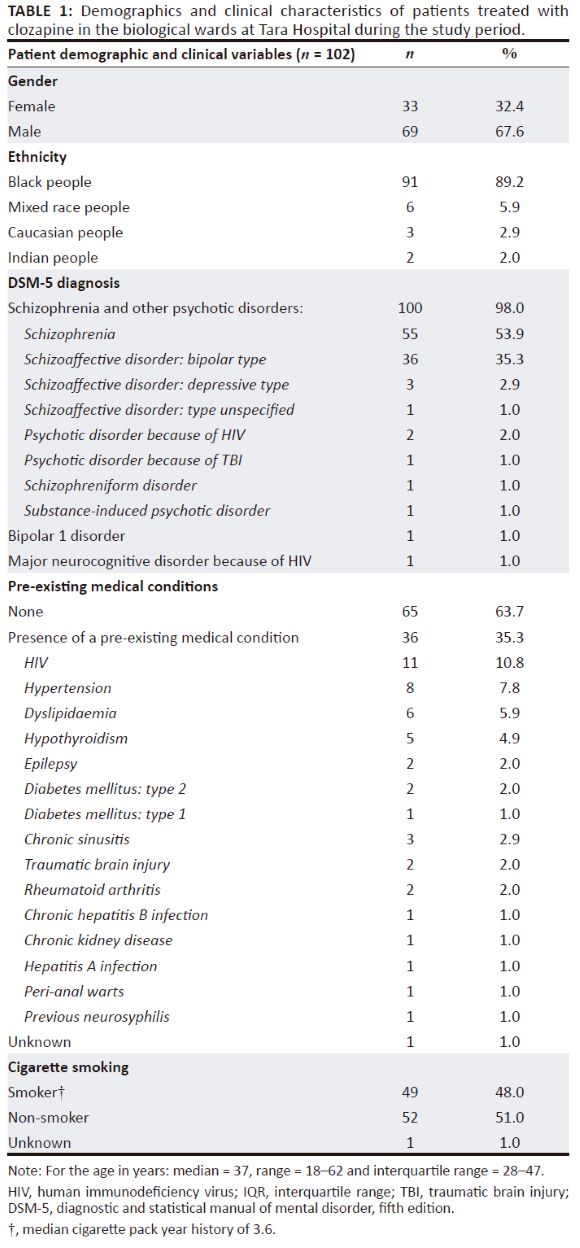
Of the 307 patients admitted to the biological wards over the study period, 102 met inclusion criteria, and thus the prevalence of clozapine use was 33.2%. Treatment-resistant psychosis was the most common indication for clozapine (98.0%, n = 100), with the remainder being for tardive dyskinesia (2.0%, n = 2). Regarding the number of documented previous failed antipsychotic trials, most patients (97.1%, n = 99) had a history of two or more failed antipsychotic trials prior to clozapine (2 trials, n = 51; 3 trials, n = 29; 4 trials, n = 17; 5 trials, n = 2).
Demographics and clinical characteristics
The patients' demographic and clinical characteristics are displayed in Table 1.
Prescription characteristics
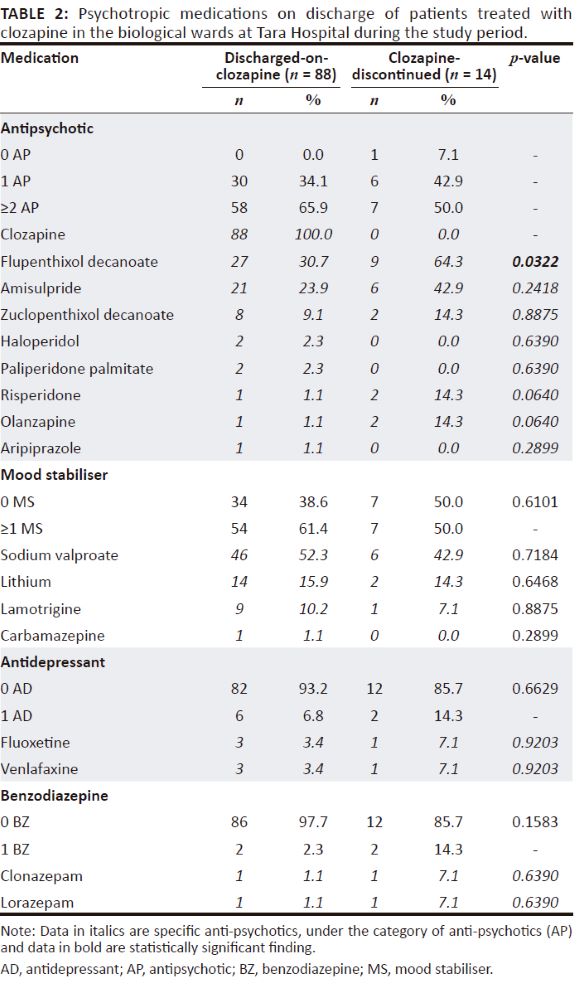
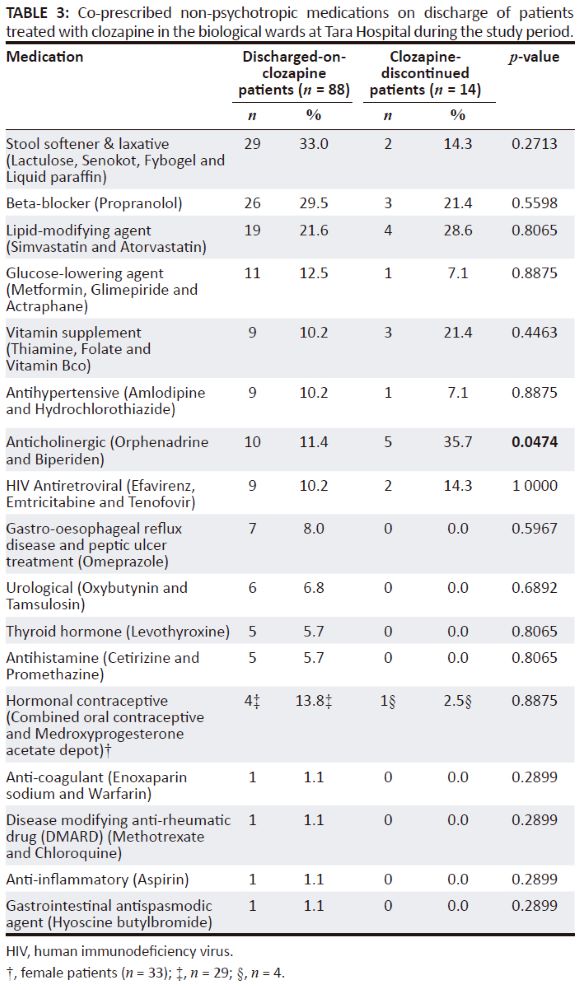
The total number of medications on discharge was high in both groups, those discharged on clozapine (mean 4.5; range 1-9) and those in whom clozapine was discontinued (average 4.1; range 1-8). According to the Chi-Square test, this was not significant (p = 0.1801). Details regarding co-prescribed psychotropic and non-psychotropic medications are shown in Table 2 and Table 3. The frequency of flupenthixol decanoate prescriptions was significantly higher in the clozapine-discontinued group as opposed to the discharged-on-clozapine group (64.3% vs. 30.7%; p = 0.0322) and similarly with regard to the frequency of anticholinergic prescriptions (35.7% vs. 11.4%; p = 0.0474). Of the 88 patients (86.3%) who remained on clozapine at discharge, the median total daily dose of clozapine was 350 mg, with an interquartile range (IQR) of 250 mg-450 mg, and maximum dose of 575 mg. Male clozapine doses did not follow a normal distribution, and as such, we report on the median dose as 225 mg, with an IQR of 125 mg-400 mg (maximum dose was 575 mg). Female clozapine doses did follow a normal distribution, with a mean dose of 260 mg, a range of 25 mg-575 mg, and s.d. of 155 mg. Almost half of the patients were on clozapine split-dosing schedules (n = 37; 42.0%), of which 7 were female (24.1%) and 30 were male (50.8%), which was statistically significant (Satterthwaite method Pr > |t| 0.0012).
Side effects profiles
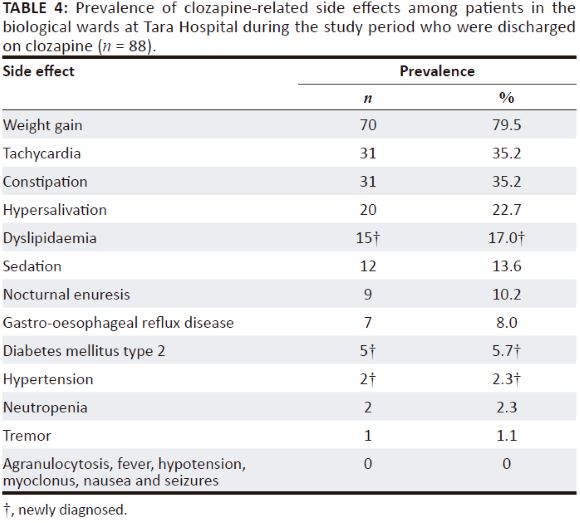
Side effects are shown in Table 4. The most frequently documented side effect of clozapine was weight gain, followed by tachycardia and constipation.
The mean weight gain by the end of admission among the clozapine-discontinued patients was 1.6 kg, compared with 9.3 kg among the discharged-on-clozapine patients. Discharged-on-clozapine patients had a median body mass index (BMI) of 24.1 and 28.0, at admission and discharge, respectively (increased by 3.4, IQR 25.3-32.9). Clozapine-discontinued patients had a median admission BMI of 25.9 and a median discharge BMI of 25.4 (IQR 23.4-31.4). Differences in BMI at discharge between groups were statistically significant (p = 0.0408).
Rates of antihypertensive prescription on discharge increased (i.e. hypertension diagnosed during current admission) only in the discharged-on-clozapine group, by two. Rates of lipid-lowering medications, indicative of dyslipidaemia, were increased in both populations of patients: increased twofold in the clozapine-discontinued group to a total of four patients, and more than fourfold increase in overall number in the discharged-on-clozapine group (total of 19 patients). This was statistically significant (p = 0.0282).
Two patients experienced neutropenia during their admission, with neutrophils at their lowest of 1.08 (range 1.40-4.20). Clozapine was not discontinued, and at discharge, neutrophils had normalised.
Clozapine discontinuation
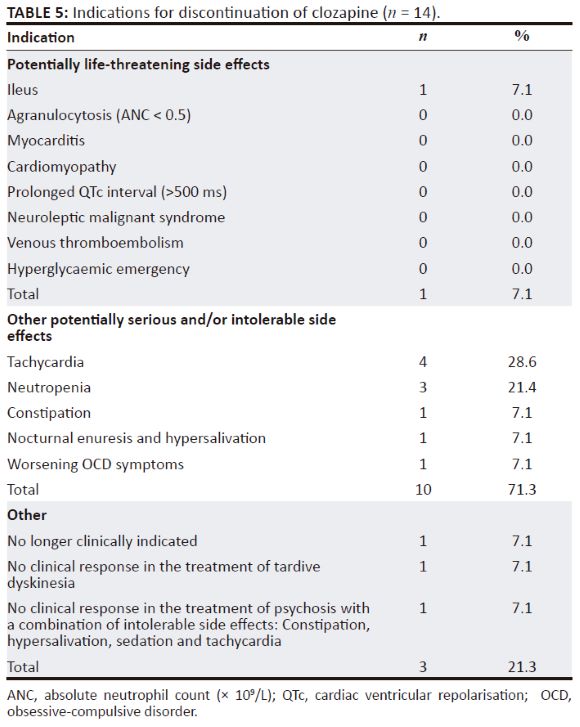
Clozapine was discontinued in 14 patients (13.7%). The mean dose at discontinuation was 246 mg, with an s.d. of 126 mg (W = 0.903379, p = 0.1263). The mean duration of therapy prior to discontinuation was 83.5 days, s.d. 38.8 days and range 21-140 days (W = 0.884554, p = 0.0822). Indications for clozapine discontinuation are shown in Table 5.
One patient experienced a potentially life-threatening side effect, ileus, which was successfully managed without surgery. Ten patients discontinued clozapine because of other potentially serious and intolerable side effects, or a combination of side effects and poor clinical response. Tachycardia was most common culprit for intolerability. Three of the patients did incur neutropenia, which resulted in clozapine discontinuation, but none met the criteria for agranulocytosis (< 0.5 × 109733
Discussion
A third (33.2%) of all the patients admitted to the biological wards at Tara Hospital over the study period received a trial of clozapine. The percentage of in-patients diagnosed with schizophrenia or other psychotic disorders that were treated with clozapine was not calculated for the purpose of this study, but rather the percentage of all the biological admissions, representing a patient population inclusive of all severe mental illnesses, not only psychotic disorders. Nonetheless, this result demonstrates that clozapine is not uncommonly used in the biological wards, which was not an unexpected finding as Tara Hospital is a medium to long-term treatment facility, likely to manage a greater proportion of patients who have responded poorly to standard first-line treatment and are treatment-resistant.
Treatment-resistant schizophrenia (or psychosis), defined as 'the persistence of positive symptoms despite ≥ 2 trials of adequate dose and duration of antipsychotic medication with documented adherence',2526272829
Regarding the characteristics of clozapine users, the KZN study found a male and black race predominance of 67% and 71%.283031323033
High rates of polypharmacy were found across both groups in this study. Psychiatric polypharmacy, the prescription of two or more psychotropic medications, occurs commonly and can be described as same-class, multi-class, adjunctive, augmentation and total polypharmacy.3415p = 0.0322), compared with the discharged-on-clozapine group, which may also explain the significantly greater use of anticholinergics in the clozapine-discontinued group (p = 0.0474). This trend is echoed in a systematic review and meta-regression of global and regional trends of antipsychotic polypharmacy, which found antipsychotic polypharmacy significantly associated with the following: inpatient status, diagnosis of schizophrenia, greater long-acting injectable antipsychotic prescription and anticholinergics.35
The most common side effects found in this study were weight gain, tachycardia and constipation. A recent UK-based data review of electronic health records of clozapine users from 2007 to 2016 similarly showed high rates of weight gain (56%), tachycardia (25%) and constipation (25%), with other notable side effects including hypersalivation (48%), sedation (46%) and insomnia (33%).36378
Consensus on the threshold for treatment interruption because of neutropenia is not conclusive. According to USA guidelines, the threshold is < 1.0 × 109999389,393911
The rate of clozapine discontinuation in this study was relatively low (13.7%); however, only in-patient discontinuations were reviewed. A retrospective medication utilisation review, performed in the Eastern Cape, of a small cohort of patients discharged on clozapine found discontinuation rates of 29% and 35% at 3 and 6 months, respectively.244015
Strengths and limitations
This study not only highlighted the issue of delays in clozapine initiation, polypharmacy and the side effect burden among clozapine users but also the relatively low discontinuation rate. Limitations because of the study's retrospective nature included missing files and incomplete clinical notes. This study did not account for clozapine side effects that may have occurred and subsequently resolved during admission, or any that were not otherwise documented in the discharge summary. No side effect rating scales were used. Polypharmacy and comorbid conditions made interpreting side effects attributable only to clozapine difficult. There was no comparison with regard to the length of stay between the two groups of patients. Furthermore, the results from this study may not be generalisable to other settings as Tara Hospital is a medium- to long-term specialised psychiatric unit.
Implications and recommendations
Proper monitoring and pre-emptive management of clozapine-related side effects, particularly in the first few months of treatment, is recommended. This may also assist in reducing avoidable or unnecessary clozapine discontinuations.41424334
Competing interests
The authors declare that they have no financial or personal relationships that may have inappropriately influenced them in writing this article.
Authors' contributions
B.M. and K.L.O. contributed equally to the design and implementation of the research, as well as to the analysis of results, and composition and execution of the article.
Funding information
This research received no funding from any agency in public, commercial or not-for-profit sectors.
Data availability
Data that supports the findings of this research may be available from the corresponding author, K.L.O., upon reasonable request.
Disclaimer
The views expressed in this article are those of the authors and are not the official position of the affiliated institutions.
Acknowledgements
The authors would like to acknowledge the clinician, Dr Belinda Marais, who supervised this study. They would also like to thank the CEO of Tara Hospital and the Tara Research committee who allowed the research to be performed, as well as support staff members who assisted in the retrieval of files from the registry.
References
- 1.Royal College of Psychiatrists. National Clinical Audit of Psychosis - National report for the early intervention in psychosis spotlight audit 2018/2019. London: Healthcare Quality Improvement Partnership; 2019.
- 2.Freudenreich O, McEvoy J. Guidelines for prescribing clozapine in schizophrenia. Waltham: UpToDate Top; 2015, p. 14772.
-
3.De Hert M, Correll CU, Cohen D. Do antipsychotic medications reduce or increase mortality in schizophrenia? A critical appraisal of the FIN-11 study. Schizophr Res. 2010;117(1):68-74. https://doi.org/10.1016/j.schres.2009.12.029
» https://doi.org/10.1016/j.schres.2009.12.029 -
4.Joober R, Boksa P. Clozapine: A distinct, poorly understood and under-used molecule. J Psychiatry Neurosci. 2010;35(3):147-149. https://doi.org/10.1503/jpn.100055
» https://doi.org/10.1503/jpn.100055 - 5.McGurk SR. The effects of clozapine on cognitive functioning in schizophrenia. J Clin Psychiatry. 1999;60(12):24-29.
-
6.Kane JM, Agid O, Baldwin ML, et al. Clinical guidance on the identification and management of treatment-resistant schizophrenia. J Clin Psychiatry. 2019;80(2):2783. https://doi.org/10.4088/JCP.18com12123
» https://doi.org/10.4088/JCP.18com12123 -
7.Mijovic A, MacCabe JH. Clozapine-induced agranulocytosis. Ann Hematol. 2020;99(11):2477-2482. https://doi.org/10.1007/s00277-020-04215-y
» https://doi.org/10.1007/s00277-020-04215-y -
8.Nielsen J, Correll CU, Manu P, Kane JM. Termination of clozapine treatment due to medical reasons: When is it warranted and how can it be avoided? J Clin Psychiatry. 2013;74(6):20799. https://doi.org/10.4088/JCP.12r08064
» https://doi.org/10.4088/JCP.12r08064 -
9.Gurrera RJ, Gearin PF, Love J, et al. Recognition and management of clozapine adverse effects: A systematic review and qualitative synthesis. Acta Psychiatr Scand. 2022;145(5):423-441. https://doi.org/10.1111/acps.13406
» https://doi.org/10.1111/acps.13406 -
10.Wagner E, Siafis S, Fernando P, et al. Efficacy and safety of clozapine in psychotic disorders - A systematic quantitative meta-review. Transl Psychiatry. 2021;11(1):1-18. https://doi.org/10.1038/s41398-021-01613-2
» https://doi.org/10.1038/s41398-021-01613-2 -
11.Albitar O, Harun SN, Zainal H, Ibrahim B, Sheikh Ghadzi SM. Population pharmacokinetics of clozapine: A systematic review. BioMed Res Int. 2020;2020:9872936. https://doi.org/10.1155/2020/9872936
» https://doi.org/10.1155/2020/9872936 - 12.Stahl SM. Stahl's essential psychopharmacology: Neuroscientific basis and practical application. 4th ed. Cambridge: Cambridge University Press; 2013, 608 p. (Cambridge Medicine).
-
13.Meyer JM. Individual changes in clozapine levels after smoking cessation: Results and a predictive model. J Clin Psychopharmacol. 2001;21(6):569-574. https://doi.org/10.1097/00004714-200112000-00005
» https://doi.org/10.1097/00004714-200112000-00005 -
14.Gaertner I, Baumann P, Hiemke C, et al. The AGNP-TDM expert group consensus guidelines: Therapeutic drug monitoring in psychiatry. Pharmacopsychiatry. 2005;38(01):32. https://doi.org/10.1055/s-2005-862645
» https://doi.org/10.1055/s-2005-862645 - 15.Taylor DM, Barnes TR, Young AH. The Maudsley prescribing guidelines in psychiatry. New York: John Wiley & Sons; 2021.
-
16.Barnes TR, MacCabe JH, Kane JM, Delgado O, Paton C. The physical health and side-effect monitoring of patients prescribed clozapine: Data from a clinical audit conducted in UK mental health services. Ther Adv Psychopharmacol. 2020;10:2045125320937908. https://doi.org/10.1177/2045125320937908
» https://doi.org/10.1177/2045125320937908 -
17.Tiihonen J, Taipale H, Mehtälä J, Vattulainen P, Correll CU, Tanskanen A. Association of antipsychotic polypharmacy vs monotherapy with psychiatric rehospitalization among adults with schizophrenia. JAMA Psychiatry. 2019;76(5):499-507. https://doi.org/10.1001/jamapsychiatry.2018.4320
» https://doi.org/10.1001/jamapsychiatry.2018.4320 - 18.Boland RJ, Ruiz P, Shah A, Verduin ML, Sadock BJ, editors. Kaplan & Sadock's synopsis of psychiatry. 11th ed. Philadelphia, PA: Wolters Kluwer; 2015, 1181 p.
-
19.Stroup TS, Gerhard T, Crystal S, Huang C, Olfson M. Geographic and clinical variation in clozapine use in the United States. Psychiatr Serv. 2014;65(2):186-192. https://doi.org/10.1176/appi.ps.201300180
» https://doi.org/10.1176/appi.ps.201300180 -
20.Köhler-Forsberg O, Horsdal HT, Legge SE, MacCabe JH, Gasse C. Predictors of nonhospitalization and functional response in clozapine treatment: A nationwide, population-based cohort study. J Clin Psychopharmacol. 2017;37(2):148-154. https://doi.org/10.1097/JCP.0000000000000649
» https://doi.org/10.1097/JCP.0000000000000649 -
21.Bachmann C, Aagaard L, Bernardo M, et al. International trends in clozapine use: A study in 17 countries. Acta Psychiatr Scand. 2017;136(1):37-51. https://doi.org/10.1111/acps.12742
» https://doi.org/10.1111/acps.12742 - 22.Koen L, Magni P, Niehaus D, Le Roux A. Antipsychotic prescription patterns in Xhosa patients with schizophrenia or schizoaffective disorder. Afr J Psychiatry. 2008;11(4):287-290.
-
23.Faasen N, Niehaus D, Koen I, Jordaan E. Undiagnosed metabolic syndrome and other adverse effects among clozapine users of Xhosa descent. S Afr J Psychiatry. 2014;20(2):54-57. https://doi.org/10.4102/sajpsychiatry.v20i2.528
» https://doi.org/10.4102/sajpsychiatry.v20i2.528 - 24.Moolman MS. Clozapine usage in a public sector psychiatric hospital in the Nelson Mandela Metropole. Potchefstroom: North-West University; 2013.
-
25.Potkin SG, Kane JM, Correll CU, et al. The neurobiology of treatment-resistant schizophrenia: Paths to antipsychotic resistance and a roadmap for future research. NPJ Schizophr. 2020;6(1):1-10. https://doi.org/10.1038/s41537-019-0090-z
» https://doi.org/10.1038/s41537-019-0090-z -
26.Shah P, Iwata Y, Plitman E, et al. The impact of delay in clozapine initiation on treatment outcomes in patients with treatment-resistant schizophrenia: A systematic review. Psychiatry Res. 2018;268:114-122. https://doi.org/10.1016/j.psychres.2018.06.070
» https://doi.org/10.1016/j.psychres.2018.06.070 -
27.Farooq S, Choudry A, Cohen D, Naeem F, Ayub M. Barriers to using clozapine in treatment-resistant schizophrenia: Systematic review. BJPsych Bull. 2019;43(1):8-16. https://doi.org/10.1192/bjb.2018.67
» https://doi.org/10.1192/bjb.2018.67 -
28.Paruk S, Roojee SA. Attitude and knowledge towards clozapine among outpatients prescribed clozapine in Durban, KwaZulu-Natal. S Afr J Psychiatry. 2018;24(1):a1316. https://doi.org/10.4102/sajpsychiatry.v24i0.1316
» https://doi.org/10.4102/sajpsychiatry.v24i0.1316 -
29.Hodge K, Jespersen S. Side-effects and treatment with clozapine: A comparison between the views of consumers and their clinicians. Int J Ment Health Nurs. 2008;17(1):2-8. https://doi.org/10.1111/j.1447-0349.2007.00506.x
» https://doi.org/10.1111/j.1447-0349.2007.00506.x -
30.National Department of Health, ICF. South Africa Demographic and Health Survey 2016 [homepage on the Internet]. Pretoria: National Department of Health - NDoH - ICF; 2019. [cited 2022 July 04]. Available from: http://dhsprogram.com/pubs/pdf/FR337/FR337.pdf
» http://dhsprogram.com/pubs/pdf/FR337/FR337.pdf -
31.Reiger S, Jardim TV, Abrahams-Gessel S, et al. Awareness, treatment, and control of dyslipidemia in rural South Africa: The HAALSI (Health and Aging in Africa: A Longitudinal Study of an INDEPTH Community in South Africa) study. PLoS One. 2017;12(10):e0187347. https://doi.org/10.1371/journal.pone.0187347
» https://doi.org/10.1371/journal.pone.0187347 -
32.Brink M, Green A, Bojesen AB, Lamberti JS, Conwell Y, Andersen K. Excess medical comorbidity and mortality across the lifespan in schizophrenia: A nationwide Danish register study. Schizophr Res. 2019;206:347-354. https://doi.org/10.1016/j.schres.2018.10.020
» https://doi.org/10.1016/j.schres.2018.10.020 -
33.Prochaska JJ, Das S, Young-Wolff KC. Smoking, mental illness, and public health. Ann Rev Public Health. 2017;38:165-185. https://doi.org/10.1146/annurev-publhealth-031816-044618
» https://doi.org/10.1146/annurev-publhealth-031816-044618 -
34.Kukreja S, Kalra G, Shah N, Shrivastava A. Polypharmacy in psychiatry: A review. Mens Sana Monogr. 2013;11(1):82-99. https://doi.org/10.4103/0973-1229.104497
» https://doi.org/10.4103/0973-1229.104497 -
35.Gallego JA, Bonetti J, Zhang J, Kane JM, Correll CU. Prevalence and correlates of antipsychotic polypharmacy: A systematic review and meta-regression of global and regional trends from the 1970s to 2009. Schizophr Res. 2012;138(1):18-28. https://doi.org/10.1016/j.schres.2012.03.018
» https://doi.org/10.1016/j.schres.2012.03.018 -
36.Iqbal E, Govind R, Romero A, et al. The side effect profile of Clozapine in real world data of three large mental health hospitals. PLoS One. 2020;15(12):e0243437. https://doi.org/10.1371/journal.pone.0243437
» https://doi.org/10.1371/journal.pone.0243437 -
37.Hirigo AT, Teshome T, Abera Gitore W, Worku E. Prevalence and associated factors of dyslipidemia among psychiatric patients on antipsychotic treatment at Hawassa University Comprehensive Specialized Hospital. Nutr Metab Insights. 2021;14:11786388211016842. https://doi.org/10.1177/11786388211016842
» https://doi.org/10.1177/11786388211016842 -
38.Silva E, Higgins M, Hammer B, Stephenson P. Clozapine re-challenge and initiation following neutropenia: A review and case series of 14 patients in a high-secure forensic hospital. Ther Adv Psychopharmacol. 2021;11:20451253211015070. https://doi.org/10.1177/20451253211015070
» https://doi.org/10.1177/20451253211015070 -
39.Manu P, Sarvaiya N, Rogozea LM, Kane JM, Correll CU. Benign ethnic neutropenia and clozapine use: A systematic review of the evidence and treatment recommendations. J Clin Psychiatry. 2016;77(7):1827. https://doi.org/10.4088/JCP.15r10085
» https://doi.org/10.4088/JCP.15r10085 -
40.Li H, Xing M, Zhang C. Antipsychotics-associated obsessive-compulsive symptoms: Individualized treatments and clinical benefits of memantine: A case report. Ann Palliat Med. 2020;9(2):472-477. https://doi.org/10.21037/apm.2020.02.22
» https://doi.org/10.21037/apm.2020.02.22 -
41.Legge SE, Hamshere M, Hayes RD, et al. Reasons for discontinuing clozapine: A cohort study of patients commencing treatment. Schizophr Res. 2016;174(1-3):113-119. https://doi.org/10.1016/j.schres.2016.05.002
» https://doi.org/10.1016/j.schres.2016.05.002 -
42.Ignjatović Ristić D, Cohen D, Obradović A, Nikić-Đuričić K, Drašković M, Hinić D. The Glasgow antipsychotic side-effects scale for clozapine in inpatients and outpatients with schizophrenia or schizoaffective disorder. Nord J Psychiatry. 2018;72(2):124-129. https://doi.org/10.1080/08039488.2017.1400097
» https://doi.org/10.1080/08039488.2017.1400097 -
43.Brown T, Avenell A, Edmunds LD, et al. Systematic review of long-term lifestyle interventions to prevent weight gain and morbidity in adults. Obes Rev Off J Int Assoc Study Obes. 2009;10(6):627-638. https://doi.org/10.1111/j.1467-789X.2009.00641.x
» https://doi.org/10.1111/j.1467-789X.2009.00641.x

Accepted: 13 Feb. 2023
Published: 04 Apr. 2023