The History of the South African Journal of Occupational Therapy (SAJOT), 1953-2024: Charting the Evolution of a Profession's Voice - Part III
Blanche PretoriusI; Denise FranzsenII
IEditor in Chief: SAJOT. https://orcid.org/0000-0002-3543-0743
IIUniversity of the Witwatersrand. https://orcid.org/0000-0001-8295-6329
In the first two editorials celebrating the 80th Anniversary of our Publisher, the Occupational Therapy association of South Africa (OTASA), I gave an overview of the history of the SAJOT in terms of its accessibility, its development from a paper-based magazine distributed only to OTASA members and university libraries, to its current, digital format, now accessible globally and featured on many international platforms.
In this final tribute, I will show how the leadership of OTASA, together with the Health Profession's Council of South Africa (HPCSA), has shaped the quality and diversity of the content published from 1953 to 2024. These improvements in quality were enabled by OTASA, through upgrading educational curricula and supporting post-graduate research, practice guidelines and standards, and the establishment of various standing committees in the numerous practice fields of our profession, including research.
1. TYPES OF ARTICLES PUBLISHED (SECTIONS)
Reports
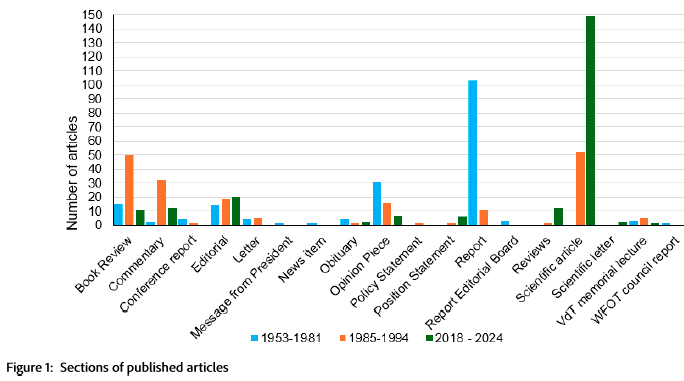
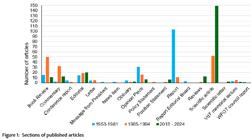
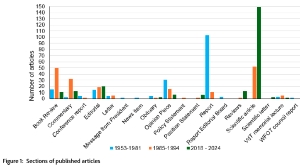
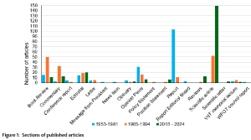
In the early years (1953-1981), the first 20 available hard copy, newsletter-style journals featured a total of 186 publications. More than half of the publications during this period were reports (n=103; 53%)) on WHAT occupational therapists were doing in different sectors, settings, and with different diagnostic groups in general. Other reports highlighted the construction and use of some innovative assistive devices developed for specific conditions, or the therapeutic use of a specific task/activity in a specific practice environment. The number of reports published during the second period (1985-1994) dropped significantly to 11, constituting only 5.6% of the total of 195 articles published. In the latest period (2018-2024), no reports were published.
Scientific Articles
In the 1970-1980's, degree courses at various universities were introduced to replace the diploma courses offered up until then. In addition, some universities offered 'conversion courses', enabling diplomates to convert their diplomas to degrees, which enabled them to enrol for post-graduate studies, which were now also being offered. The curricula of these courses, which included research modules and theses/dissertations, drastically changed the publication landscape for SAJOT. As is clear from Fig. 1 (above), it took time in a time of academic isolation for the publication of research to be encouraged, with scientific articles only appearing during the late 1980's and early 1990's. In this period, this section constituted 26% (n=52) of the total number of articles published, and in the last 20 issues, this figure increased to 67% (n=149). This increase clearly elevated the SAJOT from a 'newsletter' status to a more, globally recognised, 'scholarly' publication, as the content progressed from featuring the 'WHAT' to the 'SO WHAT?', 'HOW and the 'WHY?, showing clearly the outcomes achieved by and impact of what occupational therapists weredoing.
Commentaries and Opinion Pieces
The two commentaries and 31 opinion pieces published in the first 20 issues of the SAJOT also - as was the case with the 'reports' section - featured mainly very generalised information on aspects around the 'what we do' in our profession. The number of commentaries published peaked in the second time period (n=32) and decreased again in the final 20 issues (n=12), while the opinion pieces decreased from 31 to 16 to seven during the three periods respectively. However, there is an evident 'shift' in the content and topics covered - they became more 'current' and raised relevant and important issues and questions around a variety of topics, often leading to changes in policies, focus areas and developments for our profession, as well as calls for further investigation and research into many practice areas.
Systematic/Mapping/Rapid/Scoping/Narrative Reviews
As the need for evidence to prove the effectiveness of 'what we do' in occupational therapy became crucial, andin line with international trends, some researchers resorted to the literature to consolidate evidence around the impact of certain treatment techniques, and the outcomes achieved through interventions in certain diagnostic groups. Others used these reviews to identify 'gaps' in research methodologies and areas pertinent to our country, and to make recommendations based on their findings.
Other Sections
This category includes Editorials, Book Reviews, Letters to the Editor, Obituaries, Conference/WFOT Council/Editorial Board Reports, Vona du Toit Memorial Lectures, Policy Statements, and very important to guide practitioners, OTASA Position Papers (Figure 1, Page 1).
2. FOCUS AREAS (FIELDS OF PRACTICE AND DIAGNOSES)
Fields of Practice
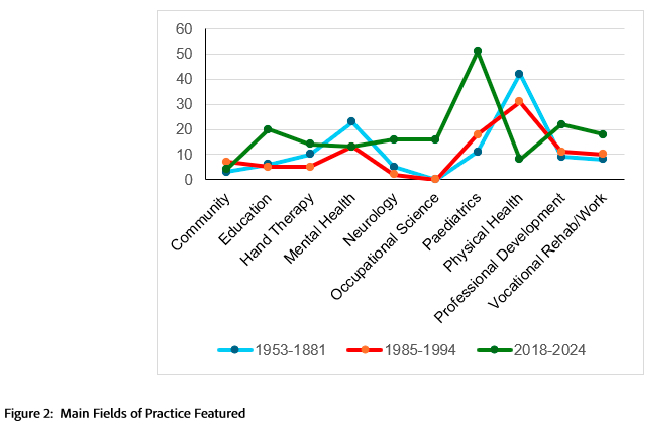
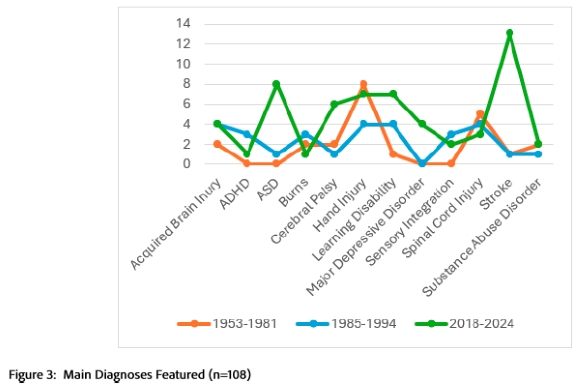
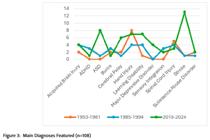
Figures 2 (below) and 3 (page 3) depict the most common fields of practice and diagnoses addressed across sections over the three periods mentioned above:
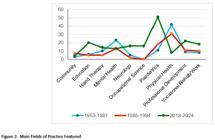
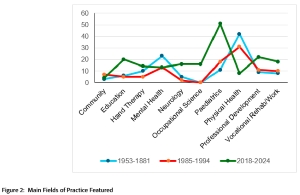
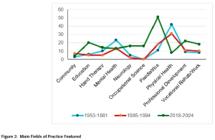
Fields of practice not included in Figure 2 (above) all have a total of between 1 and 9 and include, inter alia, Geriatrics, Driving Ability, Caregiver Training, Pain Management and Palliative Care.
The noteworthy rapid decline in number of articles in the fields 'Mental Health' and 'Physical Health', can probably be ascribed to the fact that in the earlier two periods, the 'reports' and 'articles' were - as mentioned above - generalised overviews on the 'what we do' in these two practice areas, without specifying a particular diagnosis, research methodology, treatment technique or group of participants. For example, Occupational Therapy at Sterkfontein Hospital'1, or 'The rehabilitation of the non-white disabled in South Africa'2
Main Diagnoses featured:
In Figure 3 (page 3), only diagnoses with a total of four or more are depicted, due to the varied diagnoses featured across all publications. Not surprisingly, the main diagnoses correlate well with the main fields of practice as shown in Figure 2 (above), namely, paediatrics (n=37; 34%), followed by hand injuries (n=19; 17%), stroke (n=15; 13%), and spinal cord injuries (n=15; 13%).
3. MAIN METHOLOGIES EMPLOYED
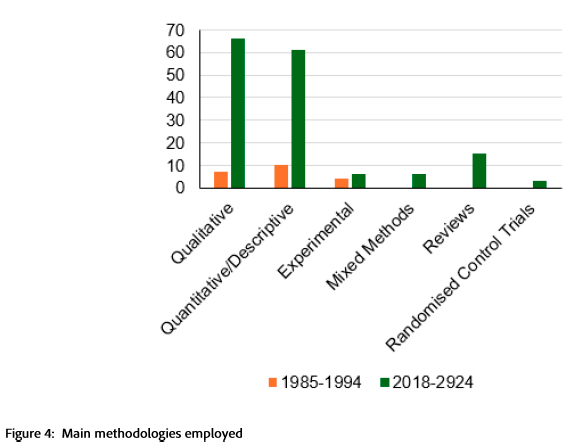
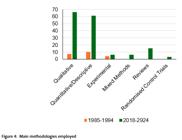
In Figure 4 (below), the main methodologies employed for scientific articles in the middle and most recent 20 issues are shown. Despite various calls from OTASA and various other authorities for more evidence-based research, it is clear that there still remains an over-reliance on qualitative and descriptive methodologies. The section 'Reviews', include Rapid (n=5), Integrative (n=5), Scoping (n=3), Systematic (n=2) and Mapping (n=1) Reviews. A further breakdownandanalysis of the Level of Evidence of published material in 2024, can be found in the 2024 SAJOT Annual Report3
CONCLUSION
The evolution of the South African Journal of Occupational Therapy mirrors the growth and maturation of the profession itself. From its early years as a newsletter capturing snapshots of practice, to its current standing as a credible scholarly platform disseminating evidence-driven knowledge, SAJOT's history reflects the ongoing efforts of OTASA, the HPCSA, educational institutions, and countless practitioners and researchers committed to advancing occupational therapy in South Africa. The shift from descriptive reporting to more rigorous scientific inquiry, the diversification of content areas, and the increasingly critical engagement found in commentaries and reviews all demonstrate a profession continuously striving to refine its voice, relevance, and impact.
As SAJOT enters its next chapter, the challenge-and opportunity-remains to elevate the level of evidence, broaden the methodological repertoire, and continue addressing both local needs and global trends. By sustaining collaborative leadership and nurturing a strong culture of research, SAJOT will remain a vital vehicle for shaping practice, informing policy, and giving expression to the dynamic and evolving identity of occupational therapy. In celebrating its past, the journal stands poised to contribute even more meaningfully to the future of the profession.
REFERENCES
- 1. Cooper S. Occupational Therapy at Sterkfontein Hospital. South African Journal of Occupational Therapy. 1958. Vol 1 No 6. pp3-4.
- 2. Wright, C.W. The rehabilitation of the non-white disabled child in South Africa. South African Journal of Occupational Therapy. 1967. Vol 1 No 18. pp8-12.
-
3. SAJOT Annual Report 2024. Available at: https://journals.assaf.org.za/index.php/sajot/libraryFiles/downloadPublic/223
» https://journals.assaf.org.za/index.php/sajot/libraryFiles/downloadPublic/223