Research Orientation of South African occupational therapists
Abstract
The value placed on and the extent of involvement of occupational therapists in research is unknown. This article reports on the quantitative part of a mixed methods study conducted to establish the multi-dimensional factors that influence Research Orientation. A cross-sectional descriptive design was employed. Data were collected through the use of a previously validated instrument, the Edmonton Research Orientation Survey (EROS). The survey was posted to all occupational therapists on the HPCSA register (2279 occupational therapists) in August 2007. A thirteen percent response rate (298 of 2279) was achieved. Most respondents (177/275, 67%) had high overall EROS scores (mean = 133.6 and median =136.) indicating a strong research orientation. With further analyses it became clear that these occupational therapists valued research ( 195 / 290, 67%) and saw themselves at the leading edge of the profession (214 / 291, 73% ) yet evidence based practice (149 / 285, 52%) and involvement in research was limited (76 / 275, 28%). The results suggest that although occupational therapists value research they do not engage in applying research in practice or participate in the execution of research. The positive research orientation provides an opportunity for the profession to use the available potential to increase research output.
Research orientation; evidence-based practice; research involvement
INTRODUCTION
"Research is frequently seen as the life blood, hallmark or cornerstone in the development of a profession" 1:116 in that it forms its scientific basis213
The concept of 'research orientation' (RO) incorporates four components, namely: 'valuing research', 'involvement in research', 'evidence-based practice' and 'being at the leading edge of the profession'4et al.45
Conceptualising 'research orientation (RO)' as consisting of these four components indicates that it encompasses far more than merely conducting research. RO embraces the belief in the importance of research, through incorporating research into practice, and using research to grow the profession and the professional36
A country such as South Africa (SA), with such diverse health challenges, requires research evidence to inform the provision of relevant and effective services that meet the needs of the population. According to Dawes et al.7899:9 even though there are multiple areas for South African occupational therapists in which research can be conducted. Crouch affirmed this position in stating that "...because of the desperate need for occupational therapy services in Africa, research is likely to be the last priority. It should actually be the first, but we know from experience that this is seldom the case?" 11:139.
A review of the literature related to RO and the factors influencing research, identified that RO is of concern in many disciplines and many countries such as Britain, Canada, Australia and the United States of America12,13,14,15,16,17. A search for literature on the RO of South African occupational therapists in the South African Journal of Occupational Therapy (SAJOT) , identified four articles, of which one was a scientific article910,18,19. The study by Du Toit and Wilkinson in 2009910,8, and an opinion piece which emphasised the difficulty of getting research published1919
Through contacting South African Universities where occupational therapists are educated, a further two related research studies were found. The first was an unpublished content analysis of SAJOT from 1999 and 2000 by OT students at the University of Durban Westville which aimed at determining the readers' perceptions, attitudes and opinions in respect to the South African Journal of Occupational Therapy (SAJOT)2021
Due to the paucity of articles about the RO of occupational therapists in South Africa identified in the literature search, an investigation was undertaken to establish the factors influencing the RO of SA occupational therapists. The purpose of the study was to determine the current RO of SA occupational therapists and to identify barriers and support for RO so that specific strategies could be developed to increase research production, publication and EBP
METHODOLOGY
This study formed the first part of a larger mixed methods study. A cross-sectional descriptive survey was conducted between July and October 2007 with all occupational therapists registered with the Health Professions Council of South Africa (HPCSA) in 2007 (N=2279). The questionnaire consisted of two sections:
- Section 1 contained questions pertaining to demographics (for example, age, gender and qualification) and practice characteristics (such as workplace and job responsibilities), and questions on previous research involvement including participation and research output.
- Section 2 consisted of the Edmonton Research Orientation Survey (EROS) which was developed in Canada4444
Questionnaires were posted with an option provided in the questionnaire to request an electronic copy via email. An information sheet that explained the purpose of the study and requested permission to use the data was included. Completed questionnaires could be returned by mail or email. In an attempt to overcome the low response rate, reminders were sent out via the provincial representatives of the National Forum for Occupational Therapists in the Public Sector, to occupational therapists on their databases.
Confidentiality and anonymity were ensured by numbering the questionnaires as they were received instead of using a name or the HPCSA number for identification. The HPCSA numbers, were, however used to ensure that duplication was avoided.
Data were entered into Epi InfoTM, version 3.5.3 and exported into Excel 2007for further analysis. Frequencies and proportions were calculated for categorical variables. Numerical data were checked for normality and the appropriate descriptive statistics were used. The overall EROS score was established for each respondent and scores were categorised into high, medium and low, based on the criteria outlined by Pain et al.4234
RESULTS
A total of 298 of the 2279 occupational therapists registered with the HPCSA returned completed questionnaires representing a response rate of 13%.
Respondents' demographic and practice characteristics
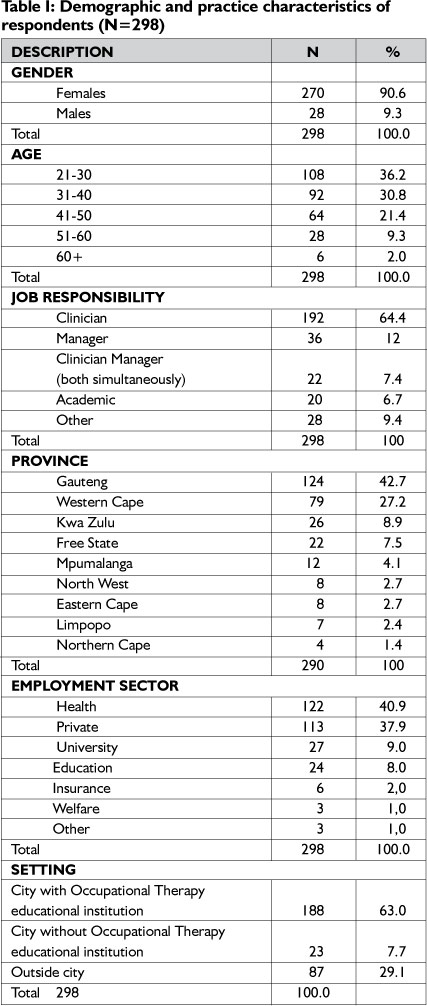
The demographic and practice profile of the respondents is shown in Table 1 on page 7. Comparison with data from the OTASA census that was conducted at the same time22
Research orientation
The mean overall EROS score was 133.6 (SD=22.7) of a possible total of 215. Most respondents (177/276, 64%) achieved a high overall EROS score, while 35% (97/276) obtained a medium and less than 1% (2/276) a low EROS score. According to Pain et al. this indicates a high RO (between 143 and 215 points) 4
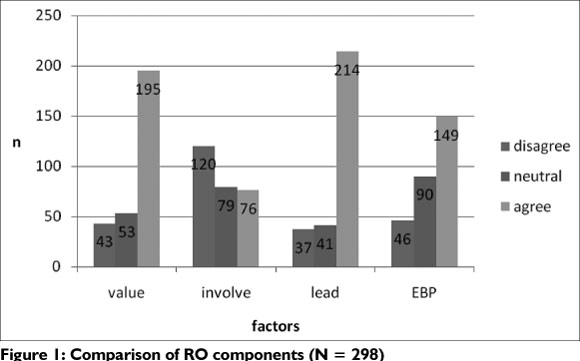
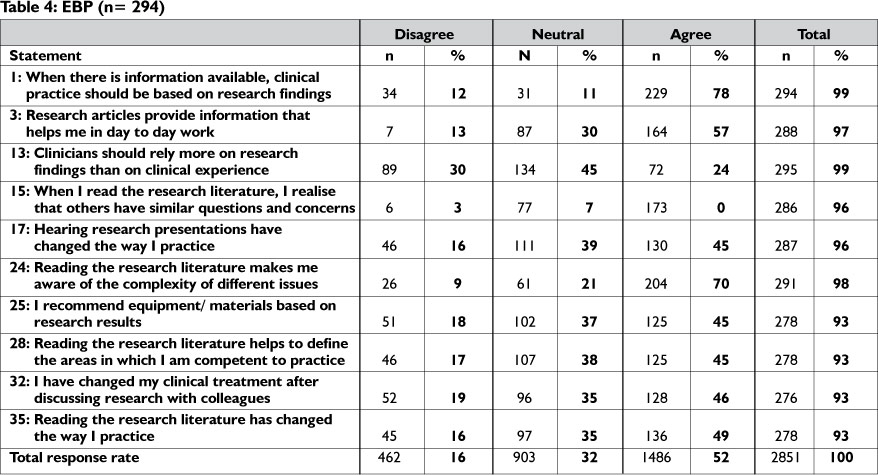
Scores for the four RO components are shown in Figure 1 on page 6. The component valuing research and being at the leading edge had the strongest agreement from respondents with 73% (214/291) and 67% (195/290) respectively. Involvement in research was the one component with which most respondents (120/275, 43%) disagreed.
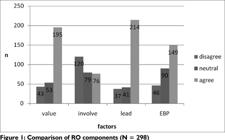
Each component is now described in more detail:
1. Value research
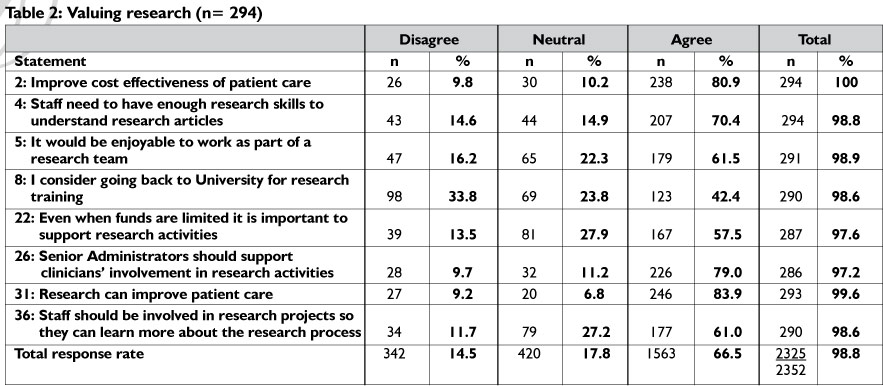
This component consisted of eight statements. The majority of respondents obtained a high score (67%, 195/290) while 18% (53/290) responded neutrally and 15% (43/290) had low scores. Statements under this component that elicited strong positive re- sponses included 'research can improve patient care' (84%, 246/293) and 'research improves cost effective patient care'. (82%, 238/294). Refer to Table 2 on page 8 for more detail on the statements and the response rate.
2.
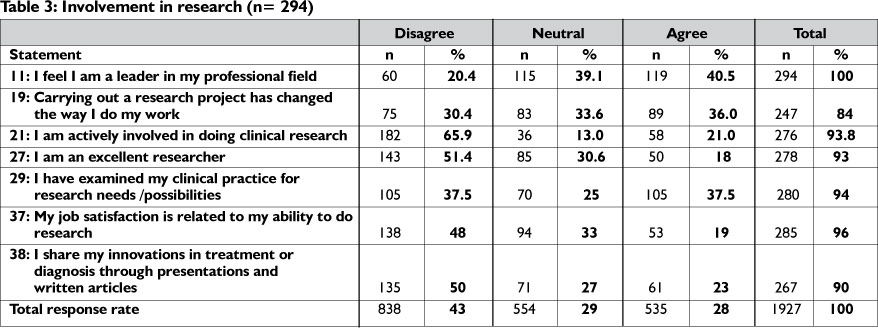
Research involvementThis component consisted of seven statements. Scores indicated that 28% (76/275) agreed with statements on involvement in research, while 43% (120/275) disagreed. Two statements (items 19 and 38) that referred to participation in research were left unanswered by 17 and 10 respondents respectively. (See Table 3 on page 8).
In support of this finding on research involvement, only 32% (94/275) indicated in section 1 that they had participated in research since qualifying. Of those that participated, 51 % (48/94) had published and 64% (60/94) had given oral presentations of their research. Of those who had published, 56% (27/48) had published only once. The majority (46%, 22/48) had published in the SAJOT although 54% (26/48) indicated that they would prefer to publish in other journals, especially international journals that are read by a wider population. Of the 36 respondents with post graduate degrees (12%, n=298), half had never published.
3.
Use of evidence to inform practiceJust over half the respondents (52%, 149/285) agreed with the ten statements in this component and 32% (90/285) were neutral i.e. they neither agreed nor disagreed with the statements. (See Table 4 on page 8).
4.
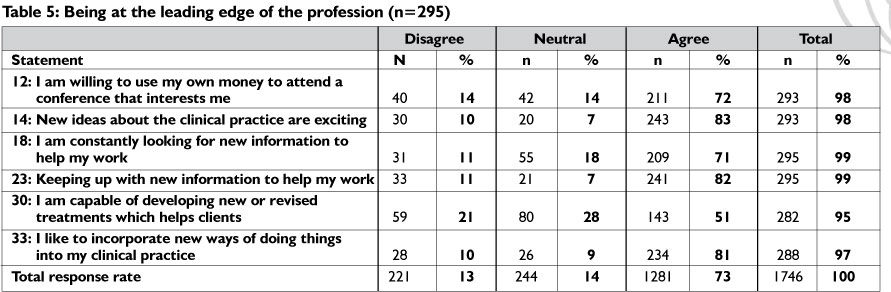
Leading edge of the professionBeing at the leading edge of the profession elicited the most positive response of the four components, with the majority (73%, 214/291) indicating that they agreed with the six statements. It appears that although respondents looked for new information as indicated in statements 12 and 18, they did not seem to be equally confident in using it in their clinical settings as seen in their responses to statement 30. (See Table 5 on page 9).
Barriers and supports for research
Barriers and support for research were identified by analysing the relevant EROS statements in the sections on barriers and support and the qualitative data supplied by respondents as part of the questionnaires.
Barriers to research
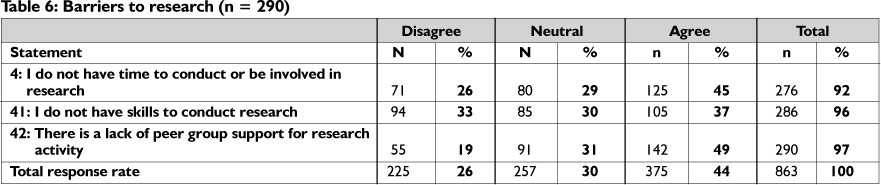
Barriers to research included three items on the EROS. The barriers' statements in contrast to all other statements are formulated in a negative direction to reduce the chance of a response set T. The barrier's scores were converted to a positive direction during data capturing to follow the format of the rest of the questionnaire and thereby prevent false interpretation of the overall score, as suggested by the original authors.
For all three items about one third (30%) of respondents were neutral in response to the barriers indicating that the barrier did not have an effect on them. (See Table 6 on page 9).
Qualitative data were listed and then combined to identify specific barriers. An additional barrier not included in the statements but indicated under the comments from the respondents was lack of skills e.g. skill to understand research literature.
Support for research included two statements. (See Table 7 on page 9).
DISCUSSION
The high scores in terms of overall RO indicate a positive response to RO. The scores were higher than those obtained for occupational therapists in the original studies where the EROS was used4,23. A possible reason for this difference may be that firstly, in the Pain et al423
The high scores for the component "valuing research" indicate that occupational therapists believe in the importance of research for the profession and the benefit derived from research in terms of improving care for patients. The respondents also indicated that 'senior administrators should support clinicians' involvement in research activity'. Personal and administrative support is important in an organisation to encourage research24,25. The statement on the EROS relating to going back to the University for additional research training was not strongly supported. In SA it is not common practice and may not be easily achievable in terms of the cost, accessibility to courses offered and the time involved to do a course at a University, to strengthen research knowledge and/ or ability to evaluate and apply research. Research preparation is included in undergraduate occupational therapy courses in South Africa research as projects are an HPCSA requirement92627,28,29,30. Cusick saw the value of research for the individual's personal growth, rather than for the profession or the context and reported that occupational therapists who are clinician-researchers do research mainly "because of earlier life experiences which means that research and scholarship were valued" 31:10. Seale and Barnard23
Lack of research involvement may contribute to a limited knowledge base and lack of evidence, which may threaten the profession321:116 warned in 1981 that "...it is worth noting that our [occupational therapists'] failure to meet the challenge of research may ultimately lead to our demise as a viable discipline". Occupational therapists prefer "doing" both in their approach and action and they focus on clinical application rather than on working to expand the knowledge base16et al. warned that "...unless a strong link can be forged between therapist-clinicians and researchers who produce more focused and applied research, scarce health funding will be directed to other health disciplines that are prepared to provide more overt and appropriate evidence of clinical effectiveness" 33:90. The researcher_practice gap is one of the factors that contribute to the lack of applied research. One suggestion is for increased collaboration between researchers and clinicians34235,36. Andresen et al.3618
A measure of research involvement is that of research output which consists of publishing research articles and oral presentation of research. The research output analysis revealed that the respondents, who had published, had mostly done research in collaboration with others and most had only published once. Two statements (items 19 and 38) that referred to participation in research were left unanswered by 17 and 10 respondents respectively. The items were possibly left out because the respondents had not undertaken research projects. The fact that many occupational therapists only published once may be associated with the difficulties in the publication process e.g. lack of experience, of time and of language and writing skills19
The use of evidence to inform practice yielded ambiguous results. This may be due to a lack of understanding of how to access and use research findings to inform practice as not all occupational therapists are experienced in EBP Being a research consumer3et al. established that lack of time; evidence and skills are the main barriers to EBP36
The fact that the majority of respondents saw themselves at the leading edge of the profession might indicate a strong motivation to access the latest information and implement it in practice. This might again be part of valuing research and being consumers33838et al.3737
Lack of time was a strong barrier to research in the current study. Time has similarly been indicated as a common reason for limited RO in the literature28,39,40,41,42. Time was closely linked with financial reasons for not conducting research because research constitutes time away from patient treatment or in Connolly's25:1128 words: "inability to give up revenue producing time".
The fact that the response rate was only 13% was disappointing. Even though it is well known that mailed questionnaires usually yield a limited response rate, the researcher wished to obtain responses from as wide a variety of participants as possible. Possible reasons for the low response rate include incorrect addresses and perhaps lack of interest in the topic of research. The study results are probably not generalisable to the SA occupational therapy population as respondents with an interest in, and a higher level of RO, are more likely to have completed the questionnaire. According to Asch et al. the response rate to a mail survey is at best only an indirect indication of the extent of non-respondent bias4344
CONCLUSION AND RECOMMENDATIONS
It is encouraging that the South African occupational therapists who responded to the questionnaire, value research. This positive response could indicate that the time is right to encourage more research involvement. Some respondents indicated that they would like to become involved in research projects to learn from researchers. One way of harnessing this resource and increasing research involvement is through encouraging collaborative research projects between clinicians and academics. Collaboration provides benefits for both, as academics gain access to clients and clinicians gain access to research support such as. statistical services and ethical approval30,42,45. Collaborative research with other departments and professions may also culminate in the development of research skills and outputs.
Current research involvement is limited as shown by the low number of articles in journals such as the SAJOT. There is thus a lack of local evidence on which best practice can be based. To address the challenges of publishing workshops, mentorships in research and publication and writing retreats hosted by the OTASA could contribute to addressing some of the obstacles to publication. This could form part of responsibilities of the newly formed research subcommittee of OTASA.
The results of this study provide an indication of the RO of occupational therapists in SA, but cannot necessarily be generalised to all occupational therapists in SA due to the limited response rate. It can however be used as a starting point in the development of a research strategy for further development of research involvement and implementation of EBP A national research strategy has been used successfully in several countries to increase research involvement16,17,42. It is, therefore, suggested that a national research strategy for occupational therapy is urgently needed to address the limited coordination of research efforts and lack of research output in the profession.
ETHICAL APPROVALEthical approval to conduct the study was obtained from Medunsa Research and Ethical Committee MCREC/H/08/2007: PG and MREC/H/222/2008). All respondents gave informed consent and anonymity of participants was ensured by keeping consent forms and identifying data separate from data that were analysed.
ACKNOWLEDGEMENTS
The researcher would like to thank all the respondents and the participants for their input. A special word of thanks to my supervisor, Prof E. Shipham for her input in the research process and to Prof. U. McIntyre for her assistance with the data analysis. Thanks to Prof E. Ramani, Prof A. Rhoda and Dr. H. Buchanan for their valuable inputs during the writing of this article. This research project was done as part of my Masters degree in Occupational Therapy at the University of Limpopo, Medunsa Campus.
REFERENCES
- 1. Christiansen CH. Editorial:Toward resolution of a crisis: Research requisites in occupational therapy. Occup Ther Jnl of Research, 1981; 1,116-124
- 2. Seale J & Barnard S. Therapy Research: process and practicalities. Oxford: Butterworth Heinemann, 1998.
- 3. Eakin P Research: Why we need a strategy. Br J Occup Ther, 1997; 60: 469.
- 4. Pain K, Hagler P Warren S. Development of an instrument to evaluate the research orientation of clinical professionals. Can J Rehab, 1996; 9: 93-100.
- 5. Tickle-Degnen, L. Communicating with clients, family members and colleagues about research evidence. Am J Occup Ther, 2000; 54(3): 341-343.
- 6. Alsop A. Enhancing potential through lifelong learning and research, Chapter 17. In Practice and service learning in Occupational Therapy. Enhancing potential in context. 2006. Edited by Lorenzo, T., Duncan, M., Buchanan, H. & Alsop, A. West Sussex: Whurr.
- 7. Dawes, M., Summerskill, W., Glasziou, P, Cartabellotta, A., Martin, J., Hopayian, K., Porzsolt, F., Burls, A. & Osborne, J. Sicily statement on evidence-based practice. BMC Medical Education, 2005.
-
8. WFOT minimum standards. Accessed on 30 November 2012 at http//www.wfot.org
» http//www.wfot.org - 9. Du Toit S and Wilkinson A. Publish or perish: A practical solution for research and publication challenges of occupational therapists in SA. SAJOT, 2009; 39(1): 2-7.
- 10. Joubert R. Evidence-based practice: a critique based on occupational therapy within the SA context. SAJOT, 2005; Sep, 35(2): 8-12.
- 11. Crouch R B. Education and research in Africa: Identifying and meeting the need. Occupational Therapy International, 2001; 8: 139-144.
- 12. Sturgess J & Fleming J. A survey about completing an honours degree and future occupational therapy career paths. Aust Occup Ther J, 1994; 41:65-72.
- 13. Thomas, Y Research: Do we know how well we are doing? Aust Occup Ther J, 2007; 54:87.
- 14. Roxburgh, M. An exploration of factors which constrain nurses from research participation. J Clin Nurs, 2006; 15(5):535-545.
- 15. Kamwendo, K. & Törnquist, K. Do occupational therapy and physiotherapy students' care about research? A survey of perceptions and attitudes to research. Scand J Caring Science, 2001; 15(4):295-302.
- 16. IIott, I. Challenges and strategic solutions for a research emergent profession. Am J Occup Ther, 2004; May-Jun: 58(3): 347-352.
- 17. Frontera W R Fuhrer M J, Jette A M, Chan L, Cooper RA, Duncan PW, Kemp JD, Ottenbacher KJ, Peckham PH, Roth EJ & Tate DG. Rehabilitation medicine summit: Building research capacity: Executive summary. Am J Occup Ther, 2006; 60(2):165-176.
- 18. Watson R & Buchanan H. Making our practice evidence-based. SAJOT, 2005; Nov, 35(3):14-19.
- 19. Leishman A. The long winding road to publication. SAJOT, 2003; Aug: I.
- 20. Lundy T, Maistry N, Jugpath J, Sagadavan K. A readership survey of the South African Journal of Occupational Therapy: Phase two of journal evaluation. Unpublished undergraduate student research, 2001; Durban: University of Durban Westville.
- 21. Head C, Vosloo S, Bogoshi R. Occupational therapy research and CPD. Unpublished 4th year research project, 2008; University of Witwatersrand.
- 22. Castelijn D. Census of South African occupational therapy. Unpublished report for OTASA. 2007; Pretoria.
- 23. Waine M, Magill-Evans J, Pain K. Alberta occupational therapists' perspectives on and participation in research. Can J Occup. Ther, 1997; 82-88.
- 24. Ilott, I. The research assessment exercise: a personal SWOT analysis. Br J Occup Ther, 1997; 60(4): 167-168.
- 25. Connolly BH, Lupinnaci NS, Bush AJ. Changes in attitudes and perceptions about research in physical therapy among professional physical therapist students and new graduates. Phys Ther, 2001; May 81(5):1127-1134.
- 26. Dubouloz CJ, Egan M, Vallerand J,Von Zweck C. Occupational therapists' perceptions of evidence-based practice. Am J Occup Ther, 1999; 53 (5): 445-453.
- 27. Corcoran, M A. busy practitioner's approach to evidence-based practice. Am J Occup Ther, 2006; 60(2):127-128.
- 28. Dysart AM & Tomlin GS. Factors related to evidence-based practice among U.S. occupational therapy clinicians. Am J Occup Ther, 2002. 56(3): 275-284.
- 29. Lloyd C, King R. & Basset H. Occupational Therapy and clinical research in mental health rehabilitation. Br J Occup Ther, 2005; 68(4):172-176.
- 30. Bennett S, Tooth L, McKenna K, Rodger S, Strong J, Ziviani J, Mickan S, Gibson L. Perceptions of evidence-based practice: A survey of Australian occupational therapists. Aust Occup Ther J, 2003; 50:13-22.
- 31. Cusick A. The experience of clinician researchers in occupational therapy. Am J Occup Ther, 2001; Jun, 55 (1):9-18.
- 32. Taylor E & Mitchell M. Research attitudes and activities of occupational clinicians. Am J Occup Ther, 1990; 44(4): 350-355.
- 33. Grimmer K, Bialocerkowski A, Kumar S, Milanese S. Implementing evidence in clinical practice: the 'therapies' dilemma'. Physiotherapy, 2004; 90(4):189-194.
- 34. Tsai, L. Nurses' participation and utilization of research in the Republic of China. Int J of Nursing Studies, 2000, 37(5):435-444.
- 35. Rappolt S & Tassone M. How rehabilitation therapists gather, evaluate, and implement new knowledge. J Contin Educ Health Prof, 2002; 22(3):170-180.
- 36. Andresen EM, Tang JJ, Barney KF. The importance of occupational therapy contributions to Health Services Research. OTJR Occupation, Participation, Health. 2006; 26(3):108-116.
- 37. Bennett, S, Hoffmann, T, McCluskey, A, McKenna, K., Strong J. & Tooth, L. Introducing OT seeker: a new evidence database for OT. Am J Occup Ther, 2003; Nov-Dec; 57(6): 635-638.
- 38. Retsas, A. Barriers to using research evidence in nursing practice. Jnl Adv Nurs, 2000; March 31(3):599-606.
- 39. Finlayson M, Shevil E, Mathiowetz V & Matuska K. Reflections of occupational therapists working as members of a research team. Aust Occup Ther J, 2005, 52: 101-108.
- 40. Dysart AM, Tomlin GS. Factors related to evidence-based practice among U.S. occupational therapy clinicians. Am J Occup Ther, 2002; 56(3): 275-284.
- 41. Philibert D B, Snyder P, Judd D. & Windsor, M. M. Practitioners' reading patterns, attitudes and use of research reported in Occupational Therapy Journals. Am J Occup Ther, 2003. 57 (4):450-458.
- 42. Bannigan K, Hughes S, Booth M. Research is now every occupational therapist's business. Br J Occup Ther, 2007; March 70(3):95.
-
43. Asch, DA, Jedrziewski, MK, Christakis NA. Response rates to mail surveys published in medical journals. Jnl of Clinical Epidemiology 1997; 50(10):1129-1136. Accessed on 14 II 2012 http://ukpmc.ac.uk/abstract/MED/9368521.
» http://ukpmc.ac.uk/abstract/MED/9368521 -
44. Kanuk, L & Berenson,C. Mail Surveys and Response Rates: A Literature Review. Journal of Marketing Research, 1975; 12(4): 440-453. Accessed on 14 11 2012 http://www.jstor.org/stable/3I5I093?seq=I.
» http://www.jstor.org/stable/3I5I093?seq=I - 45. Lloyd C, King R. & Basset H. Occupational Therapy and clinical research in mental health rehabilitation. Br J Occup Ther, 2005; 68(4):172-176.
 Correspondence:
Hanlie Pitout