Learning styles of first year occupational therapy students studying at a university in South Africa
Abstract
INTRODUCTION: Occupational therapists by the very nature of their scope of practice have to apply an evolving broad spectrum of knowledge and skills to be able to fulfil their various roles as therapists. In order to understand how occupational therapy students learn, learning style studies have been conducted in various countries. Due to differing terminology used by the various measurement instruments, it is difficult to compare findings to allow for generalisation of the results. The aim of this study was to identify the learning style profiles of first year occupational therapy students at a university in South Africa. These profiles are used to broaden their self-knowledge in order to become socially and professionally well-adjusted therapists that take responsibility for their own continual learning. METHOD: A descriptive study to determine a learning style profile by means of the instrument known as the Felder-Soloman Index of Learning Styles was undertaken. A convenience sample of 114 first year occupational therapy students between 2009 and 2011 was used. FINDINGS: Results indicated sensing, visual, active and sequential learning styles as the most representative learning styles. The active learning style being the most dominant. CONCLUSION: Occupational therapy students should be encouraged and assisted to determine their own learning styles. Understanding their own learning style profiles may equip students better to fulfil the need to become lifelong learners. Further studies may identify possible changes to this learning style profile due to the changing demographics of occupational therapy students.
Learning styles; occupational therapy students; teaching and learning
INTRODUCTION
Enabling occupational therapy students to both meet the educational requirements of their undergraduate degree and continue to meet the professional requirements of being lifelong learners is important, yet remains a challenge. Occupational therapists by the very nature of their scope of practice have to apply an evolving broad spectrum of knowledge and skills to be able to fulfil their various roles as therapists12
Learning and more specifically how people learn has been questioned and studied since the early 20th century34,5. A definition given by Dunn5:88 stating that "Learning styles are a biologically and developmentally imposed set of personal characteristics that make the same teaching method effective for some and ineffective for others", appears to capture the conclusions reached by many of these researchers3,5.
Understanding their own learning style preferences could provide occupational therapy students with an understanding of how they may maximise their own learning and how to adapt to teaching methods that are not dominant in their existing learning style profile. This understanding of their own learning style preferences may lead to an increased ability to integrate information, resulting in cognitive maturity and the stimulation of a deep approach to learning6
The use of learning styles for optimising the interaction of occupational therapy students with information, has been investigated internationally by various researchers6,7,8,9. Even though a degree of overlapping of the learning requirements or styles of occupational therapy students was evident in some of the international studies, there is insufficient information to assume that a similar learning style profile exists for occupational therapy students worldwide. As a profession it therefore appears that there is a lack of a universal learning style profile for occupational therapy students.
In order to determine if the first year occupational therapy students at a university in South Africa have a similar learning style profile a study was conducted from 2009 to 2011. The aim of this study was to explore the learning style preferences of these first-year occupational therapy students and to provide these students with a deeper insight into their own learning style profiles. This paper reports on the finding of the study and makes a number of recommendations.
During the early 20th century, Jung3et al10
The purpose and how learning styles are categorised for each of these learning style instruments appear to differ according to the point of view held by the developer of each instrument. For example, the Myers-Briggs Type Indicator11125
Another confounding factor is that there are two opposing commonly held views about learning styles. The first is that learning styles are fixed, i.e. learning styles remain the same throughout life. This in turn leads to the understanding that education should be adapted to adhere to the identified learning style(s) in order for successful learning to be achieved. The opposing view is that learning styles change or broaden over time according to the content and demands of the information being received13147777
Several studies have been conducted on the learning styles of occupational therapy students6-9, but the use of different measurement instruments complicates the comparison of findings. However, similarities in the key-words used in some of the measurement instruments, make it possible to deduct possible commonalities between the findings in order to draw comparisons. The Kolb Learning Style Indicator instrument was used in two of these studies undertaken with occupational therapy students in United States of America and Israel6,7. Both these studies identified abstract-conceptualisation, (indicating logical analytical thinking) and active-experimentation (indicating active learning or doing) as the preferred learning styles of occupational therapy students. A study conducted in Australia with occupational therapy students combined the Kolb Learning Style Indicator instrument with the Visual-Aural-Writing-Kinaesthetic (VARK) instrument in order to add information on the teaching method of the students8999
The measurement instrument used for this study
The Felder-Soloman Index of Learning Styles instrument was used to determine the learning styles of first year occupational therapy students at a university in South Africa. Felder and Silverman developed the original Index of Learning Styles instrument in 19881414
The five domains as described by Felder and Silverman were the following:
φ Perception: focus on sensory-intuitive learning with teaching methods consisting of concrete or intuitive and abstract teaching.
φ Presentation: focus on the visual-verbal-means of learning with teaching methods consisting of verbal or visual teaching methods.
φ Organisation: focus on inductive-deductive learning with teaching methods consisting of inductive or deductive teaching methods.
φ Processing: focus on active-reflective learning with the teaching methods consisting of active or passive participation in the teaching methods.
φ Understanding: focus on sequential-global learning with the teaching method consisting of sequential or global teaching methods14
In 1995, the original Felder-Silverman instrument underwent adaptation by Felder151516,17. The eight learning preferences representing the four domains are:
φ Sensing-Intuitive (Perception): The sensing learner learns through more concrete hands-on experience like sight, sounds and other physical sensations while the intuitive learner is more comfortable with theories and models based on thoughts, memories and insights.
φ Visual-Verbal (Presentation): The visual learner prefers to interact with information through pictures, diagrams, demonstrations, animations and other visual stimuli while the verbal learner prefers the written or spoken word. Cognitive scientists have established that the brain converts the spoken and the written words into the verbal equivalent, thus spoken and written words are included in the same category.
φ Active-Reflective (Processing): The active learner processes information through physical engagement or discussion while the reflective student processes information through introspection.
φ Sequential-Global (Understanding): The sequential learner prefers the progression of understanding to be a logical linear process, and functions well with partial understanding. The global learner wants to have the "big picture" to be able to think in a system-orientated manner and in order to achieve full understanding. All the information must therefore be available and understood, resulting in a holistic perspective16,18.
Each domain consists of two opposing learning preferences but one is usually more dominant. The more dominant learning preference for each domain is determined by adding the scores representing each learning preference. The extent of the difference between the two preferences may vary, indicating the degree of dominance of the one learning preference in comparison to the other.
Kolb1219suggest behavioural tendencies and should be regarded as a continuum and not as a separate either/or learning style preference. Each learning domain represents a different characteristic of learning; e.g. cognitive, psychological, and behavioural. For identification of the learning style profile of a student, each of the four domains should be determined20
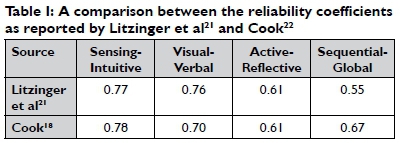
Various studies to determine the reliability and validity of the Felder-Soloman Index of Learning Styles instrument have been conducted internationally. Litzinger et al2121et al.21et al. and Zwanenberg et al and compared these with the results of their own study and reported similar results with only marginal differences confirming the reliability and validity212222et al2122Table 1.
METHODOLOGY
Design
A descriptive study with the use of a sample of convenience was used, while employing the Felder-Soloman Index of Learning Styles instrument23
Study population
The first year occupational therapy students from 2009 to 2011 (n=114) were invited to participate in the study. Information regarding the purpose of the study was provided in an information leaflet. Informed consent forms were provided for signature as well as a basic demographic questionnaire. Voluntary participation was emphasised and consent forms signed. Confidentiality was assured by allocating students with numbers from a predetermined range. All data were collected according to these numbers in order to maintain the anonymity of the participants. The Felder-Soloman Index of Learning Styles instrument is available on the internet with permission for individuals and researchers to use the instrument without cost. The Felder-Soloman Index of Learning Styles instrument was transcribed to the Umfundi programme that is used to enter information on the intranet before manual submission to the internet by the researcher. This method enabled the researcher to have access to the raw data to simplify statistical analyses.
Ethical clearance was obtained for the study from the Ethics Committee of the Faculty of Health Sciences at the University of Pretoria.
Data analysis
Questions in the Index of Felder-Soloman Learning Styles instrument are answered in a dichotomous manner, with a choice between two statements2415
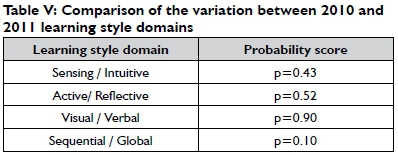
To confirm the reliability of the Felder-Soloman Index of Learning Styles for the South African context a reliability study was conducted on the 2009 group of students. To determine the internal consistency of each scale the Cronbach's alpha was calculated for each year group after which the non-parametric Mann-Whitney test was conducted to compare the alpha coefficients of the 2010 and 2011 year groups to determine any significant variations between these two year groups. An analysis of variance was used to provide a simple frequency distribution table reflecting the number of responses representing each learning preference according to the four domains. The frequency values for each scale were determined for each year group after which the data of the three year groups were combined to reflect the total sample group. The statistical tool used for analyses was the STATA 11.
RESULTS
Population demographics
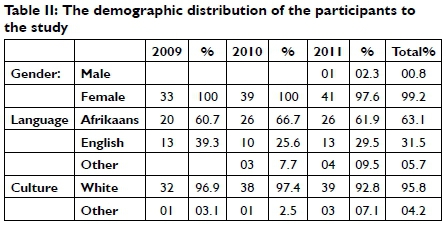
The demographics of the participants in the study are reflected in Table II. Gender: female 99.2%, male 0.8%. Home Language: English 31.5%, Afrikaans 63.1%, and other languages 5.7%. Cultural differences: White South African 95.8% and other SA cultural groups 4.2%.
Learning styles of population / students
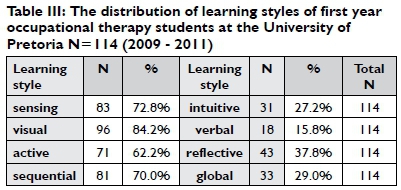
According to the frequency distribution of the learning style preferences the dominant preferences of the participants were sensing, visual, active and sequential. These results indicate that a large percentage of the sample group falls within this learning style profile. The intuitive, verbal, reflective and global learning style preferences are represented by a smaller percentage of the sample group. It must be remembered that the learning style preferences vary according to each individual in the sample group, there are many different combinations of learning style preferences that are beyond the scope of this study to analyse in detail. The results of the identified learning preferences of the study group over the three year-groups (N=114) are reflected in Table III (page 25).
Reliability of the Questionnaire
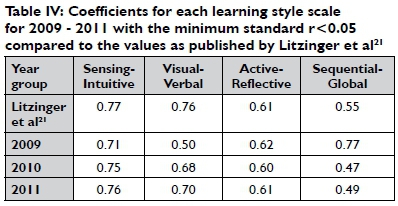
The alpha coefficients for the 2009 sample group (n = 33) in terms of reliability were determined for this study. Each of the four domains are reflected in Table IV indicating similar reliability for all the learning style domains as reported by Litzinger et al24
DISCUSSION
The Felder-Soloman Index of Learning Style instrument identified the most dominant learning style preferences for the sample group as sensing-visual-active-sequential. The intuitive-verbal-reflective-global learning style preferences were represented to a less dominant degree. The visual learning preference was the most frequently represented in the sample group.
After completing the Felder-Soloman Index of Learning Styles, feedback of the results were given to the individual participants. Feedback consisted of an information leaflet explaining the implications of their own results and suggestions on how other learning style preferences may be cultivated. This information leaflet is provided as a part of the electronic interpretation of the Felder-Soloman Index of Learning Style instrument23
Insight gained by educators from the learning preferences of the students may direct their teaching methods used in educating these occupational therapy students. The results indicate that teaching should follow a logical order (sequential) building knowledge from basic to more complex, concrete (sensing) examples should be used in a visual active manner to establish a good basis for ground level knowledge. The existing sensing-visual-active-sequential learning style requirements may thus be employed but according to Felder it is possible to stimulate the development of the less dominant learning style by employing diverse sources of information like articles, class notes, discussions and textbooks to stimulate expansion of especially the global, intuitive and reflective learning styles14
Due to the lack of common terminology it is difficult to compare the learning preferences identified by this research with the findings of other studies. Some similarity to the learning preferences of occupational therapy students in other countries may be deducted, especially the results of the studies conducted with the use of the Kolb Learning Style Index instrument6-8. The combination of the Kolb Learning Style Index instrument and the VARK7999
Since the learning style profiles identified in the research for each of the three year-groups are similar, it could be concluded that the identified learning style profile is representative of the present population of first-year occupational therapy students at one university in South Africa. It is, however, not possible to generalise the findings of this research in terms of a bigger population because the demographic distribution at the different universities in South Africa may vary. The gradual increase in especially Black, Coloured and Asian students being interested in and qualifying for selection to study occupational therapy may result in a change in the learning style profile due to different cultural and schooling backgrounds.
RECOMMENDATIONSA longitudinal study on learning style profiles that explores cultural/ gender/schooling differences may assist lecturers in educating students from different backgrounds. It is recommended therefore that learning style preferences of the first year occupational therapy students continue to be determined so that possible changes may be identified in each new group. The information will enable educators to be informed about changes in the teaching and learning requirements of he students so that they might stay in step with appropriate teaching and learning methods. More importantly self-knowledge might lead occupational therapists to become life-long learners, a pre-requisite to remain on the cutting-edge of their chosen profession.
Repeating the Felder-Soloman Index of Learning Styles instrument test at the end of the four-year course, or after the student has qualified and started working as a therapist, might determine possible changes in the learning style profiles of the individuals. The results of such retesting may provide insight into the effect of personal growth and the development of different learning methods.
CONCLUSION
The learning style preferences representative of the first-year occupational therapy students studying at a university in South Africa were found to be sensing-visual-active-sequential. In order to facilitate more effective interaction with information, occupational therapy students should have an understanding of their own learning styles. Occupational therapy students should thus be encouraged and assisted to determine their learning styles at the beginning of their first year of study. Determining the representative learning styles on a regular basis will identify possible changes in the teaching and learning requirements of the occupational therapy students. This will indicate to educators possible changes needed in the teaching methods that will satisfy the learning style requirements of the majority, as well as areas that need stimulation in order to extend the personal growth of the students to benefit from teaching and learning methods other than their own preferred requirements.
Further studies determining learning style profiles on different racial groups, language groups, and even rural and urban groups may provide valuable information on possible changes in the learning style profile of occupational therapy students. To establish a learning style profile for South African occupational therapy students, more extensive studies at different universities will need to be conducted with the same measurement instrument.
REFERENCES
LITERATURE REVIEW
-
1. Steinard NYU. Occupational therapy. New York University. New York: New York University of Steinard; 2011. <http://steinhardt.nyu.edu/ot/> (Aug 2010)
» http://steinhardt.nyu.edu/ot/ - 2. Martin IG, Stark P Jolly B. Benefiting from clinical experience: the influence of learning style and clinical experience on performance in an undergraduate objective structured clinical examination. Medical Education, 2000; 34: 530-4.
- 3. Main.S, The Other Half' of Education: Unconscious education of children. In: Semetsky I editor. Jung and Educational Theory. Melbourne: Blackwell, 2013:76-89
-
4. Wynne R. Learner centred methodologies. 29 Mar 2014. <http://www.assetproject.info/learner_methodologies/before/learning_analysis.html> (1 Sept 2014)
» http://www.assetproject.info/learner_methodologies/before/learning_analysis.html - 5. Dunn R Beaudry JS, Klavas A. Survey of Research on Learning Styles. California Journal of Science Education, 2002; 11(2): 75-98
- 6. Titiloye VM, Scott AH. Occupational therapy students' learning styles and application to professional academic training. Occupational Therapy Health Care, 2001; 15(1/2): 145-55
- 7. Katz N and Heinemann N. Learning style of students and practitioners in five health professions. Occupational Therapy Journal of Research, 1991; 11(4): 239-45
- 8. French G, Cosgiff T, Brown T. Learning style preference of Australian occupational therapy students. Australian Occupational Therapy Journal, 2007; S58-S65
- 9. Katz N. Problem solving and time: Functions of learning style and teaching methods. Occupational Therapy Journal of Research, 1990;10(4):221-325.
- 10. Litzinger TA, Lee SH, Wise JC, Felder RM. A Psychometric study of the index of learning styles. Journal of Engineering Education, 2007; 96(4): 309-19.
-
11. Barbara P Ring R.N. Myers-Briggs Type Indicator: A Research Report. 2008. <http://personalityinstitute.tripod.com/mbtiresearchreport.htm> (28 Aug 2014)
» http://personalityinstitute.tripod.com/mbtiresearchreport.htm - 12. Kolb AY The Kolb Learning Style Inventory-Version 3.1. In: Kolb DA, editor. Experience Based Learning Systems. Boston: Case Western Reserve University, 2005:1-71.
- 13. Hall E, Moseley D. Is there a role for learning style in personalized education and training. International Journal of Lifelong Education, 2005; 24(3): 243-55.
- 14. Felder RM, Silverman LK. Learning and teaching styles in engineering education. Journal of Engineering Education, 1988; 78(7):674-81.
- 15. Felder RM. Learning and teaching styles in engineering education. [2002 [about 2p.
- ]. <http://www4.ncsu.edu/unity/lockers/users/f/felder/public/Papers/LS-1988.pdf> (11 Sept 2009)
- 16. Felder RM, Spurlin J. Applications, reliability and validity of the index of learning styles. International Journal of Engineering Education, 2005; 21(1):103-12.
- 17. Litzinger TA, Lee SH, Wise JC, Felder RM. A Psychometric study of the index of learning styles. Journal of Engineering Education, 2007;96(4):309-19.
- 18. Provitera MJ, Esendal E. Learning and teaching styles in management education: Identifying, analyzing, and facilitating. Journal of College Teaching and Learning, 1(5):69-78
- 19. Felder RM, Brent R. Understanding student differences. Journal of Engineering Education, 2005;94(1):57-72.
-
20. Felder R. Index of Learning Styles (ILS). <www4.ncsu.edu//unity/lockers/users/f/felder/public/ILSpage.html> (June 2009)
» www4.ncsu.edu//unity/lockers/users/f/felder/public/ILSpage.html - 21. Litzinger TA, Lee SH, Wise JC, Felder RM. A study of the reliability and validity of the Felder-Soloman Index of Learning Styles. Washington DC: American Society for Engineering Education Annual Conference & Exposition, 2003.
-
23. Soloman BA, Felder RM. Index of Learning Styles Questionnaire. <www.engr.ncsu.edu/learningstyles/ilsweb.html>. (24Aug 2009)
» www.engr.ncsu.edu/learningstyles/ilsweb.html - 24. Driscoll P, Lecky F, Crosby M. An introduction to everyday statistics-1. Journal of Accident and Emergency Medcine, 2000; 17:205-11.
Elsje Rudman
Occupational Therapy Department
Faculty of Health Sciences University of Pretoria