The application of the Vona du Toit Model of Creative Ability to self-employment in South African informal microenterprises
INTRODUCTION: Persons with disabilities experience difficulties entering the formal South African labour market despite progressive legislation to enhance their economic participation. Consequently, self-employment becomes a work placement consideration for occupational therapy clients. However, self-employment requires certain volitional attributes, and the identification of such attributes would greatly enhance the outcome of vocational rehabilitation efforts. The aim of the study was to describe the level of creative ability of self-employed business owners in informal microenterprisesMETHOD: A descriptive, quantitative non-experimental research design was used. Sixteen self-employed business owners of informal microenterprises were interviewed and observed completing work tasks using the eight domains of the Activity Participation Outcome Measure (ApOM) based on the Vona du Toit Model of Creative Ability (VdTMoCARESULTS: Participants were between 27 and 50 years of age. Their education levels ranged from no-education (6%) to tertiary education (19%) with the majority (38%) having a high school education. Based on the APOM scores, participants functioned on three levels of creative ability namely: Passive Participation, Imitative Participation and Active Participation. Most participants functioned at the Imitative patient-directed level with the highest APOM domain scores for all participants being Communication Skills, Affect and Role PerformanceCONCLUSION: To be successfully self-employed in an informal microenterprise, the required level of creative ability ranging from Passive to Active Participation, was identified. This provides occupational therapists with an understanding of these requirements when considering self-employment as work placement option
Self-employment; informal; microenterprise; Vona du Toit Model of Creative Ability; VdTMoCA; Activity Participation Outcome Measure (APOM); work; vocational rehabilitation; placement
The application of the Vona du Toit Model of Creative Ability to self-employment in South African informal microenterprises
Luther L. MonarengI, *; Denise FranzsenII; Daleen CasteleijnIII; Hester M. van BiljonIV
IBSc (Wits); PGD in Hand Therapy (UP); MSc (Wits). https://orcid.org/0000-0001-6780-2436; Lecturer, Department of Occupational Therapy, Faculty of Health Sciences, School of Therapeutic Sciences, University of the Witwatersrand, Johannesburg, South Africa
IIBSc OT (Wits); MSc OT (Wits); DHT (UP); PhD (Wits). https://orcid.org/0000-0001-8295-6329; Sessional senior lecturer, Department of Occupational Therapy, Faculty of Health Sciences, School of Therapeutic Sciences, University of the Witwatersrand, Johannesburg, South Africa
IIIB. Occ. Ther (UP); PGD Voc Rehab (UP); M. Occ. Ther. (Hons)(Medunsa); DHETP (UP); M. Occ Ther (UP); PhD (UP). https://orcid.org/0000-0002-0611-8662; Associate Professor, Department of Occupational Therapy, Faculty of Health Sciences, School of Therapeutic Sciences, University of the Witwatersrand, Johannesburg, South Africa
IVB. Occ. Ther. (UFS); M. Occ. Ther. (UFS); PhD (Wits). https://orcid.org/0000-0003-4433-6457; Private practitioner, Work-Link Vocational Rehabilitation Private Practice, Gauteng, South Africa
INTRODUCTION: Persons with disabilities experience difficulties entering the formal South African labour market despite progressive legislation to enhance their economic participation. Consequently, self-employment becomes a work placement consideration for occupational therapy clients. However, self-employment requires certain volitional attributes, and the identification of such attributes would greatly enhance the outcome of vocational rehabilitation efforts. The aim of the study was to describe the level of creative ability of self-employed business owners in informal microenterprises
METHOD: A descriptive, quantitative non-experimental research design was used. Sixteen self-employed business owners of informal microenterprises were interviewed and observed completing work tasks using the eight domains of the Activity Participation Outcome Measure (ApOM) based on the Vona du Toit Model of Creative Ability (VdTMoCA
RESULTS: Participants were between 27 and 50 years of age. Their education levels ranged from no-education (6%) to tertiary education (19%) with the majority (38%) having a high school education. Based on the APOM scores, participants functioned on three levels of creative ability namely: Passive Participation, Imitative Participation and Active Participation. Most participants functioned at the Imitative patient-directed level with the highest APOM domain scores for all participants being Communication Skills, Affect and Role Performance
CONCLUSION: To be successfully self-employed in an informal microenterprise, the required level of creative ability ranging from Passive to Active Participation, was identified. This provides occupational therapists with an understanding of these requirements when considering self-employment as work placement option
Key words: Self-employment, informal, microenterprise, Vona du Toit Model of Creative Ability (VdTMoCA), Activity Participation Outcome Measure (APOM), work, vocational rehabilitation, placement.
INTRODUCTION AND LITERATURE REVIEW
South Africa has progressive legislation that protects and promotes the right of persons with disability (PWDs) to enter, return and/ or remain employed in the formal open labour market. However, 25 years after the promulgation of this law, PWDs are still under-represented in the work force123-5, The Commission of Employment Equity (CEE)167
Occupational therapists have a well-defined role in facilitating clients' engagement in the occupation of work8910,11. Occupational therapy vocational rehabilitation services are currently not in line with the South African government's call for citizens to explore self-employment as an alternative in the face of the high level of unemployment and its effects1213
Although there is no consensus on the definition of self-employment14an individual who is working for themselves, being directly or indirectly involved in running a successful and profitable small business or microenterprise in order to earn an income or generate a salary, instead of being employed by another person or an employer. A microenterprise may include, but is not limited to, buying and selling, offering services and manufacturing products on a micro scale1415716,l7.
Du Toit postulated that motivation governs action1819181018
The Activity Participation Outcome Measure (APOM) based on the VdTMoCA, was used in this study to establish the ability to meet the demands that self-employment places on an individual in microenterprises in the informal sector. The APOM provided a description of the self-employed individual's activity participation profile which forms the basis for deciding whether an individual has a skill at a level that would allow them to run a particular type of business. Since activity participation in the APOM20
This study explored self-employment of able-bodied individuals in informal microenterprises in a low resourced urban setting, to provide occupational therapists with a benchmark of the level of activity participation required before exploring self-employment as a work option for their clients.
METHODS
This study used a quantitative, non-experimental, cross sectional design, where convenience and snowball sampling2122> three years2324
The research instrument used for this study was a questionnaire which recorded demographic data (15 questions) and the APOM scores. The psychometric properties (validity and reliability) of the APOM have been assessed using Rasch analysis25
Individuals who met the inclusion criteria were visited at their place of business and invited to participate. Appointments were made with each participant to collect the data at a time that was convenient to them. Data for this study were collected by two researchers. Each researcher interviewed each participant and completed the questionnaire specifically designed for this study. Each researcher then observed each participant operating their business for one to two hours and then completed the APOM tool based on their observations. The interview to complete the questionnaire was done first followed by completion of the APOM. The researcher also watched the participant complete their work tasks in their business for e.g., setting up for the day, interacting and/or communicating with customers.
Following the data collection phase, the researchers convened to share, discuss and concur on their findings and scores for purposes of interrater reliability i.e. APOM ratings were discussed and justified with regular reference to the APOM guidelines. The APOM scores were recorded on a spreadsheet and spider graphs20
Data were analysed descriptively using frequencies and percentages. Demographic data of the participants and type of businesses were presented in frequency tables. APOM results (level of creative ability of the participant), type of business and category of business were described in a table. Median scores for the APOM domains were used to show the level of creative ability for each phase in each level of creative ability. Interpretation of the APOM scores are as follows: scores of 1 - 3 presents the level of Tone, 4 - 6 the level of Self-differentiation, 7 - 9 level of Self-presentation, 10 - 12 level of Passive Participation, 13 - 15 level of Imitative Participation and 16 - 18 level of Active Participation. The phases are represented by the specific score within the level e.g. a score of 13 indicates the therapist-directed phase within the level of Imitative Participation, a score ofl4 is the person (patient)-directed phase while 15 points to the transitional phase of Imitative Participation20
Ethical clearance (MI70820) was obtained for this study from theUniversity of the Witwatersrand Health Science Research Committee.* During the data collection phase, the purpose of the study and the role of participants in the study were explained using the approved information sheet. Those who agreed to participate signed an informed consent form prior to the data collection. It was explained to participants that their participation in the study was voluntary and they could withdraw without consequence at any time and that the data collected were confidential. To ensure anonymity and confidentiality data collected were coded, no names were captured on any data collection sheets and all docu-ments were kept in secure storage.
RESULTS
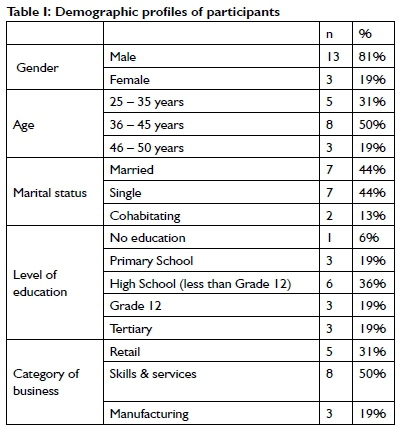
Table I (above) summarises the demographics of the 16 participants. Participants were mostly males, their ages ranged between 27 and 50 years and just over half (56%) of them were either married or co-habiting.
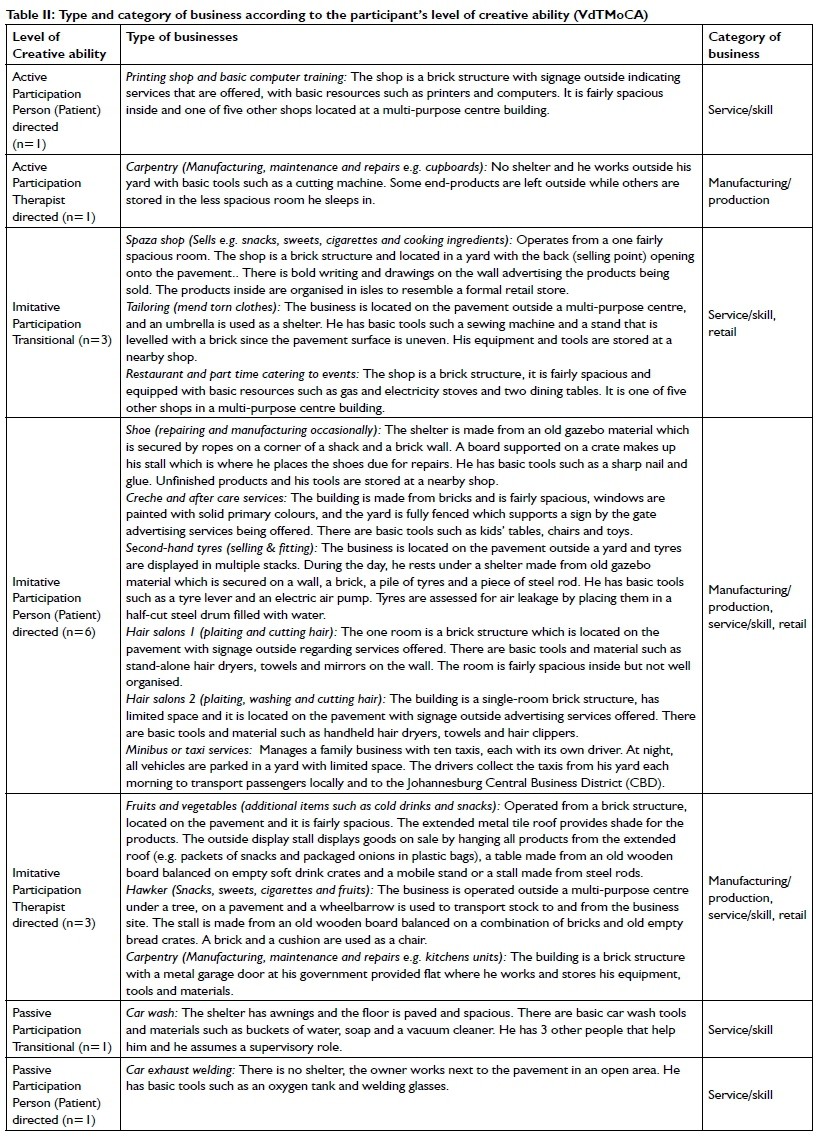
Participants had different levels of creative ability (VdTMoCA). Most businesses were in the retail and service and skills sector (Table II, p77). The type of microenterprises were service and skill, retail and manufacturing/production businesses13
Activity Participation
The highest level of VdTMoCA observed was Active Participation for two (12.5%) of the business owners. Twelve (75%) were at the Imitative Participation level and two (12.5%) at Passive Participation.
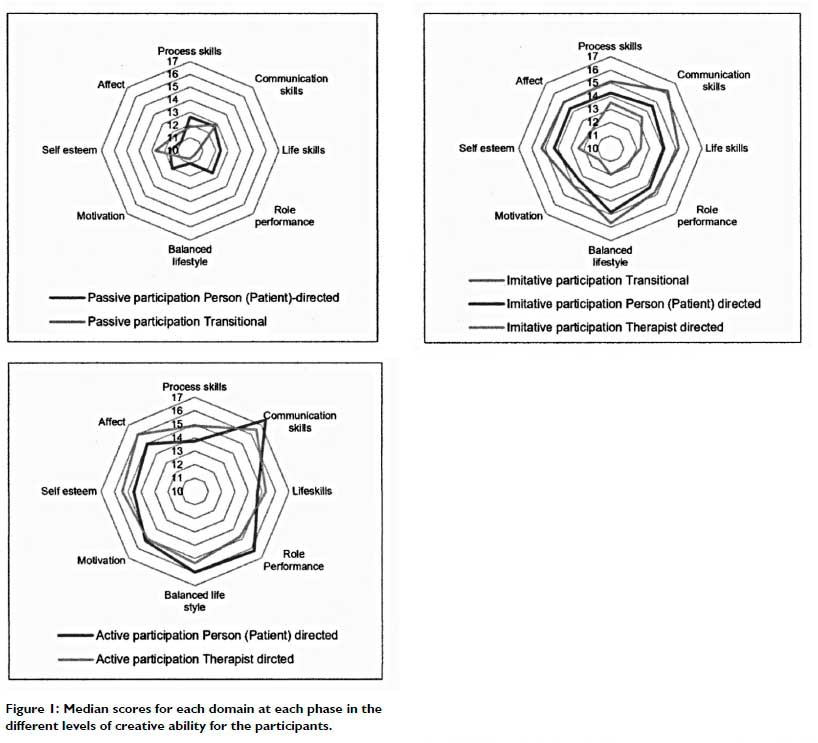
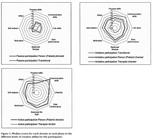
Figure 1 (above) indicates the median scores for each domain at each phase within the different levels of creative ability for the participants. The median of the APOM domain scores indicate that all participants scored at or above the Imitative Participation level, person (patient) directed phase (<I4) for the domain of Communication Skills. Motivation domain had the lowest median score with participants on Imitative Participation (11-14) and Active Participation (15) having Motivation scores which were lower than expected for their level of creative ability. In other domains the scores varied according to the level of creative ability. The participants on Active Participation had lower than expected median scores for Process Skills (14-15) while participants on Imitative Participation person (patient) directed and transitional phase) had higher than expected scores for Self-Esteem (15-16) and Balanced Lifestyle (15-16).
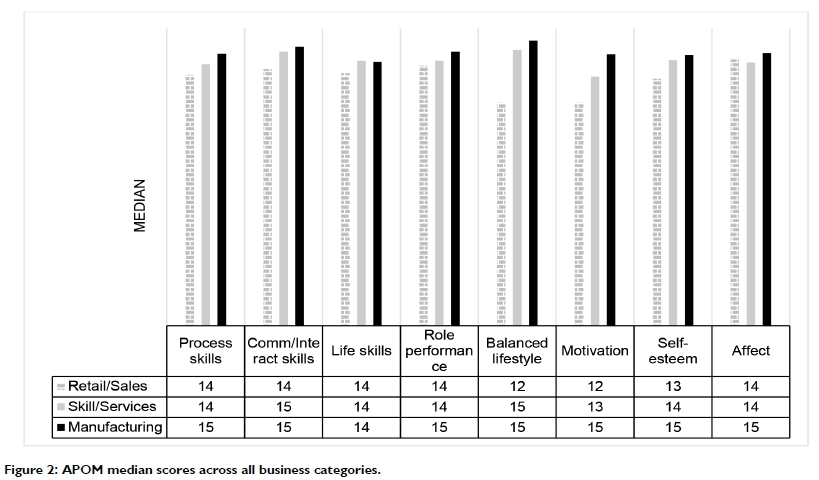
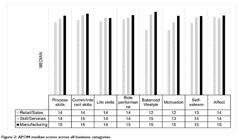
The APOM median scores across business categories indicated that the highest scores were in "manufacturing" followed by the "services" and "skills" category. The lowest scores were found in the "retail" category across all domains except for the domain of Affect (Figure 2, above).
DISCUSSION
The demographics of the participants in this study are similar to those reported in the literature for self-employment in low resourced communities in South Africa, with the majority being males between 36-45 years and with 12 years of formal education22
Two of 16 participants were on the Passive Participation level of creative ability of VdTMoCA and they were running businesses in the "service" and "skills" categories. Individuals functioning at this level have difficulty sustaining effort over time and they give up easily if they do not receive support or guidance2618
The majority of the participants (n=12) in this study functioned on the Imitative Participation level according to the VdTMoCA. Individuals functioning at this level need less external structure than those on the Passive Participation level, due to their ability to work independently. They have better Balanced Lifestyle skills and are more organized, structured, follow socially appropriate norms, can evaluate their own performance, and with guidance and practice they can problem-solve, manage their stress and budget and manage their finances adequately2027
Only two (12,5%) participants in this study functioned on the Active Participation level of creative ability. Such individuals transcend the self, are less egocentric, their focus is on other peoples' needs, they are independent and original in their actions with innovative, problem-solving skills and have a wide repertoire of work skills for which they have received specialized training282027
When the median scores of the domains of the APOM were considered in this study, the high scores for Communication Skills (15) followed by the Affect domain score of 14 suggested that participants in this study had good Communication Skills and a stable mood with appropriate emotional expressions which supported the success of their businesses. A good relationship with customers and the community as well as being a people's person was reported to be instrumental in self-employment29
The median score of the Motivation domain (13) was lowest which seems contrary to that suggested by literature3031273233
CONCLUSIONS
This study showed that participants with lower levels of creative ability were involved in retail businesses e.g., buying and selling of snacks on the side of the road. This finding can probably be ascribed to the fact that these businesses require less specific vocational skills and retail businesses in this sector are not complex. This also applies to the management aspect of the business which is often lower in those smaller retail enterprises as they require less organisation and completion of fewer tasks and responsibilities to sustain the business. When the product requires innovation (which participants with a higher level of creative ability are able to introduce), both manufacturing and service businesses are more likely to succeed34
By knowing the abilities required by individuals to be successfully self-employed, occupational therapists should select clients with appropriate skills and abilities when suggesting they engage in self-employment. The use of the APOM based on the VdTMoCA proved useful in identifying individual business owners' skills on eight domains which reflected their ability to run a micro-enterprise. Although individuals at the Passive Participation level according to the VdTMoCA may be involved in self-employment, they will probably need to be supervised on a regular basis. In this study, those functioning at the higher levels of creative ability (Imitative and Active Participation), were able to independently run successful microenterprises with some differences pertaining to for example, business systems. The study provides information on the amount of support and supervision a person (patient) may need to successfully engage in self-employment, as well as the necessary therapeutic intervention and support to facilitate sustainability.
RECOMMENDATIONSThis research identified several knowledge gaps that need to be addressed to broaden contextually relevant South African evidence of self-employment for PWD in occupational therapy. The perceptions of PWD on self-employment need to be explored as this could also affect the outcome of occupational therapists' interventions. Guidelines or a conceptual framework, based on the VdTMoCA to enable occupational therapists to identify, encourage and support self-employment for PWDs should be developed.
LIMITATIONS OF THIS STUDYThe small sample of microenterprise owners participating in this study limits generalisation of the findings. Due to the cross-sectional nature of the observations (which included habituated tasks) may not be consistent with each business owner's general performance. A second visit for observational purposes could have been considered and would have enhanced the discussion.
AUTHOR CONTRIBUTIONS:
The principal author, Luther Monareng, conducted the research and co-wrote the article.
Denise Franzsen and Daleen Casteleijn assisted in the development of this research, co-supervised the study and contributed to writing the article. Hester van Biljon assisted Mr Monareng with data collection and with writing the article.
• University of the Witwatersrand's Faculty of Health Sciences.
• Colleagues in vocational rehabilitation (Dr. Jennie McAdam, Mr. July Masango and Mr. Simon Rabothata) and Prof P de Witt for assistance with the article.
• University of the Witwatersrand's Faculty of Health Sciences'
• Claude Leon Merit Award Grant and
• Faculty Research Committee individual grant.
Acknowledgements
Thank you to all the following departments and people who made this research possible:
REFERENCES
- 1. Department of Labour. 18th Commission for Employment Equity: I.Department of Labour. 18th Commission for Employment Equity: Annual Report 2017-2018. Pretoria: 2019.
-
2. Ndzwayiba N, Ned L. The Complexity of Disability Inclusion in the Workplace: A South African Study. 2017:127-54. doi: https://doi.org/10.1108/S1479-354720170000010014.
» https://doi.org/10.1108/S1479-354720170000010014 -
3. International Labour Office. World Employment and Social Outlook: Trends 2019 Geneva: International Labour Office; 2020 [cited 2020 5th May 2020]. Available from: https://www.ilo.org/wcmsp5/groups/public/---dgreports/---dcomm/---publ/documents/publication/wcms_670542.pdf.
» https://www.ilo.org/wcmsp5/groups/public/---dgreports/---dcomm/---publ/documents/publication/wcms_670542.pdf -
4. Shakespeare T, Mugeere A, Nyariki E, Simbaya J. Success in Africa: People with disabilities share their stories. African Journal of Disability (Online). 2019;8:1-7. doi: http://dx.doi.org/10.4102/ajod.v8i0.522.
» http://dx.doi.org/10.4102/ajod.v8i0.522 -
5. Statistics South Africa. Significant movements into the labour force in the 3rd quarter of 2020 Pretoria South Africa: Statistics South Africa; 2020 [updated I2 November 2020]. Available from: http://www.statssa.gov.za/?p=13758.
» http://www.statssa.gov.za/?p=13758 - 6. Republic of South Africa. Employment Equity Act, No. 55. Pretoria: The Government Printer; 1998.
-
7. United Nations Development Programme. Sustainable Development Goals 20I5. Available from: https://www.undp.org/content/undp/en/home/sustainable-development-goals.html.
» https://www.undp.org/content/undp/en/home/sustainable-development-goals.html - 8. American Occupational Therapy Association. Occupational therapy practice framework: Domain and process (3rd ed.). American Journal of Occupational Therapy. 2014;68.
-
9. van Biljon HM, Casteljien D, du Toit SH, Soulsby L. Opinions of occupational therapists on the positioning of vocational rehabilitation services in Gauteng Public Healthcare. South African Journal of Occupational Therapy. 20I6;46(1):45-52. doi: http://dx.doi.org/10.17159/2310-3833/2017/vol48n3a8
» http://dx.doi.org/10.17159/2310-3833/2017/vol48n3a8 - 10. Casteleijn D, de Vos H. The model of creative ability in vocational rehabilitation. Work. 2007;29(1):55-61.
- 11. Crepeau EB CE, Schell BAB. Willard & Spackman's occupational therapy. 10 ed. Philadelphia: Lippincott; 2003.
- 12. Bendile N. Ramaphosa encourages entrepreneurship among young South Africans. EYEWITNESS NEWS, 2016.
-
13. Monareng LL, Franzsen D, van Biljon H. A survey of occupational therapists' involvement in facilitating self- employment for people with disabilities. South African Journal of Occupational Therapy. 2018;48(4):52-7. doi: https://doi.org/10.17159/2310-3833/2017/vol48n3a8.
» https://doi.org/10.17159/2310-3833/2017/vol48n3a8 - 14. Parker SC. The economics of self-employment and entrepreneurship: Cambridge University Press; 2004.
- 15. International Labour Organisation. Small Matters: Global evidence on the contribution to employment by the self-employed, micro-enterprises and SMEs. 2019.
-
16. Junior Achievement Entrepreneurs are made, not born 2006. Available from: https://www.juniorachievement.org/web/ja-indy/ja-in-the-news/-/blogs/are-entrepreneurs-born-or-made-.
» https://www.juniorachievement.org/web/ja-indy/ja-in-the-news/-/blogs/are-entrepreneurs-born-or-made- - 17. Alharthi SZ. Entrepreneurs are Not Born nor Made. Research Journal of Science and IT Management. 2013;2(11):27-34.
- 18. de Witt P. Creative ability: A model for individual and group occupational therapy for clients with psychosocial dysfunction. In: R C, V A, editors. Occupational therapy in psychiatry and mental health. 5th ed. Oxford: Wiley Blackwell; 2014.
- 19. du Toit V. Patient volition and action in occupational therapy. Patient volition and action in occupational therapy. South Africa: Vona and Marie du Toit Foundation; 1991.
- 20. Casteleijn JMF. Development of an outcome measure for occupational therapists in mental health care settings. South Africa: University of Pretoria; 20I0.
- 21. Kielhofner G. Research in Occupational Therapy: Methods of Inquiry for Enhancing Practice Waltner P Fratantoro CA, editors. Philadelphia: F. A. Davis; 2006.
- 22. Bartlett JE, Kotrlik JW, Higgins CC. Organizational research: Determining appropriate sample size in survey research appropriate sample size in survey research. Information technology, learning, and performance journal. 2001;19(1):43.
-
23. Pretorius M. Defining business decline, failure and turnaround: A content analysis. The Southern African Journal of Entrepre-neurship and Small Business Management. 2009;2(1):1-16. doi: https://doi.org/10.4102/sajesbm.v2i1.15.
» https://doi.org/10.4102/sajesbm.v2i1.15 -
24. South African Social Security Agency (20I7) Disability Grant. Available at: http://www.sassa.gov.za/index.php/social-grants/disability-grant (accessed June 09 20I7).
» http://www.sassa.gov.za/index.php/social-grants/disability-grant - 25. Casteleijn D. Using measurement principles to confirm the levels of creative ability as described in the Vona du Toit Model of Creative Ability. South African Journal of Occupational Therapy. 2014;44(1):14-9.
-
26. Oosterbeek H, Van Praag M, Ijsselstein A. The impact of entrepreneurship education on entrepreneurship skills and motivation. European economic review. 20I0;54(3):442-54. doi: https://doi.org/https://doi.org/10.1016/j.euroecor-ev.2009.08.002.
» https://doi.org/https://doi.org/10.1016/j.euroecor-ev.2009.08.002 -
27. Luthans F, Avey JB, Avolio BJ, Norman SM, Combs GM. Psychological capital development: toward a micro intervention. Journal of Organizational Behavior: The International Journal of Industrial, Occupational and Organizational Psychology and Behavior. 2006;27(3):387-93. doi: https://doi.org/10.1002/job.373.
» https://doi.org/10.1002/job.373 -
28. Luca MR, Cazan A-M, Tomulescu D. To be or not to be an entrepreneur. Procedia-Social and Behavioral Sciences. 2012;33:173-7. doi: https://doi.org/https://doi.org/10.1016/j.sbspro.2012.01.106.
» https://doi.org/https://doi.org/10.1016/j.sbspro.2012.01.106 -
29. Chatterjee N, Das N. A study on the impact of key entrepreneurial skills on business success of Indian micro-entrepreneurs: A case of Jharkhand region. Global Business Review. 2016;17(1):226-37. doi: https://doi.org/10.1177/0972150915610729.
» https://doi.org/10.1177/0972150915610729 -
30. Barba-Sánchez V, Atienza-Sahuquillo C. Entrepreneurial motivation and self-employment: evidence from expectancy theory. International Entrepreneurship and Management Journal. 2017;13(4):1097-115. doi: https://doi.org/10.1007/s11365-017-0441-z.
» https://doi.org/10.1007/s11365-017-0441-z - 31. Chell E. The entrepreneurial personality: A social construction: Routledge; 2008.
-
32. Krasniqi BA. Characteristics of self-employment: A refuge from unemployment or road to entrepreneurship. Small Enterprise Research. 2014;21(1):33-53. doi: https://doi.org/10.1080/13215906.2014.11082075.
» https://doi.org/10.1080/13215906.2014.11082075 - 33. Smallbone D, Welter F. Entrepreneurship and small business development in post-socialist economies: Routledge; 2008.
- 34. De Mel S, McKenzie D, Woodruff C. Innovative firms or innovative owners? Determinants of innovation in micro, small, and medium enterprises: The World Bank; 2009.
* Ethical clearance for this study was granted prior to the enactment of the amended POPIA on 21-07-01