Development of a contextually relevant cognitive driving screen: CoDriS
INTRODUCTION
Comprehensive driving evaluations by occupational therapists assess whether individuals have the necessary physical, cognitive, visual and sensory abilities to drive in traffic12
In clinical practice, general cognitive tests are used to assess domains relevant to driving, supported by researched cut scores for driving fitness. However, these tests were typically developed outside South Africa and are not normed on the local population. General cognitive tests are also not driving-specific and do not assess practical driving knowledge. This makes it challenging to interpret how scores relate to actual driving ability, both for clinicians and for those being assessed. Since these tests do not assess familiarity with traffic rules or the ability to navigate real traffic conditions, assessors have limited insight into the individual's driving knowledge before conducting the on-road assessment.
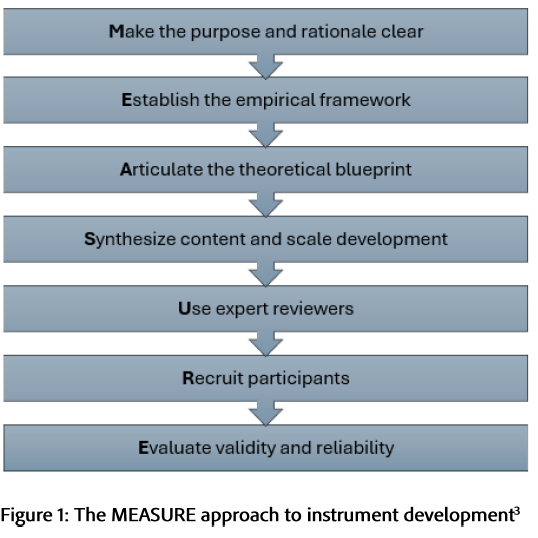
To strengthen the link between clinical assessment findings and actual driving performance, and to mitigate for safety during the on-road assessment, the first author (a clinical expert in the field) is in the process of developing a cognitive screening instrument that combines the assessment of relevant cognitive domains with driving-related knowledge required for independent driving, namely the Cognitive Driving Screen (CoDriS). The instrument development process is following the MEASURE approach, an acronym for seven pragmatic steps in instrument development and initial validation proposed by Kalkbrenner (see Figure 1, below)3Figure 1, below.
METHOD
1. Make the purpose and rationale clear
In the first step of the MEASURE approach34,pg.169. Additionally, a rationale is provided to highlight gaps in the current knowledge base and explain how addressing these gaps can advance both practice and research3
Cognitive domains
Driving requires multiple cognitive domains; thus, comprehensive driving evaluations typically combine existing cognitive tests with researched cut scores to determine fitness to drive. Commonly used instruments include the Montreal Cognitive Assessment (MoCA), Trail Making Tests A and B, Snellgrove Maze and Useful Field of View (UFOV)5-7. Composite batteries such as the Occupational Therapy Driver Off-Road Assessment Battery (OT-DORA) and Rookwood Driving Battery are also used8,9. None of these tests or their cut scores were developed for the South African context, limiting local applicability10
Existing cognitive tests are based on general concepts that assume baseline language, literacy, numeracy and cultural knowledge. Interpreting how these test items relate to driving requires further analysis and individuals with cognitive impairment often struggle to understand how abstract test results impact their driving ability. Additionally, in the absence of South African cut scores, assessors must carefully consider the relevance of test scores in light of the individual's educational and social background.
Driving knowledge
Most cognitive tests used do not assess an individual's driving knowledge, which is central to the learnt skill of driving. The Road Law and Road Craft Test (RLRCT) in the OT-DORA battery addresses this by evaluating knowledge of left-hand driving traffic rules8,11. The RLRCT utilises multiple-choice questions, written reasoning and sequencing tasks based on Australian and UK road rules8,11. While useful, some South African drivers struggle with the format and the subtle differences in international traffic rules, often due to language and educational factors rather than cognitive impairment.
Driving assessments typically focus on on-road driving performance. However, occupational therapists also consider broader occupational demands, such as trip planning and handling unforeseen events. Existing standardised cognitive tests largely target on-road performance; therefore, the first author identified a need to assess additional trip-related skills to better evaluate an individual's capacity to manage an entire journey.
Insight
Insight is a critical cognitive domain in driving assessments. Understanding one's limitations and their potential impact on driving helps ensure responsible behaviour. Self-assessment questions that ask individuals to rate their ability to handle various traffic situations can be compared to objective test results and on-road performance to understand how their perceived ability aligns with their actual ability.
Instruments used include the Brain Injury Driving Self-Awareness Measure (BIDSAM)121314
Instrument administration
Several paper-based cognitive tests require sufficient fine motor dexterity, which is not essential for driving; thus, individuals with fine motor impairments may score poorly despite adequate cognitive ability. Similarly, tests which require verbal responses disadvantage those with communication disorders such as aphasia, even if their driving-related cognition is intact, highlighting the need for alternative formats.
Some of the tests that were explored rely on assessor scoring and interpretation. Although administrator training is available, minor adaptations to test instructions and scoring in clinical practice introduce variability, which may affect standardisation.
The first author recognised the potential to develop an online assessment format that minimises fine motor and verbal communication barriers, with automated scoring to ensure standardised results.
2. Establish the empirical framework
The empirical framework clarifies how the instrument's items relate to the construct being measured43
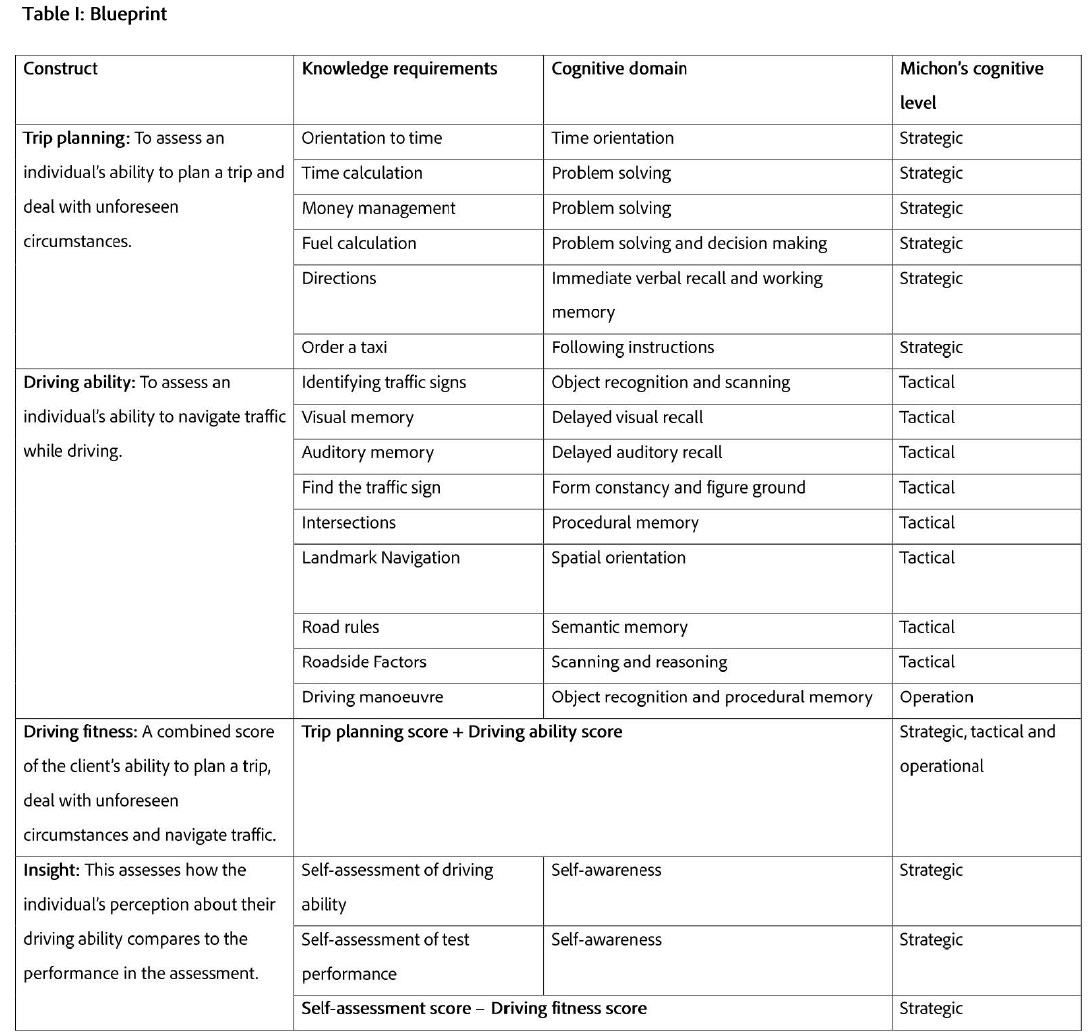
In the first instance, clinical need and discussions with occupational therapists experienced in comprehensive driving evaluation informed the driving-related content. The theoretical framework of Michon's hierarchical model of cognition and driving behaviour15
3. Articulate the theoretical blueprint
The first two steps aid in articulating the theoretical blueprint during instrument development. Once the construct, purpose and rationale are known, and the appropriate empirical framework is established, test developers can create a blueprint, outlining the domain or content areas that are to be included in the instrument33Table I, page 3.
4. Synthesize content and scale development
Drawing on clinical experience, the first author initially developed informal, paper-based questions featuring images of traffic signs and traffic scenarios to assess cognitive domains relevant to driving, as well as driving knowledge and trip planning ability. To improve accessibility and standardisation, these questions were refined for online administration with automated scoring. The revised test items use multiple-choice and click-on-image formats, removing the need for verbal responses or fine motor dexterity. The online format directly captures responses, applies automated scoring algorithms to generate item and construct scores, reduces the need for assessor training, eliminates time required for manual score calculation and minimises potential administrator bias.
RESULTS
Administration
The CoDriS is expected to take 20-50 minutes to complete, with the extended timeframe accommodating individual processing styles and potential cognitive impairment affecting thought processing speed.
The CoDriS starts with an introduction that explains the purpose of the test and provides navigation instructions, including guidance on what assistance is allowed.
This is followed by a demographic section that collects non-personal identifying information.
Each CoDriS has a unique number stored in the database, which only the assessor and the individual performing the CoDriS can link to a name.
Instrument administration and score interpretation documents are provided.
Content
Insight is assessed through self-assessment questions where individuals rate their ability to manage specific trip conditions that match scenarios tested in the CoDriS. This allows comparison between perceived and actual performance. Two versions of these questions are provided, one for active drivers and one for non-active drivers, using slightly different wording but identical content to maintain relevance and avoid confusion. Additionally, at the end of the CoDriS, individuals rate their overall test performance, providing further insight into their self-awareness, which can then be compared to their actual test scores.
The CoDriS includes a range of test items designed to assess different cognitive domains and driving knowledge, using practical trip planning and traffic scenarios relevant to independent driving.
While both Trip Planning and Driving Ability are important components of a comprehensive driving assessment, greater emphasis is placed on the individual's capacity to drive and navigate traffic. Consequently, the CoDriS includes more test items assessing Driving Ability than Trip Planning.
The sequence of test items has been carefully structured to reduce the risk of interference between items, e.g. for those assessing delayed memory.
Language
The instructions (currently in South African English) are clear and designed to address common assumptions or questions that may affect understanding.
While individuals are encouraged to read the instructions themselves, assessors may read them aloud to accommodate varying literacy levels.
Given South Africa's multicultural context with diverse language nuances, assessors are permitted to rephrase instructions up to twice to ensure comprehension is not hindered by language barriers.
Design
Due to screen size, the CoDriS is recommended for use on computers or tablets, not smartphones.
Each test item follows a consistent layout in heading, font, colour and size to maintain simplicity and avoid distraction.
Apart from typing in their age, all test items use multiple-choice or click-on-image formats for easy, intuitive touchscreen use. The design simulates smartphone interaction to broaden accessibility beyond computer literacy. Individuals may receive help navigating the device, as long as they answer the questions themselves, to ensure unfamiliarity with the device doesn't affect their performance.
Multiple-choice options are presented in sequential order (e.g. lowest to highest) to minimise cognitive load. When the question has no predetermined number of options (e.g. weekdays), four options are used for consistency.
Each test item is designed to fit on a single screen. Items with multiple questions appear over several pages accessed by clicking "NEXT". For items not testing immediate recall, instructions are repeated on each page to ensure results reflect the intended cognitive domain rather than memory for instructions.
Once "NEXT" is selected, the previous page becomes inaccessible. This ensures that information from subsequent test items, which measure different cognitive domains, cannot be used to answer earlier items.
To mitigate interruptions from connectivity issues or accidental exits, the test can be resumed via a unique link, with previously completed scores saved. This also allows completion across multiple sessions if needed, though this is not recommended.
Construct scores
Test responses are recorded upon selecting "NEXT" and automatically scored in the background database.
Individual item scores are grouped to calculate construct scores: Trip Planning, Driving Ability, Driving Fitness, Self-Assessment and Insight.
On completion of the CoDriS, a scoresheet is generated with item and construct scores alongside descriptive interpretations.
Construct scores are presented as percentages for consistency and ease of comparison.
Score formulas
A three-point Likert scale was selected for the Self-Assessment questions to avoid overwhelming individuals with cognitive impairment. For the seven driving-related items, response options are Never/No, Sometimes/Maybe and Always/Yes. For the test performance item, the options are Great, Average and Poor.
Most items are multiple-choice with a single correct response.
Orientation to time is evaluated using the device's date, day and time settings, with leniency buffers for time.
Click-on-image scoring is more complex, with positive, neutral and negative points assigned per item to keep scores within set minimum (0) and maximum limits.
Score weighting
After assigning scores to individual test items, their weighting within each construct was reviewed by examining the cognitive domain's relevance to driving, adjusting for repeated domains and benchmarking against standardised cognitive tests. Individual response scores were then refined accordingly.
Driving Fitness (45 points) is a composite score combining Trip Planning (15 points) and Driving Ability (30 points), weighted to reflect greater importance of Driving Ability.
Each self-assessment question is scored up to 2 points, for a total maximum score of 16.
The Insight score is calculated by subtracting the Driving Fitness score from the Self-Assessment score. It can be a positive or negative score. The bigger the difference between these scores, the poorer the individual's insight.
CONCLUSION
The CoDriS is an online cognitive driving screening instrument under development within South Africa, combining assessments of cognitive domains with contextually relevant driving knowledge, using the MEASURE instrument development approach3
Acknowledgements and Declaration
The first listed author - who developed the instrument described in this article - gratefully acknowledges the support of the Driver Fitness Coalition committee members. The instrument is commercially available through a company in which she holds a financial interest.
REFERENCES
-
1. Anstey KJ, Wood J, Lord S, Walker JG. Cognitive, sensory and physical factors enabling driving safety in older adults. Clinical Psychology Review. 2005;25(1):45-65. https://doi.org/10.1016/j.cpr.2004.07.008
» https://doi.org/10.1016/j.cpr.2004.07.008 -
2. Swanepoel L, Classen S, Goliath C. Validity of the Stellenbosch University On-road Assessment. South African Journal of Occupational Therapy. 2015;45(3). https://doi.org/10.17159/2310-3833/2015/v45n3/a3
» https://doi.org/10.17159/2310-3833/2015/v45n3/a3 -
3. Kalkbrenner MT. A Practical Guide to Instrument Development and Score Validation in the Social Sciences: The MEASURE Approach. 2021;26(1). https://doi.org/10.7275/svg4-e671
» https://doi.org/10.7275/svg4-e671 - 4. de Vet H, Terwee C, Mokkink L, Knol D. Measurement in Medicine: A Practical Guide. Cambridge University Press; 2011.
-
5. Vaucher P et al. The trail making test as a screening instrument for driving performance in older drivers; a translational research. 2014 [accessed 2025 Jul 24]. http://www.biomedcentral.com/1471-2318/14/123. https://doi.org/10.1186/1471-2318-14-123
» http://www.biomedcentral.com/1471-2318/14/123 -
6. Selander H, Wressle E, Samuelsson K. Scandinavian Journal of Occupational Therapy Cognitive prerequisites for fitness to drive: Norm values for the TMT, UFOV and NorSDSA tests Cognitive prerequisites for fitness to drive: Norm values for the TMT, UFOV and NorSDSA tests. 2019 [accessed 2025 Jul 24]. https://www.tandfonline.com/action/journalInformation?journalCode=iocc20. https://doi.org/10.1080/11038128.2019.1614214
» https://www.tandfonline.com/action/journalInformation?journalCode=iocc20 -
7. Hansmann K et al. THE GENERALIST RESOURCE TO INTEGRATE DRIVING: MEASURING THE CLINICAL UTILITY OF THE GRID TOOL. Innovation in Aging. 2024 [accessed 2025 Jul 24];8(Suppl 1):793. https://pmc.ncbi.nlm.nih.gov/articles/PMC11691812/. https://doi.org/10.1093/GERONI/IGAE098.2576
» https://pmc.ncbi.nlm.nih.gov/articles/PMC11691812/ -
8. Unsworth CA et al. Occupational Therapy-Driver Off Road Assessment Battery. Disability and Rehabilitation. 2018 [accessed 2025 Jul 24];41:1797-1802. https://doi.org/10.1080/09638288.2018.1445784
» https://doi.org/10.1080/09638288.2018.1445784 -
9. Vella K, Lincoln NB. Neuropsychological Rehabilitation An International Journal Comparison of assessments of fitness to drive for people with dementia. 2014 [accessed 2025 Jul 24]. https://www.tandfonline.com/action/journalInformation?journalCode=pnrh20. https://doi.org/10.1080/0962011.2014.903197
» https://www.tandfonline.com/action/journalInformation?journalCode=pnrh20 -
10. Van Biljon HM, Casteleijn D, Du Toit SHJ, Rabothata S. Screening the Ability to Drive by Occupational Therapists in Gauteng Public Healthcare - an Action Learning Action Research Outcome. South African Journal of Occupational Therapy. 2019;49(1):4-11. https://doi.org/10.17159/2310-3833/2019/vol49n1a2
» https://doi.org/10.17159/2310-3833/2019/vol49n1a2 -
11. Unsworth CA et al. Development of a standardised Occupational Therapy - Driver Off-Road Assessment Battery to assess older and/or functionally impaired drivers. Australian Occupational Therapy Journal. 2012 [accessed 2025 Jul 24];59(1):23-36. https://doi.org/10.1111/J.1440-1630.2011.00979.x
» https://doi.org/10.1111/J.1440-1630.2011.00979.x -
12. Gooden JR et al. The development and initial validation of a new tool to measure self-awareness of driving ability after brain injury. Australian Occupational Therapy Journal. 2017 [accessed 2025 Jul 24];64(1):33-40. /doi/pdf/10.1111/1440-1630.12306. https://doi.org/10.1111/1440-1630.12306
» https://doi.org/10.1111/1440-1630.12306 -
13. Sherrilene C et al. Psychometrics of the fitness-to-drive screening measure. OTJR Occupation, Participation and Health. 2015;35(1):42-52. https://doi.org/10.1177/1539449214561761
» https://doi.org/10.1177/1539449214561761 -
14. Lang B, Parkes A, Fernandez-Medina K. Driving choices for the older motorist: the role of self-assessment tools. 2013 Feb [accessed 2025 Jul 24]. https://www.racfoundation.org/research/safety/driving-choices-for-the-older-motorist
» https://www.racfoundation.org/research/safety/driving-choices-for-the-older-motorist -
15. Michon JA. A critical view of driver behavior models: what do we know, what should we do? In: Human behavior and traffic safety. Springer, US; 1985. p 485-524. https://www.jamichon.nl/jam_writings/1985_criticial_view.pdf
» https://www.jamichon.nl/jam_writings/1985_criticial_view.pdf

Reviewed: 16 October 2025
Revised: 10 December 2025
Accepted: 7 January 2026
DATA AVAILABILITY: Upon reasonable request, from corresponding author.
FUNDING: No funding was received for this study.