The therapeutic impact of occupational therapy groups on the activity participation of persons with major depressive disorder in an acute mental health setting
INTRODUCTION: Participation in meaningful activities is compromised in mental health care users living with major depressive disorder. In acute mental health settings, occupational therapy groups are the main treatment modality used to address occupational dysfunction or activity participation in these mental health care users. However, the evidence for the therapeutic impact of occupational therapy groups on activity participation is limited This study aimed to determine change in the activity participation of mental healthcare users with major depression attending occupational therapy groups based on the Occupational Therapy Interactive Group Model during their admission to an acute private mental health setting. METHOD: A quasi-experimental, longitudinal, pre-post group study design was employed to collect data from a sample of 70 participants diagnosed with major depressive disorder. The Activity Participation Outcome Measure (APOM) was used to measure change in activity participation in this study RESULTS: A significant improvement in activity participation was evident from admission to discharge across all the domains of the APOM. Correlations between the independent variables and improvement in APOM scores indicated stronger correlations for the number of groups attended by participants than their length of stay. Additionally, closed groups yielded a stronger correlation with improvement in APOM scores in comparison to open groups DISCUSSION: Occupational therapy groups play an integral role in the road to healing for mental health care users diagnosed with major depression admitted to acute private mental health settings IMPLICATIONS FOR PRACTICE: • Incorporating the Occupational Therapy Interactive Groupwork Model (OTIGM) in the treatment of patients with major depressive disorder, especially with closed groups, enables members to experience a sense of security and continuity, which can enhance therapeutic outcomes. • Integrating tools such as the APOM in clinical settings to measure the efficacy of interventions and identify areas needing further attention, will build evidence-based practice. • Incorporating stress management techniques, such as mindfulness, relaxation therapy, Tension Release Exercises (TRE) and sensory activities, into the therapeutic regimen can be highly beneficial in the treatment of the acute symptoms of major depressive disorder.
activity participation outcome measure (APOM); Occupational Therapy Interactive Group Model (OTIGM); private psychiatric hospital; open groups; closed groups
The therapeutic impact of occupational therapy groups on the activity participation of persons with major depressive disorder in an acute mental health setting
Annalie F. MeyerI, II; Daleen CasteleijnIII; Olindah SilauleIV
IAt the time of study: Post-Graduate student, Department of Occupational Therapy, School of Therapeutic Sciences, University of the Witwatersrand, Johannesburg, South Africa. https://orcid.org/0009-0002-3304-7967
IICurrent: Private Practitioner, Western Cape, South Africa
IIIDepartment of Occupational Therapy, School of Therapeutic Sciences, University of the Witwatersrand, Johannesburg, South Africa. https://orcid.org/0000-0002-0611-8662
IVDepartment of Occupational Therapy, School of Therapeutic Sciences, University of the Witwatersrand, Johannesburg, South Africa. https://orcid.org/0000-0003-0406-9788
INTRODUCTION: Participation in meaningful activities is compromised in mental health care users living with major depressive disorder. In acute mental health settings, occupational therapy groups are the main treatment modality used to address occupational dysfunction or activity participation in these mental health care users. However, the evidence for the therapeutic impact of occupational therapy groups on activity participation is limited
This study aimed to determine change in the activity participation of mental healthcare users with major depression attending occupational therapy groups based on the Occupational Therapy Interactive Group Model during their admission to an acute private mental health setting.
METHOD: A quasi-experimental, longitudinal, pre-post group study design was employed to collect data from a sample of 70 participants diagnosed with major depressive disorder. The Activity Participation Outcome Measure (APOM) was used to measure change in activity participation in this study
RESULTS: A significant improvement in activity participation was evident from admission to discharge across all the domains of the APOM. Correlations between the independent variables and improvement in APOM scores indicated stronger correlations for the number of groups attended by participants than their length of stay. Additionally, closed groups yielded a stronger correlation with improvement in APOM scores in comparison to open groups
DISCUSSION: Occupational therapy groups play an integral role in the road to healing for mental health care users diagnosed with major depression admitted to acute private mental health settings
IMPLICATIONS FOR PRACTICE:
• Incorporating the Occupational Therapy Interactive Groupwork Model (OTIGM) in the treatment of patients with major depressive disorder, especially with closed groups, enables members to experience a sense of security and continuity, which can enhance therapeutic outcomes.
• Integrating tools such as the APOM in clinical settings to measure the efficacy of interventions and identify areas needing further attention, will build evidence-based practice.
• Incorporating stress management techniques, such as mindfulness, relaxation therapy, Tension Release Exercises (TRE) and sensory activities, into the therapeutic regimen can be highly beneficial in the treatment of the acute symptoms of major depressive disorder.
Keywords: activity participation outcome measure (APOM), Occupational Therapy Interactive Group Model (OTIGM), private psychiatric hospital, open groups, closed groups
BACKGROUND AND LITERATURE REVIEW
Major Depressive Disorder (MDD) is a debilitating mental disorder which was declared a leading cause of disability by the World Health Organization (WHO) as of 2018123,4,5. Major Depressive Disorder is characterised by acute symptoms such as persistent sadness, loneliness, loss of interest in activities, anhedonia, avolition, lack of energy, self-harm, suicidal thoughts, and feelings of worthlessness6,7. When left untreated, it often results in suicide, increased medical morbidity and mortality, workplace absenteeism, as well as occupational and social dysfunction6
When an individual is diagnosed with MDD, participation in meaningful activities of choice is often compromised by lack of energy and decreased motivation to participate in these activities5,6,7. Occupational therapy intervention for individuals with MDD aims to address occupational dysfunction and occupational imbalance by encouraging engagement in a variety of occupations8,9. Social dysfunction, or social withdrawal caused by MDD, is often addressed by providing opportunities for mental healthcare users (MHCUs) to engage in occupations with others. Participation in occupations is necessary to prepare individuals with MDD to cope with the demands of their immediate environment and to re-integrate into their everyday lives9,10,11.
In an acute mental health setting, occupational therapy intervention consists of individual assessments, individual treatment, groupwork/therapeutic groups, discharge planning, and community re-integration12131414,15,16. This aims to improve MHCUs' engagement in their daily occupations and roles, such as work and social participation11,16.
The Occupational Therapy Interactive Group Model (OTIGM) is an approach used by South-African occupational therapists in both public and private mental healthcare settings. The OTIGM is an occupation focused, psychosocial approach and was developed in the 1980's by an occupational therapist, in conjunction with a psychologist, as reported in Fouche141414
In a South African study conducted by Ramano et al.1819202118222324
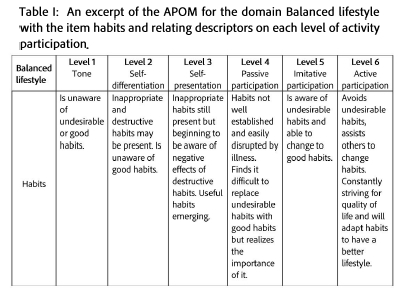
One of the main reasons occupational therapists use symptom and functional performance scales as outcome measures with MHCUs, is the lack of context appropriate, occupation-based outcome measures in mental health252426,27. The model comprises of three inter-related concepts of volition, motivation, and action. Volition and motivation are believed to govern action, while action is the manifestation of volition and motivation26,27. The VdTMoCA model is concerned with the way in which humans relate to their world through participation in daily activities, with volition, motivation, and corresponding action developing in sequential stages known as the 'levels of creative ability'26,27. There are nine levels of creative ability, with defined levels of motivation and corresponding action, but the APOM comprises of the first six levels since those are the levels which may require a degree of therapeutic input24,25. Each item on the APOM has six descriptors, where each descriptor represents one of the six levels of creative ability (Table I, below). When using the APOM, therapists use their clinical reasoning, observations made during assessment, and knowledge of the VdTMoCA to determine which descriptor best fits the involved MHCU and scores them accordingly.
Once the level of creative ability has been determined, the occupational therapists use their clinical reasoning and observations to determine the phase within the level, i.e. therapist-directed, patient-directed or transitional phase24,25. Occupational therapists familiar with the VdTMoCA, who attend a one-day training workshop are eligible to administer the APOM and use the online scoring.
Many studies have shown that the APOM is able to track changes in activity participation with occupational therapy intervention23,28,29,30,31. However, limited evidence is available on the effectiveness and impact of the OTIGM approach on the activity participation of MHCHs with a diagnosis of MDD. The aim of this study was to determine changes in activity participation from admission to discharge in MHCUs diagnosed with MDD, who attended occupational therapy groups. The majority of groups attended by participants in the study was based on the OTIGM. Factors impacting on the change in activity participation, such as length of stay and number and types of groups attended during admission to the private psychiatric clinic, were accounted for. The association between activity participation and severity of symptoms were also considered.
METHODS
Study design
The design of the study was a quasi-experimental, pre-post-test group design with longitudinal features. Data were collected before intervention and then again after the intervention. No control group was used. The study took place in a 170-bed acute psychiatric clinic in a major city in South Africa.
Sample
A non-probabilistic, convenience sample was used. Inclusion criteria were first admission to the clinic with a diagnosis of MDD, age between 18 and 65 years and provision of consent to be included in the study. The exclusion criterion was admission shorter than 6 days as this short period would not allow for a baseline and a final assessment. The sample size was determined based on results from a previous study by Carter30
Research Instrument
The Activity Participation Outcome Measure Activity participation in the APOM consists of 53 items, represented by eight domains: Process skills, Communication and Interaction skills, Life skills, Balanced lifestyle, Role performance, Self-esteem as well as Motivation and Affect24,25,32,33. Scoring of the APOM usually follows assessment of the client in different situations including an interview, participation in various activities or observations made in a social context. After choosing the appropriate level for the item being assessed, a therapist needs to determine the phase within the level. Each level consists of three phases: therapist-directed, patient-directed, and transitional phase (to the next level).
Construct and content validity of the APOM has been established with good inter-rater reliability. Internal consistency and validity of the APOM was confirmed on various South-African populations32 23,25,29,30,31,33,34. Previous studies conducted in South African mental health settings using the APOM focused on adolescent MHCUs31,35, forensic MHCUs28,33, and MHCUs in a rural context3430
Research Procedure
Data collection commenced only after ethical clearance was obtained from the Human Research Ethics Committee at the University of the Witwatersrand (M170913). All participants received an information sheet outlining the research aims and procedures and signed informed consent.
Occupational therapy Intervention
Attendance of occupational therapy groups at the research site is voluntary. Mental health care users attend an introduction session in the beginning of their admission where the programme is explained by an occupational therapist. Participants choose the groups they are motivated to attend during their admission. A screening activity during the introduction group assists the occupational therapist to provide guidance to MHCUs who struggle to choose the appropriate groups or to identify those who are not yet suited for certain groups. An average of two to three sessions are covered by the medical aid each day. Participants choose from three categories of groups: stress management groups, craft groups and interpersonal groups. The programme consists of various types of groups with open and closed group membership options. A closed group is a group where the same members are present for a few consecutive sessions without new members joining. With open groups, members are free to join the group regardless of attendance of a previous group with the same theme. The researcher kept track of the number and types of groups participants attended during their admission.
Groups in the interpersonal category at the research site follow the group process and principles of the OTIGM. Therapists facilitating these groups undergo additional training to enhance their understanding and facilitation skills when using the OTIGM. Groups in the stress management category make use of elements of the OTIGM but do not strictly follow the group process of the OTIGM. Occupational therapists at the research site make use of occupation as a means and an end to facilitate participation in activities presented in the groups and, through engagement in activities, assist members in becoming aware of meaningful roles they fulfil in the group or in their lives. The open groups in the craft group category are self-directed. Clients participate in craft activities of their choice at their own pace. While working on their individual products, aspects such as decision making, task initiation and completion and time management are facilitated, depending on each MHCUs' process and needs. Closed groups in the craft group category follow elements of the OTIGM. Although each member works on their own product, they usually follow the same process e.g., emotional check-in at the start of the group, sharing experiences of creating the products and its significance.
Data collection
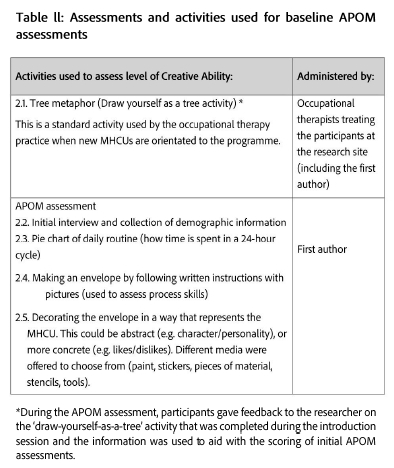
An initial baseline assessment was completed by the first author (who is trained in the administration of the APOM) before intervention commenced. Table II (page 21) reflects the content of the baseline assessments.
Final APOM assessments
Final APOM assessments were administered one ortwo days before discharge. Participants reflected on personal growth, group participation, and discharge plans. The draw-yourself-as-tree activity was repeated to conclude which areas they felt improved the most during their admission. Similar to the envelope, participants had to follow instructions to fold a box to aid in the scoring of process skills, motivation, and self-esteem domains. The decorated envelope as created during the initial assessment was shown to participants to add any attributes or qualities they discovered or rediscovered about themselves during admission.
Above mentioned assessment activities along with feedback from therapists regarding participants' activity participation in group sessions, were used to complete final APOM scoring sheets. Feedback, in the form of a spider graph, was discussed with participants upon discharge.
Data Management and Analysis
All data were captured by the first author and Statistica ν 13.2 software was used for analysis. Demographic data and the scores on the APOM assessments were analysed by using descriptive statistics36373837
RESULTS
A total of 75 baseline APOM assessments were conducted, five participants were excluded from the study due to change in diagnosis during admission resulting in a sample size of 70. Nine of the MHCUs were discharged before the final APOM could be conducted. A total of 61 final APOM assessments were administered and used for analysis.
Demographics of the sample
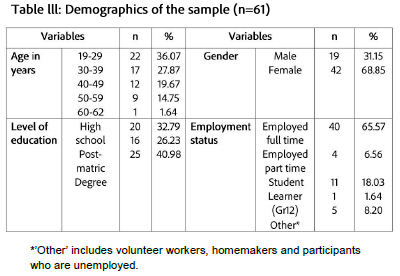
Male participants made up 31,15% (n=19) of the sample while 68,85% were female (n=42) with the majority of participants between the ages of 18-29 years (Table III, below). The demographic information of the nine participants whose data were omitted from analysis due to discharge were not included in the demographic information below.
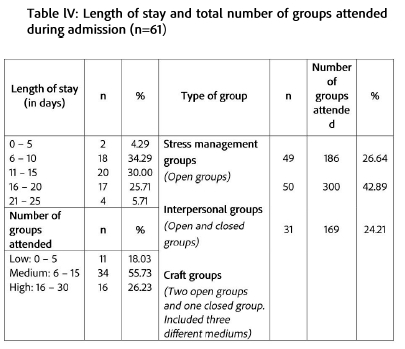
In Table IV (below), the length of stay, total number of groups attended, and the types of groups attended by each participant are indicated. The majority of participants stayed between six and 15 days and interpersonal and stress management groups were attended most often.
Change in Activity Participation scores
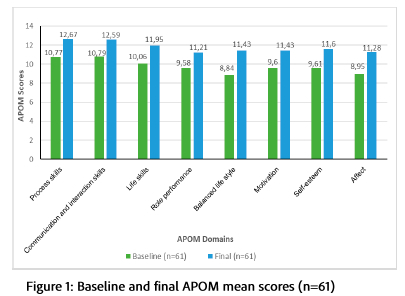
In Figure 1 (page 5), the change in activity participation for all the domains of the APOM from baseline to discharge is indicated. The change was positive for all the domains of the APOM and indicated a mean baseline APOM score of 9.8 (Self-presentation level, transitional phase) to an average final APOM score on discharge of 11.8 (Passive participation, transitional phase). Balanced lifestyle had the greatest change from baseline to discharge followed by the Affect domain. The lowest positive change from baseline to discharge was Role performance.
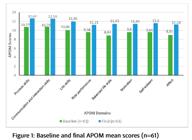
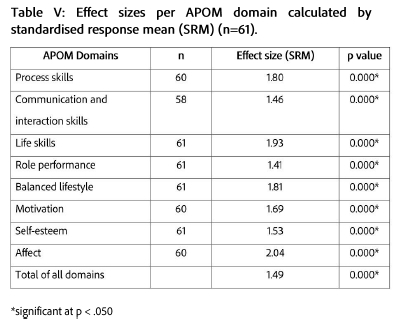
In Table V (below) the SRM for each domain of the APOM as well as the significance in change of APOM scores according to the Wilcoxon sign ranked tests from baseline to discharge is depicted. The changes in all activity participation scores from baseline to discharge were highly significant with ρ = 0.00 for all the domains of the APOM.
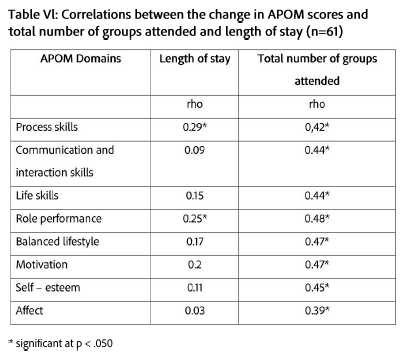
In Table VI (adjacent), shows correlations between changes in APOM scores and the number of groups attended, as well as the length of stay. Marked correlations indicate a p-value below 0.05, thus indicating a statistically significant correlation. Non-significant, negligible correlations (rs =0 - 0.2) were found between length of stay and six domains of the APOM and change in APOM scores. Statistically significant, low correlations (rs = 0.2 - 0.4) were indicated between length of stay and change in two APOM domains for Process skills and Role performance.
Correlations between total number of groups and change in APOM scores were higher than those of length of stay and indicated statistically significant correlations across all the domains of the APOM. Moderate correlation (rs =0.4 - 0.6) were indicated between number of groups attended and the change in APOM scores, with Role performance, Motivation, and Balanced lifestyle indicating the highest correlations. The lowest correlation was indicated by the Affect domain.
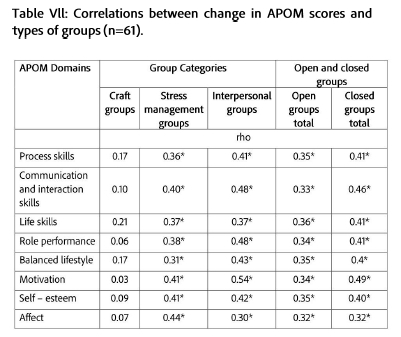
Results of the correlations indicated the relationship between the different types of groups attended by participants during their admission and change in activity participation represented by APOM domain scores are presented in Table VII (below). Marked correlations are statistically significant.
Statistically significant correlations were found between the domains of the APOM and stress management groups, Interpersonal groups, open groups, and closed groups, while the correlation between craft groups and APOM scores indicated negligible non-significant correlations. The strongest low to moderate correlations were indicated by the interpersonal group category and closed groups.
DISCUSSION
Demographics of the study
Most participants were under the age of 29 years which was in line with the South African Stress and Health (SASH) study conducted in 200939
The level of education for the sample of this study was significantly higher than that of the general population in South Africa. According to the Organisation for Economic Co-operation and Development (OECD) indicators of 20194041
Change in levels of activity participation
A statistically significant positive change in mean APOM scores from baseline to discharge for all the domains of the APOM indicate a change from the average baseline APOM score of 9.8 which represents the Self-presentation level, transitional phase to an average APOM score on discharge of 11.8, representing the transitional phase of Passive Participation. These findings differ from those in previous studies where APOM scores for populations with various other psychiatric conditions, represented lower levels of creative ability at baseline and discharge.
In a study conducted in an inpatient mental health setting in a rural context, more than 80% of the sample had diagnoses of substance abuse or schizophrenia and the mean baseline APOM score was 6,43 (Self-differentiation, transitional phase) and the final mean APOM score post- rehabilitation was 8,18 (Self-presentation, patient directed)343030
Change in APOM scores
An overall improvement in activity participation from admission to discharge was indicated by the change in APOM scores from the baseline to final APOM assessments. Additionally, all effect sizes were statistically significant (p<0.05) across all the domains of the APOM. It can therefore be concluded that positive changes in APOM scores from baseline to discharge were related to the interventions participants received. However, the sample size may have impacted the statistical significance in the change of scores thus SRMs and effect sizes were used to determine clinically significant change. Since the criteria for interpreting effect sizes used to indicate improvements in this study may be quite relative, Cohen suggested that practitioners determine their own effect sizes for their populations38
The importance of considering effect size on clinical improvement was seen when considering the improvement in change in mean APOM domain scores. The greatest improvement in APOM scores from baseline to discharge for participants were Balanced lifestyle, where a mix between physical, mental, social, spiritual and rest activities; and use of time, habits and routines are considered. This was followed by the Affect domain which includes repertoire of emotions, emotional control and mood. The largest effect size was found for the Affect domain at 2.04 with the SRM for Balanced lifestyle at 1.81 indicating greater clinical change in the Affect domain. It should be noted however, that the Affect domain is not exclusively addressed by occupational therapy. Psychopharmacology and psychotherapy provided by psychiatrists and psychologists at the research site also play an integral part in the treatment of mood-related symptoms.
The findings for Balanced lifestyle and the Affect domain are in keeping with results found by Carter3034
Role performance showed the lowest effect size of 1.41 from baseline to discharge which differs from other studies where treatment effects were measured over 11-14 weeks3442
Relationship between dependent and independent variables
Length of stay and total number of groups attended
In the current study, the length of stay was not significantly associated to the change in APOM scores with only Process skills and Role performance found to show a low significant correlation (rs= 0.2 - 0.4). This may be accounted for by the small differences in days in the length of stay in an acute mental health setting since the study by Silaule3434
The relationship between the total number of occupational therapy groups attended by each participant and mean difference in APOM scores was indicated by statistically significant, moderate correlations (rs = 0.4 - 0.6) across all the domains of the APOM. This is in line with findings from Carter3034
Open and dosed groups
A stronger correlation existed between closed groups and change in APOM scores when compared to the correlations for open groups. In occupational therapy, there is limited evidence about the difference in group therapy outcomes for open and closed groups. Tourigny and Hébert4445
Interpersonal groups
Correlations indicated by the interpersonal group category were statistically significant across all the domains of the APOM and showed moderate correlations (rs =0.4 - 0.6) for most domains of the APOM. The Motivation domain had the highest correlation with change in APOM scores, followed by Role performance and Communication and interaction skills. In comparison to the other types of groups, the interpersonal group category had the strongest correlation with change in APOM scores across all the domains of the APOM except for the Affect domain, which also showed the lowest correlation for interpersonal groups. With the use of the OTIGM, members become aware of what they are feeling towards each other, themselves and the activities presented in the group space. Once members have identified their emotions, a cognitive process usually follows during which members make sense of the possible causes or meaning of these emotions141717
Interpersonal groups at the research site consisted of both open and closed groups with various themes related to interpersonal relationships, addictive behaviour, and self-esteem. All groups in this category strictly followed the process of the OTIGM which made use of Yalom's curative factors to facilitate the group process and to ensure a safe environment conducive to growth1446
Direct communication between group members is an essential principle of the OTIGM141414:33 stated that "the way people interact with others in the world outside the group will be the same way in which they interact with others in the group."
Craft groups
The relationship between the attendance of craft groups and change in APOM scores was found to have negligible correlations across all the domains of the APOM, except for Life skills, where a low non-significant correlation was seen.
There was a lack of attendance at craft groups in the current study. Only 11 participants attended more than five craft groups during their admission. From a VdTMoCA perspective, a possible interpretation for these participants who did not join the craft groups, could be that they prioritised the interpersonal groups to achieve their goals in therapy. Most participants were at the level of Passive participation and on this level, there is awareness of norms and a need to develop skills to cope with the demands of their occupations2727
Previous studies on the effectiveness of craft groups as a treatment modality for MHCUs suffering from MDD have yielded positive results. Reported changes include improved social interaction, improved confidence, enhanced self-expression, improved quality of admission in psychiatric inpatient settings and improved daily functioning47,48,49. In this study, however, these benefits of improved confidence and improved social interaction were more evident in the interpersonal group category than the craft groups.
Stress management groups
The relationship between attendance of stress management groups and change in APOM scores indicated statistically significant, low to moderate correlations across all the domains of the APOM. Communication and Interactions skills, Motivation, Self-esteem, and Affect showed the highest correlations for this type of group while the Affect domain had the highest correlation with the number of stress management groups attended. In the current study, the stress management group category appeared to be effective in addressing the acute symptoms of MDD, that are categorised as client factors under mental functioning by the Occupational Therapy Practice Framework (OTPF-lll)10 . These client factors may have been addressed directly by the stress management groups that facilitate the experience of mindfulness. The approach followed in these groups facilitated elements of the OTIGM with a focus on sensory activities (such as drumming, or finger painting), psychomotor activation, relaxation therapy, tension release exercises, all of which follow a 'here and now' approach.
CONCLUSION
The positive change in all the domains of the APOM after attending occupational therapy group intervention provides evidence of the effectiveness of occupational therapy groups in the treatment of MHCUs diagnosed with MDD. Although it was not a randomised study, the outcome shows a statistically significant positive change in activity participation from baseline to discharge across all the domains of the APOM for MHCUs diagnosed with MDD attending an occupational therapy group programme.
The number of groups attended during admission had moderate correlations with change in activity participation and highlight the importance of attendance of the occupational therapy group programme for MHCUs diagnosed with MDD. The association between improvement in activity participation that favoured closed groups over open groups is of clinical significant since there is little evidence in literature to support this finding. This may serve as a stepping stone for future experimental studies with a randomised sample, investigating the difference in outcomes between open and closed groups in occupational therapy.
Attendance of the stress management groups were found to have a better correlation with changes in the APOM domains such as affect, motivation and self-esteem. In the acute phase of MDD these domains of the APOM align with typical symptoms of depression such as low mood, poor motivation and low self-esteem. Attendance of the interpersonal groups had moderate correlations with most of the domains of the APOM except for Affect and Life skills which indicated low correlations. In comparison to the other types of groups, the Interpersonal groups had the strongest correlations with changes in APOM scores and indicated the benefits of using to the OTIGM approach in acute psychiatric settings. It can be concluded that occupational therapy groups play a valuable and integral role in the road to recovery for MHCUs diagnosed with MDD during a short admission to a private psychiatric setting.
Limitations
This study was a pre-post-test design with a convenience sample and without a control group. Causality of results were therefore limited as there was no randomisation of participants. Generalisation of the results were further limited by the fact that data collection occurred at only one psychiatric facility. Correlations discussed in the study represented identified relationships between dependent and independent variables, but there was no description of the causal effects of independent variables on one another. The findings in this study should therefore be followed-up with an experimental study with a control group.
Author Contributions:
Annalie Meyer conceptualised the study, collected and analysed the data, prepared the draft manuscript. Daleen Casteleijn assisted with conceptualisation of the study, statistical analysis and discussion Olindah Silaule assisted with conceptualisation of the study, methodology and discussion. All listed authors contributed to finalising and editing the manuscript.
Acknowledgements
We would like to express our gratitude to the occupational therapists who facilitated the occupational therapy groups at the research site. Without their contribution, this study would not have been possible.
REFERENCES
-
1. World Health Organization. Depressive disorder (depression) 2023 [updated 31 March 2023; cited 2023 14 October 2023]. Available from: https://www.who.int/news-room/fact-sheets/detail/depression].
» https://www.who.int/news-room/fact-sheets/detail/depression -
2. Nglazi M, Joubert J, Stein D, Lund C, Wiysonge C, Vos T, et al. Epidemiology of major depressive disorder in South Africa (1997-2015): a systematic review protocol. BMJ Open. 2016;6(7):e011749 https://dx.doi.org/10.1136/bmjopen-2016-011749.
» https://dx.doi.org/10.1136/bmjopen-2016-011749 -
3. Bell IH, Nicholas J, Broomhall A, Bailey E, Bendall S, Boland A, et al. The impact of COVID-19 on youth mental health: A mixed methods survey. Psychiatry Research. 2023;321:115082 https://dx.doi.org/https://doi.org/10.1016/j.psvchres.2023.115082.
» https://dx.doi.org/https://doi.org/10.1016/j.psvchres.2023.115082 -
4. Ettman CK, Fan AY, Subramanian M, Adam GP, Badillo Goicoechea E, Abdalla SM, et al. Prevalence of depressive symptoms in U.S. adults during the COVID-19 pandemic: A systematic review. SSM -Population Health. 2023;21:101348 https://dx.doi.org/https://doi.org/10.1016/j.ssmph.2023.101348.
» https://dx.doi.org/https://doi.org/10.1016/j.ssmph.2023.101348 -
5. Wu J, Yang H, Qin Y, Wu J, Yan H, Xu Y, et al. Change of daily life and depression among adults under stringent lockdown restrictions during COVID-19 pandemic in Shanghai, China. Asian Journal of Psychiatry. 2023,79:103327 https://dx.doi.org/https://doi.org/10.1016/j.ajp.2022.103327.
» https://dx.doi.org/https://doi.org/10.1016/j.ajp.2022.103327 -
6. Freeman CP, Joska JA. Dealing with major depression in general practice. South African Family Practice. 2013;55(4):319-25 https://dx.doi.org/10.1080/20786204.2013.10874369.
» https://dx.doi.org/10.1080/20786204.2013.10874369 - 7. Sadock BJ, Sadock VA, P. R. Kaplan and Sadock's synopsis of psychiatry: behavioral sciences/clinical psychiatry.. 11 ed. Philadelphia: Wolters Kluwer; 2015.
-
8. Rocamora-Montenegro M, Compañ-Gabucio LM, Garcia de la Hera M. Occupational therapy interventions for adults with severe mental illness: a scoping review. BMJ Open. 2021;11(10):e047467 https://dx.doi.org/10.1136/bmjopen-2020-047467.
» https://dx.doi.org/10.1136/bmjopen-2020-047467 - 9. Christiansen C, E. T. Introduction to Occupation: The Art and Science of Living. Upper Saddle River: Pearson Education Inc; 2004.
-
10. American Occupational Therapy Association. Occupational Therapy Practice Framework: Domain and Process (3rd Edition). The American Journal of Occupational Therapy. 2014;68(Supplement_1):S1-S48 https://dx.doi.org/10.5014/ajot.2014.682006.
» https://dx.doi.org/10.5014/ajot.2014.682006 - 11. Duncan M, Prowse C. Occupational therapy with mood disorders. In: Crouch R, V. A, editors. Occupational Therapy in Psychiatry and Mental Health. Oxford: Wiley-Blackwell; 2014. p. 389-407.
-
12. Lloyd C, Williams PL. Occupational therapy in the modern adult acute mental health setting: a review of current practice. International Journal of Therapy and Rehabilitation. 2010,-17(9):483-93 https://dx.doi.org/10.12968/ijtr.2010.17.978038.
» https://dx.doi.org/10.12968/ijtr.2010.17.978038 -
13. Schwartzberg SL, Trudeau SA, Vega V. Principles of Occupational Therapy Group Outcome Assessment in Mental Health. Occupational Therapy in Mental Health. 2013;29(2):134-48 https://dx.doi.org/10.1080/0164212X.2013.788976.
» https://dx.doi.org/10.1080/0164212X.2013.788976 - 14. Fouché L. Occupational Therapy Interactive Group Model (OTIGM). In: Crouch R, editor. Occupational Group Therapy. Oxford: Whiley Blackwell; 2021.
-
15. Ngooi BX, Wong SR, Chen JD, Yin Koh VS. Exploring the use of activity-based group therapy in increasing self-efficacy and subjective well-being in acute mental health. Hong Kong Journal of Occupational Therapy. 2022;35(1):52-61 https://dx.doi.org/10.1177/15691861221075798.
» https://dx.doi.org/10.1177/15691861221075798 -
16. Kirsh B, Martin L, Hultqvist J, Eklund M. Occupational Therapy Interventions in Mental Health: A Literature Review in Search of Evidence. Occupational Therapy in Mental Health. 2019;35(2):109-56 https://dx.doi.org/10.1080/0164212X.2019.1588832.
» https://dx.doi.org/10.1080/0164212X.2019.1588832 -
17. Davidson S. Perceptions of mental health care users on the contribution of the interactive groupwork model in occupational therapy groups to their recovery [MSc Occupational Therapy]. Cape Town: University of Cape Town; 2018. Retrieved from http://hdl.handle.net/11427/29557.
» http://hdl.handle.net/11427/29557 -
18. Ramano EM, de Beer M. The Outcome of Two Occupational Therapy Group Programs on the Social Functioning of Individuals with Major Depressive Disorder. Occupational Therapy in Mental Health. 2020,-36(1):29-54 https://dx.doi.org/10.1080/0164212X.2019.1663336.
» https://dx.doi.org/10.1080/0164212X.2019.1663336 - 19. Bloomer J. Bay Area Functional Performance Evaluation. 2nd ed. USA: Maddack Inc.; 1987.. 2 ed. San Mateo: Consulting Psychologists Press; 1987.
-
20. Kroenke K, RL. S. The PHQ-9: a new depression diagnostic and severity measure. Psychiatric Annals. 2013;32(9):509-15 https://dx.doi.org/https://doi.org/10.3928/0048-5713-20020901-06.
» https://dx.doi.org/https://doi.org/10.3928/0048-5713-20020901-06 -
21. Löwe B, Unützer J, Callahan CM, Perkins AJ, Kroenke K Monitoring depression treatment outcomes with the patient health questionnaire-9. Med Care. 2004;42(12):1194-201 https://dx.doi.org/10.1097/00005650-200412000-00006.
» https://dx.doi.org/10.1097/00005650-200412000-00006 -
22. Babulal GM, Bakhshi P, Kopriva S, Ali SA, Goette SA, Trani JF. Measuring participation for persons with mental illness: a systematic review assessing relevance of existing scales for low and middle income countries. BMC Psychol. 2015;3:36 https://dx.doi.org/10.1186/s40359-015-0093-0.
» https://dx.doi.org/10.1186/s40359-015-0093-0 -
23. Meyer A. Change in activity participation of mental health care users with major depressive disorder attending occupational therapy groups [MSc Occupational Therapy (course work)]. Johannesburg: Unviversity of the Witwatersrand; 2020. Retrieved from https://hdl.handle.net/10539/32004.
» https://hdl.handle.net/10539/32004 -
24. Casteleijn D. Development of an outcome measure for occupational therapists in mental healthcare settings [PhD]: University of Pretoria; 2010. Retrieved from http://hdl.handle.net/2263/28019.
» http://hdl.handle.net/2263/28019 - 25. Casteleijn D. The 22nd Vona du Toit Memorial Lecture: Stepping Stones from Input to Outcomes: An Occupational Perspective. South African Journal of Occupational Therapy. 2013;43:01-9.
- 26. du Toit V. Patient volition and action in occupational therapy 4ed. Pretoria: Vona & Marié du Toit Foundation; 2009.
- 27. van der Reyden D, Casteleijn D, Sherwood W, de Witt P. The Vona du Toit Model of Creative Ability: Origins, Constructs, Principles and Application in Occupational Therapy. Cape Town: Vona and Marié du Toit Foundation; 2019.
-
28. Brooke C. Psychometric properties of the activity participation outcome measure to describe trends in a forensic population of mental health care users [MSc Occupational Therapy (course work)]. Johannesburg: University of the Witwatersrand; 2015. Retrieved from http://hdl.handle.net/10539/18684.
» http://hdl.handle.net/10539/18684 -
29. Camp AL, Casteleijn D, Thupae D. Responsiveness of the Activity Participation Outcome Measure in adult patients with Traumatic Brain Injury in an acute private neurological rehabilitation setting in South Africa. South African Journal of Occupational Therapy. 2020:50:70-6 http://dx.doi.org/10.17159/2310-3833/2020/vol50no2a9.
» http://dx.doi.org/10.17159/2310-3833/2020/vol50no2a9 - 30. Carter M. Analysis of routine outcome measurement data in mental health occupational therapy [MSc Occupational Therapy]. Northampton: University of Northampton; 2013
-
31. Pillay S. Responsiveness to change and convergent validity of the Activity Participation Outcome Measure (APOM) in adolescent mental health care users [MSc Occupational Therapy]. Johannesburg: University of the Witwatersrand; 2016. Retrieved from http://hdl.handle.net/10539/21311.
» http://hdl.handle.net/10539/21311 -
32. Casteleijn D, Graham M. Domains for occupational therapy outcomes in mental health practices. South African Journal of Occupational Therapy. 2012;42:26-34 http://dx.doi.org/www.scielo.orgza/pdf/sajot/v42n1/07.pdf.
» http://dx.doi.org/www.scielo.orgza/pdf/sajot/v42n1/07.pdf -
33. Girardi A, Zywicka-Rospond M. Activity Participation and Inpatient Violence in Secure Mental Health. Occupational Therapy in Mental Health.2020;36(4):394-410 https://dx.doi.org/10.1080/0164212X.2020.1831418.
» https://dx.doi.org/10.1080/0164212X.2020.1831418 -
34. Silaule O, Casteleijn D. Measuring Change in Activity Participation of Mental Health Care Users Attending an Occupational Therapy Programme in Rural South Africa. South African Journal of Occupational Therapy. 2021;51:63-73 http://dx.doi.org/10.17159/2310-3833/2021/vol51n3a8.
» http://dx.doi.org/10.17159/2310-3833/2021/vol51n3a8 -
35. Wolhuter K. The impact of adolescence-initiated alcohol and cannabis abuse/dependence on the level of activity participation in adult males suffering from a pyschotic disorder [MSc Occupational Therapy (course work)]. Johannesburg: University of the Witwatersrand; 2014. Retrieved from http://wiredspace.wits.ac.za/handle/10539/17399.
» http://wiredspace.wits.ac.za/handle/10539/17399 - 36. Warner R. Applied statistics: from bivariate through multivariate techniques. Philadelphia: Sage; 2012.
-
37. Middel B, van Sonderen E. Statistical significant change versus relevant or important change in (quasi) experimental design: some conceptual and methodological problems in estimating magnitude of intervention-related change in health services research. Int J Integr Care. 2002;2:e15 https://dx.doi.org/10.5334/ijic.65.
» https://dx.doi.org/10.5334/ijic.65 - 38. Lachenbruch P, Cohen J. Statistical Power Analysis for the Behavioural Sciences. 2 ed. Hillsdale, NJ: Erlbaum; 1988.
-
39. Tomlinson M, Grimsrud AT, Stein DJ, Williams DR, Myer L. The epidemiology of major depression in South Africa : results from the South African Stress and Health study: mental health. South African Medical Journal. 2009;99(5):368-73 https://dx.doi.org/doi:10.10520/EJC69473.
» https://dx.doi.org/doi:10.10520/EJC69473 -
40. OECD. Education at a Glance 2023 [Available from: https://www.oecd-ilibrary.org/content/publication/e13bef63-enl
» https://www.oecd-ilibrary.org/content/publication/e13bef63-enl -
41. Tzoneva D. Psychiatric hospitalisation - attending to mental crises. Mental Health Matters. 2014;1 (2):47-50 https://dx.doi.org/doi:10.10520/EJC157685.
» https://dx.doi.org/doi:10.10520/EJC157685 -
42. de Witt PA, Roestorff-Hambrock N, Adams F, Franzsen D. Challenges impacting functional recovery experienced by Mental Health Care Users with Major Depressive Disorder after a short-term admission to hospital. South African Journal of Occupational Therapy. 2021;51:55-64 http://doi.org/10.17159/2310-3833/2021/vol51n2a8.
» http://doi.org/10.17159/2310-3833/2021/vol51n2a8 - 43. Casteleijn D, Holsten E. Creative Ability - its emergence and manifestation. In: D van der Reyden, D Casteleijn, W Sherwood, P. de Witt, editors. The Vona du Toit Model of Creative Ability: Origins, Constructs, Principles and Application in Occupational Therapy. Cape Town: Vona and Marié du Toit Foundation; 2019. p. 119-24.
-
44. Tourigny M, Hébert M. Comparison of Open Versus Closed Group Interventions for Sexually Abused Adolescent Girls. Violence Vict. 2007(3):334-49 https://dx.doi.org/10.1891/088667007780842775.
» https://dx.doi.org/10.1891/088667007780842775 -
45. Stevenson EK, Thomas SDM, Daffern M. Open Versus Closed Group Treatment of Men with a History of Sexual Offenses. Sexual Abuse. 2022;35(6):667-86 https://dx.doi.org/10.1177/10790632221139175.
» https://dx.doi.org/10.1177/10790632221139175 - 46. Yalom I, Leszcz M. The theory and practice of group psychotherapy 5ed. Cambridge: Basic Books Incorporated; 2005.
-
47. Chandraiah S, Ainlay Anand S, Avent LC. Efficacy of Group Art Therapy on Depressive Symptoms in Adult Heterogeneous Psychiatric Outpatients. Art Therapy. 2012;29(2):80-6 https://dx.doi.org/10.1080/07421656.2012.683739.
» https://dx.doi.org/10.1080/07421656.2012.683739 -
48. Horghagen S, Fostvedt B, Alsaker S. Craft activities in groups at meeting places: supporting mental health users' everyday occupations. Scandinavian Journal of Occupational Therapy. 2014;21(2):145-52 https://dx.doi.org/10.3109/11038128.2013.866691.
» https://dx.doi.org/10.3109/11038128.2013.866691 -
49. Lim KH, Morris J, Craik C. Inpatients' perspectives of occupational therapy in acute mental health. Australian Occupational Therapy Journal. 2007,-54(1):22-32 https://dx.doi.org/https://doi.org/10.1111/j.1440-1630.2006.00647.x.
» https://dx.doi.org/https://doi.org/10.1111/j.1440-1630.2006.00647.x

Reviewed: 1 December 2022
Revised: 31 January 2024
Accepted: 2 January 2024
Data availabiity: On request from corresponding author
Funding:No funding was obtained for this study.