Occupational therapy in child and adolescent mental health
INTRODUCTION
South African children and adolescents regardless of their gender, cultural group and social circumstances in which they live face significant adversities. Some of these adversities include socioeconomic and sociocultural distress, trauma, violence, exposure to substance use, screen overuse and cyberbullying, gender-based violence, stigma toward youth with gender-diversity and disabilities, child-headed households, and unequal access to health, education and social services that compromise mental health and occupational participation. This is especially true in rural and underserved communities1,2.
Occupational therapy, as a profession, responds to these challenges through;
• preventive strategies that promote optimal occupational participation development and milestone achievement that support mental health in children. Occupational therapists screen children and adolescents to identify early signs of mental distress and mental health concerns which are mediated through short term community-based person-specific activity and participation-based interventions, caregiver support, and intersectoral collaboration across health, education, justice, social development, and community sectors3
• occupational therapy service provision for children and adolescents who have diagnosed Mental health conditions in hospitals, institutions and in the community as part of the provision of universal health coverage,
OCCUPATIONAL THERAPY IN CHILD AND ADOLESCENT MENTAL HEALTH SERVICE PROVISIONMental health problems in children and adolescents may include developmental disorders, behavioural disorders, common mental health disorders, psychosis, substance use, and self-harm or suicidal gestures4,5.
Following a comprehensive assessment, occupational therapists provide evidence-based interventions to young people experiencing emotional, behavioural, and developmental difficulties that interfere with engagement in daily occupations such as self-care, education and learning, play, and social participation along the mental health continuum67
Occupational therapy is grounded in holistic, developmental, and functional approaches and is rooted in a person-centred philosophy. Occupational therapy draws on the eight dimensions of wellness named in the 2005 Children's Act 3889,10.
Play, as the primary occupation of childhood, is both a goal and a means in occupational therapy. Occupational therapists use participation in play activities and other meaningful occupations to achieve recovery goals. This includes addressing interpersonal, psychosocial, sensory and perceptual factors impacting occupational performance. Additionally, they advocate for occupational justice for children and adolescents with mental health problems, supporting their rights to participate in a broad range of meaningful occupations and achieve their potential in safe, child-friendly environments in school, home, or community contexts, which enhances self-regulation and engagement in developmentally appropriate occupations9,10.
According to the Health Professions Council of South Africa (HPCSA), occupational therapists' scope of profession119,10,11.
and the South African white paper on the rights of persons with disabilities (2016)171819
Occupational therapists are uniquely equipped to provide services to children and adolescents with mental health problems20
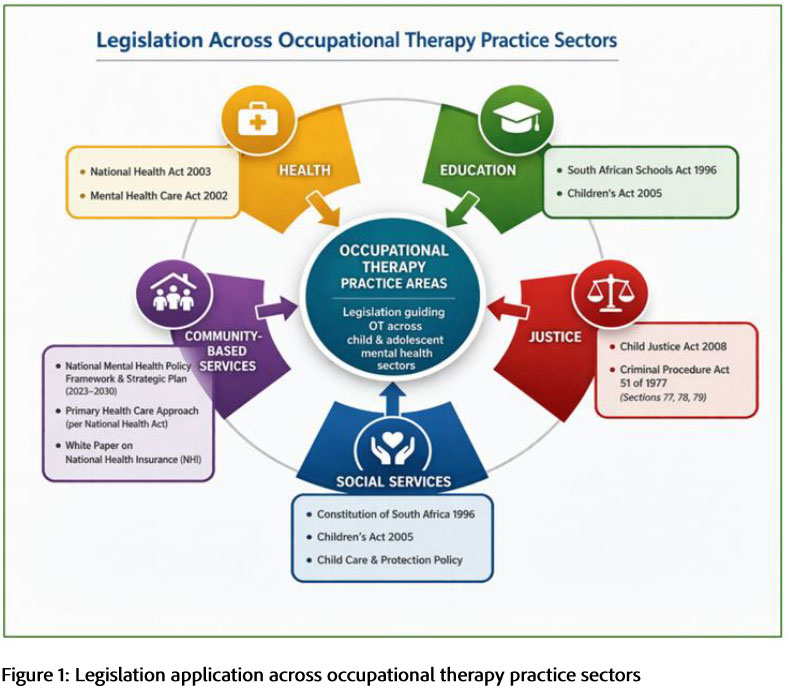
POLICY ALIGNMENT AND LEGISLATIVE FOUNDATIONSOccupational therapy's contribution is guided by constitutional and legislative imperatives to ensure child-centred, developmentally appropriate mental health care. These include the Constitution (1996)12813141516162122152223,24, and emotional dysregulation receive appropriate assessment accommodations enabling full participation in the curriculum and assessment processes. Together, these policies strengthen the mandate for inclusive education and reinforce the role of occupational therapists in supporting learner participation, reducing barriers to learning and development as well as promoting psychosocial wellbeing within school environments25,26.
OCCUPATIONAL THERAPY INTERVENTION
Occupational therapy services for children and adolescents with mental health concerns can be delivered in a range of private and public sector venues from the child's home to ECD centres, schools by school based practitioners and district support teams, primary health clinics, hospitals at all levels of care, institutions (such as children's homes, orphanages, places of safety, and juvenile detention centres), non-governmental organisations (NGOs), non-profit organisations (NPOs), and the private practices2027
Occupational therapy intervention accommodates children's and adolescents' mental health needs as they shift with age. Occupational therapists support their development and mental health through carefully selected therapeutic activities that are meaningful, goal-directed, and purposeful in line with key developmental occupations at each stage11
0-6 Years: Interventions focus on foundational skills needed for participation in family and community life, and readiness for school through sensory integration, play, and motor coordination. These are provided through Early Childhood Development (ECD), Primary Health Care (PHC), and family-centred services. Occupational therapy addresses emotional dysregulation, attachment challenges, and trauma in this stage28
6-12 Years: Occupational therapy responds to academic, behavioural, and emotional difficulties that affect participation in school and daily life. Bullying (including cyberbullying), anxiety, school-related gender-based violence, and self-harm are emerging risks23,24 and therapists play a key role in prevention, early intervention, and school-based support.
Adolescence (10-19 Years): A critical period for identity formation and life skills development. Occupational therapists support adolescents to develop the culturally defined knowledge, skills and attitudes needed for participation in meaningful occupations in adulthood. Interventions may include stress management, self-harm prevention, substance abuse intervention, and vocational guidance through school and community programmes29,30.
CORE COMPETENCIES AND KNOWLEDGECore occupational therapy competencies in Child and Adolescent Mental Health (CAMH) include early identification, activity program design informed by theory, use of therapeutic media, and clinical reasoning to address diagnostic overshadowing of physical symptoms mistakenly attributed to an existing mental health condition, caregiver guidance, multi-disciplinary team integration, and inclusion of school-based role players in therapeutic design and case management31,32. The core competencies and knowledge application must be embedded in occupation and the scope of Occupational Therapy profession11
Four areas of knowledge are needed by the occupational therapist working in CAMH33
Human development throughout the lifespan, including stages and tasks in sensory-motor, cognitive, and social-emotional growth.
Purposeful activity in the areas of activities of daily living, and specifically, play.
Theoretical frameworks and practice models, to use appropriate occupational therapy models and frameworks for the specific client group.
Psychopathology and Psychiatry: the problems and disorders commonly encountered in child psychiatry.
Contemporary South African children and adolescents are growing up in a rapidly shifting socio-temporal landscape that deeply influences their mental health and occupational participation. Occupational therapists must remain responsive to these current realities, drawing on culturally relevant, inclusive, and developmentally supportive frameworks to promote mental health and meaningful participation34,35.
CONCLUSION
This position statement draws on national research, best practice guidelines and highlights Occupational Therapists' intersectoral competencies and alignment with the shift toward decentralised, community-based mental health care in line with universal health care using a primary health care approach.
Occupational therapy offers an integrated, developmentally attuned response to the mental health needs of children and adolescents in South Africa. Through clinical expertise, advocacy, and systems-level engagement, occupational therapists promote resilience, inclusion, and long-term well-being. This holistic, occupation-centred approach enables young people to participate meaningfully in daily life across home, school, and community settings, even in the presence of emotional, behavioural, developmental, or psychosocial challenges.
This position statement affirms that strengthening of occupational therapists' integration across health, education, justice, and social development systems is essential for building a responsive, inclusive, and future-focused CAMH landscape in South Africa. Through clinical expertise, advocacy, research, and systems-level engagement, occupational therapists contribute to a society in which every child and adolescent can participate optimally, thrive and realise their potential.
Contributors:
Gina Rencken
https://orcid.org/0000-0002-3658-4453
Marieta Visser
https://orcid.org/0009-0007-3608-9376
Juanita Swanepoel
https://orcid.org/0000-0003-4805-2312
Ina Grobler
https://orcid.org/0009-0008-4523-9812
Thavanesi Gurayah
https://orcid.org/0000-0001-9005-6355
Nicola Plastow
https://orcid.org/0000-0002-3536-9129
Millicent Boaduo
https://orcid.org/0009-0008-7285-2532
Patricia Ann de Witt
REFERENCES
-
1. World Health Organization and Unicef. Mental Health of Children and Young People: Service Guidance. Geneva: WHO. 2024. https://iris.who.int/server/api/core/bitstreams/5f3697e2-0696-48c1-a6e0-21c51b7da1a0/content
» https://iris.who.int/server/api/core/bitstreams/5f3697e2-0696-48c1-a6e0-21c51b7da1a0/content -
2. Skeen S, Laurenzi CA, Gordon SL, Du Toit S, Tomlinson M, Dua T, Fleischmann A, Kohl K, Ross D, Servili C, Brand AS. Adolescent mental health program components and behavior risk reduction: a meta-analysis. Pediatrics. 2019 Aug 1;144(2): e20183488. https://doi.org/10.1542/peds.2018-3488
» https://doi.org/10.1542/peds.2018-3488 - 3. Schell BA, Gillen G, Scaffa M, Cohn ES. Willard and Spackman's Occupational Therapy (13th ed.). Philadelphia: Lippincott Williams & Wilkins. 2019.
-
4. Tarasenko, A., Josy, G., Minnis, H., Hall, J., Danese, A., Lau, J.Y., Cortese, S., Stringaris, A., Redlich, C. and Ougrin, D., 2025. Mental health of children and young people in the WHO Europe region. The Lancet Regional Health-Europe, 2025:57. 101459 https://doi.org/10.1016/j.lanepe.2025.101489
» https://doi.org/10.1016/j.lanepe.2025.101489 -
5. Hudson, J.L., Minihan, S., Chen, W., Carl, T., Fu, M., Tully, L., Kangas, M., Rosewell, L., McDermott, E.A., Wang, Y. and Stubbs, T., 2023. Interventions for young children's mental health: A review of reviews. Clinical Child and Family Psychology Review, 26(3), pp.593-641. https://doi.org/10.1007/s10567-023-00443-6
» https://doi.org/10.1007/s10567-023-00443-6 -
6. Arbesman, M., Bazyk, S. and Nochajski, S.M., 2013. Systematic review of occupational therapy and mental health promotion, prevention, and intervention for children and youth. The American Journal of Occupational Therapy, 67(6), pp.e120-e130. http://dx.doi.org/10.5014/ajot.2013.008359
» http://dx.doi.org/10.5014/ajot.2013.008359 - 7. Myers JE, Sweeney TJ. The indivisible self: An evidence-based model of wellness. Journal of Individual Psychology. 2004; 60:234-44.
-
8. Republic of South Africa Children's Act 38 of 2005. South African Government. Pretoria: 2005. https://www.gov.za/documents/childrens-act
» https://www.gov.za/documents/childrens-act -
9. American Occupational Therapy Association. (2020). Occupational Therapy Practice Framework: Domain and Process (4th ed.). American Journal of Occupational Therapy, 74(Suppl. 2), 7412410010p1-7412410010p87 https://doi.org/10.5014/ajot.2020.74S2001
» https://doi.org/10.5014/ajot.2020.74S2001 -
10. World Federation of Occupational Therapists (WFOT). Statement on Occupational Therapy in Mental Health. Retrieved from: https://www.wfot.org. 2012.
» https://www.wfot.org -
11. HPCSA Scope of Profession of Occupational Therapy, available from https://www.gov.za/documents/notices/healthprofessions-act-regulations-defining-scope-profession-occupational-therapy
» https://www.gov.za/documents/notices/healthprofessions-act-regulations-defining-scope-profession-occupational-therapy -
12. Republic of South Africa. Constitution of the Republic of South Africa. Pretoria: 1996 https://www.gov.za/documents/constitution/constitution-republic-south-africa-04-feb-1997
» https://www.gov.za/documents/constitution/constitution-republic-south-africa-04-feb-1997 -
13. Republic of South Africa. Mental health Care Act 17 of 2002. South African Government Pretoria 2002 https://www.gov.za/sites/default/files/gcis_document/201409/a17-02.pdf
» https://www.gov.za/sites/default/files/gcis_document/201409/a17-02.pdf -
14. Republic of South Africa National Health Act 61 of 2003. South African Government. Pretoria: 2003 https://www.gov.za/documents/acts/national-health-act-61-2003-23-jul-2004.
» https://www.gov.za/documents/acts/national-health-act-61-2003-23-jul-2004 -
15. Republic of South Africa. South African Schools Act, No. 84 of 1996. South African Government. Government Gazette, 17579. Pretoria: 1996. https://www.gov.za/sites/default/files/gcis_document/201409/act84of1996.pdf
» https://www.gov.za/sites/default/files/gcis_document/201409/act84of1996.pdf -
16. United Nations. Convention on the Rights of Persons with Disabilities. United Nations 2006. https://www.un.org/development/desa/disabilities/convention-on-the-rights-of-persons-with-disabilities.html.
» https://www.un.org/development/desa/disabilities/convention-on-the-rights-of-persons-with-disabilities.html -
17. Republic of South Africa. White Paper on the Rights of Persons with Disabilities South African Government Pretoria 2016 https://www.gov.za/sites/default/files/gcis_document/201603/39792gon230.pdf.
» https://www.gov.za/sites/default/files/gcis_document/201603/39792gon230.pdf -
18. National Department of Health. National Mental Health Policy Framework and Strategic Plan 2023-2030. Republic of South Africa. Pretoria: 2023 https://www.health.gov.za/wp-content/uploads/2024/02/National-Mental-Health-Policy-framework-and-strategic-Plan-2023-2030.pdf
» https://www.health.gov.za/wp-content/uploads/2024/02/National-Mental-Health-Policy-framework-and-strategic-Plan-2023-2030.pdf -
19. World Health Organization Standards for improving the quality of care for children and young adolescents in health facilities. Geneva: World Health Organization; 2018. https://www.who.int/publications/i/item/9789241565554
» https://www.who.int/publications/i/item/9789241565554 - 20. Perrins Gendron, M.C. Occupational Therapy with Children with Psychosocial Disorders and Autism. In Crouch et al. Occupational Therapy in Psychiatry and Mental Health. 6ed. Wiley Blackwell: UK. p.251. 2025.
-
21. Department of Basic Education. Policy on Screening, Identification, Assessment and Support (SIAS). Republic of South Africa. 2014. https://www.gov.za/sites/default/files/gcis_document/201409/sias-revised-final-comment.pdf
» https://www.gov.za/sites/default/files/gcis_document/201409/sias-revised-final-comment.pdf -
22. South African Comprehensive Assessment Institute. Policy on Accommodations and Concessions. 2024. https://www.sacai.org.za/wp-content/uploads/SACAI-2026-Policy-on-Accommodations-and-Concessions.pdf
» https://www.sacai.org.za/wp-content/uploads/SACAI-2026-Policy-on-Accommodations-and-Concessions.pdf - 23. Burton P, Leoschut L. School Violence in South Africa: Results of the 2012 National School Violence Study centre for justice and crime prevention • monograph series, no 12. Cape Town: March 2013
-
24. Paat YF, Markham C. Digital crime, trauma, and abuse: Internet safety and cyber risks for adolescents and emerging adults in the 21st century. Social Work in Mental Health. 2021 Jan 2;19(1):18-40. https://doi.org/10.1080/15332985.2020.1845281
» https://doi.org/10.1080/15332985.2020.1845281 -
25. Chan C, Dennis D, Kim S, Jankowski J. An integrative review of school-based mental health interventions for elementary students: Implications for occupational therapy. Occupational therapy in mental health. 2017 Jan 2;33(1):81-101. https://doi.org/10.1080/0164212X.2016.1202804
» https://doi.org/10.1080/0164212X.2016.1202804 -
26. Cahill, S.M., Egan, B.E. and Seber, J., 2020. Activity-and occupation-based interventions to support mental health, positive behavior, and social participation for children and youth: A systematic review. The American Journal of Occupational Therapy, 74(2), pp.7402180020p1-7402180020. https://doi.org/10.5014/ajot.2020.744001
» https://doi.org/10.5014/ajot.2020.744001 -
27. Arendse P, Hess-April L. Collaboration within a curriculum of support in the classroom: occupational therapists' and educators' perceptions and experiences. South African Journal of Occupational Therapy. 2023 Dec;53(3):13-21. https://doi.org/10.17159/2310-3833/2023/vol53n3a3
» https://doi.org/10.17159/2310-3833/2023/vol53n3a3 - 28. Greenspan SI, Wieder S. Developmental patterns and outcomes in infants and children with disorders in relating and communicating: A chart review of 200 cases of children with autistic spectrum diagnoses. Journal of Developmental and Learning disorders. 1997 Jan 30;1:87-142
-
29. World Health Organization. Adolescent Health. 2025 https://www.who.int/health-topics/adolescent-health#tab=tab_1.
» https://www.who.int/health-topics/adolescent-health#tab=tab_1 -
30. National Department of Health. National Mental Health Policy Framework and Strategic Plan 2013-2020. Republic of South Africa. Pretoria: 2013. https://www.safmh.org/wp-content/uploads/2020/09/National-Mental-Health-Policy-Framework-2013-2020.pdf
» https://www.safmh.org/wp-content/uploads/2020/09/National-Mental-Health-Policy-Framework-2013-2020.pdf -
31. Sheerin F, Fleming S, Burke E, Byrne K, Cleary M, Doyle C, Keenan P. Exploring mental health issues in people with an intellectual disability. Learning Disability Practice. 2026 Apr 13;29(2). https://doi.org/10.7748/ldp.2019.e1999
» https://doi.org/10.7748/ldp.2019.e1999 -
32. Einfeld SL, Ellis LA, Emerson E. Comorbidity of intellectual disability and mental disorder in children and adolescents: A systematic review. Journal of Intellectual and Developmental Disability. 2011 Jun 1;36(2):137-43. https://doi.org/10.1080/13668250.2011.572548
» https://doi.org/10.1080/13668250.2011.572548 -
33. Brooks R, Bannigan K. Occupational therapy interventions in child and adolescent mental health to increase participation: A mixed methods systematic review. British Journal of Occupational Therapy. 2021 Aug;84(8):474-87. https://doi.org/10.11124/jbisrir-2017-003612
» https://doi.org/10.11124/jbisrir-2017-003612 -
34. Meintjes H, Hall K. Demography of South Africa's children. In South African Child Gauge 2010/2011. Children's Institute, University of Cape Town. 2010. https://ci.uct.ac.za/sites/default/files/content_migration/health_uct_ac_za/533/files/sa_child_gauge_2010-11_demography.pdf
» https://ci.uct.ac.za/sites/default/files/content_migration/health_uct_ac_za/533/files/sa_child_gauge_2010-11_demography.pdf -
35. Jamieson L, Rizzini I, Collins TM, Wright LH. International perspectives on the participation of children and young people in the Global South. Third World Thematics: A TWQ Journal. 2022 May 4;7(1-3):56-74. https://doi.org/10.1080/23802014.2022.2050940
» https://doi.org/10.1080/23802014.2022.2050940