SAJOT: Current status, progress and editorial activity over the last 12
As many of our users have probably noticed, the SAJOT has seen many changes and improvements over the last year.
When the SAJOT was accepted by Khulisa Journals, a federated publishing platform hosted by the Academy of Science of South Africa (ASSAf) in 2024, OTASA entered into a service level agreement with this platform. As part of this agreement, Ina Smith (Planning Manager, Scholarly Platform Programme), conducted a detailed evaluation report1
Increased Discoverability & Traffic: Indexing a journal in DOAJ automatically supplies our metadata to major aggregators and library portals. Traffic to journal websites typically triples after inclusion2
Credibility and Prestige: DOAJ enforces strict quality checks for peer review, transparency, and ethical publishing. Listing serves as a globally recognized stamp of quality, separating the journal from predatory publishers2,3,4.
Funder Compliance: Many major research funders and institutional consortia require or strongly encourage that published research be openly accessible in DOAJ-indexed outlets1
South African DHET Accreditation: For local institutions, the South African Department of Higher Education and Training (DHET) formally includes the DOAJ as an approved, accredited index. Publishing here counts toward university subsidies and research output2,3.
In addition, the importance of this listing is that it gives the journal:
credibility: Journals in DOAJ are vetted for editorial quality, peer review, and transparency;
visibility: Articles become accessible to the global scientific community,
compliance: Many funding agencies (e.g., Horizon Europe, Plan S) require open access journals indexed in DOAJ; and
trust: Authors, readers, and institutions recognize DOAJ journals as safe, non-predatory outlets4
In order to achieve the above, several updates to our policy documents and author/reviewer guidelines were made. The first of these was the change in our Creative Commons License (CC-BY). We changed from a rather restrictive CC-BY-NC-ND to a CC-BY 4.0 Attribution license. Secondly, where our publisher (OTASA) previous retained copyright of all published material, copyright is now retained by the authors of their work.
The recommendations in this report directly affecting and involving our users and author guidelines included:
All listed authors now have to be registered on our user database
All user ORCID's have to be authenticated
All listed authors' affiliations should reflect their affiliation at the time of the study, and this should be verifiable on their ORCID profiles. This is a requirement for DHET subsidy purposes.
All affiliations should contain the full physical address of the institution
In cases where funding was received to conduct the study, the funding Grant number should be clearly stated
Each and every DOI and link included in the Reference list should be in the correct format with the prefix https://doi.org/ and each link should be checked to verify whether it resolves to the correct website/page before the manuscript is submitted
As part of the Title Page supplementary file, author contributions should be submitted in tabular format as indicated in the author guidelines for CRediT purposes. These contributions/CRediT roles will now appear on the article landing page on our website from August 2026 onward.
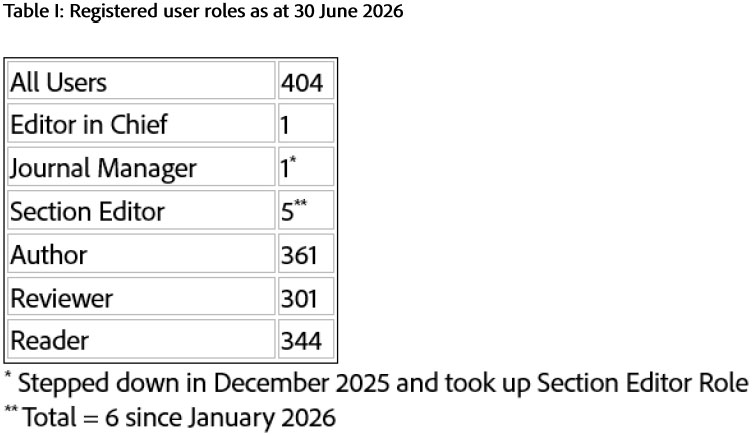
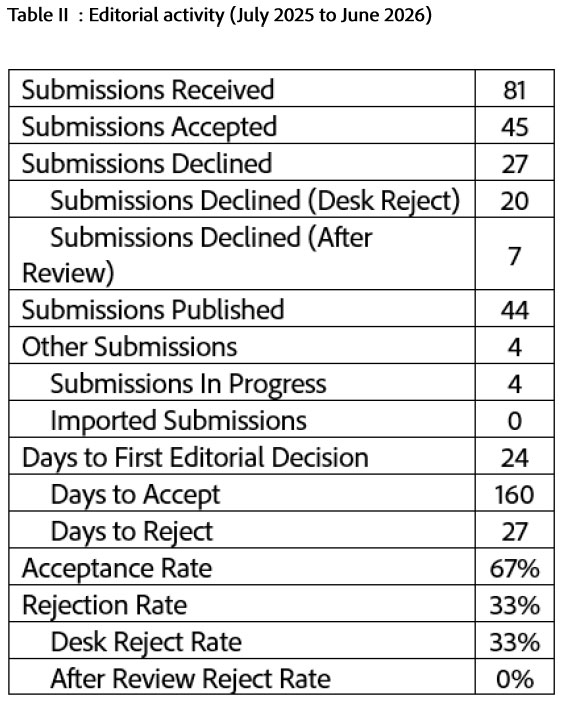
It is clear from the Table I (above) that the SAJOT has a relatively small reviewer database. As the majority of submissions received are subject to a double-blind peer review, it means that an average of 53% of our registered reviewers are needed for the average of 81 submissions received per annum (see Table II below). This puts tremendous pressure on our registered reviewers, and subsequently, this causes delays in our workflow and article processing. We would therefore encourage our readers across the globe to apply for registration as reviewers. This can be done by sending a request with an abbreviated CV to https://journals.assaf.org.za/index.php/sajot/cpd.
EDITORIAL ACTIVITY
With the introduction of our pre-review desk-edit procedure, where articles are vetted in terms of publication standards, suitability and relevance, the number of submissions finally accepted for review has reduced our turn-around time for article processing from 292 days in 2024-2025 to 160 days as can be seen from Table II below. This is largely due to the fact that articles are 'review-ready' before being accepted for review, as they are either declined outright before the review stage, or 'soft-declined', where authors are asked to revise the submission and re-submit before they are sent for review. The number of submissions published has also increased from 31 to 44 per annum.
ARTICLE VIEWS AND PDF DOWNLOADS
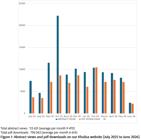
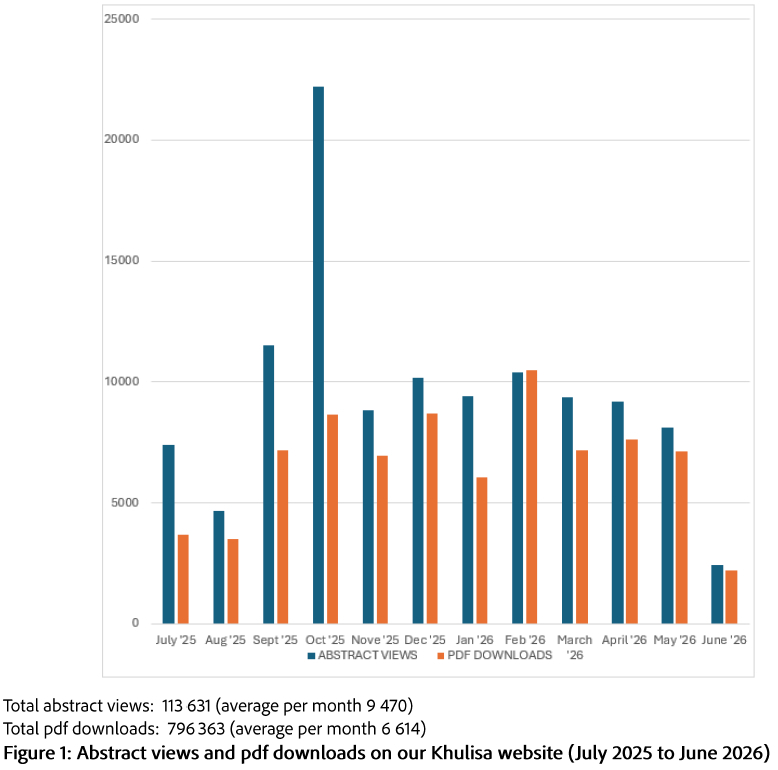
As our previous website (www.sajot.com) was closed down at the end of 2025, it was not possible to collect the number of PDF downloads and Abstract Views with the previous year for comparison purposes. However, it is encouraging to note that compared to the previous year, our number of Abstract views and PDF downloads on our Khulisa website have increased from 18 100 to 113 631 (84.07%) and from 84 310 to 796 363 (89.4%) respectively.
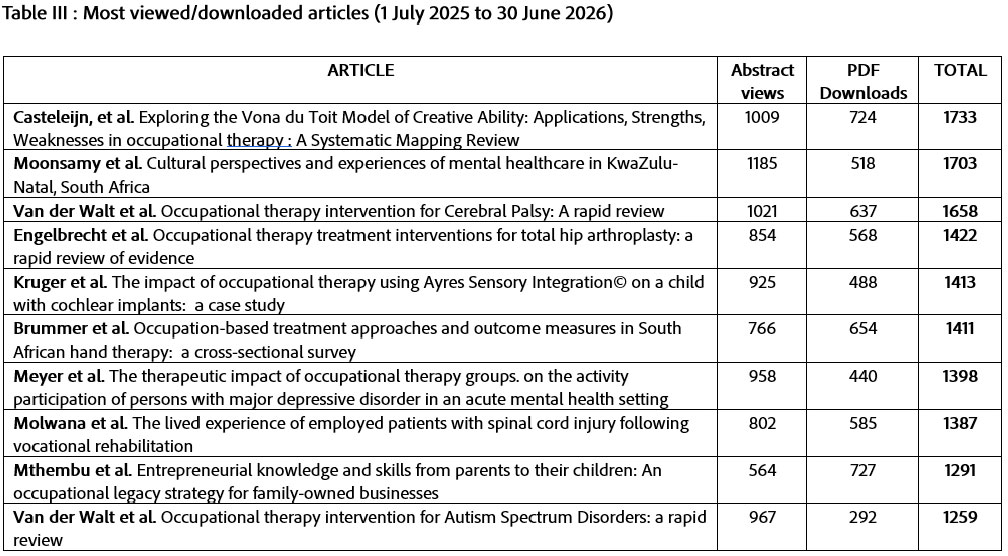
In Table III (below), the top 10 viewed/downloaded articles show a wide range of practice fields, including paediatrics, mental health, models, vocational rehabilitation, and hand therapy. The task team appointed by OTASA to investigate the contribution of occupational therapy in fields of practice where gaps in our publications were identified through Rapid Reviews of international and local literature, has proved to be very valuable to our readers, as three of the 10 articles in this list emanated from this initiative taken by our professional association.
CONCLUDING REMARKS:
Although the statistics reflected in this Editorial were taken from our current Khulisa website, it is important to note that SAJOT further increases it's indexing or discoverability through DOAJ, AJOL, SciELO SA, EBSCOhost, CINAHL, ProQuest and OTDBASE, with preservation through Portico.
In her Journal Evaluation Report mentioned above11p3.
As mentioned above, the editorial team are hard at work to implement all the recommendations outlined in this report, and our goal is that once addressed, applications for listing on SCOPUS and WoS will be submitted, to further increase our visibility and the dissemination of the important research done by you, our users.
Blanche Pretorius
https://orcid.org/0000-0002-3543-0743
Editor in Chief: SAJOT
REFERENCES
-
1. Khulisa Journals SAJOT Report 2026. https://journals.assaf.org.za/index.php/sajot/management/settings/workflow#library
» https://journals.assaf.org.za/index.php/sajot/management/settings/workflow#library -
2. DOAJ. Why index your journal on DOAJ? https://doaj.org/apply/why-index/
» https://doaj.org/apply/why-index/ -
3. Scientific News. DOAJ Journals. A complete guide. https://news.europub.co.uk/doaj-journals-a-complete-guide/
» https://news.europub.co.uk/doaj-journals-a-complete-guide/ -
4. Institute of Advanced engineering and Science. How to get OA journals indexed in the DOAJ: Updated guide in 2024. https://www.iaesjournal.com/how-to-get-oa-journals-indexed-in-the-doaj-updated-guide-in-2024/
» https://www.iaesjournal.com/how-to-get-oa-journals-indexed-in-the-doaj-updated-guide-in-2024/