South African occupational therapists' orthotic management of trigger finger and factors influencing their decision regarding splint type
Abstract
BACKGROUND: Orthotic management of trigger finger refers to the use of splints to immobilise affected joints. The prevalence of trigger finger and the assessment and treatment practices utilised by occupational therapists for this affliction in South Africa, are not yet documented. AIM: To explore occupational therapists' orthotic management for clients with trigger finger in KwaZulu-Natal, and the factors influencing the therapists' decision when prescribing orthoses. METHODS: A quantitative cross-sectional study design was implemented with a sample size of 102 via a stratified random sampling approach. A survey questionnaire was administered. Data were coded using frequencies and then descriptively analysed using SPSS. RESULTS: Findings indicated that trigger finger is common in clinical settings and the majority (99%) of the occupational therapists use splints when managing trigger finger and as a first line of treatment (69.9%). The joint-blocking splint is preferred by 96.6% of the participants with the MCP joint-blocking splint being favoured by 55.0%. The most considered factors when deciding on the splint type are clinical presentation (99.1%), and the client's occupation (92.4%), and the most preferred measures of the effectiveness of treatment are pain (97.1%) and range of motion (97%). CONCLUSION: The study has demonstrated that the inconsistencies noted in global research also apply in KwaZulu-Natal. Therefore, further investigations on the effectiveness of splinting and a guide on deciding on splint type as well as appropriate outcome measures are necessary to ensure that clients receive optimal care through evidence-informed practice. IMPLICATIONS FOR OCCUPATIONAL THERAPY PRACTICE • This study informs further understanding of the current assessment prior to splinting and treatment practices that occupational therapists in the South African context provide for their clients with trigger finger. • The study demonstrates that irrespective of the participant's level of experience and their clinical settings, the considerations when deciding on splint types remain the same. • The results are consistent with available literature particularly with which splint type to issue. However, the development for a guide regarding the orthotic management of trigger finger covering aspects like the splint regime and the recommendations of exercises is vital as discrepancies emerged largely from these areas. The type of exercises, stages at which they may be introduced, duration and frequency should be considered for deeper engagement. • The development of this protocol will ensure consistency of treatment and evidence-informed practice.
trigger digit; stenosing flexor tenosynovitis; orthotic management; hand splint; joint-blocking splint
INTRODUCTION
Trigger finger, also known as stenosing flexor tenosynovitis or trigger digit, is a sudden release or locking of a finger during flexion and extension which can be characterised by painful snapping and/or locking during flexion12
There are several treatment approaches for persons with trigger finger; including conservative or surgical treatment3456
A study by Langer et al.5112,4,5 and 6 which therefore indicates the need to establish what works within the South African context.
This research will establish the current orthotic management practices by occupational therapists in KwaZulu-Natal. It will therefore explore the occupational therapists' approach to the treatment of trigger finger, and their preferred splint designs when treating clients with trigger finger. Furthermore; the factors considered by occupational therapists before and/or during treatment of this condition will be explored as well as the outcome measures used by occupational therapists to evaluate their treatment.
Trigger finger is a hand condition in which flexor tendons "trigger" with movement6566885 961068
Clinical considerations on the splint type to issue and outcome measures involve several factors. Tarbhai et al.1065
In the South African context, no studies were found to support or refute the international trends on the management of trigger finger. There are, nonetheless, studies on hand conditions such as hand assessment practices and occupation-based hand therapy11,12. These studies highlighted the need for more research on assessment practices by South African occupational therapists11
Study aim and objectives
The study sought to explore occupational therapists' orthotic management for clients with trigger finger in a South African context, and the factors influencing the occupational therapists' decision when prescribing orthoses.
METHODS
Research design
A quantitative cross-sectional study design was used allowing for the use of a questionnaire survey to provide numerical description of opinions, trends, or attitudes of occupational therapists1314
Population and sampling
As the population size of occupational therapists in KwaZulu-Natal currently treating clients with hand conditions is unknown, an equation for large populations was applied as the size of the population. Using the Cochran sample size calculator to determine the sample size, the precision level was set at +-5%, confidence level at 90% and estimated proportion set to 0.516. The stratified random sampling approach was applied allowing for the identification of a representative sample through the use of inclusion and exclusion criteria therefore enabling the identification of a sample frame to which the results may be generalised. The criteria were as follows:
Inclusion criteria:
• Qualified occupational therapists including community service therapists.
• Occupational therapists currently registered with HPCSA.
• Occupational therapists currently practising in KwaZulu-Natal.
• Occupational therapists with access to gadgets (i.e. Smartphone, tablet, laptop) and internet.
Exclusion criteria:
• Occupational therapists practicing for the Department of Education.
The survey questionnaire developed in Google Forms was distributed via email to 271 occupational therapists and/or occupational therapy departments from the 22nd of September 2022 until the 22nd of November 2022, and a sample size of 102 was achieved. Therapists were from both the public and the private sector in KwaZulu-Natal. This was done to ensure that both sectors are represented thus allowing for results to be generalised across both sectors. The email addresses were obtained from the Department of Health communiqué mailing list for those in the public sector following being granted gatekeeper permission. Occupational therapists in the private sector were contacted through emails obtained from their professional websites and through referrals from colleagues. Telephonic reminders and emails were sent after two weeks to increase the return rate of the survey.
Research tools
Questionnaire on management of trigger finger
The occupational therapy orthotic management of trigger finger survey questionnaire (please see Supplementary File 1) was used for data collection. This was distributed to occupational therapists who met the inclusion criteria through personalised emails. The documents included the consent form, information sheet and the link to access the questionnaire. The 23-item self-administered questionnaire comprised of one 'yes' or 'no' question for the consent, six multiple choice questions focusing on the therapists' demographic information such as age, gender, level of education, as well as the sector in which they are currently working at. Six questions explored orthotic treatment prescribed; these were multiple choice, Likert scale, or checkbox questions.
In addition; six questions explored the factors considered during prescription and four explored treatment outcome measures. Questions in these sections compromised of Likert scale questions, multiple choice questions as well as open ended questions. This survey questionnaire was in English and the expected duration for participation was 25 minutes. It was developed by the first author and was informed by literature5,6,8 and the objectives of the study.
Data analysis
The data collected and analysed were of ordinal or nominal data. All responses were transferred from Google Forms to Google Sheets and then downloaded into an Excel spreadsheet. With the guidance of a statistician, data were coded and then descriptively analysed using SPSS. Descriptive statistics were used to analyse the data which included the frequencies of the demographical data and the survey data. To explore the differences between the different sectors, and level of experience, the Pearson chi-square test was used with the confidence level set at 95%. Responses to open-ended questions and those with multiple responses were coded and grouped into categories such as the splint type and regimen. Variable sets were then defined such as theSplintT, OtherCons, SplintReg, Exercises, OtherMes and Duration, after which frequencies were calculated.
Ethical consideration
Ethical clearance was obtained from Biomedical Research Ethics Committee (BREC) of the University of KwaZulu-Natal (BREC/00004347/2022). Gatekeeper permission was received from the KwaZulu-Natal Provincial Department of Health Disability and Rehabilitation programme office. Informed consent was obtained from all participants electronically. During the research process, the researcher adhered to ethical principles which included confidentiality, informed consent, beneficence, non-maleficence, autonomy and justice17
Validity and reliability
This study's reliability and validity were ensured by having the principal researcher input the data according to allocated numerical coding on the SPSS system software, ensuring consistency, reliability, and validity of data collection.
Through the pilot study, reliability and validity were also ensured. For content validity of the questionnaire a pilot study was conducted with two occupational therapists who met the inclusion criteria. Through the results obtained; it was noted that the research tool was measuring the relevant and appropriate concepts related to trigger finger management, taking into consideration the objectives of the study. Irrelevant questions were deleted such as the precautionary measures relayed to clients regarding the splints and whether or not they invited clients for follow-up appointments.
For internal validity of the study, the stratified random sampling approach allowed for participants to be selected randomly through extending the invitation to participate to the members that met the inclusion criteria, thereby ensuring that both sectors were represented and this further allowed for generalisation of the findings within the sample as discussed above.
To increase external validity of the study, the researcher had clearly defined the target population through the inclusion and exclusion criteria which therefore defined the sample in which the results may be generalised to15
RESULTS
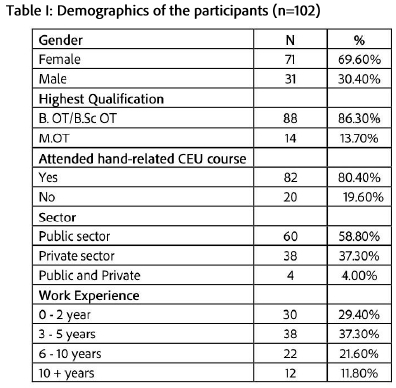
Results represent the 102 responses that were received from participants. This includes the demographics of participants shown in Table I (below).
Demographics
The results are skewed towards occupational therapists working in the public sector (58.88%, n=102) with a high proportion of female participants (69.6%, n=102). In particular, 86.3% possessed basic level degree and 80.40% (n=102) of the participants have engaged in continuous professional development for hand-related conditions. Furthermore; more than half of the participants (70.7%) reported experience of three years and above practising as occupational therapists.
Orthotic treatment methods for trigger finger
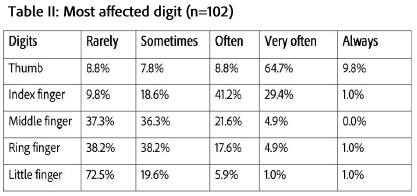
All the participants reported treating clients with trigger finger in their specific practice settings. According to their clinical experience, the thumb (83.3%) and the index finger (71.6%) are the more commonly affected digits with the little finger being a rarely affected digit (72.5%) (Table II, below).
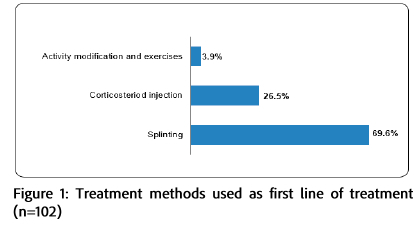
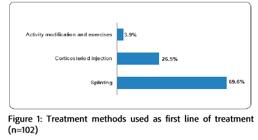
Of the four treatment modalities for trigger finger presented to participants; 99% of the participants reported using splints as part of treatment for trigger finger with 69.6% using it as the first line of treatment (Figure 1, above). For the 1.0% who reported to not be using splinting, activity modification and exercise was the first line of treatment in their practice setting.
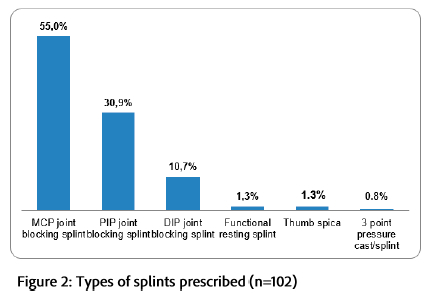
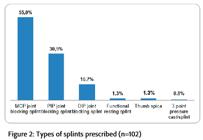
From the open-ended question focusing on the splint type that the participants issued to clients, six types of splints were reported. Some participants named more than one splint type thus indicating that certain factors influence their decisions when deciding on a splint type to issue. The joint-blocking splint (96.6%) was the most preferred splint with the MCP joint-blocking splint being mostly favoured by 55.0% of the participants.
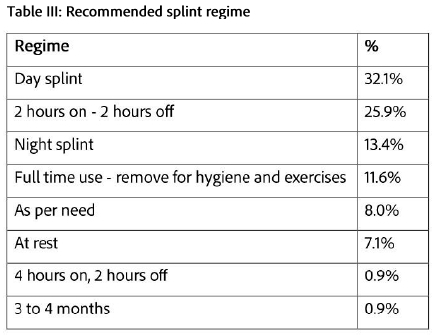
With prescribing splints, a regime is necessary to ensure that it is correctly worn so as to improve effectiveness of the splint as well as prevent secondary complications. Presented with an open-ended question in a fill-in format on their recommended splint regimen; there seemed to be confusion regarding splint regime and for how long clients should wear the splint. Table III (above) reflects the seven splint regimens that emerged. The most preferred splint regime was for the splint to be worn during the day (32.1%) and on 2 hours on-2 hours off intervals (25.9%).
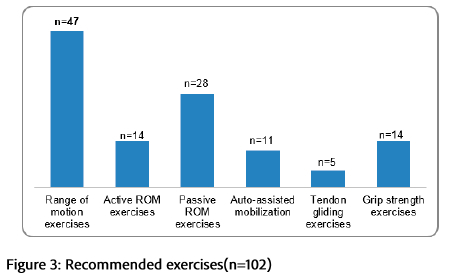
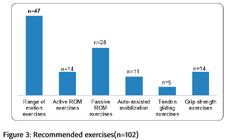
A mode of treatment can be used singularly or in conjunction with others. The majority of the participants (96%) recommended exercises as part of treatment with a splint. Presented with an open-ended question which allowed participants to express themselves regarding exercises that they recommended, six exercises emerged. Most participants recommended more than one type of exercise hence the presentation being in numbers rather than percentages. Overall, the recommended exercises were categorised into range of motion and grip strength exercises. The majority of the participants recommend range of motion exercises.
Considerations when prescribing splints
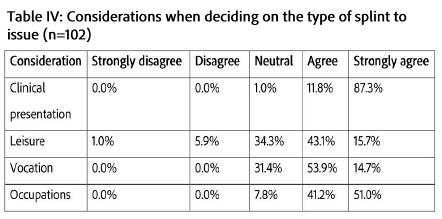
Evidently, the participants prescribe different splint types as depicted in Figure 2 (adjacent) and different regimens (Table III, above) and use it at different stages of treatment. Hence, certain factors influence the participants' decision. As shown in Table IV (page 12), the most considered factors when deciding on the splint type are clinical presentation (99.1%) and the client's occupations (92.4%). Occupations in this regard being set duties and responsibilities; and vocation referring to the client's employment.
Leisure is however not recommended by 6.9% of the participants thus alerting to the application of a more holistic and client-centred treatment approach.
Other considerations when issuing splints
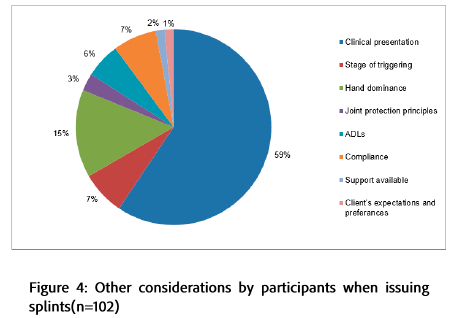
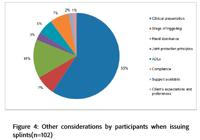
Although participants considered the four factors as reflected in Table IV (above), they indicated other considerations that influence their decisions. Figure 4 (below) illustrates the grouped considerations as this was an open-ended question, 59.4% of the participants still included factors that are under clinical presentation of the clients focusing on sensation, affected joint and/or digit, and oedema, 14.5% considered hand dominance as this may influence compliance with the regime especially if it is the dominant hand being affected, whilst 5.8% consider the ADLs participated in and 1.4% consider the clients' expectations and preferences.
No statistically significant relationship was found between the participants' sector and their considerations when deciding on a splint type to issue (chi-square=1.311; p=1.000) There was also no statistically significant relationship (p>0.05) between the participants' level of experience (chi-square=4.818; p= 0.619) and their considerations when deciding on a splint type to issue. This could possibly indicate that both experienced and less experienced individuals consider similar factors.
Outcome measures used for evaluation of treatment
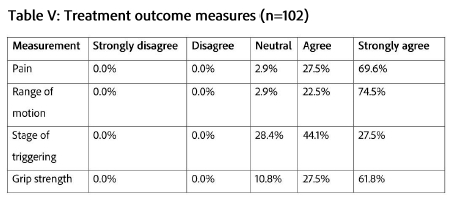
The participants prescribed different splint types (as noted in Figure 2, page 4), had different splint regimens (Table III, page 4), and recommended different exercises (Figure 3, page 4). Therefore; their measures of the effectiveness of treatment are likely to vary. The participants all appeared to use pain, range of motion, stage of triggering, and grip strength as measures as reflected in Table V (page 14). However, the degree at which these are used varies. As indicated above, the mostly preferred measures are pain (97.1%) and range of motion by 97% of the participants.
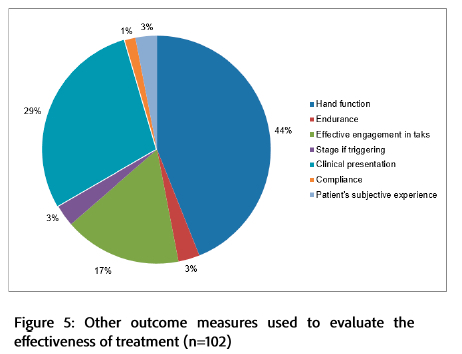
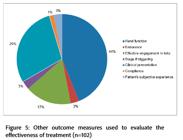
Although participants used the four factors on Table V (above) to measure the effectiveness of treatment, they also have other measures that they use. Figure 5 (below) illustrates the grouped and coded measures. A higher percentage (44%) of the participants use improved hand function and clinical presentation (29%) to measure the effectiveness of treatment. This leads to effective engagement in tasks which is used as a measure by (17%) of the participants. No standardized assessment tools were indicated and/or mentioned. A statistically significant relationship was found between the use of pain as a measure of effectiveness of treatment and the participants' level of experience (chi-square=16.067; p=0.013). However; there is no statistically significant relationship between the participants' level of experience and the use of ROM, stage of triggering and grip strength (p>0.05).
DISCUSSION
The study results revealed that all participants do treat clients with trigger finger in their settings with 35% treating them often which supports available literature on trigger finger being frequently included in the range of practice in clinical settings8
Considering that any digit can be affected by trigger finger, the findings establish that the thumb is the most frequently affected digit. Available literature1,2 supports the present findings and therefore the results are consistent with the existing research. However; the ring finger was reported to be rarely affected while available research revealed it as the second most affected digit. The index finger which is second in line in this study's findings was identified as the least affected finger in literature2
Trigger finger treatment methods used in a South African context
The results of the study support findings by Langer et al.5Figure 1, page 4). Hence, this indicates that even though splinting may not be first line, other conservative treatment methods are considered before the doctors explore the surgical option. These findings are consistent with previous research on conservative management being recommended before surgical management5
Preferred splint type, regime and recommended exercises
Several splint types are available and/or recommended for the management of trigger finger. These include the MCP joint-blocking splint, the DIP joint-blocking and PIP joint-blocking splint. The effectiveness of these splints has been explored in various studies5, 10and the results showed that participants who had the MCP joint-blocking splint had a higher success rate of 77%510518
The lack of standardised guidelines regarding the splint regimen that have been highlighted in previous studies have also been evident in this study. The most recommended regimen is for the splint to be worn as day splint with at wo-hours-on-and-two-hours-off regime. The rationale may potentially be that the focus of conservative treatment has been reported to be more effective on reducing symptoms55,6,10.
Factors considered by occupational therapists when prescribing orthosis for trigger finger in a South African context
There are marked inconsistencies in literature concerning considerations when issuing splints and outcome measures. There is more emphasis on body structures and body functions with less emphasis being placed on activity participations. Due to limited research in South Africa and KwaZulu-Natal regarding orthotic management of trigger finger, no studies could refute or support these findings. It was noted in this study that 6.9% of the participants do not consider the clients' leisure activities when deciding on splint type while majority agreed to be considering the clients' occupation and vocation. When exploring the considerations on deciding on the splint type to issue further, the results revealed that all the participants do consider the client's clinical presentation, vocational activities and their occupations.
Outcome measures used for trigger finger in South African context
When exploring the assessments used to measure the effectiveness of treatment, only 17% of the participants use effective engagement in tasks. The majority of therapists measure effectiveness of treatment based on body structures and functions. This is validated in available literature on emphasis being less on activity participation5,6,19. This further demonstrates the need fora treatment guideline and protocol to ensure evidence-based practice. Although research on the orthotic management of trigger finger is limited, the available literature measured the effectiveness of the splints based on them being able to reduce the symptoms that the client presented with55
In summary, the study has reported that the majority of the occupational therapists in a South African context make use of splints in the management of trigger finger with the MCP joint blocking splint being the most prevalent one. Although there are discrepancies with regards to the regime and whether or not exercises are recommended; their preferences are distinctive. In addition, the factors considered when issuing splints as well as the treatment outcome measures used were identified.
CONCLUSION
The study focused on orthotic management of trigger finger practices by the occupational therapists in a South African context. It has established that the inconsistencies in global research on orthotic management of trigger finger are also applicable in the study setting. This is a result of the lack of research and guidelines on assessment and treatment procedures which occupational therapists have at their disposal to use as treatment and to determine the effectiveness of the treatment provided. The prevalence of trigger finger remains common in clinical settings for both sectors. The majority of the participants reported the use of splints in treatment of trigger finger. In addition, it was also used by most occupational therapists as the first line of treatment. Therefore, due to a lack of evidence, further investigations on the effectiveness of this treatment method as well as a guide on deciding on splint type, treatment and appropriate outcome measures for the study population is necessary to ensure that clients receive optimal care through evidence-based practice.
Limitations and Recommendations
Limitations of this study included a low response rate from the occupational therapists and the sample size being skewed towards occupational therapists working in the public sector. There seemed to be confusion in the questionnaire regarding recommended splint regimen and for how long clients should wear the splint for, therefore a description of a precise and descriptive regimen is essential for further studies as this negatively affects content validity.
In addition; the study was conducted in one province out of the 9 provinces in South Africa, therefore results should be generalized with caution in the said province and further studies on trigger finger in the South African context are recommended so to provide valuable insight into various aspects of this condition. Studies should mainly focus on evaluating the effectiveness of splinting. Additionally, comparative studies should be conducted to determine the most effective treatment through exploring long-term outcomes for the different modalities. Studies may also explore the rationale behind recommending exercises as part of treatment, stages at which the exercises are introduced; their frequency and duration.
It is recommended that the Occupational Therapy Association of South Africa and the South African Society of Hand Therapists conduct seminars, workshops and/or educational programmes for occupational therapists to keep them updated on developments on trigger finger management and current therapeutic techniques as well as increase awareness on resources available on trigger finger management. These programmes may be inclusive of not only therapists but hand surgeons as well. This will ultimately enhance the therapists' knowledge and skills in managing this condition. Furthermore; this will ensure consistency in treatment approaches thus ensuring better continuity of care as client's transition between different therapists and/or setting i.e. when referred from a tertiary hospital to other levels of care. Moreover; a development of a guideline for the treatment of trigger finger is recommended to ensure evidence-based practice. The results of this study should be interpreted with caution and may only be generalised to the population defined in the inclusion criteria.
Author contributions
Kuhlekonke V. Mathenjwa conceptualised the study, developed the data collection tool, and conducted data collection and analysis of the raw data as well as the completion of the manuscript. December M. Mpanza and Chantai Christopher organised and held meetings to discuss the structure of the manuscript, were involved in conceptualisation of the manuscript and in writing up of some sections of the manuscript. All listed authors regularly held meetings to review the direction of the manuscript, revised the manuscript, guided the first author on key concepts, revised the final documents and feedback from reviewers and the editor, and lastly; accepted the revised final manuscript.
REFERENCES
Acknowledgements, sources of funding and conflict of interest
We would like to express our deepest gratitude the occupational therapists who participated in the study, the biostatisticians from the University of KwaZulu-Natal for generously providing their knowledge and expertise, and lastly, the University of KwaZulu-Natal for their tuition fee remission without which this work could have not begun.
LITERATURE REVIEW
-
1. Ferrara PE, Codazza S, Maccauro G, Zirio G, Ferriero G, Ronconi G. Physical therapies for the conservative treatment of the trigger finger: a narrative review. Orthopedic Reviews. 2020 Jun 6;12(Suppl 1). https://doi.org/10.4081/or.2020.8680
» https://doi.org/10.4081/or.2020.8680 - 2. Camargo DA, Angelini LC, de Oliveira MT, Sawaeda DM. Prospective study of the conservative treatment of trigger finger: evaluation of 131 fingers. EINSTEIN-SAO PAULO. 2009 Jan 1,7(1):76-80.
-
3. Nikolaou VS, Malahias MA, Kaseta MK, Sourlas I, Babis GC. Comparative clinical study of ultrasound-guided A1 pulley release vs open surgical intervention in the treatment of trigger finger. World Journal of Orthopedics. 2017 Feb 2;8(2):163. https://doi.org/10.5312/wjo.v8.i2.163
» https://doi.org/10.5312/wjo.v8.i2.163 - 4. Matthews A, Smith K, Read L, Nicholas J, Schmidt E. Trigger finger: An overview of the treatment options. JAAPA. 2019 Jan 1;32(1):17-21.
-
5. Langer D, Luria S, Maeir A, Erez A. Occupation-based assessments and treatments of trigger finger: a survey of occupational therapists from Israel and the United States. Occupational Therapy International. 2014 Dec;21 (4):143-55. https://doi.org/10.1002/oti.1372
» https://doi.org/10.1002/oti.1372 -
6. Colbourn J, Heath N, Manary S, Pacifico D. Effectiveness of splinting for the treatment of trigger finger. Journal of hand therapy. 2008 Oct 1;21 (4):33643. https://doi.Org/10.1197/j.jht.2008.05.001
» https://doi.Org/10.1197/j.jht.2008.05.001 -
7. Nag, O. S. (2018). Retrieved from https://www.worldatlas.com/articles/the-largest-provinces-of-south-africa-by-area-and-by-population.html
» https://www.worldatlas.com/articles/the-largest-provinces-of-south-africa-by-area-and-by-population.html -
8. Huisstede BM, Hoogvliet P, Coert JH, Fridén J, European HANDGUIDE Group. Multidisciplinary consensus guideline for managing trigger finger: results from the European HANDGUIDE Study. Physical therapy. 2014 Oct 1,94(10):1421-33. https://doi.org/10.2522/ptj.20130135
» https://doi.org/10.2522/ptj.20130135 -
9. Henton J, Jain A, Medhurst C, Hettiaratchy S. Adult trigger finger. BMJ: British Medical Journal (Online). 2012 Oct 12;345. https://doi.org/10.1136/bmj.e5743
» https://doi.org/10.1136/bmj.e5743 -
10. Tarbhai K, Hannah S, von Schroeder HP. Trigger finger treatment: a comparison of 2 splint designs. The Journal of hand surgery. 2012 Feb 1;37(2):243-9. https://doi.org/10.1016/j.jhsa.2011.10.038
» https://doi.org/10.1016/j.jhsa.2011.10.038 -
11. De Klerk S, Buchanan H, Pretorius B. Occupational therapy hand assessment practices: Cause for concern?. South African Journal of Occupational Therapy. 2015 Aug;45(2):43-50. https://doi.org/10.17159/2310-3833/2015/v45n2a7
» https://doi.org/10.17159/2310-3833/2015/v45n2a7 - 12. Teuchert R, De Klerk S, Nieuwoudt HC, Otero M, van Zyl N, Coetzé M. Occupational therapy intervention into Osteo-Arthritis of the Carpometacarpal joint of the thumb in the South African context. South African Journal of Occupational Therapy. 2017 Apr;47(1):41-5.
-
13. Ahmad S, Wasim S, Irfan S, Gogoi S, Srivastava A, Farheen Z. Qualitative v/s. quantitative research-A summarized review. Journal of Evidence Based Medicine and Healthcare. 2019;6(43):2828-32. https://doi.org/10.18410/jebmh/2019/587
» https://doi.org/10.18410/jebmh/2019/587 - 14. Wang X, Cheng Z. Cross-sectional studies: strengths, weaknesses, and recommendations. Chest. 2020 Jul 1;158(1):S65-71.
- 15. Last J. International epidemiological association. A dictionary of epidemiology. 2001.
-
16. Sample Size Calculator. Socscistatistics.com. (2022). Retrieved 24 May 2022, from https://www.socscistatistics.com/tests/samplesize/default.aspx.
» https://www.socscistatistics.com/tests/samplesize/default.aspx -
17. Wagle, K. (2020). Research ethics: Definition, principles and advantages. Retrieved from https://www.publichealthnotes.com/research-ethics-definition-principles-and-advantages/
» https://www.publichealthnotes.com/research-ethics-definition-principles-and-advantages/ -
18. Leong L, Chai, S. C, Howell, J. W., & Hirth, M. J. (2023). Orthotic intervention options to non-surgically manage adult and pediatric trigger finger: A systematic review. Journal of Hand Therapy, 36(2), 302-315. https://doi.org/10.1016/j.jht.2023.05.016
» https://doi.org/10.1016/j.jht.2023.05.016 -
19. Teo, S., Ng D., & Wong, Y. (2019). Effectiveness of proximal interphalangeal joint-blocking orthosis vs metacarpophalangeal joint-blocking orthosis in trigger digit management: A randomized clinical trial. Journal Of Hand Therapy, 32(4), 444-451. https://doi.org/10.1016/j.jht.2018.02.007
» https://doi.org/10.1016/j.jht.2018.02.007

Reviewed: 22 April 2024
Revised: 13 August 2024
Accepted: 14 August 2024
Editor: Blanche Pretoriushttps://orcid.org/0000-0002-3543-0743
Data availabiity:Upon reasonable request, from corresponding author.
Funding: No funding was obtained for this study