Rehabilitation in community-oriented primary care: Perspectives of rehabilitation therapists in the Western Cape Province, South Africa
Abstract
INTRODUCTION: Re-engineering of primary health care in South Africa is occurring through the implementation of a Ward-Based Primary Health Care Outreach Team (WBPHCOT) strategy. It supports the traditional model of nurse-led ward-based, outreach teams with community health workers. The Western Cape Department of Health uses community-oriented primary care (COPC) as an implementation framework for the improvement of primary level district health services. Rehabilitation WBPHCOTs, consisting of rehabilitation care workers (RCWs) and led by rehabilitation therapists, were piloted in two peri-urban health sub-districts to introduce rehabilitation in COPC METHOD: A collaborative inquiry was implemented with members of the pilot rehabilitation WBPHCOTs to explore their perspectives on rehabilitation in COPC. Qualitative, descriptive data were collected during three narrative action reflection workshops. Data were deductively coded and categorized using the principles and elements of COPC FINDINGS: Enablers and barriers to rehabilitation at primary level were identified and actions aligned with COPC highlighted DISCUSSION: The inclusion of rehabilitation in COPC will require health system planners to endorse disability inclusion and community-based rehabilitation for health system strengthening at the primary level of care. Endorsement will require the use of different health classification frameworks and support for the capacitation and employment of mid-level rehabilitation workforce CONCLUSION: Rehabilitation therapists and RCWs are essential contributors to COPC. This should be considered during human resource planning for universal health coverage and national health insurance IMPLICATIONS FOR PRACTICE: •Rehabilitation therapists and mid-level rehabilitation workers strengthen COPC through inter-sectoral CPR services for persons with disabilities and their families •Rehabilitation therapists and mid-level rehabilitation workers in rehabilitation WBPHCOTs require task-sharing and task-shifting competencies •Health information systems need to increase rehabilitation and disability inclusion indicators to reflect community-based rehabilitation in COPC •Disability inclusion and community-based rehabilitation as components of universal health coverage must be addressed in the training of medical students and rehabilitation therapists
community-oriented primary care; rehabilitation; disability; rehabilitation care workers; health systems strengthening
INTRODUCTION
Primary health care (PHC) is a whole-of-society approach to effectively organise and strengthen national health systems to bring services for health and wellbeing closer to communities11
The health system in the Western Cape province of South Africa is organised around a commitment to community-oriented primary care (COPC)23344
The comprehensive service approach advocated in the COPC literature assumes that nurses and CHWs in WBPHCOTs are equipped to deliver rehabilitative HCBC456,7. However, WBPHCOTs consisting of rehabilitation therapists and mid-level rehabilitation workers delivering rehabilitative HCBC are not yet included in health system planning within the COPC framework or within the national WBPHCOT policy895,10,11. The NHI will require rehabilitation therapists, whether in the public or private sector, to understand how each contracting unit for PHC accredits facility-based rehabilitation services at primary, secondary, tertiary and quaternary levels of care. Including rehabilitation WBPHCOTs in COPC will expand access to rehabilitation beyond primary care facilities to rehabilitative HCBC interventions that target the public health burden of disability in accordance with the CBR approach.
To date, the concept of WBPHCOTs dedicated to rehabilitative HCBC aligned with the principles of CBR as a critical component of district health system strengthening within the COPC framework is unique to the Western Cape Department of Health (WCDoH)12
BACKGROUND
Cognisant of the need to promote rehabilitation in COPC, the WCDoH initiated a partnership with the Division of Disability Studies in the Department of Health and Rehabilitation Sciences at the University of Cape Town in 2012 to develop a mid-level rehabilitation worker training programme for the province. A one-year Higher Certificate in Disability Practice (HCDP) was designed by a team of rehabilitation therapists and persons with disability. The HCDP is the only one of its kind in South Africa and was registered with the South African Qualification Authority (SAQA) at Level 5 of the National Qualification Framework131413,15. It is envisaged that the HCDP qualification could serve as the basis of career laddering for CHWs and RCWs to become CRWs, technicians in one of the rehabilitation professions or rehabilitation therapists.
The first HCDP cohort of 28 students graduated in 2014. Students included CHWs, home-based care workers and persons with a Grade 12 education. One hundred and twenty RCWs have graduated to date, most of whom are employed in the Cape Town metropole in WCDoH posts or by NGOs with their salaries paid by the WCDoH. Additionally, in 2019, with COPC in mind, the district health system management in the Cape Metropole introduced two rehabilitation WBPHCOTs at two peri-urban sites to pilot rehabilitative HCBC and ambulatory facility-based rehabilitative care at primary level. This article reports on the perspectives of rehabilitation therapists linked to the pilot rehabilitation WBPHCOTs.
Community-oriented primary care
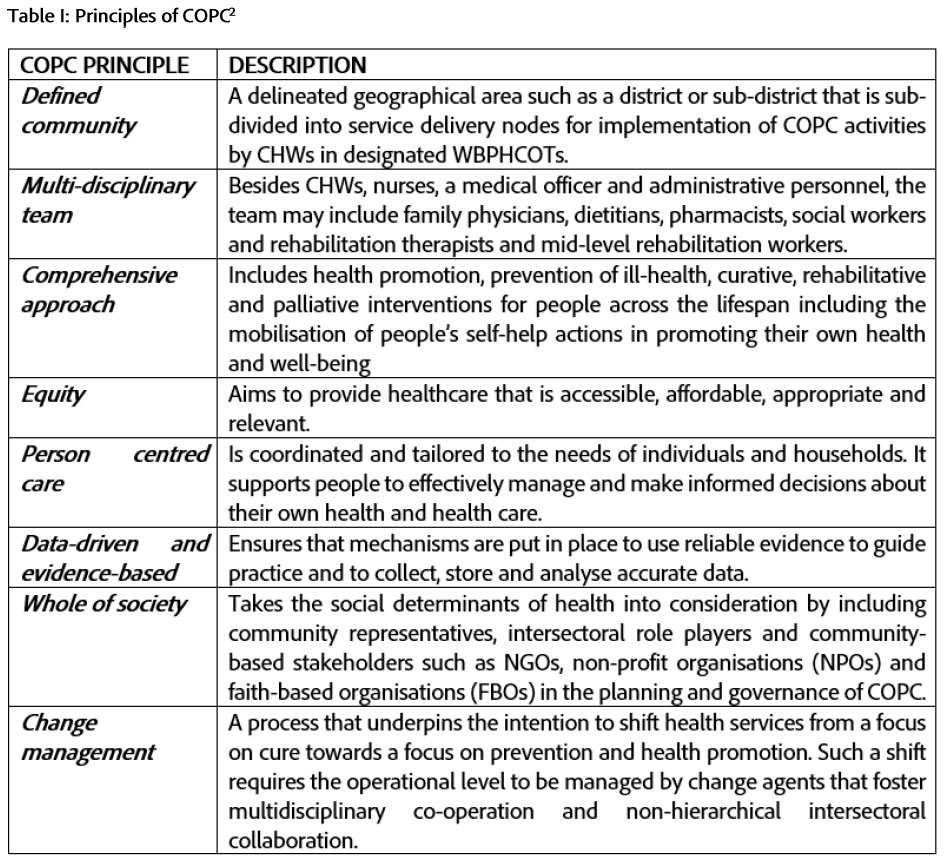
The WCDoH established several urban and rural COPC learning sites as part of provincial healthcare reforms to pilot a population based PHC delivery model that enables UHC2,4. Based on lessons learnt at these sites, the WCDoH adopted a position statement on COPC in 2023 that outlines the benefits, principles and implementation steps of the COPC approach2332Table I (page 3) provides a brief description of each COPC principle.
The COPC principles are applied by restructuring primary care services according to the following inter-related elements of a COPC framework namely: geographic delineation of PHC teams; composition of PHC teams; facility-based and community-based teamwork; partnership of government and NGOs, NPOs, FBOs; scope of practice; information system; community engagement; stakeholder engagement; training and development of PHC teams and system preparation and change management42,12.
Rehabilitation and disability inclusion
At the 2023 World Health Assembly on strengthening rehabilitation in health systems, the World Health Organisation (WHO) defined rehabilitation as
"a set of interventions designed to optimize functioning in individuals with health conditions or impairments in interaction with their environment and, as such, is an essential health strategy for achieving universal health coverage, increasing health and well-being, improving quality of life, delaying the need for long-term care and empowering persons to achieve their full potential and participate in society"10:1.
This definition points to rehabilitation as an essential component of health system strengthening at all levels of care, including primary care where it contributes to UHC and disability inclusive development16,17. The International Classification of Functioning, Disability and Health (ICF) defines disability from an individual health perspective as an umbrella term for impairments, activity limitations and participation restrictions arising from the interaction between a person's health condition(s) and context (environmental and personal factors)181916,17. CBR is an intersectoral community development strategy that creates equal opportunities for rehabilitation, poverty reduction, and social inclusion of persons with disability and their families202021
Rehabilitation in COPC
The Framework and Strategy for Disability and Rehabilitation Services (FSDRS) in South Africa, 2015-2020 was developed to strengthen access to rehabilitation services at all levels of care and to ensure the inclusion of persons with disabilities in all aspects of community life621,22,23.
Aspects of rehabilitative HCBC, as it is currently envisaged by the WCDoH position statement on COPC, are delivered by nurses and CHWs28813
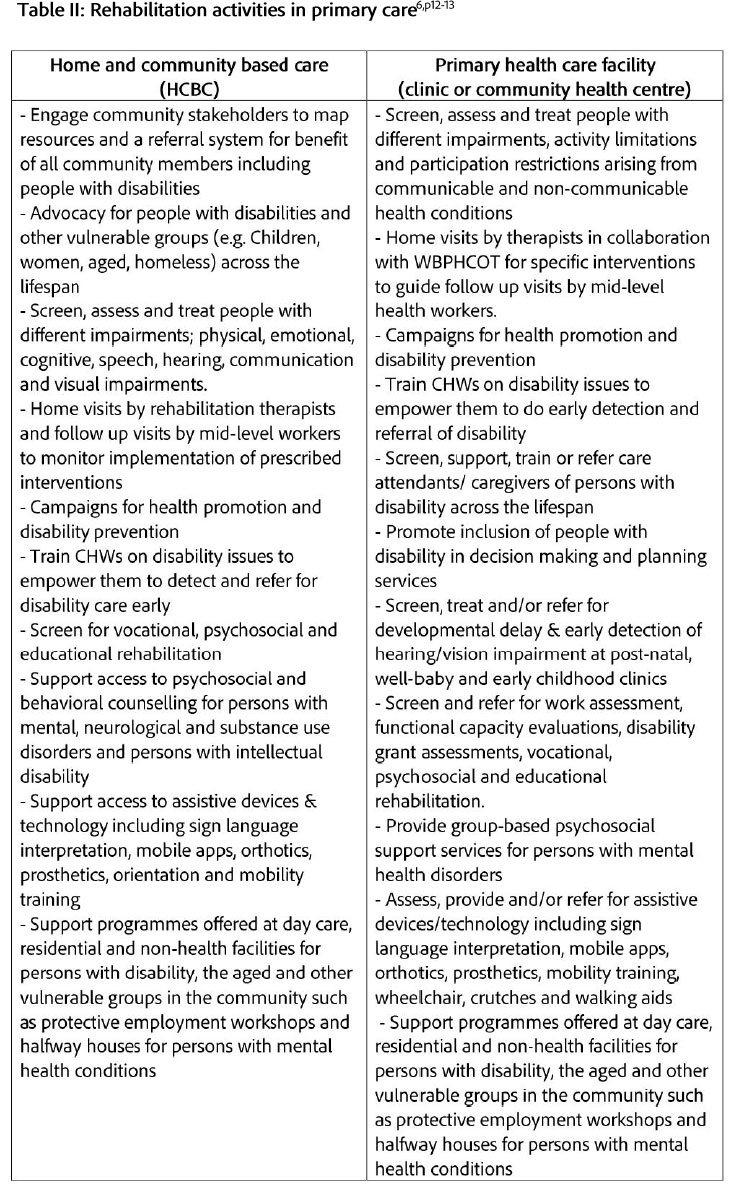
Table II (below) provides a summary of the FSDRS recommended rehabilitation activities at primary level (HCBC, clinics, community health centres)620
METHODS
Research Design
This study investigated the research question: "How do rehabilitation therapists and RCWs contribute to health system strengthening at the primary level?". The purpose of the study was to gather practice-based evidence for the inclusion of rehabilitation WBPHCOTs in COPC as a means of strengthening UHC. The aim of the study was to describe how the work of a rehabilitation WBPHCOT fits into COPC by achieving two objectives:
mapping the perceived convergence of rehabilitation at primary level with the principles and elements of COPC
mapping the types and range of rehabilitation activities provided at the primary level
A collaborative inquiry (CI) process with members of the two rehabilitation WBPHCOTs and persons with disability with whom they worked was implemented over a five-month period. CI is a qualitative research design that brings together action and reflection, theory and practice, in pursuit of practical solutions to shared concerns2424,p259. The shared concerns of participants pertained to insufficient information about rehabilitation in COPC and the service activities by the rehabilitation WBPHCOTs in the two pilot practice sites. The CI was conducted by four academics involved with the HCDP programme, a research consultant, a director of a non-governmental organisation that provides services for persons with disability who was an alumnus of the postgraduate diploma in Disability Studies at UCT, and a WCDoH manager of comprehensive health services, including rehabilitation services.
Study sites
The study sites are situated in the Cape Town Metropole districts of Klipfontein and Mitchells Plain. These districts have a combined population of approximately a million. A cross-sectional descriptive survey using stratified cluster sampling in two under-resourced communities in the Western Cape province in 2019 provides some indication of disability prevalence in the two study sites25
Participants
Access to the participants was facilitated by the principal investigator who had well-established communication channels with the WCDoH. Three purposefully sampled groups participated voluntarily in the CI. The group of rehabilitation therapists consisted of three occupational therapists (OT), one speech and language therapist (SLT) and one social worker (SW). There were no physiotherapists in the rehabilitation WBPHCOTs at the time of the study. The rehabilitation therapists all had a minimum of three years full time experience at primary level and they had all worked with RCWs either in HCBC or at primary facility level. The RCW group consisted of eight RCWs, all of whom had completed the HCDP between 2014-2020 and had a minimum of three years full time experience in the RCW role. The group of persons with disability included four persons with either mobility, visual or psychosocial impairments. They could communicate in English, Xhosa or Afrikaans with the help of an interpreter, and all had direct exposure to RCWs and rehabilitation therapists. This article reports on the perspectives of the group of rehabilitation therapists. The findings of the other participants are reported separately12,13, 26. The CI was also conducted in a rural sub-district with one RCW, one community development worker, two persons with disabilities, two mothers of children with disability and one occupational therapist and one speech and language therapist35
Data Collection
Data were gathered during three, one-day narrative action reflection (NAR) workshops27
Venn diagram. Groups created and discussed a Venn diagram that illustrated the relationships between various service sectors in the pilot sites
Checklist of RCW activities based on the HCDP curriculum outcomes. The checklist consisted of a three-point Likert scale: 1) a frequent service activity (regular part of the RCW role in the WBPHCOT); 2) an infrequent service activity (not often required by the RCW role in the WBPHCOT) and 3) a recommended service activity (currently not part of the RCW role in the WBPHCOT but should be included). Participants completed the checklist on their own and then discussed their perspectives of RCW activities in COPC.
Listing and discussing the overlaps and differences in activities of CHW with and without HCDP training. Referring to the principles and elements of COPC framework, the participants deliberated on the contribution of rehabilitation WBPHCOTs to health system strengthening.
Plenary discussions at the end of each workshop to identify insights and future actions by the rehabilitation WBPHCOT teams within the COPC framework.
Data Analysis
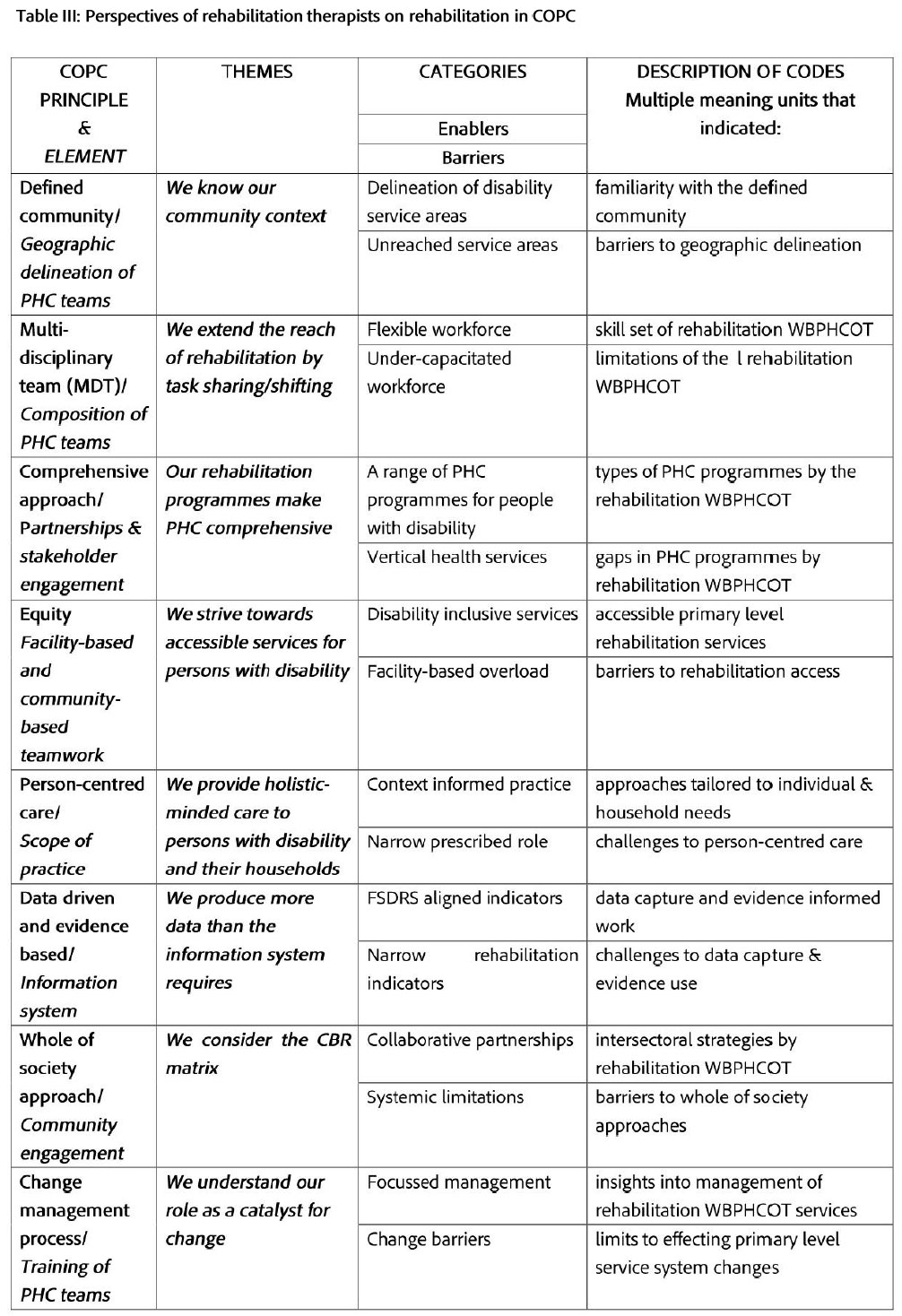
Digital recordings of group discussions were transcribed and deductively colour coded. Codes consisted of meaning units that pertained to the principles and elements of the COPC framework. Multiples codes were generated and categorised within the COPC framework. Each data category was re-coded into two sub-categories to answer the research question: enablers (factors that support rehabilitation at primary level, inclusive of HCBC.) and barriers (factors that curtailed or hindered rehabilitation at primary level, inclusive of HCBC.). A qualitative descriptive theme for each principle and element of the COPC framework was identified. The research team met at regular intervals to compare analysis and interpretation of data. Findings were member checked with participants and triangulated with the WCDoH Position Statement on COPC26
Data Management
Digital recordings and the transcribed interviews and analysed data were captured in chronological order and saved on UCT One-Drive, with a secure password. The data were only accessed by the research team. Participants were anonymised by number.
Rigour
The research group met regularly to compare notes in research journals and to triangulate the deductive findings against the selected policy literature. Confirmability was ensured through research team members cross-checking data analysis amongst each other. The thick description of the study promotes the transferability of the findings. Credibility was ensured by member-checking the data transcripts and initial themes with participants during the second and third workshops. The findings of the study were disseminated at a three-hour seminar with 15 key provincial representatives and policy planners, academics from the three universities in the province, and other stakeholders involved with HCDP and implementation of the COPC position statement.
Ethics
Ethical clearance was received from the Human Research Ethics Committee of the Faculty of Health Sciences, University of Cape Town (HREC ref 064/2023) and from the relevant substructure of the WCDoH.
FINDINGS
Table III (below) summarises the perspectives of rehabilitation therapists on their contribution to health system strengthening at the primary level within the COPC framework.
Generative themes
"We know our community context"
The enablers category of 'delineation of disability service areas' indicated that the rehabilitation WBPHCOT had knowledge about the population with disability residing in the geographic locations where they were working and were broadly familiar with community and individual needs, structures and assets based on community and environment mapping.
"Covid I had a list of organisations where I could refer mental health clients or persons with disability to protective workshops. We had a good relationship. Post-Covid there has been a decline in services. Many places have closed and some are struggling to rebuild themselves." (Participant 3, OT)
"Our [disabled] population live in houses that are so small, when you turn to your right, is your bathroom, and turn to your left, is your bedroom. We think about access for someone coming home with a wheelchair. It is impossible to have a reasonable quality of life in a home, the size of a match box!" (Participant 2, OT)
The barriers category of 'unreached service areas' pointed to gaps in services for persons with disability in the geographically delineated areas.
"If you are at the sub-structure, and there is need for social support, we consider if social support is available locally. Support [for people with disability] is clustered [only available in small pockets] in the substructure". (Participant 5, SW)
"We know that SAPs [South African police] is intact but in some community spaces there is no security, and there is violence in the community that affects the ability to provide [rehabilitation] services there." (Participant 3, OT)
"We extend the reach of rehabilitation by task sharing and task shifting"
The enabler category of a 'flexible workforce' pointed to an integrated way of working amongst the various rehabilitation professions and the RCWs.
"We are a team. I think our strength is that we work inter-professionally by working close to one another ... with a system like ours you will never have enough human resources. There is always gonna be a scarcity so at some stage there is task shifting and task sharing, so we gonna be all in one 'cos our clients do not look at us as speech therapist or OT, they look at you as a person connecting and linking them to the necessary care.. ... I think that is the strength of our rehab team ... we work interconnectedly and we have shifted some of our skills to each other." (Participant 1, OT)
The barrier category of an 'under-capacitated workforce' pointed to the limited range of rehabilitation activities that can be provided by CHWs without HCDP competences.
"CHWs are good at nurse-based things and medication distribution ... I think RCWs are better equipped [than CHWs] 'cos they have skills putting together the skills of OTs, PTs, STs." (Participant 2, OT)
"Our rehabilitation programmes make PHC comprehensive"
The enablers category of 'a range of PHC programmes for people with disability' complied with the COPC requirements of a comprehensive approach through partnerships and stakeholder engagement. Participants indicated that primary level, in particular, HCBC rehabilitation included health promotion, disability prevention, and various types of rehabilitation (medical, psychosocial, educational, work/vocational).
"Our role in health prevention and health promotion is progressive and developing." (Participant 4, SLT).
"We include the whole of society. We include the NGO's, as well as the persons with disability, and the department of education and the department of housing. We want to move away from a medical model. We are coordinating the inclusion of health promotion and prevention." (Participant 2, OT)
"The important thing is that we don't only focus on health (disease), we include a focus on employment, and life in general." (Participant 1, OT)
The barriers category of 'vertical services' pointed to the restrictions placed on rehabilitation therapists by policy prescriptions and the expectations of community members. Managers enforced the employment requirements of the health sector including treatment of acute cases at facility level, thereby placing restrictions on therapists' role in rehabilitative HCBC.
"if you look at how OTs are functioning, which is any of us, your speech therapist, our other sub structure, they've [managers] boxed us into this one vision, tunnel vision on what we supposed to do. They say 'you are employed by health, you must meet health needs" (Participant 4, SLT)
" ...... pressure from the specialist team, they want us to do acute things [facility based, individual treatment]" (Participant 4, SLT)
"We see how our clients see us....here is a top-down approach, even if you want to break the barrier, the community wants you to be that hierarchy on "what will you do for me?"(Participant 5, SW).
"We strive towards accessible services for persons with disability"
The category of 'disability inclusive services' showed that rehabilitation closer to where persons with disability live promoted the accessibility and affordability of appropriate and relevant care.
"So currently RCWs can provide interventions in the homes [to people with disabilities]. It contributes to [reducing] that waiting time ... . For example, it may still be a year for a child with autism on waiting list for school but at least there will be regular intervention, additional support for that mom, for that child. With the RCWs they do not focus only on a child specifically, it's a household approach. Mom will be trained to continue the intervention when RCW is not there with regular follow up [supervision from rehabilitation professional]. " (Participant 1, OT)
"We have seen positive outcomes of the home-based interventions. We are now striving towards providing access to work opportunities, empowerment projects and programmes, support in employment. We need a business model, we partner with local businesses." (Participant 2, OT)
However, the category 'facility-based overload' pointed to constraints placed on disability equity in HCBC services by the large volume of clients being referred from tertiary, secondary and transitional levels of care to facility-based primary services at PHC clinics (Table II, page 4).
"So going out the facility to do the vision of COPC and CBR is difficult when we can't get through the number of [acute] referrals [at facility level]" (Participant 4, SLT)
"We provide holistic-minded care to persons with disability and their households"
The category of 'context-informed practice' enabled the holistic consideration of individuals and households in the context of their lived environments.
We look at the person holistically, we are client-centred ... the therapeutic aspect and background ... RCWs can merge health with other needs, whether it's education or social ... .it is wellness". (Participant 1, OT)
The category of 'narrow prescribed role' provided insights into the barriers placed by job descriptions on the ability of the rehabilitation WBPHCOTs to deliver person-centred care to persons with disability and their households.
" ... and we look at our definition of holistic ... . just getting our [rehabilitation uninformed facility] managers to understand [disability prevention & health promotion in HCBC rehabilitation] has been a nightmare. We are told to remain in our health focus ... aspects like drugs [behavioural counselling for substance abuse] or food insecurity [alleviate hunger through food related livelihood] we must refer to DSD, we can't always address it ourselves" [for example, CBR includes mental health and livelihood] (Participant 3, OT)
"We produce more data than the information system requires"
The enablers category of 'FSDRS aligned indicators' contained examples of the HCBC and clinic level activities listed in Table 2, suggesting that rehabilitation WBPHCOTs require expanded information system indicators.
"We have on many occasions advocated for our patients with disabilities for adequate housing and living circumstances, like that patient we visited who was without water for a year. We assisted her by contacting the ward counselor to get involved and resolve her problem." (Participant 2, OT)
" ... and the important thing is that it [indicators for statistics] ... can also be with regards to employment opportunities, it can be with regards to cultural opportunities." (Participant 1, OT)
The category of 'limited rehabilitation data' highlighted that the WCDoH information system only captured evidence for physical rehabilitation at primary facility level.
"The facility is demanding stats, that's our package of care. Our indicators are three: how many wheelchairs, hearing aids and assistive devices handed out" (Participant 2, OT)
"'We consider the CBR matrix"
The category 'collaborative partnerships' affirmed a whole of society approach. Intersectoral services, built on collaborative links between stakeholders concerned with the needs of persons with disability in the geographic areas were offered to persons with disability across the lifespan.
"I know we helping the [CBR] matrix -intersectoral collaboration is in the [CBR] matrix. Where we are working with RCWs. we come to realise we cannot segregate the two [health and social components] because the one impacts the other ... you need to bridge the gap to close the vicious cycle, stop the revolving door, stop people from re-entering the [health] system" (Participant 3, OT)
We act as intersectoral mediators, on behalf of persons with disabilities, we have to step outside of our [sectoral] boundaries to act as a bridge for our patients in order for them to access the right service. (Participant 2, OT).
The barriers category of 'systemic limitations' suggested that the siloed approach amongst government sectors and community attitudes made the implementation of multi-sectoral CBR difficult.
"Because we propose [intersectoral] programmes and projects, but if it is not diabetes related or stroke support group ... .. we get flagged ... they [managers] say this is not a health care program, they cannot endorse it." (Participant 4, SLT).
" ... .so the purpose of the [wellness] hub is to bring about lifestyle changes, people with disability become disempowered, when we want to have collaboration, involvement, inclusivity we often get the perception that people will say " I just want a DG", "I want a wheelchair", "ek wil nie werk nie [I do not want to work]" (Participant 5, SW)
"We understand our role as a catalyst for change"
The enabler category 'designated management focus" pointed to the positive impact of service managers that understand and promote rehabilitation in HCBC.
"When you bridge the gap between levels, like we are doing with the district hospital, they [managers] understand what we do, they refer appropriately and they see there is communication, no "this is mine," and "that is yours." (Participant 1, OT)
"In our substructure, the managers have seen our benefit so now they want more RCWs for CBS, and they want to use OTs in health prevention and promotion programmes, in CBS." (Participant 2, OT)
The 'change barriers' category highlighted limited awareness about disability and CBR as a factor affecting PHC system change.
" ... . people [senior managers and other clinicians] don't really know about it [CBR], they are not informed about referral pathways, the knowledge of the [CBR] process. We constantly have to educate them." (Participant 1, OT)
DISCUSSION
The findings suggest that rehabilitation WBPHCOTs can provide services for persons with disability and for persons at risk of becoming disabled that are aligned with the principles and elements of COPC. The inclusion of rehabilitation WBPHCOTs teams in COPC strengthens the district health system by expanding UHC beyond the current COPC public health focus on the burden of communicable diseases. Recognition of rehabilitation WBPHCOTs will require health system planners to prioritise disability inclusion by broadening their classification frameworks and supporting the capacitation of the mid-level rehabilitation workforce.
Prioritising disability inclusion
In the first global study of its kind, Cieza et al. (2020) reported that the need for rehabilitation services, such as physical therapy, occupational therapy and speech and language therapy, has increased 63% since 1990, from 1.48 billion to 2.41 billion people who could benefit from some form of rehabilitation at least once in the course of their illness or injury1162828285,21 will pave the way for CBR as a health system strengthening component of COPC.
The Presidential Health Summit2929, p45
increased appointment of community health workers (CHWs),
the formalisation of their training with emphasis on the recruitment of health workers delivering rehabilitative services,
development of a policy that will formalise the roles and appointment of CHWs,
increased investments towards a community-based health system and
a shift in focus from curative to promotive and preventive health care through entrenching multidisciplinary health teams.
The Commission Five recommendations may materialise by broadening public health conceptual frameworks such as COPC to include CBR. The findings of the current study point to the contribution of rehabilitation WBPHCOTs including CHWs that have become RCWs through completion of the HCDP. The WCDoH is formalising the roles and appointments of RCWs and entrenching WBPHCOTs led by rehabilitation therapists12
Broadening classification frameworks.
The findings of this study indicate that rehabilitation WBPHCOTs strengthen the principles and elements of COPC, highlighting the benefits of broadening its classification frameworks beyond a biomedical public health focus. COPC is informed by the core constructs of the International Classification of Diseases (ICD-11) such as signs and symptoms of health and disease, diagnostics (clinical functioning and surveillance), monitoring morbidity and mortality, patient, drug and device safety and compliance and social determinants of health23
A South African case study by the World Health Organization in 2017 of primary health care (PHC) systems reported a mixed picture of strengths and weaknesses2222, p25-26. However, the WHO study reported that health system managers and human resource planners were unfamiliar with or reticent to consider the CBR Guidelines2030221212,31
Disability inclusive workforce development
Rehabilitation therapists and mid-level rehabilitation workers are scarce human resources for UHC32,33. These scarce resources were optimised in the two pilot sites by extending the scope of practice of rehabilitation therapists beyond secondary and tertiary levels of care and care at transitional facilities to include the FSDRS related HCBC and primary level activities listed in Table 2. The findings of this study confirm that these activities can be delivered through reciprocal task-shifting and task-sharing (TS/S) between rehabilitation therapists and appropriately trained mid-level rehabilitation workers such as RCWs. Task shifting occurs when a task is transferred or delegated343433313112
CONCLUSION
This paper reports evidence that primary level services inclusive of rehabilitation therapists and RCWs with HCDP competences strengthen primary care by promoting health equity for persons with disability and their families. We argue that human resource planning for UHC and NHI should include rehabilitation therapists and RCWs as essential contributors to COPC. We propose that rehabilitation in COPC would be strengthened if, besides nurse-led teams of CHWs primarily targeting communicable diseases, it also included teams of RCWs supported by rehabilitation therapists. WBPHCOTs providing rehabilitation activities would contribute to the continuum of care at the primary level for persons with disability after discharge from acute, specialist (secondary and tertiary levels of PHC) and transitional, step-down care facilities.
Limitations
We were unable to recruit parents or caregivers of children with disability or employed youth with disability due to time and logistical constraints, which limited insights on the contribution of rehabilitation WBPHCOTs to HCBC programmes for child development and return to work programmes for adults.
Recommendations
Healthy system planners and managers would benefit from information on the difference between CBR and facility-based rehabilitation at primary level, the CBR Guidelines as a framework for rehabilitation in COPC and the ICF as a framework for developing rehabilitation indicators within COPC. Institutions of higher learning could follow the example of the UCT Department of Health and Rehabilitation Sciences in partnering with provincial departments of health in launching accredited training of mid-level rehabilitation workers. Provincial departments of health could follow the threefold WCDoH example of a) funding the upskilling of CHWs to RCWs through SAQA accredited certification like the HCDP; b) creation of RCW posts and funding of RCW posts linked to NGOs and c) establishing WBPHCOTs of RCWs led by rehabilitation professionals. In preparation for COPC, the graduate competences of rehabilitation therapists should include disability inclusive development practice, CBR and TS/S.
Conflicts of interest
None to declare
Author contributions
F. Peters and M. Duncan contributed equally to the drafting, revision and format of the article. Peters provided and checked policy information, M. Duncan assisted with documentation and T. Lorenzo, as project leader, sourced the funding, conceptualised the study with M. Duncan, facilitated the data gathering workshops, and read the drafts and edited final version. All listed authors agreed on the final version of the manuscript.
Acknowledgements
We are grateful for the contribution of participants with disability and their caregivers, rehabilitation care workers, speech language therapists, audiologists, occupational therapists, physiotherapists and social workers at the urban and rural research pilot sites and members of the Community Rehabilitation Empowered Workforce (CREW) research project team: Dr. Nafisa Mayat, Ms. Sumaya Gabriels, Ms. Shireen Damonse, Ms Judith Mahlangu, Ms Fatima Essop.
REFERENCES
-
1. World Health Organization. Astana Declaration on Primary Health Care. 2018. https://www.who.int/primary-health/conference-phc/declaration. [Accessed 2025 Oct 3].
» https://www.who.int/primary-health/conference-phc/declaration -
2. Western Cape Department of Health. Position Statement on Community Orientated Primary Care (COPC): towards Universal Health Coverage (UHC). 2023. Circular H11/2023. https://www.westerncape.gov.za. [Accessed 2025 Oct 3].
» https://www.westerncape.gov.za -
3. Mash R, Ray S, Essuman A, Burgueno E. Community-orientated primary care: a scoping review of different models, and their effectiveness and feasibility in sub-Saharan Africa. BMJ Global Health. 2019. 4:e001489. https://doi:10.1136/bmjgh-2019-001489
» https://doi:10.1136/bmjgh-2019-001489 -
4. Mash R, Goliath C, Mahomed H, Reid S, Hellenberg D, Perez G. A framework for implementation of community orientated primary care in the Metro Health Services, Cape Town. Journal of Primary Health Care and Family Medicine. 2020. Vol 12(1)a2632. https://doi.org/10.4102/phcfm.V12i1.2632
» https://doi.org/10.4102/phcfm.V12i1.2632 -
5. Bruijn P. Disability inclusion in universal health coverage. KIT Brief. SIDA and Royal Tropical Institute. 2020. https://www.kit.nl [cited 2023 14 Dec].
» https://www.kit.nl -
6. National Department of Health. 2015. Framework and strategy for disability and rehabilitation services in South Africa 2015-2020. https://www.gov.za
» https://www.gov.za -
7. Philpott S, McLaren P, Rule S. Toward 'Rehab 2030': building on the contribution of mid-level community-based rehabilitation workers in South Africa. South African Health Review. 2020:155-162. https://journals.co.za/doi/pdf/10.10520/ejc-healthr-v2020-n1-a19
» https://journals.co.za/doi/pdf/10.10520/ejc-healthr-v2020-n1-a19 -
8. South African Government. National Health Insurance for South Africa: towards national health coverage. Government Gazette N 1230. National Act of 2003. White Paper on National health Insurance. 2015. https://www.gpwonline.co.za
» https://www.gpwonline.co.za -
9. National Department of Health. Policy framework and strategy for ward-based primary healthcare outreach teams 2018/19-2023/24. Pretoria: National Department of Health. 2018. https://rhap.org.za/wp-content/uploads/2018/04/Policy-WBPHCOT-4-April-2018-1.pdf
» https://rhap.org.za/wp-content/uploads/2018/04/Policy-WBPHCOT-4-April-2018-1.pdf - 10. World Health Organization. Strengthening rehabilitation in health systems. Seventy-sixth World Health Assembly. 2023. WHA76.6.
-
11. Cieza A, Causey K, Kamenov K, Hanson S W, Chatterji S, Vos T. Global estimates of the need for rehabilitation based on the Global Burden of Disease study 2019. The Lancet. 2020. Vol 396. Issue 10267: 2006-2017. https://doi.org/10.1016/S0140-6736(20)32340-0
» https://doi.org/10.1016/S0140-6736(20)32340-0 -
12. Peters F, Hull R, Damonse S, Lorenzo T, Davids N. Improving access to mental health care at community-based level: the role of rehabilitation care workers. South African Health Review 2024. Available online: https://sahr.hst.org.za/article/141636-improving-access-to-mental-health-care-at-community-based-level-the-role-of-rehabilitation-care-workers?auth_token=q7L1ZZP7ESEltEYrJhNp
» https://sahr.hst.org.za/article/141636-improving-access-to-mental-health-care-at-community-based-level-the-role-of-rehabilitation-care-workers?auth_token=q7L1ZZP7ESEltEYrJhNp -
13. Damonse S, Mayat N, Gabriels S, Duncan EM. The Higher Certificate in Disability strengthening rehabilitation in community oriented primary care. African Journal of Disability. 2025: 14(0), a1515. https://doi.org/10.4102/ajod.v14i0.1515
» https://doi.org/10.4102/ajod.v14i0.1515 -
14. Ned L, Tiwari R, Hess April L, Lorenzo T, Chikte U. A situational mapping overview of training programmes for community-based rehabilitation workers in southern Africa: strategies for strengthening accessible rural rehabilitation practice. Frontiers in Public Health. 2020. Vol 8. https://doi.org/10.3389/fpubh.2020.569279
» https://doi.org/10.3389/fpubh.2020.569279 - 15. Gamiet S, Rowe M. The role of rehabilitation care workers in South African healthcare: A Q-methodological study. African Journal of Disability. 2019; 8(0), a537.
-
16. Christian Blind Mission. Community Based Inclusive Development Report. 2022. https://www.cbm.org/fileadmin/user_upload/CBID_Report_2022.pdf
» https://www.cbm.org/fileadmin/user_upload/CBID_Report_2022.pdf -
17. Christian Blind Mission. Disability-Inclusive Development Toolkit. 2015. https://disability-hub.com/wp-content/uploads/2020/06/Disability-Inclusive-Development-Toolkit.pdf
» https://disability-hub.com/wp-content/uploads/2020/06/Disability-Inclusive-Development-Toolkit.pdf -
18. World Health Organization. International Classification of Health, Disability and Functioning. 2012. https://www.who.int/standards/classifications/internal-classification-of-functioning-disability-and-health.
» https://www.who.int/standards/classifications/internal-classification-of-functioning-disability-and-health - 19. Goodley, D. Who is disabled? Exploring the scope of the social model of disability. In J. Swain, S. French, C. Barnes, C. Thomas. Editors. Disabling barriers -Enabling environments, 3rd Edition, London: SAGE. 2014:130-137.
-
20. World Health Organization. Community-based Rehabilitation Guidelines. 2010. http://www.who.int/publications-detail-redirect/9789241548052
» http://www.who.int/publications-detail-redirect/9789241548052 -
21. Editorial. Disability-a neglected issue in public health. The Lancet Public Health. Vol 6(6) E346. 2021. https://doi.org/10.1016/S2468-2667(21)00109-2
» https://doi.org/10.1016/S2468-2667(21)00109-2 -
22. World Health Organization. Primary Health Care System (PRIMASYS) Case study from South Africa. 2017. http://www.WHO-HIS-HSR-17.15-eng.pdf
» http://www.WHO-HIS-HSR-17.15-eng.pdf - 23. Gusso G. The international classification of primary care: capturing and sorting clinical information. Cien Saude Colet. 2020. 25(4):1241-1250. l
- 24. Savin-Baden M, Howell Major C. Collaborative approaches. In Qualitative research: the essential guide to theory and practice. London: Routledge. 2013: 258-272.
-
25. Maart S, Amosun S, Jelsma J. Disability prevalence - context matters: a descriptive community-based survey. African Journal of Disability, 2019. Vol 18 a512. https://doi.10.4102/ajod.v810.512
» https://doi.10.4102/ajod.v810.512 -
26. Mahlangu J, Lorenzo T, Duncan EM. Rehabilitation care workers address environmental factors with persons with disabilities. African Journal of Disability. 2025: 14(0), a1609. https://doi.org/10.4102/ajod.v14i0.1609
» https://doi.org/10.4102/ajod.v14i0.1609 - 27. Lorenzo T. Listening spaces: connecting diverse voices for social action and change. In M. Savin-Baden, C.H. Major. Editors. New approaches for qualitative research: wisdom and uncertainty. London: Routledge. 2010: 131-144
-
28. Statistics South Africa. Profiling the socio-economic status and living arrangements of persons with disabilities in South Africa, 2011-2022. Report-No-03-01-37. 2022. https://www.statssa.gov.za/?page_id=1854&PPN=Report-No-03-01-37. [Accessed 3 October 2025].
» https://www.statssa.gov.za/?page_id=1854&PPN=Report-No-03-01-37 -
29. South African Government. PILLAR 5 Presidential Health Summit Compact 2018: Strengthening the South African health system towards an integrated and unified health system. Pretoria: South African Government. 2019. https://www.Presidential_Health_Compact.pdf
» https://www.Presidential_Health_Compact.pdf -
30. World Health Organization. International Classification of Functioning, Disability and Health. 2001. https://www.who.int/standards/classifications/internal-classification-of-functioning-disability-and-health.
» https://www.who.int/standards/classifications/internal-classification-of-functioning-disability-and-health -
31. Academy of Science of South Africa. Provider core competences for improved mental health care of the nation: an ASSAf consensus study. ASSAf 2021. http://dx.doi.org/10.17159/assaf.2019/0067
» http://dx.doi.org/10.17159/assaf.2019/0067 -
32. Tiwari R, Ned L, Chikte U. HRH planning for rehabilitation services: a focus to reduce inter-provincial inequities. South African Health Review 2020. SAHR 2020: 51-62. https://www.hst.org.za
» https://www.hst.org.za -
33. Ned L, Tiwari R, Hess April L, Lorenzo T, Chikte U. A situational mapping overview of training programmes for community-based rehabilitation workers in southern Africa: strategies for strengthening accessible rural rehabilitation practice. Frontiers in Public Health. 2020. Vol 8. https://doi.org/10.3389/fpubh.2020.569279
» https://doi.org/10.3389/fpubh.2020.569279 -
34. Orkin AM, Rao S, Venugopal J. et al. 2021. Conceptual framework for task shifting and task sharing: an international Delphi study. Hum Resour Health. 2021. Vol 19 (61). https://doi.org/10.1186/s12960-021-00605-z
» https://doi.org/10.1186/s12960-021-00605-z -
35. Mayat N, Duncan M, Lorenzo T. Strengthening rehabilitation services in rural communities. South African Journal of Occupational Therapy. 2025. Vol 55(1). https://doi.org/10.17159/2310-3833/2025/vol55no1a11
» https://doi.org/10.17159/2310-3833/2025/vol55no1a11

Submitted: 10 February 2025
Reviewed: 11 September 2025
Revised: 11 November 2025
Accepted: 12 November 2025
DATA AVAILABILITY: The authors confirm that all the data supporting the findings of this study are available within the article and its references
FUNDING: Stimulus Grant, Research Office, Faculty of Health Sciences, University of Cape Town