Usability of eLearning interventions for teachers and day care workers in Africa: a scoping review protocol
Abstract
INTRODUCTION: Poor quality teacher training is one reason why children do not achieve school readiness. The Occupational Therapy Practice Framework (OTPF) includes teacher and day care provider training in teaching basic concepts to pre-schoolers, as an essential occupational therapy role. eLearning and mLearning are affordable, accessible, and usable formats for this training. This scoping review will provide a framework for improving the usability of eLearning and mLearning for teachers and day care providers of pre-schoolersMETHODS AND ANALYSIS: This scoping review follows Arksey and O'Malley's (2005) framework and the PRISMA-ScR reporting guidelines using ERIC, CIHNAL, Africa Wide Information and Academic Search Premier databases, and a blind review process by two researchers. COVIDENCE software will be used to manage the review. Framework analysis using the nine usability criteria and WeftQDA will identify recommendations for eLearning and mLearning design.ETHICS AND DISSEMINATION: This protocol is published to improve transparency and avoid duplication of work, as recommended in the PRISMA-ScR guidelines. The findings of this scoping review will be published in a peer-reviewed journal in 2020 and presented at conferences. The results will also inform the design of an mLearning application for teachers and day care providers within the African context.
early childhood development; pre-school; school readiness; teacher training; eLearning; mLearning; LMICs
INTRODUCTION
Background to the problem
In South Africa only 34 % of children who enrolled in Grade 1 in 20071234-6.
As occupational therapists, we address school readiness through individual therapy, teacher training and community programmes. The Occupational Therapy Practice Framework: Domain and Process (OTPF)787,8. The accessibility and affordability of teacher training is increasingly addressed through online programmes and distance learning9
eLearning, which includes online learning and mobile learning (mLearning), has become more prevalent in recent years. According to the GMSA Mobile Economy report of 2019104,9,10.
Usability testing is one step in the cycle of developing eLearning or mobile curriculum. The cycle includes designing, testing and implementing results until design and usability goals are met111213-15 emphasise the need for proper evaluation of online training programs, which includes heuristic evaluation of the design and process of development, to ensure that the intended learning outcomes are reached. The intended learning outcome of mLearning for day care providers, is an increase in knowledge of teaching the basic concepts necessary for school readiness. Therefore, proper evaluation of mLearning programs are essential1-14.
In preparation for developing a mobile application to teach basic concepts, we want to understand the key factors that influence design and usability of eLearning and mLearning programmes for day care providers in low- and middle-income countries (LMICs) such as South Africa. The results of a scoping review will help us understand who participates in online training for day care providers, how they access the information and what their needs are for the format and design of online training.
Aim and objectives
The objectives of this scoping review are three-fold:
• To summarize and map the available peer reviewed literature on eLearning and mLearning for day care providers in LMICs in the last 10 years
• To identify research gaps within usability studies for eLearning and mLearning of day care providers in LMICs
• To make recommendations for future usability studies for eLearning and mLearning of day care providers in LMICs
METHODS AND ANALYSIS
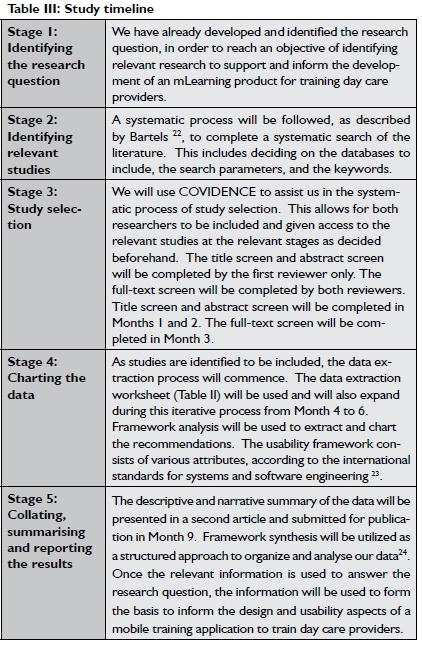
Stage 1: Identifying the research question
The research question was developed with our target population and context in mind, but also stated as broadly as possible, as to not exclude any relevant studies.
The question is: What is known about the usability of mobile or eLearning interventions, that improve the knowledge, skills and attitudes among day care providers in LMICs, to promote early childhood development of 3-6-year olds?
Stage 2: Identifying relevant studies
The search will include three phases, namely: a database search, hand-searching of relevant journals and screening of reference lists of already included articles in previous phases. We chose ERIC, CIHNAL, Africa-Wide Information and Academic Search Premier as relevant databases for the search as these include research in the field of education, allied healthcare professions, and research conducted in Africa.
We selected the parameters to limit our search to studies published in peer-reviewed journals, in English, between January 2009 and January 2019. Peer-reviewed journals were selected to ensure the inclusion of high-quality primary sources. Development of hardware and software are a continuously changing landscape, therefore, only the last 10 years of published research will be considered for this scoping review. This timeframe also coincides with the emergence of smartphones within the African context1020
After considering our research question, we developed the following terms in consultation with a librarian in order of inclusion importance. These will be included in the systematic search: "Early childhood development" OR pre-school OR teacher OR day care
1. Train* OR teach* OR learn*
2. e-Learning OR mlearning OR online OR mobile
3. Africa OR LMIC
When the initial search is done, duplicates of exact results will be automatically removed by the search engine.
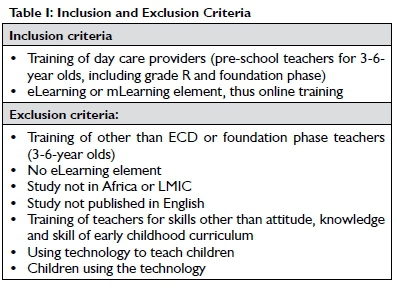
Once the total unique studies are identified using our search string, results will be uploaded to COVIDENCE, a review management software. The first reviewer will consider all the titles against the inclusion and exclusion criteria as described in Table I, after which selected articles will be included for the abstract screen. Journals that publish research on technology will be hand-searched using the same parameters and key-word combination, and additional articles will be selected for abstract screening.
Stage 3: Study selection
Only the first reviewer will complete the next phase by reading the abstracts, considering the inclusion and exclusion criteria, and selecting articles for full text screening. It is important to note that this is part of an iterative process and as inclusion and exclusion criteria develop, studies will be added or eliminated.
Both reviewers will complete the next phase of full text reading. Studies that meet all the inclusion criteria according to both reviewers, will then be added to the final list of articles for this scoping review. All reference lists of studies selected for final inclusion will be scanned for additional articles that may meet the inclusion criteria. These articles will be reviewed and included if appropriate. The COVIDENCE software will be used to maintain an audit trail of all decisions made for inclusion and exclusion by each of the reviewers. The software will also generate the final PRISMA flow diagram indicating the various stages of article review.
Stage 4: Charting the data
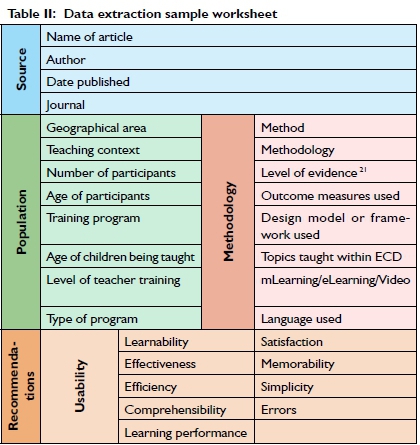
The reviewers developed a data-charting form, using Excel. Data will be extracted on characteristics of the population, the methodology and the results and recommendations. Table II presents a preliminary set of information that we will extract from each study. As we are using an iterative process, the data-charting form may be modified as we proceed through the data extraction process and more information is available from each study. Anticipated changes may be within the aspects of usability, as we will be looking at these recommendations from each included study. During the data extraction and charting process, it is once again very important to reflect on the research question and focus on data from each study that will shed light on the design and usability of the eLearning programs used by the intended population. The changes in this worksheet will be tracked and described during the reporting of the scoping review results.
Stage 5: Collating, summarising, and reporting the results
Results will be reported in a descriptive and narrative summary. We will report on the demographic description of the population, as well as which geographical areas within Africa in which research has been conducted. Other areas of focus for reporting the results will be on the quality of the research included21priori framework to analyse and organize the data. The findings of the scoping review will be published in an article, as well as inform the design and usability considerations for further research on development of a mobile training programme for day care providers in a LMIC.
Patient and public involvement
Although Arksey and O'Malley1718
Ethics and Dissemination
This review does not involve primary data collection, additional institutional ethics review, or informed consent procedures.
CONCLUSION
According to the OTPF7
Authors like Davids et al13-15, emphasised the need for proper usability studies and heuristic evaluation of eLearning and mLearning products, to ensure that the learning outcomes can be achieved by the intended population. This scoping review is necessary to assess what is known about the usability aspects for eLearning and mLearning products used by day care providers for their own formal learning or professional development. This scoping review will help summarize the current peer reviewed literature, identify the research gaps within usability studies and inform future design and usability, as applicable to mLearning products for day care providers in LMICs. The results of this scoping review will also form part of the literature review for the development and testing of a mobile application to train day care providers to teach basic concepts, all within a LMIC context11-13.
Existing literature published in the last 10 years will be analysed and therefore, ethics approval was not required. The scoping review protocol and publication of the protocol is an important step in this scoping review, to ensure transparency and reduce duplication of work. It will be useful to determine what is known about the design and usability of eLearning and mLearning product used by teachers and day care providers in LMICs. mLearning in general is an affordable, accessible, and convenient method for formal training and professional development and should be informed by research to move forward with successful outcomes.
REFERENCES
-
1. Department of Education. Education Statistics in South Africa. Pretoria, http://www.dhet.gov.za/DHETStatisticsPublication/DoEStatsataGlance2007.pdf (2009).
» http://www.dhet.gov.za/DHETStatisticsPublication/DoEStatsataGlance2007.pdf -
2. Department of Basic Education. National Senior Certificate 2018 Highlights Report. Pretoria, https://www.gov.za/sites/default/files/gcis_document/201810/dbe-201718-annual-report.pdf (2019).
» https://www.gov.za/sites/default/files/gcis_document/201810/dbe-201718-annual-report.pdf -
3. Janse van Rensburg O. The school readiness performance of a group of Grade R learners in primary schools in the Gauteng Province of South Africa. South African J Child Educ. 2015; 5: 106-124. http://doi.org/10.4102/sajce.v5i1.352
» http://doi.org/10.4102/sajce.v5i1.352 -
4. Ramey CT Ramey SL. Early Learning and School Readiness: Can Early Intervention Make a Difference? Merrill Palmer Q. 2004; 50: 471-491. http://doi.org/10.1353/mpq.2004.0034
» http://doi.org/10.1353/mpq.2004.0034 -
5. Mashburn AJ, Pianta RC, Hamre BK, et al. Measures of Classroom Quality in Prekindergarten and Children's Development of Academic, Language, and Social Skills. Child Dev. 2008; 79: 732-749. http://doi.org/10.1111/j.1467-8624.2008.01154.x
» http://doi.org/10.1111/j.1467-8624.2008.01154.x -
6. Atmore E, van Niekerk L, Ashley-Cooper M. Challenges Facing the Early Childhood Development Sector in South Africa. http://www.nda.org.za/docs/Challenges-facing-ECD-Sector-in-SA-Prof-Atmore.pdf (2012).
» http://www.nda.org.za/docs/Challenges-facing-ECD-Sector-in-SA-Prof-Atmore.pdf -
7. American Occupational Therapy Association. Occupational therapy practice Framework: Domain and process 3rd Edition. Am J Occup Ther. 2014; 68: 48. http://doi.org/10.5014/ajot.2014.682006
» http://doi.org/10.5014/ajot.2014.682006 -
8. American Occupational Therapy Association. Occupational Therapy Services in Early Childhood and School-Based Settings. Am J Occup Ther. 2011; 65: S46-S54. http://doi.org/10.5014/ajot.2011.65s46
» http://doi.org/10.5014/ajot.2011.65s46 -
9. Delany A, Jehoma S, Lake L. South Afican Child Gauge 2016. Cape Town: Department of Planning, Monitoring and Evaluation, http://www.ci.uct.ac.za/sites/default/files/image_tool/images/367/Child_Gauge/2006/Book_Child_Gauge_2016_lowres.pdf (2016).
» http://www.ci.uct.ac.za/sites/default/files/image_tool/images/367/Child_Gauge/2006/Book_Child_Gauge_2016_lowres.pdf -
10. GSMA. The Mobile Economy. Sub-Saharan Africa. 2019; 1-35. https://www.gsma.com/betterfuture/wp-content/uploads/2019/10/2019-09-24-a60d6541465e86561f37f0f77ebee0f7-1.pdf
» https://www.gsma.com/betterfuture/wp-content/uploads/2019/10/2019-09-24-a60d6541465e86561f37f0f77ebee0f7-1.pdf -
11. Davids M. Development and evaluation of a multimedia e-learning resource for electrolyte and acid-base disorders. Adv Physiol Educ. 2011; 295-306. http://doi.org/10.1152/advan.00127.2010.
» http://doi.org/10.1152/advan.00127.2010 -
12. Zhang D, Adipat B. Challenges, Methodologies, and Issues in the Usability Testing of Mobile Applications. Int J Hum Comput Interact. 2005; 18: 293-308. http://doi.org/10.1207/s15327590ijhc1803_3
» http://doi.org/10.1207/s15327590ijhc1803_3 -
13. Davids MR, Chikte UME, Halperin ML. Effect of improving the usability of an e-learning resource: a randomized trial. AJP Adv Physiol Educ. 2014; 38: 155-160. http://doi.org/10.1152/advan.00119.2013
» http://doi.org/10.1152/advan.00119.2013 -
14. Davids MR, Chikte UME, Halperin ML. An efficient approach to improve the usability of e-learning resources: the role of heuristic evaluation. AJP Adv Physiol Educ .2013; 37: 242-248. http://doi.org/10.1152/advan.00043.2013
» http://doi.org/10.1152/advan.00043.2013 -
15. Davids MR, Chikte U, Grimmer-Somers K, et al. Usability testing of a multimedia e-learning resource for electrolyte and acid-base disorders. Br J Educ Techno.l 2014; 45: 367-381. http://doi.org/10.1111/bjet.12042
» http://doi.org/10.1111/bjet.12042 -
16. Ackerman DJ. Online child care training in the United States: a preliminary investigation of who participates, what is offered, and on which topics the workforce is focusing. Int J Child Care Educ Policy. 2017; 11: 12. http://doi.org/10.1186/s40723-017-0037-7
» http://doi.org/10.1186/s40723-017-0037-7 -
17. Arksey H, O'Malley L. Scoping Studies: Towards a Methodological Framework. Int J Soc Res Methodol. 2005; 8: 19-32. http://doi.org/10.1017/S0922156508005621
» http://doi.org/10.1017/S0922156508005621 -
18. Levac D, Colquhoun H, O'Brien K. Scoping Studies: advancing the methodology. Syst Rev J. 2015; 4: 1-9. http://doi.org/10.1029/2003JD004173.Aires
» http://doi.org/10.1029/2003JD004173.Aires -
19. Garritty C, Moher D, Aldcroft A, et al. PRISMA Extension for Scoping Reviews (PRISMA-ScR): Checklist and Explanation. Ann Intern Med. 2018; 169: 467. http://doi.org/10.7326/m18-0850
» http://doi.org/10.7326/m18-0850 -
20. https://datahelpdesk.worldbank.org/knowledgebase/articles/906519-world-bank-country-and-lending-groups.
» https://datahelpdesk.worldbank.org/knowledgebase/articles/906519-world-bank-country-and-lending-groups -
21. Merlin T, Weston A, Tooher R. Extending an evidence hierarchy to include topics other than treatment : revising the Australian ' levels of evidence'. 2009; 8: 1-8. http://doi.org/10.1186/1471-2288-9-34
» http://doi.org/10.1186/1471-2288-9-34 -
22. Bartels EM. How to perform a systematic search. Best Pract Res Clin Rheumatol. 2013; 27: 295-306. http://doi.org/10.1016/j.berh.2013.02.001
» http://doi.org/10.1016/j.berh.2013.02.001 -
23. International Standards Organization/International Electrotechnical Commission. System and software quality models. https://pdfs.semanticscholar.org/57a5/b99eceff9da205e-244337c9f4678b5b23d25.pdf (2011).
» https://pdfs.semanticscholar.org/57a5/b99eceff9da205e-244337c9f4678b5b23d25.pdf -
24. Barnett-Page E, Thomas J. Methods for the synthesis of qualitative research: A critical review. BMC Med Res Methodol; 9. Epub ahead of print 2009. http://doi.org/10.1186/1471-2288-9-59
» http://doi.org/10.1186/1471-2288-9-59

ROLES OF AUTHORS:
Monique De Wit is the first author and this article is the first of two as part of her Master's Degree at the Stellenbosch University.
Nicola Ann Plastow is the second author and acted as supervisor for the thesis, and contributed to the study as the second reviewer where indicated.