Changes in cognitive functional performance and basic activities of daily living in patients with traumatic brain injury after two methods of cognitive retraining
INTRODUCTION: Evidence supports a bottom-up approach to assist in addressing functional cognitive deficits in patients with traumatic brain injury (TBI). There is however, little evidence supporting the use of online programmes for this purpose. The aim of this research was to describe the outcomes for cognitive functional performance and basic activities of daily living (bADL) or self-care functioning after cognitive retraining using an online programme versus task-oriented intervention for patients with acute mild and moderate traumatic brain injury. METHODS: A quantitative, quasi-experimental, longitudinal research design was used for determining within-group and between-groups changes for cognitive functional performance and bADL functioning in two sample groups with mild to moderate TBI. Intervention using an online programme (n=7) or task-oriented activities (n=15) was evaluated at three assessment intervals: on recruitment into the study (Assessment 1), on completion of inpatient hospital intervention (Assessment 2) and after four weeks of home programme intervention and fortnightly outpatient intervention (Assessment 3). RESULTS: Results for both groups showed a statistically significant change for cognitive functional performance assessed on the Bay Area Functional Performance Evaluation (BaFPE) while the task-oriented cognitive training group also achieved a statistically significant change in bADL scores during the first inpatient assessment period. Only the online programme group had statistically significant improvement during the home programme in the third assessment period. CONCLUSION: Cognitive retraining using an online programme or task-oriented activities resulted in positive change in a therapist-directed inpatient programme but a structured, graded, online programme was more effective in supporting significant improvement in cognitive functional performance when used together with an outpatient home programme. IMPLICATIONS FOR PRACTICE • Cognitive retraining using an online programme or task orientated activities have a positive outcome for cognitive functional performance in patients with mild or moderate TBI in a therapist directed inpatient intervention. • A task orientated approach for cognitive retraining appears to have positive effect on bADL outcomes. • Cognitive retraining using an online programme intervention should be considered as a home programme to improve cognitive functional performance in patients with mild or moderate TBI.
online programme; task-oriented activities; mild to moderate TBI; inpatient; outpatient home programme; Bay Area Functional Performance Evaluation; BaFPE
Changes in cognitive functional performance and basic activities of daily living in patients with traumatic brain injury after two methods of cognitive retraining
Denise FranzsenI; Zukiswa MsenganaII
IDepartment of Occupational Therapy, School of Therapeutic Sciences, Faculty of Health Sciences, University of the Witwatersrand,7 York Rd, Parktown, Johannesburg, Gauteng, South Africa. https://orcid.org/0000-0001-8295-6329
IIOccupational Therapist - Acute Stroke Unit, Assessment and Rehabilitation Unit, Whangärei Hospital, 2 Hospital Road, Whangārei New Zealand. https://orcid.org/0000-0001-7302-8088
INTRODUCTION: Evidence supports a bottom-up approach to assist in addressing functional cognitive deficits in patients with traumatic brain injury (TBI). There is however, little evidence supporting the use of online programmes for this purpose. The aim of this research was to describe the outcomes for cognitive functional performance and basic activities of daily living (bADL) or self-care functioning after cognitive retraining using an online programme versus task-oriented intervention for patients with acute mild and moderate traumatic brain injury.
METHODS: A quantitative, quasi-experimental, longitudinal research design was used for determining within-group and between-groups changes for cognitive functional performance and bADL functioning in two sample groups with mild to moderate TBI. Intervention using an online programme (n=7) or task-oriented activities (n=15) was evaluated at three assessment intervals: on recruitment into the study (Assessment 1), on completion of inpatient hospital intervention (Assessment 2) and after four weeks of home programme intervention and fortnightly outpatient intervention (Assessment 3).
RESULTS: Results for both groups showed a statistically significant change for cognitive functional performance assessed on the Bay Area Functional Performance Evaluation (BaFPE) while the task-oriented cognitive training group also achieved a statistically significant change in bADL scores during the first inpatient assessment period. Only the online programme group had statistically significant improvement during the home programme in the third assessment period.
CONCLUSION: Cognitive retraining using an online programme or task-oriented activities resulted in positive change in a therapist-directed inpatient programme but a structured, graded, online programme was more effective in supporting significant improvement in cognitive functional performance when used together with an outpatient home programme.
IMPLICATIONS FOR PRACTICE
• Cognitive retraining using an online programme or task orientated activities have a positive outcome for cognitive functional performance in patients with mild or moderate TBI in a therapist directed inpatient intervention.
• A task orientated approach for cognitive retraining appears to have positive effect on bADL outcomes.
• Cognitive retraining using an online programme intervention should be considered as a home programme to improve cognitive functional performance in patients with mild or moderate TBI.
Keywords: online programme, task-oriented activities, mild to moderate TBI, inpatient, outpatient home programme, Bay Area Functional Performance Evaluation (BaFPE)
INTRODUCTION AND LITERATURE REVIEW
Traumatic brain injury (TBI) is an "alteration in brain function, or other evidence of brain pathology, caused by an external force"1:1368 Individuals with TBI are treated by the multi-disciplinary team (MDT), including occupational therapists2345
A 2020 study by Nowell et al.67897
Both international and national best practice guidelines support cognitive retraining associated with impaired self-awareness and personalised life skills training, as well as facilitating learning and internal and external compensatory strategies for memory8,9. Visual perceptual deficits, apraxia, and visual neglect should be addressed using remedial-based strategies. Technology such as computers have been recommended for improving working memory and attention8,9. Other techniques such as mirror therapy for unilateral inattention can also be considered777
These best practice guidelines support occupational therapy intervention in understanding the impact of functional cognition on everyday task performance for both assessment and intervention10 1011121314
There is also evidence that cognitive retraining supports the ability to accomplish daily life functional activities that rely on cognitive abilities or functional cognition5,15. However, the effect of cognitive retraining on functional performance is not clear. Radomski et al.141416616
In their systematic review of computer-based cognitive interventions in TBI in 2020, Lopez and Antoli17141819202122
This study investigated interventions that are in keeping with evidence-based practice to support treatment modalities used in the cognitive rehabilitation of individuals with mild to moderate TBI in the South African public health care service. The purpose of the study was to compare outcomes for cognitive functional performance and bADL using two methods of cognitive retraining intervention.
METHODOLOGY
Research Design
A quantitative quasi-experimental longitudinal research design was used in order to compare cognitive functional performance and bADL outcomes in patients with mild and moderate acute TBI. Intervention for cognitive retraining included either an online programme or a task orientated approach in conjunction within a routine occupational therapy intervention programme23
Research setting
The study took place at tertiary hospital in South Africa. The occupational therapy department at the research site serves patients with a variety of neurological deficits, including patients with TBI. The TBI survivors are referred by the multidisciplinary team or by routine screening of the neurosurgical wards. Patients include those who survived traumatic external insults to the brain such as assaults, falling from heights and motor or pedestrian vehicle accidents as well as those with internal brain insults due to tumours.
The patients are hospitalised for periods varying from five days to over a month depending on the extent of physical injury or the need for surgery. A multidisciplinary team, consisting of doctors, nurses, occupational therapists, physiotherapists, speech therapists and dieticians, provides comprehensive intervention. Occupational therapy intervention occurred either in the ward or in the occupational therapy department. Therapists were using an eclectic approach which addresses cognitive and physical deficits as well as independence in activities of daily living. On discharge, TBI patients were booked for follow up appointments with the multi-disciplinary team. The waiting time for an outpatient post-discharge appointment was approximately two weeks.
Research population and sample
The population for this study consisted of potential participants that were referred to occupational therapy with mild or moderate TBI who met the inclusion criteria during the 10-month research period.
Inclusion criteria included males and female patients aged between 18 and 60 years, with mild or moderate TBI based on the Glascow Coma Scale (GCS) > 12 on admission to hospital. Participants needed to be medically stable and required adequate motor skills of the non-affected hand to perform tasks successfully24< 24 on SLUMS and now had a GCS =15, they were deemed to need rehabilitation for cognition and were invited to participate in the study. Those with receptive aphasia, as confirmed by a speech therapist, and those who were unable to speak were excluded from the study since the assessment tools required patients to give verbal responses. Patients with a history of mental illness were also excluded from the study.
The sample size for this study was based on an 18 points difference with an SD of 15, between Assessment 1 when recruited into the study to Assessment 2 on completion of inpatient treatment2225
Measuring instruments
Demographic Questionnaire
A demographic questionnaire was specifically designed for this study. With participants' permission the family was contacted for collateral information if the participant could not give sufficient information.
Saint Louis Mini Mental Status Examination (SLUMS)
Bay Area Functional Performance Evaluation (BaFPE)
The BaFPE32
The BaFPE TOA is consistent with a functional perspective and evaluates functional parameters reflected by productive and active use of skills for successful interaction with the environment321832
The validity of the BaFPE has been reported from different research findings. Kaufman333434,35.
Modified Barthel Index (MBI)
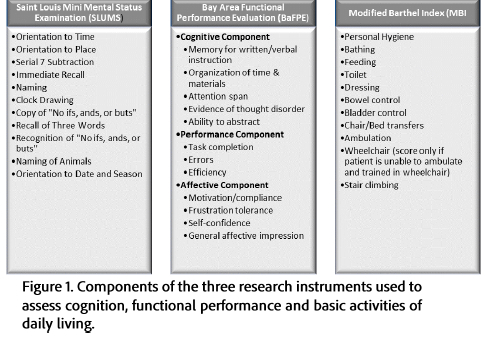
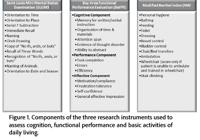
The Modified Barthel Index2236363738Figure 1, (below).
Data collection
Treating occupational therapists identified patients who met in the inclusion criteria and recruited patients into the study. Signed informed consent for participation in study and permission to access to medical records was obtained from either the patients or their family members if the patient was functioning at a level of self-presentation or below according to the Vona du Toit Model of Creative Ability (VdTMoCA)3940
The first author who was the primary researcher collected the demographic information from the participants, or their relatives and the medical history was obtained from the patients' medical record. She also administrated and scored the BaFPE and MBI to establish baseline cognitive functional performance skills and bADL function within 24 hours after referral to the study (Assessment 1). Participants were allocated to either the online programme group if they indicated that they had access to a smart phone or the task orientated group if they did not. All participants formed part of the second author's patient load to ensure consistent routine therapy for each group. The routine occupation-based intervention focussing on assisting them in reducing or compensating for motor fallout for hemiplegia present in all participants, as well as achieving emotional and behavioural goals. Participants received treatment a minimum of four times per week for 45 minutes as inpatients.
After discharge from the hospital, participants followed a daily home programme using the online programme or task-oriented home programmes for a minimum of four weeks with an out-patient appointment every two weeks. The second author reassessed their cognition using the SLUMs to confirm continuing impairment and need for intervention. Cognitive functional performance skills and bADL functions were reassessed using the BaFPE and MBI on the completion of inpatient treatment (Assessment 2) and at four weeks post discharge. (Assessment 3).
Intervention
Online programme group
The online programme intervention group used Luminosity414142
Task-oriented activities group
The task-oriented activities intervention which was completed by participants as in-patients and as a home programme, aimed to improve learning, memory, awareness, problem solving and attention as well as addressing any identified visual perceptual problems, using purposeful tasks and recreation activities to maintain patient motivation4344
Home programme
All participants were provided with a home programme on discharge. The online programme group continued with the Luminosity programme once a day while the task-oriented activities group were provided with a schedule for 30-minute task orientated activities to complete each day. All participants were asked to keep a diary of their compliance to both home programmes. They received daily messages on their phones reminding them to complete the programme via WhatsApp or SMS and the log for completion of Luminosity tasks was checked on participants phones during their outpatient visits.
Ethical Considerations
The research protocol was approved by the Medical Advisory Committee at the Chris Hani Baragwanath Hospital and the head of the occupational therapy department at the research site. Ethical clearance was gained from University of the Witwatersrand, Human Research Ethics Committee (M200883). Patients with TBIs were identified by treating occupational therapists who provided the approved information sheets to all the participants or a family member. The research was verbally explained in three languages (English, isiZulu and Sesotho) as they applied to the participants or their family. All participants or family members gave signed informed consent for participation in the study and review of the patients' medical records. Participation was voluntary and participants or their family had the right to withdraw from the study at any time without consequence. Autonomy was ensured by respecting the decisions of the participants or their family about participating in and continued participation in the study beyond discharge from the hospital. Within this research study there was an exchange of information between the researcher and participants keeping the participants (and the family with the participants' permission) fully informed throughout the study period.
Data Analysis
Descriptive statistics were used for the demographic data, SLUMS, BaFPE and MBI for this study. The outcomes of online programme and the task-orientated group were compared using statistics that suited the small sample size and ordinal data454647
RESULTS
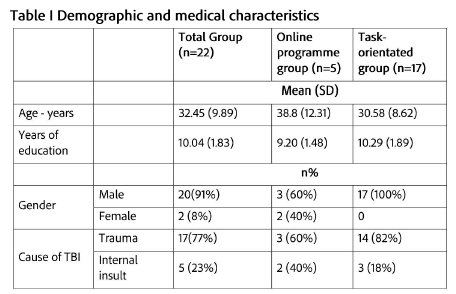
The analysis of the data was completed on 22 participants who all scored in the moderate range for cognitive function on the SLUMS on referral to occupational therapy. Five participants had smart phones and made up the online programme group while 17 were in the task-orientated group.
Most participants were male (91%), and the mean age of participants was 32.45 years. On average participants had nine years of education and trauma (77%) was the most frequent cause of the TBI (Table I. above).
Within-Group Results
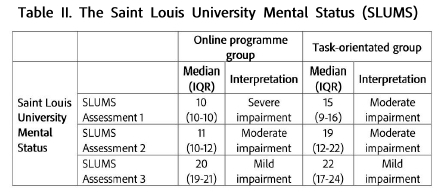
The online programme group presented with lower SLUMS scores on Assessment 1 indicated participants presented with severe cognitive deficits even though they had a GCS indicating mild to moderate TBI when recruited into the study. At Assessment 2 on discharge than the task-orientated group had further improvement but both groups had mild impairment with median scores of 20 and 22 respectively at Assessment 3 after four weeks home programme (Table II, below):
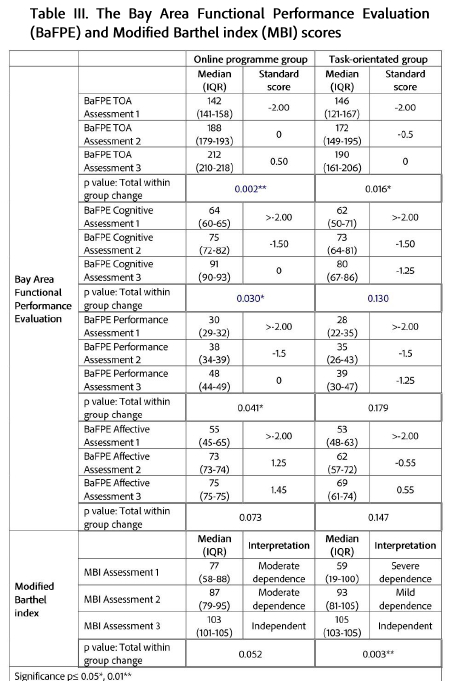
The BaFPE total TOA scores improved for both groups during therapist guided intervention in-hospital programme between Assessment 1 and Assessment 2 and greater improvement was seen in the online programme group during the home programme between Assessment 2 and Assessment 3. Both groups scored standard ζ scores of -2.0 on Assessment 1 when recruited into the study indicating moderate dysfunction. The total change within both groups was statistically significant and both groups had standard scores close to 0 at Assessment 3 (Table III, below):
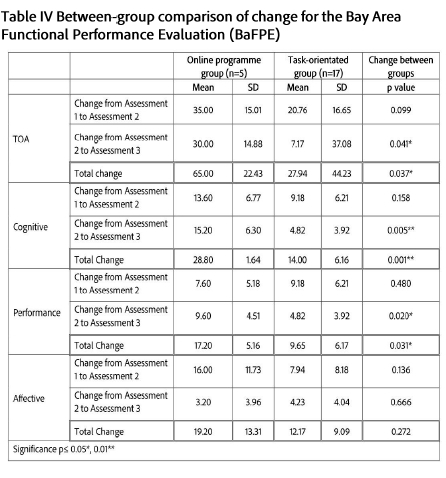
Results for BaFPE cognitive, and performance parameters found that scores for the two groups were similar for the Assessment 1 when recruited into the study and Assessment 2, but the online programme groups had higher scores at Assessment 3 after a four-week home programme, with a statistically significant change for both parameters. The total change for the affective component was not statistically significant for either group.
The MBI scores were lower for task-orientation group on Assessment 1 when recruited into the study but were nearly equal for both groups at Assessment 2 with scores the online programme group still having moderate dependence at this stage. All participants were independent at Assessment 3 with the total change for the task orientation group being statistically significant (Table III. adjacent).
Between-Group Results
Change in functional performance scores.
Bay Area Functional Performance Evaluation (BaFPE)
Functional performance in the total TOA indicated greater change in the online programme group during in-hospital-based programme from Assessment 1 when recruited into the study compared to Assessment 2, but this did not differ significantly from the task orientated group (Table IV, below). However, the change when completing the home programme from Assessment 2 to Assessment 3 and the total change from Assessment 1 when recruited into the study to Assessment 3 was statistically significant between the two groups with the online programme group having a greater change. The results for changes in cognitive scores and performance scores were similar. Affective functional performance did not differ significantly between the two groups.
Change in Basic Activities of Daily Living scores
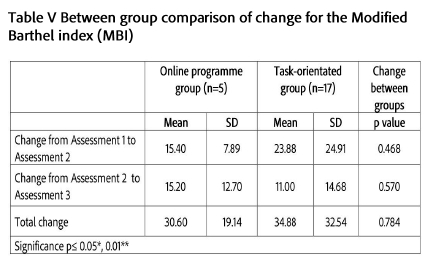
The change between Assessment 1 when recruited into the study to Assessment 2 (discharge) was greater for the task-orientated group who had lower MBI scores indicating severe dependence on Assessment 1 when recruited into the study. The online programme group showed less improvement while in hospital and greater improvement at home when completing the home programme on Assessment 3 with no significant difference found between the groups at any assessment period (Table V, page 6).
Correlations between basic activities of daily living and cognitive/functional performance scores
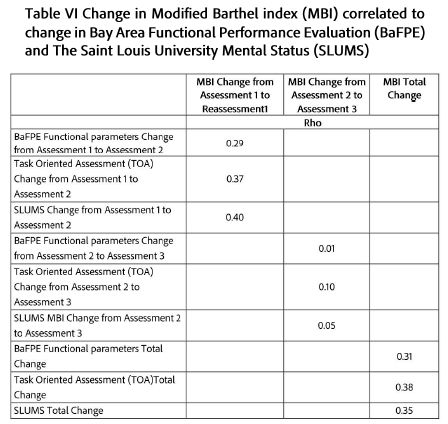
All low and moderate non-significant corrections indicated 16%-20% of variation in bADL assessed with the MBI can be accounted for by variation in functional performance assessed by the BaFPE and cognition assessed by the SLUMS for the Assessment 1 when recruited into the study scores and for overall change (Table VI, below).
DISCUSSION
The aim of the research was to describe the outcomes of cognitive retraining using an online programme or task orientated interventions on daily living cognitive functional performance and bADL functioning, in patients with mild or moderate TBIs.
The demographics of the patients did differ in the two groups for gender with both females in the online programme group. The sample did however reflect the profile for patients with mild and moderate TBI reported for South Africa by Malaie et al48
All participants were identified with cognitive impairment based on a SLUMS score below 24 set as a cutoff for TBI patients. The SLUMS examination has been found to be more accurate than other cognitive screening tools for identifying cognitive impairment in TBI patients with less than 12 years formal education26302949
The within-group results for all the scores on the BaFPE indicated a significant improvement overall for the online programme group while only the TOA and the MBI indicated a significant improvement overall within the task orientation group. This result appears to indicate that both interventions were effective in addressing task based functional performance over the in-patient study period. Only the online programme group had significant improvement for the cognitive and performance parameters on the BaFPE, indicating improvement in memory for instructions, organisation, ability to abstract, task completion and efficiency as well as reduction in errors during task completion. The improvement in these skills were supported by Finn et al.4265051
It appears that when using the online programme which targeted specific cognitive components there was carry-over particularly in the cognitive and performance parameters assessed by the BaFPE. The BaFPE cognitive parameters included memory for instructions, organisation of time and materials, attention span, thought progression and ability to abstract. These findings are supported by Dams-O'Connor and Gordon5252
The between group change in scores from Assessment 1 to Assessment 2 did not differ between the two groups when they completed the intervention while in hospital. In the second assessment period while using the home programme, a significant change was found for all scores on the BaFPE, when the online programme group was compared to the task-orientated group, with a highly significant total change between the groups over the study period. The results of this study support the use of the online programme for effective intervention within a home programme. The app provides a structured graded programme which patients can easily follow.
The task orientated intervention was effective when it was therapist-directed in hospital but as a home programme, the support required to facilitate performance and application of cognitive skills in everyday activities may have been lacking. Thus, the implementation of this type of home programme was less effective. The standard ζ scores of the task-orientated group indicated participants were still at risk for dysfunction in both cognitive and performance parameters on the BaFPE after completing their home programme for four weeks post discharge.
The affective parameter which assesses motivation, compliance, frustration tolerance, self-confidence as well as general affective and behavioural impression32
A highly significant within-group change on the MBI was found for the task-orientated group while in hospital on Assessment 2. This change was greater than that reported by Shah et al.2250
The online programme group achieved similar change to the task-orientated group for bADL functioning during the home programme to Assessment 3. This may have occurred since there was no control over what activities participants engaged in once they were discharged and the online programme group may well have been involved in similar activities to those suggested for the task-orientated group in this time. The final MBI scores indicate that participants in this sample were independent in bADL functioning despite their residual motor deficits. However, based on the BaFPE cognitive and performance parameter scores, the participants in the task-orientated group still required reminders to complete activities. Although the MBI is identified as suited to assessment of bADL it does need to be administered as an observed assessment for TBI patients when cognition affects bADL. It is possible that other assessments which consider habits and routines and evaluate a broader aspect of functional cognition considering tasks in bADL functioning and instrumental activities of daily living (iADLs) should be considered38
Limitations of the study
The second author who collected the data was not blinded to the participant groups and for logistical reasons had to complete both the assessments and the treatment for all participants. The resource constrained context from which the participants were recruited resulted in only a small number of participants with access to a smart phone or computer. This was in line with the about one third of the country's population who use smart phones53
CONCLUSION
This study considered the effectiveness of cognitive retraining interventions using an online programme as compared to a task-oriented activity approach with patients with mild or moderate TBI. The outcomes for daily life cognitive functional performance and bADL function indicated both intervention approaches were effective for an inpatient hospital programme which was therapist directed. Both the online and task orientated interventions supported the assumption that intervention for basic cognitive functions may be a prerequisite for improving higher-order cognitive skills to achieve outcomes for performance and cognition in tasks.
However, this assumption appears to be better supported by the online intervention in home programmes where engagement in therapy is patient-directed. The use of an online programme with daily reminders facilitated significant improvement in the cognitive and performance parameters required for task completion as assessed by the BaFPE. The task-oriented activities approach did not achieve similar results when only a task-based home programme was used with participants post discharge.
Author contributions
Denise Franzsen and Zukiswe Msengana conceptualised the project and Zukiswe Msengana collected the data. Denise Franzsen analysed the data. Both authors wrote and revised the article to completion and approved the final version.
Conflicts of interest
Authors have no competing interests to declare
REFERENCES
-
1. Menon DK, Schwab K, Wright DW, Maas AI. Position statement: Definition of traumatic brain injury. Archives of Physical Medicine and Rehabilitation. 2010;91(11):1637-1640. doi: https://doi.org/10.1016/j.apmr.2010.05.017
» https://doi.org/10.1016/j.apmr.2010.05.017 -
2. Li LM, Dilley MD, Carson A, Twelftree J, Hutchinson PJ, Belli A, Betteridge S, Cooper PN, Griffin CM, Jenkins PO, et al. Management of traumatic brain injury (TBI): A clinical neuroscience-led pathway for the NHS. Clinical Medicine, Journal of the Royal College of Physicians of London. 2021;21(2):E198-E205. doi: https://doi.org/10.7861/CLINMED.2020-0336
» https://doi.org/10.7861/CLINMED.2020-0336 -
3. Rabinowitz AR, Levin HS. Cognitive Sequelae of Traumatic Brain Injury. Psychiatric Clinics of North America. 2014;37(1):1-11. doi: https://doi.org/10.1016/j.psc.2013.11.004
» https://doi.org/10.1016/j.psc.2013.11.004 -
4. Gorgoraptis N, Zaw-Linn J, Feeney C, Tenorio-Jiménez, C, Niemi M, Malik A, Ham T, Goldstone AP, Sharp D. Cognitive impairment and health-related quality of life following traumatic brain injury. NeuroRehabilitation. 2019;44(3):321-331. doi: https://doi.org/10.3233/NRE-182618
» https://doi.org/10.3233/NRE-182618 -
5. Donovan NJ, Heaton SC, Kimberg CI. Conceptualizing functional cognition in traumatic brain injury rehabilitation Conceptualizing functional cognition in traumatic brain injury rehabilitation. 2011;(February). doi: https://doi.org/10.3109/02699052.2011.556105
» https://doi.org/10.3109/02699052.2011.556105 -
6. Nowell C, Downing M, Bragge P, Ponsford J, Nowell C, Downing M, Bragge P, Ponsford J, Bragge P. Current practice of cognitive rehabilitation following traumatic brain injury: An international survey. Neuropsychological Rehabilitation. 2020;30(10):1976-1995. doi: https://doi.org/10.1080/09602011.2019.1623823
» https://doi.org/10.1080/09602011.2019.1623823 - 7. Poulin JA, Lamontagne M., Pellerin M., Viau-Guay A, Ouellet M. Identifying clinicians' priorities for the implementation of best practices in cognitive rehabilitation post-acquired brain injury. Disability and Rehabilitation. 2021;43(20):2952-2962.
-
8. Lanctôt KL, Lindsay MP, Smith EE, Sahlas DJ, Foley N, Gubitz G, Austin M, Ball K, Bhogal S, Blake T, et al. Canadian Stroke Best Practice Recommendations: Mood, Cognition and Fatigue following Stroke, 6th edition update 2019. International Journal of Stroke. 2020;15(6):668-688. doi: https://doi.org/10.1177/174749301984733
» https://doi.org/10.1177/174749301984733 -
9. Institut national d'excellence en santé et en services sociaux (INESSS) and Ontario Neurotrauma Foundation (ONF). INESSS-ONF clinical practice guideline for the rehabilitation of adults with moderate to severe TBI. 2023. https://braininjuryguidelines.org
» https://braininjuryguidelines.org -
10.Giles GM, Edwards DF, Baum C, Furniss J, Skidmore E, Wolf T, Leland NE. Making functional cognition a professional priority. The. American Journal of Occupational Therapy. 2020;74(1):7401090010p1-7401090010p6. doi: https://doi.org/10.5014/ajot.2020.741002
» https://doi.org/10.5014/ajot.2020.741002 -
11. Dang B, Chen W, He W, Chen G. Rehabilitation Treatment and Progress of Traumatic Brain Injury Dysfunction. Neural Plasticity. 2017, 2017. doi: https://doi.org/10.1155/2017/1582182
» https://doi.org/10.1155/2017/1582182 - 12. Vas A, Luedtke A, Ortiz E, Neville M. Bottom-up and top-down cognitive rehabilitation following mild traumatic brain injury -Occupational therapists' perspective: An online survey study. The Indian Journal of Occupational Therapy. 2021;53(2):56.
-
13. Giles GM. Cognitive versus functional approaches to rehabilitation after traumatic brain injury: Commentary on a randomized controlled trial. American Journal of Occupational Therapy. 2010;64(1):182-185. doi: https://doi.org/10.5014/ajot.64.1.182
» https://doi.org/10.5014/ajot.64.1.182 -
14. Radomski MV, Anheluk M, Penny Bartzen M, Zola J. Effectiveness of interventions to address cognitive impairments and improve occupational performance after traumatic brain injury: A systematic review. American Journal of Occupational Therapy. 2016,70(3):1-10. doi: https://doi.org/10.5014/ajot.2016.020776
» https://doi.org/10.5014/ajot.2016.020776 -
15. Taylor Postma R, Rider J V, Otty R. Functional Cognition: An Opportunity to Highlight the Role of Occupational Therapy in Post-Concussion Care. The Open Journal of Occupational Therapy. 2022,10(2):1-6. doi: https://doi.org/10.15453/2168-6408.1909
» https://doi.org/10.15453/2168-6408.1909 -
16. Wong D, Sinclair K, Seebrook E, McKay A, Ponsford J. Smartphones as assistive technology following traumatic brain injury: a preliminary study of what helps and what hinders. Disability and Rehabilitation. 2017;39(23):2387-2394. doi: http://dx.doi.org/10.1080/09638288.2016.1226434
» http://dx.doi.org/10.1080/09638288.2016.1226434 -
17. Lopez RF, Antoli A. Computer-based cognitive interventions in acquired brain injury: A systematic review and meta-analysis of randomized controlled trials. PLoS ONE. 2020, 15(7 July):1-14. doi: https://doi.org/10.1371/journal.pone.0235510
» https://doi.org/10.1371/journal.pone.0235510 -
18. Mann WC, KlyczekJP, Fiedler RC. Bay Area Functional Performance Evaluation (BaFPE) Standard Scores. Occupational Therapy in Mental Health. Occupational Therapy in Mental Health. 1998;9(3):1-7. doi: https://doi.org/10.1300/J004v09n03
» https://doi.org/10.1300/J004v09n03 - 19. Burns T. Cognitive Performance Test revised manual. Pequannock: Maddak; 2018.
- 20. Baum CM, Wolf TJ. Executive Function Performance Test (EFPT). St. Louis.: Washington University; 2013.
-
21. Khan F, Amatya B, Judson R, Chung P, Truesdale M, Elmalik A, Galea MP. Factors associated with long-term functional and psychological outcomes in persons with moderate to severe traumatic brain injury. Journal of Rehabilitation Medicine. 2016;48(5):442-448. doi:https://10.2340/16501977-2084
» https://10.2340/16501977-2084 -
22.Shah S, Müncer S, Griffin J, Elliott L. The utility of the Modified Barthel Index of Traumatic Brain Injury rehabilitation and prognosis. British Journal of Occupational Therapy. 2000;63(10):469-475. doi: https://doi.org/10.1177/030802260006301003
» https://doi.org/10.1177/030802260006301003 - 23. Kielhofner G. Research in Occupational Therapy: Methods of Inquiry for Enhancing Practice. FA Davis; 2006.
-
24. Breen-Franklin A. Assessments in Occupational Therapy Mental Health: An Integrative Approach (4th ed.). Occupational Therapy In Health Care. 2021:1-3. doi: https://doi.org/10.1080/07380577.2021.2005856
» https://doi.org/10.1080/07380577.2021.2005856 -
25.Schmidt SA, Lo S, Hollestein L. Research techniques made simple: sample size estimation and power calculation. Journal of Investigative Dermatology. 2018;138(8):1678-1682. doi: https://doi.org/10.1016/j.jid.2018.06.165
» https://doi.org/10.1016/j.jid.2018.06.165 -
26. Wu Y, Wang Y, Zhang Y, Yuan X, Gao X. A preliminary study of the Saint Louis University Mental Status examination (SLUMS) for the assessment of cognition in moderate to severe traumatic brain injury patients. Applied Neuropsychology:Adult. 2023;30(4):409-413. doi: https://doi.org/10.1080/23279095.2021.1952414
» https://doi.org/10.1080/23279095.2021.1952414 - 27.-0-0p-Folstein M, McHugh P. Mini mental state a practical method for grading the cognitive state of patients for the clinician. Journal of Psychiatric Research. 1975;12(1):189-198.
-
28. Tariq SH, Tumosa N, Chibnall JT, Perry MH, Morley JE. Comparison of the Saint Louis University Mental Status examination and the Mini-Mental State Examination for detecting dementia and mild neurocognitive disorder - A pilot study. American Journal of Geriatric Psychiatry. 2006;14(11):900-910. doi: https://doi.org/10.1097/01JGP.0000221510.33817.86
» https://doi.org/10.1097/01JGP.0000221510.33817.86 -
29. Noyes ET, Major S, Wilson AM, Campbell EB, Ratcliffe LN, Spencer RJ. Reliability and Factor Structure of the Saint Louis University Mental Status (SLUMS) Examination. Clinical Gerontologist. 2022;00(00):1-7. doi: https://doi.org/10.1080/07317115.2022.2120446
» https://doi.org/10.1080/07317115.2022.2120446 -
30. Zhang S, Wu YH, Zhang Y, Zhang Y, Cheng Y Preliminary study of the validity and reliability of the Chinese version of the Saint Louis University Mental Status Examination (SLUMS) in detecting cognitive impairment in patients with traumatic brain injury. Applied Neuropsychology:Adult. 2021;28(6):633-640. doi: https://doi.org/10.1080/23279095.2019.1680986
» https://doi.org/10.1080/23279095.2019.1680986 -
31.Shwartz SK, Morris RD, Penna S. Psychometric properties of the Saint Louis University Mental Status Examination. Applied Neuropsychology:Adult. 2019;26(2):101-110. doi: https://doi.org/10.1080/23279095.2017.1362407
» https://doi.org/10.1080/23279095.2017.1362407 -
32. Houston D, Williams SL, Bloomer J, Mann WC. The Bay Area Functional Performance Evaluation: Development and Standardization. American Journal of Occupational Therapy. 1989;43(3):170-183. doi: https://doi.org/10.5014/ajot.43.3.170
» https://doi.org/10.5014/ajot.43.3.170 - 33. Kaufman L. A Comparison of Performance on the Bay Area of Functional Performance Evaluation and Kohlman Evaluation of Living Skills in Adult Psychiatric Patients (thesis). Professionals MC of AH, editor. Gainesville: University of Florida,; 1982.
- 34. Accardi M. The Bay Area of Functional Performance Evaluation: A validity Study (thesis). Medford: Tufts University; 1982.
-
35. Wener-Altman P, Wolfe A, Staley D. Utilization of the Bay Area Functional Performance Evaluation with an adolescent psychiatric population, pp.129-136. Canadian Journal of Occupational Therapy. 1991, 58(3):129-136. doi: https://doi.org/10.1177/000841749105800305
» https://doi.org/10.1177/000841749105800305 - 36. Shah S, Vanclay F, Cooper B. Improving the sensitivity of the Bartel Index for stroke rehabilitation. Journal of Clinical Epidemiology. 1989;42(8):703-709.
-
37. Ohura T, Hase K, Nakajima Y, Nakayama T. Validity and reliability of a performance evaluation tool based on the modified Barthel Index for stroke patients. BMC Medical Research Methodology. 2017, 17(1). doi: https://doi.org/10.1186/s12874-017-0409-2
» https://doi.org/10.1186/s12874-017-0409-2 -
38. Breytenbach FC, Freeme JD, De Witt PA, Franzsen D. Content validity of the modified Barthel Index for stroke patients in an African country. South African Journal of Occupational Therapy. 2023;53(3):3-12. doi: https://10.17159/2310-3833/2023/vol53n3a2
» https://10.17159/2310-3833/2023/vol53n3a2 - 39. van der Reyden D, Casteleijn D, Sherwood W, de Witt P. The Vona du Toit Model of Creative Ability: Origins, Constructs, Principles and Application in Occupational Therapy. Pretoria: The Marie and Vona du Toit Foundation; 2019.
- 40. Hagen C, Malkmus D, Stenderup-Bowman K. The Rancho levels of cognitive functioning. Downey, CA: Rancho Los Amigos Medical Center; 1998.
-
41. Bainbridge K, Mayer RE. Shining the Light of Research on Lumosity. 2018:43-62. doi: https://doi.org/10.1007/s41465-017-0040-5
» https://doi.org/10.1007/s41465-017-0040-5 - 42. Finn M, Mcdonald S. Computerised Cognitive Training for Older Persons With Mild Cognitive Impairment : A Pilot Study Using a Randomised Controlled Trial Design. Brain Impairment. 2007;12(3):187-199.
- 43. Cognitive rehabilitation: A pilot survey of therapeutic modalities used by Canadian occupational... Canadian Journal of Occupational Therapy. 2000;67(3):184.
-
44. Park HY, Maitra K, Martinez KM. The effect of occupation-based cognitive rehabilitation for traumatic brain injury: A meta-analysis of randomized controlled trials. Occupational Therapy International. 2015, 22(2):104-116. doi: https://doi.org/10.1002/oti.1389
» https://doi.org/10.1002/oti.1389 - 45. Field A. Discovering Statistics using SPSS (and sex and drugs rck and roll). 2009.
-
46. Trochim WM, Donnelly JP. Research Methods Knowledge Base. 2001. https://www.researchgate.net/publication/243783609 The Research Methods Knowledge Base
» https://www.researchgate.net/publication/243783609 - 47.Creswell J. Research Design: Qualitative, Quantitative and Mixed Method Approaches. Third. Knight V, Connelly S, Habib L, Quesenberry S, Power Scott M, editors. California: Sage Publications; 2009.
-
48. Malaie ML, Dufourq N, Parag N. A profile of traumatic brain injuries and associated cervical spine injuries at a regional hospital in the kwazulu-natal province. South African Family Practice. 2020, 62(1):1-6. doi: https://doi.org/10.4102/safp.v62i1.5136
» https://doi.org/10.4102/safp.v62i1.5136 -
49. Merz ZC, Lace JW. Clinical utility of the Saint Louis University Mental Status Examination (SLUMS) in a mixed neurological sample: Proposed revised cutoff scores for normal cognition, mild cognitive impairment, and dementia. Applied Neuropsychology:Adult. 2022;0(0):1-8. doi: https://doi.org/10.1080/23279095.2022.2106572
» https://doi.org/10.1080/23279095.2022.2106572 -
50. Cicerone KD, Langenbahn DM, Braden C, Malee JF, Kalmar K, Fraas M, Felicetti T, Laatsch L, Harley JP, Bergquist T, et al. Evidence-based cognitive rehabilitation: Updated review of the literature from 2003 through 2008. Archives of Physical Medicine and Rehabilitation. 2011;92(4):519-530. http://dx.doi.org/10.1016/j.apmr.2010.11.015. doi: https://10.1016/j.apmr.2010.11.015
» http://dx.doi.org/10.1016/j.apmr.2010.11.015 -
51. Douglas A, Liu L, Warren S, Hopper T. Cognitive assessments for older adults: Which ones are used by Canadian therapists and why. Canadian Journal of Occupational Therapy. 2007,74(5):370-381. doi: https://doi.org/10.2182/cjot.07.010
» https://doi.org/10.2182/cjot.07.010 -
52. Dams-O'Connor K, Gordon WA. Integrating interventions after traumatic brain injury: A synergistic approach to neurorehabilitation. Brain Impairment. 2013,14(1):51-62. doi: https://doi.org/10.1017/Brlmp.2013.9
» https://doi.org/10.1017/Brlmp.2013.9 -
53. Taylor P. Smartphone users in South Africa 2014-2023. Statistica. 2023. https://www.statista.com/statistics/488376/forecast-of-smartphone-users-in-south-africa/
» https://www.statista.com/statistics/488376/forecast-of-smartphone-users-in-south-africa/

Reviewed: 16 December 2023
Revised: 22 March 2024
Accepted: 8 April 2024
Data availability: Upon reasonable request from corresponding author
Funding: No funding was received for this research