Occupational identity and competence in autistic adults: An exploratory study
Abstract
INTRODUCTION: Perceived or actual inability to engage in meaningful activities or occupations can threaten occupational identity, the capacity to engage, self-efficacy, satisfaction with daily occupations and quality of life. The purpose of this study was to explore the lived experiences of engagement in occupations among autistic adults and how these experiences affected their occupational identity and competence METHODS: An atypical qualitative research method used an existing blog and asynchronous email interviews to collect data. In Phase 1, 196 blog posts from an existing online group for autistic individuals were analysed. Five autistic adults who were group members participated in email interviews in Phase 2. Data were deductively analysed according to the themes of occupational identity and occupational competence FINDINGS: A strong occupational identity supported occupational competence, within the unique abilities of individuals, to engage in meaningful occupations and meet performance expectations. This included using technology, advocating for autism awareness and a sense of control while enacting valued interests. Perceived challenges were meeting obligations, work expectations, financial independence, working with others, relationships, establishing routines, and managing environmental sensory triggers. These affected both occupational identity and competence CONCLUSION: Despite many challenges and a limited awareness of autism, a strong occupational identity encouraged competence in meaningful occupations. These findings can facilitate client-centred occupational therapy intervention IMPLICATIONS FOR PRACTICE: • Autistic adults were found to have a strong occupational identity and competence within roles where adaptations accommodated their occupational performance. • The occupational identity and competence of autistic adults are affected by differences when engaging in some desired activities, which have the potential to result in occupational disruption, particularly in routines and social participation in society and at work. • It is important for occupational therapists: ○ to explore the occupational identity and competence of autistic adults, ○ to support and facilitate environmental modification and other adaptations for successful engagement in the meaningful activities they need and want to do, ○ to improve quality of life and wellbeing.
autism; occupational identity; occupational competence; occupational engagement; wellbeing; occupational therapy
INTRODUCTION
The neurodiversity model assumes that the difficulties which autistic individuals experience are not a disability but a variation of the intersection of the characteristics of the person, the environment and society1233:174 This approach requires exploration of the person's occupational profile and analysis of their occupational identity and competence to facilitate everyday activities (known as occupations) that they want to do and which give their life meaning and purpose424
Being and doing in meeting occupational demands and expectations, particularly with routines and roles that require doing with others and reflecting on relationships51
The purpose of this study was to explore the lived experiences of autistic individuals to understand the experienced meaning of occupations in their lives, affecting their perceived occupational identity and competence.
METHODS
A social constructivist worldview678
The use of blogs and email interviews was supported by recent research, based on an increase in the use of social networks by individuals with autism as a safe space for shared interests910111213
Other electronic methods of data collection, such as asynchronous email interviews, are also considered robust, although more time-consuming, but give the researcher time to explore the issues at hand141516
Research procedure
The principal researcher (first author) negotiated membership in an existing international Facebook group for autistic individuals over the age of 18 years, where communication with other members was through text. A request for the principal researcher to join the Facebook group was made by the group administrator and once all members provided permission, they gave signed consent via email for the blogs to be analysed for the study. A survey was used to recruit individuals for participation in Phase 2 of the study. Those who indicated they were willing to participate were sent emails detailing the information about the study. In this study, ethical care of a vulnerable group was considered to ensure they felt safe, respected and heard while participating1718
Data were collected and analysed in two sequential phases, where the first phase informed the second phase. All data were stored in a secure online location.
Phase 1
In phase 1 the researcher sampled blog information on two topics: participation in occupations of daily living and the meaning or value of occupations in daily living as expressed by the participants. The positionality of the principal researcher in the Facebook group represented an intersubjective role and required reflexivity1920
The data in the form of 196 pieces of blogged information were collected for six months during Phase 1, until no new topics were identified, and the data were saturated21
Phase 2
Phase 2 examined participants' perspectives14
Participants reviewed the information obtained in Phase 1 to verify the accuracy of the analysis on the meaning of occupations in their lives. With the principal researcher, they identified their experience of occupational participation from the data collected. Asynchronous email interviews were then conducted based on five wide-ranging questions formulated based on the analysis of Phase 1 which included what occupations were routinely done, which occupations they liked and did not like to do and which occupations were obligations. Once the responses were collected, probing questions were sent to the individuals to obtain thick, rich descriptions to ensure clarity as well as to encourage detailed answers. The principal researcher clarified any misunderstandings, rephrased questions and provided prompts to assist the participants in answering comprehensively. She was sensitive to participants' feelings, checking that participants were comfortable in providing answers. The asynchronous email interviews, while time-intensive, also allowed participants the time and space to respond in a way that was comfortable and not judgmental14
Data analysis
The data from Phase 1 was analysed using text data, in the form of transcripts, using inductive thematic analysis for a clearer understanding of the importance of occupations in the participants' lives22
The data from Phase 2 included the text from the email interviews of the five participants. The data collected from the blogs and email interviews were combined and text data were initially manually analysed deductively using the concepts of occupational identity and occupational competence as described by Kielhofner in the Model of Human Occupation (MOHO)4232425
Trustworthiness
Trustworthiness was achieved through triangulation, where inferences included in the blogs were converged with the answers and discussions obtained in the email interviews. These inferences were assessed in relation to each other and interpreted. Rich, thick descriptions contained the shared experiences of the autistic individuals and their different perspectives on the importance of occupations to each person were explored2617
FINDINGS
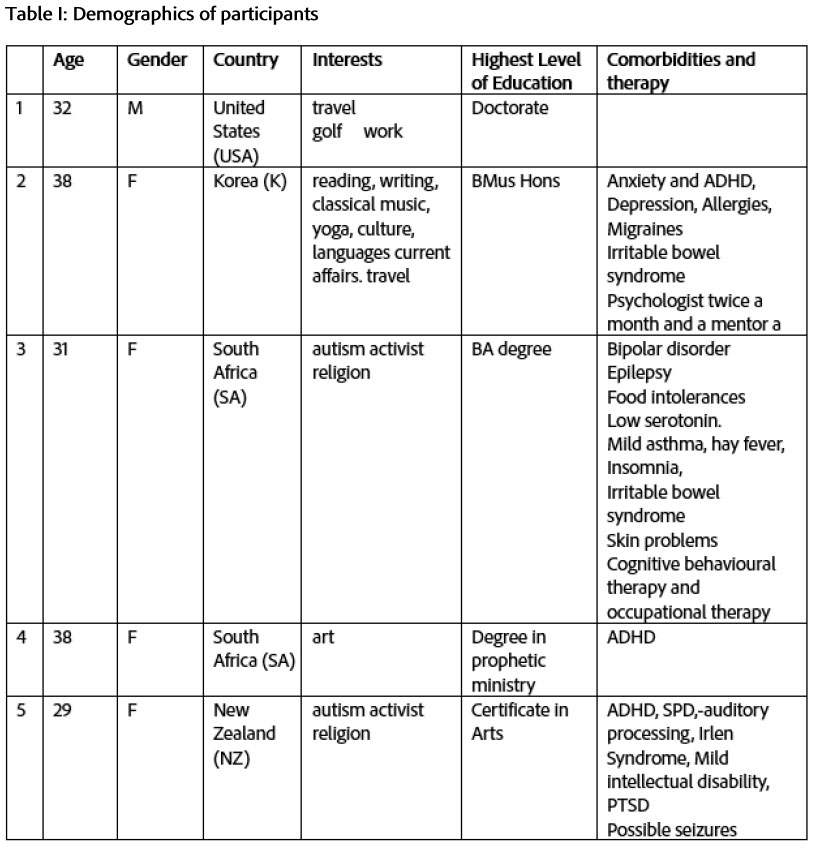
Five participants with ASD from Africa, Korea, the United States of America (USA) and New Zealand took part in Phase 2. Four participants were female. Participants were diagnosed with a range of comorbid conditions, including ADHD and anxiety27Table I, below).
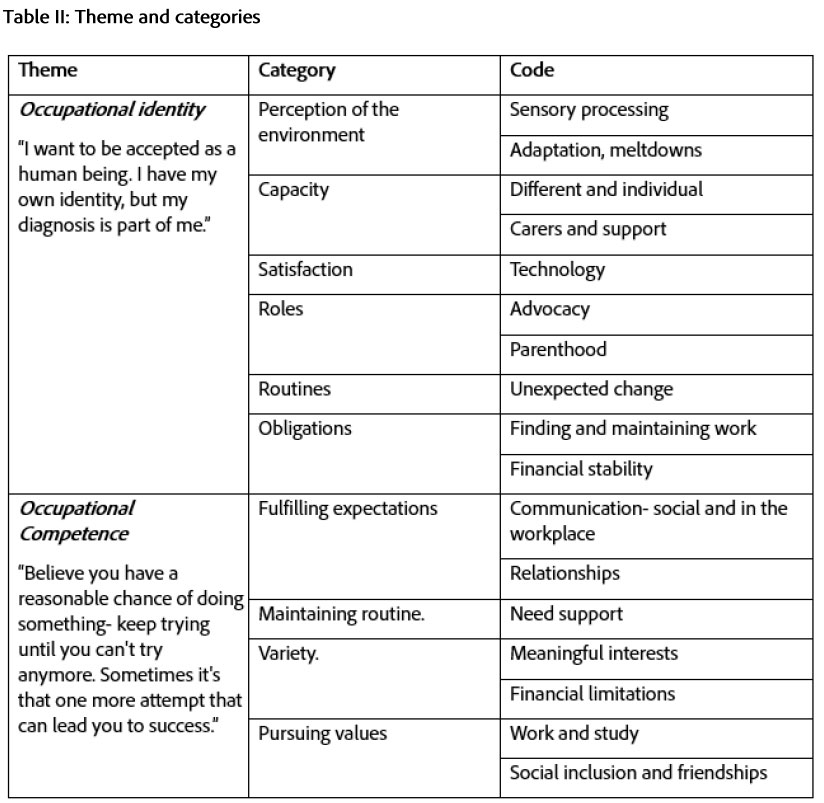
Two themes that emerged, namely Occupational identity and Occupational competence, based on the participants' experiences, are reported in this paper (Table II, below).
Theme 1: Occupational Identity
The first theme captured the essence of the participants' experience of their occupational identity and individuality through the occupations in which they engaged, and which made them feel human, as opposed to a diagnosis. This is evidenced by their sense of pride in what they had achieved and their perceived capacity, as well as satisfaction with the occupations and the roles they wished to or did enact. Enacting routines and obligations were described as difficult, especially with social limitations and sensory processing problems.
Perception of the environment
Difficulties with sensory processing caused challenges in forming a strong occupational identity since it affected their perception of the environment. This influenced their ability to organise, interpret and respond to the essential information. Thus, their capacity to engage in essential everyday activities, such as communicating, showering and driving, required strategies to enable occupational performance.
"Sensory sensitivity and sensory overload are a big struggle for me. I can share and think better when I am talking to someone if I make LESS eye contact than the "normal" person is required to do"..."I still find the sensation of water on my skin a both exhilarating and painful experience. I like swimming in the sea and in pools but showering and bathing are a struggle "...sensory problems also made it too difficult to drive."
(F,38,SA)
Participants reported dealing with their sensory sensitivity in their unique ways using a range of sensory strategies for visual and auditory input and heavy pressure.
"...well I like my weighted blanket and my weighted cat (not a real cat), swimming and the therapressure brush."
(F,29,NZ)
When the sensory experiences overwhelm autistic individuals, meltdowns result. The nature and severity of meltdowns differ, as to how participants manage their meltdowns.
"I have challenging behaviours and meltdowns so severe that I head bang and self-bite."
(F,29,NZ)
"One may not want to be touched at all during a meltdown; another will need a bear hug to stabilise the body system."
(F,38,SA)
Participants perceived that sensory overload needs accommodation in the workplace.
"One thing that would affect an autistic person in their working environment is the smells, sounds and lights in particular. The need to sometimes have a dark room to go to, to recover from the light and overstimulation, is necessary."
(F,38,SA)
Capacity
However, even with the differences described above, participants, when discussing their autistic identity in relation to their capacity in occupations, perceived that they had embraced their unique way of doing, knew what facilitated their ability to perform occupations successfully and had come to terms with being different.
"If I try to be what I am not, I will stumble for the rest of my life. I've learnt to embrace the things that make me different, instead of obsessing over them."
(F,31,SA)
"I am not separate from my autism; it is who I am. Some things I am not able to do unless certain things are in place before I start my autism is an "unseen" thing it makes me look like I am not different from the outside but the way I need to do things is VERY different from the inside!"
(F,38,SA)
They perceived that being 'normal' is a social construct. This embraced the idea that all people are created differently, and each person has capacities and abilities in varying degrees. One participant described how being badly treated has motivated her to rise above this unfair judgment.
"We are all different and are not and were not created the same."
(F,38,SA)
"I feel my blood boiling when someone calls me... a 'retard'."
(F,31,SA)
Three participants had carers to assist in performing activities of daily living. This facilitated participants in engaging in occupations since most carers did not judge their incapacity but calmly supported and guided them to achieve end goals and manage time as well as their lives.
"...I need full supervision and assistance and personal carers."
(F,29,NZ)
"I talk, she never judges me. She always remains calm. She helps me make good decisions by asking the right questions."
(F,38,K)
Unfortunately, not all carers provided the appropriate level of assistance and took over the tasks that could be accomplished with support, highlighting incapacity and negatively influencing their occupational identity.
"i feel they take over in areas i can do well and that can be frustrating. i need to be supervised, supported, but i need an element of independence as well."
(F,29,NZ)
Satisfaction
One activity in which all participants identified capacity and were satisfied with was the use of technology in assisting with communication, social networking and participating in social groups. Participants perceived it to be easier to relay messages and to offload burdening emotions online.
"Whenever I feel upset about something, I write emails. It helps to write it all down and send it. My emotions are very strong, so it helps to let off steam...Hooray for technology."
(F,38,K)
Although participants agreed that social media activities were beneficial and satisfying, for one participant, they caused distress and sadness.
"Social media is good and bad. It helps me connect with other autistics worldwide, but I am also inundated with pictures of happy families and couples. This makes me feel lonely."
(F,38,K)
Roles
The participants described roles as important to a positive occupational identity, such as being an advocate. They expressed the desire for understanding and used their voices to be heard to achieve acceptance.
"I have autism awareness shirts that I wear. ...If I get the opportunity to go to a meeting where the government or journalists are, I try to bring up an issue that autistics need help with. I've been asked to a lot of public talks about autism over the years."
(F,31,SA)
One desired role that was rarely enacted was that of romantic relationships. However, having different abilities from neurotypicals, they doubted they would be able to find the right person. They felt that they did not have sufficient knowledge about sex and sexual relationships and needed to be educated to prevent them from being taken advantage of.
"I don't know if sex is different for autistics, but the specialists say I don't know enough to consent to sexual activity. But I often wonder, could I cope if the guy was moderate to severely autistic too?".
(F,29,NZ)
One participant believed the role of being a parent should be supported; however, not all participants valued this role.
"our government tends to take babies of autistic mothers that have high support needs and put them in foster care. i don't want to be a mother if I'm not supported to be a mother."
(F,29,NZ)
Routines
To enact roles, it is important that routines are followed. The participants mentioned that they struggle with this, especially when sudden changes happen without warning, but acknowledged this was a reality of life that they could not control.
"Embracing change when it happens it is hard. So, I just focus on doing the best I can each day.''
(M,32,USA)
Obligations
Routines support meeting obligations, such as finding and keeping a job, which, for some participants, was challenging, affecting their occupational identity. They reported that even the initial job interview was daunting.
"Many ASD people also struggle with interviews."
(F,38,K)
Employers do not understand autism and the accommodations needed, like time out to manage sensory overload and work relationships, which makes it difficult for the individual to develop capacity and perform at their best.
"He said none of the staff are allowed to take time off work at any time. He said because I asked -he thinks I am not serious about working and won't be committed to the job. He refused to let me explain myself and did not want to understand me."
(F,31,SA)
Participants also felt that, as adults, they should support themselves financially and their inability to find and maintain suitable jobs affected their ability to meet all financial obligations.
"I have stress when I am not sure about finances because I need to use finances to help me get to places and pay for electricity, food and airtime to contact people."
(F,38,SA)
Theme 2: Occupational Competence
The second theme, occupational competence or successfully enacting occupations, supported the development of a strong occupational identity when fulfilling expectations. Participants reported competence in a variety of activities within their interests, but their competence affected maintaining routines and participation in the valued social and work occupations.
Fulfilling expectations
Achieving occupational competence through fulfilling expectations, their own or those of others, was important. The participants perceived that when this meant compliance with stereotypical social and cultural norms, they often felt dismissed and unheard in terms of expectations.
"I think people should ask autistic people what they want, and let autistic people help each other, rather than decide what we need, and tell us what to do."
(F,38,K)
Experiences of communication expected by others within society and especially at work, were perceived as challenging. They emphasised that communication expectations from the neurotypical population should be flexible and adaptive to accommodate autistic individuals to avoid misunderstandings and an uncomfortable social environment being created.
"...and then the communication gap between autistic people and neuro-typical people who like things done a certain way. I wonder how many 'neuro-typical' people realise that the way that they communicate to other people who are 'not the same' can be confusing and sometimes very patronizing."
(F,38,SA)
"... society's perceptions of autistic individuals limit our ability to achieve and make us more disabled over time and give up hope on us ever achieving anything in life."
(F,29,NZ)
The participants suggested that once employers understand ASD, they should make the accommodations that the individuals need. How instructions are given can influence competence in the expectations for productivity
"I think you need a boss willing to listen and who is also able to adapt your working environment to get the best out of your skills. Communication that is done piece by piece and in a clear way and written down in a doable list if needed."
(F,38,SA)
The aspiration to work hard and to achieve competence should be encouraged by providing accommodations to support fair work practices. But participants reported having to make an extra effort to find their solutions to issues affecting their ability.
"My conditions have greatly hindered my work opportunities. I can't work in an open office, because there are too many distractions and noise for me to concentrate. I had to try even harder to be good at what I did. I read books on spelling, grammar, etc and my mother helped me. The situation did greatly decrease my self-esteem and made me frustrated, depressed and sometimes angry."
(F,31,SA)
Developing competence in social skills to meet personal expectations in building and maintaining relationships was seen as important. The participants indicated needing extra support when developing and maintaining relationships, but that trying to initiate or maintain relationships was positive.
"I feel that a key reason my social skills have improved is because I have a motivation to work hard at it. my support system won't build itself if I don't build relationships with people who might potentially support me. Of course, consistently getting positive feedback has helped. In the autism context, successes will breed confidence."
(M,32,USA)
Participants described that forming work relationships was stressful. Despite their difficulties in social situations, they reported that friendly relationships ensured a more conducive working environment.
Participant 4: "Stress adds to the equation of challenging work environments and relationships."
(F,38,SA)
Maintaining a routine
To achieve competence and meet their own and others' expectations, maintaining a daily routine is essential. Participants reported difficulty with this.
"For most people, setting an alarm, getting up, putting on a geyser, then having breakfast, showering, tidying up and taking the right things to work is quite an easy routine in the morning to follow. For most autistic people, this is not necessarily so true."
(F,38,SA)
They stressed the need for support to assist them in carrying out their routine occupations in a more efficient way.
"..with the personal cares I really struggle with remembering how to wash and in the order. I do have a visual aide, steps chart, but there are times I freeze up."
(F,29,NZ)
Variety
However, occupational competence in a variety of occupations was reported by all participants. Although autism is generally associated with having limited interests, it was clear that the participants in this study had a range of interests and their successful participation in these interests was used to assist with reducing stress and improving their quality of life.
"The things that I really love to do are knitting, researching autism particular genetics and nutrition and sensory issues and I love to write and i love my science studies and i love being a aunty, i love getting out in the outdoors and I love swimming and the movies and ten pin bowling."
(F,29,NZ)
"When I get the opportunity, I swim. It helps me a great deal by de-stressing me."
(F,31,SA)
Participation in a greater variety of activities and interests was limited by financial strain, which restricted the number of interests participants could engage in. Sometimes the inability to engage in interests as well as financial issues increased levels of stress and anxiety.
"I don't go out often with friends, but money prevents me from doing a lot of things right now."
(F,38,SA)
Pursuing values
Pursuing values was supported by engaging in occupations that the participants valued. Motivation to study and work hard, to be successful and make a life for themselves was valued. The participants sought jobs and university courses that matched their abilities and occupational strengths, as it gave a sense of purpose, which added meaning to their lives.
"I am looking for a new job that matches my skills better."
(F,38,SA)
Limited knowledge of autism in communities, amongst lecturers and employers impacted their university and workplace experience. They emphasised how awareness of ASD can assist individuals in achieving their goals when accommodations are tailored to their needs.
"the plan for my disability needs is stuff like I have note takers, separate exams, use of computer, sensory modulation, one on one in science lab, and allowed to do work at home etc. I've had to leave science labs cause of meltdowns lately. I've just been changed to a noise-friendly class. The lecturer was sorry that she didn't think of the sensory environment at the beginning of the semester."
(F,29,NZ)
A lack of social inclusion and abuse impacted their opportunity to achieve occupational competence, personal growth and self-worth in social participation. All participants valued inclusively doing with others on their terms. The participants reported having faced many barriers to social inclusion and had endured social rejection, which they experienced as extremely hurtful.
"Ever since I started mainstream school, I was bullied and teased. I was made to feel inferior, like something all the kids could walk over when they pleased. They would verbally abuse me. They would either refuse me verbally or walk off as soon as I approached them. I ended up sitting by myself at break in Matric. This did great damage to my self-esteem and my emotions. - I was not accepted as a person."
(F,31,SA)
One participant described how, although friends were valued, it was a struggle to form the friendships longed for, leading to negative feelings when these relationships did not last.
"I struggled to relate to other people my age...All I knew was that most of the time I had the opportunity to connect with people and develop friendships, I'd mess it up. Then I'd hate myself for it."
(F,31,SA)
DISCUSSION
This study considered the voices of autistic individuals as occupational beings, acknowledging their experience of those occupations which provide meaning, value to their lives and which they consider support their well-being2829
Throughout this study, the aim was to understand how the meaning of occupation influenced the occupational identity and occupational competence of the participants. The positive view of a strong occupational identity was related to the participants' sense of self being expressed through individual agency and their way of doing and being and individual success or subjective engagement in chosen occupations30312
The participants reflected on the differences between themselves and the neurotypical society that labels them as disabled and overlooks their abilities and needs, which Turnock et al.324433
It is therefore vital for autistic individuals to have input into creating environments that allow for productive engagement in occupations by dealing with each individual's unique sensory processing challenges343536
All participants had experienced occupational injustice in the form of occupational deprivation, as they were unable to use their full capacity. This was due to external factors such as being bullied, excluded from participation in society and work, resulting in financial difficulties, which limited their experience in occupations and the development of their occupational identity3738:124 persisted through many of the participants' responses. While the participants perceived their limitations to their capacity, they expressed a desire to do more, highlighting the need for engagement in other occupations or becoming. The need for help from unjudgmental personal carers was identified as a positive influence on their occupational performance, allowing effective engagement in their occupations while functioning within their own defined capacity3940
The participants in this study were aware of their strengths in their occupational capacity and how aspects of autism required adaptations3641304243236
Participants perceived success in doing as technology users created a strong occupational identity with a resultant sense of satisfaction. Technology allowed the participants to communicate with other people with ease while accommodating their sensory needs. There was less pressure to make eye contact, which reduces miscommunications and anxiety44454646
In terms of future roles, participants indicated they would like to be involved in romantic relationships but emphasised sex education to provide them with a sense of identity legitimacy, defined as "who one is" in an occupational role47484950
A central obligation expressed by participants was that of supporting themselves financially. All participants engaged in productive, regular work or furthering their education. For some, however, their occupational identity was affected as they perceived they were unable to fully live up to their potential515253
Thus, occupational competence and achievement are achieved through engaging successfully in valued activities42525455
Maintaining a consistent routine of behaviour in patterns to meet expectations and obligations is a feature of occupational competence4565745859
Based on experience, participants indicated other limitations to occupational identity in a value-based vision of the development of their occupational self602614562
Limitations of the study
The study was limited to autistic individuals who all had a post-secondary qualification and a range of interests, and who were able to communicate effectively using email. While this was reflective of the members of the blog used in this study. This may not be reflective of many other autistic individuals and results may not be transferable. The majority of participants were female, which may have biased perceptions in terms of participation in occupations and other findings. All data collected was in a text format and while this reduced errors that may occur due to transcription of data, nonverbal cues and responses of participants could not be observed in the email interviews.
CONCLUSION
This study explored a client-centred view of occupational identity and competence from the perspective of autistic individuals. The methodology allowed for the engagement with participants in the research process for understanding the occupational limitations, experiences and needs of autistic individuals632
Conflicts of interest
None to declare.
Author contributions
Arisha Magan and Lyndsay Koch conceptualized the study and Arisha Magan completed the data collection. Analysis of data was completed by Arisha Magan and Lyndsay Koch. The data were validated and the article conceptualized and by Denise Franzsen and Patricia Ann de Witt with all approving the final draft
REFERENCES
-
1. Dwyer P. The Neurodiversity Approach(es): What Are They and What Do They Mean for Researchers? Human Development. 2022;66(2):73-92. doi:https://doi.org/10.1159/000523723
» https://doi.org/10.1159/000523723 -
2. Lynch J, Murphy A, Cezar D, Cruz D. A phenomenological exploration of the occupational identity of late-diagnosed autistic women in the United Kingdom. Discover Psychology. 2024. doi:https://doi.org/10.1007/s44202-024-00234-2
» https://doi.org/10.1007/s44202-024-00234-2 -
3. Whalley Hammell KR. Client-centred occupational therapy: The importance of critical perspectives. Scandinavian Journal of Occupational Therapy. 2015;22(4):237-243. doi: https://doi.org/110.3109/11038128.2015.1004103
» https://doi.org/110.3109/11038128.2015.1004103 - 4. Kielhofner G. A Model of Human Occupation: Theory and Application 4th edition. USA: Lippincott Williams & Wilkins; 2008.
-
5. Hansson SO, Carlstedt AB, Morville A. Occupational identity in occupational therapy: A concept analysis. Scandinavian Journal of Occupational Therapy. 2022;29(3):198-209. doi: https://doi.org/10.1080/11038128.2021.1948608
» https://doi.org/10.1080/11038128.2021.1948608 - 6. Boyland JR. A social constructivist approach to the gathering of empirical data. Australian Counselling Research Journal. 2019;13(2):30-34.
-
7. Haas K, Costley D, Falkmer M, Richdale A, Sofronoff K, Falkmer T. Factors Influencing the Research Participation of Adults with Autism Spectrum Disorders. Journal of Autism and Developmental Disorders. 2016;46(5):1793-1805. doi: https://doi.org/10.1007/s10803-016-2708-6
» https://doi.org/10.1007/s10803-016-2708-6 - 8. Howlin P. Outcomes in autism spectrum disorders. In: Volkmar R, Paul R, Klin D, Cohen D, editors. Handbook of autism and pervasive developmental disorders. Diagnosis, development, neurobiology, and behavior. 3rd ed. 2005. p. 201-220.
-
9. Chan D V., Doran JD, Galobardi OD. Beyond Friendship: The Spectrum of Social Participation of Autistic Adults. Journal of Autism and Developmental Disorders. 2023;53(1):424-437. doi: https://doi.org/110.1007/s10803-022-05441-1
» https://doi.org/110.1007/s10803-022-05441-1 -
10. Wilson E, Kenny A, Dickson-Swift V. Using Blogs as a Qualitative Health Research Tool: A Scoping Review. International Journal of Qualitative Methods. 2015;14(5):1-12. doi: https://doi.org/10.1177/1609406915618049
» https://doi.org/10.1177/1609406915618049 -
11. Petty S, Allen S, Pickup H, Woodier B. A Blog-Based Study of Autistic Adults' Experiences of Aloneness and Connection and the Interplay with Well-Being: Corpus-Based and Thematic Analyses. Autism in Adulthood. 2023;5(4):437-449. doi: https://doi.org/10.1089/aut.2022.0073
» https://doi.org/10.1089/aut.2022.0073 -
12. Welch C, Cameron D, Fitch M, Polatajko H. From "since" to "if": using blogs to explore an insider-informed framing of autism. Disability and Society. 2022;37(4):638-661. doi: https://doi.org/10.1080/09687599.2020.1836479
» https://doi.org/10.1080/09687599.2020.1836479 - 13. Rains S. Blogging, microblogging, and exposure to health and risk messages. In: Oxford Research Encyclopedia of Communication. Oxford University Press Inc; 2017.
-
14. Dahlin E. Email Interviews: A Guide to Research Design and Implementation. International Journal of Qualitative Methods. 2021;20:1-10. doi: https://doi.org/10.1177/16094069211025453
» https://doi.org/10.1177/16094069211025453 -
15. Cummins C, Pellicano E, Crane L. Autistic adults' views of their communication skills and needs. International Journal of Language and Communication Disorders. 2020;55(5):678-689. doi: https://doi.org/10.1111/1460-6984.12552
» https://doi.org/10.1111/1460-6984.12552 - 16. Chapman CM. Using email interviews to understand autistic experiences. In: Rosqvist HB, Jackson-Perry D, editors. The Palgrave handbook of research methods and ethics in neurodiversity studies. Switzerland: Springer Nature; 2024. p. 359-378.
-
17. Shaw RM, Howe J, Beazer J, Carr T. Ethics and positionality in qualitative research with vulnerable and marginal groups. Qualitative Research. 2020;20(3):277-293. doi: https://doi.org/10.1177/1468794119841839
» https://doi.org/10.1177/1468794119841839 -
18. Nicolaidis C, Raymaker D, Kapp S, Baggs A, Ashkenazy E, McDonald K, Weiner M, Maslak J, Hunter M, Joyce A. The AASPIRE Practice-Based Guidelines for the Inclusion of Autistic Adults in Research as Co-Researchers and Study Participants. Autism: The International Journal of Research and Practice. 2019;23(8):2007-2019. doi: https://doi.org/10.1177/1362361319830523
» https://doi.org/10.1177/1362361319830523 -
19. Reich JA. Power, Positionality, and the Ethic of Care in Qualitative Research. Qualitative Sociology. 2021;44(4):575-581. https://doi.org/10.1007/s11133-021-09500-4. doi: https://doi.org/10.1007/s11133-021-09500-4
» https://doi.org/10.1007/s11133-021-09500-4 -
20. Dwyer SC, Buckle JL. The Space Between: On Being an Insider-Outsider in Qualitative Research. International Journal of Qualitative Methods. 2009;8(1):54-63. doi: https://doi.org/10.1177/160940690900800105
» https://doi.org/10.1177/160940690900800105 -
21. Lowe A, Norris AC, Farris AJ, Babbage DR. Quantifying Thematic Saturation in Qualitative Data Analysis. Field Methods. 2018;30(3):191-207. doi: https://doi.org/10.1177/1525822X17749386
» https://doi.org/10.1177/1525822X17749386 - 22. Creswell JW. Research Design: Qualitative, Quantitative and Mixed Approaches. 3rd Editio. CA, US: Sage Publications, Inc; 2009. doi:10.2307/1523157
-
23. MAXQDA. MAXQDA Manual. 2025. https://www.maxqda.com/help/welcome
» https://www.maxqda.com/help/welcome - 24. Creswell JW, Poth CN. Qualitative inquiry and research design: Choosing among five approaches. 4th ed. Philadelphia: Sage; 2016.
- 25. Maxwell JA, Chmiel M. Notes toward a theory of qualitative data analysis. The SAGE handbook of qualitative data analysis. In: Flick U, editor. The SAGE handbook of qualitative data analysis. Sage Publications; 2014. p. 21-34.
-
26. Kakar ZUH, Rasheed R, Rashid A, Akhter S. Criteria for Assessing and Ensuring the Trustworthiness in Qualitative Research. International Journal of Business Reflections. 2023;4(2):150-173. doi: https://doi.org/10.56249/ijbr.03.01.44
» https://doi.org/10.56249/ijbr.03.01.44 -
27. Levy SE, Giarelli E, Lee LC, Schieve LA, Kirby RS, Cunniff C, Nicholas J, Reaven J, Rice CE. Autism spectrum disorder and co-occurring developmental, psychiatric, and medical conditions among children in multiple populations of the United States. Journal of Developmental and Behavioral Pediatrics. 2010;31(4):267-275. doi: http://dx.doi.org/10.1097/DBP.0b013e3181d5d03b
» http://dx.doi.org/10.1097/DBP.0b013e3181d5d03b -
28. Restall GJ, Egan MY. Collaborative Relationship-Focused Occupational Therapy: Evolving Lexicon and Practice. Canadian Journal of Occupational Therapy. 2021;88(3):220-230. doi:https://doi.org/10.1177/00084174211022889
» https://doi.org/10.1177/00084174211022889 -
29. World Health Organization. International classification of functioning, disability and health: ICF. 2001. http://apps.who.int/iris/bitstream/handle/10665/42407/9241545429.pdf
» http://apps.who.int/iris/bitstream/handle/10665/42407/9241545429.pdf -
30. Taylor J, Kay S. The construction of identities in narratives about serious leisure occupations. Journal of Occupational Science. 2015;22(3):260-276. doi:http://dx.doi.org/10.1080/14427591.2013.803298
» http://dx.doi.org/10.1080/14427591.2013.803298 -
31. Anthony LG, Kenworthy L, Yerys BE, Jankowski KF, James JD, Harms MB, Martin A, Wallace GL. Interests in high-functioning autism are more intense, interfering, and idiosyncratic than those in neurotypical development. Development and Psychopathology. 2013;25(3):643-652. doi:https://doi.org/10.1017/S0954579413000072
» https://doi.org/10.1017/S0954579413000072 -
32. Turnock A, Langley K, Jones CRG. Understanding Stigma in Autism: A Narrative Review and Theoretical Model. Autism in Adulthood. 2022;4(1):76-91. doi:https://doi.org/10.1089/aut.2021.0005
» https://doi.org/10.1089/aut.2021.0005 -
33. Raymaker DM, Teo AR, Steckler NA, Lentz B, Scharer M, Santos AD. '" Having All of Your Internal Resources Exhausted Beyond Measure and Being Left with No Clean-Up Crew "': Defining Autistic Burnout. 2020;2(2):132-143. doi:https://doi.org/10.1089/aut.2019.0079
» https://doi.org/10.1089/aut.2019.0079 -
34. Lewis LF, Stevens K. The lived experience of meltdowns for autistic adults. 2023. doi:https://doi.org/10.1177/13623613221145783
» https://doi.org/10.1177/13623613221145783 - 35. Nussbaum M. Creating Capabilities. Harvard University Press; 2011.
-
36. McConachie H, Wilson C, Mason D, Garland D, Parr JR, Rattazzi A, Rodgers J, Skevington S, Uljarevic M, Magiati I. What Is Important in Measuring Quality of Life? Reflections by Autistic Adults in Four Countries. Autism in Adulthood. 2020;2(1):4-12. doi:https://doi.org/10.1089/aut.2019.0008
» https://doi.org/10.1089/aut.2019.0008 -
37. Townsend E, Wilcock A. Occupationaljustice and Client-Centred Practice: A Dialogue in Progress. Canadian Journal of Occupational Therapy. 2004;71(2):75-87. doi:https://doi.org/10.1177/000841740407100203
» doi:https://doi.org/10.1177/000841740407100203 - 38. Cunningham M. Broadening understandings of occupational identity: illustrations from a research study of homeless adults. In: Sakellariou D, Pollard N, editors. Occupational therapies without borders: integrating justice with practice. Elsevier; 2016. p. 118-125.
-
39. Griffith GM, Totsika V, Nash S, Hastings RP. "I just don't fit anywhere": Support experiences and future support needs of individuals with Asperger syndrome in middle adulthood. Autism. 2012;16(5):532-546. doi:https://doi.org/10.1177/1362361311405223
» https://doi.org/10.1177/1362361311405223 -
40. Urbistondo Cano F. Urbistondo Cano, F., 2021. Autism and learning disabilities: developing a relationship-centred approach for support workers in social care. University of Bedfordshire; 2021. https://uobrep.openrepository.com/handle/10547/625497
» https://uobrep.openrepository.com/handle/10547/625497 -
41. McComas JJ, Wilczynski S, Cerda M-L, Beavis HS, Drossel C, Sundberg S, Anderson KD. Ableism in Applied Behavior Analysis: A Beginner's Guide to Understanding and Dismantling Ableism in Practice with Autistic People. Behavior Analysis in Practice. 2025;(0123456789). doi:https://doi.org/10.1007/s40617-025-01128-y
» https://doi.org/10.1007/s40617-025-01128-y -
42. Ward MJ, Meyer RN. Self-determination for people with developmental disabilities and autism: Two self-advocates' perspectives. Focus on Autism and Other Developmental Disabilities. 1999;14(3):133-139. doi:https://doi.org/10.1177/108835769901400302
» https://doi.org/10.1177/108835769901400302 -
43. Casagrande KA, Davis S, Moore BS, Dahiya A V., Smith I, Krebsbach S, Mancini J. "Nothing about Us without Us" Meets the "All Teach, All Learn" Model: Autistic Self-Advocates as Leaders and Collaborators in Project ECHO. Education Sciences. 2024;14(8):1-13.doi: https://doi.org/10.3390/educsci14080910
» https://doi.org/10.3390/educsci14080910 -
44. Gillespie-Lynch K, Kapp SK, Shane-simpson C, Smith DS. Intersections Between the Autism Spectrum and the Internet: Perceived Benefits and Preferred Functions of Computer-Mediated Communication. 2014;52(6):456-469. doi:https://doi.org/10.1352/1934-9556-52.6.456
» https://doi.org/10.1352/1934-9556-52.6.456 -
45. Causton-Theoharis J, Ashby C, Cosier M. Islands of loneliness: Exploring social interaction through the autobiographies of individuals with autism. Intellectual and Developmental Disabilities. 2009;47(2):84-96. doi: https://doi.org/10.1352/1934-9556-47.2.84
» https://doi.org/10.1352/1934-9556-47.2.84 -
46. Hassrick EMG, Holmes LG, Sosnowy C, Walton J, Carley K. Benefits and Risks: A Systematic Review of Information and Communication Technology Use by Autistic People. Autism in Adulthood. 2021;3(1):72-84. doi:https://doi.org/10.1089/aut.2020.0048
» https://doi.org/10.1089/aut.2020.0048 -
47. Yew RY, Samuel P, Hooley M, Mesibov GB, Stokes MA. A systematic review of romantic relationship initiation and maintenance factors in autism. Personal Relationships. 2021;28(4):777-802. doi:https://doi.org/10.1111/pere.12397
» https://doi.org/10.1111/pere.12397 -
48. Belluzzo M, Giaquinto V, De Alfieri E, Esposito C, Amodeo AL. Sexuality, Gender Identity, Romantic Relations, and Intimacy Among Individuals with Autism Spectrum Disorder: A Narrative Review of the Literature. Psychiatry International. 2025;6(2):1-31. doi: https://doi.org/10.3390/psychiatryint6020044
» https://doi.org/10.3390/psychiatryint6020044 - 49. Kahn LG, Kofke M. The taboo should be taught: Supporting autistic young adults in their sexuality, intimacy, and relationships. In: Elster N, Parsi K, editors. Transitioning to adulthood with autism: Ethical, legal and social issues. Springer International Publishing; 2022. p. 41-61.
-
50. Pohl AL, Crockford SK, Blakemore M, Allison C, Baron-Cohen S. A comparative study of autistic and non-autistic women's experience of motherhood. Molecular Autism. 2020;11(1):1-12. doi:https://doi.org/10.1186/s13229-019-0304-2
» https://doi.org/10.1186/s13229-019-0304-2 -
51. Pellicano E, Hall G, Ying Cai R. Autistic adults' experiences of financial wellbeing: Part II. Autism. 2024;28(5):1090-1106. doi:https://doi.org/10.1177/13623613231191594
» https://doi.org/10.1177/13623613231191594 -
52. Bury SM, Flower RL, Zulla R, Nicholas DB, Hedley D. Workplace Social Challenges Experienced by Employees on the Autism Spectrum: An International Exploratory Study Examining Employee and Supervisor Perspectives. J Autism Dev Disord 51, 1614-1627 (2021). Journal of Autism and Developmental disorders. 2021;51(5):1614-1627. doi:https://doi.org/10.1007/s10803-020-04662-6
» https://doi.org/10.1007/s10803-020-04662-6 -
53. Hayward SM, Mcvilly KR, Stokes MA. Research in Autism Spectrum Disorders Autism and employment: What works. 2019;60(June 2018):48-58. doi:https://doi.org/10.1016/j.rasd.2019.01.006
» https://doi.org/10.1016/j.rasd.2019.01.006 -
54. Khalifa G, Sharif Z, Sultan M, Rezze B Di. Workplace accommodations for adults with autism spectrum disorder: a scoping review. Disability and Rehabilitation. 2020;42(9):1316-1331. https://doi.org/10.1080/09638288.2018.1527952 . doi:https://doi.org/10.1080/09638288.2018.1527952
» https://doi.org/10.1080/09638288.2018.1527952 -
55. Mukaetova-Ladinska EB, Stuart-Hamilton I. Adults with Autism Spectrum Disorder (ASD: Service User Perspective on Ageing Transition. 2016;2(1):1-11. doi:https://doi.org/10.7726/aja.2016.1001
» https://doi.org/10.7726/aja.2016.1001 -
56. Rydzewska E. Unexpected changes of itinerary - adaptive functioning difficulties in daily transitions for adults with autism spectrum disorder. European Journal of Special Needs Education. 2016;6257:0. http://dx.doi.org/10.1080/08856257.2016.1187889 . doi:https://doi.org/https://doi.org/10.1080/08856257.2016.1187889
» http://dx.doi.org/10.1080/08856257.2016.1187889 -
57. Pérez AV, Blázquez A, Delgar BG, Ortiz AE, Borràs R, Morer A. Phenomenology of repetitive and restrictive behaviors and sensory phenomena in neurodevelopmental disorders: an exploratory study. BMC Psychiatry. 2025. doi:https://doi.org/10.1186/s12888-025-06569-x
» https://doi.org/10.1186/s12888-025-06569-x -
58. Bishop-Fitzpatrick L, Smith DaWalt L, Greenberg JS, Mailick MR. Participation in recreational activities buffers the impact of perceived stress on quality of life in adults with autism spectrum disorder. Autism Research. 2017;10(5):973-982. doi:https://doi.org/10.1002/aur.1753
» https://doi.org/10.1002/aur.1753 -
59. Stacey TL, Froude EH, Trollor J, Foley KR. Leisure participation and satisfaction in autistic adults and neurotypical adults. Autism. 2019;23(4):993-1004. doi:https://doi.org/10.1177/1362361318791275
» https://doi.org/10.1177/1362361318791275 -
60. Rudman DL, Dennhardt S. Shaping knowledge regarding occupation: Examining the cultural underpinnings of the evolving concept of occupational identity. Australian Occupational Therapy Journal. 2008;55(3):153-162. doi:https://doi.org/10.1111/j.1440-1630.2007.00715.x
» https://doi.org/10.1111/j.1440-1630.2007.00715.x -
61. Levi MK, Schreuer N, Granovsky Y, Bar-Shalita T, Weissman-Fogel, I., Hoffman T, Gal E. "Feeling unwanted, when nobody wants you around": Perceptions of social pain among people with autism. American Journal of Occupational Therapy. 2023;77(2):7702185050. doi:https://doi.org/10.5014/ajot.2023.050061
» https://doi.org/10.5014/ajot.2023.050061 -
62. Fletcher-Watson S, Adams J, Brook K, Charman T, Crane L, Cusack J, Leekam S, Milton D, Parr JR, Pellicano E. Making the future together: Shaping autism research through meaningful participation. Autism. 2019;23(4):943-953. doi:https://doi.org/10.1177/1362361318786721
» https://doi.org/10.1177/1362361318786721 -
63. Pellicano E, Fatima U, Hall G, Heyworth M, Lawson W, Lilley R, Mahony J, Stears M. A capabilities approach to understanding and supporting autistic adulthood. Nature Reviews Psychology. 2022;1(11):624-639. doi: https://doi.org/10.1038/s44159-022-00099-za
» https://doi.org/10.1038/s44159-022-00099-za

Submitted: 28 January 2026
Reviewed: 01 June 2026
Revised: 23 June 2026
Accepted: 29 June 2026
First online:
EDITOR: Sharifa Moosa Tayob https://orcid.org/0000-0003-3299-4188
DATA AVAILABILITY: Available on request from the corresponding author
FUNDING: No funding was received for this study