An exploration of undergraduate health science students' experiences of blended learning andragogy: A rapid review
Abstract
INTRODUCTION: Blended learning is defined as the combined use of in-person and online learning, through interactive multimedia and face-to-face engagement with curriculum content. Recently, higher education institutions have experienced major inevitable changes in teaching and learning approaches, sparking interest in the exploration of these approaches- including blended learning. AIM: To explore undergraduate health sciences students' experiences of blended learning. METHOD: A rapid review of articles published in English was conducted between the 18th and 22nd February 2022, using the following databases: Pubmed, Ebscohost, Web of Science, Scopus, Africawide Information, and CINAHL. Articles found were exported to Endnote, version 20.2.1. The Preferred Reporting Items for Systematic Reviews and Meta-analysis flow chart was used to document the search. The Critical Appraisal Skills Programme was used to appraise the articles, which were analysed using thematic analysis. FINDINGS: Eight quantitative articles were analysed and categorised on the hierarchy of evidence. Three themes emerged: 1. Student engagement and perceptions of blended learning, 2. Student academic performance, and 3. Challenges of blended learning. CONCLUSION: Positive experiences of blended learning were reported, including: significant improvement of student academic performance, higher levels of satisfaction and an increased student engagement. Ineffective online learning platforms and/or technological devices resulted in students experiencing anxiety and frustration. IMPLICATIONS FOR PRACTICE • Blended learning may be a feasible option to maintain and enhance students learning experience. • Students' academic performance could improve with blended learning • Blended learning could increase students' engagement within the andragogic field.
hybrid teaching higher education institutions; student engagement; academic performance; online learning platforms; quality education
INTRODUCTION
A current notable interest exists in the investigation of eclectic teaching and learning methods used while combining traditional face-to-face with online methods of teaching and learning for students in higher education1234
With blended learning in effect globally, the need to evolve with changes within higher education is pivotal to curriculum planning. Blended learning has the potential to enhance students' learning experience, improve students' motivation, is an effective way for achieving learning objectives567 7222
Due to a lack of exploration of blended learning amongst undergraduate health science education, a need to synthesise and thoroughly explore recent literature regarding students' experiences of blended learning is imperative. Our review aimed to explore undergraduate health science students' experiences of blended learning as andragogy. The review was guided by the following research question: What is the effectiveness of blended learning amongst undergraduate students in health science education? As such, this review highlights and offers insights into the strengths and limitations of the blended learning approach as andragogy.
METHOD
Study Design
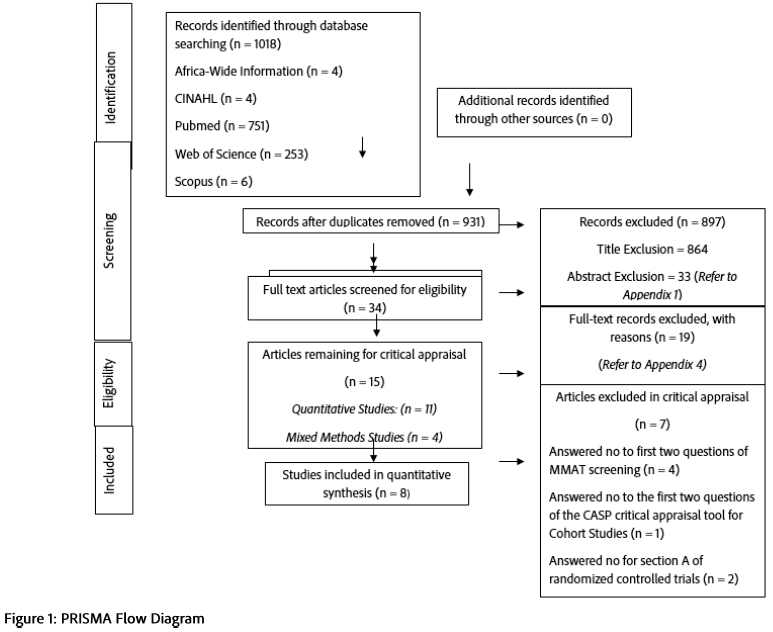
A rapid review is a resource-efficient, and time-sensitive approach to knowledge synthesis8910 Figure 1, page 3) that were included in the review process and ensure methodological rigour11
Search Strategy
The reviewers collaborated and conducted a search of article published in English, between 18th-22nd February 2022, using the following databases: Pubmed, Web of Science, Scopus, Africawide Information via Ebscohost and CINAHL via Ebscohost. The string used included the following search and Boolean terms: Blended learning OR hybrid learning OR computer aided learning OR integrated learning AND Undergrad* OR Bachelor's degree OR First degree OR baccalaureate OR Health Sciences OR Medical Sciences OR Allied Health Sciences (Education, Medical, Undergraduate [MeSH Terms] - only used on PubMed) AND Effectiveness OR Efficacy OR Usefulness (Outcome Assessment, Health Care [MeSH Terms] - only used on Pubmed) AND Tertiary institution OR Higher education OR Higher learning institutions.
Study Selection and Screening Process
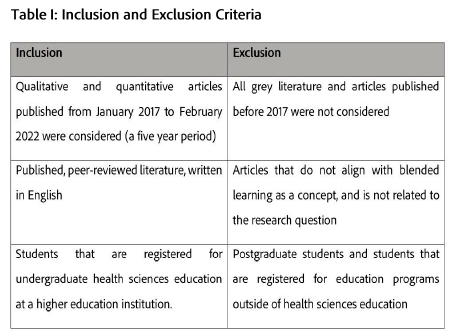
The results found on the above-mentioned databases were exported to EndNote version 20.2.1, where duplicates were excluded. The remaining articles were then exported to Rayyan where the inclusion and exclusion criteria (see Table I adjacent) were applied for the title and abstract screening process. Articles were excluded based on the relevance of their title to the research question. Thereafter, the selected articles were divided amongst the researchers for abstract screening. The inclusion and exclusion criteria were once again applied in full-text screening to conclude the screening process and finalise the studies selected. These studies were critically discussed and evaluated for confirmation of inclusion amongst the researchers.
ASSESSMENT OF METHODOLOGICAL QUALITY
Risk of Bias Appraisal
The researchers collectively appraised the selected articles in an effort to increase the confirmability of the rapid review and reduce its risk of bias11. Critical appraisal tools was applied to identify the risk of bias. This review made use of the Critical Appraisal Skills Programme (CASP) checklists1213
Data Extraction
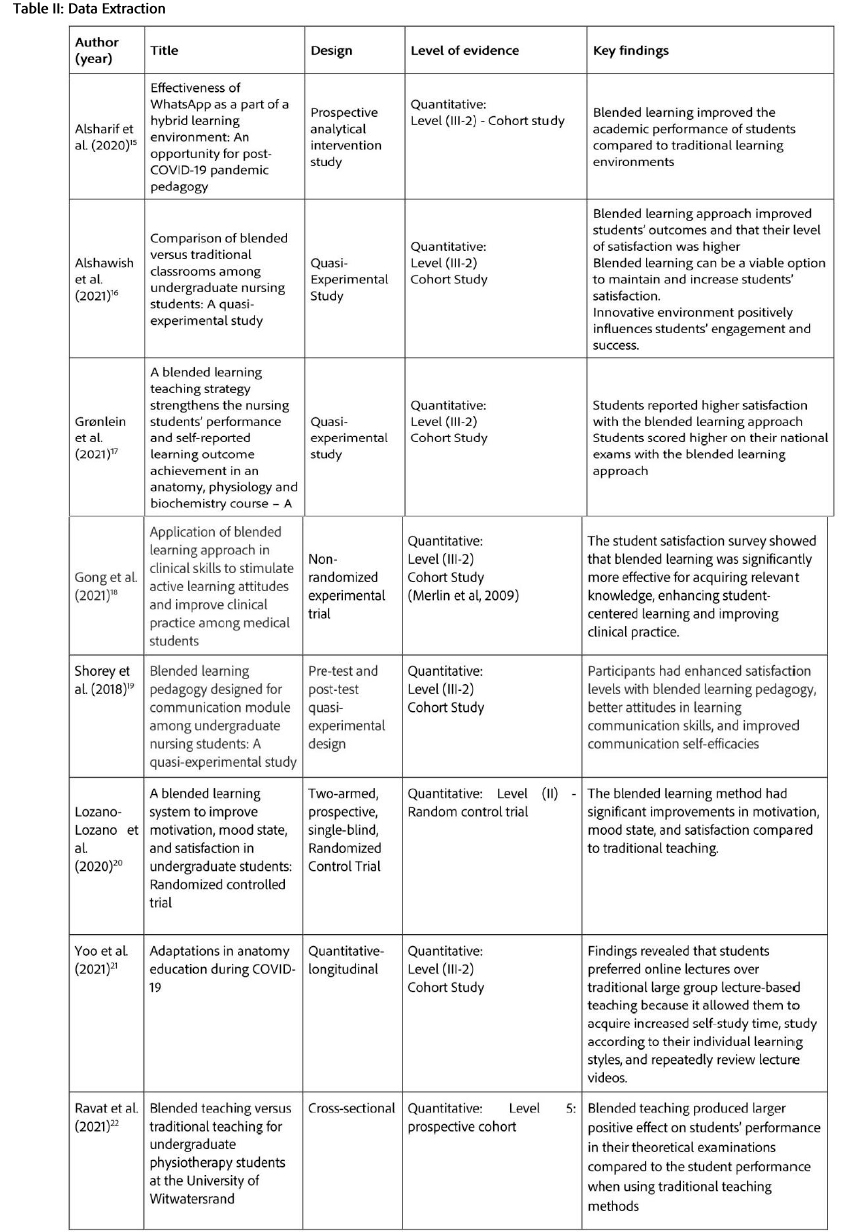
The researchers used a data extraction table that included the following criteria: author, date, design, level of evidence, and key findings. The relevant data to the research question was unearthed and tabulated below, see Table II (page 3).
Data Analysis
Ethics
No ethical clearance of this study was necessary as the article is a review of published literature.
RESULTS
Study Selection and Rationale
The total number of articles found from the initial search was 1018. From this, 87 duplicates were found on EndNote version 20.2.1 and excluded from the review, resulting in 931 articles. These articles were screened by title and abstract, and subsequently resulted in 34 articles eligible for full-text screening. These 34 articles were then screened and evaluated based on the relevance of each article to the research question and aim. From this, 15 articles remained after full-text screening. These remaining 15 articles underwent critical appraisal, of which eight of the articles were found to be trustworthy, valid, reliable, and relevant to the review. Therefore, eight articles were included in the rapid review and knowledge synthesis process (see Figure 1 page 3).
Data Extraction/Characteristics of Included Studies
All eight articles were quantitative studies. One study was a prospective analytical intervention study, three were quasi-experimental studies, one non-randomised experimental trial, one longitudinal design, one cross sectional design and one randomised controlled trial. These articles were situated globally, namely: Saudi Arabia, Palestine, Norway, China, Singapore, Spain, Korea, and South Africa. The characteristics of the various studies are outlined in the data extraction Table II below.

Risk of Bias
The quantitative hierarchy by the National Health and Medical Research Council (NHMRC)23
Lozana-Lozana et al.20221721 191516
The study by Gong et al.18
Synthesis of Results
Analysis of the eight included articles revealed the following themes: 1. Student engagement and perceptions of blended learning, 2. Student academic performance, and 3. Challenges associated with blended learning.
1. Student perceptions and engagement of blended learning
The current review found that undergraduate health science students had overall positive perceptions of blended learning, with high levels of enthusiasm, improved satisfaction levels, and an increase in self-efficacy, motivation and mood15-20. In addition, convenience and accessibility to curriculum content was highlighted as some of the key findings and advantages of blended learning, allowing the students to access the content at their own leisure16,18, 21, 22. In their study, Yoo et al.2115
Three of the included articles reported that the use of social media, mobile learning applications as well as online resource platforms as part of blended learning contributed to students having positive perceptions of the blended learning approach15,18,20. In particular, Lozano-Lozano et al.20
Five of the included articles found that student engagement had improved when using blended learning in comparison to traditional face-to-face approaches16-19,20. Students found the blended learning approach to be flexible, making it more convenient for their learning experience and understanding of content15,16,21, resulting again in improved attitudes towards learning.
Students reported overall satisfaction with knowledge acquisition1816-18,22.
2.
Student Academic PerformanceThe current review found that blended learning was more effective and had consistently superior effects on knowledge acquisition and health science education outcomes when compared to traditional face-to-face approaches15-18,21,22. Students felt as though they were able to understand and conceptualise key concepts easier when using the blended learning approach2215-17,21,22. However, there was no significant difference in these students' clinical performance and marks, indicating that the transfer of theoretical knowledge to the clinical platform was not improved by the higher theoretical marks18,21,22.
3.
Challenges of blended learningSome studies found that lecturer availability was one of the key challenges experienced by students using the blended learning approach. Since students were able to access curriculum content at their own time, they expected lecturers to be available for assistance at all times15,19. Some students found using the blended learning approach more difficult to navigate than using traditional approaches161818
Although one of the advantages of using blended learning was the use of technological devices201715,19. Similarly, connectivity challenges interrupted students' ability to learn, however since they were able to revisit the content at any time on various platforms they were able to overcome these challenges22
DISCUSSION
Higher levels of student satisfaction, increased student engagement in curriculum activities and an improved academic performance were found to support the use of blended learning. The current review found that blended learning provides students with an opportunity to learn in more conducive environments that aided their learning experience and enhanced their academic performance15,16,22.
The current review echoes a previous study252117,20. Geng et al.242425
The findings indicated that the use of the internet as part of blended learning is opportune for the students as it is in sync with the current technological era15,16,20. The use of smartphones, for example, is considered an effective learning tool for improving academic performance within the blended learning approach2015,21. Geng et al.2425
CONCLUSION
This review aimed to explore current literature on undergraduate health science students' experiences of blended learning as andragogy. Positive experiences of blended learning among undergraduate health science students was found in the review, as students experienced an improved academic performance and higher levels of engagement when using the blended learning approach. Academic performance and student engagement in curriculum activities were found to be the most significant factors to consider when implementing a blended learning approach. However, the lecturers' perceptions and their level of training when using the blended learning approach could also be explored in future research, as this contributes to the outcomes of blended learning. The review had no qualitative articles included its synthesis, which indicates a gap in literature. As a result, the researchers recommend that future research employ a qualitative approach, allowing for a more meaningful and detailed understanding of the research topic. The findings in this review support the use of blended learning in undergraduate health science education, and therefore suggests that blended learning may be a feasible option to maintain and enhance student satisfaction.
Conflict of interest
The authors have no conflict of interest to declare. All authors agree to the submission of the article to SAJOT.
Author contributions
lesrafeel Abbas and Zarina Syed provided supervision throughout the research and article writing process, they critically reviewed the data and analysis thereof, and conceptualised the manuscript. Khanya Lujabe, Zintle Mdleleni, Mapule Mokoto, Bridget Pama, and Baby Sinelizwi Somdaka conducted the search, initially analysed the data and took part in the writing of the article seeing it to conclusion. All authors agreed on the final manuscript.
Acknowledgements
Ms Dunyiswa Ngombane for her contribution to the research.
REFERENCES
-
1. Rowe M, Frantz J, Bozalek V. The role of blended learning in the clinical education of healthcare students: a systematic review. Medical teacher. 2012;34(4):e216-21. https://doi.org/10.3109/0142159x.2012.642831
» https://doi.org/10.3109/0142159x.2012.642831 -
2. Liu Q, Peng W, Zhang F, Hu R, Li Y, Yan W. The effectiveness of blended learning in health professions: systematic review and meta-analysis. Journal of medical Internet research. 2016;18(1):e2. https://doi.org/10.2196/jmir.4807
» https://doi.org/10.2196/jmir.4807 - 3. Karamizadeh Z, Zarifsanayei N, Faghihi AA, Mohammadi H, Habibi M. The study of effectiveness of blended learning approach for medical training courses. Iranian Red Crescent Medical Journal. 2012;14(1):41. PMC3372023
-
4. Dunleavy G, Nikolaou CK, Nifakos S, Atun R, Law GC, Tudor Car L. Mobile digital education for health professions: systematic review and meta-analysis by the digital health education collaboration. Journal of medical Internet research. 2019, 21(2). https://doi.org/10.2196/12937
» https://doi.org/10.2196/12937 -
5. Utami IS. The effect of blended learning model on senior high school students' achievement. InSHS Web of Conferences 2018 (Vol. 42, p. 00027). EDP Sciences. https://doi.org/10.1051/shsconf/20184200027
» https://doi.org/10.1051/shsconf/20184200027 -
6. Kiviniemi MT. Effects of a blended learning approach on student outcomes in a graduate-level public health course. BMC medical education. 2014;14:1-7. https://doi.org/10.1186/1472-6920-14-47
» https://doi.org/10.1186/1472-6920-14-47 -
7. Borba MC, Askar P, Engelbrecht J, Gadanidis G, Llinares S, Aguilar MS. Blended learning, e-learning and mobile learning in mathematics education. ZDM. 2016;48:589-610. https://doi.org/10.1007/s11858-016-0798-4
» https://doi.org/10.1007/s11858-016-0798-4 -
8. Kelly SE, Moher D, Clifford TJ. Expediting evidence synthesis for healthcare decision-making: exploring attitudes and perceptions towards rapid reviews using Q methodology. PeerJ. 2016;4:e2522. https://doi.org/10.7717/peerj.2522
» https://doi.org/10.7717/peerj.2522 - 9. Farrugia P, Petrisor BA, Farrokhyar F, Bhandari M. Research questions, hypotheses and objectives. Canadian journal of surgery. 2010;53(4):278. PMC2912019
-
10. Selçuk AA. A guide for systematic reviews: PRISMA. Turkish archives of otorhinolaryngology. 2019;57(1):57. https://doi.org/10.5152/tao.20194058
» https://doi.org/10.5152/tao.20194058 -
11. Ghafouri R, Ofoghi S. Trustworth and rigor in qualitative research. International journal of advanced biotechnology and research. 2016;7(4):1914-22. [accessed 2022 March 12]. https://www.researchgate.net/profile/Raziyeh-Ghafouri/publication/322715130_Trustworth_and_Rigor_in_Qualitative_Research/links/5a6acf3ba6fdcc2aedee29b7/Trustworth-and-Rigor-in-Qualitative-Research.pdf
» https://www.researchgate.net/profile/Raziyeh-Ghafouri/publication/322715130_Trustworth_and_Rigor_in_Qualitative_Research/links/5a6acf3ba6fdcc2aedee29b7/Trustworth-and-Rigor-in-Qualitative-Research.pdf -
12. Brice R. CASP CHECKLISTS. CASP-Critical Appraisal Skills Programme. 2022. [accessed 2022 May 13]. https://casp-uk.net/casp-tools-checklists/
» https://casp-uk.net/casp-tools-checklists/ -
13. Hong QN, Fàbregues S, Bartlett G, Boardman F, Cargo M, Dagenais P, Gagnon MP, Griffiths F, Nicolau B, O'Cathain A, Rousseau MC. The Mixed Methods Appraisal Tool (MMAT) version 2018 for information professionals and researchers. Education for information. 2018;34(4):285-91. https://doi.org/10.3233/efi-18022
» https://doi.org/10.3233/efi-18022 -
14. Maguire M, Delahunt B. Doing a thematic analysis: A practical, step-by-step guide for learning and teaching scholars. All Ireland journal of higher education. 2017;9(3). https://ojs.aishe.org/index.php/aishe-j/article/view/335/553
» https://ojs.aishe.org/index.php/aishe-j/article/view/335/553 -
15. Alsharif AT, Alsharif B, Alsharif L, Althagafi N, Natto ZS, Kassim S. Effectiveness of WhatsApp as a part of a hybrid learning environment: an opportunity for post-COVID-19 pandemic pedagogy. J Contemp Dent Pract. 2020;21 (12):1331-6. https://doi.org/10.5005/jp-journals-10024-2978
» https://doi.org/10.5005/jp-journals-10024-2978 -
16. Alshawish E, El-Banna MM, Alrimawi I. Comparison of blended versus traditional classrooms among undergraduate nursing students: A quasi-experimental study. Nurse Education Today. 2021;106:105049. https://doi.org/10.1016/j.nedt.2021.105049
» https://doi.org/10.1016/j.nedt.2021.105049 -
17. Gronlien HK, Christoffersen TE, Ringstad 0, Andreassen M, Lugo RG. A blended learning teaching strategy strengthens the nursing students' performance and self-reported learning outcome achievement in an anatomy, physiology and biochemistry course-A quasi-experimental study. Nurse education in practice. 2021;52:103046. https://doi.org/10.1016/j.nepr.2021.103046
» https://doi.org/10.1016/j.nepr.2021.103046 -
18. Gong J, Rúan M, Yang W, Peng M, Wang Z, Ouyang L, Yang G. Application of blended learning approach in clinical skills to stimulate active learning attitudes and improve clinical practice among medical students. PeerJ. 2021;9:e11690. https://doi.org/10.7717/peerj.11690
» https://doi.org/10.7717/peerj.11690 -
19. Shorey S, Kowitlawakul Y, Devi MK, Chen HC, Soong SK, Ang E. Blended learning pedagogy designed for communication module among undergraduate nursing students: A quasi-experimental study. Nurse Education Today. 2018;61:120-6. https://doi.org/10.1016/j.nedt.2017.11.011
» https://doi.org/10.1016/j.nedt.2017.11.011 -
20. Lozano-Lozano M, Fernández-Lao C, Cantarero-Villa nueva I, Noguerol I, Álvarez-Salvago F, Cruz-Fernández M, Arroyo-Morales M, Galiano-Castillo N. A blended learning system to improve motivation, mood state, and satisfaction in undergraduate students: Randomized controlled trial. Journal of medical Internet research. 2020;22(5):e17101. https://doi.org/10.2196/17101
» https://doi.org/10.2196/17101 -
21. Yoo H, Kim D, Lee YM. Adaptations in anatomy education during COVID-19. Journal of Korean medical science. 2021;36(1). https://doi.org/10.3346/jkms.2021.36.e13
» https://doi.org/10.3346/jkms.2021.36.e13 -
22. Ravat S, Barnard-Ashton P, Keller MM. Blended teaching versus traditional teaching for undergraduate physiotherapy students at the University of the Witwatersrand. The South African Journal of Physiotherapy. 2021,77(1). https://doi.org/10.4102/sajp.v77i1.1544
» https://doi.org/10.4102/sajp.v77i1.1544 -
23. Merlin T, Weston A, Tooher R. Extending an evidence hierarchy to include topics other than treatment: revising the Australian'levels of evidence'. BMC medical research methodology. 2009;9:1-8. https://doi.org/10.1186/1471-2288-9-34
» https://doi.org/10.1186/1471-2288-9-34 -
24. GengS, Law KM, Niu B. Investigating self-directed learning and technology readiness in blending learning environment. International journal of educational technology in higher education. 2019,16(1):1-22. https://doi.org/10.1186/s41239-019-0147-0
» https://doi.org/10.1186/s41239-019-0147-0 -
25. Leidl DM, Ritchie L, Moslemi N. Blended learning in undergraduate nursing education-A scoping review. Nurse Education Today. 2020;86:104318. https://doi.org/10.1016/j.nedt.2019.104318
» https://doi.org/10.1016/j.nedt.2019.104318
Reviewed: 20 June 2024
Revised: 17 July 2024
Accepted: 18 July 2024
Editor: Hester M van Biljon https://orcid.org/0000-0003-4433-6457
Data availablity: Upon reasonable request from the corresponding author.
Funding: No funding was received for this review.