Occupational therapy intervention for Cerebral Palsy - a rapid review
Abstract
INTRODUCTION: Cerebral palsy is an early-onset lifelong condition that requires comprehensive care. Occupational therapy contributes to the care of individuals with Cerebral Palsy through various intervention methods which aim to promote independence and well-being in all areas of life. This rapid review aimed to describe the intervention methods used globally by occupational therapists for Cerebral Palsy to inform policymakers on integrating occupational therapy into the healthcare system for effective management of cerebral palsy within the care team. METHOD: Searches were conducted of the Cochrane and Medline databases. Systematic reviews published in peer-reviewed journals from January 2014 to December 2023 were included for screening if the search terms "occupational therapy/therapist" and "cerebral palsy" were included in the title or abstract. Screenings took place in Rayyan.ai first by title and abstract by two reviewers, and then by full text. A third reviewer resolved conflicts. The included reviews were analysed and data plotted on a custom excel worksheet. All studies were assessed for bias and quality using the CASP appraisal tool. RESULTS: Eleven articles were included in the review. Seven themes were identified from the included systematic reviews through thematic analysis: gaming, early intervention, cognitive approaches, interventions that impact cognitive function, constraint-induced movement therapy, interventions that improve motor performance, and a general overview of treatment methods for cerebral palsy among children. Nine approaches with 24 intervention methods were identified from the individual systematic reviews, with varied evidence. Intervention venues and duration also varied widely. A multi-model approach, using more than one intervention method was the preferred intervention approach, yielding better outcomes. CONCLUSION: High-quality evidence from eleven systematic reviews supports the role of occupational therapy intervention for Cerebral Palsy. Implications for practice - Occupational therapy plays an integral part in supporting individuals with Cerebral Palsy by providing varied interventions aiming to optimise functional abilities, promote independence and enhance overall quality of life. - A multi-model occupational therapy approach for Cerebral Palsy is supported by research evidence. - Intervention settings and duration vary widely according to intervention aims and approaches. - High-quality systematic reviews guide policy development in Africa, however research in the form of scoping reviews is recommended to include lower-level evidence studies and information to plot current practices and gaps in therapy service delivery in Africa.
early intervention; cognitive function; constraint-induced movement therapy; multi-model approach
INTRODUCTION
Cerebral palsy (CP) is a neurological disorder that affects movement and posture. It is caused by a disturbance in the developing brain of an unborn foetus or infant and is a non-progressive, but permanent and lifelong condition12Surveillance of Cerebral Palsy in Europe (SCPE) classification replaces former classifications134
The importance of effective medical and therapeutic input to assist people with CP to be as independent as possible is highlighted considering that CP is the most common childhood disorder564447
Rapid reviews are often used to provide evidence for informed decisionmaking8910611
This rapid review specifically focuses on the methods of intervention applied by occupational therapists globally for people with CP from birth and across all lifespans and sub-categories as published in peer-reviewed journals as level I and II evidence12
METHOD
Scope and question
The methods guide for rapid reviews for Covid-19 medicine reviews913
Eligibility criteria
Systematic reviews classified as level I or II evidence were included in this rapid review. Systematic reviews on level I include randomised controlled trials (RCT) with or without meta-analysis. Level II evidence includes SRs of a combination of RCTs and quasi-experimental studies with or without meta-analysis12
Search Approach
Online searches were conducted using the Cochrane and Medline databases through the use of the web-based Stellenbosch University library. The following search string was used: Cerebral Palsy OR CP AND Occupational Therapy OR occupational therapist AND intervention. Relevant filters were applied and Boolean markers were used. Initially, SRs published in peer-reviewed journals between January 2013 and December 2022 were included, but the review was later updated to include records from January 2014 to December 2023 due to the time lapse while executing the review, in order to ensure an up-to-date review.
Study selection
Due to the vast number of records identified, and considering the purpose and characteristics of the rapid review, only SRs including the words "cerebral palsy" and "occupational therapy" in the title or abstract were included for further screening. Studies where the CP population made out less than 30% of the total population reported in the SR were excluded. Only articles written in English and with the full text available from Stellenbosch University library were included. References were stored in the online database Mendeley1415
Appraisal of study quality
The Critical Appraisals Skills Program (CASP) checklist for SRs16
Data extraction
Data were extracted and charted on a custom Microsoft Excel® worksheet. The data extraction sheet included the sections: author; study title; study design; CASP score, number and type of records included in the review, population (gender, age, geographical location, setting); intervention method and strategies used; duration, frequency and session length of interventions, comparisons; outcomes measures and outcomes, limitations of studies, and any other comments.
Evidence analysis
Quantitative and qualitative data were collected and charted. The quantitative data were analysed and reported by means of percentage and frequency. Qualitative information was recorded under the relevant headings and thematically analysed through deductive reasoning to be grouped accordingly for effective reporting.
RESULTS
Search results
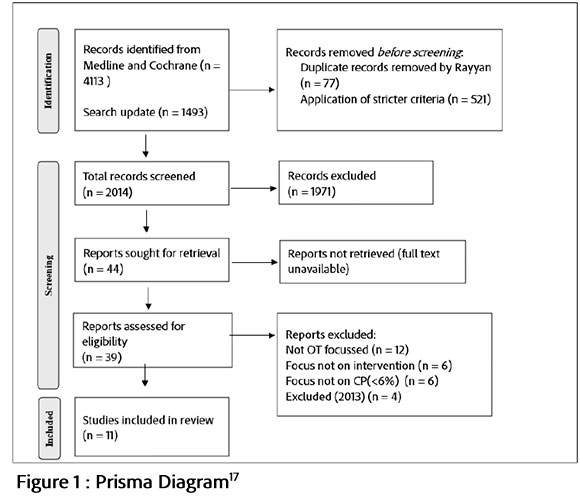
From the initial Medline and Cochrane searches conducted in March 2023, 4113 records were identified that satisfied the inclusion criteria. These included SRs and RCTs. Applying stricter inclusion criteria, i.e. only SRs identified through the initial search criteria but that contained the words "occupational therapy/ist" and cerebral palsy in the abstract or title, 521 records were included for further screening. Following an update of the review (February 2024), a total of 2014 records were identified for title and abstract screening resulting in 39 articles for full text screening and with 11 articles included in the review for analysis. The search process is illustrated in a Prisma diagram in Figure 1 below:
Quality Control
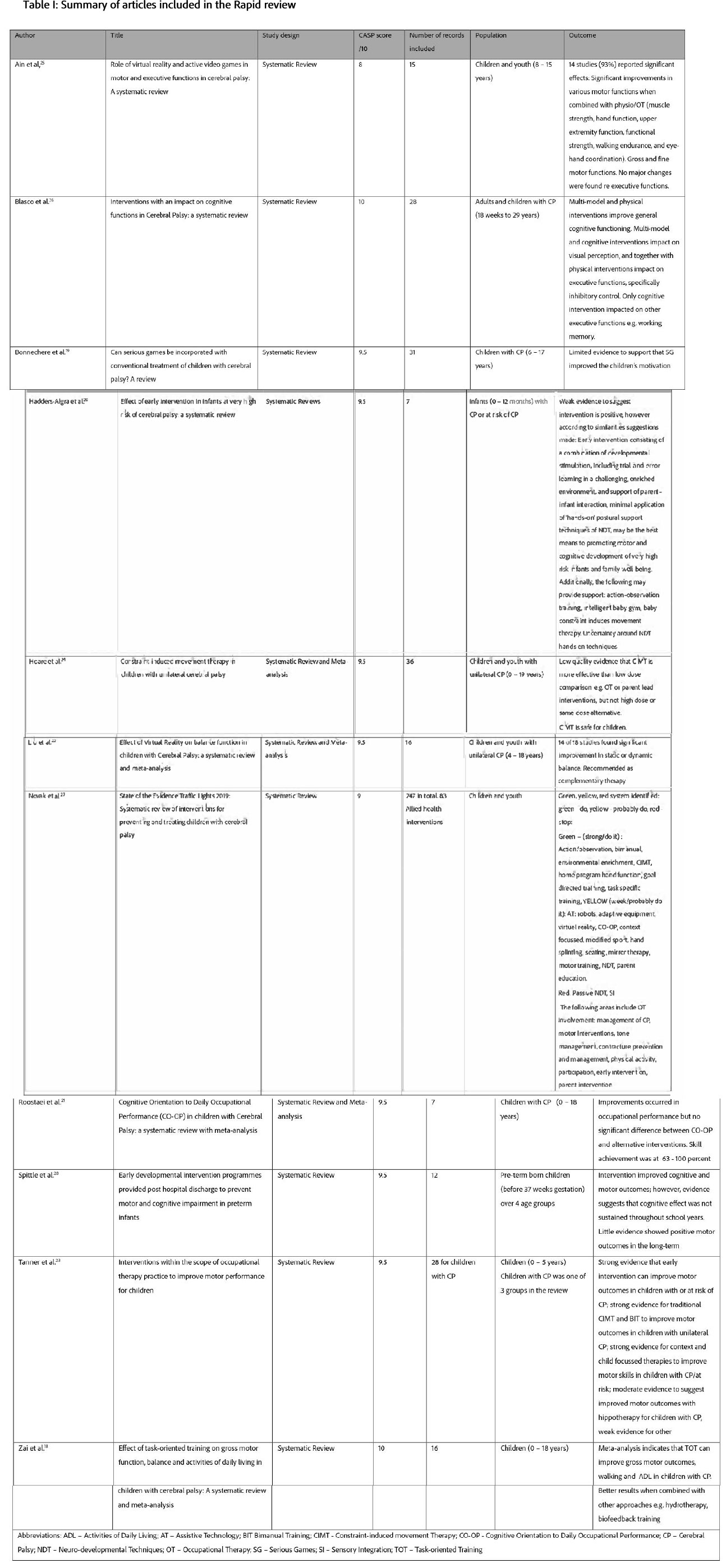
All studies included in this rapid review scored between 8 -10 out of 10 on the CASP and is considered to be high quality SRs. The score for each article is included in Table 1. However, some of the SRs included in this review reported on their own limitations18,19 i.e. limited availability of well-organised and good-quality RCTs, heterogeneous control interventions20212223,24, the studies indicated and explained the risks and consequences.
Study compositions
All included studies were SRs, with different compositions. Three studies only included RCTs while one study included RCTs and cluster RCTs18, 20,22,24. Only one study included SRs and RCTs2719,21,23,25,26,28.Five of the SRs included meta-analyses18,2122,24,28. The number of records included in the SRs varied between seven and 247. Of the 247 records included in Novak et al.'s comprehensive study of CP interventions, only the 84 records related to various therapies were considered for further discussion in this review. The additional records focussed on medical procedures and interventions2723
All studies included only children under the age of 19 years, in various age bands from pre-term born infants2820231922,25, to all children up to 18/19 years18,21,24,27. One study included both children and adults2620
Although study settings were not reported for four studies, records included studies from both high-income and low- and middle-income countries, namely; Australia, Brazil, Canada, China, Egypt, Germany, India, Iran, Israel, Italy, Japan, Jordan,
Korea, Netherlands, Pakistan, Sweden, Switzerland, Taiwan, United Kingdom and the United States of America.
Interventions
Themes, approaches and techniques Among the 11 included articles, seven themes were recognised according to the main concept/aim of the specific SR. The most common theme was gaming (virtual reality and serious games) as an intervention method (n=3) for motor and executive function19,22,25 ('Serious games' refer to virtual reality games, but with the added goal of education and/or rehabilitation and not entertainment only1920,28 and two studies on cognitive approaches18,21. The other themes reflected interventions that impact on cognitive function26242327
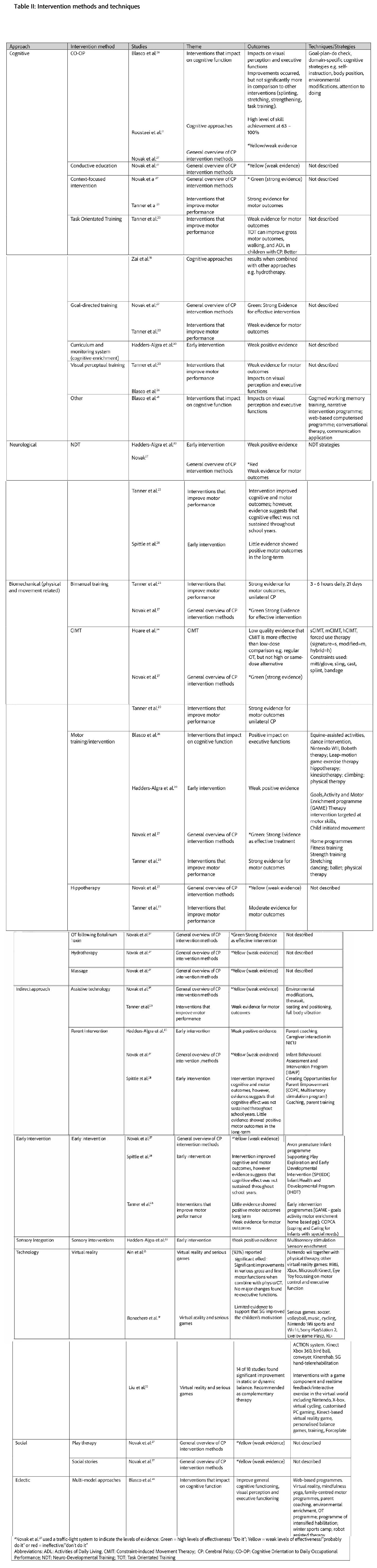
Table II (below) provides a detailed outlay of the different categories of treatment approaches with their associated methods, as reported in the included SRs. Most themes revealed several different treatment approaches, depending on the inclusion of studies in the specific SR. For clarity, themes are indicated in Table II for each named SR. Techniques and strategies were added where the SRs made the information available, Approaches identified include cognitive, neurological, biomechanical, sensory integration, indirect, early intervention, technological, social, and eclectic approaches.


Recommended intervention regimes
Recommendations for intervention regimes were described in two papers.
Hadders-Algra et al. suggested that a combination of developmental stimulation and parent-infant interaction support, with minimal application of'hands-on' postural support techniques of NDT, might be the best early intervention regime to promote motor and cognitive development of at-risk infants and family well-being20
Novak et al. made recommendations for standard care for all children with CP. This included medical and therapy care as follows: medication for spasticity management and bone density, anticonvulsants, pressure care, casting for improved mobility, hip surveillance, bimanual training, CIMT, context-focused therapy, goal-directed or functional training, and/or home programmes to improve motor activities or self-care, and fitness training27
Intervention structure
Interventions were delivered in various modalities including group interventions, individual treatment, home programmes, parent groups, written information, and audiotapes. Intervention venues varied and included clinical treatment centres, hospitals (including neonatal intensive care units (NICUs)), community centres, child development centres, preschools, schools, theme camps and homes, or a combination of venues. The duration of interventions varied widely according to the specific intervention from a single once-off session, to a 14-month treatment period. Session times ranged from 20 minutes to 120 minutes, while frequency ranged from one single session to daily intervention.
DISCUSSION
This rapid review reports on evidence of occupational therapy interventions for CP from high-quality SRs over the past 10 years up to December 2023. The included SRs represent global research across varied socio-economic areas, however, sub-Saharan Africa was not represented, so affirming Donald et al.'s concerns about limited CP research and guidelines specific to Africa29
The 11 included SRs reported on seven themes, nine different approaches, and 24 intervention methods with occupational therapy involvement aiming to optimise functional abilities, promote independence and enhance overall quality of life so strongly affirming the role of occupational therapy within the multi-professional CP care team. The many approaches and methods associated with occupational therapy intervention reflect the complexity and heterogeneous nature of CP227267
Cognitive approaches were most frequently reported, with outcomes varying from motor skills to visual perception and executive function or ADLs. Different intervention methods however had varied levels of effectiveness with positive outcomes for context-focussed intervention and goal-directed training23,27. Biomechanical approaches included positive outcomes for bimanual training2723,27 and general gross motor skills training using various techniques23,26,27. Strong evidence for effectiveness was further reported for occupational therapy intervention following Botulinum Toxin treatment2726
Other intervention approaches that were reported in the SR's had less positive outcomes. Although NDT was reported in four SRs, only weak evidence for positive outcomes was reported -Spittle et al.'s SR on early development reported positive evidence for motor and cognitive outcomes when using NDT, but with uncertainty around long-term outcomes2819, 22, 252618,20,26,27. Cognitive approaches such as TOT showed improved results when combined with movement techniques such as hydrotherapy1822, 252720
Intervention settings varied according to the type of intervention. The wide range of settings indicates involvement from occupational therapists across sectors. Early intervention therapists initiate intervention in hospitals, NICUs, and home settings20,23,27,28. Therapists providing intervention to young children may be involved in a community setting, pre-school or school setting, child development centre, or clinic23,25 27
Intervention frequency, session time and duration were variable and depended on the type of intervention, treatment aims, and location of the intervention. Cerebral Palsy as a lifelong condition affects multiple functional aspects26,11.
Limitations
The rapid review included only systematic reviews, which may have excluded South African and other important RCTs as well as evidence of a lower quality rating. Results from this review thus need to be considered against factors such as socio-economic environments, resources, infrastructure and developing health systems.
Ethics
Ethical clearance was not required for this study as primary data collection was not required.
CONCLUSION AND RECOMMENDATIONS
This review contributes to the knowledge base of occupational therapy interventions for CP and iterates the essential part that occupational therapists play through many different facets to enhance quality of life for persons with CP and their caregivers. This may also highlight a challenge for the South African health system - while evidence demonstrates positive outcomes associated with occupational therapy this raises notable concerns in the context of low-resourced countries across Africa, where the scarcity of trained therapists presents a significant challenge430
Conflicts of Interest and other declarations.
The authors declare they received remuneration from the Occupational Therapy Association of South Africa (OTASA) for this review. They declare that this did not affect their decision making in the review and they have no bias to declare. The authors do not have any conflict of interest.
Author contribution
All four authors (Janke van der Walt, Madri Engelbrecht, Hester van Biljon and Shaheed M Soeker) contributed substantially to the design of the study and the screening process. Janke van der Walt analysed and interpreted the data with the support of the other authors as critical reviewers. Janke van der Walt wrote the article which was revised by the other three authors. All authors agreed on the final content as presented.
REFERENCES
-
1. Sadowska M, Sarecka-Hujar B, Kopyta I. Cerebral Palsy: current opinions on definition, epidemiology, risk factors, classification and treatment options. Neuropsychiatrie Disease and Treatment. 2020;16:1505-1518. doi:https://doi.org/10.2147/ndt.s235165
» https://doi.org/10.2147/ndt.s235165 -
2. Te Velde A, Morgan C, Novak I, Tantsis E, Badawi N. Early diagnosis and classification of Cerebral Palsy: an historical perspective and barriers to an early diagnosis. Journal of Clinical Medicine. 2019,-8(10):1599. doi: https://doi.org.10.3390/jcm8101599
» https://doi.org.10.3390/jcm8101599 -
3. SCPE. Surveillance of Cerebral Palsy in Europe (SCPE) Scientific report 1998 - 2018.2018 [accessed 2024 Apr 25]. https://scpe.edu.eacd.org/sites/default/files/SCPE%20Scientific%20report%201998-2018.pdf
» https://scpe.edu.eacd.org/sites/default/files/SCPE%20Scientific%20report%201998-2018.pdf -
4. Donald KA, Kakooza AM, Wammanda RD, Mallewa M, Samia Ρ, Babakir H, Bearden D, Majnemer A, Fehlings D, Shevell M, et al.. Pediatric Cerebral Palsy in Africa: where are we? Journal of Child Neurology. 2015;30(8). doi: https://doi.org/10.1177/0883073814549245
» https://doi.org/10.1177/0883073814549245 -
5. Metz C, Jaster M, Walch Ε, Sarpong-Bengelsdorf A, Kaindl AM, Schneider J. Clinical phenotype of Cerebral Palsy depends on the cause: is it really Cerebral Palsy? A retrospective study. Journal of Child Neurology. 2022;37(2).doi: https://doi.org/10.1177/08830738211059686
» https://doi.org/10.1177/08830738211059686 -
6. Vitrikas K, Dalton H, Breish D. Cerebral palsy: an overview. American Family Physician. 2020;101(4).[accessed 2024 April 27] https://www.mendeley.com/catalogue/f3f273fd-dc89-39fc-b67f-6b341b0e3ab7/
» https://www.mendeley.com/catalogue/f3f273fd-dc89-39fc-b67f-6b341b0e3ab7/ -
7. Bottos M, Feliciangeli A, Sciuto L, Gericke C, Vianello A. Functional status of adults with cerebral palsy and implications for treatment of children. Developmental Medicine and Child Neurology. 2001;43(8). doi: https://doi.Org/10.1111/j.1469-8749.2001.tb00755.x
» https://doi.Org/10.1111/j.1469-8749.2001.tb00755.x -
8. Dobbins M. Rapid Review Guidebook. Steps for conducting a rapid review. Public Health Agency of Canada. 2017. doi:https://www.nccmtca/uploads/media/media/0001/01/a816af720e4d587e13da6bb307df8c907a5dff9a.pdf
» https://www.nccmtca/uploads/media/media/0001/01/a816af720e4d587e13da6bb307df8c907a5dff9a.pdf -
9. Department of Health RSA. Methods guide for rapid reviews for Covid-19 medicine reviews, 2022 [accessed 2022 Mar 12]. https://www.health.gov.za/wp-content/uploads/2022/03/Protocol-Template-for-rapid-reviews-of-COVID-19v4.012March2022.pdf
» https://www.health.gov.za/wp-content/uploads/2022/03/Protocol-Template-for-rapid-reviews-of-COVID-19v4.012March2022.pdf -
10. Tricco AC, Antony J, Zarin W, Strifler L, Ghassemi M, Ivory J, et al. A scoping review of rapid review methods. BMC Medicine. 2015:13(1).https://iris.who.int/handle/10665/258698
» https://iris.who.int/handle/10665/258698 -
11. WFOT. WFOT. About Occupational Therapy. 2023 [accessed 2023 Jun 24]. https://wfot.org/about/about-occupational-therapy.
» https://wfot.org/about/about-occupational-therapy -
12. Burns PB, Rohrich RI, Chungh KC. The levels of evidence and their role in evidence-based medicine. Plastic and Reconstructive Surgery. 2011;128(1):305-310. doi: https://doi.org/10.1097/prs.0b013e318219c171
» https://doi.org/10.1097/prs.0b013e318219c171 -
13. Longlois EV, Straus SE, Mijumbi-Deve R, Lewin S, Tricco AC. The need for rapid reviews to inform health policy and systems. In: Tricco AC, Langlois Ε V, Straus SE, editors. Rapid reviews to strengthen health policy and systems: a practical guide. Geneve: World Health Organization; 2017 [accessed 2023 Jun 24lhttps://iris.who.int/handle/10665/258698
» lhttps://iris.who.int/handle/10665/258698 -
14. Elsevier. Mendely. 2020 [accessed 2020 Jun 26]. https://www.elsevier.com/solutions/mendeley
» https://www.elsevier.com/solutions/mendeley -
15. Rayyann. Rayyan. 2022 [accessed 2023 Jun 24]. https://www.rayyan.ai/
» https://www.rayyan.ai/ -
16. CASP. CASP Checklists. 2023 [accessed 2023 Jun 27lhttps://casp-uk.net/casp-tools-checklists/
» lhttps://casp-uk.net/casp-tools-checklists/ -
17. The PRISMA Group (2009) Preferred Reporting Items for Systematic Reviews and Meta-Analyses: The PRISMA Statement. PLoS Med. 2009;6(7: e1000097).[accessed 2024 Nov 24]https://www.prisma-statement.org/prisma-2020-flow-diagram
» https://www.prisma-statement.org/prisma-2020-flow-diagram -
18. Zai W, Xu N, Wu W, Wang Y, Wang R. Effect of task-oriented training on gross motor function, balance and activities of daily living in children with cerebral palsy: A systematic review and meta-analysis. Medicine. 2022;101(44).doi: http://doi.org/10.1080/01942638.2019.1642287
» http://doi.org/10.1080/01942638.2019.1642287 -
19. Bonnechère Β, Jansen Β, Omelina L, Degelaen M, Wermenbol V, Rooze M, Van Sint Jan S. Can serious games be incorporated with conventional treatment of children with cerebral palsy? A review. Research in Developmental Disabilities. 2014;35(8):1899-1913. doi: https://doi.Org/10.1016/j.ridd.2014.04.016
» https://doi.Org/10.1016/j.ridd.2014.04.016 -
20. Hadders-Algra M, Boxum AG, Hielkema T, Hamer EG. Effect of early intervention in infants at very high risk of cerebral palsy: A systematic review. Developmental Medicine and Child Neurology. 2017;59(3):246-258.doi: https://doi.org/10.1111/dmcn.13331.
» https://doi.org/10.1111/dmcn.13331 -
21. Roostaei M, Dalvand H, Rassafiani M, Kelly G, Razi B. Cognitive Orientation to Daily Occupational Performance (CO-OP) in children with Cerebral Palsy: a systematic review with metaanalysis. Canadian Journal of Occupational Therapy. 2022;89(1):72-91. doi: https://doi.org/10.1177/00084174211066651
» https://doi.org/10.1177/00084174211066651 -
22. Wei Liu, Wei Liu, Yuanyan Hu, Junfeng Li, Jindong Chang. Effect of virtual reality on balance function in children with Cerebral Palsy: a systematic review and meta-analysis. Frontiers in Public Health. 2022;10. doi: https://doi.org/10.3389/fpubh.2022.865474
» https://doi.org/10.3389/fpubh.2022.865474 -
23. Tanner K, Schmidt E, Martin K, Bassi M. Interventions within the scope of occupational therapy practice to improve motor performance for children ages 0-5 years: a systematic review. The American Journal of Occupational Therapy. 2020;74(2):7402180060p1-7402180060p40. doi: https://doi.org/10.5014/ajot.2020.039644
» https://doi.org/10.5014/ajot.2020.039644 -
24. Hoare BJ, Wallen MA, Thorley MN, Jackman ML, Carey LM, Imms C, Hoare BJ. Constraint-induced movement therapy in children with unilateral cerebral palsy. Cochrane Library. 2019;2019(5). doi: https://doi.org/10.1542/peds.2020-033878
» https://doi.org/10.1542/peds.2020-033878 -
25. Ain AQU, Fatima A, Yousaf F, Shoukat F, Siddiqui K, Ahmed A. Role of virtual reality and active video games in motor and executive functions in Cerebral Palsy: a systematic review. Journal of the Pakistan Medical Association. 2022,72(5):929-934. doi: https://doi.org/10.47391/JPMA2140
» https://doi.org/10.47391/JPMA2140 -
26. Blasco M, Garcia-Galant M, Berenguer-González A, Caldú X, Arqué M, Laporta-Hoyos Ο, Ballester-Plané J, Miralbell J, Jurado MÁ, Roser Pueyo. Interventions with an impact on cognitive functions in Cerebral Palsy: a systematic review. Neuropsychology Review. 2023;33(2):551-577. doi: https://doi.org/10.1007/s11065-022-09550-7
» https://doi.org/10.1007/s11065-022-09550-7 -
27. Novak I, Morgan C, Fahey M, Finch-Edmondson M, Galea C, Hines A, Langdon K, Namara MM, Paton MC, Popat H, et al.. State of the evidence traffic lights 2019: systematic review of interventions for preventing and treating children with Cerebral Palsy. Current Neurology and Neuroscience Reports. 2020;20(2):3. doi: https://doi.org/10.1007/s11910-020-1022-z
» https://doi.org/10.1007/s11910-020-1022-z -
28. Spittle A, Orton J, Anderson PJ, Boyd R, Doyle LW, Spittle A. Early developmental intervention programmes provided post hospital discharge to prevent motor and cognitive impairment in preterm infants. Cochrane Library. 2015;2015(11). doi: https://doi.org/10.1002/14651858.cd005495.pub4
» https://doi.org/10.1002/14651858.cd005495.pub4 -
29. Donald KA, Samia P, Kakooza-Mwesige A, Bearden D. Pediatric Cerebral Palsy in Africa: a systematic review. Seminars in pediatric neurology. 2014;21(1):30-35. doi: https://doi.org/10.1016/j.spen.2014.01.001
» https://doi.org/10.1016/j.spen.2014.01.001 -
30. Damiano DL, Longo Ε, Carolina de Campos A, Forssberg Η, Rauch A. Systematic review of clinical guidelines related to care of individuals with Cerebral Palsy as part of the World Health Organization efforts to develop a global package of interventions for rehabilitation. Archives of Physical Medicine and Rehabilitation. 2021;102(9):1764-1774. doi: https://doi.org/10.1016/j.apmr.2020.11.015
» https://doi.org/10.1016/j.apmr.2020.11.015
Reviewed: 26 September 2024
Revised: 18 October 2024
Accepted: 14 November 2024
EDTOR
Blanche Pretorius https://orcid.org/0000-0002-3543-0743
DATA AVAILABILITY
Upon reasonable request, from corresponding author
FUNDING
The Occupational Therapy Association of South Africa (OTASA) who requested the authors to do this rapid review, remunerated the authors.