A proposal for an undergraduate stroke rehabilitation curriculum appropriate for South African occupational therapy
Abstract
The incidence of stroke will likely increase in the next few decades as the expected health of sub-Saharan Africans is predicted to deteriorate as a result of increasing infectious and poverty-related diseases. In addition, studies have shown that the risk factors for vascular disease as well as the increasing age of the population will add to this problem. Effective curriculum planning regarding stroke rehabilitation in tertiary educational institutions training occupational therapy students should be a pertinent topic in South Africa. This paper explores the opinions of clinicians and experts in the field of neurology about the occupational therapy stroke rehabilitation curricula. It also aims to clarify and evaluate opinions regarding occupational therapy stroke rehabilitation curricula, by raising awareness of the issues pertaining to the current educational curricula. Two combined methods were used which included a curriculum audit and a panel discussion. Specific information was extracted from the audit regarding the requirements for training in stroke rehabilitation, revising the number of stroke rehabilitation theories taught, the use of updated and uniform terminology across all universities, and lastly the need to teach and use standardised assessments to measure effectiveness of stroke rehabilitation techniques. Several common topics arose from the panel discussion, including the need for a suitable stroke rehabilitation theory, the difficulties in supervising students due to outdated and conflicting use of stroke rehabilitation terminology, and the importance of focussing the curricula on the needs of the South African community.
Stroke rehabilitation; curriculum; occupational therapy training; South Africa
INTRODUCTION
Stroke has been identified as an important cause of death and disability worldwide. Recently the impact of this condition on lower income countries has drawn significant attention11121
Due to the disabling effects of stroke, occupational therapists are required to treat this population of patients by facilitating and improving motor control and hand function in the hemiplegic upper limb, maximising the patient's ability to perform occupational performance tasks, helping the patient manage cognitive, perceptual and behavioural changes due to the stroke, and preparing the patient for return to home and work environments344
Occupational therapists' patient load will be affected by the increased incidence of stroke in South Africa, and it is important that they are adequately trained to manage stroke patients effectively. It is important to explore whether the current occupational therapy stroke rehabilitation curricula are adequately preparing occupational therapists practising in this field to meet the demands of practice in this country.
Aligning the curriculum with clinical practice needs
The primary objective of universities offering occupational therapy training programmes is to generate competent, autonomous, and knowledgeable occupational therapists. This is achieved by providing professional education that teaches fundamental theoretical and clinical skills through academic and practical study56789,10.
The guidelines provided by McCluskey11
With the current wide range of therapy interventions that exist, curriculum developers and researchers could consult occupational therapists in the field regarding methods they find effective and appropriate in clinical practice, and they could consider these opinions in curriculum development12912
Academics are often perceived to only value evidence and theory, and clinicians argue that they need to react to difficult and complex situations immediately and spontaneously, and skills and techniques they were taught might not always be applicable in reality12
In other countries such as the USA, the challenge of aligning the content of a curriculum with the requirements of clinical practice has been continuing since a study in 1979. A study has found discrepancies between the treatment activities therapists had been taught during their academic courses and activities they were using in clinical practice913141516
The average South African stroke patient may present differently from the average British or Australian patient, as the majority of South Africans still face challenges such as extreme poverty, lack of basic resources (e.g. running water and electricity) and the effect of HIV/AIDS on stroke presentation and prognosis8178,16,17. Stroke rehabilitation is therefore a complex process, and requires a high level of experience and problem solving skills to influence the patients' ability to function as independently as possible.
An appropriate starting point for developing or revising a curriculum should be with the priorities of the stroke rehabilitation practices and the problems clinicians find most important to address. Training should then align with the health needs and available resources of the patient population.
In a previous study carried out in Australia regarding collaborative curriculum development in neurology, occupational therapy clinicians elaborated on the components they felt stroke rehabilitation training should include1111
Assessment in stroke rehabilitation
It has also been felt that there is a need to use standardised assessments to ensure rehabilitation goals are related to activity and participation1833,18. There should therefore be exposure to appropriate and relevant standardised assessments during the training of occupational therapy students. Educators should scrutinise assessment tools based on the areas in which occupational therapists will practise, the resources available and the population being assessed1811
Examples of standardised measures for assessment of areas of occupation in stroke rehabilitation include the Functional independence measure (FIM)1920212223,24. These disorders affect the ability of the patient to move normally in order to perform tasks in all areas of occupation. Assessments available for measurement of cognitive, memory and executive functioning abilities are the Mini Mental State Examination (MMSE)2526273333,28 and the Motor Assessment Scale293
Stroke rehabilitation theories
Another factor that has been highlighted is the need to teach appropriate stroke rehabilitation theories, which focusses on motor retraining, particularly of the upper limb1111111111
The NDT theory is a popular approach used by occupational therapists worldwide, as well as all the members of the neurological rehabilitation multidisciplinary teaml3,30,3l,32. The original NDT theory developed by Bobath and Bobath in the 1940s included the use of manual techniques to eliminate spasticity and dysfunctional movement patterns and to retrain normal patterns of coordination in the affected trunk, arm, and leg. The Bobaths have presented their methods and theories in two well-known books published in l974 and in l99033,34. NDT is based on current neurophysiology, muscle, and motor learning to promote specificity and individuality in assessment and treatment353631,37, and it has not been shown to be superior to other methods of intervention30,38.
The MRT by Carr and Shepherd suggests that active practice of context specific motor tasks with appropriate feedback would promote motor learning and motor recovery. The MRT is based on the dynamic systems theory of motor control, the neuroplasticity of the CNS, and the maladaptive biomechanical changes that occur after CNS injuryl4,39. Principles of motor learning guide the therapist in structuring the therapeutic environment to maximise the patient's recovery of motor function39l4.
The Brunnström theory is another theory well known in South Africa. This theory encourages treatment that progresses developmentally from evocation of reflex responses to willed control of voluntary movement, to automatic, functional movements40
The Rood theory is also a theory used in stroke rehabilitation by occupational therapists. This theory uses facilitation techniques to facilitate muscle activation, and this includes tactile, thermal, proprioceptive and special senses. A therapist trained in the Rood theory will use facilitation techniques to elicit muscle activity, and inhibitory techniques are used for the treatment of hypertonicity414l. Again, there is very little evidence to support the effectiveness of this method of intervention.
It is crucial that occupational therapy stroke rehabilitation curricula are continuously reviewed to ensure that occupational therapists qualify with basic and essential knowledge and skills to manage stroke patients in South Africa, understanding the complexities of the condition, but also understanding the complexities of the South African population and its health needs. Occupational therapists should also not follow theories blindly after their training, but should continually evaluate their patients' progress through reliable and valid assessments to ensure that their intervention is effective.
Course requirements for training confident occupational therapists
As the field of neurology is complex, it is a difficult area of practice in which occupational therapists have to build confidence. This factor was identified by the occupational therapy clinicians in the Australian study as essential in assessment and treatment of patients with neurological dysfunction1111ll and it is crucial that students are supervised by occupational therapists with sound foundational knowledge, good assessment and treatment skills, and excellent justification for their use of specific theories. Supervisors with sound evidence based practice knowledge and skills and who are role models in their practice of stroke rehabilitation theories should be selected to be involved in student training.
METHODOLOGY
The methodology will be presented in two parts. The first part relates to the curriculum audit and the second part to the panel discussion. The audit was done as part of a M.Sc. (Occupational Therapy) study. The recommendations from this study led to the researcher seeking to further discuss the issues regarding the training of occupational therapists in the field of stroke rehabilitation. A panel discussion was held at the occupational therapy association of South Africa's (OTASA) conference held in Kwa-Zulu Natal in July 2012 to elaborate on the topic.
Methodology of survey
A cross-sectional descriptive survey was used to audit the stroke rehabilitation curricula of the occupational therapy training centres in South Africa. Lecturers responsible for the teaching of stroke rehabilitation at all eight occupational therapy training centres were invited to participate in the study. This was done by providing the necessary information regarding the content of the curricula at the centres. The study sample consisted of seven of the eight occupational therapy training centres in South Africa that gave permission to participate in the study (the universities of the Witwatersrand, the Free State, Pretoria, the Western Cape, Stellenbosch, Kwa-Zulu Natal and Cape Town). One lecturer from each centre submitted the information for the audit.
The research measuring instrument used to obtain information for the curriculum audit was an electronic, self-administered form. Curricular structures were different at each university; therefore the researcher asked specific questions and requested documentation in order to make a comparison between the courses. The curriculum audit form was purpose-designed for the study, based on a questionnaire used in studies done in the UK, Australia, New Zealand, Canada, and South Africa5
The curriculum content specifically focussed on the structure and the objectives set for the course.
The information requested in the second part included:
- The specific requirements regarding the number of patients with neurological dysfunction, and the estimated number of patients with neurological dysfunction the students would assess and treat during the four year course.
- The stroke rehabilitation theories taught to the students during the four year course.
- The stroke rehabilitation assessments (standardised and non-standardised) taught to the students during the four year course.
The researcher collected all the information electronically from the respective lecturers.
Descriptive analysis was done to ascertain the content of the different courses. The data were processed and presented in tables and figures.
Methodology of panel discussion
Participants for the panel discussion were invited prior to the OTASA conference in July 2012. The researcher invited all registered attendees of the conference to participate as panelists in the panel discussion. The invitation was sent through the conference organisers. Four panelists were selected by the researcher to participate. The panelists were selected if they were occupational therapists practising in the field of stroke rehabilitation and the researcher ensured that they were from diverse backgrounds. The panel included two lecturers from different training centres, one newly qualified occupational therapist and an occupational therapist experienced in the field of stroke rehabilitation. Each panelist was asked to prepare a five minute presentation on (i) perceived current assets to enable effective practice and training in stroke rehabilitation (ii) perceived current frustrations and barriers preventing effective practice and training in stroke rehabilitation (iii) perceived problems with the current curricula (iv) perceived strengths of the current curricula, and (v) suggestions for the future of stroke rehabilitation training in South Africa. The audience was able to ask questions and give their comments to the panel. The panelists and audience members gave informed consent to participate and to be audio recorded. The panel discussion was recorded and transcribed by the researcher. The main points from the panel discussion were summarised, and organised based on the answers from the curriculum audit, i.e. the requirements of the courses, the stroke rehabilitation theories taught and the assessments taught.
RESULTS
The results from the curriculum audit and the main points from the panel discussion are presented under the following headings: The stroke rehabilitation curricula content, the specific requirements, the stroke rehabilitation theories and the assessments taught.
The stroke rehabilitation curricula content
The typical route for qualifying as an occupational therapist in South Africa is through a four year degree at any one of the eight training centres. The training centres have differently structured programmes. The students will have some exposure to patients in the first three years, but the final year of the course consists mainly of clinical fieldwork practice under the supervision of qualified occupational therapists. Students only have exposure to stroke patients when they are in a setting for the treatment of patients with physical dysfunction, or a community setting where they would manage patients with a variety of physical and psychiatric conditions.
The researcher found differences in the requirements of assessment and treatment of stroke patients at the training centres, due to the different structures of the occupational therapy courses. Some training centres teach clinical skills in occupational therapy applied to physical dysfunction, psychiatric dysfunction and applied to paediatrics in one course, and theoretical foundations in another. At other training centres, physical dysfunction, psychiatry, and paediatrics are taught theoretically and practically in different courses. Comparison of the stroke rehabilitation courses is therefore difficult due to these differences in the curricular structures.
Modes of teaching were unique to each setting and curricular structure. These methods ranged from problem based learning, traditional teaching, case based teaching, and a hybridisation of different methods. Training centres were similar in their structure of clinical fieldwork. Occupational therapy students were exposed to clinical fieldwork practice with patients in all junior years, and they have an opportunity to manage stroke patients in a variety of settings in the final year of study.
Specific requirements in stroke rehabilitation courses
None of the training centres indicated that there are stipulated requirements regarding the number of stroke patients assessed and treated during the four year course. The lecturers noted that the number of stroke patients managed during the four year course depends on where the student is placed during clinical fieldwork. All the centres reported that the students have the opportunity to practise assessment and/or treatment skills with at least one stroke patient during the four years of training. Thus, an occupational therapist may graduate after assessing and/or treating only one stroke patient and still meet the minimum requirements for training in occupational therapy.
A concern raised in the panel discussion was the insufficient amount of time in the curriculum to teach and practise stroke rehabilitation clinical skills. While some training centres are equipped with state-of-the-art clinical skills laboratories for students to use independently and in their study time, the current frustration is that students do not seem to utilise this facility optimally. The students still require some instructions and guidance due to the complexity of stroke rehabilitation.
Results from the panel discussion indicated that there does not seem to be a shortage of appropriate patients for students to practise their skills, and there are sufficient placements for students to do clinical fieldwork. There are also sufficient opportunities for students to be exposed to stroke patients, but students sometimes lack correct guidance from supervisors or are exposed to supervisors who practise differently due to diverse training.
Panelists discussed the difficulty of separating undergraduate skills and requirements from postgraduate requirements, as stroke rehabilitation is complex. The audience also emphasised the difficulties of expecting unrealistic knowledge, skill and experience from newly-qualified occupational therapists. A high level of skill is often expected after only minimal contact with stroke patients in training. The complexity of stroke rehabilitation was noted, reminding occupational therapists and lecturers of the high level of skills and knowledge that are required to manage stroke patients effectively; which only comes with postgraduate training and several years of experience.
Stroke rehabilitation theories taught at an undergraduate level
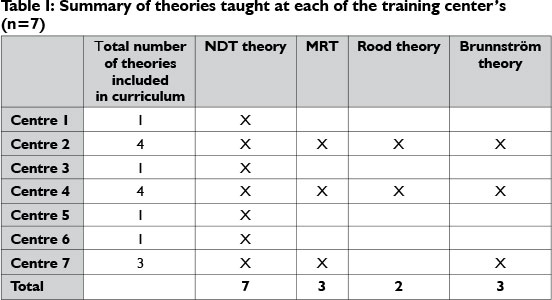
As can be seen in Table I the NDT theory is taught at all the centers in the sample (n = 7). Only three centers are providing training to the students in the MRT and Brunnström theory. Only two centres are including the Rood theory in their training.
During the panel discussion it was noted that the NDT theory is seen as the most superior theory to use in South African stroke rehabilitation. This was also raised by the audience as a concern in terms of the status attached to NDT training and the expectation that all occupational therapists working in stroke rehabilitation should be trained in NDT in order to be competent. A point was raised that there was insufficient evidence to show that this theory is the most effective theory to use in the South African context.
Assessments taught at an undergraduate level Non-standardised assessments
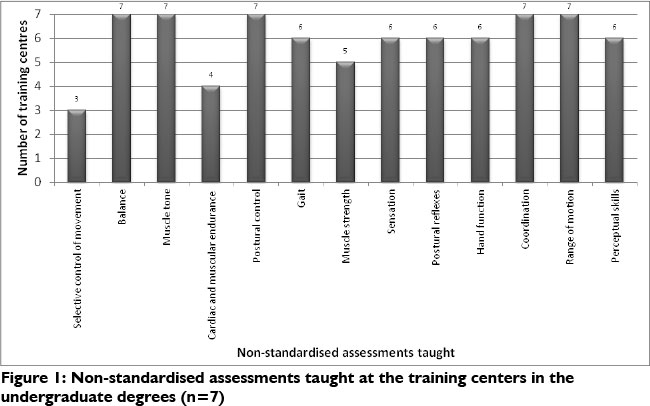
All the training centres in the sample taught assessment of the commonly affected body functions: balance, muscle tone, postural control, coordination and range of motion as part of the undergraduate training (see Figure I). Commonly affected body functions such as cardiac and muscular endurance are only taught at four centers (57.1%), and selective control of movement is taught at only three centres (42.9%). At five centres muscle strength assessment is taught, although it was not determined if this is taught in relation to neurological conditions specifically, or in general (i.e. as part of the musculoskeletal conditions).
There was also a discussion by panelists and the audience around curricula being outdated in terms of terminology. There seems to be an outdated focus on treatment of certain body functions and performance skills such as spasticity, and the lack of teaching of skills in muscle strengthening and alleviating secondary impairments caused by stroke. The view of the panelists was that students become frustrated when they are supervised by clinicians from different universities, as some clinicians avoid muscle strengthening, while others believe firmly in normalising muscle tone.
Standardised assessments
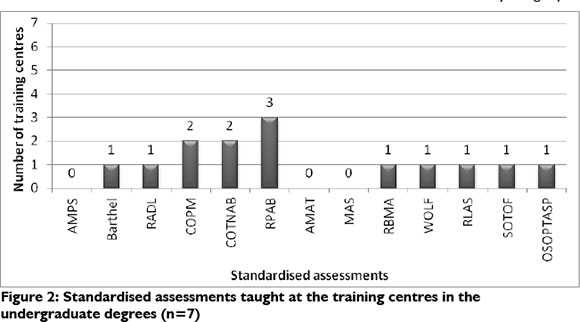
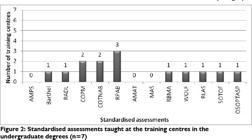
A wide range of options were given in the survey, and the participants had to select the standardised assessments taught at their training centres (see Figure 2). The Rivermead Perceptual Assessment Battery (RPAB)224243442921
DISCUSSION
The stroke rehabilitation curricula content
The diverse structures of the occupational therapy courses across the universities in South Africa will limit university departments' ability to standardise the stroke rehabilitation curricula. A solution would be for university lecturers and curriculum developers to join with experienced occupational therapists working in the field of stroke rehabilitation to align the curriculum with the situation in the clinical field, so that the stroke rehabilitation course is appropriate for an entry level occupational therapist. It is suggested that curriculum developers at the training centres should review the exact core competencies or basic skills required of entry-level occupational therapists in the field of neurological rehabilitation. A reduction in the amount of information given in a course could allow for more time to practise essential clinical skills. Further research is required regarding this topic, and a method of data collection to extract more in-depth information should be developed.
Course requirements for stroke rehabilitation
The survey and panel discussion highlighted that there are no set requirements regarding the assessment and treatment of stroke patients, particularly the number of patients seen during the four year undergraduate training course. The lack of set basic requirements is of concern as a novice's confidence in treating patients can only be developed through sufficient opportunities to practise. A study in the United Kingdom regarding graduates' perceptions of their preparation for clinical roles indicated that they felt ill-prepared for more specific evaluation procedures and that they needed more practical knowledge in their curricula511
A recommendation made by the panelists was that educators could optimise students' learning experiences with teaching tools in addition to formal clinical placement opportunities to interact with and manage stroke patients. These tools could include videos, practical skills laboratories and patient simulations. Students could also have access to a variety of learning material available through electronic-learning, through lecturers and clinical supervisors developing electronic audiovisual resources to enrich the students' experiences.
Clinical skills laboratories are an ideal solution to the problem of limited time doing clinical fieldwork to ensure students are competent in stroke rehabilitation. A suggestion was made that the student could be given outcomes and measurable evaluations to test whether their skills are sufficient; quizzes and computerised skills tests could be used to indicate to them whether they had become competent. These self-evaluations would encourage more effective use of their self-study time.
Stroke rehabilitation theories taught at an undergraduate level
One study suggested that training in the NDT theory, MRT and PNF should be given1131
The NDT theory has historically been the most popular stroke rehabilitation theory amongst occupational therapists and phys-iotherapists13,30,31,35,45,46. Often the decision to use NDT is based on initial education and previous experience, and not necessarily on evidence based research findings3013
The confusion regarding which theory to use in practice might however be overstated. Recent studies showed that any stroke rehabilitation theory an occupational therapist uses will be effective4511
Another concern raised in the discussion was that occupational therapists might be realising the shortcomings of certain stroke rehabilitation theories, and therefore supplementing them with other theories, and thereby hybridising several very different theories. The danger of hybridisation is that occupational therapists become unsure of what techniques they are using and are unable to explain their actions. This is confusing for students who are learning the use of theories as interpreted by their role models.
It was mentioned in the panel discussion that the answer might lie in teaching one effective stroke rehabilitation theory rather than several theories that do not have sufficient evidence for effectiveness in our unique context. Which theory this is to be has yet to be decided.
Assessments taught at an undergraduate level
Non-standardised assessments
Due to the differences in non-standardised assessments taught at the different training centres, as well as emerging evidence of the most effective treatment of body functions that should be addressed in intervention with stroke patients, it is recommended that the curricula be revised. The revision should be based on the latest research in stroke rehabilitation. This includes a reduced focus on the treatment of spasticity. Reducing spasticity during intervention with stroke patients has been proven ineffective in automatically improving performance, and there is little correlation between a reduction in spasticity and an improvement in function. Although the presence of spasticity is acknowledged, the emphasis in therapy has been questioned47,48. The reduction of spasticity is traditionally treated using the NDT33,34 and Rood theories13,49. The results from this study show that all training centres teach the assessment of muscle tone. However, it is important to note the research findings regarding the effect of abnormal muscle tone on a person's function after stroke and that abnormalities in muscle tone alone do not cause dysfunction14,39,47.
The treatment of negative impairments, as described in lit-erature5039,47, and skills in assessing these components should also be a priority. The results from this study show that not all centres consider muscle testing as part of the assessments taught in stroke rehabilitation. The improvement of muscle strength and reduction of secondary impairments have been shown to be correlated with an improvement in function of stroke patients14,47, and may be seen as essential in a stroke rehabilitation curriculum.
As discussed in the panel, students are experiencing frustrations due to the different terminology used by clinicians, and the different focuses in stroke rehabilitation. Revision of the content of the curricula should also clear up confusion regarding terminology and the most important factors affecting abnormal movement after central nervous system injury. Supervisors should ensure that they are updated regarding the latest information in stroke rehabilitation, and training centres should host regular workshops to ensure that clinicians understand what students are taught.
Standardised assessments
The findings from the current study show that very few standardised assessments are included in the undergraduate curricula. If occupational therapists are not taught to use standardised assessments effectively during their undergraduate training, their subsequent ability to use these assessments as part of their intervention protocols could be negatively affected. Assessments should not be based on observations and subjective opinion only. However, previous surveys showed that general observations were used most frequently, and occupational therapists have been widely criticised for their lack of use of standardised assessments3,18,23. A principle should be followed in the occupational therapy profession that a sound assessment or re-assessment cannot be based on observations only, but should be supplemented and substantiated by standardised assessments39
CONCLUSION
Stroke is a disabling condition which affects stroke survivors and their families' ability to function in everyday tasks. Stroke rehabilitation is an important field in which students should receive adequate training and experience in order to manage stroke patients effectively and competently, as research predicts an increase in stroke incidence in sub-Saharan countries. In order to ensure that training at an undergraduate level is sufficient to ensure that newly qualified occupational therapists can manage stroke patients effectively, several changes would have to be made to the current stroke rehabilitation curricula in South Africa. Firstly, requirements of the number of stroke patients students assess and treat during the four years of training should be revised and formally set. Secondly, the most suitable stroke rehabilitation theory for the South African setting should be selected, and the number of theories taught should be limited to ensure competence and understanding of all concepts related to that theory. Thirdly, the terminology and focus on underlying dysfunctional components after stroke should be based on the latest evidence in stroke rehabilitation, and all training centres should use the same terminology to make supervision less frustrating and confusing across the different universities. And lastly, the use of standardised assessments should be introduced at an undergraduate level, to ensure that occupational therapists are evaluating their effectiveness and ensuring that their practice is evidence based. This will also allow for sound evidence to be presented regarding the most suitable stroke rehabilitation theory for South Africa.
REFERENCES
Special thanks and acknowledgements
The author would like to thank the following persons and acknowledge their contribution to the article by assisting with the panel discussion: Fiona Millan, Amshuda Sonday (University of Cape Town), Anupa Singh and Jodie de Bruyn (University of Pretoria).
LITERATURE REVIEW
- 1. Connor MD, Walker R, Modi G, Warlow CP Burden of stroke in black populations in sub-Saharan Africa. Lancet Neurology. 2007 March; 6: 269 - 278.
- 2. Mochan A, Modi M, Modi G. Stroke in black South African HIV-positive patients: A prospective analysis. Stroke. 2003;(34): 10 - 15.
- 3. Rowland TJ, Cooke DM, Gustafsson LA. Role of occupational therapy after stroke. Annals of Indian Academy of Neurology. 2008;(ll): S99 - SI07.
- 4. Steultjens EMJ, Dekker J, Bouter LM, Van de Nes JCM, Cup EHC, Van den Ende CHM. Occupational therapy for stroke patients, a systematic review. Stroke. 2003 March; 34: 676 - 686.
- 5. Brown GT, Brown A, Roever C. Paediatric occupational therapy university programme curricula in the United Kingdom. British Journal of Occupational Therapy. 2005 October; 68(10): 457 - 466.
- 6. Dubouloz C, Egan M, Vallerand J, Von Zweck C. Occupational Therapists' perceptions of evidence-based practice. American Journal of Occupational Therapy. 1999 September/October; 53(5): 445 - 453.
-
7. World Federation of Occupational Therpists. WFOT. [Online].; 2008 [cited 2013 June 7. Available from: HYPERLINK "http://www.wfot.org" http://www.wfot.org.
» http://www.wfot.org - 8. Fritz V Stroke in South Africa. International Journal of Stroke. 2006 February; l: 47 - 48.
- 9. Nelson CE, Cash SH, Bauer DF. Adult physical dysfunction content in professional curricula. The American Journal of Occupational Therapy. 1990 December; 44(12): 1079 - 1087.
- 10. Ballinger C, Ashburn A, Low J, Roderick P. Unpacking the black box of therapy - A pilot study to describe occupational therapy and physiotherapy interventions for people with stroke. Clinical Rehabilitation. 1999 January 13; 13: 301 - 309.
- 11. McCluskey A. Collaborative curriculum development: Clinicians' views on neurology content of a new occupational therapy course. Australian Journal of Occupational Therapy. 2000; 47: I - 10.
- 12. Prince Wittman P. The disparity between educational preparation and the expectations of practice. The American Journal of Occupational Therapy. 1990 December; 44(12): 1130 - 1131.
- 13. Lennon S, Baxter D, Ashburn A. Physiotherapy based on the Bobath concept in stroke rehabilitation: A survey within the UK. Disability and Rehabilitation. 2001; 23(6): 254 - 262.
- 14. Carr JH, Shepherd RB. Neurological rehabilitation. Optimizing motor performance. Edinburgh: Elsevier Limited; 1998.
- 15. Langhammer B. Bobath or motor relearning programme? A comparison of two different approaches of physiotherapy in stroke rehabilitation: a randomized controlled study. Clinical Rehabilitation. 2000; 14: 361 - 369.
- 16. Joubert R. Evidence-based practice: a critique based on occupational therapy within the SA context. South African Journal of Occupational Therapy. 2005 September; 35(2): 8 - 12.
- 17. Crouch R. The impact of poverty on the service delivery of occupational therapy in Africa. In Crouch R, Alers V editors. Occupational Therapy: An African Perspective. Johannesburg: Sarah Shorten publishers; 2010. 98 - 108.
- 18. Unsworth C. Measuring the outcome of occupational therapy: Tools and resources. Australian Occupational Therapy Journal. 2000; 47: 147 - 158.
- 19. Granger CV Guide for the uniform data set for medical rehabilitation (Adult FIM), Buffalo: State University of New York; 1993.
- 20. Mahoney FI, Barthel DW. Functional evaluation: The Barthel Index. MD State Medical Journal. 1965; 14: 61 - 65.
- 21. Fisher AG. Assessment of motor and process skills. 2nd ed. Fort Collins: Three star press; l997.
- 22. Whiting S. RPAB - Rivermead perceptual assessment battery. Windsor: NFER-Nelson; 1985.
- 23. Woodson AM. Stroke. In Radomski MV, Trombly Latham CA, editors. Occupational Therapy for Physical Dysfunction. 6th ed. Philadelpia: Wolters Kluwer / Lippincott Williams Wilkins; 2008: 1001 - 1041.
- 24. Gillen G. Cerebrovascular accident/Stroke. In McHugh Pendleton H, Schultz-Krohn W, editors. Pedretti's Occupational therapy practice skills for physical dysfunction. 6th ed. Missouri: Mosby Inc.; 2006: 802 - 837.
- 25. Folstein MF Folstein SE, McHugh PR. Mini-Mental state: A practical method for grading cognitive state of patients for the clinician. Journal of Psychiatric Resources. 1975; 12: 189-198.
- 26. Rustad RA. Cognitive assessment of Minnesota. Texas: Harcourt Assessment; l993.
- 27. Wilson B, Cockburn J, Baddeley A, Hiorns R. The development and validation of a test battery for detecting and monitoring everyday memory problems. Journal of Clinical Experiences in Neuropsychology. I989;(ll): 855-870.
- 28. Gladstone DJ, Danells CJ, Black S. The Fugl-Meyer assessment of motor recovery after stroke: A critical review of its measurement properties. Neurorehabilitation and Neural Repair. 2002; 16: 232 - 240.
- 29. Carr JH, Shepherd RB, Nordholm L, Lynne D. Investigation of a new motor assessment scale for stroke patients. Physical Therapy. 1985 February; 65(2): 175 - 180.
- 30. Walker MF, Drummond AER, Gatt J, Sackley CM. Occupational therapy for stroke patients: A survey of current practice. British Journal of Occupational Therapy. 2000; 63(8): 367 - 372.
- 31. Natarajan P Oelschlager A, Agah A, Pohl PS, Ahmad SO, Lui W. Current clinical practices in stroke rehabilitation: Regional pilot survey. Journal of Rehabilitation Research and Development. 2008; 45(6): 841 - 849.
- 32. Langhammer B. Bobath or motor relearning programme? A comparison of two different approaches of physiotherapy in stroke rehabilitation: a randomized controlled study. Clinical Rehabilitation. 2000; 14: 361 - 369.
- 33. Bobath B. Adult hemiplegia. 2nd ed. Oxford: Butterworth-Heinemann Ltd.; 1974.
- 34. Bobath B. Adult hemiplegia. 3rd ed. Oxford: Butterworth-Heinemann Ltd.; 1990.
- 35. Raine S. Defining the Bobath concept using the Delphi technique. Physiotherapy Research International. 2006; 11(1): 4 - 13.
-
36. Neuro-developmental treatment association. Neuro-developmental treatment association. [Online].; 2010 [cited 2010 August 25]. Available from: HYPERLINK "http://www.ndta.org/" http://www.ndta.org.
» http://www.ndta.org - 37. Paci M. Physiotherapy based on the Bobath concepts for adults with post stroke hemiplegia: A review of effectiveness studies. Journal of Rehabilitation medicine. 2003; 35(1): 2 - 7.
- 38. Luke C, Dodd KJ, Brock K. Outcomes of the Bobath concept on upper limb recovery following stroke. Clinical Rehabilitation. 2004; 18(8): 888 - 898.
- 39. Shapero Sabari J. Optimizing motor skill using task related training. In Radomski MV Trombly Latham CA, editors. Occupational Therapy for Physical Dysfunction. 6th ed. Philadelphia: Wolters Kluwer / Lippincott Williams Wilkins; 2008. 618 - 7I3.
- \
- 40. Trombly Latham CA. Optimizing motor behaviour using the Brunnstrom movement therapy approach. In Radomski MV, Trombly Latham CA, editors. Occupational Therapy for Physical Dysfunction. 6th ed. Philadelphia: Wolters Kluwer / Lippincott Williams Wilkins; 2008. 667 - 689.
- 41. Longenecker Rust K. Managing deficit of first-level motor control capacities using Rood and Proprioceptive neuromuscular facilitation techniques. In Radomski MV, Trombly Latham CA, editors. Occupational Therapy for Physical Dysfunction. 6th ed. Philadelphia: Wolters Kluwer / Lippincott Williams Wilkins; 2008. p. 690 - 727.
- 42. Carswell A, McColl M, Baptiste S, Law M, Polatajko H, Pollock N. The Canadian occupational performance measure: A research and clinical literature review. Canadian Journal of Occupational Therapy. 2004;(7l): 210-222.
- 43. Tyerman R Tyerman AHP Hadfied C. Chessington occupational therapy neurological assessment battery. Nottingham: Nottingham Rehab; 1986.
- 44. Kopp B, Kunkel A, Flor H, Platz T, Rose U, Mauritz KH. The arm motor ability test: Reliability, validity and sensitivity to change of an instrument for assessing disabilitites in activities of daily living. Archives of Physical Medical Rehabilitation. I997;(78): 615 - 620.
- 45. Kwakkel G, Kollen BJ, Wagenaar RC. Therapy impact on functional recovery in stroke rehabilitation: A critical review of the literature. Physiotherapy. 1999; 85(7): 377 - 391.
- 46. Lennon S, Ashburn A. The Bobath concept in stroke rehabilitation: A focus group study of the experienced physiotherapist's perspective. Disability and Rehabilitation. 2000; 22(15): 665 - 674.
- 47. Ada L, Canning C. Changing the way we view the contribution of motor impairments to the physical disability after stroke. In Refshauge K, Ada L, Ellis E, editors. Science-based Rehabilitation -Theories into practice. 1st ed. Edinburgh: Butterworth Heinemann; 2005. 87 - 106.
- 48. McCluskey A, Lannin N, Schurr K. Optimising motor performance following brain impairment. In Curtin M, Molineux M, Supyk-Mellson J, editors. Occupational Therapy and Physical Dysfunction: Enabling Occupation. 6th ed. Edinburgh: Churchill Livingstone Elsevier; 2010.
- 49. Rood MS. The use of sensory receptors to activate, facilitate and inhibit motor response, autonomic and somatic, in developmental sequence. In Sattely C. Approaches to the treatment of patients with neuromuscular dysfunction. Dubuque: W.C. Brown; 1962: 26 - 37.
- 50. Carr JH, Shepherd RB. Stroke rehabilitation: Guidelines for exercise and training to optimise motor skill. London: Butterworth-Heinemann; 2003.
 Correspondence:
Juliana Freeme