Translation and validation of the Malay version of the Pelvic Floor Distress Inventory (M-PFDI-20) and Pelvic Floor Impact Questionnaire (M-PFIQ-7)
BACKGROUND. Pelvic floor disorders substantially affect womens quality of life. The Pelvic Floor Distress Inventory (PFDI-20) and Pelvic Floor Impact Questionnaire (PFIQ-7) are widely used patient-reported outcome measures, but no validated Malay versions exist. Linguistic and cultural validation is essential to ensure accurate assessment of pelvic floor symptoms and their impact among Malay-speaking women. OBJECTIVE. To translate and validate the Pelvic Floor Distress Inventory (M-PFDI-20) and Pelvic Floor Impact Questionnaire (M-PFIQ-7) questionnaires into the Malay language. METHODS. This cross-sectional study at a public university involved 196 women who understand the Malay language. Both questionnaires underwent forward and backward translations. Subsequently, face validation was done among five women, followed by a pilot study among 30 women. Using the final version, a cross-sectional study was done, followed by test-retest reliability after 4 weeks. RESULTS. In M-PFIQ-7, inter-item correlation ranged between 0.40 and 0.90 and in M-PFDI-20, all but nine items ranged between 0.3 to 0.6. However, as the extraction communalities for all items exceeded 0.3, no items were excluded. Both questionnaires showed no correlation between factors exceeded 0.7 and demonstrated adequate construct validity. The internal consistency for M-PFDI-20 and M-PFIQ-7 was excellent, with Cronbach's alpha values of 0.906 and 0.976, respectively. Both showed low Cronbach's alpha value in test-retest analysis. CONCLUSION. The Malay versions of the PFDI-20 and PFIQ-7 demonstrate good construct validity and excellent internal consistency, supporting their use for assessing pelvic floor distress and impact among Malay-speaking women. However, limited test-retest reliability suggests caution when using these instruments for longitudinal assessment.
pelvic floor disorders; psychometrics; quality of life; translations
S DaudI, II; B AbdulahIII, IV; S IdrisV; M R IsaVI, VII; F ShamVIII
IMB ChB, DFFP, FRCOG; Maternofetal and Embryo (MatE) Research Group, Faculty of Medicine, Universiti Teknologi MARA, Sungai Buloh Campus, Selangor, Malaysia
IIMB ChB, DFFP, FRCOG; Department of Obstetrics and Gynaecology, Faculty of Medicine, Universiti Teknologi MARA (UiTM), Sungai Buloh Campus, Sungai Buloh, Selangor Darul Ehsan, Malaysia
IIIMD, MOG, MRCOG; Maternofetal and Embryo (MatE) Research Group, Faculty of Medicine, Universiti Teknologi MARA, Sungai Buloh Campus, Selangor, Malaysia
IVMD, MOG, MRCOG; Department of Obstetrics and Gynaecology, Faculty of Medicine, Universiti Teknologi MARA (UiTM), Sungai Buloh Campus, Sungai Buloh, Selangor Darul Ehsan, Malaysia
VMBBS, MOG; Department of Obstetrics and Gynaecology, Faculty of Medicine, Universiti Teknologi MARA (UiTM), Sungai Buloh Campus, Sungai Buloh, Selangor Darul Ehsan, Malaysia
VIMBBS, MPH, DrPH; Maternofetal and Embryo (MatE) Research Group, Faculty of Medicine, Universiti Teknologi MARA, Sungai Buloh Campus, Selangor, Malaysia
VIIMBBS, MPH, DrPH; Department of Population Health and Prevention Medicine, Faculty of Medicine, Universiti Teknologi MARA, Sungai Buloh Campus, Selangor, Malaysia
VIIIBSc (Nursing), MSc (Nursing) (Comm Health); Faculty of Health Science, Universiti Teknologi MARA (UiTM), Puncak Alam Campus, Selangor, Malaysia
BACKGROUND. Pelvic floor disorders substantially affect womens quality of life. The Pelvic Floor Distress Inventory (PFDI-20) and Pelvic Floor Impact Questionnaire (PFIQ-7) are widely used patient-reported outcome measures, but no validated Malay versions exist. Linguistic and cultural validation is essential to ensure accurate assessment of pelvic floor symptoms and their impact among Malay-speaking women.
OBJECTIVE. To translate and validate the Pelvic Floor Distress Inventory (M-PFDI-20) and Pelvic Floor Impact Questionnaire (M-PFIQ-7) questionnaires into the Malay language.
METHODS. This cross-sectional study at a public university involved 196 women who understand the Malay language. Both questionnaires underwent forward and backward translations. Subsequently, face validation was done among five women, followed by a pilot study among 30 women. Using the final version, a cross-sectional study was done, followed by test-retest reliability after 4 weeks.
RESULTS. In M-PFIQ-7, inter-item correlation ranged between 0.40 and 0.90 and in M-PFDI-20, all but nine items ranged between 0.3 to 0.6. However, as the extraction communalities for all items exceeded 0.3, no items were excluded. Both questionnaires showed no correlation between factors exceeded 0.7 and demonstrated adequate construct validity. The internal consistency for M-PFDI-20 and M-PFIQ-7 was excellent, with Cronbach's alpha values of 0.906 and 0.976, respectively. Both showed low Cronbach's alpha value in test-retest analysis.
CONCLUSION. The Malay versions of the PFDI-20 and PFIQ-7 demonstrate good construct validity and excellent internal consistency, supporting their use for assessing pelvic floor distress and impact among Malay-speaking women. However, limited test-retest reliability suggests caution when using these instruments for longitudinal assessment.
Keywords: pelvic floor disorders; psychometrics; quality of life; translations.
Pelvic floor disorder is a very common condition among women, and it may cause a significant negative impact on their quality of life.[1] This includes urinary incontinence, faecal/flatal incontinence and pelvic organ prolapse. A significant proportion of women may require surgical intervention to alleviate the problem.[2] However, many women do not know when they should seek treatment, as they themselves were not sure whether their problem was severe enough to require medical attention. Furthermore, some of them thought that their conditions were part of the natural aging process and so would continue suffering in silence and were not aware of available treatment options.
It is crucial for the healthcare providers to have a reliable tool to assess the severity of any form of pelvic floor disorders. It should not solely rely on the anatomical findings during the physical examination. The severity of the condition should be determined by the patient themselves. Hence various questionnaire to assess the impact of PFD to women's quality of life have been developed.
The Pelvic Floor Impact Questionnaire (PFIQ), and the Pelvic Floor Distress Inventory (PFDI), developed by Barbet et al (2001),[3] were among the most frequently used questionnaires for this purpose. The short versions (PFDI-20 and PFIQ-7) which had been validated for use,[4] were found to be more useful in daily clinical practice because of the shorter time required for the women to answer, making them more practical tools.
These questionnaires have been translated to various languages (including and not limited to Spanish, French, Portuguese, Dutch Chinese);[5-11] however, the Malay language version remains unavailable. Therefore, the present study aimed to translate and validate the PFDI-20 and PFIQ-7 questionnaires in the Malay language.
Methods
This study was conducted from January 2021 to June 2022 in two faculties of a public university in Malaysia. Ethics approval was obtained from the university's Research Ethics Committee (ref. no. REC /11/2020(FB/363)).
PFDI-20 consists of three separate scales: 6 questions of Pelvic Organ Prolapse Distress Inventory (POPDI) about the inconvenience of the prolapse; 8 questions of Colorectal-Anal Distress Inventory (CRADI) concerning difficulties of defecation; and 6 questions of Urinary Distress Inventory (UDI) about difficulties in urination.[4] If the response for the item was affirmative, there was a grading scale to pick from 0 to 4, which indicates mild to severe symptoms. The mean value of all the answered items within the corresponding scale was then multiplied by 25 to obtain the subscale score (range 0 to 100). The scores from all the 3 subscales were added to obtain the overall score, which varied from 0 to 300.[4] Higher total and subscale scores indicate greater symptom severity and a more substantial negative impact of pelvic floor disorders on quality of life.
Similarly, the PFIQ-7 consists of three scales, each of them containing seven questions: the Pelvic Organ Prolapse Impact Questionnaire (POPIQ), the Colorectal-Anal Impact Questionnaire (CRAIQ) and the Urinary Impact Questionnaire (UIQ). There are four answers for each item (not at all = 0; somewhat = 1; moderately = 2; quite a bit= 3). The mean value for all the answered items within the corresponding scale was multiplied by 100/3 to obtain the subscale score which ranged from 0 to 100. The final score was calculated when subscale scores were added (range from 0 to 300).[4]
The PFDI-20 and PFIQ-7 questionnaires were translated and validated into Malay language. Both questionnaires underwent forward and backward translation by two independent translators at each stage. The translation process was conducted in accordance with the WHO guideline of translating and adapting of instruments. Two independent native Malay language experts carried out the forward translation whose quality was checked by another independent translators. The backward translation into English language was carried out by another two independent translators. Discrepancies found from this process were resolved prior to its use in this study and a preliminary version was finalised. The preliminary version underwent a face validity test among five subjects. Subsequently, it was piloted among 30 subjects before the final version was used in the study.
A cross-sectional study was then performed among female staff from the Faculty of Health Sciences who were aged 20 years old and above and understand the Malay language. Women who were pregnant or with no history of sexual intercourse were excluded.
Based on the rule of thumb, the sample size is calculated using ratio 1:10 per item for items less than 20, and ratio of 1:5 per item for items 20 and above. Since there are 20 items in PFDI-20, 100 subjects were required, and in addition, there are 7 items in PFIQ-7, 70 subjects were required. Therefore, a total of 170 subjects were required. By considering 10% attrition rate, the minimum sample size needed for this study was 187. The convenience sampling approach was used in this study until the target sample size was reached.
The questionnaire was distributed through Google Forms and the study information sheet was provided on the first page. The questionnaire had two parts. Part 1 demographic details about the participants. This includes age, marital status, parity, previous mode of delivery, body mass index (BMI), menopausal status, educational level, occupation and total monthly income. Part 2 was the Malay version of PFDI-20 and PFIQ-7. Test-retest reliability was performed among 31 subjects from the whole initial respondents after four weeks.
Statistical analysis
SPSS Statistics version 24 (IBM Corp., USA) was used for data entry and statistical analysis. Means and standard deviations (SDs) were used to~express continuous variables. Frequencies and percentages were used to express categorical variables.
The Malay version of the PFDI-20 and PFIQ-7 underwent three levels of psychometric properties evaluation. Before factor extraction, sampling adequacy using the Kaiser-Meyer-Olkin (KMO) criterion was used to confirm that the items were eligible for principal component analysis (PCA). For factor analysis, a KMO criteria of >0.5 was selected as the minimum value, with >0.8 deemed ideal. Data suitability was determined using Bartlett's sphericity test. To proceed with factor analysis, a p-value of 0.05 was considered significant.
Principal axis factoring with Promax rotation was subsequently used to investigate the dimensionality and construct validity of the Malay version of the PFDI-20. The lower cut-off criterion in the development of the factor structure was chosen at factor loadings of >0.30. To decide how many elements to keep, the Eigenvalues and scree plot were employed.
According to Kaiser's criteria, factors with an Eigenvalue of 1.34 were kept. Factors having a low Eigenvalue of 1 were deemed redundant as they did not explain much of the data variation. The number of elements to be retained, according to the scree plot, are the data points above the point of deflection.
Finally, the internal reliability of the Malay version PFDI-20 and PFIQ-7 were assessed using Cronbach's alpha coefficient and corrected item total correlations. A Cronbach's alpha coefficient below 0.70 indicates an unacceptable level of clinical significance, between 0.70 and 0.79 indicates fair significance, while the significance is good between 0.80 and 0.89 and excellent when it is 0.90 and above.[12] Intraclass correlation coefficients (ICCs) were used to assess test-retest reliability of the questionnaire. The higher the values nearing 1.00, the more stable the items over time.[13]
Results
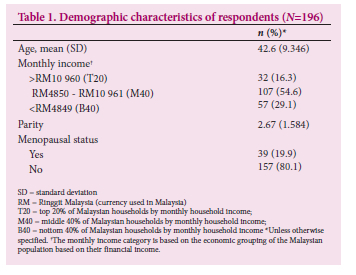
A total of 196 women, in which the majority (92.9%) were Malay, participated in this study. The demographic characteristics of respondents are shown in Table 1.
Validity analysis
PFDI-20
The data obtained for M-PFDI-20 were not normally distributed. The Kaiser-Meyer-Olkin (KMO) measure of sampling adequacy value for M-PFDI-20 was 0.868 with a significant p-value of <0.001 for the Bartlett's test of sphericity. These results showed that the data set was suitable to proceed with further factor analysis.
The inter-item correlation for all items was between 0.3 to 0.6 except for items A7, A8, A9, A11, A13, A14, A17, A18 and A19 which were less than 0.3. However, the extraction communalities for all these items was more than 0.3, therefore no items were excluded from the analysis.
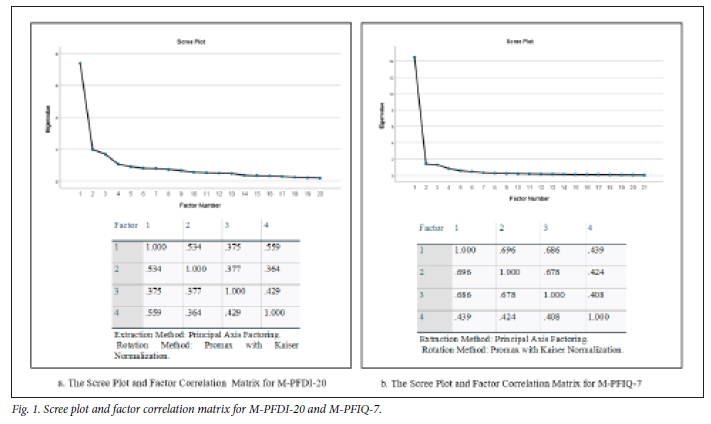
Using principle axis factoring with Promax rotation, four-factor domains were identified. However, further analysis was done with the factor fixed at three, and it was deemed to be the most conceptually appropriate and equivalent to the original PFDI-20 questionnaire. The Kaiser's criterion showed three factors with Eigenvalues of >1, with the total variance of 55.20%. The Scree plot was as below (Fig. 1).
Oblique rotation was opted for, considering the expectation that the factors correlate with each other. The structure matrix demonstrated that all items cross load to either 2 or 3 factors, but there was significant difference of > 0.1 from the dominant factor domain (major domain) compared with the others. Therefore, item A1 to A6 were under 1 factor, A7 to A14 were under 1 factor and items A15 to A20 were under another factor. No item was excluded from the M-PFDI-20.
The pattern matrix also showed similar findings, and this deemed to be the most conceptually appropriate and equivalent to the original PFDI-20 questionnaire.
There was also no correlation between factors that exceed 0.7 (Fig. 1), therefore discriminant validity was achieved, and no multicollinearity issue was present.
PFIQ-7
The data obtained for PFIQ-7 were not normally distributed. The Kaiser-Meyer-Olkin (KMO) measure of sampling adequacy for M-PFIQ-7 was 0.932, with a significant p-value of <0.001 for the Bartlett's test of sphericity. These results showed that the data set was suitable to proceed with further factor analysis.
All the items in M-PFIQ-7 had inter-item correlation between 0.40 and 0.90 and extraction communalities were more than 0.3, which indicates that all the extracted components represent the variables well.
The Kaiser's criterion showed three factors with Eigenvalues of >1, with a total variance of 81.46%. On the Scree plot, the elbow of the curve occurred at 3 (Fig. 1). Using principle axis factoring with Promax rotation, three-factor domains were identified.
Oblique rotation was opted considering the expectation that the factors correlate with each other. The structure matrix demonstrated that all items cross loading to all factors, but there was significant difference of > 0.1 from the dominant factor domain (major domain) than the others. Therefore, items B1a, B2a, B3a, B4a, B5a, B6a, B7a were under 1 factor, B1b, B2b, B3b, B4b, B5b, B6b, B7b were under 1 factor and items B1c, B2c, B3c, B4c, B5c, B6c, B7c were under another factor. No item was excluded from the M-PFIQ-7.
The pattern matrix also demonstrated a similar three-factor structure, supporting the retention of all items and confirming that the factor solution was conceptually appropriate and equivalent to the original PFIQ-7 questionnaire.
There was also no correlation between factors exceeding 0.7 (Fig. 1), therefore discriminant validity was achieved and no multicollinearity issue was present.
Reliability analysis
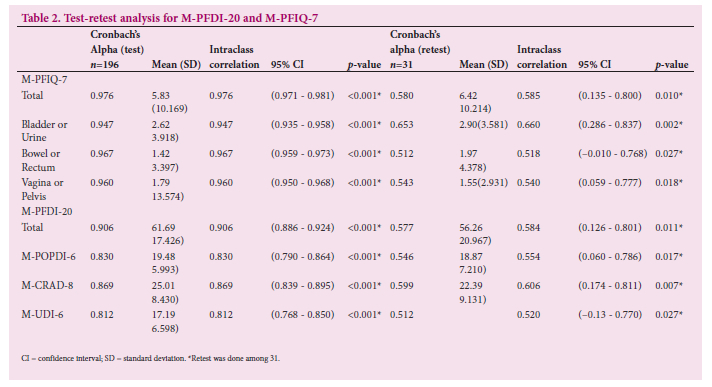
Total scores from both questionnaires (PFIQ-7 and PFDI-20) presented adequate internal consistency, with a Cronbach's alpha values of 0.976 (PFIQ-7) and 0.906 (PFDI-20), respectively (Table 2). Their subscales also showed adequate internal consistency, with values varying from 0.947 to 0.967 in the PFIQ-7 group and from 0.812 to 0.869 in the PFDI-20 group. However, the test-retest analysis showed consistently low Cronbach's alpha values for both questionnaires. Therefore, both the M-PFIQ-7 and M-PFDI-20 did not show stability over time (Table 2).
Discussion
The M-PFDI-20 and M-PFIQ-7 are the first to undergo the process of translation, adaptation and validation to the Malay language following recommended guidelines. It was crucial to address the need to have a tool that can be used by Malay-speaking women who suffer from various pelvic floor disorders.
A review of 52 studies on translation methods showed that there was a consensus among researchers on using the forward and backward translations with the use of Cronbach's alpha for testing internal validity.[14] Further, it suggested to include either a professional translator, a translator with the same mother tongue as target audience, an expert review group, or a lay-person translator. A previous study[5] employed translators who were native speakers with proficiency in English and were professionally certified by a recognised scientific or professional translation body. Other translators used in earlier research were native speakers who were healthcare experts in pelvic floor disorders and fluent in English.[15]
Furthermore, a Dutch study[16] used three independent forward translators whereas the backward translation done by a native speaker. The choice of the forward translator matters, as an understanding of the objective of the material requiring translation was necessary to ensure better restitution of the intended measurement. On the contrary, in order to eliminate bias and to allow the chance to reveal unexpected meaning in the translation, the backward translation is recommended to be performed by a native speaker without prior knowledge of objectives of the material requiring translation.[17] Therefore, the present study has followed this recommendation by employing two healthcare workers who were certified translators and who understood the objectives of the questionnaires for forward translation, while a native speaker, who was a certified translator (without prior knowledge on the objectives of the questionnaire) was employed for backward translation.
The validity analysis of M-PFDI-20 demonstrated that all items cross-loaded to one dominant factor domain, which concluded that no item need to be deleted, and the distribution of items tallied with the three factors domain structure in the original questionnaire, i.e. POPDI-6, CRAD-8 and UDI-6. Similarly, the validity analysis for M-PFIQ-7 also showed that all items were cross loading to one dominant factor domain. All items were retained, and the distribution of items aligned with the three-factor domain structure in the original questionnaire, i.e. bladder or urine, bowel or rectum and vagina or pelvis. This finding that confirmed the discriminant validity of the items led to the final version of the M-PFDI-20 and M-PFIQ-7, which have the same number of items as the original questionnaires. Similarly, the construct validity of the items in the questionnaires have been demonstrated to be adequate in other validation studies.[5,10,16,18,19]
The present study also showed that both the M-PFDI-20 and M-PFIQ-7 were reliable. The Cronbach's alpha value for PFDI-20 was 0.906 (excellent internal consistency), while its subscale varied from 0.812 to 0.869 (good internal consistency). On the other hand, the PFIQ-7 had excellent internal consistency, both overall (0.976) and for its subscales (varied from 0.947 to 0.967). This finding was similar to those observed in a Brazilian study;[5] both overall questionnaires and their subscales had good internal consistency with a Cronbach's alpha value for the overall PFIQ-7 and PFDI-20 of 0.846 and 0.844, respectively. In a validation study[18] among Swedish women, the Cronbach alpha values were 0.925 and 0.841 for the PFIQ-7 and PFDI-20, respectively, while a separate validation study[16] among Dutch women produced Cronbach alpha values of 0.89 and 0.74 for the PFIQ-7 and PFDI-20, respectively.
However, our study found that the ICCs for the M-PFIQ-7 and M-PFDI-20 were 0.585 and 0.584, respectively. This may indicate that both the M-PFIQ-7 and M-PFDI-20 were not stable over a time interval. However, it is important to appreciate the potential factors that may affect the different responses, including symptom severity, as clinical conditions are dynamic.
Good test-retest reliability was demonstrated by both the Dutch[16] and Swedish[18] studies. In the Dutch study,[16] the ICC was 0.88 and 0.83 for the PFDI-20 and PFIQ-7, respectively, while the ICC was 0.932 and 0.906 for PFDI-20 and PFIQ-7, respectively, in the Swedish study. The differences could be explained by a much shorter retest interval. The average retest interval was 8 days for the Dutch study and 2 weeks for the Swedish study. In the Brazilian study,[5] the retest was performed at 4 weeks, which was similar to the retest time period in our study. They obtained good test-retest reliability, with ICC values of 0.803 and 0.843 for the PFDI-20 and PFIQ-7, respectively. Owing to a lack of further clinical information obtained from the participants, it was difficult to determine the reason for the low ICC during the test-retest reliability assessment in the present study.
Study limitations
The present study only had one cohort of participants, with no comparison group. Nonetheless, it was adequate to achieve the objectives of the study. The scores obtained for both questionnaires were not normally distributed which suggest that the participants studied may not represent the population well. Therefore, the prevalence of pelvic floor disorders could not be reported as it likely did not reflect the true prevalence in the population.
Conclusion
The Malay version of the PFDI-20 and PFIQ7 are valid and reliable tools to assess pelvic floor disorders among women; however, we were unable to demonstrate its stability over time, owing to a low interclass correlation coefficient during test-retest reliability. Therefore, we suggest caution when using these instruments for longitudinal assessment.
Declaration. None.
Acknowledgements. None.
Author contributions. BA contributed to the conceptualisation, design, statistical analysis and manuscript revision. SD contributed to the conceptualisation, design, and manuscript writing. SI contributed to the conceptualisation, design and data collection. MRI contributed to the conceptualisation, design, primary statistical analysis and interpretation of data. FS contributed to the conceptualisation, design and data collection. All authors approved the final version for publication.
Funding. None.
Conflicts of interest. None.
References
-
1. Good MM, Solomon ER. Pelvic floor disorders. Obstet Gynecol Clin North Am 2019;46(3):527-540. https://doi.org/10.1016/j.ogc.2019.04.010
» https://doi.org/10.1016/j.ogc.2019.04.010 -
2. Meekins AR, Siddiqui NY. Diagnosis and management of postpartum pelvic floor disorders. Obstet Gynecol Clin North Am 2020;47(3):477-486. https://doi.org/10.1016/j.ogc.2020.05.002
» https://doi.org/10.1016/j.ogc.2020.05.002 -
3. Barber MD, Kuchibhatla MN, Pieper CF, Bump RC. Psychometric evaluation of 2 comprehensive condition-specific quality of life instruments for women with pelvic floor disorders. Am J Obstet Gynecol 2001;185(6):1388-1395. https://doi.org/10.1067/mob.2001.118659
» https://doi.org/10.1067/mob.2001.118659 -
4. Barber MD, Walters MD, Bump RC. Short forms of two condition-specific quality-of-life questionnaires for women with pelvic floor disorders (PFDI-20 and PFIQ-7). Am J Obstet Gynecol 2005;193(1):103-113. https://doi.org/10.1016/j.ajog.2004.12.025
» https://doi.org/10.1016/j.ajog.2004.12.025 -
5. Arouca MA, Duarte TB, Lott DA, et al. Validation and cultural translation for Brazilian Portuguese version of the Pelvic Floor Impact Questionnaire (PFIQ-7) and Pelvic Floor Distress Inventory (PFDI-20). Int Urogynecol J 2016;27(7):1097-1106. https://doi.org/10.1007/s00192-015-2938-8
» https://doi.org/10.1007/s00192-015-2938-8 - 6. Chan SS, Pang SM, Lai BP, Choy KW. Quality of life and symptom measurement in Chinese women with pelvic floor disorders: Validation study of Pelvic Floor Distress Inventory and Pelvic Floor Impact Questionnaire. Hong Kong Med J 2017;23(Suppl 2)(3):38-41.
-
7. De Tayrac R, Deval B, Fernandez H, Mares P, MAPI Research Institute. Development of a linguistically validated French version of two short-form, condition-specific quality of life questionnaires for women with pelvic floor disorders (PFDI-20 and PFIQ-7). J Gynecol Obstet Biol Reprod 2007;36(8):738-748. https://doi.org/10.1016/j.jgyn.2007.08.002
» https://doi.org/10.1016/j.jgyn.2007.08.002 -
8. Due U, Brostrøm S, Lose G. Validation of the Pelvic Floor Distress Inventory-20 and the Pelvic Floor Impact Questionnaire-7 in Danish women with pelvic organ prolapse. Acta Obstet Gynecol Scand 2013;92(9):1041-1048. https://doi.org/10.1111/aogs.12189
» https://doi.org/10.1111/aogs.12189 -
9. Grzybowska ME, Griffith JW, Kenton K, et al. Validation of the Polish version of the Pelvic Floor Distress Inventory. Int Urogynecol J 2019;30(1):101-105. https://doi.org/10.1007/s00192-018-3715-2.
» https://doi.org/10.1007/s00192-018-3715-2 -
10. Henn EW, Richter BW, Marokane MMP. Validation of the PFDI-20 and PFIQ-7 quality of life questionnaires in two African languages. Int Urogynecol J 2017;28(12):1883-1890. https://doi.org/10.1007/s00192-017-3318-3
» https://doi.org/10.1007/s00192-017-3318-3 -
11. Teig CJ, Grotle M, Bond MJ, et al. Norwegian translation, and validation, of the Pelvic Floor Distress Inventory (PFDI-20) and the Pelvic Floor Impact Questionnaire (PFIQ-7). Int Urogynecol J 2017;28(7):1005-1017. https://doi.org/10.1007/s00192-016-3209-z
» https://doi.org/10.1007/s00192-016-3209-z -
12. Cicchetti DV. Guidelines, criteria, and rules of thumb for evaluating normed and standardised assessment instruments in psychology. Psychol Assessment 1994;6(4):284. https://doi.org/10.1037/1040-3590.6.4.284
» https://doi.org/10.1037/1040-3590.6.4.284 - 13. Tabachnick BG, Fidell LS, Ullman JB. Using Multivariate Statistics. 6th ed. Boston: Pearson, 2013.
-
14. Danielsen AK PH-C, Burcharth J, Angenete E, Rosenberg J. Translation of questionnaires measuring health related quality of life is not standardised: A literature based research study. PLoS ONE 2015;10(5):e0127050. https://doi.org/10.1371/journal.pone.0127050
» https://doi.org/10.1371/journal.pone.0127050 -
15. Yoshida M, Murayama R, Ota E, Nakata M, Kozuma S, Homma Y. Reliability and validity of the Japanese version of the pelvic floor distress inventory-short form 20. Int Urogynecol J 2013;24(6):1039-1046. https://doi.org/10.1007/s00192-012-1962-1
» https://doi.org/10.1007/s00192-012-1962-1 -
16. Utomo E, Blok BF, Steensma AB, Korfage IJ. Validation of the Pelvic Floor Distress Inventory (PFDI-20) and Pelvic Floor Impact Questionnaire (PFIQ-7) in a Dutch population. Int Urogynecol J 2014;25(4):531-544. https://doi.org/10.1007/s00192-013-2263-z
» https://doi.org/10.1007/s00192-013-2263-z -
17. Guillemin F, Bombardier C, Beaton D. Cross-cultural adaptation of health-related quality of life measures: Literature review and proposed guidelines. J Clin Epidemiol 1993;46(12):1417-1432. https://doi.org/10.1016/0895-4356(93)90142-n
» https://doi.org/10.1016/0895-4356(93)90142-n -
18. Teleman P, Stenzelius K, Iorizzo L, Jakobsson U. Validation of the Swedish short forms of the Pelvic Floor Impact Questionnaire (PFIQ-7), Pelvic Floor Distress Inventory (PFDI-20) and Pelvic Organ Prolapse/Urinary Incontinence Sexual Questionnaire (PISQ-12). Acta Obstet Gynecol Scand 2011;90(5):483-487. https://doi.org/10.1111/j.1600-0412.2011.01085.x
» https://doi.org/10.1111/j.1600-0412.2011.01085.x -
19. Ma Y, Xu T, Zhang Y, Mao M, Kang J, Zhu L. Validation of the Chinese version of the Pelvic Floor Distress Inventory-20 (PFDI-20) according to the COSMIN checklist. Int Urogynecol J 2019;30(7):1127-1139. https://doi.org/10.1007/s00192-018-3847-4
» https://doi.org/10.1007/s00192-018-3847-4

Accepted 15 August 2025