Chemotherapy-induced seizures: A rare case of paclitaxel-induced neurotoxicity at Chris Hani Baragwanath Oncology Centre
Paclitaxel is widely used for advanced Kaposi sarcoma (KS) in resource-limited settings because of cost-effectiveness and proven efficacy. Neurotoxicity is recognised, but infusion-related seizures are exceedingly rare, particularly in human immunodeficiency virus (HIV)-positive patients. A 32-year-old HIV-positive male, virologically suppressed (CD4 450 cells/mm3), presented with T1-stage nodular KS. Paclitaxel (120 mg/m2) infusion induced a self-limiting generalised tonic-clonic seizure within 10 min. Despite a 20% dose reduction during the second cycle, a similar seizure recurred. Neuroimaging, cerebrospinal fluid analysis, and laboratory investigations were unremarkable. Electroencephalography was unavailable. Paclitaxel was discontinued; doxorubicin-based chemotherapy was initiated, with no further seizures and partial regression of lesions after two cycles. CONTRIBUTION: This case identifies paclitaxel-induced seizures as a rare adverse event in an HIV-positive patient, underscoring the need for vigilant infusion monitoring, prompt diagnostic exclusion of opportunistic causes, and individualised chemotherapy selection.
South Africa; Chris Hani Baragwanath Hospital; Gauteng; Kaposi sarcoma; paclitaxel; neurotoxicity
CASE STUDY
Chemotherapy-induced seizures: A rare case of paclitaxel-induced neurotoxicity at Chris Hani Baragwanath Oncology Centre
Asma AdamI; Tivanya PillayI; Rofhiwa T. MathibaI, II, III
IDepartment of Internal Medicine, Chris Hani Baragwanath Hospital, Johannesburg, South Africa
IIDepartment of Internal Medicine, Faculty of Health Sciences, University of the Witwatersrand, Johannesburg, South Africa
IIIDivision of Medical Oncology, Soweto Comprehensive Care Centre, Johannesburg, South Africa
Paclitaxel is widely used for advanced Kaposi sarcoma (KS) in resource-limited settings because of cost-effectiveness and proven efficacy. Neurotoxicity is recognised, but infusion-related seizures are exceedingly rare, particularly in human immunodeficiency virus (HIV)-positive patients. A 32-year-old HIV-positive male, virologically suppressed (CD4 450 cells/mm32
CONTRIBUTION: This case identifies paclitaxel-induced seizures as a rare adverse event in an HIV-positive patient, underscoring the need for vigilant infusion monitoring, prompt diagnostic exclusion of opportunistic causes, and individualised chemotherapy selection.
Keywords: South Africa; Chris Hani Baragwanath Hospital; Gauteng; Kaposi sarcoma; paclitaxel; neurotoxicity
Case summary
This is a case of a 32-year-old male from Soweto who was referred to our oncology unit for further management of his condition. He is known to be human immunodeficiency virus (HIV)-positive, virologically suppressed on first-line antiretroviral therapy, with a cluster of differentiation 4 (CD4) count of 450 cells/mm32
During the first infusion of paclitaxel, the patient experienced a generalised tonic-clonic seizure approximately 10 min into the infusion. At the time of the event, he was normoglycaemic and other vitals remained within normal limits. The seizure self-aborted and lasted less than 3 min. The patient made full recovery within an hour. He was subsequently admitted for observation and monitored for 24 h, during which no further seizure activity was witnessed.
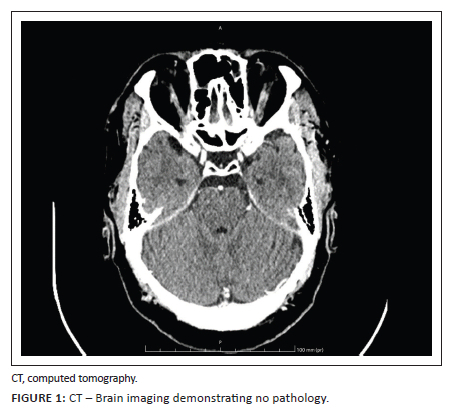
Given the unclear aetiology of the initial seizure and need for ongoing treatment, the decision was made to cautiously rechallenge the patient during the second cycle with a 20% reduction of paclitaxel. Unfortunately, he developed a second seizure, similar to the first episode. He was evaluated with a contrast-enhanced computed tomography (CT) scan of the brain (Figure 1), and it revealed no intracranial abnormalities. Cerebrospinal fluid analysis and blood workup were all within normal limits. An electroencephalogram could not be obtained because of resource constraints.
Because of these recurrent infusion-associated seizures and absence of other identifiable triggers, paclitaxel was discontinued. For the third cycle, the patient was transitioned to doxorubicin-based chemotherapy following a normal baseline echocardiogram. He has since completed two cycles of this regimen without any further seizure activity and is tolerating treatment well.
Discussion
The management of AIDS-related KS is based on clinical staging.123,4 It has also been found to accumulate in the dorsal columns resulting in length-dependent sensory neuropathy because of symmetrical axonal death.3,4 To our knowledge, no cases within the last 5 years reporting seizures in response to paclitaxel single agent therapy have been reported, especially in HIV-positive patients.
While HIV itself can cause seizures by causing direct damage to the brain,56,7 Human immunodeficiency virus-Associated Neurocognitive Disorder (HAND) could be a consideration in advanced cases; however, motor and cognitive symptoms would be more pre-dominant.55
Alternative treatments to systemic chemotherapy include local treatment options such as intralesional chemotherapy with vinblastine, radiotherapy for symptomatic treatment, topical alitretinoin, topical imiquimod and cryotherapy. While these options offer effective indications, their use and patient response vary, requiring decisions to be based on expert experience and the individual patient's clinical profile.
Therefore, in the South African context, at Chris Hani Baragwanath Hospital, paclitaxel cost-effectiveness and demonstrated efficacy make it an ideal option for reaching more patients in populations facing a high disease burden as a first-line systemic treatment provided patients are virally suppressed and compliant with their cART.
Conclusion
We present a case of an HIV-positive patient with KS that developed recurrent seizures secondary to paclitaxel despite being rechallenged at a reduced dose at a slower infusion rate. While paclitaxel is an excellent systemic chemotherapy for stage T1 KS with superior outcomes, especially in resource-limited settings, paclitaxel has known neurotoxic side effects, emphasising the importance of patient monitoring during infusions. This case highlights the differential diagnosis of seizures in an immunocompromised patient, which is a common presentation in our patient population. These patients are at risk of concurrent opportunistic infection; thus, a guided workup is pivotal in avoiding misdiagnoses, and the importance of viral suppression is emphasised. The limitations in our case were limited access to MRI and an electroencephalogram at the time of seizures. However, with the change of therapy, the outcome of our patient was favourable, and the lesions are regressing on the new chemotherapy regimen.
Competing interests
The authors declare that they have no financial or personal relationships that may have inappropriately influenced them in writing this article.
CRediT authorship contribution
Asma Adam: Methodology, Formal analysis, Investigation, Writing - original draft, Project administration, Resources, Writing - review & editing. Tivanya Pillay: Methodology, Formal analysis, Investigation, Writing - original draft, Project administration, Resources, Writing - review & editing. Rofhiwa T. Mathiba: Writing - review & editing, Supervision. All authors reviewed the article, contributed to the discussion of results, approved the final version for submission and publication, and take responsibility for the integrity of its findings.
Ethical considerations
Ethical clearance to conduct this study was obtained from the Chris Hani Baragwanath Academic Hospital Research Committee (No. GP 202506074).
Funding information
This research received no specific grant from any funding agency in the public, commercial or not-for-profit sectors.
Data availability
Data sharing is not applicable to this article as no new data were created or analysed in this study.
Disclaimer
The views and opinions expressed in this article are those of the authors and are the product of professional research. It does not necessarily reflect the official policy or position of any affiliated institution, funder, agency, or that of the publisher. The authors are responsible for this article's results, findings and content.
Acknowledgements
The authors gratefully acknowledge Marco L.V.P. Tubb for his contributions to this article.
References
-
1. Krown SE, Moser CB, MacPhail P, et al. Treatment of advanced AIDS-associated Kaposi sarcoma in resource-limited settings: A three-arm, open-label, randomised, non-inferiority trial. Lancet. 2020;395(10231):1195-1207. https://doi.org/10.1016/S0140-6736(19)33222-2
» https://doi.org/10.1016/S0140-6736(19)33222-2 -
2. Sati P, Sharma E, Dhyani P, et al. Paclitaxel and its semi-synthetic derivatives: Comprehensive insights into chemical structure, mechanisms of action, and anticancer properties. Eur J Med Res. 2024;29:90. https://doi.org/10.1186/s40001-024-01657-2
» https://doi.org/10.1186/s40001-024-01657-2 -
3. Klein I, Lehmann HC. Pathomechanisms of paclitaxel-induced peripheral neuropathy. Toxics. 2021;9(10):229. https://doi.org/10.3390/toxics9100229
» https://doi.org/10.3390/toxics9100229 -
4. Velasco-González R, Coffeen U. Neurophysiopathological aspects of paclitaxel-induced peripheral neuropathy. Neurotox Res. 2022;40:1673-1689. https://doi.org/10.1007/s12640-022-00582-8
» https://doi.org/10.1007/s12640-022-00582-8 -
5. Purandare J, Mishra KK, Awalekar A, Sathe HS. Seizure as a path for the diagnosis of human immunodeficiency virus. Telangana J IMA. 2025;5(1):22-24. https://doi.org/10.4103/TJIMA.TJIMA_2_25
» https://doi.org/10.4103/TJIMA.TJIMA_2_25 -
6. Bhigjee AI. Seizures in HIV/AIDS: A southern African perspective. Acta Neurol Scand. 2005;112(s181):4-7. https://doi.org/10.1111/j.1600-0404.2005.00500
» https://doi.org/10.1111/j.1600-0404.2005.00500 -
7. Amare A. Seizure in HIV-infected patients: Clinical presentation, cause and treatment outcome in Ethiopia - A retrospective study. BMC Infect Dis. 2021;21(1):790. https://doi.org/10.1186/s12879-021-06497-7
» https://doi.org/10.1186/s12879-021-06497-7

Accepted: 30 Mar. 2026
Published: 06 May 2026