Integrated physiotherapy and music therapy for paediatric oncology care: A scoping review protocol
Abstract
BACKGROUND: Children and adolescents undergoing cancer treatment often experience physical and psychosocial challenges, such as weakness, fatigue, anxiety, and social isolation, which significantly impact quality of life (QoL) and daily activities, including school. Physiotherapy addresses physical limitations, while music therapy supports emotional well-being and social engagement. Although both therapies are used in paediatric oncology, evidence on multimodal rehabilitation approaches combining these interventions is limited, particularly in low- and middle-income countries (LMICs) with scarce rehabilitation resources. Mapping available literature may help inform more holistic care in these contexts. AIM: To map and describe evidence on multimodal rehabilitation interventions incorporating physiotherapy and music therapy for children and adolescents with cancer, focusing on intervention characteristics, outcomes, implementation, and contextual factors, especially in LMICs. METHODS: This scoping review will use the PCC (Population, Concept, Context) framework following JBI guidance. Studies from 2016 to 2026 will be identified through searches in PubMed, PsycINFO, Web of Science, Scopus, EMBASE, CINAHL, and grey literature, with the search strategy peer-reviewed using PRESS guidelines. Eligible studies will include children and adolescents (6 years - 17 years) with cancer who received multimodal rehabilitation involving physiotherapy and/or music therapy, or combined exercise and music-based approaches, during inpatient or hospital care. RESULTS: Studies will report on any outcomes related to physical function, psychosocial well-being, QoL, feasibility, acceptability, implementation, or barriers and facilitators. Two reviewers will independently screen and extract data, which will be synthesised both descriptively and thematically. Studies from LMICs will be analysed separately where sufficient data exist, with contextual factors thematically analysed. CONCLUSION: This review will support the development of effective, culturally relevant rehabilitation for paediatric oncology in resource-limited settings. CONTRIBUTION: The review will highlight current evidence and gaps, supporting the development of culturally appropriate, multimodal interventions.
paediatric oncology; physiotherapy; music therapy; scoping review; PCC; rehabilitation; multimodal interventions; LMICs
Introduction
Cancer treatment in children and adolescents can result in physical problems such as weakness and fatigue as well as psychosocial issues including anxiety, low mood and social isolation.1,2 These challenges can significantly affect the quality of life and interfere with education and social participation.34,5 while music therapy can support emotional health and social engagement through interventions such as active music listening, participation and expressive engagement that promote emotional wellbeing.67,8 There is limited understanding of how these interventions are integrated, their reported outcomes and implementation experiences in paediatric cancer care, especially in low- and middle-income countries (LMICs), where access to resources and specialist services is constrained.8
For this review, integration refers to a 'multimodal', or combined approach in which rehabilitation interventions incorporate both physiotherapy and music therapy components to support the complex needs of children and adolescents with cancer. Such multimodal approaches may offer advantages over single-modality interventions by addressing the multifaceted challenges associated with cancer treatment.
However, evidence on the characteristics, implementation and outcomes of such integrated approaches, particularly in resource-constrained settings, is scarce.2910
Review question
What is known about multimodal rehabilitation interventions that incorporate physiotherapy and music therapy for children and adolescents with cancer?
Methods
This review follows the JBI methodology for scoping reviews,9101112
Information sources and search strategy
The search strategy will include both published and unpublished (grey) literature. A comprehensive search will be conducted across major databases, including PubMed, PsycINFO, Web of Science, Scopus, EMBASE, CINAHL and Cochrane Library. The search strategy will be peer-reviewed using Peer Review of Electronic Search Strategies (PRESS) guidelines. A detailed search strategy was developed using relevant text words (tw) from article titles and abstracts, as well as index terms for PubMed (see Online Appendix 1). For South African and LMIC contexts, grey literature searches will include university unpublished manuscripts and non-governmental organisation (NGO) reports (e.g. CHOC Childhood Cancer Foundation South Africa), and provincial health department rehabilitation guidelines.
The strategy will combine Medical Subject Headings (MeSH), text words, and relevant keywords such as 'paediatric cancer', 'physiotherapy', 'music therapy', 'psychological health' and 'rehabilitation'. These terms, along with their related synonyms, will be used in various combinations with Boolean operators (AND/OR) to maximise sensitivity. The search strategy, including all identified keywords and index terms, will be tailored to each database or information source. Additionally, the reference lists of all included sources will be reviewed to identify further relevant studies.9
All records retrieved from the searches will be exported to Covidence, (Melbourne, Victoria, Australia) a software tool for managing reviews, where duplicate entries will be removed, and the screening process will be managed.
Source of evidence selection
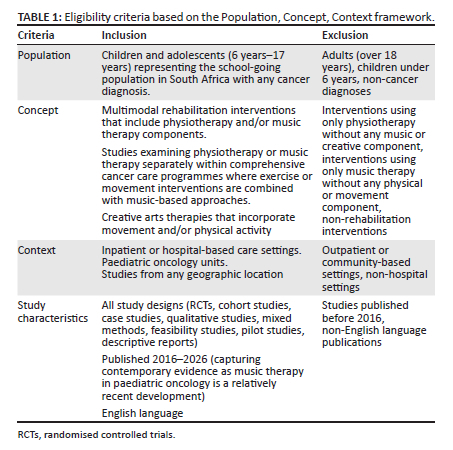
Study selection will be conducted in two phases. Firstly, all identified citations will be uploaded into Covidence and duplications removed. Secondly, two independent reviewers will screen the titles and abstracts for relevance based on inclusion criteria, following a pilot test of the screening process (Table 1). Two independent reviewers Joyful S. Msomi and Verusia Chetty will assess the full text of selected studies against the inclusion criteria. Reasons for exclusion at the full text stage will be documented and reported. Any disagreements will be resolved through discussion; if consensus cannot be reached, a third reviewer Levin Chetty will be consulted. The selection process will be reported in detail and illustrated using the PRISMA-ScR diagram.12
Data extraction
A standardised data extraction form will be developed and piloted to ensure consistency between reviewers. This form will collect information on study characteristics (author, publication year, country, study design), participant details (including age, diagnosis and treatment setting), intervention characteristics (type, duration, and frequency of both physiotherapy and music therapy) and outcomes aligned with the PCC framework. Additional data on barriers, facilitators and contextual factors relevant to implementation will be systematically extracted, with particular attention to resource availability, healthcare system characteristics and implementation contexts in LMICs.
During data extraction, concurrent physiotherapy interventions and associated discomfort reported in included studies will be documented to examine how these factors may influence reported music therapy outcomes and identify gaps in the literature regarding these interactions.
Data extraction will be conducted independently by two reviewers. Any discrepancies will be resolved through discussion or, if needed, consultation with a third reviewer. The data extraction form may be revised or updated during the review process, with all changes documented and reported in the final scoping review. If necessary, the study authors will be contacted to provide missing data. A draft version of the data extraction form is provided in Online Appendix 2.
Data analysis and synthesis
Extracted data will be summarised using both descriptive statistics (e.g. frequencies, proportions) for quantitative variables and narrative synthesis for qualitative findings. Thematic analysis will be conducted using both inductive and deductive coding processes to organise the findings into categories such as intervention characteristics, outcome domains and contextual factors influencing implementation.13
Findings will be presented in tables and figures to provide a clear summary of the study characteristics and major themes. Where sufficient data exist, LMIC studies will be analysed separately, and contextual factors will be thematically analysed to inform LMIC-relevant recommendations. Where relevant, both quantitative and qualitative data will be integrated to provide a comprehensive overview. Any gaps in the evidence and implications for future research will be discussed. The approach will follow the guidance of Arksey & O'Malley1011
Ethical considerations
Ethical approval is not required for this study because it involves analysis of publicly available published literature and does not include human participants.
Discussion
This review will synthesise evidence on multimodal rehabilitation interventions that incorporate physiotherapy and music therapy for hospitalised paediatric oncology patients, focusing on the characteristics and reported outcomes of these integrated approaches. We will systematically map the current literature to provide a comprehensive description of intervention strategies, outcome measures spanning physical, psychological and Quality of Life (QoL) domains, and emerging research trends. Particular attention will be given to studies from LMICs, where resource constraints may shape intervention delivery and feasibility. Through thematic analysis, we will clarify the scope of available evidence and identify key knowledge gaps. The synthesised findings will directly inform the development of evidence-based multimodal rehabilitation approaches, prioritising feasibility and clinical relevance for paediatric oncology patients, particularly in underserved healthcare settings.
Limitations
By limiting the search to studies published in English, we may unintentionally exclude relevant research published in other languages. Like most scoping reviews, we will not formally assess the methodological quality of the included studies, which could influence how the findings are interpreted. Although we will use a comprehensive search strategy, it is still possible that some relevant studies may not be identified due to publication bias, incomplete indexing or other search-related limitations.
Conclusion
This scoping review will provide a comprehensive overview of multimodal rehabilitation interventions incorporating physiotherapy and music therapy for hospitalised paediatric oncology patients. By systematically mapping the existing literature, the review aims to clarify current evidence, highlight research gaps, and inform the development of practical, evidence-based rehabilitation strategies, particularly in resource-limited settings. The findings are expected to guide future research and support improved clinical practice in paediatric oncology rehabilitation.
Competing interests
The authors, Joyful S. Msomi; Levin Chetty and Verusia Chetty, declare that they have no financial or personal relationships that may have inappropriately influenced them in writing this article.
CRediT authorship contribution
Joyful S. Msomi: Conceptualisation, Data curation, Formal analysis, Investigation, Methodology, Project administration, Resources, Validation, Visualisation, Writing - original draft, Writing - review & editing. Levin Chetty: Methodology, Resources, Supervision, Validation. Verusia Chetty: Conceptualisation, Formal analysis, Methodology, Supervision, Validation, Writing - review & editing. All authors reviewed the article, contributed to the discussion of results, approved the final version for submission and publication, and take responsibility for the integrity of its findings.
Funding information
The authors received no financial support for the research, authorship and/or publication of this article.
Data availability
Data sharing is not applicable to this article as no new data were created or analysed in this study.
Disclaimer
The views and opinions expressed in this article are those of the authors and are the product of professional research. They do not necessarily reflect the official policy or position of any affiliated institution, funder, agency or that of the publisher. The authors are responsible for this article's results, findings, and content.
Acknowledgements
The authors gratefully acknowledge I. Edem for providing methodological expertise on the search strategy.
References
-
1. Barbosa RMF, Goretti PF, Chagas PSDC. Muscle strength, functional mobility, and performance in activities of daily living in children and adolescents with cancer. Eur J Pediatr. 2024;184(1):28. https://doi.org/10.1007/s00431-024-05827-6
» https://doi.org/10.1007/s00431-024-05827-6 -
2. Chowdhury RA, Brennan FP, Gardiner MD. Cancer rehabilitation and palliative care-exploring the synergies. J Pain Symptom Manage. 2020;60(6):1239-1252. https://doi.org/10.1016/j.jpainsymman.2020.07.030
» https://doi.org/10.1016/j.jpainsymman.2020.07.030 -
3. World Health Organization. Childhood cancer fact sheet [homepage on the Internet]. 2024 [cited 2026 Mar 27]. Available from: https://www.who.int/news-room/fact-sheets/detail/cancer-in-children.
» https://www.who.int/news-room/fact-sheets/detail/cancer-in-children -
4. Fiuza-Luces C, Padilla JR, Soares-Miranda L, et al. Exercise intervention in pediatric patients with solid tumors: the physical activity in pediatric cancer trial. Med Sci Sports Exerc. 2017;49(2):223-230. https://doi.org/10.1249/MSS.0000000000001094
» https://doi.org/10.1249/MSS.0000000000001094 -
5. Baumann FT, Bloch W, Beulertz J. Exercise for patients with pediatric cancer: A systematic review of the literature. Pediatr Blood Cancer. 2013;60(1):1-10. https://doi.org/10.1002/pbc.24110
» https://doi.org/10.1002/pbc.24110 -
6. Da Silva Santa IN, Schveitzer MC, Dos Santos MLBM, Ghelman R, Filho VO. Music interventions in pediatric oncology: Systematic review and meta-analysis. Complement Ther Med. 2021;59:102725. https://doi.org/10.1016/j.ctim.2021.102725
» https://doi.org/10.1016/j.ctim.2021.102725 -
7. Prabhu NS, Maiya GA, Bhat KV. Implementation of physical rehabilitation programs for children with cancer across low-and middle-income countries: A need of the hour perspective. Pediatr Blood Cancer. 2024;71(4):e30876. https://doi.org/10.1002/pbc.30876
» https://doi.org/10.1002/pbc.30876 -
8. Rajendran T. Music therapy in cancer care: Unravelling the complexities in LMICs. Support Care Cancer. 2023;31(12):715. https://doi.org/10.1007/s00520-023-08188-2
» https://doi.org/10.1007/s00520-023-08188-2 -
9. Peters MD, Marnie C, Tricco AC, et al. Updated methodological guidance for the conduct of scoping reviews. JBI Evid Synth. 2020;18(10):2119-2126. https://doi.org/10.11124/JBIES-20-00167
» https://doi.org/10.11124/JBIES-20-00167 -
10. Arksey H, O'Malley L. Scoping studies: Towards a methodological framework. Int J Soc Res Methodol. 2005;8(1):19-32. https://doi.org/10.1080/1364557032000119616
» https://doi.org/10.1080/1364557032000119616 -
11. Levac D, Colquhoun H, O'Brien KK. Scoping studies: Advancing the methodology. Implement Sci. 2010;5(1):69. https://doi.org/10.1186/1748-5908-5-69
» https://doi.org/10.1186/1748-5908-5-69 -
12. Tricco AC, Lillie E, Zarin W, et al. PRISMA extension for scoping reviews (PRISMA-ScR): checklist and explanation. Ann Intern Med. 2018;169(7):467-473. https://doi.org/10.7326/M18-0850
» https://doi.org/10.7326/M18-0850 -
13. Fereday J, Muir-Cochrane E. Demonstrating rigor using thematic analysis: A hybrid approach of inductive and deductive coding and theme development. Int J Qual Methods. 2006;5(1):80-92. https://doi.org/10.1177/160940690600500107
» https://doi.org/10.1177/160940690600500107

Accepted: 06 Aug. 2026
Published: 08 Sept. 2026