Intellectual property awareness, education and training programmes at universities in Zimbabwe
Abstract
Zimbabwean universities demonstrate significant creativity and innovation; however, the full benefits are not realised due to low intellectual property (IP) awareness. This study investigates the extent of IP awareness, as well as the education and training programs available within Zimbabwean universities. The study surveyed five universities, including lecturers, research officers, an IP officer, faculty librarians, and final-year undergraduate students. Questionnaires were distributed to lecturers and students, and interviews were conducted with IP officers, research officers, and faculty librarians. Data was analysed using Google Forms and Microsoft Excel. The findings show that, while universities prioritise IP awareness and make IP information available through university websites, libraries, and research offices, students, and lecturers face difficulties in accessing it. IP concepts are introduced in specific courses and degree programmes, usually during the first year, with a strong emphasis on copyright. This study recommends strengthening IP education and training content in Zimbabwe and similar contexts.
IP awareness; IP education and training; IP information dissemination; IP knowledge diffusion; IP in universities
1 Introduction
Intellectual property (IP) is an important part of the global economy, but infringements and violations persist to occur worldwide. The World Intellectual Property Organisation (WIPO) frequently receives requests from member states for technical assistance with IP enforcement, indicating widespread challenges in managing and protecting IP rights (WIPO, 2012:5). IP includes human-created works such as inventions, literature, artistic works, and commercial symbols or images. According to Ncube (2022), Zimbabwe has a troubling lack of IP awareness, with the public frequently unaware of the illegality of copyright infringement. Furthermore, many creators and innovators fail to register their IP rights, resulting in lost potential protection and commercial benefits. Common IP violations at universities include unauthorised downloads and plagiarism, in which students present existing designs or creations as original work. This lack of understanding of IP affects not only economic factors like employment and income, but also societal attitudes towards innovation and creativity, which has a negative impact on original content and inventions. To address these issues, Gimenez et al. (2012:177) emphasise the importance of accessible IP content in educational institutions.
In response to these challenges, Zimbabwe's Ministry of Higher and Tertiary Education, Science, and Technology Development (MHTESTD) implemented the Education 5.0 framework in 2019. This initiative emphasises the importance of tertiary institutions focusing on innovation and industrialisation in addition to teaching and research. Given this mandate, awareness of IP has become increasingly important. Zimbabwe currently has 24 universities-14 public and 10 private. The country also hosts the African Regional Intellectual Property Organisation (ARIPO), which serves as WIPO's regional office in Africa. According to the ARIPO report (2018:5), many universities and research institutions in Zimbabwe, Liberia, and Namibia lack the policies and incentives required to encourage academics to prioritise innovation and IP registration. As a result, many innovative ideas go unpublished or are only available in theses and institutional archives.
ARIPO (2020:19) and WIPO (2018:2) have documented efforts in Zimbabwe to raise awareness and respect for intellectual property. According to a 2019 WIPO report, only five of the 38 students in Zimbabwe's 11th cohort of the Master's in Intellectual Property program were from Zimbabwe, with the majority coming from the private sector. This suggests that IP education has limited reach in the public sector. Researchers such as Mawire (2014), Garwe (2014), and Pasipanodya (2012) have noted that IP studies in Zimbabwe are typically associated with law faculties, leaving other disciplines with limited exposure. Given the interdisciplinary relevance of IP, a comprehensive study on IP education should ideally include institutions with no dedicated law schools.
2 Significance of the study
This study aims to make a significant contribution to the development of programs and strategies that improve intellectual property awareness, education, and training in Zimbabwean universities. This research, which addresses current gaps in IP knowledge, will benefit a wide range of stakeholders, including students, educators, creators, and policymakers. Enhanced intellectual property education could better equip students to protect and leverage their creations, fostering an innovative and entrepreneurial culture within the academic environment (Batchelor, 2016; Anderson, 2014).
For educators, this study proposes a framework for incorporating IP content into curricula, providing graduates with the necessary knowledge to navigate IP complexities in various industries (Mawire, 2014; Albitz, 2013). Policymakers could use these findings to improve national intellectual property policies, resulting in a more robust legal framework that promotes innovation and economic growth (WIPO, 2019:2; Adams & Adams, 2018:2). This study may also be useful as a reference for other African or developing countries facing similar challenges, thereby contributing to a larger regional and global effort to improve IP awareness and utilisation.
Finally, the study aims to foster a sustainable culture of IP respect and utilisation, which could benefit Zimbabwe's economy by maximising the potential of local innovations and creative products (Gimenez et al., 2012). This research is more relevant to local stakeholders than studies conducted in other regions since it addresses Zimbabwe's unique economic, cultural, and technological context (Soetendorp, 2012; Knight, 2011; Nguyen, 2011).
3 Statement of the problem
The Zimbabwe National IP Policy and Strategy (ZNIPPS) of 2018 (WIPO, 2019:2; Adams & Adams, 2018:2) emphasises the role of intellectual property in promoting cultural, economic, and social development. However, this policy indicates that the potential of intellectual property is being underutilised, owing in large part to a lack of public understanding of IP. Insufficient awareness of intellectual property's role in fostering and rewarding innovation has hampered Zimbabwe's ability to fully capitalise on the creative outputs of its research institutions and universities (ARIPO, 2018:5). Garwe (2014:2) and Matsika (2006:1) found that many Zimbabwean university libraries lack essential IP resources, leaving graduates with insufficient knowledge of IP concepts. This paper proposes content that can help universities establish effective intellectual property awareness, education, and training initiatives. By doing this, it hopes to cultivate a culture in which graduates not only understand the importance of valuing creativity but also recognise how to exploit intellectual property assets for economic gains at the national level.
3. Purpose and objectives of the study
The purpose of the study was to explore IP awareness, education, and training programmes in universities in order to ascertain IP concepts adequate for an IP literate graduate. The objectives of the study were to:
• establish the extent to which universities value IP awareness.
• ascertain how IP content was delivered within courses/ programmes at the universities.
• determine the content that should go into IP education, training and awareness programmes in the universities
4 Methodology
This study was based on the post-positivist paradigm, which, while maintaining the positivist emphasis on objective truth, also recognises the complexity and contextual nature of knowledge. Using this paradigm, the researchers were able to reduce the multifaceted issues surrounding IP awareness in universities to measurable variables that could be quantified and generalised within the context of IP awareness. The study took a quantitative approach, measuring levels of awareness, availability, and accessibility of intellectual property information using specific scales. However, qualitative data collection and analysis techniques were also used to gain a deeper understanding of the contents of IP programmes.
The study used a survey design, which was suitable for gathering information from a large number of participants. This design was chosen to determine the prevalence of IP awareness and to gain a comprehensive understanding of the contents of IP awareness programs at Zimbabwean universities. The study included seven public universities and one private university, but only four (GZU, LSU, MSU, and NUST) took part due to COVID-19 travel restrictions and lockdowns, which prevented the others from responding.
The study population consisted of 1,305 lecturers, 11 research officers, 27 faculty librarians, one intellectual property officer, and 8,755 final-year undergraduate students. The sample size consisted of 692 lecturers and 1,197 students. Multi-stage sampling was used for lecturers and students, who were first divided by university and then randomly selected within each university. Purposive sampling was used for the IP officer, faculty librarians (FLs), and research officers (ROs), who were deemed information-rich cases relevant to the study's focus on IP awareness programs and activities. The study targeted one intellectual property officer, one faculty librarian, and one research officer per university, but only one university provided an IP officer, who was designated as an IP educator.
Data collection involved administering questionnaires to lecturers and students via an online survey using Google Forms, which primarily consisted of closed-ended questions, supplemented by open-ended questions as needed. The IP officer, research officers, and faculty librarians were interviewed in person using a structured format. Quantitative data was analysed using Google Forms and Microsoft Excel, which were used to create charts and conduct statistical analyses. Qualitative data from interviews was thematically analysed, with categories developed within the context of IP awareness. The analysis of qualitative data began early in the study and continued throughout the data collection period.
To ensure the research instruments' validity and reliability, they were reviewed by information science experts and pretested at one of the universities being studied. The University of South Africa (UNISA), Zimbabwe's Ministry of Higher and Tertiary Education, Science, and Technology Development (MHTESTD), and the participating universities' registrars all provided ethical clearance. The researchers also conducted a comprehensive review of the existing literature on the topic and provided consent forms for all participants.
5 Findings of the study
From the survey, 784 students responded, representing a 65.5% response rate out of 1,197 distributed questionnaires, and 366 lecturers responded, accounting for 52.9% of the 692 questionnaires sent. In addition, interviews with four Faculty Librarians, four Research Officers, and one Intellectual Property (IP) officer were conducted to gain in-depth insights. The data collected aimed to identify the core components of intellectual property awareness programs implemented in Zimbabwean universities.
5.1 IP Awareness in the universities
Participants in universities were asked three key questions to assess their level of intellectual property awareness. Responses to these questions are discussed below.
5.1.1 To what extent should universities value IP awareness?
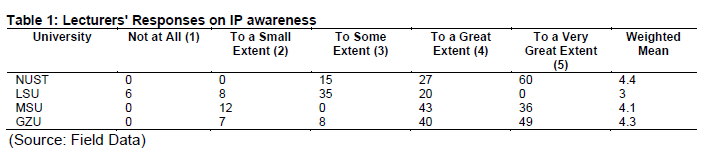
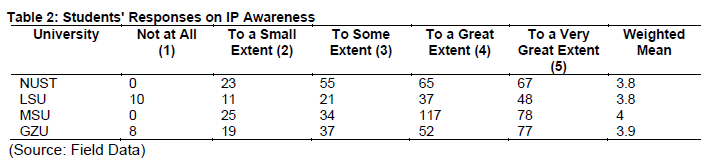
The first question sought to assess how much lecturers and students thought universities should prioritise IP awareness. Responses were scored on a scale of 1 ("Not at All") to 5 ("To a Very Great Extent"). Tables 1 and 2 present the summarised findings.
The majority of lecturers chose "To a Great Extent" and "To a Very Great Extent," indicating a strong belief in the importance of intellectual property awareness in universities. Interestingly, no lecturers at any of the surveyed universities chose "Not at All," indicating widespread agreement on the importance of IP awareness. Weighted mean scores from three universities were all around 4.0, indicating that they shared similar views on the importance of intellectual property awareness.
The students' responses varied slightly. "To a Great Extent" was the most common response, chosen by 34.5% (271 students), closely followed by "To a Very Great Extent," which was agreed upon by 34.4% (270 students). Only a small percentage (2.3%) of students, 18 respondents selected "Not at All," indicating little opposition to the importance of IP awareness. Weighted mean scores across universities ranged from 3.8 to 4.0, indicating a consensus among students about the importance of IP awareness.
Interviews with faculty librarians, research officers, and the IP officer confirmed these quantitative findings. All interviewees agreed that universities should prioritise intellectual property awareness, education, and training. One faculty librarian emphasised that "Universities should value IP awareness as it defines their research credibility," while a research officer emphasised that "University students and lecturers need to appreciate the value of their research, as it holds the potential for generating income for the institutions through IP." These qualitative insights highlight a shared recognition of the importance of IP awareness in improving both the research credibility and financial stability of universities.
5.1.2 Availability status of information on aspects of IP
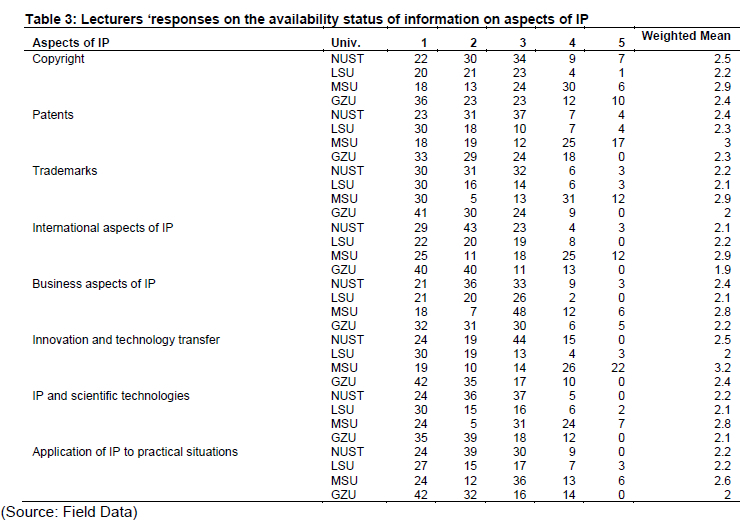
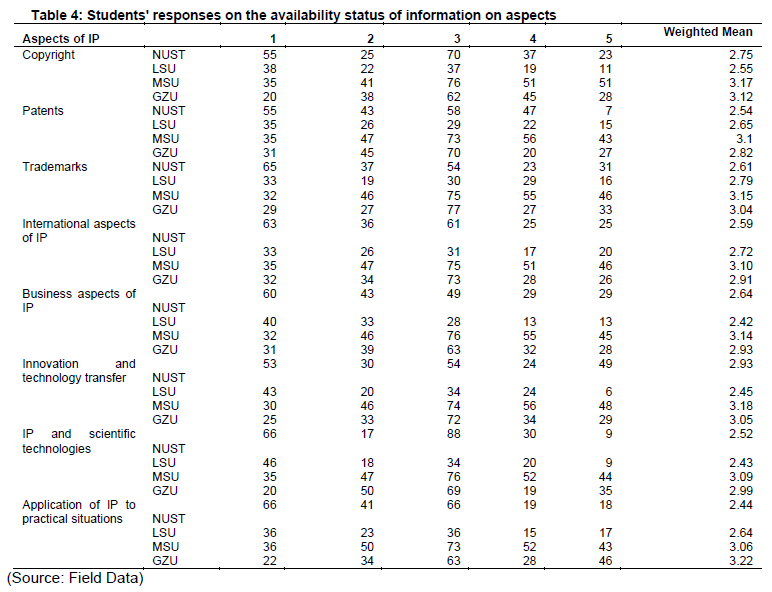
The second question in this study assessed how readily available information on various aspects of Intellectual Property (IP) was within universities, as perceived by lecturers and students. Respondents rated availability on a scale of 1 ('Poor') to 5 ('Excellent'). Tables 3 and 4 provide an overview of the results.
Lecturers at NUST rated the availability of 'Copyright' information with a weighted mean of 2.5, 2.2 at LSU, 2.9 at MSU, and 2.4 at GZU. Similarly, 'Patents' information received average scores of 2.4 at NUST, 2.3 at LSU, 3.0 at MSU, and 2.3 at GZU. For 'Trademarks,' the weighted means were lower, with NUST at 2.2 and LSU at 2.1, though MSU had a higher average of 2.9 and GZU at 2.0. Other IP topics, such as 'International aspects of IP,' had even lower availability scores, indicating a significant need for improvement. GZU, for example, scored 1.9, whereas NUST and LSU scored between 2.1 and 2.2.
The students' responses followed a similar pattern. For 'Copyright,' the weighted means varied from 2.75 at NUST to 3.17 at MSU. 'Patents' data was moderately available, with GZU at 2.82 and MSU at 3.1. The availability ratings for 'trademarks' ranged from 2.61 at NUST to 3.15 at MSU. For 'International aspects of IP,' ratings indicated moderate to low availability, with GZU at 2.91 and NUST at 2.59. Similarly, 'Business aspects of IP' and 'Innovation and technology transfer' had moderate availability scores of 2.5 to 3.0 across institutions.
Interviews with faculty librarians, research officers, and an IP educator confirmed these findings, pointing out that IP information was available through libraries, research units, and IP offices, though accessibility could be improved. Faculty librarians emphasised their role in educating the university community about intellectual property resources and their importance.
5.1.3 Rate the accessibility of information on IP in the universities
Both lecturers and students rated the accessibility of IP information on a scale of 1 (very poor) to 5 (very good). The results are presented in Tables 5 and 6. The most common rating for lecturers was 'acceptable' (3), with weighted means of 2.3 at NUST, 2.6 at LSU, 2.6 at MSU, and 2.5 at GZU. Students' responses were also centred on 'Acceptable,' with weighted means ranging from 2.9 at NUST and LSU to 3.5 at MSU and GZU. This suggests that, while IP information is available, it may not be easily obtained.
The interviews revealed that although IP resources are available through university websites, libraries, and research offices, both students and lecturers rarely access these resources.
5.2 IP content delivery within courses/ programmes at the universities
To determine IP content delivery within courses/programmes at universities, two questions were asked, and the responses are presented in the following sections.
5.2.1 Coverage of certain IP concepts in specific courses or degree programmes at the universities
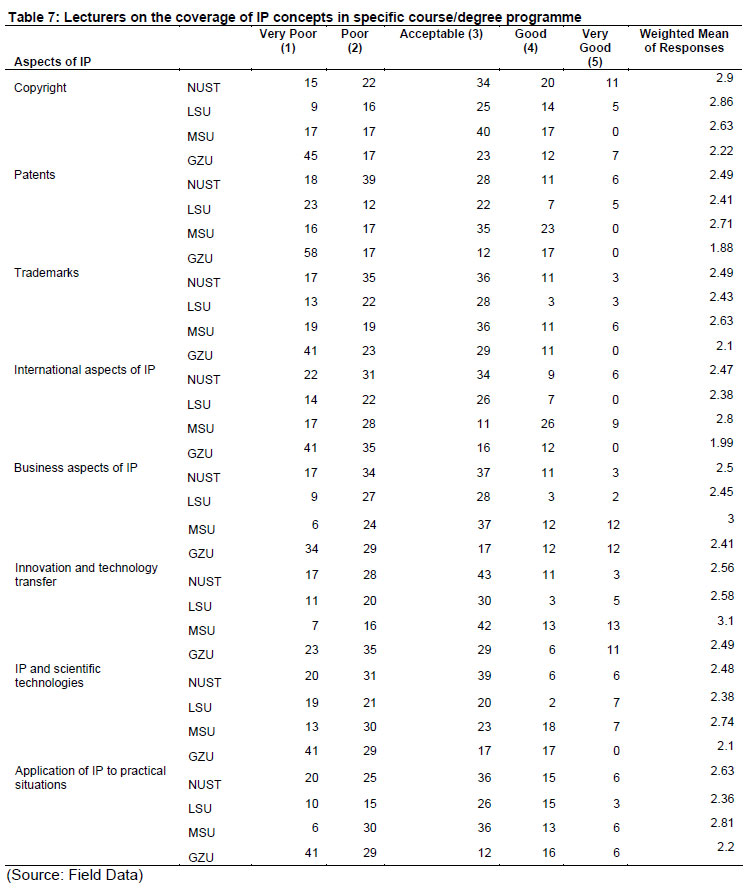
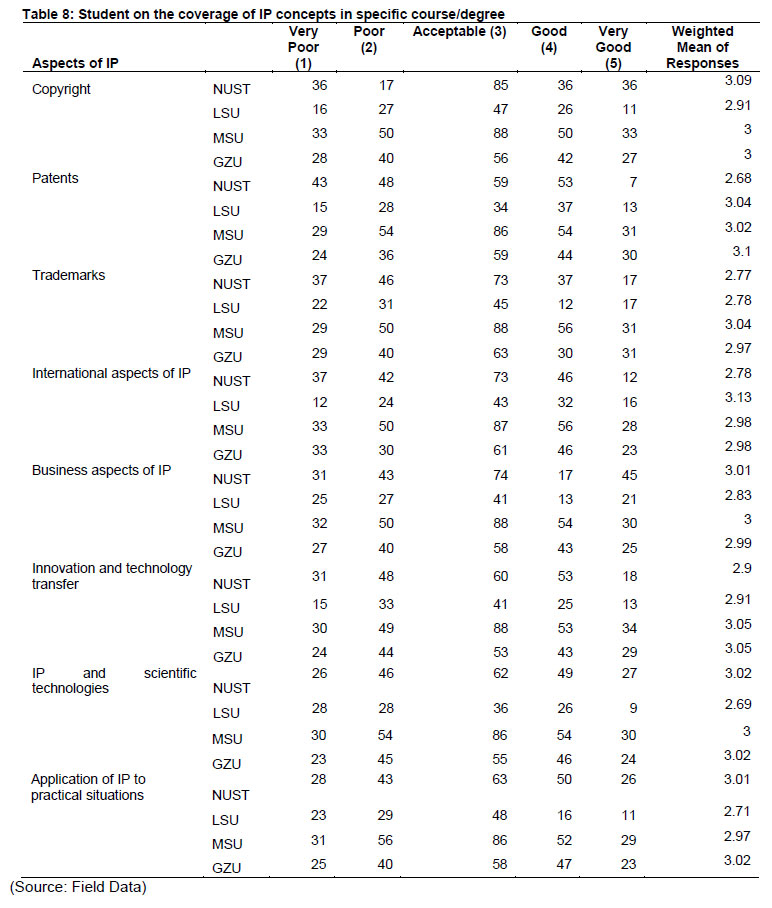
In the first instance, the study investigated the breadth of coverage of various intellectual property topics within specific courses or programs. Respondents gave coverage ratings ranging from 1 ('Very Poor') to 5 ('Very Good'). Lecturers rated 'Copyright' coverage with weighted means of 2.9 at NUST, 2.86 at LSU, and 2.22 at GZU, indicating moderate coverage. For 'Patents,' students gave similar ratings, with weighted means of 2.68 at NUST and 3.1 at GZU. 'Trademarks' received moderate coverage ratings, with MSU scoring 3.04.
Additional topics deemed essential for IP education were discussed during interviews, including Creative Commons licenses, fair use, IP registration processes, and plagiarism. Faculty librarians mentioned that, although there are no specific IP programs, library training sessions occasionally address copyright.
According to one Faculty Librarian, "while there are no awareness, education, and training programmes specifically on IP at the library, the ILS trainings only touch on copyright as an IP management issue." Another Faculty Librarian answered, "All of them, that is, copyright, patents, and trademarks." The Research Officers and the IP Educator both identified these types of intellectual property. The IP educator went on to explain that their IP awareness programmes primarily focused on copyright, while other types were addressed in passing or in response to student enquiries.
5.2.2 Level of study for IP programme delivery
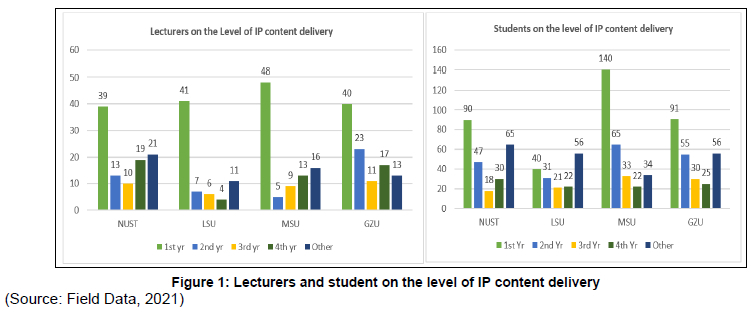
The study solicited feedback from lecturers and students on the level of study at which IP content is introduced, with options ranging from first to fourth year, or "other." Figure 1 shows the summarised data. The responses revealed differences in the perceived level at which IP content is delivered. Both lecturers and students stated that IP content is most commonly introduced during the first year of study. For lecturers, the first-year delivery of IP content received 147 (40.2%) responses, while students responded with 329 (42%).
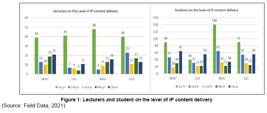
Interviews corroborated these findings, with some participants mentioning that IP topics are covered during first-year library orientation sessions. A faculty librarian suggested that intellectual property education be integrated from undergraduate to advanced levels, with seminars and workshops serving as awareness-building activities. One research officer emphasised the importance of mandatory IP training for all undergraduate students to promote early awareness.
5.3 Recommended Content for IP Education, Training, and Awareness Programmes
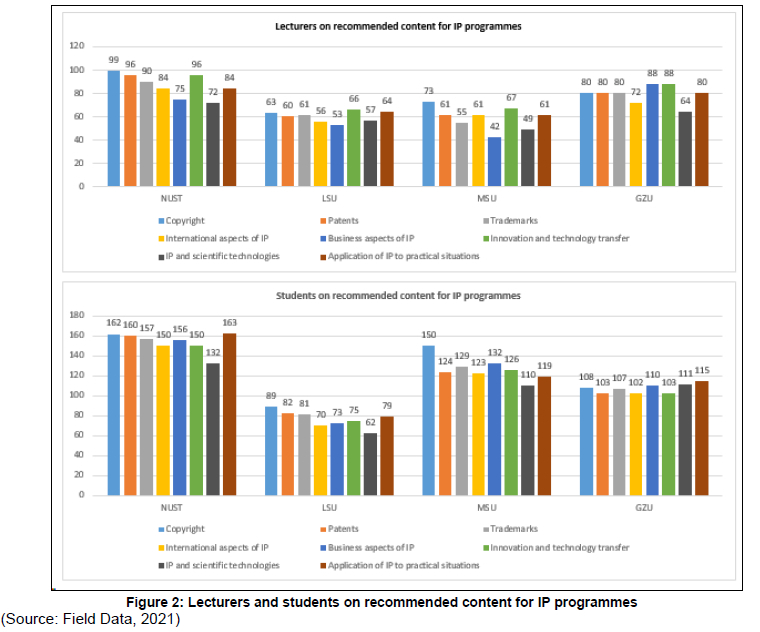
The survey also asked lecturers and students to recommend content for an IP curriculum. Figure 4 shows an overview of their feedback. According to the analysis, each suggested topic received more than 50% support from respondents, indicating a strong consensus on the importance of these intellectual property concepts. "Innovation and Technology Transfer" was the most popular topic among lecturers, with 317 endorsements (86.6%), closely followed by "Copyright," which received 315 endorsements (86.1%). Among students, "Copyright" was the most recommended concept, chosen by 509 respondents (64.9%), followed by "Application of IP to Practical Situations" with 476 endorsements (60.7%).
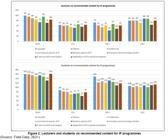
Interviewees confirmed the appropriateness of the recommended topics and suggested additional areas for inclusion. The suggested topics included IP in relation to applied sciences and engineering, plagiarism and academic integrity, the progression from research to commercialisation, the consequences of noncompliance with IP laws, and effective reference management.
6. Discussion of the findings
This section provides a detailed discussion of the study's findings, comparing them to similar research to gain broader perspectives. The findings indicate that universities recognise the value of IP awareness, with information on various IP aspects reportedly available. This is consistent with Evans' (2016) question about whether students are educated on the economic value, necessity, and potential career impacts of intellectual property. The presence of IP information indicates a commitment to teaching students about IP. However, the findings of the Intellectual Property Awareness Network (IPAN) (2016:7) study in the United Kingdom (UK) provide a different picture. In that study, a significant number of students (19%) lacked awareness of intellectual property in their project work, knowledge of how to protect it (14%), or who to contact for advice (46%). This gap indicates that, while IP information may be available, it is not easily accessible or understandable to students, potentially impeding their understanding of IP protection and management.
In terms of IP information accessibility, interviews revealed that IP resources were available on university websites, libraries, research offices, and the IP Office. Despite this, both lecturers and students rated accessibility as moderate, with many students describing it as inadequate. This reflects potential barriers to accessing intellectual property information within universities. In a similar UK-based study, IPAN (2016) discovered that 2,800 students from 152 institutions had low levels of IP understanding, with nearly 19% unaware of IP in school projects (Brachmann 2019:4). Hill (2014) elaborated on this point, revealing that, despite the fact that students at Victoria University's School of Design in Australia created intellectual property, the school did not actively provide IP information to students. Monotti (2000:28) discovered that Monash University provided a variety of intellectual property-related resources, including folders containing explanatory documents, statutes, and regulations distributed to all academic staff. Collectively, these studies suggest that universities should use a variety of strategies, including printed materials, to improve IP information accessibility.
In terms of IP content coverage within specific courses or programs, responses from lecturers and students revealed that most IP topics were only covered to an acceptable level, with some rated as poor or very poor. One faculty librarian was frustrated that copyright was only mentioned briefly in other programs. This limited coverage is consistent with Sulekha and Singh's (2018) findings, which showed that 52% of respondents were aware of copyright but only 14% were familiar with trademarks. Similarly, a study conducted by the Authors' Licensing and Collecting Society (ALCS) in the United Kingdom found that students were dissatisfied with limited IP curricula and expressed a desire for formal copyright education (ALCS 2014). This is consistent with Brachmann's (2019:5) findings from an IPAN (2016) survey, in which 76% of 2,800 surveyed students believed IP should be included in school curricula, though this did not always translate into formal coursework.
Brachmann (2019:4) found additional evidence of inadequate IP understanding in the IPAN (2016) survey, which revealed that nearly one-fifth of students (19%) were unaware of IP in their completed school projects. A National Union of Students (NUS) report (2012:8) from the United Kingdom echoed this, indicating ineffective intellectual property treatment within courses. Many students expressed a desire for better IP instruction, particularly for career preparation, pointing out that IP knowledge was frequently missing from their classes. They also emphasised the importance of incorporating practical applications and ownership of intellectual property into commercial course content. Villasenor (2012) discovered similar gaps in an informal survey at UCLA, where 68% of graduate engineering students couldn't define "trade secret," and 21% were unfamiliar with "patent." Furthermore, 32% were unable to define "copyright," and 51% were unsure about "trademark," highlighting the lack of IP education required to fully understand and leverage IP concepts.
The study also looked at the level at which IP courses or programs are offered, with first-year courses emerging as the most popular level of IP education among both lecturers and students. This suggests that most students receive IP instruction in their first year, raising the question of whether this knowledge is reinforced throughout their academic careers. Interviews revealed a preference for integrating IP education throughout undergraduate studies. Kaplan and Kaplan (2003) contend that early and ongoing IP instruction can foster creative thinking while instilling IP awareness throughout undergraduate education. IPAN (2016:8) discovered that 69% of UK students responded "NO" or "DON'T KNOW" when asked if IP had ever been mentioned in their education, implying that IP has limited relevance across various programs. A similar study at Bataan Peninsula State University found that 39% of students had some exposure to intellectual property topics in secondary school prior to university (Brachmann 2019: 7).
Soetendorp (2006:3) advocates for introducing IP concepts to undergraduates so that they can make informed decisions in this field after graduation. He explained that, while non-law students do not aspire to be IP specialists, they do require basic IP knowledge. He cited his experience guest lecturing on intellectual property at Tokyo Metropolitan University in 2003, where students compared IP to "daily sustenance" for engineers. These findings highlight the lack of a standardised level of intellectual property education across universities worldwide, despite the obvious need for comprehensive IP instruction prior to graduation.
In terms of recommended content for IP programs, participants in this study expressed interest in all suggested IP topics, with copyright ranking highest in both survey and interview responses. The importance of copyright was also highlighted in the NUS report (2012:26), where students identified plagiarism (73%) and copyright (35%) as the most covered intellectual property topics in their courses. This overemphasis on copyright may overshadow other important intellectual property areas. Villasenor (2012) found a link between specific IP education and understanding, implying that students may have gaps in essential IP topics due to a lack of coursework on these subjects.
Hill and Latimer (2003:16) conducted a parallel study on IP curriculum content at 50 law schools in the United States that are known for providing high-quality education. They discovered that the most commonly offered IP courses were introductory copyright (48 schools), introductory patent and trademark (40 schools), IP surveys (35 schools), and international IP (21 schools). However, only a few schools provided business-oriented IP courses, with ten offering entrepreneurship-related IP courses and one addressing IP Management (IPM) strategy.
Additional IP concepts were suggested through interview feedback, with Salleiro and Lopez (2009) emphasising technological property oversight, licensing, and technology transfer policies. Other areas covered included Technological Competitive Intelligence (TCI), project selection, and innovation-promoting strategies. This list of IP topics reflects the breadth of issues that could be addressed in an IP curriculum. Gimenez et al. (2012) found similar results in their research at Unicamp in Brazil, with an increase in IP-related courses (e.g., patents, copyrights, trademarks) from seven in 2003 to 17 in 2011. Their findings emphasised IP's multidisciplinary nature, demonstrating that IP instruction can transcend disciplinary boundaries. WIPO (2013:49) concurs, pointing out that intellectual property applies to a wide range of professions and recommending that methods and content be tailored to the needs of each audience. WIPO emphasised that a one-size-fits-all approach is inappropriate, advocating for customised IP programs to cater to diverse groups.
7. Conclusion and recommendations
This study emphasises the need for comprehensive IP education in Zimbabwean universities. While IP awareness is widely recognised, access to IP information remains limited, indicating a need for improved dissemination through institutional resources such as libraries and research offices. Coverage of intellectual property concepts is primarily introductory, with a focus on the first year of study, raising concerns about IP knowledge retention and reinforcement throughout students' academic careers. The findings indicate that curriculum improvements are required, emphasising diverse IP concepts beyond copyright to prepare students for real-world applications. Similar studies conducted worldwide highlight this gap, advocating for IP instruction tailored to multiple disciplines and sustained throughout undergraduate programs. To foster a strong IP culture, universities should integrate diverse IP topics across all academic levels, ensuring that graduates possess the knowledge to safeguard and capitalise on their intellectual creations.
The study provided content that could be incorporated into IP awareness, education, and training programmes at universities, including non-law schools. This research could result in university students graduating with adequate IP knowledge to properly exploit IP, be innovative, and positively contribute to the country's economic growth. This study suggests benchmark content for intellectual property education, training, and awareness in universities in Zimbabwe. The study recommends that:
• Universities should make information on IP more accessible through a variety of written materials and issue them to all lecturers and students.
• IP concepts should be covered more extensively in specific courses/ degrees.
• IP education should not be limited to the 1st year'.
• Universities should embed IP into students' activities throughout their studies.
Refs Adams & Adams. 2018. 7 key insights on Zimbabwe's new IP policy and implementation strategy. [Online]. https://www.adams.africa/intellectual-property/news-zimbabwe-ip-policy-implementation-strategy/ (30 May 2022).
References
- Albitz, R.S. 2013. Copyright Information Management and the University Library: Staffing, Organizational Placement and Authority. The Journal of Academic Librarianship 39(5): 429-435. [Online]. https://link.springer.com/chapter/10.1007/978-3-658-14681-824 (20 May 2022).
- Authors' Licensing and Collecting Society. 2014. Copyright Awareness: Let's Work Together. [Online]. https://www.alcs.co.uk/ALCS-News/2014/October-2014/Party-conference-piece-Barbara (20 May 2022).
- Alsaffar, J. 2006. Copyright Concerns in Online Education: What students need to know. Journal of Library Administration 45(1/2): 2-8. [Online]. https://www.tandfonline.com/doi/abs/10.1300/J111v45n01 01 (20 May 2022).
- Anderson, W.L. 2014. Teaching the Fundamentals of Intellectual Property Rights. Franklin Business and Law Journal (3): 3-8.
- African Regional Intellectual Property Organisation. 2018. ARIPO Magazine. 8 (2):5. [Online]. https://www.aripo.org/wp-content/uploads/2018/11/ARIPOMagVol.8No.2.pdf (30 May 2022)
- African Regional Intellectual Property Organisation. 2020. Annual Report. [Online]. https://www.aripo.org/publications/annual-reports (20 May 2022).
- Brachmann, S. 2019. IP Awareness and Attitudes: A Summary of Research and Data. [Online]. http://www.understandingip.org/wp-content/uploads/2019/03/IP-Awareness-and-Attitudes.pdf (1 October 2021).
- Deka, M. 2005. Pre-professional Intellectual Property education. The Intellectual Property Law Review 46 (1): 143-163. [Online]. https://www.wto.org/english/tratope/tripse/colloquiumpaperse/2017asian/chapter62017e.pdf (1 October 2021).
- Evans, H. 2016. Intellectual property and higher education: how well do students understand IP? [Online]. https://blog.thepienews.com/2018/10/the-big-ip-question-how-well-do-students-understand-intellectual-property/ (1 October 2021).
- Garwe, E.C. 2014. Reducing Book Piracy: The Role of the Higher Education sector. International Research in Education. 2 (2): 2-6. [Online].https://www.researchgate.net/publication/272504121_Reducing_Book_Piracy_The_Role_of_the_Higher_Education_Sector (14 June 2022).
- Hill, M. 2014. Awareness and Perception of Intellectual Property Rights and its processes in New Zealand: The disconnect between innovation and commercialisation, a study based on the Students at Victoria University's School of Design. [Online]. https://researcharchive.vuw.ac.nz/xmlui/handle/10063/5628 (1 October 2021).
- Hill, D.W. and Latimer, M.T. 2003. The Role of Intellectual Property Education in the United States. [Online]. https://ipmall.info/sites/default/files/hostedresources/TeachingIP/David Hill.pdf (14 June 2022).
- Intellectual Property Awareness Network. 2016. University IP Policy: perception and practice: how students and staff understand intellectual property policy at their HEI. [Online]. http://ipaware.org/wp-content/uploads/2016/10/IPANNUSUniversityIPPolicy16aug16.pdf (1 October 2021).
- Knight, K. 2011. Teaching intellectual property English creatively. JALT 2010 Conference 2010. Proceedings. [Online]. http://jalt-publications.org/files/pdf-article/jalt2010proc-60.pdf (30 September 2021).
- Matsika, C. 2006. Intellectual property and access to information in Zimbabwe. Paper presented at the ZULC Conference. April. [Online]. www.ir.uz.ac.zw/.../Matsika-ZULC-Conf-Intellectual-Property-Paper-April-2006 (8 December 2021).
- Mawire, I. 2014. Current status and future requirements of national IP education and training in Zimbabwe. [Online]. www.wipo.int/edocs/mdocs/aspac/...ip.../wipoiphrtyo11refzzimbabwe.pdf (8 December 2021).
- Mendes, P.2013. Integrating IP Teaching in the Educational System. Paper presented at the African Conference on the Strategic Importance of Intellectual Property (IP) Policies to Foster Innovation, Value Creation and Competitiveness, Dar es Salaam, March. [Online]. http://www.wipo.int/edocs/mdocs/mdocs/en/wipoipdar13/wipoipdar13gmendes.pdf (1 October 2021).
- Ministry of Higher and Tertiary Education, Science and Technology Development. 2019. Education 5.0: towards problem-solving and value creation. [Online]. http://www.mhtestd.gov.zw/?p=3501 (15 December 2021).
- Ncube. A. 2022. Raising Intellectual Property Awareness in Zimbabwe: a call to action. [Online]. https://www.chronicle.co.zw/raising-intellectual-property-awareness-in-zimbabwe-a-call-to-action/. (19 June 2022).
- Nguyen, N. 2011.Intellectual Property Teaching Practices in Introductory Writing Courses. [Online]. http://wac.colostate.edu/books/copywrite/chapter16.pdf (10 October 2021).
- National Union of Students. 2012. Student attitudes towards intellectual property. [Online]. www.nus.org.uk/PageFiles/12238/IP%20report.pdf (19 May 2022).
- Pasipanodya, R. 2012. Intellectual Property Perspectives: Zimbabwe's IP potential under telescope. Zimbabwe Independent 9 February. [Online]. http://www.theindependent.co.zw/2012/02/09/intellectual-property-perspectives-zimbabwes-ip-potential-under-telescope/ (8 December 2021).
- Soetendorp, R. 2006. Developing the curriculum for collaborative intellectual property. [Online]. https://www2.warwick.ac.uk/fac/soc/law/elj/jilt/20061/soetendorp/soetendorp.pdf (30 September 2021).
- Soetendorp, R. 2012. Student Attitudes to Intellectual Property. [Online]. http://www.nus.org.uk/PageFiles/12238/IP%20report.pdf (30 September 2021).
- Sulekha, S. & Singh, S. 2018. Awareness of Intellectual Property Rights among the Research Scholars of Kurukshetra University Kurukshetra. International Journal of Library and Information Studies 8(2):194. [Online]. https://www.ijlis.org/articles/awareness-of-ipr-intellectual-property-rights-among-the-research-scholars-of-kurukshetra-university-kurukshetra.pdf (30 September 2021).
Accepted: 4 February 2025