Factors influencing the incorporation of web technologies by university libraries in Southern African Development Community
Abstract
The role of web technologies into the service delivery in university libraries cannot be overemphasised. The purpose of this paper was to investigate the factors that influenced the incorporation of web technologies into the services of university libraries in the Southern African Development Community (SADC) region. The study was underpinned by the unified theory of acceptance and use of technology (UTAUT) and triangulated quantitative and qualitative research strategies in data collection and analysis. The population of this study comprised librarians from university libraries in the SADC region whose language of communication is English. A questionnaire, administered with the research electronic data capture (REDCap) software, was employed to collect quantitative data from 54 librarians, while an interview protocol was used to collect qualitative data from 6 librarians. Results showed that university libraries in the SADC region have incorporated web technologies in services. The results further revealed that the UTAUT constructs, namely, performance expectancy, effort expectancy, social influence, and facilitating conditions played a part in decisions by the university libraries to incorporate web technologies into their services and that librarians were influenced by these factors to use such tools to provide web-based library services.
Southern African Development Community; technology incorporation; university libraries; UTAUT; web technologies
1 Introduction
University libraries are increasingly reliant on web technologies to improve the sharing, exchanging, creating, and publishing of information, and to provide access to information in electronic environments (Oyieke & Dick 2017:264). This is not surprising because libraries have always been early adopters of new technologies as they evolve (Wordofa 2014:263), to carry out their numerous functions in a more efficient and effective manner (Williams 2020:137). In this study the term web technologies are defined as web-based tools offered by the library through the application of software to facilitate content discovery, content creation, interactive communication, dissemination, and the exchange of information in a variety of formats (textual, images, video, and audio) over the Internet.
A variety of web technologies including social networking tools (Harrison et al. 2017:250) and web-scale discovery tools (Foster 2018:330) have been incorporated by university libraries to enhance their services. It should, however, be borne in mind that simply incorporating web technologies in library services will be meaningless, unless they are based on an in-depth understanding of their capabilities and how they may best be applied to serve users. It is therefore imperative for librarians to continuously strive to understand, through research, evolving web technologies and the factors that influence libraries to incorporate web technologies into their services.
2 Problem statement
The incorporation of web technologies in libraries has been investigated from different perspectives. However, many studies have focused mostly on investigating the web technologies adopted, their extent and purposes of usage (Chu & Du 2012; Boateng & Liu 2014; Williams 2020). In contrast, little research has been conducted in Southern Africa to investigate the factors that influence the incorporation of web technologies in university libraries in order to facilitate the delivery of web-based services. To fill this knowledge gap, this study sought to examine the factors that influence the deployment of web technologies by university libraries in the SADC region, and how these technologies can be harnessed to facilitate the delivery of services in these libraries.
3 Aim and Objectives of the study
The aim of the study was to investigate the factors that influenced the incorporation of web technologies in the services of university libraries in the SADC region based on UTAUT (Venkatesh et al. 2003). The objectives of the study were to ascertain the web technologies incorporated in the services of university libraries in the SADC region; to determine the factors that influenced these libraries to incorporate web technologies in their services; and to determine the pros and cons of the incorporation of web technologies in service delivery by these libraries. The study was guided by the following research questions:
• What web technologies are incorporated in the services of university libraries in the SADC region?
• What factors influenced the university libraries in the SADC region to incorporate web technologies in their services?
• What are the pros and cons of the incorporation of web technologies in service delivery by university libraries in the SADC region?
4 Overview of the theoretical framework
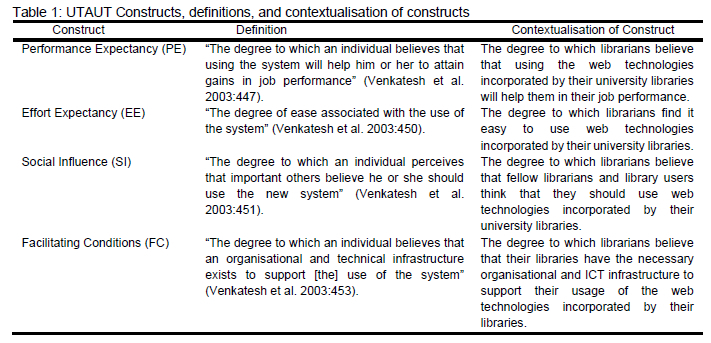
To address the research questions, the study drew on UTAUT that theorises four constructs, namely performance expectancy, effort expectancy, social influence, and facilitating conditions, play a pivotal role in influencing user acceptance and actual use of technology. The effects of these constructs are moderated by the variables of gender, age, experience, and voluntariness of use (Venkatesh et al. 2003:446-447). Table 1 provides the definitions of UTAUT constructs and their contextualisation to this study.
UTAUT was conceptualised by researchers to address the weaknesses associated with various fragmented theories of the acceptance and use of technology, such as the theory of reasoned action, the theory of planned behaviour, the technology acceptance model, and the diffusion of innovation theory (Dulle & Minishi-Majanja 2011:33). The proponents of UTAUT saw some weaknesses in the previous theories, and consequently, formulated UTAUT to harmonise these theories to enhance the explanatory factors of the acceptance and use of technology (Williams, Rana & Dwivedi 2015:44).
It is recognised that not all web technologies were purposely developed to fulfil a specific function in the provision of library services. However, scholars in the field of library and information science have shown great interest in gaining a better understanding of the opportunities that web technologies present to libraries (Collins & Quan-Haase 2014:50). The literature review for this study is confined to web technologies frequently incorporated in libraries, and the factors that influence libraries to incorporate web technologies.
5.1
Web technologies incorporated in library servicesThe literature revealed that university libraries have incorporated web technologies such as blogs, instant messaging, mash-up, multimedia sharing tools, podcasts, really simple syndication feeds, social networking sites, social bookmarking and wikis for sharing information, promoting library services, collaborative work, online reference services and training (Tella & Oladapo 2016:511; Jones & Harvey 2019:13; Akwang 2021:5).
The literature further revealed that university libraries have adopted discovery products that were purposely developed for information discovery in library settings (Ngo, Hennesy & Knabe 2019:228). Library discovery products include online public access catalogues (OPACs), discovery layers and web-scale discovery tools (Trapido 2016:10). Web-scale discovery tools are the latest tools for searching the different digital library collections (Djenno et al. 2014:264). Shi and Levy (2015:717) defined web-scale discovery tools as "a search engine that builds on unified indexes of licensed scholarly information, searches across multiple library databases provided by different vendors".
Traditional OPAC and databases search functionalities no longer meet library users' expectations as they prefer a one-click search to get the information they need from multiple library collections (Guajardo, Brett & Young 2017:16). Web-scale discovery tools satisfy library users' expectations (Hamlett & Georgas 2019:230) by searching multiple library collections through a single search interface (Djenno et al. 2014:264). They enable the library users to experience searching library collections in a similar way they search the open web (Galbreath, Merrill & Johnson 2021:1). The most used web-scale discovery tools in university libraries are EbscoHost discovery, WorldCat discovery, Ex-Libris Primo and Summon discovery (Ngo, Hennesy & Knabe 2019:228).
5.2
Factors influencing libraries to incorporate web technologiesThe literature provided evidence that web technologies are useful tools in the delivery of library services. For example, Akwang (2021:4) found that a great majority of librarians (98%) in university libraries in Akwa Ibom State in Nigeria believe that web tools improve job their performance, enhance marketing of library services, and facilitate interactive engagement with the users.
Research that examined factors that influence libraries to incorporate and/or use web technologies has employed several theories. These include the theory of reasoned action (Fishbein & Ajzen 1975), the theory of planned Behaviour (Ajzen 1991), the technology acceptance model (Davis 1989) and the UTAUT (Venkatesh et al. 2003). The UTAUT that harmonises competing theories, consists of four constructs, namely, performance expectancy, effort expectancy, social influence, and facilitating conditions. Gruzd, Staves and Wilk (2012:2347) confirmed that the UTAUT constructs are appropriate in predicting scholarly usage of web technologies.
5.2.1
Performance expectancyIn a study underpinned by UTAUT, Williams, Saunderson and Dhoest (2021:88) found that students' perceptions of the adoption of Facebook and Twitter at the universities of Antwerp and Limpopo were influenced by performance expectancy, among other factors. Mensah and Onyancha (2022:336) employed UTAUT as a theoretical framework for their study and found that performance expectancy was one of the factors that influenced librarians and library users in university libraries in Ghana to adopt and use social media. Similarly, in a study informed by UTAUT, Khan et al. (2017:1234) found that usefulness was a significant influential factor in the adoption of digital reference services by librarians at Pakistani universities. These findings suggest that librarians and library users across many university libraries hold positive views about web technologies and regard such tools as useful in improving library operations and services.
5.2.2
Effort expectancyThe requisite skills component relates to the effort expectancy in UTAUT. Training is of paramount importance since it can ensure the effective usage of web technologies, which can lead to the efficient performance of tasks. Chu and Du (2012:70) pointed out that the lack of skills was one of the stumbling blocks in the successful implementation of some of the web technologies in university libraries. Khan et al. (2017:1234) found that ease of use was a significant influential factor in the adoption of digital reference services by librarians at Pakistani universities. Jones and Harvey (2019:11) reported ease of use as one of the benefits librarians consider in using social media. Mensah and Onyancha (2022:330) found that ease of use and less effort influenced library staff's adoption and usage of social media in university libraries in Ghana.
5.2.3
Social influenceSocial influence is associated with the influence exerted on librarians by stakeholders and other external and internal factors to incorporate and use web technologies. Harrison et al. (2017:254) argued that social influences lead librarians to consider using web technologies to retain legitimacy among their peers. Librarians may therefore imitate one another to conform to contemporary trends and best practices relating to the incorporation and usage of web technologies.
In a study informed by the extended version of the technology acceptance model (TAM2), Izuagbe et al. (2019) assessed the perceived usefulness of social media in private university libraries in Nigeria and their findings revealed that social factors were key determinants in technology adoption by librarians. Akwang (2021:4) found that 72% of librarians in university libraries in Akwa Ibom State in Nigeria were influenced to adopt and use web tools by the library users. This finding contradicts that of Mensah and Onyancha (2022:330), who reported that social influence was not an influential factor for librarians' adoption and usage of social media in Ghanaian university libraries. What the literature suggests is that social influence may or may not influence librarians to use certain web technologies, and this may be dependent on the perceived usefulness they attach to a specific web technology.
5.2.4 Facilitating conditions
Facilitating conditions within an organisation include management support, level of ICT infrastructure and equipment, policy frameworks, and funding. Oh and Yoon (2014:727) reported that facilitating conditions influence the usage of Internet services. Mensah and Onyancha (2022:330) found that librarians consider facilitating conditions, such as enabling facilities and resources to be important influential factors in their usage of social media.
Mabweazara and Zinn (2016:7) reported that the usage of web technologies by librarians at the University of the Western Cape in South Africa and the National University of Science and Technology in Zimbabwe was influenced by various factors such as management support, Internet access, infrastructure and equipment, social media policy, and flexible organisational policies. These factors can play a supportive role and they fit well with UTAUT construct of facilitating conditions, as they can facilitate effective usage of web technologies.
It is regrettable that some university libraries in Africa face challenges that impede their staff and users from reaping the benefits offered by web technologies. Some of the challenges highlighted such as inadequate ICT infrastructure and limited funding (Jain & Akakandelwa 2016:149) may be beyond the control of university libraries. Where such problems exist, the libraries are likely to suffer the consequences. However, it should be emphasised that the successful use of web technologies will heavily be dependent on sound and robust ICT infrastructure.
6 Methodology
This study triangulated quantitative and qualitative research strategies in data collection and analysis. The population of this study comprised librarians from university libraries in the SADC region. Based on the language of communication, a sample of 54 librarians was drawn from university libraries in the SADC region whose language of communication is English. Thus, quantitative data were collected from 54 librarians using a questionnaire, administered with the REDCap software. Microsoft Excel 2016 was used to analyse the quantitative data.
Qualitative data were collected from 6 librarians via interviews, with purposive sampling being used to select the participants from the different university libraries. Qualitative data were analysed following the thematic qualitative analytical approach that involves organising the data, reading through the data, coding and generating themes, understanding and interpreting the data and, finally, presenting the results in an appropriate report (Marshall & Rossman 2011:209).
7 Results
The results of the study are presented in the next sections in accordance with the research questions of the study.
7.1 Web technologies incorporated by university libraries in SADC
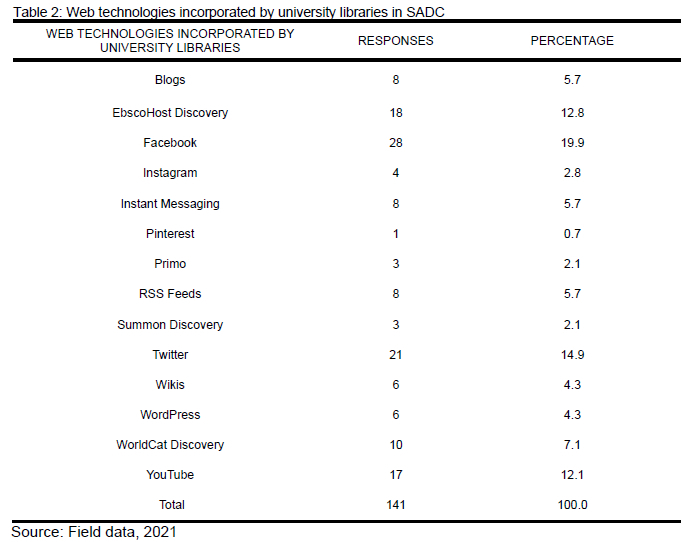
The results in Table 1.1 show the results from the quantitative data. It can clearly be seen that several web technologies have been incorporated by university libraries in the SADC region, with Facebook being the most frequently incorporated web technology with 19.9%, and Pinterest being the least incorporated web technology with 0.7%.
The results from the qualitative data revealed that other web technologies incorporated by university libraries in the SADC region included chatbot, podcast, vodcast, WhatsApp, SFX link resolver, Sierra, Alma and KOHA library management systems. DSpace software was used for managing institutional repositories, and the SciVal tool was employed to measure and analyse universities' research performance. The results further showed that SpringShare was used for libguides content creation and management. The results from the qualitative data also revealed a lesser-known tool in the library sector known as Asana that was used for content management. Web technologies such as RemoteX and EZproxy were incorporated to facilitate off-campus access to library licensed electronic resources. Google drive and GitHub were used as collaborative work tools, while zoom and Microsoft Teams were reported to be used for virtual meetings and for delivering information literacy instruction to students.
7.2 Factors influencing university libraries in SADC to incorporate web technologies
The results are presented in accordance with the UTAUT (Venkatesh et al. 2003) constructs, namely, performance expectancy, effort expectancy, social influence and facilitating conditions.
7.2.1 Performance expectancy
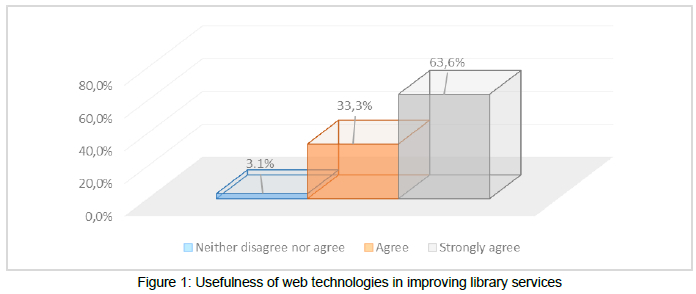
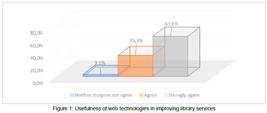
The respondents were asked to indicate the degree to which they agreed or disagreed with the statement that web technologies are useful in improving library user services. As illustrated in Figure 1, the respondents who either agreed or strongly agreed with this statement accounted for 96.9%. A small proportion of the respondents (3.1%) indicated that they neither disagreed nor agreed.
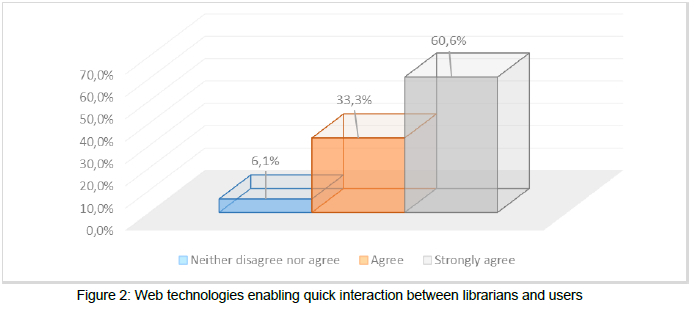
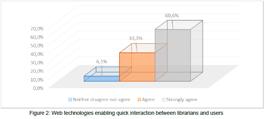
On the question about whether web technologies enabled the library to interact with users quickly, the results show that 60% of the respondents strongly agreed, while 33.3% agreed (Figure 2). It is evident that most of the respondents (93.9%) either concurred or strongly concurred that web technologies facilitate quick interaction between librarians and the users. Those who stated that they neither disagreed nor agreed accounted for only 6.1%.
The results from the qualitative data corroborated the findings from quantitative data. Six librarians who were interviewed indicated that web technologies are useful in providing online library services. As one librarian remarked, "Web technologies are extremely useful because they help improve the online library services. For example, the reference service that was only offered physically inside the library is now provided online". These librarians further indicated that web technologies proved useful in providing user education; promoting library services; broadening access to educational information; and improving work performance. Three librarians valued the usefulness of RSS feeds in providing selective dissemination of information (SDI) to lecturers and postgraduate students.
Two librarians who were interviewed also emphasised that chat tools are useful in facilitating real-time interaction between users and librarians. As one librarian stated, "When the library closed during the Covid-19 lockdowns, I and my colleagues created WhatsApp groups to offer reference services to students. We had to adjust to new ways of doing things". Surprisingly, one librarian doubted the usefulness of Facebook in library services and said, "I have no interest in Facebook, I think it is a negative platform and phenomenon, and I am very much against its usage in university libraries because it is used for many immoral things". Nevertheless, five librarians found Facebook useful for the purposes of promoting library services and current awareness. The qualitative results further revealed that the six librarians interviewed demonstrated that library web-scale discovery tools and licensed e-resources have improved access to information that supports learning, teaching, and research.
7.2.2 Effort expectancy
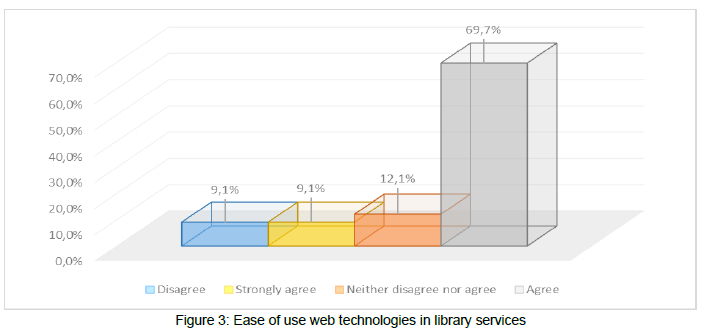
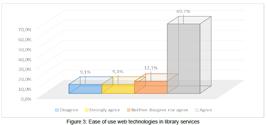
The respondents were asked to indicate the degree to which they agreed or disagreed with the statement that library staff find it easy to use web technologies in the delivery of library services. As displayed in Figure 3, the results from the quantitative data showed that 69.7% of the respondents agreed and 9.1% strongly agreed with this statement. In contrast, only 9.1% of the respondents disagreed, while 12.1% neither disagreed nor agreed.
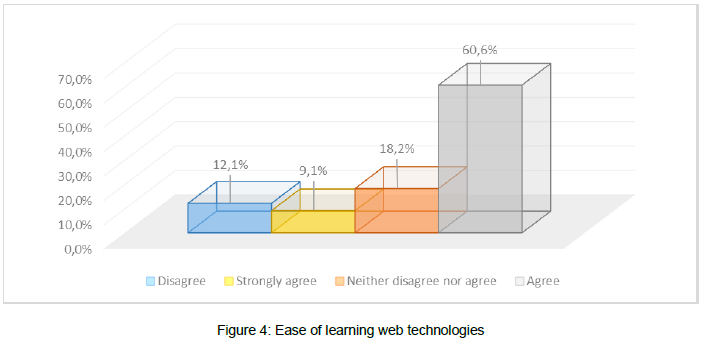
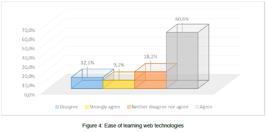
The respondents were also asked to indicate their level of agreement and disagreement regarding the ease of learning how to use web technologies. The results presented in Figure 4 reveal that most of the respondents (60.6%) agreed and 9.1% strongly agreed that it is easy to learn how to use web technologies. Only 12.1% disagreed, while 18.2% admitted that they neither disagreed nor agreed.
The results from qualitative data were congruent with those from the quantitative data. While five librarians found web technologies easy to use, only one librarian indicated the opposite. One of the librarians who found web technologies easy to use affirmed that "I find web technologies easy to use and manage complex processes in few seconds. For example, I have used the SciVal tool to generate faculties' research productivity reports". Another librarian reported that web technologies are not only easy to use, but they make possible things that were never possible previously, such as conducting online interviews. The librarian who found web technologies difficult to use asserted that, "I must admit that I faced difficulties in using podcasts to promote library services. It has always been a learning curve for me and now I invest a lot of time in learning how to use some web technologies".
7.2.3 Social influence
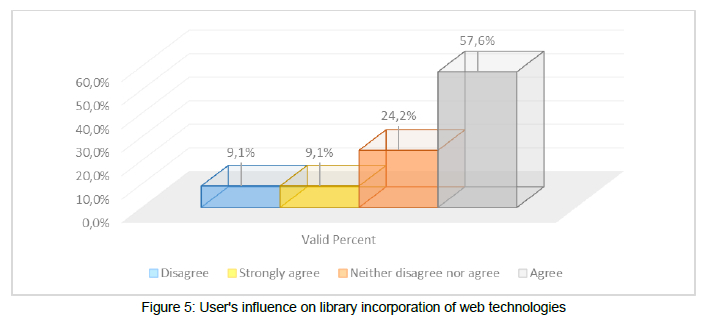
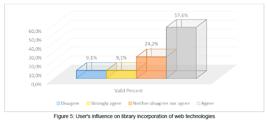
The respondents were asked to indicate the degree to which they agreed and disagreed with the statement that library users exert influence on the library to incorporate web technologies into library services. Figure 5 shows the results from the quantitative data with the majority of the respondents (57.6%) agreed and 9.1% strongly agreed with this statement. This is compared to a small proportion (9.1%) who disagreed, while 24.2% indicated that they neither disagreed nor agreed.
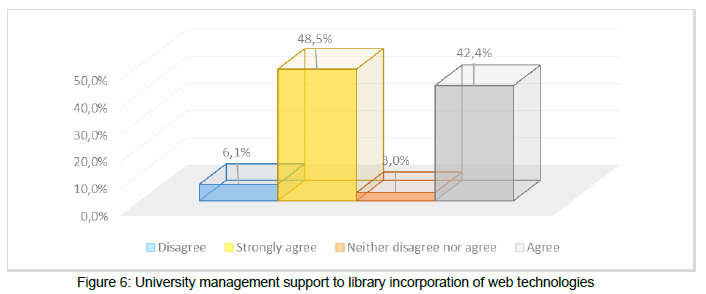
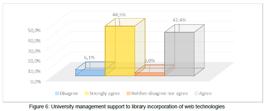
The respondents were also asked to indicate their level of agreement or disagreement with the statement that their university management supports the incorporation of web technologies into library services. In Figure 6, the results show that 42.4% of respondents agreed and 48.5% strongly agreed with the statement. In contrast, only 6.1% of the respondents disagreed, while only 3.0% of the respondents indicated that they neither disagreed nor agreed.
The results from the qualitative data demonstrated consistent findings. All six librarians who were interviewed reported that fellow librarians and library users have influenced librarians to incorporate web technologies. One librarian also acknowledged that students have a strong voice on library matters and that young students below the age of 25 years make influential suggestions leading to libraries to incorporate web technologies. This librarian stated, "Young students are exposed to web tools and smartphones at a very young age. They prefer online information not hard copies of books. As a result, we are amending our collection development policy, to concentrate on eBooks and e-journals subscriptions".
The qualitative results also indicated that academic staff influenced the library to incorporate web technologies. As one librarian asserted, "Following a professor's recommendation, the library subscribed to the trend module to analyse research trends, which helps postgraduate students to choose research topics and identify supervisors". Four librarians further acknowledged that the university management, professional networks, benchmarking and professional conferences and webinars influenced them to incorporate web technologies in library services.
7.2.4 Facilitating conditions
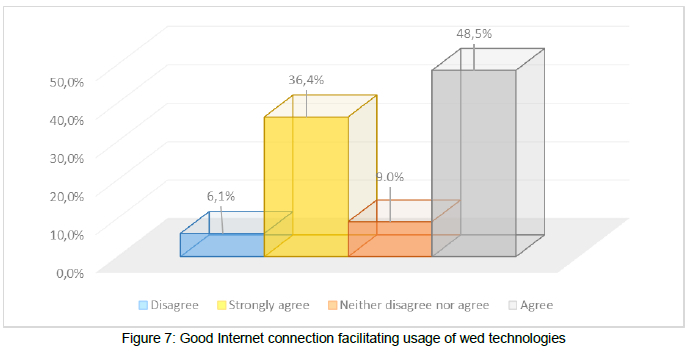
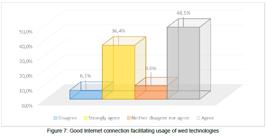
The respondents were asked to indicate their level of agreement or disagreement about whether the library has good Internet connection to facilitate the utilisation of web technologies. Figure 7 shows the results from the quantitative data, and it can be seen that 48.5% of the respondents agreed and 36.4% strongly agreed with the statement. Respondents who disagreed accounted for 6.1%, while 9.0% said that they neither disagreed nor agreed.
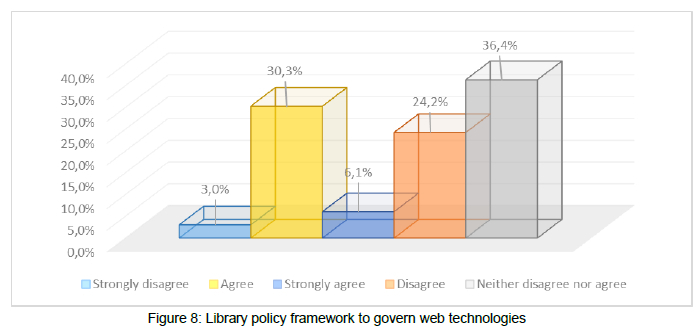
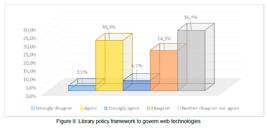
The respondents were also asked about the policy governing web technologies. As shown in Figure 8, 30.3% of the respondents agreed and 6.1% strongly agreed that their libraries have a policy framework to govern the use of web technologies. In contrast, 24.2% disagreed, and 3.0% strongly disagreed with the statement. Surprisingly, a sizable minority (36.4%) of the respondents indicated that they neither disagreed nor agreed.
Analysis of qualitative data revealed mixed results, with four librarians satisfied with facilitating conditions, while two librarians expressed serious concerns about the inadequacy of ICT infrastructure, equipment, and the lack of training to use web technologies effectively. Three librarians also reported the lack of a policy framework to govern the incorporation and use of web technologies.
It became evident that four librarians from well-resourced universities were satisfied with ICT infrastructure (Wi-Fi and wired Internet). Two librarians from poorly resourced universities were however frustrated by poor ICT infrastructure that caused intermittent disruptions to Internet connectivity. This became evident when one of these librarians remarked, "The main problem in our library is Internet bandwidth, even now I am connected to this Zoom interviews through my private mobile phone because I experienced problem with the slow Internet connectivity at the office." Other ICT challenges cited by two librarians include outdated computers, and the lack of assistive technologies to support students with special needs. In this respect, one librarian commented that "I have experienced some challenges to support our students who are visually impaired because of the lack of appropriate technologies".
The qualitative data analysis further revealed that only two librarians were not satisfied with the training provided by their libraries, while four librarians indicated that their libraries provided regular training on web technologies. As one librarian stated, "Our library provides regular in-house training, and this is important because web technologies changes very fast". It was also reported that one university library used a peer mentoring model, whereby a knowledgeable librarian gives mentorship to other librarians. A librarian from this library asserted that, "The mentoring programme in our library enjoys the support of library management and those who are well-versed in the usage of web technologies mentor other staff".
The qualitative results also showed that two university libraries do not have a policy framework to govern the usage of web technologies even though they acknowledged that such a policy is necessary. As one librarian stated, "Our library has no policy, but we are now busy formulating an ICT policy that will cover aspects of web technology usage. An appropriate policy framework is really needed to guide us on how to use web technologies in an ethical manner and for work purposes".
8 Discussion
This section discusses the findings of this study.
8.1 Web technologies incorporated by university libraries in SADC
The findings of the study showed that all university libraries investigated have incorporated a variety of web technologies for information discovery, promoting library services and sharing of information, content management and collaboration, and for interacting with the users. These are discussed first before the discussion shifts the focus to findings relating to UTAUT constructs.
8.1.1
Web technologies incorporated for information discoveryThe study revealed that all university libraries investigated have incorporated a variety of web technologies for information discovery, and these include Alma, EbscoHost, Primo, Summon, Sierra and WorldCat. This shows that these university libraries have moved away from the traditional OPAC to web-scale library discovery tools. This finding is corroborated by Wang (2020:4) who reported university libraries usage of discovery tools at San Franscisco State University Leonard Library. The shift to web-scale discovery tools can be ascribed to the fact that unlike the traditional OPAC, web-scale discovery tools comprise a single search interface, enabling the simultaneous search of all library print and electronic collections (Hamlett & Georgas 2019:231-232). A single search interface offering a one-stop-shop kind of service is useful and convenient to the users.
8.1.2
Web technologies incorporated for promotion of library services and information sharingThe study also revealed that university libraries in the SADC region have incorporated Blogs, Facebook, Instagram, Pinterest, Podcast, Vodcast, X, formerly known as Twitter, Wikis, and WordPress for promoting of library services and information sharing. Previous research (Williams 2020:142; Maturure & Rakemane 2021:192) corroborated this finding. Williams, Dhoest and Saunderson (2021:87) reported inconsistent results as they found that the University of Limpopo Library has not incorporated social media owing to a restrictive institutional policy. These contradictory findings may be ascribed to poor ICT infrastructure that slows down the Internet speed and suggest that each university library operates within its own context. The study also revealed some reservations about using Facebook in the library context. However, this did not have an adverse effect on university libraries' incorporation of such a tool for promoting their services. The disapproval of Facebook by one librarian may be attributed to the uncontrolled nature of publishing on such platforms, raising questions about privacy issues and the reliability of the information posted there (Izuagbe et al. 2019:396).
8.1.3
Web technologies incorporated for content managementContent management systems were also found to be part of university libraries web technologies. Apart from library management systems, the study also revealed that university libraries have incorporated SpringShare for libguides. Several research studies (Bangani & Tshetsha 2019:112; McDonald & Burkhardt 2021:8) reported similar results. The study also revealed that Asana was used for content management, Dspace for managing institutional repositories, SciVal for measuring universities' research performance and RemoteX and Ezproxy for facilitating off-campus access to licensed electronic resources. It is evident that university libraries in the SADC region conform to best practice as they have incorporated web technologies to provide innovative service delivery.
8.1.4
Web technologies incorporated for interactive library servicesThe findings from the qualitative data of this study revealed that librarians incorporated chatbot to facilitate synchronous communication between librarians and users. This finding concurs with the results of previous studies (Dempsey 2019:678; Walsh & Rana 2020:239; Rafiq et al. 2021:5). Interactive library services afford librarians and users an opportunity to interact effectively in real-time, thereby strengthening the library-user relationship.
8.2
Performance expectancyThe results showed that 96.9% librarians consider web tools useful in improving library services. These results are consistent with Izuagbe et al. (2019:403) who revealed that perceived usefulness of social media among librarians in private university libraries in Nigeria was high with a mean score 24.92. The results also revealed that specific web tools such as YouTube, Microsoft Teams and Zoom were cited by librarians as being instrumental in delivering information literacy instruction, improving teamwork and for holding virtual meetings. These findings concur with previous research (Gotschall et al 2021:12; Harnegie 2021:174) which reported the use of Zoom, Microsoft Teams, and other web technologies for work purposes.
8.3
Effort expectancyThe study revealed that 9.1% of librarians disagreed that web technologies are easy to use and 12% reported that these tools are not easy to learn. In addition, one librarian who was interviewed divulged the lack of skills to use web technologies. However, the majority of librarians (78.8%) either strongly concurred or concurred that web technologies are easy to use and 69.7% either strongly agreed or agreed that these tools are easy to learn. Akwang (2021:4) corroborated this finding in a study that reported that most librarians in Akwa Ibom State in Nigeria found web technologies easy to use.
8.4
Social influenceWith respect to social influence, this study showed that 66.7% librarians either strongly agreed or agreed that the library users have influenced university libraries to incorporate web technologies. These findings agree with a study conducted in Nigeria that found that library users influenced librarians to use web technologies (Akwang 2021:4). The study further revealed that an overwhelming majority of librarians (90.9%) reported that their efforts to incorporate web technologies enjoy support from their university management. This is a positive finding as the influence of senior management would encourage librarians to embrace web technologies in their work.
8.5
Facilitating conditionsRegarding facilitating conditions, the study showed that 84.9% of librarians reported that their libraries have up-to-date Internet connectivity to facilitate the usage of web technologies, while only 6.1% reported the opposite. Enakrire & Ocholla (2017:7) revealed that university libraries in Nigeria faced more ICT infrastructure challenges than their counterparts in South Africa. These findings suggest that ICT infrastructure in university libraries in Africa vary, with libraries from well-resourced universities faring well in providing modern ICT to facilitate the effective use of web technologies. Chisita and Chizoma (2021:111) noted that the Covid-19 pandemic highlighted the digital divide among universities in South Africa, with libraries in well-resourced universities coping well in terms of the digital content offered to their users.
The study also showed that 30.3% of librarians either strongly disagreed or disagreed that their university libraries have policy frameworks to govern the use of web technologies. Nevertheless, librarians indicated that such a policy framework is essential. Kelvin, Oghenetega & Jackson (2012:15) advised university libraries in Nigeria to formulate ICT policies for governing the incorporation and use of technologies. Odero and Mutula (2007:78) offered the same advice to university libraries in Kenya. In the absence of a library policy on web technologies, most university libraries are relying on the overall university ICT governance policy to guide them and their users on the use of these technologies.
Regarding training, the study revealed that the lack of regular training hindered librarians from using web technologies effectively. Upskilling and reskilling are key to ensure that librarians have the competencies to benefits from web technologies particularly in the age of AI. This is important because web technologies develop at a very fast pace. Jones and Harvey (2019:1) emphasise the need for developing appropriate competencies and skills among librarians to enable them to use web technologies effectively.
9 Conclusion and recommendations
This study concluded that 54 university libraries in the SADC region have incorporated modern web technologies in information services to support teaching, learning and research; to market library services and resources, to collaborate, to impart information literacy instruction; and to engage library users more efficiently.
The study further concluded that the UTAUT constructs, namely, performance expectancy, effort expectancy, social influence, and facilitating conditions have influenced university libraries to incorporate web technologies and librarians were influenced to use such tools to provide innovative web-based library services.
The following recommendations are made basis on the findings and limitations of the study and are presented in accordance with the UTAUT constructs.
• The study recommends a similar investigation that will focus on university libraries in lusophne and francophone SADC member states, as this study was limited only to university libraries in anglophone SADC member states because of the language barrier.
• University libraries should organise regular trainings and workshops for librarians to ensure that they update their skills needed to effectively use web technologies.
• University libraries should continuously conduct research to gauge user perceptions and views on incorporation of web technologies in library services.
• University libraries that do not have a policy to govern web technologies must consider developing one as a matter of priority; and
• University libraries that have a policy on web technologies should review it regularly to keep up with the fast pace of developments in web technologies.
References
Acknowledgement
This research project was supported financially by the Carl Schlettwein Foundation.
5 Literature review
- Refs Ajzen, I. 1991. The theory of planned behaviour. Organizational Behaviour and Human Decision Processes, 50(2): 179-211.
- Akwang, N.E. 2021. A study of librarians' perceptions and adoption of Web 2.0 technologies in academic libraries in Akwa Ibom State, Nigeria. The Journal of Academic Librarianship, 47(2): 1-9.
- Bangani, S. & Tshetsha, V. 2019. The deployment and impact of libguides at public universities in South Africa. International Information & Library Review, 51(2): 107-119.
- Boateng, F. & Liu, Y.Q. 2014. Web 2.0 applications' usage and trends in top US academic libraries. Library Hi Tech, 32(1): 120-138.
- Chisita, C.T. & Chizoma, U.S. 2021. Rethinking academic library space amidst the COVID-19 pandemic in South Africa: preparing for the future. Information Discovery and Delivery, 49(2): 105-113.
- Chu, S.K. & Du, H.S. 2012. Social networking tools for academic libraries. Journal of Librarianship and Information Science, 45(1): 64-75.
- Collins, G. & Quan-Haase, A. 2014. Are social media ubiquitous in academic libraries? a longitudinal study of adoption and usage patterns. Journal of Web Librarianship, 8(1): 48-68.
- Davis, F.D. 1989. Perceived usefulness, perceived ease of use, and user acceptance of information technology. MIS Quarterly, 13(3): 319-340.
- Dempsey, P.R. 2019. Chat reference referral strategies: making a connection or dropping the ball? College and Research Libraries, 80(5): 674-693.
- Djenno, M., Insua, G., Gregory, G.M. & Brantley, J.S. 2014. Discovering usability: comparing two discovery systems at one academic library. Journal of Web Librarianship, 8(3): 263-285.
- Dulle, F.W. & Minishi-Majanja, M.K. 2011. The suitability of the unified theory of acceptance and use of technology (UTAUT) model in open access adoption studies. Information Development, 27(1): 32-45.
- Enakrire, R.T. & Ocholla, D.N. 2017. Information and communication technologies for knowledge management in academic libraries in Nigeria and South Africa. South African Journal of Information Management, 19(1): 1-9.
- Fishbein, M. & Ajzen, I. 1975. Belief, attitude, intention, and behaviour: an introduction to theory and research. Reading, Mass: Addison-Wesley.
- Foster, A.K. 2018. Determining librarian research preferences: a comparison survey of web-scale discovery systems and subject databases. The Journal of Academic Librarianship, 44(3): 330-336.
- Galbreath, B.L., Johnson, C.M. & Merrill, A.N. 2021. A framework for measuring relevancy in discovery environments. Information Technology and Libraries, 40(2): 1-17.
- Gotschall, T., Gillum, S., Herring, P., Lambert, C., Collins, R. & Dexter, N. 2021. When one library door closes, another virtual one opens: a team response to the remote library. Medical Reference Services Quarterly, 40(1): 11-22.
- Guajardo, R., Brett, K. & Young, F. 2017. The evolution of discovery systems in academic libraries: A case study at the University of Houston libraries. Journal of Electronic Resources Librarianship, 29(1): 16-23.
- Gruzd, A., Staves, K. & Wilk, A. 2012. Connected scholars: examining the role of social media in research practices of faculty using the UTAUT model. Computers in Human Behaviour, 28(6): 2340-2350.
- Hamlett, A. & Georgas, H. 2019. In the wake of discovery: student perceptions, integration, and instructional design. Journal of Web Librarianship, 13(3): 230-245.
- Harnegie, M.P. 2021. COVID snapshot: how medical libraries and staff adapt to deliver services during a pandemic. Journal of Hospital Librarianship, 21(2): 173-183.
- Harrison, A., Burress, R., Velasquez, S. & Schreiner, L. 2017. Social media use in academic libraries: a phenomenological study. The Journal of Academic Librarianship, 43(3): 248-256.
- Izuagbe, R., Ifijeh, G., Izuagbe-Roland, E.I., Olawoyin, O.R. & Ogiamien, L.O. 2019. Determinants of perceived usefulness of social media in university libraries: subjective norm, image and voluntariness as indicators. The Journal of Academic Librarianship, 45(4): 394-405.
- Jain, P. & Akakandelwa, A. 2016. Challenges of twenty-first century academic libraries in Africa. African Journal of Library, Archives and Information Science, 26(2): 145-153.
- Jones, M.J. & Harvey, M. 2019. Library 2.0: the effectiveness of social media as a marketing tool for libraries in educational institutions. Journal of Librarianship and Information Science, 51(1): 3-19
- Kelvin, O.O., Oghenetega, I. & Jackson, A. 2012. A review of issues in information and communication technology (ICT) planning and implementation in academic libraries in Nigeria. Library Hi Tech News, 29(8): 11-17.
- Khan, A., Masrek, M.N., Mahmood, K. and Qutab, S. 2017. Factors influencing the adoption of digital reference services among the university librarians in Pakistan. The Electronic Library, 35(6): 1225-1246.
- Mabweazara, R.M. & Zinn, S. 2016. Assessing the appropriation of social media by academic librarians in South Africa and Zimbabwe. South African Journal of Libraries and Information Science, 82(1): 1-12.
- Marshall, C. & Rossman, G.B. 2011. Designing qualitative research. 5th ed. Los Angeles, CA, SAGE.
- Maturure, R. & Rakemane, D. 2021. Marketing of library collections and services in the twenty-first century environment: the use of social media. In J.P. Chigwada & N.M. Nwaohiri, (Eds). Examining the impact of industry 4.0 on academic libraries, Emerald Publishing Limited, Bingley. 191-200.
- McDonald, C. & Burkhardt, H. 2021. Web content strategy in practice within academic libraries. Information Technology and Libraries, 40(1): 2-46.
- Mensah, M. & Onyancha, O.B. 2022. Ghanaian academic libraries' use of social media: a structural equation modelling approach. Information Development, 38(2): 323-342.
- Ngo, L., Hennesy, C. & Knabe, I. 2019. The impact of web-scale discovery on the use of electronic resources. Serials Review, 45(4): 227-238.
- Odero, D.J. & Mutula, S.M. 2007. Internet access in Kenyan university libraries since 1990s. Malaysian Journal of Library & Information Science, 12(1): 65-81.
- Oh, J.C. & Yoon, S.J. 2014. Predicting the use of online information services based on a modified UTAUT model. Behaviour & Information Technology, 33(7): 716-729.
- Oyieke, L.I. & Dick, A.L. 2017. Empowering academic librarians for effective e-services: an assessment of web 2.0 competency levels. The Electronic Library, 35(2): 263-282.
- Rafiq, M., Batool, S.H., Ali, A.F. & Ullah, M. 2021. University libraries response to COVID-19 pandemic: a developing country perspective. The Journal of Academic Librarianship, 47(1): 102280.
- Shi, X. & Levy, S. 2015. An empirical review of library discovery tools. Journal of Service Science and Management, 8(05): 716-725.
- Tella, A. & Oladapo, O.J. 2016. A comparative analysis of available features and web 2.0 tools on selected Nigerian and South African university library websites. The Electronic Library, 34(3): 504-521.
- Trapido, I. 2016. Library discovery products: discovering user expectations through failure analysis. Information Technology and Libraries, 35(3): 9-26.
- Venkatesh, V., Morris, M.G., Davis, G.B. & Davis, F.D. 2003. User acceptance of information technology: toward a unified view. MIS quarterly, 27(3): 425-478.
- Walsh, B. & Rana, H. 2020. Continuity of academic library services during the pandemic the University of Toronto libraries' response. Journal of Scholarly Publishing, 51(4): 237-245.
- Wang, Y. 2020. Web-scale discovery and google scholar: a study in use patterns. Journal of Electronic Resources Librarianship, 32(1): 1-10.
- Williams, M.L. 2020. The adoption of web 2.0 technologies in academic libraries: a comparative exploration. Journal of Librarianship and Information Science, 52(1): 137-149.
- Williams, M.D., Rana, N.P. & Dwivedi, Y.K. 2015. The unified theory of acceptance and use of technology (UTAUT): a literature review. Journal of Enterprise Information Management, 28(3): 443-488.
- Williams, M.L., Saunderson, I.P. & Dhoest, A. 2021. Students' perceptions of the adoption and use of social media in academic libraries: a UTAUT study. South African Journal for Communication Theory & Research, 47(1): 76-94.
- Wordofa, K.H. 2014. Adoption of web 2.0 in academic libraries of top African universities. The Electronic Library, 32(2): 262-277.
Accepted: 5 May 2024