A case for black sartorial history: The role of orality, archives, museums, and libraries
Abstract
In this article, we investigate black sartoriality through oral history, archives, museums, and libraries by focusing on Martin Molefe, the South African black fashion designer. We do so by recovering the unknown, under-celebrated, and under-represented story of Molefe, who, for the most part, has been excluded from the history of fashion design at global, continental, and regional levels. This qualitative study adopted a multi-method research approach using archival research and in-depth oral interviews as methods of recuperating Molefe's pivotal role in the history of black sartoriality on the African continent, as seen during the Lesotho Royal Wedding in 1962. The archives were sourced from both Lesotho and South Africa, and in-depth interviews were conducted with three elderly women from Matsieng and Tebang, who participated in the wedding. The results indicated that little is known about Molefe's work, both in the archives and from the elderly women's recollections. The archives from Lesotho were silent on Molefe, and the South African archives scantily mentioned his work, apart from a few newspaper clippings. This article concludes that a combination of orality, archives, libraries, and museums is instrumental in preserving the histories of those who have largely disappeared into obscurity, like Molefe.
1962 Lesotho's Royal Wedding; Black Sartoriality; libraries; Martin Molefe; museums
1 Introduction and background
Martin Molefe was a fashion designer from Dube, a township in Soweto, South Africa (Drum November 1957:15). Molefe's fashion-making activities and creative oeuvre, though limited, were quite diverse. They included designing for the Miss South Africa beauty contest as well as his fashion show that took place in Soweto (Drum November 1957; Mayet & Nakasa 1962:57; The Lincoln Star 16 June 1963). However, his most notable work was the dresses he created for the two maids of honour and 18 bridesmaids for the 1962 Lesotho Royal Wedding between the late King Moshoeshoe II and Queen Mamohato Bereng Seeiso (Drum October 1962:57; The Lincoln Star 16 June 1963; The Friend Correspondent 21 August 1962). This event was the focus of this article and forms part of a larger research project on the fashion designer, which focused on the other aspects of his life.
The royal wedding was widely covered in both Lesotho and South African-based publications. These were: Leselinyana la Lesotho 1962, Moeletsi oa Basotho 1962, The Star 1962, Our Africa 1962, Drum Magazine 1962, The Sunday Tribune 1962, The World 1962, The Friend 1962, and Basutoland News 1962. The Sunday Tribune (1962) referred to the wedding as, "...the Basutoland's 'wedding of the century' on August 23 - billed as the country's most spectacular event since the British royal visit in 1947." While many publications did not mention Molefe's involvement in the design of the dresses worn by the two maids of honour and 18 bridesmaids, three publications that named him as the designer are used in this article. These were The Friend Correspondent, 21 August 1962, Drum, October 1962, and the American newspaper, The Lincoln Star, 16 June 1963. The discovery of these archival records on Martin Molefe elicited a project that sought to make a case for African sartorial history that used orality, museums, libraries, and archival centres.
In this article, we draw upon decolonial thoughts (Maldonado-Torres 2007; Grosfoguel 2013; Gaugele & Titton 2019; Slade & Jansen 2020). We later define decolonial thought and decoloniality by drawing upon scholarly works. Using decolonial discourse to analyse the 1962 Royal Wedding and Molefe's work we were able to "revalue a diversity that has been rendered invisible, erased, discriminated against and de-futured by the coloniality of contemporary fashion" (Jansen 2020:3).
As a case study, Martin Molefe offers possibilities to expand the canon that propounds an inclusive fashion history and narrative. African fashion history in the 2020s continues to attract scholarly attention (Nimo 2022; McGregor et al. 2022; Hansen 2023). Nimo (2022:3) asserts that the richness of African fashion history continues to remain "widely unacknowledged in the context of global fashion." Hansen (2023:11) continues with a similar argument, positing that when discussed in fashion studies, the continent's role is marginal and placed "on the fringe of the established fashion scene." The subject of this case and the argument that we extend continues this discourse by positioning the central role played by archives, oral history, museums, and libraries.
If inclusivity is to be evolved, the history and narrative of fashion designers, like Molefe, whose activities ceased to produce an overwhelming number of creative outputs in the form of seasonal fashion collections, deserve recognition. Archives and archival centres (i.e., museums and libraries) employed in this study play a role in assisting the recognition of some historical events and individuals involved in those events. When used in the context of fashion studies as we have done, these centres and the archives they collect afford fashion to be a phenomenon that is imbued with notions of pluriversality and diversity. Essentially, focusing on Martin Molefe also provides the possibility of introducing local examples in teaching heritage, history, and fashion studies in local spaces, whether in universities or in other educational contexts. The current discourse on museum exhibitions focuses on the need for museum collections to showcase African stories from their perspective (Moloney, Lephoto, & De Greef 2022; Checinska 2022). This study speaks directly to preserving knowledge and heritage to see African history featured in many future platforms.
2 Presenting the Black sartoriality
Capturing the works and practices of black fashion designers, both in Africa and the diaspora, is a crucial task. According to Pritchard (2017:109), it is additional light to grow black fashion studies, termed "black sartoriality". How do we understand present-day black sartoriality without acknowledging the practices of earlier black fashion designers? In their work on future memory practices, Gertraud Koch and Rachel Charlotte Smith (2024:2) pose the idea of participation in memory work. Participatory memory work should adopt approaches that "acknowledge the situatedness of memory making and the multitude of factors that influence the possibilities, meanings, and outcomes of participation" (Koch & Smith 2024:2). Memory work is thus "intentional processes through which people, groups, and institutions engage in - directly or indirectly - relations with other actors, identities, and past/present/future memory practices" (Koch & Smith 2024:2). There is value in oral history and collections in archival centres, museums, and libraries that enable the creation of Molefe's memory specifically, but African sartorial practices, more broadly seen, have societal and historical value. Discourse on black fashion designers should not be limited to contemporary manifestations, as it silences those designers who operated during difficult epochs like apartheid (or even earlier colonial periods). Pritchard (2017:108) employs the notion of ancestorship to fashion designers of previous times to advocate for:
turning to ancestors and the details of their lives and works as a discursive edifice for exploring historic moments beyond the surface understanding of particular figures and critical events and broadening the epistemological and pedagogical scope of black fashion studies beyond the limits of what is seemingly possible.
For clarity, black sartoriality, in this article, implies a deep engagement and study of black people's histories through their involvement in context-specific fashion systems, analysed at a particular period. Black sartoriality as a focus draws upon works of scholars such as Pritchard (2017) and Square (2021). Square (2021) studies American enslaved fashion makers from the eighteenth and nineteenth centuries. "The task of studying other early black fashion designers' histories and material culture is often difficult because during the eighteenth and nineteenth centuries, most enslaved and even free seamstresses of colo[u]r worked in relative obscurity for little or no pay" (Square 202:37). However, examining their work through archives enables researchers to understand their integral contribution and role in the development of fashion systems (Square 2021:31).
The exhibition titled Black Fashion Designers took place at the Fashion Institute of Technology in New York between 6 December 2016 and 16 May 2017. Independent scholar McElveen (2017:121) writes that the exhibition called "attention to black designers so often ignored by both the mainstream fashion industry and elite education institutions." The exhibition was organised into nine themes, which included breaking into the fashion industry, African influence design, the rise of the black designer and models, and activism (McElveen 2017:119). In this article, we centralise royal weddings as a category in fashion practice. Royal weddings in this context present the opportunity to record a fashion designer's work as a part of black sartoriality as well as black fashion studies. We specifically consider the work of fashion designer Martin Molefe, whose magnum opus, the focus of our paper, was the dresses he designed for the 1962 Royal Wedding that took place in Lesotho. We find value in decoloniality as a theoretical framework that enables further and deepened understanding of black sartoriality.
3 Decolonial fashion discourse: recuperation of the black fashion designer
Wa Thiong'o (1994), de Sousa Santos (2019), Maldonado-Torres (2007), and Slade and Jansen (2020) deepen our understanding of decoloniality. In the book, Decolonising the Mind, Wa Thiong'o (1994:3) writes about the "cultural bomb" and its effect
to annihilate a people's belief in their names, in their languages, in their environment, in their heritage of struggle, in their unity, in their capacities and ultimately in themselves. It makes them see their past as one wasteland of non-achievement and it makes them want to distance themselves from that wasteland.
De Sousa Santos (2019:118) offers what he calls the aesthetics of the epistemologies of the Global South. Positing that, in epistemologies of the Global South, there is "no single general aesthetics. The epistemic dislocation proposed by the epistemologies of the South disrupts, in fundamental ways, the credibility of general, universal, culturally monolithic conceptions of beauty, creativity, space-time, aura, authorship, orality, and so on" (de Sousa Santos 2019:119). This notion aligns with the pluriversality of knowledge production systems, which is what we promote. Similarly, albeit writing from the fashion perspective, Jansen (2020:3) states that the decolonial fashion discourse is about revaluing "a diversity that has been rendered invisible, erased, discriminated against and de-futured by the coloniality of contemporary fashion" (Jansen 2020:3).
Moloney et al. (2022:553) write about the beauty and trauma in the racist manner of collecting fashion housed in museums (specifically focusing on Museum Africa in South Africa). Museum collections, as Moloney et al. (2022:553) see it, propound the "idea of whiteness represent[ing] a beauty that needs to be collected and preserved and blackness represents a trauma that needs to be washed and thrown away." Pritchard (2017:108) promotes the trinity of beauty, style, and fashion history to recuperate black fashion histories. Pritchard (2017:108) writes that recuperation offers "cultural and political genealogies that will provide inspiration and sustenance for generations to follow". In Pritchard's study, the names of African American fashion designers - Willi Smith, Fabrice Simon, and Patrick Kelly - are offered as endeavours to revive and recuperate a black lens to fashion design practices. McElveen (2017:121) states the importance of focusing on black fashion designers who are
over-looked in larger discussions of fashion that their work was institutionally invisible - until now. This is the reality for many black Americans: our history hibernates in basements and attics, photo albums and scrapbooks, and old trunks that seem rooted in the back of the closet, waiting to be woken up, called upon, conscripted.
The notion of black histories hibernating was true in our experience of researching Molefe's work. An image of Molefe captured during a fashion parade is an example. According to a website, this image is housed at Museum Africa; however, trying to track it at the museum proved difficult, as it was explained that the image might be in their scrapbook collection, without a reference number. Without a reference number, this image and its scrapbook will be difficult to find in the archives. Despite such challenges, decolonial thoughts enable us to use interviews (viewed herein as forms of orality), in addition to visual and textual analyses of archives, as methodologies to revalue black sartoriality and contribute to black fashion studies.
Looking at the works of figures from past decades is important, but an equally important tradition to adopt is the naming of people. Naming, especially when archives provide names, becomes a practice of presence-making, which contributes to adding individuals to the present-day public sphere. Recognising people and the work they did maintain the perception of fashion as a phenomenon of pluriversality and diversity. The dangers of silencing figures who contributed to sartorial practices but have disappeared into obscurity expand the territory to not only telling stories of Christian Dior, Cristóbal Balenciaga, and Coco Chanel when sub-Saharan Africa was gifted with great talent.
4 Methods of recovery and recuperation of black sartoriality
This qualitative study relied on primary and secondary sources to recover fragments relating to Molefe and the 1962 Lesotho Royal Wedding. The primary sources included archives in the form of newspaper reports and clippings published in Lesotho and South Africa. As reliable sources of information, they provided an up-to-date report of the royal wedding. These sources included: Leselinyana la Lesotho (1962), Moeletsi oa Basotho (1962), newspaper clippings from The Friend, The Star, Our Africa, Drum Magazine, The Sunday Tribune, The World, and Basutoland News. These were accessed from the archives in Lesotho and South Africa.
The Leselinyana la Lesotho was the first newspaper established in Lesotho in 1863, founded by Adolphe Mabille as a privately owned publication (Switzer & Switzer 1979:256). It was in 1874 that it was taken over by the Paris Evangelical Mission Society (PEMS) as its mission newspaper (Switzer & Switzer 1979:256). It was associated with the Lesotho Evangelical Church of Southern Africa (LECSA), previously known as the Lesotho Evangelical Church (LEC).
On the other hand, Moeletsi oa Basotho was established in 1933 by the Roman Catholic Church (RCC) and continues to publish from Mazenod, one of the RCC sites (Switzer & Switzer 1979:260; Rosenberg 2014). The South African newspaper, The Friend, was established in 1850, published from Bloemfontein, and developed as a publication that provides information on and about Lesotho (Switzer & Switzer 1979:126). The Star is a South African daily newspaper founded on 6 January 1887 and owned by Mediahuis Ireland. While initially owned by the Argus Printing and Publishing Company, in contemporary South Africa, it is owned by the Sekunjalo Media Consortium (Ginwala 1973; Lefort 1981; South African History Online 2011; Beard 2023). Drum Magazine is a South African publication that was established in 1951 by Jim Bailey and intended for the urban black reader (Clowes 2008; Mchunu & Gounder 2024).
The Sunday Tribune is a KwaZulu-Natal-based weekend newspaper also under the monopoly of the Argus Printing and Publishing Company (Ginwala 1973:32; Lefort 1981:101). Originally called The Bantu World, The World was a black daily newspaper of Johannesburg, South Africa, founded in 1932 as a weekly, and then bi-weekly, and eventually a daily publication (Switzer & Switzer 1979:121; Peterson 2006:236; Sandwith 2016:1097). The World was targeted for the black middle-class elite and was known at its time for being distributed nationally (Switzer & Switzer 1979:123; Peterson 2006:236; Sandwith 2016:1097).
Basutoland News was a newspaper published between 1926 and 1970, "aimed mainly at the white trading community [of the Orange Free State], and to a lesser extent, colonial authorities and missionaries in Lesotho, but it was read by blacks as well as whites in Lesotho and the Orange Free State. It covered constitutional developments in Lesotho during the 1950s and 1960s, for example, and carried extensive reports" (National Library of South Africa, n.d.). These newspapers were published in 1962 and covered the news before, during, and after the wedding.
The aforementioned newspapers were sourced from the archives found in both Lesotho and South Africa. The archives in Lesotho included: Morija Museum and Archives (MMA), National University of Lesotho (NUL) Archives, the Royal Archives, Museum and Information Centre, popularly known as Royal Archives and Museum (RAM), and the RCC Archives in Maseru. According to Gill (2005) and Ambrose and Brutsch (1991), the MMA was established in 1956, and it preserves records, archival heritage related to the PEMS, LECSA in particular, and Lesotho's cultural heritage in general.
The NUL Library Archives is a special section found in the NUL Thomas Mofolo Library. It preserves archives relating to the university, published studies on Lesotho, a variety of special studies published by consultants, and many more (Molapo 1996). On the other hand, RAM is a centre specialising in the preservation of heritage relating to the Royal Family and the chieftainship institution of Lesotho. It was established in 2009 but only started operations in 2012 and has been closed since September 2021 until now. The RCC Archives in Maseru are archives of the Roman Catholic Church and include copies of the marriage and baptismal certificates.
The consulted South African archives were the Free State Provincial Archives and Bailey's African History Archives, which held Drum magazines that published Molefe's work. These publications provided an invaluable wealth of archival and photographic evidence relating to the dresses worn by the two maids of honour and 18 bridesmaids at the royal wedding. Through this evidence, this paper gained some coherence. In addition, secondary sources were also consulted, although they were scarce. These are mostly related to the conceptual framework and the contextualisation of this study.
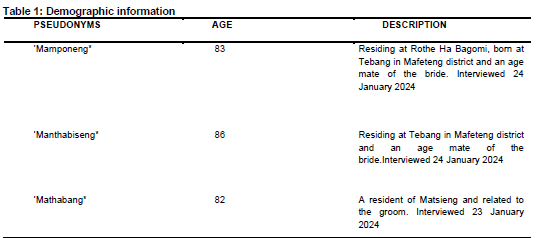
Additionally, a few of the surviving attendees of Lesotho's 1962 Royal Wedding were interviewed in this study as participants. These interviews were done to determine their knowledge of Martin Molefe and his work from their recollection of this historical event. It must be mentioned that only the bridesmaids were interviewed because the evidence gathered from the newspaper articles indicated that Molefe designed dresses for the bridesmaids. It is unknown who may have designed suits for the groomsmen, and therefore, this was not the focus of this paper. Consequently, no effort was made to identify any possible surviving groomsmen. One informant was from Matsieng, while the other two resided in Tebang and Ha Bagomi. These three interviewees were slightly above 80 years of age. Two interviewees were born in Tebang (Mafeteng district) and were peers of the bride, the late Queen Mamohato Bereng Seeiso. The remaining informant from Matsieng was a relative of the groom.
Table 1: The three participants, their ages and brief descriptions who were part of the 1962 Lesotho Royal Wedding. *Asterisks denote the pseudonyms given to each participant.
5 Ethical considerations
Ethical conduct when dealing with human beings was an important consideration for this study. Each participant consented to be interviewed. The participants invited their family members to sit in the interviews, not as participants themselves, but as observers. Having these observers enabled us, as researchers, to abide by the four research ethics principles of non-maleficence, justice, autonomy, and beneficence (De Roubaix 2011). In later parts of the paper, we discuss the nuance of what it meant to be a bridesmaid and an attendee at the wedding. For ethical reasons, pseudonyms are used in this article instead of their real names. Language was not a barrier, as the two researchers spoke and understood Sesotho (Ralebitso, one of the authors of this article, is a native of Lesotho). The three informants spoke in their local language.
6 Limitations
This study had some limitations, namely the use of the archives, and particularly the newspaper clippings, the age of the informants, and the closure of the Royal Archives. This paper relied heavily on newspaper reports that were published more than 60 years ago; some of this evidence was found in archival institutions and preserved as newspaper clippings with limited referencing details. In this instance, referencing guides were consulted to appropriately cite these sources.
Secondly, due to their advanced age, the informants' recollection of who designed the bridesmaids' and maids of honour's dresses was uncertain. Having noted this, they were unanimously adamant that their dresses were sewn by a local seamstress. This indicated that they were not the bridesmaids seen in the images from the archives. However, we continued to interview them to understand the feeling that was in the kingdom at the time of the royal wedding. Interviewing the informants also helped to get a sense of the local sewing practices involved in attending events like a wedding.
Another limitation was the closure of the Royal Archives. When the South African fashion researchers (Mchunu and Gounder) reached out to the Royal Archives seeking assistance with archives regarding Martin Molefe and the 1962 Royal Wedding, it was on the brink of closure. This, therefore, had a negative impact on the progress of the study. A year and a half later, progress was seen as the co-researcher (Ralebitso), who is the former Royal Archives manager, intervened and requested assistance from the Royal Palace and the Royal Archives Board. Without such an intervention, access to the 1962 event and additional information in the recovery of Molefe's work would not have happened. The section that follows is a discussion of the findings of our investigation.
7 Results: Recovering and recuperating Martin Molefe
The 1962 Royal Wedding was the first union of the Basotho royals to be solemnised in church by His Grace Emmanuel Mabathoana (Our Africa, October 1962:10). The marriage certificate showed that High Commissioner John Maud was the signatory and key witness to the marriage between Paramount Chief Bereng Seeiso and Princess Masentle Mojela (RCC Archives 1962 marriage certificates register). Apart from this, all the requirements associated with Basotho traditional marriage were satisfied. These included consent between the parties, consent between the two families, an agreement, and the handing over of bohali from the groom to the bride's family. According to an archived local newspaper clipping (Moeletsi oa Basotho, September 1962) and two notices by the Education Office in Quthing (7 July 1962) as well as the District Commissioner's Office (10 August 1962; 14 August 1962), the wedding was held over three days from 23 to 25 August 1962. "The first day included a public ceremony held in Maseru, which started with a procession and a church service at the Lady of Victory RCC, followed by a reception at the Resident Commissioner's house in Maseru. Four images in the Drum archives showed Martin Molefe at the wedding" (Bakoro 1962: 1,2,7,8&9). These images were taken by Peter Magubane, a Drum photographer at the time tasked with documenting the wedding (Drum October 1962). In a photograph that were eventually published in an October 1962 Drum issue, Molefe is shown assisting the bride with her veil while the bride is seated in a vehicle. Another image appears to show Molefe standing next to the couple during what was possibly moments before or after the procession. It was difficult to clarify what was happening here, as the photograph did not have any supporting caption. Two photographs showed Molefe standing next to either a bridesmaid or maid of honour.
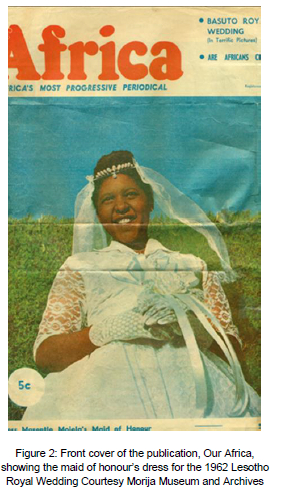
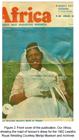
The dress's design was identical to the one that made the cover of an issue of the publication Our Africa, archived at the MMA (Figure 2). The fabric choices included a combination of white lace and an opaque fabric. This opaque textile covered the body's torso as well as the skirt area of the dress. Cut as an underlayer, it was overlaid by a lace component that formed part of the torso (including an elbow-length lace sleeve detail) and the skirt. Translucence also formed a part of the overall look of the bridesmaid's attire, as can be seen in the veil (which is attached to a tiara) and glove accessories.
Natasha Erlank's (2014) study of 1920s and 1930s black Christian weddings includes a component that focuses on the wedding dresses, similar to our work. Erlank (2014:36) writes about the announcements of these weddings in the black press, stating that these announcements typically "included details about who was marrying whom, their families, who officiated the wedding, the location of the reception, and even the attire worn by the bride and her party (bride's mother, bridesmaids, and flower girls) and the wedding presents." While the article is informative, it fleetingly mentions that brides and their mothers learnt how to sew their dresses; it was lacking as a result of a dedicated focus on the designers of wedding dresses. Here lies the gap to discourse we seek to fill.
Furthermore, Erlank (2014:32) states that "the material world of wedding dresses [is a] serious statement about identity and positioning." Likewise, our analysis of this wedding dress and the event aims to strengthen the link between Molefe and the concept of black sartoriality, thus, situating this fashion designer within the broader landscape of fashion design practices in the southern African context. While we position an individual designer, our study works with the themes of recovery, recuperation, and black sartoriality to contribute to this discourse. We continue to see the cultural and social value of oral history, archives, libraries, and museums to the project of this aspect of African sartorial history. From a decolonial lens, the work by Molefe (and perhaps those journalists who captured his story) actively contributed to the documentation of the aesthetics of the South, which de Sousa Santos (2019:120) states works at capturing "other pasts and new futures."
The second day included festivities held in Tebang, at the bride's home (Moeletsi oa Basotho September 1962; Our Africa October 1962, 11). The bride was a great-grandchild of Mojela Letsie, the grandson of Moshoeshoe I, the founder of the Basotho nation. The three informants attested to how joyous the ceremony was and that they thoroughly enjoyed themselves and were proud to have participated in the wedding. We observed that they turned a little sad when they related that the princess had lost her parents a year before 1962, and that they would have been happy to see their daughter getting married. "The third, and last, day saw festivities being held at Matsieng, the royal residence where the bride 'ngoetsi' was welcomed into her new home" (Bakoro 1962:7-9; Mohale 1962:1; Our Africa October 1962, 11).
A report by the Sunday Tribune Correspondent called the wedding "the country's most spectacular event" (n.d.), alluding to the event being one of a kind. The 1962 Royal Wedding was attended by prominent people from Southern Africa and afar. To mention but a few, those in attendance were the High Commissioner of the three High Commission territories; a representative of the Pope; British High Commissioners; Ambassadors or Ministers from Canada, Mr JJ Hurley, and France, Monsieur G Balay; African leaders such as Prince Makhosini Dlamini, Prime Minister of eSwatini at the time, and local leaders like Chieftainesse Mamathe (Our Africa, October 1962; Sefuthi & Mankoe 1962:1,2&12; Moeletsi oa Basotho, September 1962).
The interviewees indicated that the bridesmaids, or the bride's entourage, were categorised into two. According to Manthabiseng,
I was one of the bride's entourages, I was a young mother, and a number of us were part of the entourage even though we were young mothers. There were beautiful young girls, and young women of different age groups, but were still young. The bridesmaids were wearing very beautiful white dresses. Us, young mothers, were wearing dresses made from a blue cloth. We were behind the bridesmaids, I mean those who wore white dresses, we were behind them.
Although this happened over 60 years ago, while Manthabiseng was already older; her memory was sufficient and credible. She further indicated that the local seamstress sewed their dresses, and her name was Nkhono 'Makhupu. 'Mamponeng shared that "from my recollection, one of my two sisters who took part was wearing a white dress. The design was such that the lower part of the dress was designed like 'thebetha' and was in white cloth," recalled Mamponeng. Another informant, 'Mathabang*, recalled, "I was one of the bridesmaids, aged 21. We bought dresses from Fraser's shop in Maseru.
These were just normal dresses; each person was wearing any dress of their preference, and there was no pairing." From the informants' point of view, some wore white dresses and some wore dresses made from another textile. The elders who were interviewed were from the latter category; thus, when asked about Molefe, they contended that their dresses were made by a local seamstress and not by a South African fashion designer.
On the one hand, this discovery revealed that there were certainly other designers or seamstresses who contributed to black sartoriality in the early 1960s in Maseru. The discovery of these unnamed seamstresses demonstrates, to use the words of Wa Thiong'o (1994:1), that there is no "wasteland of non-achievement". There is a place rich with histories of creators whose work continues to require documentation. On the other hand, this posed a challenge to the study and its subject, Molefe. But archives came in handy and solved this predicament. Archives, whether in the form of narratives, published journalistic works, or photographic evidence, allow for histories to be traced, analysed, and written about (Square 2021:31).
The newspaper reports and notices about the 1962 Royal Wedding focused on, among other things, the exchange of bohali from the groom's to the bride's family, preparatory work such as road construction, and the unfolding of the wedding on the three days earmarked for the event (Moeletsi oa Basotho August 1962). They made no mention of the preparatory work done by Martin Molefe. One may ask why - it might have been due to several reasons.
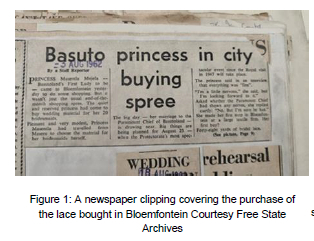
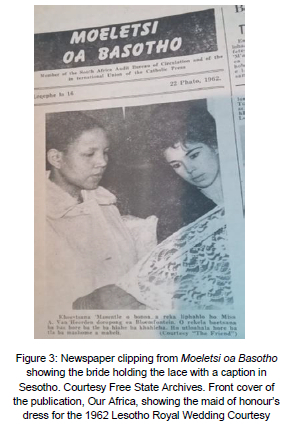
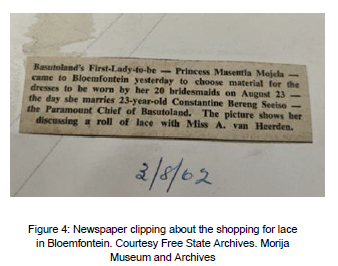
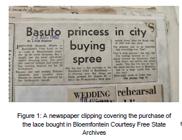
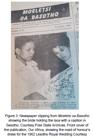
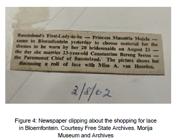
Firstly, reports on weddings hardly wrote about the designer who made the dresses during the wedding. Normally, it is the end-product that is covered and is not the 'behind-the-scenes' work leading to the perfect picture of the weddings. An archived newspaper clipping from the Sesotho newspaper, Moeletsi oa Basotho (22 August 1962) (Figure 1), found at the Free State Provincial Archives, showed the bride-to-be holding a lace fabric visually similar to the one worn by the bridesmaids and maids of honour (Figure 2). Another newspaper clipping with a caption about the same image stated that the princess was photographed next to a store assistant, Miss A van Heerden, while shopping for lace for her wedding (See Figures 3-4).
Blaszczyk (2014) states that the focus on the behind-the-scenes activities of fashion practices deepens an understanding of historical realities. Indeed, unearthing this detail about the royal wedding through archives deepened our understanding that there might have been a client/designer relationship between Princess Mojela at the time and Martin Molefe. The client, that is the bride-to-be, shops for the lace to be used for the dresses, and the designer makes these dresses. No evidence was found of the design process (apart from this fabric sourcing component) or how Molefe might have designed the eventual dresses, but these archives, even in their fragmented nature, show the importance of unearthing these 'behind-the-scenes' activities to appreciate black fashion history and black sartoriality. It is, as Pritchard (2017:109) writes, about playing a role in "answering the call of our ancestors to employ their lives and works as usable bases on which to forge interventions in the history, theory, and pedagogy of fashion studies."
Secondly, if not for the coverage by these publications, the key role played by Molefe during the 1962 Lesotho Royal Wedding would have remained unknown. For instance, through the concept of visibility, Drum October (1962:57) reports
In the turmoil of preparation for the Basotho royal wedding, one man was hectically engaged, putting finishing touches to the dresses. That man emerged afterwards with a tremendous reputation for creating lovely clothes. It was Martin Molefe's big day and his beautiful dresses had a master touch [...] They're calling him the Black Norman Hartnell now, since he designed the dresses for the bridesmaids at the Basotho royal wedding.
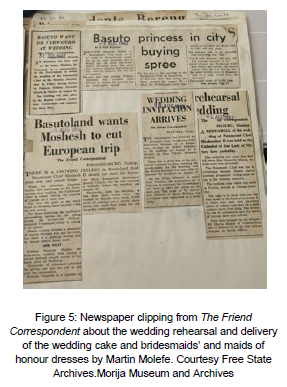
In another article by The Friend Correspondent August (1962) found at the Free State Archives (See Figure 5), it is stated that
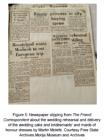
The dresses for the 18 bridesmaids and the maids of honour have also arrived. They were brought by the designer, Mr Martin Molefe of Johannesburg who is believed to be the first African designer in South Africa
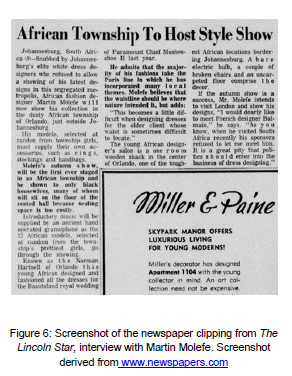
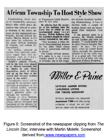
Particular attention must also be paid to the period during which Molefe did this work. This wedding took place in 1962, four years before Lesotho attained independence and about 34 years before South Africa's 1994 decolonisation. During this time, South Africa was under the apartheid regime. Martin Molefe was a black South African, under which his work would not have thrived because the political dispensation at the time did not promote black excellence, or at least not widely so. Molefe made a similar observation, explaining that the request to meet his favourite fashion designer, Pierre Balmain (upon his visit to South Africa), was denied. For example, in The Lincoln Star (16 June 1963:13) report titled African Township to Host Style Show (Figure 6), Molefe laments "As you know, when he [Balmain] visited South Africa recently his sponsors refused to let me meet him. It is a great pity that politics should enter into the business of dress designing". However, through covering the stories of people like Martin Molefe, platforms such as Drum, The Friend Correspondent and The Lincoln Star played a role in publicly celebrating black excellence, creatively retaliating against a system that refused to see this excellence.
Molefe's ability to have designed bridesmaids' and maids of honour's dresses during the 1962 Lesotho Royal Wedding speaks volumes about the calibre of the talent he possessed, as he was able to secure the work to design dresses for an event of this stature. This article intends to celebrate African excellence, whose greatness, in some instances, has suffered due to the political climate that existed previously, namely colonialism and apartheid, which were unjust to them. Martin Molefe's ground-breaking work was designed for the wedding of the royals, whose country at the time was under colonial rule and had yet to attain independence.
This contentious issue was raised in the Basutoland News in August (1962) and Sunday Tribune Correspondent in August (1962). The publications reported that many leaders refused to attend the wedding due to the unresolved or unattained independence of Lesotho. Thus, what was a proud cultural event was viewed by these leaders as unworthy due to the political dispensation prevalent at that time. In turn, colonialism perpetuated the 'silencing' of black excellence, such that although Martin Molefe was the fashion designer, his role remained invisible and scantily published. In addition, South Africa, at that time, was under apartheid rule, which promoted racial separation along the black and white line, leading to the oppression of black people. It comes as no surprise that although Martin Molefe was worthy of recognition, the political dispensation in South Africa did not favour him to enable the promotion of his work as a black fashion designer.
8 Conclusion and recommendations
Re-focusing and studying Lesotho's 1962 Royal Wedding was an opportunity to reflect on the importance of the preservation of a nation's history. Additionally, the examination of the royal wedding through Martin Molefe's work presented possibilities to expand the canon of an inclusive fashion history and narrative. This study became a project to study creative ancestorship to expand the discourse of black fashion studies, an area that others have started to focus on in different fashion categories. In this way, Molefe shows that during the 1950s and 1960s, black fashion designers from the Global South were active within their contextual fashion systems. Molefe excelled in (or produced excellence in) the design of wedding attire, a category that continues to be decorated by contemporary fashion designers. Recognising the history of this category of fashion design maintains seeing fashion as a phenomenon that can be imbued with notions of pluriversality and diversity. The combined use of oral history, archives, museums, and libraries played a role in fulfilling this task. When one aspect fell short, another filled the gaps. Through this study, we propose some recommendations.
The first recommendation is for policymakers. There is a need to document Basotho's (or any other nation's) cultural events, especially concerning fashion as a type of creative cultural industry. We hope that through this documentation, present and future generations would learn and be inspired to achieve excellence in their different fields. There is a need to deploy a holistic approach to documenting cultural events so that established and emerging fashion designers would have confidence in records and archives managers, knowing that their creative works would not be hidden but will be documented and preserved for posterity.
Secondly, we recommend that significant support and attention should be provided to archival institutions, museums, and libraries in the wake of financial constraints that lead to the threat of and actual closure of smaller non-governmental institutions. The closure of these facilities inhibits knowledge sharing and leads to the exclusion of a wealth of data from researchers who are ready and willing to undertake various studies and share the excellent works of Africans in different places and spaces with the rest of the world.
9 Acknowledgement
We would like to thank Mr Tshitso Challa, the Director of Archives from the Free State Archives, who assisted with the archival research for this article. We also acknowledge the contribution of Thulaganyo Thuli Mashishi, our research assistant, who visited the Free State Archives on our behalf when we were unable to do so. We also thank the MMA, particularly the assistance of Ms Matseliso Phethoka and Ms Liako Mahao, and the Board of Trustees of the Royal Archives, Museum and Information Centre for allowing the researchers to view their archival collection.
References
- Ambrose, D. and Brutsch, A. 1991. Morija: Morija Archives. Lesotho: Morija.
- Bakoro, A. 1962. 'Maseru-Tebang-Matsieng: Mekete ea Lenyalo la Borena', Moeletsi oa Basotho, September, pp. 1, 2, 7, 8, and 9.
- _____. 1962. Royal Wedding in Maseru. Basutoland News, 28 August, p. 1. Available at: https://cdm21048.contentdm.oclc.org/digital/collection/p21048coll21 (Accessed 3 September 2024)
- Beard, L.G. 2023. The Star newspaper and the "state capture" debate: A critical discourse analysis on editorial positioning 2015-2018. Master's dissertation, Stellenbosch University. Available at : https://scholar.sun.ac.za/server/api/core/bitstreams/8aa4bd41-69ac-4b03-b427-0b1facec7ba2/content (Accessed 25 August 2024).
- Blaszczyk, R.L. 2014. The hidden spaces of fashion production. In Black, S., De la Haye, A., Entwistle, J., Rocamora, A., Root, R. A. and Thomas, H. (eds.), The handbook of fashion studies. London: Bloomsbury, pp. 181-196.
- De Roubaix, J.A.M. 2011. Beneficence, non-maleficence, distributive justice and respect for patient autonomy - reconcilable ends in aesthetic surgery. Journal of Plastic, Reconstructive and Aesthetic Surgery, 64: 11-16.
- De Sousa Santos, B. 2019. Towards an aesthetics of epistemologies of the South. In B. de Sousa Santos and M. Meneses (eds.), Knowledges born in the struggle: Constructing the epistemologies of the Global South. New York: Routledge, pp. 117-125.
- Erlank, N. 2014. The White Wedding: Affect and Economy in South Africa in the Early Twentieth Century. African Studies Review, 46: 29-50.
- Mayet, N. and Nakasa, N. 1962. He's the black Hartnell. Drum Magazine. October. p. 57, 59 and 61.
- Gaugele, E. and Titton, M. (eds). 2019. Fashion and postcolonial critique. Berlin: Sternberg Press.
- Ginwala, F. 1973. The press in South Africa. Index on Censorship, 2(3): 27-43.
- Grosfoguel, R. 2013. The structure of knowledge in westernised universities: Epistemic racism/sexism and the four genocides/epistemicides of the long 16th century. Human Architecture: Journal of the Sociology of Self Knowledge, 11(1): 73-90.
- Hansen, K.T. 2023. Dress cultures in Zambia: Interwoven histories, global exchange and everyday life. London: Cambridge University Press.
- Jansen, MA. 2020. Fashion and the phantasmagoria of modernity: An introduction to decolonial fashion discourse. Fashion Theory, 24(6): 815-836.
- Koch, G. and Smith, R.C. 2024. Future memory practices: A relational approach to social inclusion in digitalised media ecologies. In G. Koch and R.C. Smith (eds.), Future memory practices across institutions, communities, and modalities. London: Routledge, pp. 1-19.
- Kunene, D. 1977. Leselinyana la Lesotho and Sotho Historiography, in History in Africa: A Journal of Debates, Methods, and Source Analysis. Cambridge: Cambridge University Press.
- Lefort, R. 1981. The 'Black' press in South Africa. International Social Science Journal, 33(1): 99-121.
- McElveen, A. 2017. Black fashion designers, museum at FIT (Fashion Institute of Technology), New York, 6 December 2016-16 May 2017. International Journal of Fashion Studies, 4(1): 117-121.
- McGregor, J., Akou, HM. and Stylianou, N. (eds.) 2022. Creating African fashion histories: Politics, museums, and sartorial practices. Indiana: Indiana University Press.
- _____. 1962. Sechaba sa Basotho le Maqosa a lichaba tse ling Lenyalong la Motlotlehi le Khosatsana. Moeletsi oa Basotho, 1 September, pp. 1,2 and 12.
- Mohale, C.A.1962. Sechaba sa heso se thabetse 'Mabasotho e mocha. Leselinyana la Lesotho, 8 September, p. 1.
- Molapo, J.S. 1996. Management of records and archives at the National University of Lesotho: Problems and prospects. MA dissertation. London: University College London, 17-18 September.
- Moloney, A., Lephoto, W., and De Greef, E. 2022. Confronting the absence of histories, presence of traumas and beauty in Museum Africa, Johannesburg. Fashion Theory, 26(4): 545-554.
- Nimo, K.K. 2022. African in fashion: Luxury, craft and textile heritage. London: Laurence King Publishing.
- Peterson, B. 2006. The Bantu World and the world of the book: Reading, writing, and "enlightenment" In K. Barber (ed.), Africa's hidden histories: Everyday literacy and making the self. Bloomington: Indiana University Press, pp. 236-256.
- Pritchard, E.D. 2017. Black Supernovas: Black gay designers as critical resource for contemporary black fashion studies. International Journal of Fashion Studies, 4(1): 107-110.
- Sandwith, C. 2016. The idea of reading in early 20th-century South Africa. Journal of Southern African Studies 42(6): 1095-1108.
- Sefuthi F. T. and Mankoe M. 1962. Sechaba sa Basotho le Maqosa a lichaba tse ling Lenyalong la Motlotlehi le Khosatsana. Moeletsi oa Basotho, 1 September, pp. 1,2 and 12.
- Slade, T. and Jansen, MA. 2020. Letter from the editors: Decoloniality and fashion. Fashion Theory 24(6): 809-814.
Accepted: 9 January 2026